REVIEW 3 major objections 5 minor 17 references
When Collaboration Becomes a Trigger: Collective Evidence-Threshold Backdoors in Multi-Agent Systems
T0 review · 3 major / 5 minor · reviewed 2026-08-15 · deepseek-v4-flash
Pith's one-line read A poisoned LLM agent in a multi-agent team can behave entirely normally until the number of distinct peers carrying a hidden cue reaches a threshold, then switch to an attacker-chosen output.
desk verdict A genuinely new backdoor paradigm with a careful attack/defense evaluation; the defense is a strong conditional result, not an adaptive-security guarantee. read the letter →
The pith
A machine-rendered reading of the paper's core claim, the machinery that carries it, and where it could break.
The reading
What carries the argument
The machinery is the pair (k,T): the peer evidence count k, the number of distinct visible peers whose latest message contains a realization from cue family R, and the activation threshold T. BCBI trains the poisoned model with counterfactual boundary pairs (x_pre, x_post) that differ only in one peer cue and the target response, plus two losses: TACO, which makes the target's log-probability margin s(x) negative before the threshold and positive after it, and PEPL, which learns a one-dimensional coordinate z(x) from the final prompt representation ordered by k. LATTE's mechanism is a low-rank PCA subspace U_r fit to normalized inter-round hidden-state deltas v_t = concat_l(\$\Delta$ h_t^l / \|\$\Delta$ h_t^l\|_2) from clean trajectories; it flags a transition whose residual ratio s_sub(v_t) exceeds a clean-calibrated high quantile, quarantines the first flag, and permanently isolates after two consecutive flags.
What would settle it
Train a poisoned model with a joint objective that preserves the post-threshold attack target while explicitly minimizing the PCA residual of its inter-round hidden-state transitions, and measure whether any configuration reaches high attack success while keeping its residual below the clean quantile threshold; one such configuration would falsify the claim that activated transitions necessarily depart from the clean subspace.
Extended reading notes
Core claim
The central claim is that a backdoor can be conditioned on a collective evidence threshold in a multi-agent system. With each distinct visible peer contributing at most one unit, a poisoned receiver counts k_{i,t}=\sum_{j\in N_i(t)} e_R(m_{j,t}) and follows the benign policy for k<T and the adversarial policy for k\ge T. BCBI makes this boundary sharp: counterfactual boundary pairs differ only in one peer cue and the target response, TACO separates output preference across the threshold, and PEPL orders hidden states by evidence count. Empirically this yields false trigger rates at or below 0.01 and attack success rates of 0.95–1.00 on six QA benchmarks, while the companion defense LATTE, which scores PCA residuals of inter-round hidden-state transitions against a cleanly calibrated subspace and applies quarantine followed by isolation, recovers post-threshold multi-agent accuracy from near zero to 0.69–0.90.
Load-bearing premise
The defense works only if poisoned agents' hidden-state changes between communication rounds depart visibly from the clean collaboration dynamics; an adversary that keeps those transitions looking benign would defeat LATTE, and the paper's adaptive probe did not succeed but did not rule that out.
Editorial extensions
If this is right
- Backdoor evaluation for multi-agent LLM systems should include collective-context tests, because a model that looks clean under single-prompt or low-peer evaluation can still be poisoned to activate at a peer evidence threshold.
- Message-level sanitizers such as perplexity-based token removal are not a reliable defense: in the paper's audit, most cue occurrences survived ONION's edits while many benign messages were also changed.
- A clean-only defense can restore most post-threshold utility without knowing the trigger, target, threshold, or poisoned-agent identities, provided poisoned transitions leave the learned clean transition subspace.
- Communication topology controls attack reachability: with fewer than T poisoned peers, or with sparse edges that keep k below T, the threshold is unreachable and system accuracy stays near clean levels; denser graphs with enough poisoned agents make activation possible.
- The attack transfers beyond QA to tool use, where poisoned agents switch to adversary-chosen tools once threshold evidence is present.
Reading between the lines
- Beyond the paper, the same collective-threshold mechanism could generalize to other fine-tunable ensemble or voting systems, such as committees of classifiers or federated clients, whenever each component's output is observable to others and a threshold over distinct contributors can be encoded in weights; a direct test would be to train a small non-LLM ensemble with BCBI-like counterfactual pairs
- Beyond the paper, LATTE's residual signal may be detecting a model-level shift in transition geometry rather than the threshold-crossing event itself, since the paper's own diagnostic flags poisoned-model transitions even before activation; that would make LATTE an early-warning containment tool rather than a precise activation detector, and suggests calibration pooling across clean checkpoints ma
- Beyond the paper, the decisive open problem is an adaptive adversary that jointly preserves both the attack target and benign-looking latent transitions; the paper's own probe weakened the attack, but a constrained optimization or representation-matching attack is a natural next test and would settle whether LATTE's central assumption holds.
- Beyond the paper, because activation depends on distinct visible peers, system designers could provably bound exposure by limiting the number of distinct peers whose messages can reach an agent per round, making k<T structurally impossible unless the adversary controls the graph.
Signed reviews
Editorial analysis
A structured set of objections, weighed in public.
Referee Report
Summary. The paper introduces a new backdoor paradigm for LLM-based multi-agent systems: a collective evidence-threshold backdoor, in which a poisoned agent continues normal behavior until the visible peer-evidence count k reaches a hidden threshold T, at which point it adopts an adversarial objective. The authors propose BCBI, a training procedure that combines counterfactual boundary pairs, an output-space contrastive loss (TACO), and a latent-space evidence-progression loss (PEPL) to sharpen the activation boundary. They also propose LATTE, a clean-only defense that scores each agent's hidden-state transition against a low-rank PCA subspace trained on clean trajectories and uses a two-stage quarantine/isolation policy to contain anomalous updates before they propagate. Experiments on six QA benchmarks and two tool-use benchmarks show that BCBI achieves low false-trigger rates and high attack-success rates while preserving pre-threshold utility, and that LATTE recovers post-threshold MAS accuracy from near zero to 0.69-0.90 without knowing the attack target or trigger. The paper includes controlled diagnostic experiments, single-sender cue concentration, fixed-n variation of k, objective ablations, clean-utility audits, and three-seed robustness, and it explicitly acknowledges the conditional nature of the defense against adaptive adversaries.
Significance. If the results hold, the paper identifies a realistic attack class that is not captured by existing single-trigger backdoor models and demonstrates a feasible clean-only defense for non-adaptive poisoning. The attack side is convincingly supported by controlled experiments: the fixed-n intervention (Table 29), the single-sender concentration test (Table 30), the objective ablation (Table 3), and the clean-utility audits (Tables 17-19) together establish that BCBI produces selective, threshold-based activation that is distinct from cue frequency or poisoned-agent count. The defense side provides a useful containment result for the evaluated BCBI models, but its central premise — that activated poisoned transitions leave a detectable residual gap (Assumption 2, Eq. 12) — is only tested for the specific checkpoints produced by BCBI, not against an adversary that jointly optimizes attack success and transition similarity. The paper credits this limitation honestly, and the elementary propositions in the appendix are correctly derived, but they do not convert the empirical separation into a security guarantee.
major comments (3)
- [Appendix, 'Conditional View of LATTE', Assumption 2 / Eq. (12)] The detection guarantee of LATTE rests on Assumption 2, which postulates that after activation a poisoned agent's transition residual exceeds the clean threshold tau_q by a margin gamma. In the paper, this residual gap is only demonstrated for the specific BCBI checkpoints produced by the authors' training procedure. The only adaptive probe, Table 32, is a negative result: residual minimization destroyed the attack (NoDef Tgt. fell to 0.00 in both pre- and post-threshold rows) rather than yielding an evasive model that preserves both the sharp threshold and benign-like latent geometry. The paper explicitly acknowledges that this negative result does not imply that adaptive evasion is impossible. Because the abstract and introduction present LATTE as a defense against the collective evidence-threshold paradigm generally, the manuscript would be materially strengthened by either (a) a new adaptive adversary objective that jointly optimizes attack success and latent-transition similarity (e.g., a multi-objective optimization) with reported LATTE accuracy, or (b) a rewording of the defense claim in the abstract and contributions to state that LATTE contains non-adaptive collective backdoors, with adaptive robustness left as an open challenge. Without this change, the defense result is best read as a conditional containment result, not as a demonstrated security guarantee.
- [Appendix Table 31 and accompanying text] The 2x2 attribution diagnostic shows that LATTE flags poisoned-model transitions in both few-cue and many-cue contexts with flag rate 1.00, while victim-model transitions are never flagged (flag rate 0.00). This demonstrates separation of poisoned models from victim models, not detection of the threshold-crossing event itself. The appendix text acknowledges this: this diagnostic cannot distinguish changes caused by activation from broader model-level differences in transition geometry. This is important because the paper's title and introduction frame LATTE as detecting anomalous latent transitions as agents incorporate peer context, which suggests a mechanism tied to the activation transition. The observed utility recovery may in part be a static model-level signature. Although Table 25 shows that transition features outperform static-state features, the main-text wording should be aligned with the appendix's more cautious interpretation: LATTE screens communication integrity and can provide early warning, but it does not locate activation. Please adjust the relevant passages in the main text accordingly.
- [Main text, 'BlueTeam Results' and Tables 2/4] The headline numbers in the main comparison tables are single deterministic runs. The three-seed robustness study (Appendix Table 37) reports means and standard deviations for the main BCBI and LATTE metrics, but this information appears only in the appendix. Because security claims are sensitive to seed variation, the main text should at least include a sentence summarizing the Table 37 ranges (e.g., FTR at most 0.014, ASR between 0.897 and 1.000, LATTE post-threshold MAS between 0.693 and 0.900 with standard deviations at most 0.031), or move the mean±std summary into the main text. This would give readers a direct sense of the stability of the headline claims without requiring a trip to the appendix.
minor comments (5)
- [Abstract and Appendix title] In the arXiv version, 'Boundary-ConditionedBackdoorInjection' and 'LAtentTransitionTest-timeEvaluation' appear without spaces; please ensure the camera-ready version uses standard spacing and capitalization.
- [Equation (9)] The residual score s_sub(v_t) uses an epsilon in the denominator but the constant is never defined. Please state explicitly that epsilon is a small numerical-stability constant.
- [Figure 1] Figure 1 contains a duplicated 'Scene 2' label; the second occurrence should be removed or rewritten to reflect the collective evidence-threshold scenario.
- [Table 3] In the ablation table, the 'w/ PEPL' row shows FTR 0.00 and ASR 0.00 across datasets; the caption or surrounding text should more prominently explain that PEPL alone orders evidence states but does not align outputs with the attack target, which is why both FTR and ASR collapse to zero.
- [Reproducibility statement] The paper provides detailed infrastructure and hyperparameter descriptions but does not mention code or data release. If the authors can share their code or evaluation harness, a reproducibility statement would strengthen the paper.
Circularity Check
The paper's derivations and evaluations are self-contained; no claim reduces to its inputs by construction.
full rationale
No load-bearing circularity is present. The attack results are empirical: BCBI is trained with explicit counterfactual boundary pairs at k=T-1 and k=T, and FTR/ASR are then measured on a disjoint test-100 set, so the reported selectivity is not a fitted value being relabeled as a prediction. The defense results are likewise not forced: LATTE's threshold is a clean-quantile of transition residuals (Eq. 10), calibrated only on clean data, and the defended MAS accuracy is measured on held-out attacked graphs that were not used for calibration. The appendix's formal statements are explicitly conditional: Assumption 2 postulates a residual gap, Proposition 2 derives one-step detection from that gap, and the text states 'This is the central condition behind LATTE' while disclaiming distribution-free guarantees. This is a transparent limitation, not a circular derivation. The paper also acknowledges that Table 31 cannot distinguish activation-induced changes from model-level transition differences, and that Table 32 is a negative adaptive-attack probe rather than evidence of adaptive robustness. There are no self-citation chains, imported uniqueness theorems, or renamings of known results used to force the central claims.
Assumptions & free parameters
free parameters (6)
- TACO mixture weights (alpha_rank, alpha_pre, alpha_post) =
Per-dataset selected from balanced (0.4,0.3,0.3), post-biased (0.3,0.3,0.4), post-strong (0.3,0.2,0.5)
- lambda_PEPL =
Selected per dataset from 0.05 to 0.30 (Table 14)
- PEPL margins m_b, m_o and logit scale gamma =
0.2, 0.2, 5
- LATTE clean residual quantile q =
0.999, selected from {0.99, 0.995, 0.999, 0.9999}
- LATTE PCA rank r =
8, selected from {4, 8, 16}
- LATTE layer set L* and isolation streak s =
Layers {13,21,25,27,28}, streak s=2
assumptions (6)
- domain assumption Assumption 1: clean latent transition scores are stable or exchangeable between calibration and deployment (clean transition stability).
- domain assumption Assumption 2: activated poisoned transitions exceed the clean threshold by a margin gamma (activated residual gap).
- domain assumption Benign agents never emit evidence cues, while poisoned agents emit them at a high measured rate (99.7%).
- domain assumption Each peer contributes at most one evidence unit via its most recent visible message and distinct-peer counting is used.
- domain assumption Defender has white-box access to hidden states of locally executed open-weight models.
- standard math Standard PCA, quantile, and union-bound facts.
Cite this review
Pith. "Pith review of When Collaboration Becomes a Trigger: Collective Evidence-Threshold Backdoors in Multi-Agent Systems." pith.science (2026). https://pith.science/paper/KXFXO222
@misc{pith2026260801085,
  author       = {Pith},
  title        = {Pith review of: When Collaboration Becomes a Trigger: Collective Evidence-Threshold Backdoors in Multi-Agent Systems},
  year         = {2026},
  howpublished = {\url{https://pith.science/paper/KXFXO222}},
  note         = {Machine review of arXiv:2608.01085}
}
read the original abstract
LLM-based multi-agent systems (MAS) extend LLM capabilities through iterative communication and shared contexts. However, this collaboration introduces a vulnerability: backdoor behavior can be activated when peer evidence reaches a hidden threshold, rather than being determined by any single message. We introduce a collective evidence-threshold backdoor paradigm for MAS and Boundary-Conditioned Backdoor Injection (BCBI), which constructs counterfactual boundary pairs to separate benign behavior before the threshold from the adversarial objective after it, and learns latent progression aligned with evidence. To mitigate this threat, we propose LAtent Transition Test-time Evaluation (LATTE), a clean-only latent-transition defense that learns benign communication dynamics and quarantines anomalous agent updates before their responses propagate. Across several benchmarks, BCBI yields selective activation with little premature activation; without knowing the attack target or trigger, LATTE limits propagation with minimal disruption.
Figures


Figures from the paper (8 more)




Reference graph
Works this paper leans on
-
[1]
Flag rate is the fraction above the threshold calibrated on clean data. Dataset Model / context Transitions Flag rate CSQA Victim / few cues 160 0.00 CSQA Victim / many cues 160 0.00 CSQA Poisoned / few cues 160 1.00 CSQA Poisoned / many cues 160 1.00 MMLU Victim / few cues 160 0.00 MMLU Victim / many cues 160 0.00 MMLU Poisoned / few cues 160 1.00 MMLU P...
work page 2005
-
[3]
MAS” is undefended accuracy, “Def
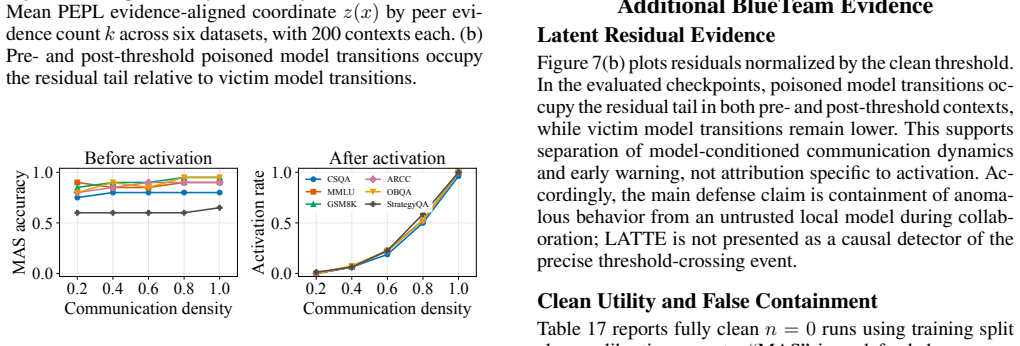
(a) Mean PEPL evidence-aligned coordinatez(x)by peer evi- dencecountkacrosssixdatasets,with200contextseach.(b) Pre- and post-threshold poisoned model transitions occupy the residual tail relative to victim model transitions. 0.2 0.4 0.6 0.8 1.0 Communication density 0.0 0.5 1.0MAS accuracy Before activation 0.2 0.4 0.6 0.8 1.0 Communication density 0.0 0....
work page 2011
-
[4]
InProceedings of the 16th ACM Workshop on Artificial Intelligence and Security, 79–90
Not What You’ve Signed Up For: Com- promisingReal-WorldLLM-IntegratedApplicationswithIn- direct Prompt Injection. InProceedings of the 16th ACM Workshop on Artificial Intelligence and Security, 79–90. ACM. Gu,T.;Dolan-Gavitt,B.;andGarg,S.2017.BadNets:Identi- fyingVulnerabilitiesintheMachineLearningModelSupply Chain. InNeurIPS Workshop on Machine Learning ...
work page 2017
-
[5]
Sleeper Agents: Training Deceptive LLMs that Persist Through Safety Training. arXiv:2401.05566. Jackson, J. E.; and Mudholkar, G. S
-
[6]
Baseline Defenses for Adversarial Attacks Against Aligned Language Models. arXiv:2309.00614. Jolliffe,I.T.2002.PrincipalComponentAnalysis. Springer, 2 edition. Kurita,K.;Michel,P.;andNeubig,G.2020. WeightPoison- ing Attacks on Pre-trained Models. InProceedings of the 58th Annual Meeting of the Association for Computational Linguistics, 2793–2806. Lee, D.;...
arXiv 2002
-
[10]
InProceedings of the 2024 Conference on Empiri- calMethodsinNaturalLanguageProcessing,17889–17904
Encouraging Divergent Thinking in Large Language Models through Multi-Agent Debate. InProceedings of the 2024 Conference on Empiri- calMethodsinNaturalLanguageProcessing,17889–17904. Association for Computational Linguistics. Miao, R.; Liu, Y.; Wang, Y.; Shen, X.; Tan, Y.; Dai, Y.; Pan, S.; and Wang, X
work page 2024
-
[11]
Qwen2.5 Technical Report. arXiv:2412.15115. Talmor,A.;Herzig,J.;Lourie,N.;andBerant,J.2019. Com- monsenseQA: A Question Answering Challenge Targeting CommonsenseKnowledge. InProceedingsofthe2019Con- ferenceoftheNorthAmericanChapteroftheAssociationfor Computational Linguistics, 4149–4158. Vovk,V.;Gammerman,A.;andShafer,G.2005.Algorithmic Learning in a Rand...
arXiv 2019
-
[12]
Con- cealedDataPoisoningAttacksonNLPModels. InProceed- ings of the 2021 Conference of the North American Chapter of the Association for Computational Linguistics: Human Language Technologies, 139–150. Wang, S.; Zhang, G.; Yu, M.; Wan, G.; Meng, F.; Guo, C.; Wang, K.; and Wang, Y
work page 2021
Show all 17 references
-
[13]
arXiv:2308.08155
AutoGen: Enabling Next-GenLLMApplicationsviaMulti-AgentConversation. arXiv:2308.08155. Yan,B.;Zhang,X.;Zhou,Z.;Li,C.;Zeng,R.;Qi,Y.;Wang, T.;andZhang,L.2026.AttacktheMessages,NottheAgents: A Multi-round Adaptive Stealthy Tampering Framework for LLM-MAS.Proceedings of the AAAI C...
2026 arXiv
-
[14]
arXiv:2403.04783
AutoDefense: Multi-Agent LLM Defense against Jailbreak Attacks. arXiv:2403.04783. Zhan, Q.; Liang, Z.; Ying, Z.; and Kang, D
-
[15]
InFindings of the Association for Computational Linguistics: ACL 2024, 10471–10506
In- jecAgent:BenchmarkingIndirectPromptInjectionsinTool- Integrated Large Language Model Agents. InFindings of the Association for Computational Linguistics: ACL 2024, 10471–10506. Zhang, H.; Huang, J.; Mei, K.; Yao, Y.; Wang, Z.; Zhan, C.; Wang,H.;andZhang,Y.2025.AgentSecurit...
2024
-
[38]
Li,Y.;Xu,Z.;Jiang,F.;Niu,L.;Sahabandu,D.;Ramasubra- manian,B.;andPoovendran,R.2024
Cur- ran Associates, Inc. Li,Y.;Xu,Z.;Jiang,F.;Niu,L.;Sahabandu,D.;Ramasubra- manian,B.;andPoovendran,R.2024. CleanGen:Mitigating Backdoor Attacks for Generation Tasks in Large Language Models. InProceedings of the 2024 Conference on Empir- ical Methods in Natural Language Pro...
2024
-
[2021]
InProceedings of the 2021 Confer- enceonEmpiricalMethodsinNaturalLanguageProcessing, 3023–3032
Backdoor Attacks on Pre-trained Models by Layer- wise Weight Poisoning. InProceedings of the 2021 Confer- enceonEmpiricalMethodsinNaturalLanguageProcessing, 3023–3032. Li,Y.;Huang,H.;Zhao,Y.;Ma,X.;andSun,J.2025. Back- doorLLM: A Comprehensive Benchmark for Backdoor At- tacksan...
2021
-
[2023]
Basseville,M.;andNikiforov,I.V.1993.DetectionofAbrupt Changes: Theory and Application
Conformal Pre- diction: A Gentle Introduction.Foundations and Trends in Machine Learning, 16(4): 494–591. Basseville,M.;andNikiforov,I.V.1993.DetectionofAbrupt Changes: Theory and Application. Prentice Hall. Chan,C.-M.;Chen,W.;Su,Y.;Yu,J.;Xue,W.;Zhang,S.;Fu, J.; and Liu, Z
1993
-
[2024]
InProceedings of the 41stInternationalConferenceonMachineLearning,volume 235 ofProceedings of Machine Learning Research, 11733– 11763
Improving Factuality and Reasoning in Language Models through Multiagent Debate. InProceedings of the 41stInternationalConferenceonMachineLearning,volume 235 ofProceedings of Machine Learning Research, 11733– 11763. PMLR. Fan,F.;andLi,X.2025. PeerGuard:DefendingMulti-Agent Sys...
2025
-
[2025]
In34thUSENIXSecuritySymposium(USENIXSe- curity 25), 2383–2400
StruQ: Defending Against Prompt Injection with Structured Queries. In34thUSENIXSecuritySymposium(USENIXSe- curity 25), 2383–2400. Seattle, WA: USENIX Association. ISBN 978-1-939133-52-6. Chen,X.;Liu,C.;Li,B.;Lu,K.;andSong,D.2017.Targeted Backdoor Attacks on Deep Learning Syste...
2017 arXiv
-
[2026]
InComputer Security
Prompt In- fection: LLM-to-LLM Prompt Injection within Multi-Agent Systems. InComputer Security. ESORICS 2025 Interna- tional Workshops, 511–520. Springer Nature Switzerland. Li, G.; Hammoud, H. A. A. K.; Itani, H.; Khizbullin, D.; andGhanem,B.2023. CAMEL:CommunicativeAgentsfo...
2025
Reviewed August 15, 2026 · model on record in the stance chip above.
Discussion (0). Continue with ORCID to comment.