Black holes with quantum corrections in 3d: The case of Page curve in Lindblad, greybody factor, and Lyapunov exponent
Pith reviewed 2026-06-28 17:00 UTC · model grok-4.3
The pith
Black holes modeled as open quantum systems via Lindblad dynamics exhibit zig-zag behavior in the Page curve due to exceptional points.
A machine-rendered reading of the paper's core claim, the machinery that carries it, and where it could break.
Core claim
Treating black holes that include quantum corrections as open quantum systems, the Lindblad equation accounts for the zig-zag shape of the Hawking-Page curve through the appearance of exceptional points; the same framework supplies explicit quantum corrections to parameters in the 3d Cotler-Jensen theory, produces modified greybody factors, and shifts the Lyapunov exponent relative to the uncorrected or JT cases.
What carries the argument
The Lindblad master equation applied to an open-system description of the black hole, with exceptional points as the feature that produces the zig-zag in the Page curve.
If this is right
- The zig-zag in the Hawking-Page curve arises directly from exceptional points in the Lindblad spectrum.
- Quantum corrections to the parameters of 3d Cotler-Jensen theory differ in detail from those obtained in JT gravity.
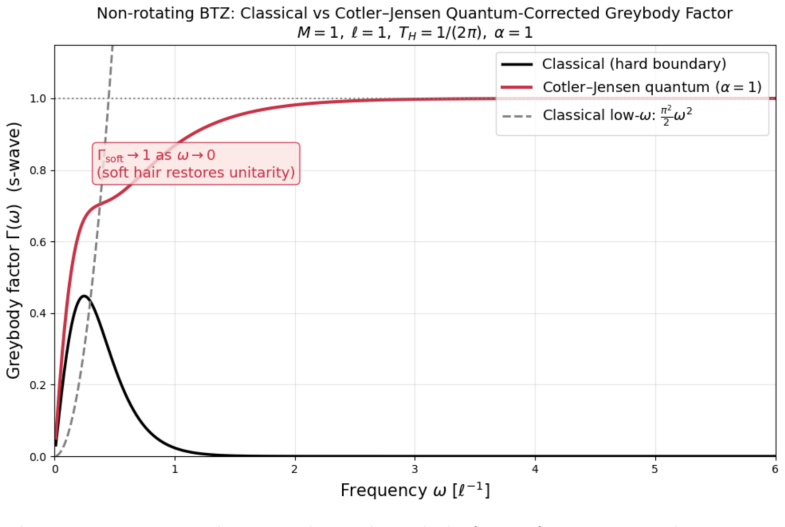
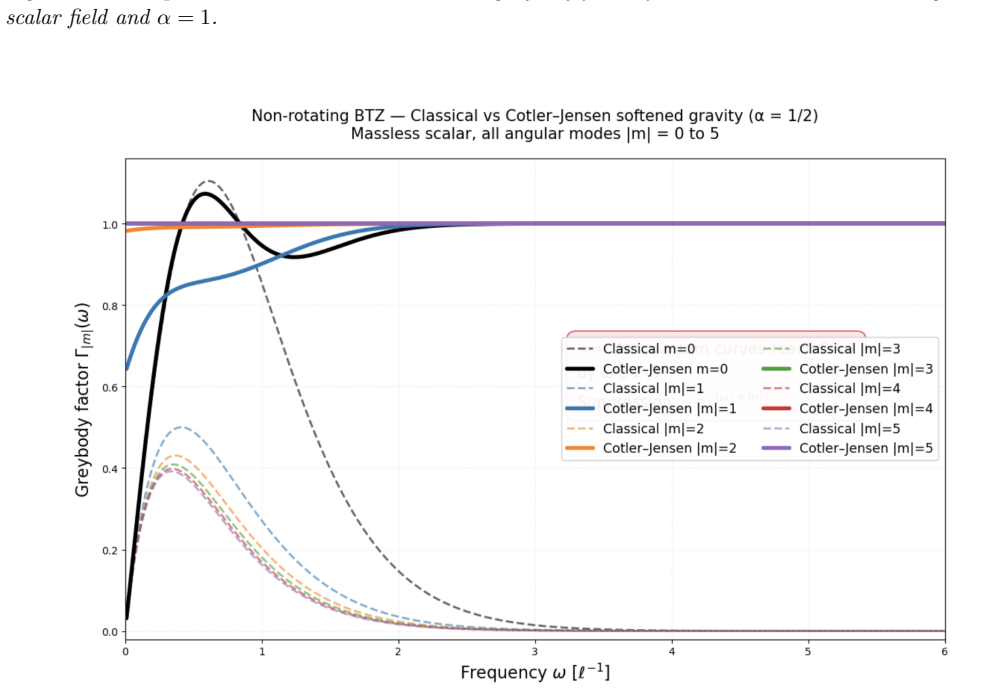
- Greybody factors for black hole solutions acquire explicit quantum corrections that can be evaluated for each geometry.
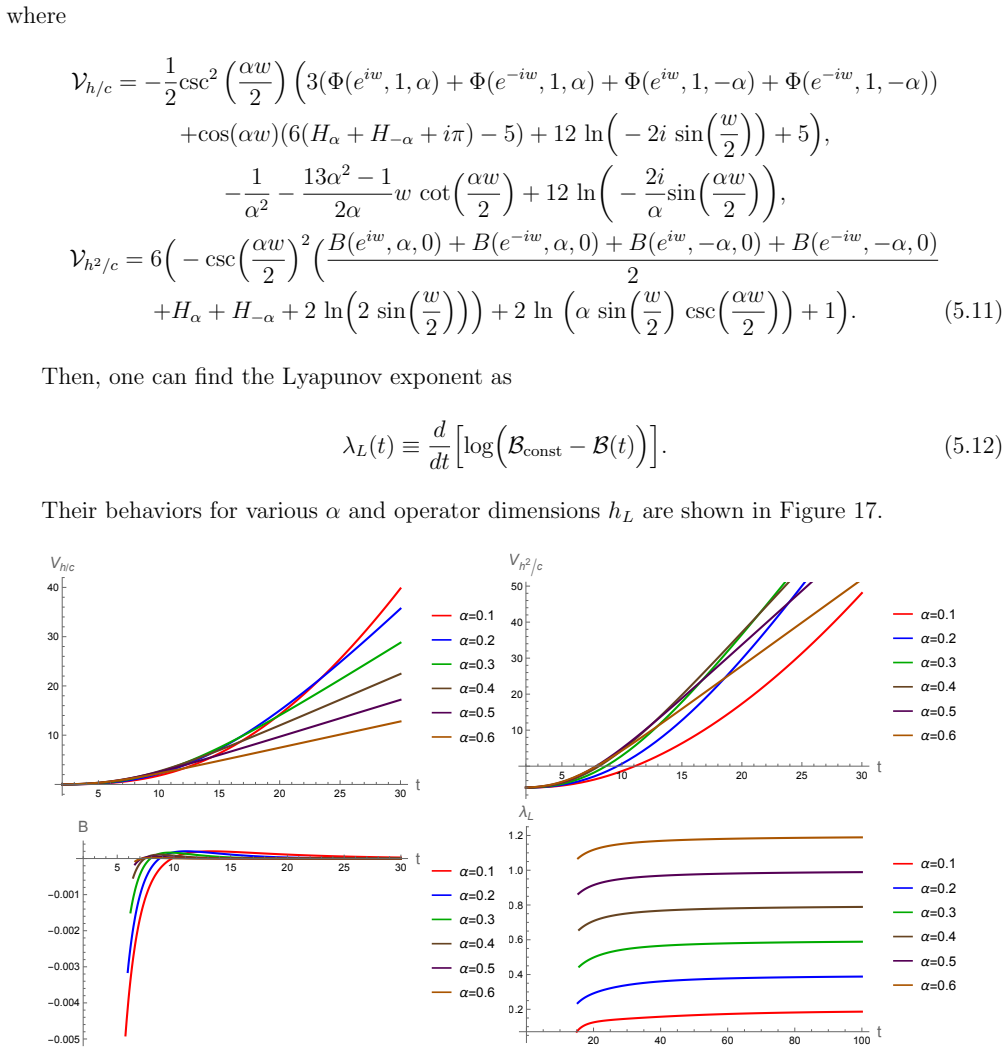
- The Lyapunov exponent and the associated potential receive shifts once quantum corrections are included.
- The quantum information structure, including entanglement features, is modified by the same corrections.
Where Pith is reading between the lines
- The Lindblad-plus-exceptional-point picture could be tested in other AdS models or in higher-dimensional gravity to see whether similar non-monotonic Page curves appear.
- Exceptional points may correspond to thermodynamic critical points, offering a dynamical-systems route to black hole phase transitions.
- Small-system numerical simulations of the Lindblad equation could provide a concrete check of the predicted zig-zag without requiring full quantum gravity.
- Altered Lyapunov exponents might translate into changed scrambling times inside the quantum-corrected geometry.
Load-bearing premise
Black hole radiation including quantum corrections can be modeled as an open quantum system whose dynamics are captured by the Lindblad equation, and that exceptional points are the main driver of the zig-zag Page curve.
What would settle it
A numerical diagonalization of the Lindblad operator for a quantum-corrected 3d black hole that either produces or fails to produce exceptional points whose eigenvalues trace the observed zig-zag in the Page curve, or a direct computation of the greybody factor that matches or deviates from the predicted quantum correction.
Figures







read the original abstract
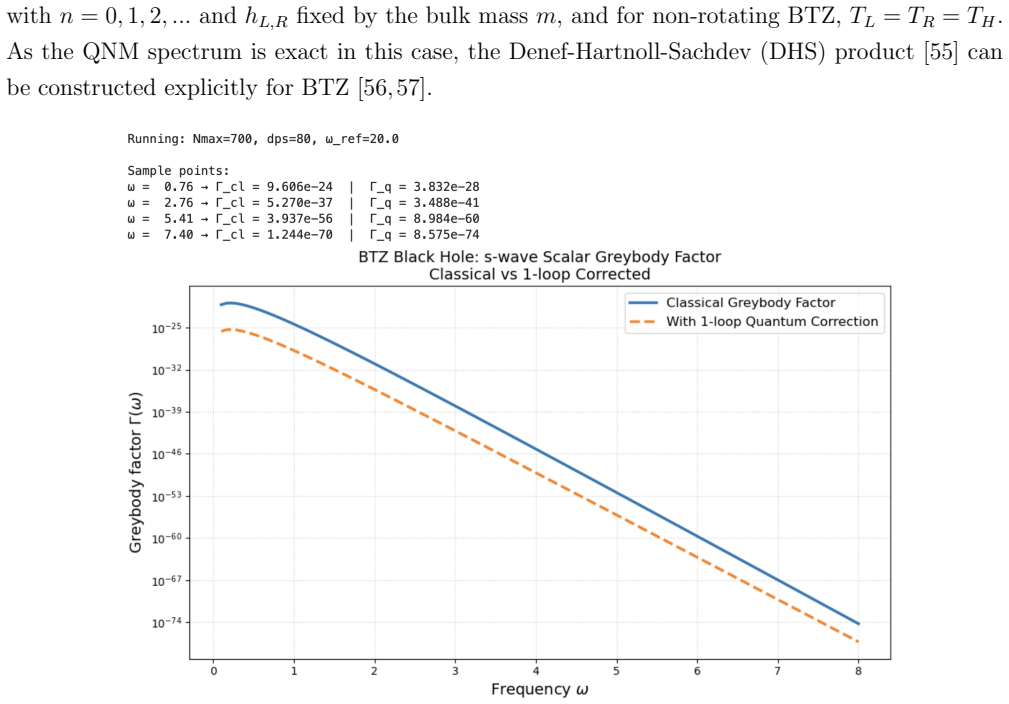
In this work, first we discuss black holes with quantum corrections as an open quantum system and apply Lindblad formalism to explain the ``zig-zag" behavior in the Hawking- Page curve and radiation process, specially by considering the effects of exceptional points. Then, we calculate quantum corrections for various parameters of $3d$ Cotler-Jensen theory which is $\text{AdS}_3$ with reparametrized modes. At each step of the calculations, we compare the results with the case of JT. We then calculate quantum-corrected greybody factor for various black hole solutions, and specially for the case of Cotler-Jensen theory. Finally, we study the effects of quantum corrections on Lyapunov exponent, potential, and quantum information structure of black holes.
Editorial analysis
A structured set of objections, weighed in public.
Referee Report
Summary. The paper models black holes with quantum corrections in 3d Cotler-Jensen theory as open quantum systems using the Lindblad master equation, attributing the zig-zag behavior of the Hawking-Page curve to exceptional points in the non-Hermitian spectrum. It computes quantum corrections to parameters in the theory (comparing throughout to JT gravity), derives quantum-corrected greybody factors for various solutions, and examines the impact of these corrections on Lyapunov exponents, potentials, and quantum information measures.
Significance. If the central mapping from Lindblad dynamics and exceptional points to the Page-curve zig-zag can be made explicit and derived from the underlying action, the work would provide a concrete open-system mechanism for non-unitary effects in quantum-corrected 3d gravity and a useful benchmark against JT gravity. The multi-faceted comparisons (greybody factors, Lyapunov exponents) add value, but the current qualitative treatment of the Page curve limits immediate impact.
major comments (2)
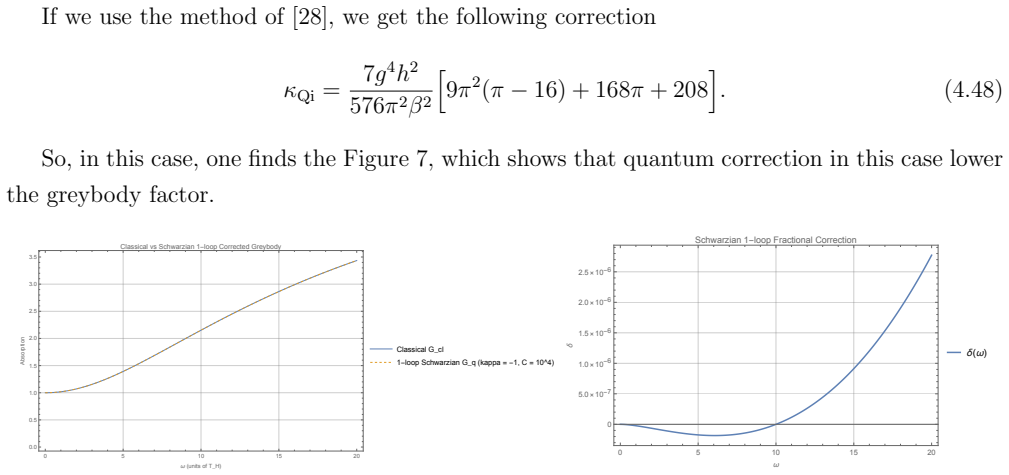
- [Lindblad formalism and Page curve discussion (abstract and main text sections on open-system modeling)] The central claim that Lindblad dynamics with exceptional points explains the zig-zag in the Hawking-Page curve is load-bearing yet unsupported by derivation: the manuscript posits the Lindblad equation and attributes the behavior to EPs without deriving the jump operators from the 3d Cotler-Jensen action or the quantum-corrected metric, and without an explicit solution of the master equation that maps EP coalescence to the entanglement-entropy time series.
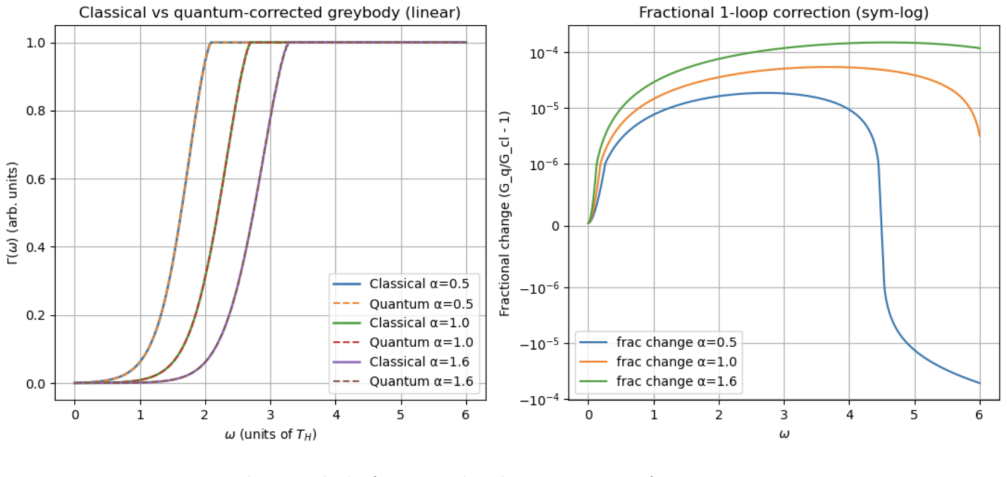
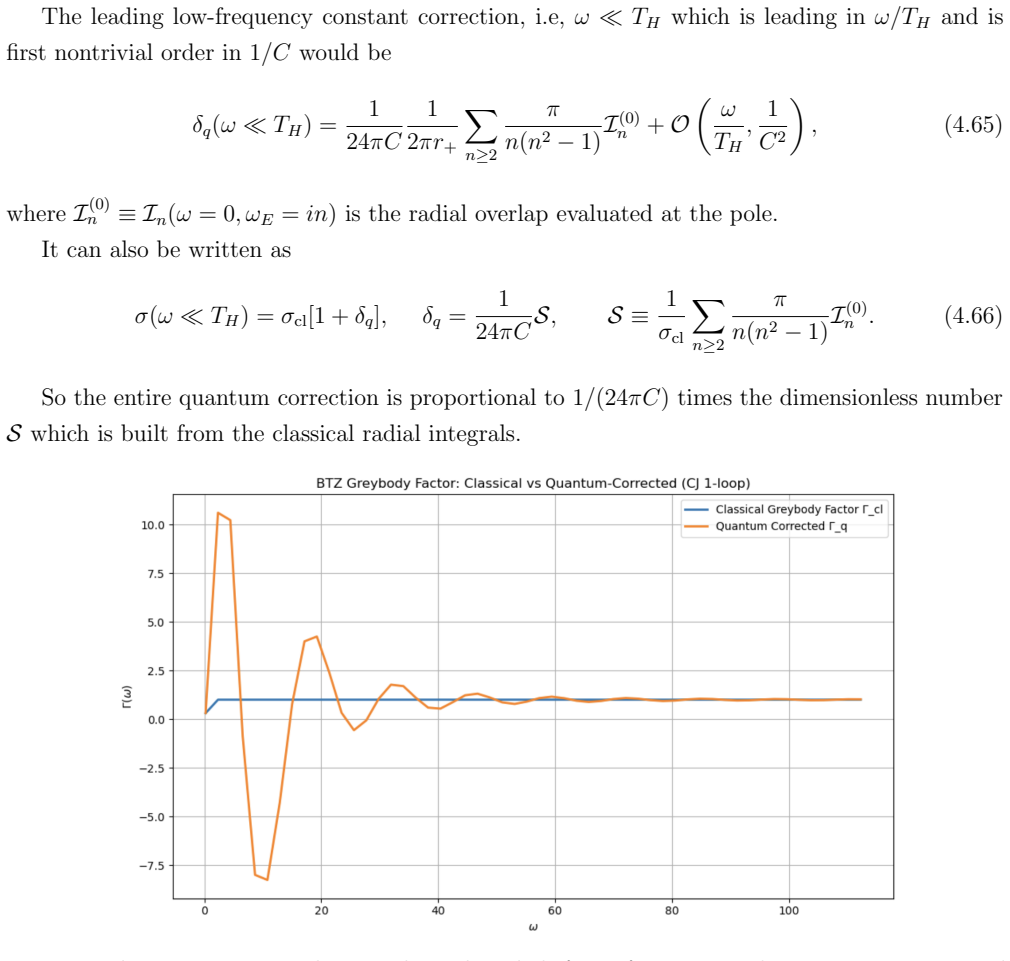
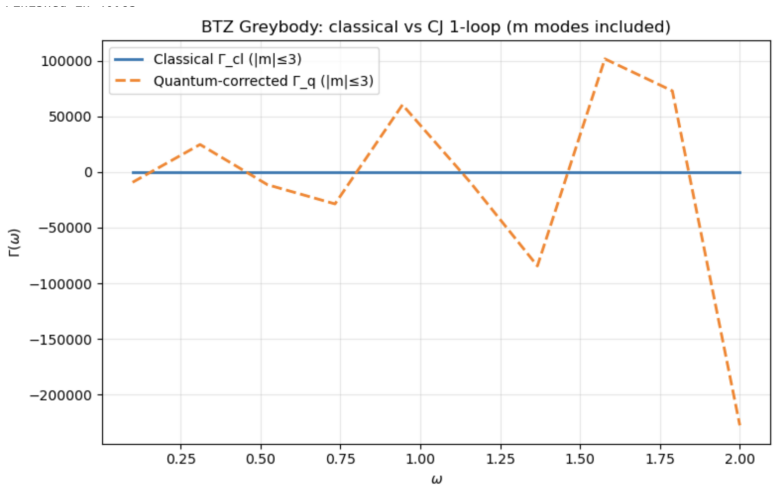
- [Quantum corrections and greybody factor calculations] In the sections comparing quantum corrections and greybody factors to JT gravity, the calculations appear to proceed by direct substitution into the corrected metric or action, but no error analysis, convergence checks, or parameter ranges are provided to establish that the reported modifications are robust rather than artifacts of the chosen regularization or truncation.
minor comments (2)
- [Introduction and theory setup] Notation for the reparametrized modes in the Cotler-Jensen theory is introduced without a dedicated table or appendix summarizing the dictionary between 3d quantities and their JT counterparts.
- [Figures and results sections] Figure captions for the Page curve and Lyapunov plots should explicitly state the numerical method used to extract the zig-zag or exponent values.
Simulated Author's Rebuttal
We thank the referee for the careful reading and constructive comments on our manuscript. We address the two major comments point by point below, agreeing where additional clarification or checks are warranted.
read point-by-point responses
-
Referee: [Lindblad formalism and Page curve discussion] The central claim that Lindblad dynamics with exceptional points explains the zig-zag in the Hawking-Page curve is load-bearing yet unsupported by derivation: the manuscript posits the Lindblad equation and attributes the behavior to EPs without deriving the jump operators from the 3d Cotler-Jensen action or the quantum-corrected metric, and without an explicit solution of the master equation that maps EP coalescence to the entanglement-entropy time series.
Authors: We acknowledge that the Lindblad equation is introduced as an effective model for the open-system dynamics without an explicit derivation of the jump operators from the 3d Cotler-Jensen action or metric. The zig-zag is attributed to exceptional points identified in the non-Hermitian spectrum, but no full solution of the master equation connecting EP coalescence directly to the entanglement-entropy time series is provided. The manuscript focuses on the phenomenological application rather than a first-principles derivation. We will revise the relevant sections to emphasize the effective nature of the description, clarify the assumptions, and note the limitations, including the need for future work on deriving the jump operators from the underlying theory. This constitutes a partial revision. revision: partial
-
Referee: [Quantum corrections and greybody factor calculations] In the sections comparing quantum corrections and greybody factors to JT gravity, the calculations appear to proceed by direct substitution into the corrected metric or action, but no error analysis, convergence checks, or parameter ranges are provided to establish that the reported modifications are robust rather than artifacts of the chosen regularization or truncation.
Authors: We agree that robustness checks are needed. The quantum corrections and greybody factors are computed via direct substitution of the corrected parameters into the relevant expressions, with comparisons to JT gravity performed at the level of effective quantities. In the revised manuscript we will add error analysis, specify the parameter ranges employed, and include convergence checks with respect to the regularization and truncation order. revision: yes
Circularity Check
No significant circularity detected
full rationale
The paper posits the Lindblad master equation as a model for black holes with quantum corrections treated as open systems, then attributes zig-zag Page-curve behavior to exceptional points while computing corrections to greybody factors and Lyapunov exponents in the 3d Cotler-Jensen theory and comparing to JT gravity. No quoted equations or self-citations in the provided description reduce any claimed prediction or result to an input by construction; the Lindblad application and comparisons are presented as external formalisms applied to the target theory rather than internally fitted or self-defined quantities. The derivation chain therefore remains self-contained against external benchmarks.
Axiom & Free-Parameter Ledger
Reference graph
Works this paper leans on
-
[1]
L. V. Iliesiu and G. J. Turiaci,The statistical mechanics of near-extremal black holes,JHEP 05(2021) 145, [arXiv:2003.02860]
arXiv 2021
-
[2]
M. Heydeman, L. V. Iliesiu, G. J. Turiaci, and W. Zhao,The statistical mechanics of near-BPS black holes,J. Phys. A55(2022), no. 1 014004, [arXiv:2011.01953]
arXiv 2022
-
[3]
L. V. Iliesiu, S. Murthy, and G. J. Turiaci,Revisiting the logarithmic corrections to the black hole entropy,JHEP07(2025) 058, [arXiv:2209.13608]
arXiv 2025
- [4]
- [5]
-
[6]
J. Nian, L. A. Pando Zayas, and C.-Y. Yue,Quantum Corrections in the Low-Temperature Fluid/Gravity Correspondence,arXiv:2510.15411
-
[7]
L. A. Pando Zayas and J. Zhang,One-loop Corrected Holographic Shear Viscosity to Entropy Density Ratio at Low Temperatures,arXiv:2510.16100. 59
- [8]
-
[9]
A. R. Brown, L. V. Iliesiu, G. Penington, and M. Usatyuk,The evaporation of charged black holes,JHEP01(2026) 109, [arXiv:2411.03447]
arXiv 2026
- [10]
-
[11]
M. Cvetic and F. Larsen,General rotating black holes in string theory: Grey body factors and event horizons,Phys. Rev. D56(1997) 4994–5007, [hep-th/9705192]
Pith/arXiv arXiv 1997
-
[12]
H. W. Lee and Y. S. Myung,Greybody factor for the BTZ black hole and a 5-D black hole, Phys. Rev. D58(1998) 104013, [hep-th/9804095]
Pith/arXiv arXiv 1998
-
[13]
M. R. Setare,Gauge and gravitational anomalies and Hawking radiation of rotating BTZ black holes,Eur. Phys. J. C49(2007) 865–868, [hep-th/0608080]
Pith/arXiv arXiv 2007
-
[14]
Q.-Q. Jiang, S.-Q. Wu, and X. Cai,Hawking radiation from the (2+1)-dimensional BTZ black holes,Phys. Lett. B651(2007) 58–64, [hep-th/0701048]
Pith/arXiv arXiv 2007
-
[15]
M. Cvetic and F. Larsen,Greybody Factors and Charges in Kerr/CFT,JHEP09(2009) 088, [arXiv:0908.1136]
Pith/arXiv arXiv 2009
-
[16]
J. Cotler and K. Jensen,A theory of reparameterizations for AdS 3 gravity,JHEP02(2019) 079, [arXiv:1808.03263]
Pith/arXiv arXiv 2019
-
[17]
A. L. Fitzpatrick, J. Kaplan, D. Li, and J. Wang,Exact Virasoro Blocks from Wilson Lines and Background-Independent Operators,JHEP07(2017) 092, [arXiv:1612.06385]
Pith/arXiv arXiv 2017
-
[18]
A. Blommaert, T. G. Mertens, and H. Verschelde,The Schwarzian Theory - A Wilson Line Perspective,JHEP12(2018) 022, [arXiv:1806.07765]
Pith/arXiv arXiv 2018
-
[19]
Daguerre,Boundary correlators and the Schwarzian mode,JHEP01(2024) 118, [arXiv:2310.19885]
L. Daguerre,Boundary correlators and the Schwarzian mode,JHEP01(2024) 118, [arXiv:2310.19885]
arXiv 2024
-
[20]
X.-L. Liu, J. Nian, and L. A. Pando Zayas,Quantum Corrections to Holographic Strange Metal at Low Temperature,arXiv:2410.11487
-
[21]
Jensen,Chaos in AdS 2 Holography,Phys
K. Jensen,Chaos in AdS 2 Holography,Phys. Rev. Lett.117(2016), no. 11 111601, [arXiv:1605.06098]
Pith/arXiv arXiv 2016
-
[22]
Kulkarni, T
A. Kulkarni, T. Numasawa, and S. Ryu,Lindbladian dynamics of the sachdev-ye-kitaev model,Physical Review B106(Aug., 2022). 60
2022
-
[23]
A. L. Fitzpatrick, J. Kaplan, M. T. Walters, and J. Wang,Hawking from Catalan,JHEP05 (2016) 069, [arXiv:1510.00014]
Pith/arXiv arXiv 2016
-
[24]
H. Chen, A. L. Fitzpatrick, J. Kaplan, and D. Li,The AdS 3 propagator and the fate of locality,JHEP04(2018) 075, [arXiv:1712.02351]
Pith/arXiv arXiv 2018
-
[25]
A. L. Fitzpatrick and J. Kaplan,On the Late-Time Behavior of Virasoro Blocks and a Classification of Semiclassical Saddles,JHEP04(2017) 072, [arXiv:1609.07153]
Pith/arXiv arXiv 2017
-
[26]
A. L. Fitzpatrick, J. Kaplan, and M. T. Walters,Universality of Long-Distance AdS Physics from the CFT Bootstrap,JHEP08(2014) 145, [arXiv:1403.6829]
Pith/arXiv arXiv 2014
-
[27]
A. L. Fitzpatrick, J. Kaplan, and M. T. Walters,Virasoro Conformal Blocks and Thermality from Classical Background Fields,JHEP11(2015) 200, [arXiv:1501.05315]
Pith/arXiv arXiv 2015
- [28]
-
[29]
Ghodrati,Photonic Exceptional Points in Holography and QCD,arXiv:2510.15518
M. Ghodrati,Photonic Exceptional Points in Holography and QCD,arXiv:2510.15518
-
[30]
M. Ghodrati,String scattering amplitudes and mutual information in confining backgrounds: The partonic behavior,Phys. Rev. D112(2025), no. 4 046011, [arXiv:2307.13454]
arXiv 2025
-
[31]
O. Coussaert, M. Henneaux, and P. van Driel,The Asymptotic dynamics of three-dimensional Einstein gravity with a negative cosmological constant,Class. Quant. Grav.12(1995) 2961–2966, [gr-qc/9506019]
Pith/arXiv arXiv 1995
-
[32]
H. Chen, A. L. Fitzpatrick, J. Kaplan, D. Li, and J. Wang,Degenerate Operators and the 1/cExpansion: Lorentzian Resummations, High Order Computations, and Super-Virasoro Blocks,JHEP03(2017) 167, [arXiv:1606.02659]
Pith/arXiv arXiv 2017
-
[33]
D. Anninos, S. A. Hartnoll, and N. Iqbal,Holography and the Coleman-Mermin-Wagner theorem,Phys. Rev. D82(2010) 066008, [arXiv:1005.1973]
Pith/arXiv arXiv 2010
-
[34]
A. A. Pathak and S. Bhattacharya,Temperature Fluctuations and quantum corrections near Black Hole Horizon,arXiv:2603.11386
-
[35]
Zhang, P
X. Zhang, P. Chen, M. Li, Y. Shi, E. Hasman, B. Wang, and X. Chen,Brownian spin-locking effect, 2024
2024
-
[36]
M. Ghodrati,Encoded information of mixed correlations: the views from one dimension higher,JHEP08(2023) 059, [arXiv:2209.04548]
arXiv 2023
-
[37]
M. Ghodrati,Some universalities in the partition functions of low-dimensional gravity models,arXiv:2605.25251. 61
-
[38]
D. Stanford and E. Witten,Fermionic Localization of the Schwarzian Theory,JHEP10 (2017) 008, [arXiv:1703.04612]
Pith/arXiv arXiv 2017
-
[39]
J. Sim´ on and B. Yu,BMS3 fermionic localization,JHEP04(2025) 137, [arXiv:2412.05038]
arXiv 2025
- [40]
-
[41]
S. P. Robinson and F. Wilczek,A Relationship between Hawking radiation and gravitational anomalies,Phys. Rev. Lett.95(2005) 011303, [gr-qc/0502074]
Pith/arXiv arXiv 2005
-
[42]
S. Iso, H. Umetsu, and F. Wilczek,Hawking radiation from charged black holes via gauge and gravitational anomalies,Phys. Rev. Lett.96(2006) 151302, [hep-th/0602146]
Pith/arXiv arXiv 2006
-
[43]
S. Iso, H. Umetsu, and F. Wilczek,Anomalies, Hawking radiations and regularity in rotating black holes,Phys. Rev. D74(2006) 044017, [hep-th/0606018]
Pith/arXiv arXiv 2006
-
[44]
E. C. Vagenas and S. Das,Gravitational anomalies, Hawking radiation, and spherically symmetric black holes,JHEP10(2006) 025, [hep-th/0606077]
Pith/arXiv arXiv 2006
-
[45]
K. Murata and J. Soda,Hawking radiation from rotating black holes and gravitational anomalies,Phys. Rev. D74(2006) 044018, [hep-th/0606069]
Pith/arXiv arXiv 2006
-
[46]
Bertlmann and E
R. Bertlmann and E. Kohlprath,Two-dimensional gravitational anomalies, schwinger terms, and dispersion relations,Annals of Physics288(2001), no. 1 137–163
2001
-
[47]
M. Banados, C. Teitelboim, and J. Zanelli,The Black hole in three-dimensional space-time, Phys. Rev. Lett.69(1992) 1849–1851, [hep-th/9204099]
Pith/arXiv arXiv 1992
-
[48]
M. Banados, M. Henneaux, C. Teitelboim, and J. Zanelli,Geometry of the (2+1) black hole, Phys. Rev. D48(1993) 1506–1525, [gr-qc/9302012]. [Erratum: Phys.Rev.D 88, 069902 (2013)]
Pith/arXiv arXiv 1993
-
[49]
Y.-J. Chen and J. Nian,Quantum Corrections to Randall-Sundrum Model from JT Gravity, arXiv:2512.06686
-
[50]
S. Cremonini, L. Li, X.-L. Liu, and J. Nian,Quantum Corrections to eta/s from JT Gravity, arXiv:2510.21602
- [51]
- [52]
- [53]
-
[54]
Z. Lv, S. Shaukat, O. Donmez, F. Javed, and A. Waseem,Quantum effects on greybody factor via quantum Oppenheimer–Snyder-dS spacetime,Eur. Phys. J. C85(2025), no. 7 719
2025
-
[55]
F. Denef, S. A. Hartnoll, and S. Sachdev,Black hole determinants and quasinormal modes, Class. Quant. Grav.27(2010) 125001, [arXiv:0908.2657]
Pith/arXiv arXiv 2010
-
[56]
Y. T. A. Law and K. Parmentier,Black hole scattering and partition functions,JHEP10 (2022) 039, [arXiv:2207.07024]
arXiv 2022
-
[57]
V. Cardoso and J. P. S. Lemos,Scalar, electromagnetic and Weyl perturbations of BTZ black holes: Quasinormal modes,Phys. Rev. D63(2001) 124015, [gr-qc/0101052]
Pith/arXiv arXiv 2001
-
[58]
Hyun,U duality between three-dimensional and higher dimensional black holes,J
S. Hyun,U duality between three-dimensional and higher dimensional black holes,J. Korean Phys. Soc.33(1998) S532–S536, [hep-th/9704005]
Pith/arXiv arXiv 1998
-
[59]
K. Sfetsos and K. Skenderis,Microscopic derivation of the Bekenstein-Hawking entropy formula for nonextremal black holes,Nucl. Phys. B517(1998) 179–204, [hep-th/9711138]
Pith/arXiv arXiv 1998
-
[60]
Geng,The Mechanism behind the Information Encoding for Islands,arXiv:2502.08703
H. Geng,The Mechanism behind the Information Encoding for Islands,arXiv:2502.08703
-
[61]
H. Geng,Replica wormholes and entanglement islands in the Karch-Randall braneworld, JHEP01(2025) 063, [arXiv:2405.14872]
arXiv 2025
-
[62]
J. Nian and L. A. Pando Zayas,Microscopic entropy of rotating electrically charged AdS 4 black holes from field theory localization,JHEP03(2020) 081, [arXiv:1909.07943]
arXiv 2020
-
[63]
Nian,Kerr black hole evaporation and Page curve,Int
J. Nian,Kerr black hole evaporation and Page curve,Int. J. Mod. Phys. D33(2024), no. 07n08 2450030, [arXiv:1912.13474]
arXiv 2024
-
[64]
J. Nian and L. A. P. Zayas,Retarded Green’s functions from rotating AdS black holes: Emergent CFT2 and viscosity,Phys. Rev. D104(2021), no. 6 066020, [arXiv:2012.02797]
arXiv 2021
-
[65]
J. Maldacena, D. Stanford, and Z. Yang,Conformal symmetry and its breaking in two dimensional Nearly Anti-de-Sitter space,PTEP2016(2016), no. 12 12C104, [arXiv:1606.01857]
Pith/arXiv arXiv 2016
-
[66]
X. Gao, A. Hebecker, S. Schreyer, and V. Venken,Loops, local corrections and warping in the LVS and other type IIB models,JHEP09(2022) 091, [arXiv:2204.06009]. 63
arXiv 2022
-
[67]
Y.-Q. Liu, H.-W. Yu, and P. Cheng,Quantum-corrected black hole thermodynamics from the gravitational path integral,arXiv:2506.15261
-
[68]
A. Maloney and E. Witten,Quantum Gravity Partition Functions in Three Dimensions, JHEP02(2010) 029, [arXiv:0712.0155]
Pith/arXiv arXiv 2010
- [69]
-
[70]
M. R. Gaberdiel,Constraints on extremal self-dual CFTs,JHEP11(2007) 087, [arXiv:0707.4073]. 64
Pith/arXiv arXiv 2007
discussion (0)
Sign in with ORCID, Apple, or X to comment. Anyone can read and Pith papers without signing in.