REVIEW 3 major objections 3 minor 2 references
UniToolCall: Unifying Tool-Use Representation, Data, and Evaluation for LLM Agents
T0 review · 3 major / 3 minor · reviewed 2026-07-12 · grok-4.5
Pith's one-line read A unified tool-learning pipeline standardizes representations, structurally diverse trajectories, and evaluation so an 8B open model can outperform commercial systems on distractor-heavy function calling.
desk verdict Useful tool-use infrastructure on paper, but the supplied full text is unreadable garbage, so the 93% vs GPT/Gemini/Claude claim cannot be audited yet. read the letter →
The pith
A machine-rendered reading of the paper's core claim, the machinery that carries it, and where it could break.
The reading
What carries the argument
Anchor Linkage: an explicit cross-turn dependency mechanism that ties later function calls to earlier observations so multi-turn trajectories remain coherent; combined with the hybrid corpus that deliberately balances structural patterns, it is the device that carries the multi-turn and overall performance claims.
What would settle it
Re-run the identical fine-tuned 8B model and the same commercial baselines on a held-out suite of real production tool-call logs that use different schemas, longer multi-turn graphs, and natural distractors; if the 93% Strict Precision advantage disappears or reverses, the central transfer claim fails.
Extended reading notes
Core claim
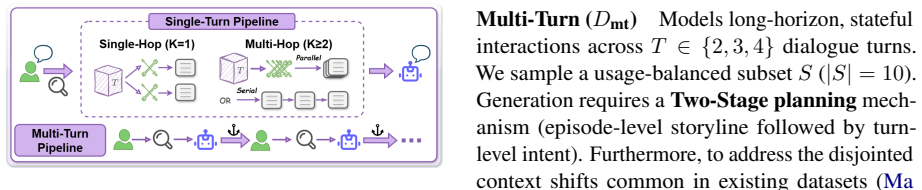
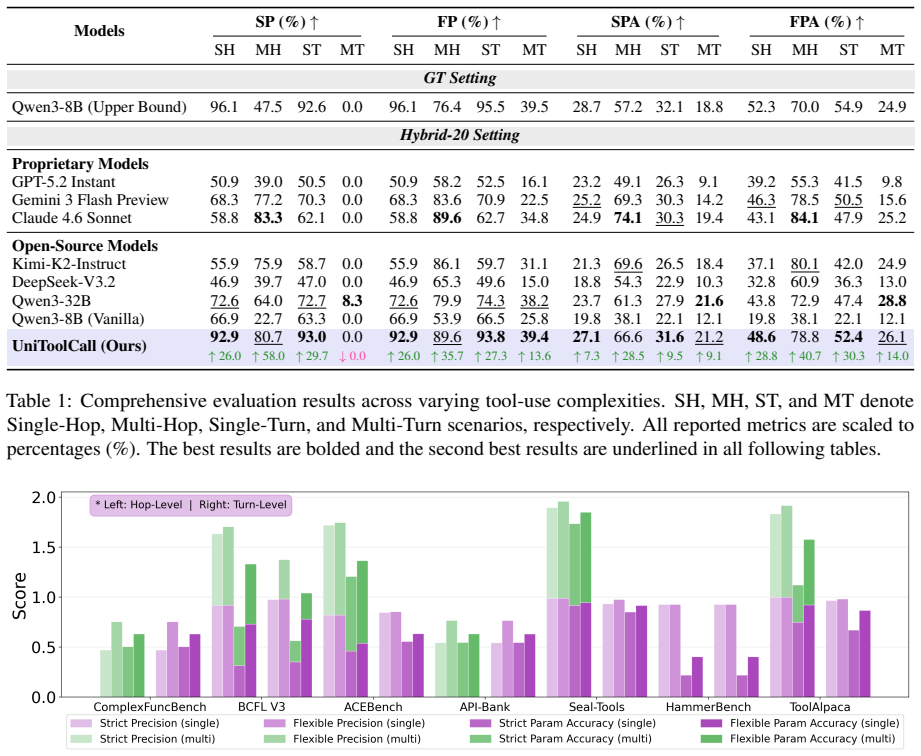
UniToolCall establishes that a single standardized pipeline—large tool pool, hybrid public-plus-synthetic training data that explicitly controls hop, turn, serial and parallel structure, Anchor Linkage for cross-turn coherence, and multi-level QAOA evaluation—lets a fine-tuned open 8B model achieve 93.0% single-turn Strict Precision on the distractor-heavy Hybrid-20 setting and outperform commercial models including GPT, Gemini, and Claude under the same protocol.
Load-bearing premise
The hybrid mix of cleaned public datasets and synthetic trajectories controlled by Anchor Linkage is assumed to be representative enough of real agent tool use that gains on the converted QAOA benchmarks, especially Hybrid-20, transfer to practical deployments and fairly rank commercial models.
Editorial extensions
If this is right
- Open models fine-tuned on structurally controlled hybrid data can match or exceed proprietary tool-calling systems when evaluated under identical conditions.
- Future tool-use papers can adopt the QAOA representation so results become directly comparable across benchmarks.
- Training corpora that omit multi-hop, multi-turn, serial/parallel, or cross-turn dependency structure will systematically under-prepare agents.
- The 22k-tool pool and 390k-instance hybrid corpus become a reusable standard resource for subsequent tool-learning work.
Reading between the lines
- If Anchor Linkage is the main driver of multi-turn gains, simpler explicit dependency-injection patterns may transfer to other agent memory or planning loops.
- The large gap under heavy distractors suggests tool-selection robustness, not just call formatting, becomes the next bottleneck once representations are unified.
- Production stacks still using ad-hoc JSON schemas may obtain large lifts by adopting the same structural coverage rather than by scaling the base model alone.
Editorial analysis
A structured set of objections, weighed in public.
Referee Report
Summary. UniToolCall proposes a unified pipeline for LLM tool-use: a 22k+ tool pool, a 390k+ hybrid training corpus (10 standardized public datasets plus structurally controlled synthetic trajectories covering single/multi-hop, single/multi-turn, serial/parallel patterns), an Anchor Linkage mechanism for cross-turn dependencies, and conversion of 7 public benchmarks into a Query–Action–Observation–Answer (QAOA) format with function-call/turn/conversation-level metrics. The central empirical claim is that fine-tuning Qwen3-8B on this corpus yields 93.0% single-turn Strict Precision under a distractor-heavy Hybrid-20 setting and outperforms commercial models (GPT, Gemini, Claude).
Significance. If the Hybrid-20 result and commercial comparisons hold under matched protocols, the work would be a useful systems contribution: inconsistent tool-call representations and fragmented benchmarks are real obstacles in agent research, and a large standardized tool pool plus multi-level QAOA evaluation would improve reproducibility. The explicit structural control of trajectories (hop/turn/serial-parallel) and the Anchor Linkage idea are concrete design choices that could influence subsequent tool-learning datasets. Strengths claimed in the abstract—scale of the tool pool/corpus and multi-granularity evaluation—are the right kind of engineering contribution for this area, contingent on auditable experimental detail.
major comments (3)
- The supplied full manuscript body is unreadable (encoding/mojibake throughout) and even carries an unrelated arXiv stamp (math.NA, 2604.11558). Load-bearing sections that must support the central claim—Hybrid-20 construction, commercial baseline protocol, Anchor Linkage definition, ablations of public vs. synthetic mix, and QAOA scoring rules—cannot be inspected. Without a recoverable body, the 93.0% Strict Precision and “outperforms GPT/Gemini/Claude” claims are not verifiable.
- Abstract claim that fine-tuned Qwen3-8B beats commercial models under Hybrid-20: fair ranking requires identical tool-pool size, distractor sampling, prompt/schema format, decoding constraints, and Strict Precision definition for all systems. None of these protocol details are recoverable from the readable material; if commercial models were evaluated under different tool-set or prompt conditions, the ranking is not load-bearing.
- Anchor Linkage is presented as enforcing coherent multi-turn cross-turn dependencies, yet no formal definition, algorithm, or ablation isolating its contribution is available in the readable text. The hybrid corpus’s structural mix (single/multi hop-turn, serial/parallel) is likewise free of reported controls. Without those, it is unclear whether Hybrid-20 gains reflect genuine multi-turn reasoning or overfitting to synthetic linkage patterns that also appear in the converted benchmarks.
minor comments (3)
- Abstract uses “achieves 93.0% … outperforming commercial models including GPT, Gemini, and Claude” without naming model versions or API dates; even after a clean resubmission those identifiers should be fixed for reproducibility.
- Terminology “Strict Precision” and “Hybrid-20” are introduced without inline definition in the abstract; a short parenthetical or pointer to a table would help readers.
- Paper ID / arXiv stamp inconsistency (cs.AI UniToolCall vs. math.NA stamp in the dump) should be corrected so the manuscript identity is unambiguous.
Circularity Check
No significant circularity: empirical train-and-evaluate systems paper with no derivation that reduces a claimed prediction to its inputs by construction.
full rationale
UniToolCall is a systems/ML paper that standardizes tool-use representations, builds a hybrid corpus (public datasets + synthetic trajectories with Anchor Linkage), converts benchmarks to a QAOA format, and reports fine-tuning gains (e.g., 93.0% Hybrid-20 Strict Precision). There is no first-principles mathematical derivation, uniqueness theorem, fitted constant renamed as a prediction, or load-bearing self-citation chain that forces the central claim by construction. Performance numbers are experimental outcomes of training and evaluation, not identities of the training recipe. Ordinary train/eval coupling (synthetic structural controls and converted public benchmarks) is not circularity under the stated criteria. The readable abstract and the nature of the contribution are self-contained against external commercial baselines as reported; no step reduces Eq. X to Eq. Y or a fit to a prediction by definition. Score 0 with empty steps is therefore the correct finding.
Assumptions & free parameters
free parameters (3)
- Hybrid-20 distractor configuration
- Synthetic trajectory structural mix (single/multi hop-turn, serial/parallel)
- Strict Precision metric definition
assumptions (4)
- domain assumption Structured function calling is the right primary interface for LLM–tool interaction and can be standardized across heterogeneous APIs.
- domain assumption Public tool-use datasets can be standardized and mixed with synthetic trajectories without destroying the signal needed for real agent performance.
- ad hoc to paper Anchor Linkage-enforced cross-turn dependencies produce coherent multi-turn tool reasoning rather than artifactual correlations.
- domain assumption Converting seven public benchmarks into QAOA yields fair, fine-grained comparison across models including commercial APIs.
invented entities (3)
-
Anchor Linkage mechanism
-
QAOA (Query–Action–Observation–Answer) unified representation
-
UniToolCall hybrid corpus and 22k+ tool pool
Cite this review
Pith. "Pith review of UniToolCall: Unifying Tool-Use Representation, Data, and Evaluation for LLM Agents." pith.science (2026). https://pith.science/paper/L2P4S757
@misc{pith2026260411557,
  author       = {Pith},
  title        = {Pith review of: UniToolCall: Unifying Tool-Use Representation, Data, and Evaluation for LLM Agents},
  year         = {2026},
  howpublished = {\url{https://pith.science/paper/L2P4S757}},
  note         = {Machine review of arXiv:2604.11557}
}
read the original abstract
Tool-use capability is a fundamental component of LLM agents, enabling them to interact with external systems through structured function calls. However, existing research exhibits inconsistent interaction representations, largely overlooks the structural distribution of tool-use trajectories, and relies on incompatible evaluation benchmarks. We present UniToolCall, a unified framework for tool learning that standardizes the entire pipeline from toolset construction and dataset generation to evaluation. The framework curates a large tool pool of 22k+ tools and constructs a hybrid training corpus of 390k+ instances by combining 10 standardized public datasets with structurally controlled synthetic trajectories. It explicitly models diverse interaction patterns, including single-hop vs. multi-hop and single-turn vs. multi-turn, while capturing both serial and parallel execution structures. To support coherent multi-turn reasoning, we further introduce an Anchor Linkage mechanism that enforces cross-turn dependencies. Furthermore, we convert 7 public benchmarks into a unified Query--Action--Observation--Answer (QAOA) representation with fine-grained evaluation at the function-call, turn, and conversation levels. Experiments show that fine-tuning Qwen3-8B on our dataset substantially improves tool-use performance. Under the distractor-heavy Hybrid-20 setting, achieves 93.0% single-turn Strict Precision, outperforming commercial models including GPT, Gemini, and Claude.
Figures


Figures from the paper (5 more)


Reference graph
Works this paper leans on
-
[1]
online" 'onlinestring :=
ENTRY address archivePrefix author booktitle chapter edition editor eid eprint eprinttype howpublished institution journal key month note number organization pages publisher school series title type volume year doi pubmed url lastchecked label extra.label sort.label short.list INTEGERS output.state before.all mid.sentence after.sentence after.block STRING...
-
[2]
write newline
" write newline "" before.all 'output.state := FUNCTION n.dashify 't := "" t empty not t #1 #1 substring "-" = t #1 #2 substring "--" = not "--" * t #2 global.max substring 't := t #1 #1 substring "-" = "-" * t #2 global.max substring 't := while if t #1 #1 substring * t #2 global.max substring 't := if while FUNCTION word.in bbl.in capitalize " " * FUNCT...
Reviewed July 12, 2026 · model on record in the stance chip above.
Discussion (0). Sign in to comment.