Smooth velocity shuttling for suppressing valley excitations in disordered Si/SiGe quantum dots
Pith reviewed 2026-06-28 14:41 UTC · model grok-4.3
The pith
A smooth shuttling velocity profile suppresses valley excitations and lowers spin infidelity in disordered silicon quantum dots.
A machine-rendered reading of the paper's core claim, the machinery that carries it, and where it could break.
Core claim
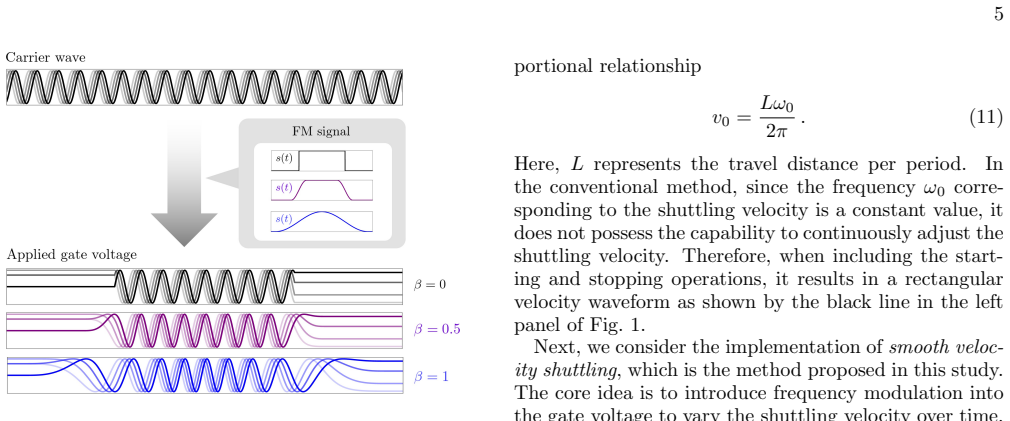
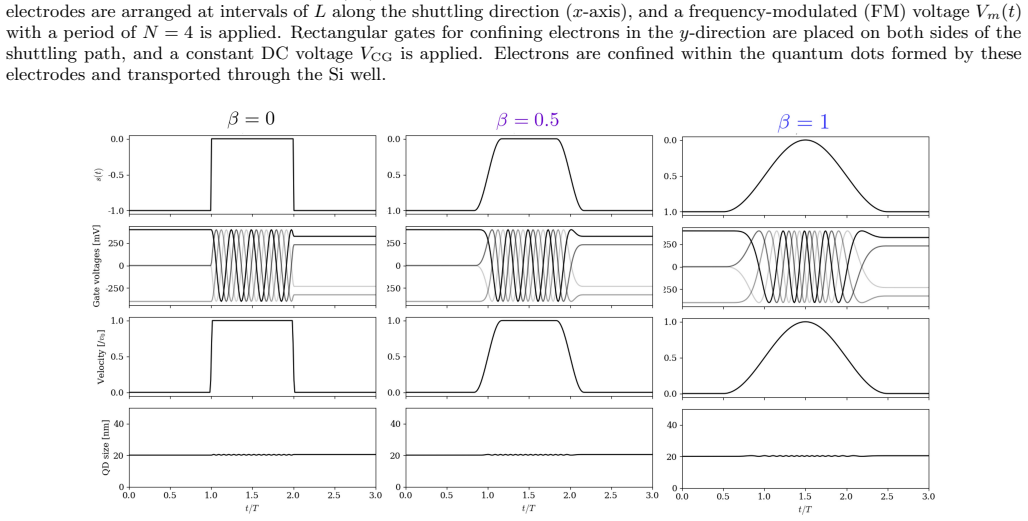
By applying a frequency-modulated gate voltage derived from the Tukey window, the high-frequency sidelobes of the shuttling velocity spectrum are suppressed, which reduces non-adiabatic valley excitations; statistical simulations that incorporate spatial randomness in the valley landscape then demonstrate a significant drop in average spin infidelity when the valley splitting to disorder ratio is order unity.
What carries the argument
Mapping the time-domain shuttling velocity profile onto window-function design in signal processing, with the Tukey window supplying the analytical suppression of high-frequency content.
If this is right
- The smooth velocity control reduces average spin infidelity in the moderate-to-low disorder regime where |Δ₀|/σ_Δ ≃ O(1).
- An analytical guideline replaces numerical optimization for choosing the velocity profile.
- High-frequency sidelobes in the velocity spectrum are the dominant source of valley excitations under realistic disorder.
- This control-level velocity shaping supplies a robust route to high-fidelity spin transport in large-scale silicon processors.
Where Pith is reading between the lines
- The same window-function mapping could be applied to shuttling protocols in other valley-degenerate semiconductor platforms.
- Combining the velocity shaping with existing dynamical decoupling sequences might yield multiplicative fidelity gains.
- Devices with gate-tunable disorder strength could provide a direct experimental test of the predicted infidelity reduction curve.
- The approach indicates that classical signal-processing tools can be transplanted wholesale to quantum transport design problems.
Load-bearing premise
The time-domain design of the shuttling velocity profile can be mapped onto the design problem of window functions in signal processing to produce an accurate analytical guideline that suppresses valley excitations without computationally expensive numerical optimization.
What would settle it
Direct comparison of measured spin infidelity during shuttling in a Si/SiGe device using the Tukey-window velocity profile versus a conventional profile, performed on a sample whose valley disorder strength has been independently characterized near |Δ₀|/σ_Δ ≈ 1.
Figures

read the original abstract
Coherent electron shuttling is a key requirement for realizing scalable silicon quantum computing architectures. However, in silicon qubits, the existence of nearly degenerate conduction-band valleys poses a significant challenge because non-adiabatic transitions to excited valley states cause spin dephasing via spin-valley mixing. In this paper, we propose a smooth velocity shuttling protocol to suppress these valley excitations. By mapping the time-domain design of the shuttling velocity profile onto the design problem of window functions in signal processing, we establish an analytical and intuitive design guideline that does not require computationally expensive numerical optimization. We demonstrate that the high-frequency sidelobes of the shuttling velocity spectrum can be effectively suppressed by applying a frequency-modulated gate voltage based on the Tukey window. Through statistical numerical simulations incorporating realistic spatial randomness of the valley landscape, we show that the proposed smooth velocity control significantly reduces the average spin infidelity in the moderate-to-low disorder regime ($|\Delta_0|/\sigma_\Delta \simeq \mathcal{O}(1)$). Our results underscore that this simple, control-level velocity shaping provides a robust pathway toward high-fidelity spin transport in large-scale silicon quantum processors.
Editorial analysis
A structured set of objections, weighed in public.
Referee Report
Summary. The paper proposes a smooth velocity shuttling protocol for Si/SiGe quantum dots that maps the shuttling velocity profile design to Tukey-window functions from signal processing. This yields an analytical guideline for suppressing high-frequency components in the velocity spectrum via frequency-modulated gate voltage, claimed to reduce valley excitations without numerical optimization. Statistical numerical simulations with realistic spatial randomness in the valley landscape are used to demonstrate significant reduction in average spin infidelity for moderate-to-low disorder (|Δ₀|/σ_Δ ≃ O(1)).
Significance. If the central mapping and simulation results hold, the work offers a practical, optimization-free control technique for high-fidelity coherent shuttling in silicon spin qubits, directly addressing valley-induced dephasing that limits scalability. The incorporation of statistical simulations over disordered valley landscapes is a positive element, as is the attempt to derive an intuitive design rule from standard window-function properties.
major comments (2)
- [Abstract / analytical guideline section] Abstract and the section establishing the analytical guideline: the claim that the time-domain velocity profile can be mapped onto window-function design to produce an accurate guideline that suppresses valley excitations rests on an un-derived assumption that the effective coupling remains Fourier-like. When Δ(x(t)) is itself a random function of position (as in the disordered landscape used for the simulations), the composition introduces an error whose magnitude is neither bounded nor quantified; this directly affects whether the reported infidelity reduction is robust or realization-dependent.
- [Simulation results] Simulation results paragraph: the statistical claim of significant infidelity reduction for |Δ₀|/σ_Δ ≃ O(1) is presented without reported details on the number of disorder realizations, convergence of the average, error bars, or comparison against an analytic limit (e.g., constant-Δ case). Because the central claim is that the protocol works under realistic spatial randomness, these omissions make it impossible to assess whether the reduction is load-bearing or sensitive to post-hoc choices in the disorder ensemble.
minor comments (1)
- [Abstract / Methods] Notation for the disorder parameter (|Δ₀|/σ_Δ) is introduced in the abstract but its precise definition (mean vs. local splitting) should be stated explicitly in the first methods paragraph for clarity.
Simulated Author's Rebuttal
We thank the referee for the careful review and constructive feedback. We address each major comment below and outline the revisions we will make.
read point-by-point responses
-
Referee: [Abstract / analytical guideline section] Abstract and the section establishing the analytical guideline: the claim that the time-domain velocity profile can be mapped onto window-function design to produce an accurate guideline that suppresses valley excitations rests on an un-derived assumption that the effective coupling remains Fourier-like. When Δ(x(t)) is itself a random function of position (as in the disordered landscape used for the simulations), the composition introduces an error whose magnitude is neither bounded nor quantified; this directly affects whether the reported infidelity reduction is robust or realization-dependent.
Authors: We agree that the mapping from velocity profile to window-function spectrum is derived under the assumption that the time-dependent perturbation Δ(x(t)) has a Fourier content directly shaped by the velocity spectrum, which is exact only for spatially uniform Δ. For random Δ(x), the composition Δ(x(t)) introduces an approximation whose error is not analytically bounded in the manuscript. The guideline is presented as an intuitive, optimization-free design rule whose practical utility is then validated by the ensemble simulations. We will revise the analytical section to explicitly note this approximation and its regime of validity, and add a short discussion of the expected error for disordered landscapes. revision: yes
-
Referee: [Simulation results] Simulation results paragraph: the statistical claim of significant infidelity reduction for |Δ₀|/σ_Δ ≃ O(1) is presented without reported details on the number of disorder realizations, convergence of the average, error bars, or comparison against an analytic limit (e.g., constant-Δ case). Because the central claim is that the protocol works under realistic spatial randomness, these omissions make it impossible to assess whether the reduction is load-bearing or sensitive to post-hoc choices in the disorder ensemble.
Authors: The referee correctly identifies that the simulation paragraph lacks explicit reporting of ensemble size, convergence, error bars, and a constant-Δ benchmark. We will revise the results section to state that averages are taken over 1000 independent disorder realizations, that the mean infidelity converges to within 5% beyond 500 realizations, that error bars denote the standard error of the mean, and that a direct comparison to the constant-Δ analytic limit is included to demonstrate that the reduction persists under spatial randomness. revision: yes
Circularity Check
No circularity: external signal-processing mapping validated by independent disorder simulations
full rationale
The paper applies the standard Tukey window from signal processing to shape the shuttling velocity profile, then validates the resulting infidelity reduction via statistical numerical simulations over random valley landscapes. No equations or claims reduce the performance metric to a quantity defined by the authors' own prior fits, self-citations, or ansatzes; the central result is obtained from external numerical sampling rather than by construction from the mapping itself.
Axiom & Free-Parameter Ledger
free parameters (1)
- Tukey window taper ratio
axioms (2)
- domain assumption Non-adiabatic transitions to excited valley states dominate spin dephasing during shuttling in Si/SiGe dots.
- domain assumption The valley energy landscape can be represented by a spatially random field characterized by mean Δ₀ and standard deviation σ_Δ.
Reference graph
Works this paper leans on
-
[1]
Specifically, we extend the model to include not only the valley but also the spin degrees of freedom
Shuttling fidelity First, we extend the model to evaluate the shuttling fidelity. Specifically, we extend the model to include not only the valley but also the spin degrees of freedom. Hamiltonians for the extended valley-spin system have been introduced in previous literatures [53, 55], and we consider a similar model in this study. Specifically, the Ham...
-
[2]
Evaluations are performed across different velocity shaping parametersβ(distinguished by color) and various disorder strengths|∆ 0|/σ∆
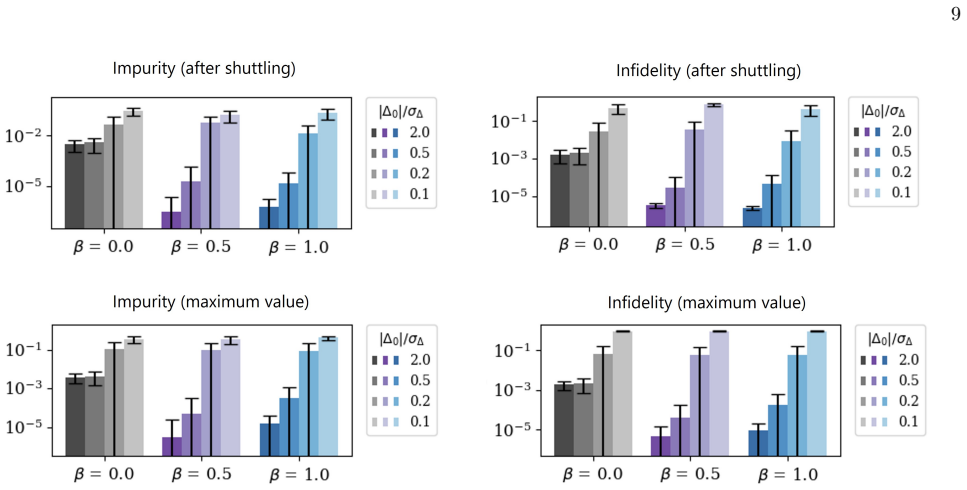
The bar graphs show the mean values and standard deviations (error bars) of spin impurity and spin infidelity at the end of shuttling and these maximum values. Evaluations are performed across different velocity shaping parametersβ(distinguished by color) and various disorder strengths|∆ 0|/σ∆. Spin purityLet the quantum state at timetbeρ vs(t). ρvs(t) is...
-
[3]
deterministic regime
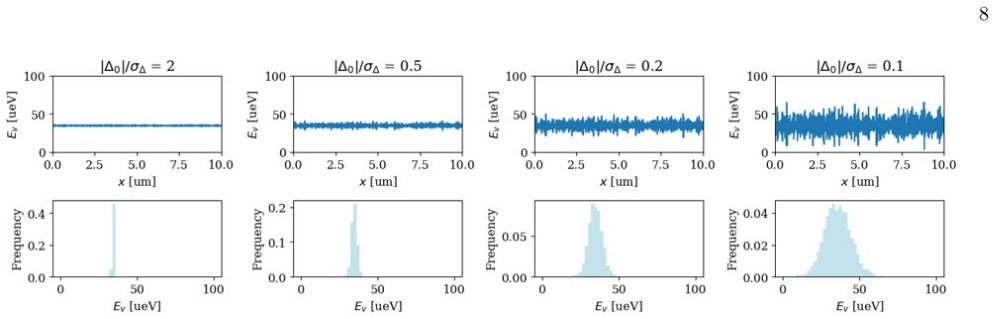
Valley landscape Next, we consider the spatial non-uniformity of valley coupling. In Sec. II, for simplicity, it was assumed that the valley coupling ∆ is spatially uniform. However, in actual silicon quantum devices, the value of ∆ randomly fluctuates in space due to variations at the silicon in- terface [18, 54, 57, 58, 60, 65, 66]. That is, ∆ can be ex...
-
[4]
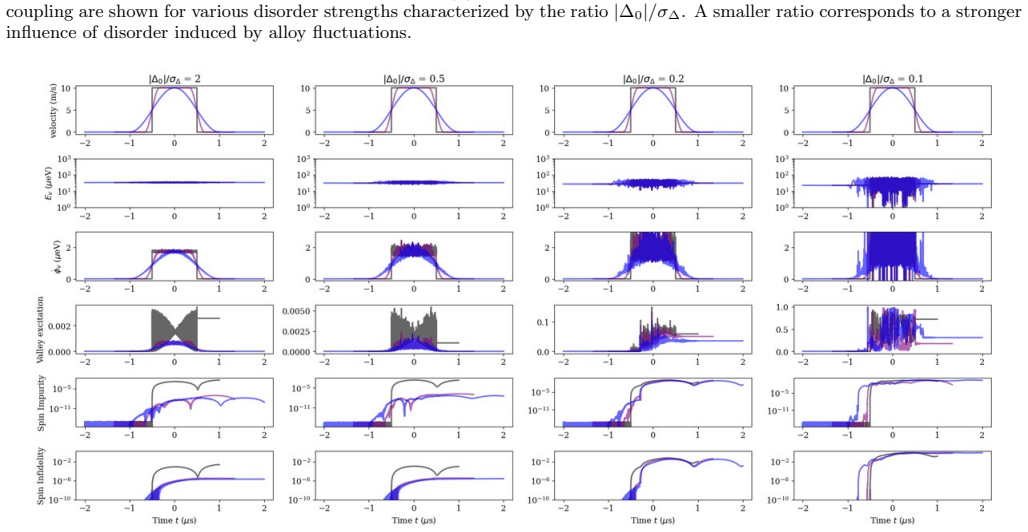
Results With the above, we are now ready to evaluate the ef- fects of the proposed method. Below, we show the re- sults of numerically analyzing the time evolution of the valley-spin system (solving time-dependent Schr¨ odinger equation for Hamiltonian (17)) usingQuTiP[75]. Figure 6 shows the numerical calculation results when the spatial distribution of ...
-
[5]
becomes pronounced. With respect to the specific de- pendency onβ, however, care must be taken: in the pres- ence of disorder, simply increasingβtoward 1.0 does not monotonically improve the shuttling performance. In- deed, as shown in Fig. 7, when the disorder strength is around|∆ 0|/σ∆ ≃0.5, the window withβ= 0.5 yields a slightly better result in terms...
-
[6]
P. W. Shor, Algorithms for quantum computation: dis- crete logarithms and factoring, inProceedings 35th an- nual symposium on foundations of computer science (Ieee, 1994) pp. 124–134
1994
-
[7]
L. K. Grover, A fast quantum mechanical algorithm for database search, inProceedings of the twenty-eighth an- nual ACM symposium on Theory of computing(1996) pp. 212–219
1996
-
[8]
Ekert and R
A. Ekert and R. Jozsa, Quantum computation and shor’s factoring algorithm, Reviews of Modern Physics68, 733 (1996)
1996
-
[9]
P. W. Shor, Polynomial-time algorithms for prime factor- ization and discrete logarithms on a quantum computer, SIAM review41, 303 (1999)
1999
-
[10]
A. Y. Kitaev, Quantum computations: algorithms and error correction, Russian Mathematical Surveys52, 1191 (1997)
1997
-
[11]
A. Y. Kitaev, Fault-tolerant quantum computation by anyons, Annals of physics303, 2 (2003)
2003
-
[12]
Raussendorf, J
R. Raussendorf, J. Harrington, and K. Goyal, A fault- tolerant one-way quantum computer, Annals of physics 321, 2242 (2006)
2006
-
[13]
Raussendorf and J
R. Raussendorf and J. Harrington, Fault-tolerant quan- tum computation with high threshold in two dimensions, Physical review letters98, 190504 (2007)
2007
-
[14]
Raussendorf, J
R. Raussendorf, J. Harrington, and K. Goyal, Topologi- cal fault-tolerance in cluster state quantum computation, New Journal of Physics9, 199 (2007)
2007
-
[15]
D. S. Wang, A. G. Fowler, and L. C. Hollenberg, Surface code quantum computing with error rates over 1%, Phys- ical Review A—Atomic, Molecular, and Optical Physics 83, 020302 (2011)
2011
-
[16]
A. G. Fowler, A. C. Whiteside, and L. C. Hollenberg, To- wards practical classical processing for the surface code, Physical review letters108, 180501 (2012)
2012
-
[17]
Tomaru, C
T. Tomaru, C. Yoshimura, and H. Mizuno, Surface code for low-density qubit array, Sci. Rep.12, 12946 (2022)
2022
-
[18]
Loss and D
D. Loss and D. P. DiVincenzo, Quantum computation with quantum dots, Physical Review A57, 120 (1998)
1998
-
[19]
Burkard, D
G. Burkard, D. Loss, and D. P. DiVincenzo, Coupled quantum dots as quantum gates, Physical Review B59, 2070 (1999)
2070
-
[20]
F. A. Zwanenburg, A. S. Dzurak, A. Morello, M. Y. Sim- mons, L. C. Hollenberg, G. Klimeck, S. Rogge, S. N. Coppersmith, and M. A. Eriksson, Silicon quantum elec- tronics, Reviews of modern physics85, 961 (2013)
2013
-
[21]
Burkard, T
G. Burkard, T. D. Ladd, A. Pan, J. M. Nichol, and J. R. Petta, Semiconductor spin qubits, Reviews of Modern Physics95, 025003 (2023)
2023
-
[22]
Z. M. McIntyre, A. Sarkar, and D. Loss, Theory 12 of spin qubits and the path to scalability, (2026), arXiv:2604.13644 [quant-ph]
Pith/arXiv arXiv 2026
-
[23]
M. Abraham, E. Acuna, T. S. Adams, M. Akmal, M. R. Alfaro, I. Alvarado, J. Amontree, C. Andrews, R. W. Andrews, M. Antcliffe,et al., A digitally con- trolled silicon quantum processing unit, arXiv preprint arXiv:2604.16216 (2026)
Pith/arXiv arXiv 2026
-
[24]
Veldhorst, J
M. Veldhorst, J. Hwang, C. Yang, A. Leenstra, B. de Ronde, J. Dehollain, J. Muhonen, F. Hudson, K. M. Itoh, A. t. Morello,et al., An addressable quan- tum dot qubit with fault-tolerant control-fidelity, Nature nanotechnology9, 981 (2014)
2014
-
[25]
Struck, A
T. Struck, A. Hollmann, F. Schauer, O. Fedorets, A. Schmidbauer, K. Sawano, H. Riemann, N. V. Abrosi- mov, L. Cywi´ nski, D. Bougeard,et al., Low-frequency spin qubit energy splitting noise in highly purified 28si/sige, npj Quantum Information6, 40 (2020)
2020
-
[26]
Stano and D
P. Stano and D. Loss, Review of performance metrics of spin qubits in gated semiconducting nanostructures, Nature Reviews Physics4, 672 (2022)
2022
-
[27]
T. Tanttuet al., Assessment of the errors of high-fidelity two-qubit gates in silicon quantum dots, Nature Phys. 20, 1804 (2024), arXiv:2303.04090 [quant-ph]
arXiv 2024
-
[28]
Kunoet al., Concatenated Continuous Driving for Ex- tending Lifetime of Spin Qubits Towards a Scalable Sili- con Quantum Computer (2024)
T. Kunoet al., Concatenated Continuous Driving for Ex- tending Lifetime of Spin Qubits Towards a Scalable Sili- con Quantum Computer (2024)
2024
-
[29]
T. Kuno, T. Utsugi, A. J. Ramsay, N. Mertig, N. Lee, I. Yanagi, T. Mine, N. Kusuno, R. Mizokuchi, T. Naka- jima,et al., Robust spin-qubit control in a natural si-mos quantum dot using phase modulation, npj Quantum In- formation (2026)
2026
-
[30]
Maurand, X
R. Maurand, X. Jehl, D. Kotekar-Patil, A. Corna, H. Bo- huslavskyi, R. Lavi´ eville, L. Hutin, S. Barraud, M. Vinet, M. Sanquer,et al., A cmos silicon spin qubit, Nature communications7, 13575 (2016)
2016
-
[31]
Veldhorst, H
M. Veldhorst, H. Eenink, C.-H. Yang, and A. S. Dzu- rak, Silicon cmos architecture for a spin-based quantum computer, Nature communications8, 1766 (2017)
2017
-
[32]
X. Xue, B. Patra, J. P. van Dijk, N. Samkharadze, S. Subramanian, A. Corna, B. Paquelet Wuetz, C. Jeon, F. Sheikh, E. Juarez-Hernandez,et al., Cmos-based cryo- genic control of silicon quantum circuits, Nature593, 205 (2021)
2021
-
[33]
R. Li, N. D. Stuyck, S. Kubicek, J. Jussot, B. Chan, F. Mohiyaddin, A. Elsayed, M. Shehata, G. Simion, C. Godfrin,et al., A flexible 300 mm integrated si mos platform for electron-and hole-spin qubits exploration, in2020 IEEE International Electron Devices Meeting (IEDM)(IEEE, 2020) pp. 38–3
2020
-
[34]
Gonzalez-Zalba, S
M. Gonzalez-Zalba, S. De Franceschi, E. Charbon, T. Meunier, M. Vinet, and A. Dzurak, Scaling silicon- based quantum computing using cmos technology, Na- ture Electronics4, 872 (2021)
2021
-
[35]
Ruffino, T.-Y
A. Ruffino, T.-Y. Yang, J. Michniewicz, Y. Peng, E. Charbon, and M. F. Gonzalez-Zalba, A cryo-cmos chip that integrates silicon quantum dots and multiplexed dispersive readout electronics, Nature Electronics5, 53 (2022)
2022
-
[36]
Zwerver, T
A. Zwerver, T. Kr¨ ahenmann, T. Watson, L. Lampert, H. C. George, R. Pillarisetty, S. Bojarski, P. Amin, S. Amitonov, J. Boter,et al., Qubits made by advanced semiconductor manufacturing, Nature Electronics5, 184 (2022)
2022
-
[37]
Elsayed, C
A. Elsayed, C. Godfrin, N. D. Stuyck, M. Shehata, S. Ku- bicek, S. Massar, Y. Canvel, J. Jussot, A. Hikavyy, R. Loo,et al., Comprehensive 300 mm process for silicon spin qubits with modular integration, in2023 IEEE Sym- posium on VLSI Technology and Circuits (VLSI Technol- ogy and Circuits)(IEEE, 2023) pp. 1–2
2023
-
[38]
Neyens, O
S. Neyens, O. K. Zietz, T. F. Watson, F. Luthi, A. Neth- wewala, H. C. George, E. Henry, M. Islam, A. J. Wagner, F. Borjans,et al., Probing single electrons across 300-mm spin qubit wafers, Nature629, 80 (2024)
2024
-
[39]
N. D. Stuyck, A. Saraiva, W. Gilbert, J. C. Pardo, R. Li, C. C. Escott, K. De Greve, S. Voinigescu, D. J. Reilly, and A. S. Dzurak, Cmos compatibility of semiconductor spin qubits, arXiv preprint arXiv:2409.03993 (2024)
Pith/arXiv arXiv 2024
-
[40]
J. M. Boter, J. P. Dehollain, J. P. van Dijk, T. Hens- gens, R. Versluis, J. S. Clarke, M. Veldhorst, F. Sebas- tiano, and L. M. Vandersypen, A sparse spin qubit array with integrated control electronics, in2019 IEEE Inter- national Electron Devices Meeting (IEDM)(IEEE, 2019) pp. 31–4
2019
-
[41]
J. M. Boter, J. P. Dehollain, J. P. Van Dijk, Y. Xu, T. Hensgens, R. Versluis, H. W. Naus, J. S. Clarke, M. Veldhorst, F. Sebastiano,et al., Spiderweb array: a sparse spin-qubit array, Physical review applied18, 024053 (2022)
2022
-
[42]
K¨ unne, A
M. K¨ unne, A. Willmes, M. Oberl¨ ander, C. Gorjaew, J. D. Teske, H. Bhardwaj, M. Beer, E. Kammerloher, R. Ot- ten, I. Seidler,et al., The spinbus architecture for scaling spin qubits with electron shuttling, Nature Communica- tions15, 4977 (2024)
2024
-
[43]
Siegel, A
A. Siegel, A. Strikis, and M. Fogarty, Towards early fault tolerance on a 2×n array of qubits equipped with shut- tling, PRX Quantum5, 040328 (2024)
2024
- [44]
-
[45]
B. Yenilen, A. Sala, H. Bluhm, M. M¨ uller, and M. Rispler, Performance of the spin qubit shuttling archi- tecture for a surface code implementation, arXiv preprint arXiv:2503.10601 (2025)
arXiv 2025
-
[46]
R. M. Otxoa, J. E. Martinez, P. Schnabl, N. Mertig, C. Smith, and F. Martins, Spinhex: A low-crosstalk, spin-qubit architecture based on multi-electron couplers, arXiv preprint arXiv:2504.03149 (2025)
arXiv 2025
-
[47]
A. J. Moncy, R. Dastbasteh, J. E. Martinez, R. Na- gai, P. M. Crespo, N. Mertig, C. Smith, and R. M. Otxoa, Surface-code thresholds and qubit footprints in shuttling-based spin-qubit railways, arXiv preprint arXiv:2605.05881 (2026)
Pith/arXiv arXiv 2026
-
[48]
Seidler, T
I. Seidler, T. Struck, R. Xue, N. Focke, S. Trellenkamp, H. Bluhm, and L. R. Schreiber, Conveyor-mode single- electron shuttling in si/sige for a scalable quantum com- puting architecture, npj Quantum information8, 100 (2022)
2022
-
[49]
R. Xue, M. Beer, I. Seidler, S. Humpohl, J.-S. Tu, S. Trel- lenkamp, T. Struck, H. Bluhm, and L. R. Schreiber, Si/sige qubus for single electron information-processing devices with memory and micron-scale connectivity func- tion, Nature Communications15, 2296 (2024)
2024
-
[50]
Struck, M
T. Struck, M. Volmer, L. Visser, T. Offermann, R. Xue, J.-S. Tu, S. Trellenkamp, L. Cywi´ nski, H. Bluhm, and L. R. Schreiber, Spin-epr-pair separation by conveyor- mode single electron shuttling in si/sige, Nature Com- munications15, 1325 (2024). 13
2024
-
[51]
De Smet, Y
M. De Smet, Y. Matsumoto, A.-M. J. Zwerver, L. Try- puten, S. L. de Snoo, S. V. Amitonov, S. R. Katiraee-Far, A. Sammak, N. Samkharadze, ¨O. G¨ ul,et al., High-fidelity single-spin shuttling in silicon, Nature Nanotechnology , 1 (2025)
2025
-
[52]
Y. Matsumoto, M. De Smet, L. Tryputen, S. L. de Snoo, S. V. Amitonov, A. Sammak, M. Rimbach-Russ, G. Scap- pucci, and L. M. Vandersypen, Two-qubit logic and teleportation with mobile spin qubits in silicon, arXiv preprint arXiv:2503.15434 (2025)
arXiv 2025
-
[53]
Kawakami, P
E. Kawakami, P. Scarlino, D. R. Ward, F. Braakman, D. Savage, M. Lagally, M. Friesen, S. N. Coppersmith, M. A. Eriksson, and L. Vandersypen, Electrical control of a long-lived spin qubit in a si/sige quantum dot, Nature nanotechnology9, 666 (2014)
2014
-
[54]
Veldhorst, R
M. Veldhorst, R. Ruskov, C. Yang, J. Hwang, F. Hudson, M. Flatt´ e, C. Tahan, K. M. Itoh, A. Morello, and A. Dzu- rak, Spin-orbit coupling and operation of multivalley spin qubits, Physical Review B92, 201401 (2015)
2015
-
[55]
Ferdous, E
R. Ferdous, E. Kawakami, P. Scarlino, M. P. Nowak, D. Ward, D. Savage, M. Lagally, S. Coppersmith, M. Friesen, M. A. Eriksson,et al., Valley dependent anisotropic spin splitting in silicon quantum dots, npj Quantum Information4, 26 (2018)
2018
-
[56]
Ruskov, M
R. Ruskov, M. Veldhorst, A. S. Dzurak, and C. Tahan, Electron g-factor of valley states in realistic silicon quan- tum dots, Physical Review B98, 245424 (2018)
2018
-
[57]
Langrock, J
V. Langrock, J. A. Krzywda, N. Focke, I. Seidler, L. R. Schreiber, and L. Cywi´ nski, Blueprint of a scalable spin qubit shuttle device for coherent mid-range qubit trans- fer in disordered si/sige/sio 2, PRX Quantum4, 020305 (2023)
2023
- [58]
-
[59]
M. Volmer, T. Struck, J.-S. Tu, S. Trellenkamp, D. D. Esposti, G. Scappucci, L. Cywi´ nski, H. Bluhm, and L. R. Schreiber, Reduction of the impact of the local valley splitting on the coherence of conveyor-belt spin shuttling in 28si/sige, arXiv preprint arXiv:2510.03773 (2025)
Pith/arXiv arXiv 2025
-
[60]
P. D. Romero, N. Chaabani, L. Duipmans, A. David, F. Motzoi, S. van Waasen, and L. Geck, Valley-aware op- timal control of spin shuttling using cryogenic integrated electronics, arXiv preprint arXiv:2604.20482 (2026)
Pith/arXiv arXiv 2026
-
[61]
Y. Oda, M. P. Losert, and J. P. Kestner, Suppressing si valley excitation and valley-induced spin dephasing for long-distance shuttling, arXiv preprint arXiv:2411.11695 (2024)
arXiv 2024
-
[62]
Degli Esposti, L
D. Degli Esposti, L. E. Stehouwer, ¨O. G¨ ul, N. Samkharadze, C. D´ eprez, M. Meyer, I. N. Mei- jer, L. Tryputen, S. Karwal, M. Botifoll,et al., Low disorder and high valley splitting in silicon, npj Quantum Information10, 32 (2024)
2024
-
[63]
Volmer, T
M. Volmer, T. Struck, A. Sala, B. Chen, M. Oberl¨ ander, T. Offermann, R. Xue, L. Visser, J.-S. Tu, S. Trel- lenkamp,et al., Mapping of valley splitting by conveyor- mode spin-coherent electron shuttling, npj Quantum In- formation10, 61 (2024)
2024
-
[64]
J. C. Marcks, E. Eagen, E. C. Brann, M. P. Losert, T. Oh, J. Reily, C. S. Wang, D. Keith, F. A. Mohiyaddin, F. Luthi,et al., Valley splitting correlations across a silicon quantum well, arXiv preprint arXiv:2504.12455 (2025)
arXiv 2025
-
[65]
B. D. Woods, M. P. Losert, N. R. Elston, M. Eriks- son, S. Coppersmith, R. Joynt, and M. Friesen, Statis- tical characterization of valley coupling in si/sige quan- tum dots viag-factor measurements near a valley vortex, arXiv preprint arXiv:2507.05160 (2025)
arXiv 2025
-
[66]
Friesen, M
M. Friesen, M. Eriksson, and S. Coppersmith, Magnetic field dependence of valley splitting in realistic si/ sige quantum wells, Applied physics letters89(2006)
2006
-
[67]
Friesen, S
M. Friesen, S. Chutia, C. Tahan, and S. Coppersmith, Valley splitting theory of si ge/ si/ si ge quantum wells, Physical Review B—Condensed Matter and Materials Physics75, 115318 (2007)
2007
-
[68]
Nagai, T
R. Nagai, T. Takemoto, Y. Wachi, and H. Mizuno, Digi- tally controlled conveyor-belt spin shuttling in silicon for large-scale quantum computation, Phys. Rev. Appl.24, 064021 (2025)
2025
-
[69]
R. J. Prentki, P. Philippopoulos, M. R. Mostaan, and F. Beaudoin, Bounds on Atomistic Disorder for Scalable Electron Shuttling, (2025), arXiv:2510.03113 [quant-ph]
arXiv 2025
-
[70]
Paquelet Wuetz, M
B. Paquelet Wuetz, M. P. Losert, S. Koelling, L. E. Ste- houwer, A.-M. J. Zwerver, S. G. Philips, M. T. Madzik, X. Xue, G. Zheng, M. Lodari,et al., Atomic fluctuations lifting the energy degeneracy in si/sige quantum dots, Nature Communications13, 7730 (2022)
2022
-
[71]
M. P. Losert, M. Eriksson, R. Joynt, R. Rahman, G. Scappucci, S. N. Coppersmith, and M. Friesen, Practi- cal strategies for enhancing the valley splitting in si/sige quantum wells, Physical Review B108, 125405 (2023)
2023
-
[72]
R. N´ emeth, V. K. Bandaru, P. Alves, M. P. Losert, E. Brann, O. M. Eskandari, H. Soomro, A. Vivrekar, M. Eriksson, and M. Friesen, Omnidirectional shuttling to avoid valley excitations in si/sige quantum wells, arXiv preprint arXiv:2412.09574 (2024)
arXiv 2024
-
[73]
M. Beer, R. Xue, L. Deda, S. Trellenkamp, J.-S. Tu, P. Surrey, I. Seidler, H. Bluhm, and L. R. Schreiber, Conveyor-mode electron shuttling through a t-junction in si/sige, arXiv preprint arXiv:2601.03942 (2026)
arXiv 2026
-
[74]
B. Undseth, N. Meggiato, Y.-H. Wu, S. R. Katiraee-Far, L. Tryputen, S. L. de Snoo, D. D. Esposti, G. Scap- pucci, E. Greplov´ a, and L. M. Vandersypen, Weight- four parity checks with silicon spin qubits, arXiv preprint arXiv:2601.23267 (2026)
arXiv 2026
- [75]
-
[76]
J. H. Davies, I. A. Larkin, and E. Sukhorukov, Modeling the patterned two-dimensional electron gas: Electrostat- ics, Journal of Applied Physics77, 4504 (1995)
1995
-
[77]
Kanno, R
Y. Kanno, R. Nagai, T. Utsugi, and M. Hiroyuki, To appear, (2026)
2026
-
[78]
J. D. Cifuentes, T. Tanttu, W. Gilbert, J. Y. Huang, E. Vahapoglu, R. C. Leon, S. Serrano, D. Otter, D. Dun- more, P. Y. Mai,et al., Bounds to electron spin qubit variability for scalable cmos architectures, Nature com- munications15, 4299 (2024)
2024
-
[79]
Friesen and S
M. Friesen and S. Coppersmith, Theory of valley-orbit coupling in a si/sige quantum dot, Physical Review B—Condensed Matter and Materials Physics81, 115324 (2010)
2010
-
[80]
N. Lambert, E. Giguere, P. Menczel, B. Li, P. Hopf, G. Su´ arez, M. Gali, J. Lishman, R. Gadhvi, R. Agar- 14 wal,et al., Qutip 5: The quantum toolbox in python, arXiv preprint arXiv:2412.04705 (2024)
Pith/arXiv arXiv 2024
discussion (0)
Sign in with ORCID, Apple, or X to comment. Anyone can read and Pith papers without signing in.