First evaluation of the tracking performance of the ARCADIA Fully Depleted MAPS with 120 GeV proton beam
Pith reviewed 2026-06-25 19:49 UTC · model grok-4.3
The pith
Test beam data show the ARCADIA fully depleted MAPS reaches above 99 percent detection efficiency and 3.8 micrometer spatial resolution with 120 GeV protons.
A machine-rendered reading of the paper's core claim, the machinery that carries it, and where it could break.
Core claim
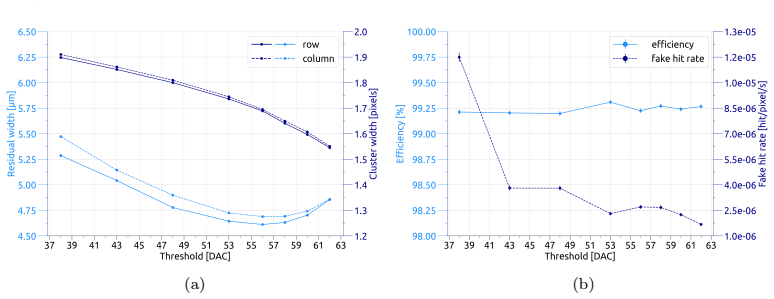
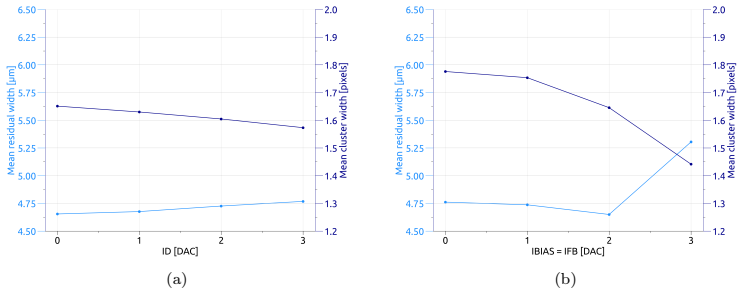
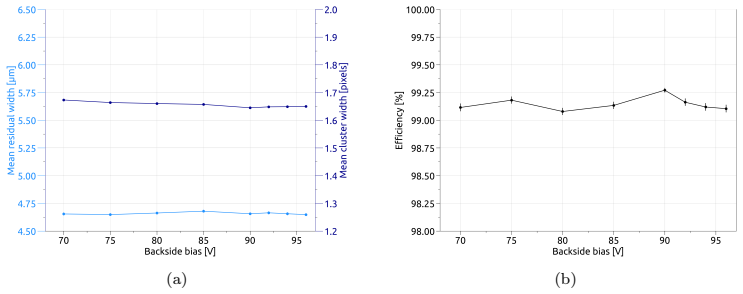
The ARCADIA Main Demonstrator 3 achieves detection efficiency exceeding 99 percent and spatial resolution down to 3.8 micrometers. These figures are extracted from cluster data collected with a 120 GeV proton beam while the sensor is operated at different thresholds, front-end currents, and backside bias voltages. The study maps how each performance metric depends on those three parameters.
What carries the argument
The ARCADIA fully depleted MAPS, a monolithic pixel sensor whose substrate is fully depleted to collect charge from a 200 micrometer thick volume in a single integrated device.
If this is right
- Efficiency stays above 99 percent across the scanned range of thresholds and backside biases.
- Spatial resolution reaches its best value of 3.8 micrometers at particular combinations of threshold and bias.
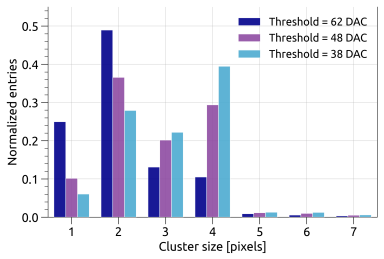
- Cluster size grows or shrinks predictably with threshold and front-end current, directly affecting the position-resolution figure.
- Performance remains stable when backside bias is increased to improve depletion depth.
Where Pith is reading between the lines
- The same operating curves could be used to tune the sensor for lower-power or higher-speed regimes in a full-scale detector.
- If radiation hardness follows the same parameter trends, the device might suit environments with moderate fluence.
- A direct comparison of cluster-charge spectra before and after irradiation would test whether the efficiency plateau shrinks.
- The reported resolution value sets a benchmark that hybrid pixel sensors or other MAPS variants would have to beat to displace this technology.
Load-bearing premise
The test-beam alignment, beam divergence, and data-selection cuts do not add significant smearing beyond the sensor's intrinsic resolution and efficiency.
What would settle it
A repeat measurement under the same 120 GeV proton beam that yields efficiency below 99 percent or resolution coarser than 5 micrometers at the same operating points would falsify the reported performance.
Figures
read the original abstract
This work presents test beam characterization of the ARCADIA Main Demonstrator 3, a 200 $\mu$m thick Fully Depleted MAPS developed using a custom LFoundry 110 nm CIS process on a high-resistivity substrate. Measurements using a 120 GeV proton beam demonstrate a detection efficiency exceeding 99% and a spatial resolution down to 3.8 $\mu$m. The study evaluates cluster size, spatial resolution, and efficiency as a function of the threshold, front-end currents, and backside bias voltage.
Editorial analysis
A structured set of objections, weighed in public.
Referee Report
Summary. This paper reports the test beam characterization of the ARCADIA Main Demonstrator 3, a 200 μm thick fully depleted MAPS fabricated in a custom LFoundry 110 nm CIS process on high-resistivity substrate. Using a 120 GeV proton beam, it demonstrates detection efficiency exceeding 99% and spatial resolution down to 3.8 μm, with evaluations of cluster size, spatial resolution, and efficiency as functions of threshold, front-end currents, and backside bias voltage.
Significance. If substantiated by the full analysis, these results establish competitive performance for FD-MAPS in high-energy tracking applications, with the parametric dependence on operating conditions providing useful optimization data and internal cross-checks. The high-energy beam choice minimizes multiple scattering, strengthening the resolution claim.
minor comments (1)
- [Abstract] Abstract: the reported performance numbers would be strengthened by a one-sentence indication of the reference telescope, alignment procedure, or residual subtraction method used to extract the quoted 3.8 μm resolution.
Simulated Author's Rebuttal
We thank the referee for the positive assessment of our work and the recommendation for minor revision. The report does not list any specific major comments requiring point-by-point response.
Circularity Check
No significant circularity: direct experimental measurement report
full rationale
This paper reports test-beam measurements of detection efficiency (>99%) and spatial resolution (down to 3.8 μm) for the ARCADIA FD-MAPS using a 120 GeV proton beam. The abstract and reader's summary indicate no derivations, equations, fitted predictions, or self-citation chains are present; results are stated as functions of threshold, front-end current, and bias voltage with internal parametric cross-checks. No load-bearing steps reduce to inputs by construction, satisfying the default expectation for experimental papers (score 0-2).
Axiom & Free-Parameter Ledger
Reference graph
Works this paper leans on
-
[1]
F. Reidt , title = ". doi:https://doi.org/10.1016/j.nima.2022.166632 , journal =
-
[2]
The ALPIDE pixel sensor chip for the upgrade of the ALICE Inner Tracking System
Gianluca. The ALPIDE pixel sensor chip for the upgrade of the ALICE Inner Tracking System. doi:https://doi.org/10.1016/j.nima.2016.05.016 , journal=
-
[3]
doi:https://doi.org/10.1016/j.nima.2023.168678 , journal=
Snoeys, Walter , title=". doi:https://doi.org/10.1016/j.nima.2023.168678 , journal=
-
[4]
doi:10.3389/fsens.2025.1603755 , journal=
Da Rocha Rolo, Manuel and Andreazza, Attilio and Ambrosi, Giovanni and Alfonsi, Fabrizio and Balbi, Gabriele and Dalla Betta, Gian-Franco and Croci, Tommaso and Caccia, Massimo and Chiappara, Davide and Corradino, Thomas and Durando, Stefano and Falchieri, Davide and Gabrielli, Alessandro and Giubilato, Piero and Garbolino, Sara and Iuppa, Roberto and Man...
-
[5]
doi:10.3390/s21113809 , journal=
Thomas Corradino and Gian-Franco Dalla Betta and Lorenzo De Cilladi and Coralie Neubuser and Lucio Pancheri , title=". doi:10.3390/s21113809 , journal=
-
[6]
doi:10.1088/1748-0221/21/04/P04003 , journal =
Pantouvakis, Caterina and Rignanese, Michele and Zenger, Todd and Ciarlantini, Sabrina and Zingaretti, Alessandra and Azzi, Patrizia and Bonini, Chiara and Chiappara, Davide and Mattiazzo, Serena and Pantano, Devis and Wyss, Jeffery and Apresyan, Artur and Bacchetta, Nicola and Bolla, Luca and Hayrapetyan, Aram and Peña, Cristián and Salvador, Nelson and ...
-
[7]
Hartz, M. and Merkel, P. and Niner, E. and Prebys, E. and Toro, N. Test Beam and Irradiation Facilities. Snowmass 2021. 2022. arXiv:2203.09944
arXiv 2021
-
[8]
Pantouvakis, C. and Garbolino, S. and Rignanese, M. and Affleck, P. and Apresyan, A. and Azzi, P. and Bacchetta, N. and Bonini, C. and Chiappara, D. and Ciarlantini, S. and Falchieri, D. and Hayrapetyan, A. and Mattiazzo, S. and Pancheri, L. and Pantano, D. and Rivetti, A. and Rolo, M. and Santoro, R. and Turrisi, R. and Wyss, J. and Xie, S. and Zingarett...
-
[9]
Fermilab Test Beam Facility
, howpublished =. Fermilab Test Beam Facility
-
[10]
Corryvreckan: a modular 4D track reconstruction and analysis software for test beam data
Dannheim, Dominik and Dort, Katharina and Huth, Lennart and Hynds, Daniel and Kremastiotis, Iraklis and Kr. Corryvreckan: a modular 4D track reconstruction and analysis software for test beam data. Journal of Instrumentation , doi=
-
[11]
2006 , publisher=
Pixel detectors: From fundamentals to applications , author=. 2006 , publisher=
2006
-
[12]
Innovative readout architecture for Monolithic Active Pixel Sensors
Davide Chiappara. Innovative readout architecture for Monolithic Active Pixel Sensors. 2023
2023
-
[13]
Performance study of the JadePix-3 telescope from a beam test
Dong, Sheng and Chen, Zhiliang and Zhou, Jia and Zhai, Xingye and Wang, Anqi and Wang, Yunxiang and Wang, Hulin and Xu, Lailin and Dong, Jing and Zhou, Yang and others , journal=. Performance study of the JadePix-3 telescope from a beam test. doi:https://doi.org/10.1016/j.nima.2024.169551 , volume=
discussion (0)
Sign in with ORCID, Apple, or X to comment. Anyone can read and Pith papers without signing in.