REVIEW 5 major objections 6 minor 23 references
Numeracy in Large Language Models: Fundamental Limitations and Paths to Improvement
T0 review · 5 major / 6 minor · reviewed 2026-08-15 · deepseek-v4-flash
Pith's one-line read This survey claims that LLM numeracy failures are grounding failures, not reasoning failures: the mapping from numeral to value fails separately from arithmetic execution, so the two need different fixes.
desk verdict Useful survey and a genuinely practical constraint, but the RG–PG dissociation result is not established: the task labeling does part of the work, and the empirical section lacks the artifacts to back its claims. read the letter →
The pith
A machine-rendered reading of the paper's core claim, the machinery that carries it, and where it could break.
The reading
What carries the argument
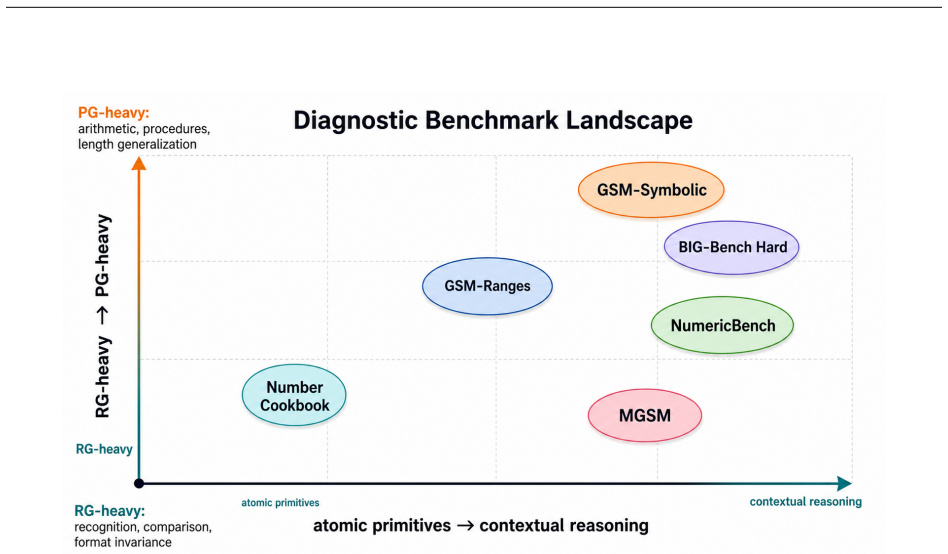
The central object is the Numerical Grounding Framework (NGF), a two-part construct that defines numerical competence as the conjunction of Representational Grounding (RG)—mapping numeral surface forms to value, magnitude, and format equivalence—and Procedural Grounding (PG)—executing arithmetic procedures consistently with their mathematical definitions. NGF does the argumentative work by assigning every failure mode, root cause, and mitigation to one or both dimensions: BPE tokenization and embedding discontinuity damage RG; positional encodings and training-data sparsity damage PG; fragility and tokenization artifacts are RG failures, while length-generalization and algorithmic-asymmetry failures are PG failures. The framework is operationalized by grouping Number Cookbook's atomic tasks into RG and PG batteries and testing them alongside NumericBench and GSM-Symbolic across three model families.
What would settle it
Re-score the Number Cookbook items after matching RG and PG tasks for difficulty, length, and tokenization exposure, for example by pairing magnitude comparison with digit manipulation on identical numbers; if the RG-PG gap shrinks to zero once difficulty is matched, the claimed dissociation collapses, and finding a model with high PG but low RG on the same tokenizer would violate the framework's predicted ordering.
Extended reading notes
Core claim
On the paper's own terms, the central discovery is that numerical grounding is architecturally distinct from mathematical reasoning: a model can reason well and still fail to anchor numerals to values. Numeracy decomposes into Representational Grounding (RG), the faithful mapping of a numeral's surface form to ordering, magnitude, and format equivalence, and Procedural Grounding (PG), the faithful execution of arithmetic procedures. The empirical claim is a dissociation: every evaluated model configuration shows higher RG than PG, by about 0.19 in-domain and 0.27 out-of-domain, and the gap widens under length extension. Extended reasoning improves out-of-domain PG by roughly three times its improvement of RG, while tokenizer choice creates model-specific RG blind spots (for instance, one model keeps float comparison accurate to longer lengths, another leads on digit counting). The paper also finds that atomic primitives only partially predict contextual numeracy, and it states the Pretrained-Model Constraint: the most structural fixes, such as digit-aware tokenization or Abacus Embeddings, must be made before pretraining, leaving pretrained-model users with fine-tuning, process rewards, and external tools.
Load-bearing premise
The argument's load-bearing assumption is that the task batteries labeled RG and PG really measure two independent constructs rather than two levels of difficulty: if representation tasks are simply easier or more frequent in training than procedure tasks, the observed RG-PG gap would be a relabeled easy-versus-hard effect, not a dissociation.
Editorial extensions
If this is right
- Benchmark accuracy on GSM8K, MATH, and similar reasoning sets can remain high while elementary numeracy fails, so deployment decisions should be based on grounding tests, not reasoning benchmarks.
- Chain-of-Thought and reasoning-model training will continue to close PG gaps faster than RG gaps, especially out-of-domain, and cannot repair tokenizer-induced errors that happen before reasoning begins.
- Different tokenizers will keep producing qualitatively different numeracy strengths, so a single global numeracy score is misleading and evaluations should report per-task RG profiles.
- The Pretrained-Model Constraint means practitioners who cannot retrain should rely on supervised fine-tuning on diverse numerical examples, process-reward training, self-consistency, and tool use for high-reliability arithmetic.
- Tool use is the near-term route to reliable PG because it externalizes computation, but it does not remove RG requirements: the model must still extract quantities and formulate correct equations.
Reading between the lines
- The manuscript's own reference list marks the NumericBench citation as needing verification; because NumericBench anchors the contextual-transfer half of the dissociation evidence, readers should treat that part of the empirical picture as provisional until the benchmark source is confirmed.
- A testable extension the paper does not run: hold tokenization fixed and swap only task labels between RG and PG batteries; if the dissociation survives matched difficulty, the construct split is real rather than a difficulty artifact.
- If NGF is right, the same two-channel decomposition should apply to other non-monotonic symbol systems, such as dates, units, chemical formulas, or hexadecimal numbers, where surface form does not carry semantics monotonically and RG failures should show the same tokenizer sensitivity.
- The $9.11 > 9.9$ error should disappear under any input representation whose embedding distance is monotone in magnitude, implying that post-hoc embedding alignment might partially rescue pretrained models even without full retraining.
Signed reviews
Editorial analysis
A structured set of objections, weighed in public.
Referee Report
Summary. The paper proposes the Numerical Grounding Framework (NGF), which splits LLM numeracy into Representational Grounding (RG) and Procedural Grounding (PG), and uses this framework to organize a survey of diagnostic benchmarks, failure modes, structural root causes, and mitigation strategies. It also reports a coordinated evaluation across Number Cookbook, NumericBench, and GSM-Symbolic, claiming a robust RG–PG dissociation, an asymmetric benefit of extended reasoning for PG, tokenizer-specific RG blind spots, and partial primitive–contextual transfer. The central conclusion is that numerical grounding is architecturally distinct from mathematical reasoning, with tokenization as the primary RG bottleneck and the Pretrained-Model Constraint shaping available interventions for deployed systems.
Significance. If the dissociation were empirically established, NGF would be a useful organizing device: it maps failure modes to structural causes, separates scaling gains from architectural fixes, and makes concrete predictions about intervention efficacy. The paper's strengths are its systematic survey of the 2024–2025 diagnostic benchmark generation, the failure-mode taxonomy, the root-cause analysis linking BPE tokenization, positional encodings, embedding geometry, and pretraining data to RG/PG, and the explicit Pretrained-Model Constraint. These contributions are valuable independent of the empirical section. However, the current empirical validation falls short of the claims made in Sections 5 and 7, so the central theoretical claim is not yet established to the standard the paper asserts.
major comments (5)
- [Section 5.2, Table 1] The RG battery in Section 5.2 includes digit counting and number length, yet Table 1 classifies digit manipulation as PG with the example 'What is the 3rd digit of 3.1415?' Counting digits and judging number length are digit-manipulation tasks under that taxonomy, so the RG battery is inflated with PG-like items. The reported RG–PG gap of about 0.19 in-domain and 0.27 out-of-domain in Section 5.3 may therefore be partly a labeling artifact rather than a measured dissociation. No item-level validation, inter-rater agreement, or factor analysis is provided to show that the two batteries measure distinct constructs rather than task difficulty, output length, or pretraining token frequency—a confound the paper itself identifies in Section 4.4. This inconsistency must be resolved before the dissociation claim can be accepted.
- [Section 5.3, Table 2] The 'robust' dissociation result is not supported by the reported statistics. No sample sizes, item counts, error bars, confidence intervals, or significance tests are given. Table 2's layout is confusing: the Gemini rows omit the digit-match columns without a stated N/A convention, and the Claude row can be misread as having '4.6' as a value rather than a model version. The 0.19/0.27 RG–PG gap is presented as an average without variance or an inferential test, so the result cannot be distinguished from noise or from a small number of outlier items.
- [Section 5.4, Table 3] The claim that extended reasoning improves PG more than RG is based on a single model family (Gemini 3, MINIMAL versus HIGH) and a single configuration at temperature 0. The 21.3× token-cost comparison and the in-domain regression rest on one pair of runs with no repeated sampling or confidence intervals. To support the framework's prediction, the asymmetry should be replicated across at least one additional model family and with multiple seeds or prompt variants.
- [Section 5.5] The tokenizer-specific RG blind-spot claim is asserted from cross-model accuracy differences, but the paper reports no tokenizer analysis (for example, actual BPE segmentation of the test numerals), no controlled comparison of models with identical training data and different tokenizers, and no release of prompts or exact API versions. Differences between GPT-5.4, Claude Opus 4.6, and Gemini 3 could be due to pretraining data, alignment, or instruction-following rather than tokenization. The claim therefore overreaches the evidence presented.
- [Sections 3.6 and 5.1] The framework's predictions partially follow from its definitions: RG is defined as mapping numerals to value and PG as executing procedures, and tasks are assigned to batteries accordingly. Finding RG > PG may then reflect task difficulty or exposure rather than a genuine cognitive dissociation. Section 4.4 itself identifies operand frequency as a strong predictor, and no attempt is made to regress out difficulty, output length, or token frequency. A dissociation claim needs item-level controls or at least a demonstration that the RG and PG items are matched on difficulty and frequency.
minor comments (6)
- [Table 2] Format the table so that model names and values are unambiguous, and state explicitly that digit-match columns are not available for Gemini 3 configurations.
- [References] The NumericBench reference (Li et al., 2025) contains the placeholder text 'Verify authors and arXiv ID before final submission' and must be completed.
- [Section 6.4.1, Table 6] Table 6 lists CoT/reasoning as costing approximately 18× tokens, while Table 3 reports a measured 21.3× token cost for Gemini HIGH; these numbers should be reconciled.
- [Section 5.2] The experimental setup does not specify how many items are in each RG and PG battery, how in-domain and out-of-domain splits were constructed, or the exact prompt templates; an appendix with these details is needed for reproducibility.
- [Figure 8] The y-axis label 'maximum digit length at which a model maintains at least 90% exact-match accuracy' is not defined; the interpolation method used to obtain the threshold should be stated.
- [General] There are several typos and spacing errors, for example 'theNumerical' in Section 3.1, 'awiderangeof' in Section 2.1, and 'improvesome' in Section 2.3; a careful proofread is needed.
Circularity Check
Section 5.2's RG/PG battery split is internally inconsistent with Table 1 and makes the central RG–PG dissociation partly a labeling artifact.
-
self definitional
[Section 5.2 Experimental Setup; Table 1 Taxonomy; Section 5.3 Aggregate Results; Section 7.1 Key Takeaways]
"All 44 task–representation combinations are evaluated and grouped into an RG battery (magnitude comparison, format conversion, significant-figure rounding, digit counting, and number length) and a PG battery (arithmetic operations, digit-wise operations, and digit extraction). ... Structural / Digit Manipulation / PG / Accessing or modifying specific digits. “What is the 3rd digit of 3.1415?”"
The dissociation claim that 'every model configuration shows higher RG than PG, with an average RG-PG gap of approximately 0.19 in domain and 0.27 out of domain' is computed directly from this battery split. But the split places digit counting and number length in the RG battery even though the paper's own taxonomy assigns digit access/modification to PG. Counting digits and judging number length are digit-access operations, so moving them into RG inflates RG relative to PG by construction. The claimed dissociation, later used in Section 7.1 to conclude that numerical grounding is architecturally distinct from mathematical reasoning, is therefore at least partly an artifact of the unvalidated and internally inconsistent task labeling rather than an independent empirical measurement.
full rationale
The paper does not fit free parameters, invoke self-citations, or rely on a uniqueness theorem; most of the survey content is an external literature review. However, its central empirical contribution, the RG–PG dissociation in Section 5.3, is not independent of the framework being tested. Section 5.2 constructs the RG and PG batteries using the same RG/PG definitions the evaluation is meant to validate, and it labels closely related digit tasks inconsistently: digit counting and number length go into RG, while digit-wise operations and digit extraction go into PG, even though Table 1 classifies digit manipulation as PG. No item-level validation, inter-rater agreement, or factor analysis is given to show the batteries differ in construct rather than in difficulty, output length, or pretraining token frequency, which Section 4.4 itself identifies as a strong accuracy predictor. The reasoning-compensation result (Figure 7) and tokenizer-specific RG profiles remain genuine empirical observations, so the circularity is partial rather than total; hence a score of 6.
Assumptions & free parameters
assumptions (5)
- domain assumption Harnad's symbol grounding problem applies to LLM numeral tokens.
- domain assumption Dehaene's dual-system number cognition maps onto RG and PG in LLMs.
- domain assumption BPE tokenization creates non-monotonic surface-to-value mappings for decimals.
- domain assumption Positional encoding such as RoPE or ALiBi is the principal cause of length-generalization failure in arithmetic.
- ad hoc to paper The RG and PG batteries in Section 5.2 are valid independent operationalizations.
Cite this review
Pith. "Pith review of Numeracy in Large Language Models: Fundamental Limitations and Paths to Improvement." pith.science (2026). https://pith.science/paper/LAH6ZMUG
@misc{pith2026260813129,
  author       = {Pith},
  title        = {Pith review of: Numeracy in Large Language Models: Fundamental Limitations and Paths to Improvement},
  year         = {2026},
  howpublished = {\url{https://pith.science/paper/LAH6ZMUG}},
  note         = {Machine review of arXiv:2608.13129}
}
read the original abstract
Large language models (LLMs) achieve strong results on mathematical reasoning benchmarks yet remain unreliable on elementary numerical tasks, including magnitude comparison, large-integer arithmetic, fractions, and scientific notation. This survey examines basic numerical understanding as a capability distinct from high-level mathematical reasoning. We propose the Numerical Grounding Framework (NGF), which decomposes numeracy into Representational Grounding (RG), mapping numeral forms to value, magnitude, and equivalent representations, and Procedural Grounding (PG), executing arithmetic operations in accordance with their mathematical definitions. Using NGF, we organize recent diagnostic benchmarks, failure modes, structural explanations, and mitigation strategies. We review evidence concerning tokenization, positional encoding, embedding geometry, and pretraining-data distribution. We also apply NGF in a coordinated evaluation of three frontier model families across Number Cookbook, NumericBench, and GSM-Symbolic, comparing atomic, contextual, and reasoning-assisted numeracy. Architectural interventions such as digit-aware tokenization and Abacus Embeddings can improve models trained from scratch but are generally unavailable to users of pretrained systems, for whom supervised fine-tuning, reasoning scaffolds, and external tools are more practical. We conclude with deployment recommendations and research directions for more reliable numerical behavior in foundation models.
Figures


Figures from the paper (8 more)


Reference graph
Works this paper leans on
-
[1]
Janice Ahn, Rishu Verma, Renze Lou, Di Liu, Rui Zhang, and Wenpeng Yin. Large language models for mathematical reasoning: Progresses and challenges.arXiv preprint arXiv:2402.00157,
-
[4]
Training verifiers to solve math word problems.arXiv preprint arXiv:2110.14168,
Karl Cobbe, Vineet Kosaraju, Mohammad Bavarian, Mark Chen, Heewoo Jun, Lukasz Kaiser, Matthias Plappert, Jerry Tworek, Jacob Hilton, Reiichiro Nakano, et al. Training verifiers to solve math word problems.arXiv preprint arXiv:2110.14168,
-
[8]
Languagemodelsrepresentspaceandtime.arXiv preprint arXiv:2310.02207,
WesGurneeandMaxTegmark. Languagemodelsrepresentspaceandtime.arXiv preprint arXiv:2310.02207,
-
[10]
Time-llm: Timeseriesforecastingbyreprogramminglargelanguage models.arXiv preprint arXiv:2310.01728,
22 Ming Jin, Shiyu Wang, Lintao Ma, Zhixuan Chu, James Y Zhang, Xiaoming Shi, Pin-Yu Chen, Yuxuan Liang, Yuan-FangLi, ShiruiPan, etal. Time-llm: Timeseriesforecastingbyreprogramminglargelanguage models.arXiv preprint arXiv:2310.01728,
-
[11]
Verify authors and arXiv ID before final submission. Hunter Lightman, Vineet Kosaraju, Yura Burda, Harri Edwards, Bowen Baker, Teddy Lee, Jan Leike, John Schulman, Ilya Sutskever, and Karl Cobbe. Let’s verify step by step.arXiv preprint arXiv:2305.20050,
-
[12]
Xiao-Yang Liu, Guoxuan Wang, Hongyang Yang, and Daochen Zha. Fingpt: Democratizing internet-scale data for financial large language models.arXiv preprint arXiv:2307.10485,
-
[14]
Seyed Iman Mirzadeh, Keivan Alizadeh, Hooman Shahrokhi, Oncel Tuzel, Samy Bengio, and Mehrdad Farajtabar. GSM-Symbolic: Understanding the limitations of mathematical reasoning in large language models.arXiv preprint arXiv:2410.05229,
-
[15]
Rodrigo Nogueira, Zhiying Jiang, and Jimmy Lin. Investigating the limitations of transformers with simple arithmetic tasks.arXiv preprint arXiv:2102.13019,
Show all 23 references
-
[16]
Show your work: Scratchpads for intermediate computation with language models.arXiv preprint arXiv:2112.00114,
Maxwell Nye, Anders Johan Andreassen, Guy Gur-Ari, Henryk Michalewski, Jacob Austin, David Bieber, David Dohan, Aitor Lewkowycz, Maarten Bosma, David Luan, et al. Show your work: Scratchpads for intermediate computation with language models.arXiv preprint arXiv:2112.00114,
-
[17]
Bowen Peng, Jeffrey Quesnelle, Honglu Fan, and Enrico Shippole
URLhttps://openai.com/index/ learning-to-reason-with-llms/. Bowen Peng, Jeffrey Quesnelle, Honglu Fan, and Enrico Shippole. YaRN: Efficient context window extension of large language models.arXiv preprint arXiv:2309.00071,
-
[18]
Deepseekmath: Pushing the limits of mathematical reasoning in open language models.arXiv preprint arXiv:2402.03300,
Zhihong Shao, Peiyi Wang, Qihao Zhu, Runxin Xu, Junxiao Song, Xiao Bi, Haowei Zhang, Mingchuan Zhang, YK Li, Yang Wu, et al. Deepseekmath: Pushing the limits of mathematical reasoning in open language models.arXiv preprint arXiv:2402.03300,
-
[19]
MathScale: Scaling instruction tuning for mathematical reasoning.arXiv preprint arXiv:2403.02884,
Zhengyang Tang, Xingxing Zhang, Benyou Wan, and Furu Wei. MathScale: Scaling instruction tuning for mathematical reasoning.arXiv preprint arXiv:2403.02884,
-
[20]
Galactica: A large language model for science.arXiv preprint arXiv:2211.09085,
Ross Taylor, Marcin Kardas, Guillem Cucurull, Thomas Scialom, Anthony Hartshorn, Elvis Saravia, Andrew Poulton, Viktor Kerkez, and Robert Stojnic. Galactica: A large language model for science.arXiv preprint arXiv:2211.09085,
-
[21]
Solvingmathwordproblemswithprocess-andoutcome-basedfeedback
Jonathan Uesato, Nate Kushman, Ramana Kumar, Francis Song, Noah Siegel, Lisa Wang, Antonia Creswell, GeoffreyIrving, andIrinaHiggins. Solvingmathwordproblemswithprocess-andoutcome-basedfeedback. arXiv preprint arXiv:2211.14275,
-
[22]
Number cookbook: Number under- standing of language models and how to improve it.arXiv preprint arXiv:2411.03766,
Han Wang, Fei Liu, Qianwen Liu, Yanfang Shi, Yuzhang Zhu, et al. Number cookbook: Number under- standing of language models and how to improve it.arXiv preprint arXiv:2411.03766,
-
[23]
Emergent abilities of large language models.Trans- actions on Machine Learning Research, 2022a
Jason Wei, Yi Tay, Rishi Bommasani, Colin Raffel, Barret Zoph, Sebastian Borgeaud, Dani Yogatama, Maarten Bosma, Denny Zhou, Donald Metzler, et al. Emergent abilities of large language models.Trans- actions on Machine Learning Research, 2022a. Jason Wei, Xuezhi Wang, Dale Schu...
-
[1990]
Measuring mathematical problem solving with the MATH dataset.arXiv preprint arXiv:2103.03874,
Dan Hendrycks, Colby Burns, Saurav Kadavath, Akul Arora, Steven Basart, Eric Tang, Dawn Song, and Jacob Steinhardt. Measuring mathematical problem solving with the MATH dataset.arXiv preprint arXiv:2103.03874,
-
[2011]
The Llama 3 herd of models.arXiv preprint arXiv:2407.21783,
Abhimanyu Dubey, Abhinav Jauhri, Abhinav Pandey, Abhishek Kadian, Ahmad Al-Dahle, Aiesha Letman, Akhil Mathur, Alan Schelten, Amy Yang, Angela Fan, et al. The Llama 3 herd of models.arXiv preprint arXiv:2407.21783,
-
[2021]
DeepSeek-R1: Incentivizing reasoning capability in LLMs via reinforcement learning.arXiv preprint arXiv:2501.12948,
DeepSeek-AI. DeepSeek-R1: Incentivizing reasoning capability in LLMs via reinforcement learning.arXiv preprint arXiv:2501.12948,
-
[2022]
Emergent autonomous scientific research capabilities of large language models.arXiv preprint arXiv:2304.05332,
Daniil A Boiko, Robert MacKnight, and Gabe Gomes. Emergent autonomous scientific research capabilities of large language models.arXiv preprint arXiv:2304.05332,
-
[2023]
xVal: A continuous number encoding for large language models
Siavash Golkar, Mariel Pettee, Michael Eickenberg, Alberto Bietti, Miles Cranmer, Geraud Krawezik, Fran- cois Lanusse, Michael McCabe, Ruben Ohana, Liam Parker, Enrico Riviere, Tiberiu Tesileanu, Kyle Cranmer, and Shirley Ho. xVal: A continuous number encoding for large langua...
2023
-
[2024]
Transformers can do arithmetic with the right embeddings.arXiv preprint arXiv:2405.17399,
Sean McLeish, Arpit Bansal, Alex Stein, Neel Jain, John Kirchenbauer, Brian R Bartoldson, Golnoosh Milani Fard, Avi Schwarzschild, Micah Goldblum, Jonas Geiping, and Tom Goldstein. Transformers can do arithmetic with the right embeddings.arXiv preprint arXiv:2405.17399,
-
[2025]
Learning the greatest common divisor: explaining transformer predictions.arXiv preprint arXiv:2201.05624,
François Charton. Learning the greatest common divisor: explaining transformer predictions.arXiv preprint arXiv:2201.05624,
Reviewed August 15, 2026 · model on record in the stance chip above.
Discussion (0). Continue with ORCID to comment.