REVIEW 3 major objections 5 minor 96 references
Spiking Neural Networks for Inference and Learning: A Memristor-based Design Perspective
T0 review · 3 major / 5 minor · reviewed 2026-08-14 · deepseek-v4-flash
Pith's one-line read This review argues that memristor-based neuromorphic systems should be built around device-aware, gradient-derived three-factor learning rules rather than classical STDP or drop-in memory replacement.
desk verdict A solid review chapter whose original contributions are mostly the authors' earlier results; the pulse-count compensation idea is clear but not robustly validated against the non-idealities it catalogs. read the letter →
The pith
A machine-rendered reading of the paper's core claim, the machinery that carries it, and where it could break.
The reading
What carries the argument
The load-bearing object is the exponential conductance-update model of Eq. (8), with fitted parameters $G_{\mathrm{max}}, G_{\mathrm{min}}, \alpha_P, \alpha_D, \beta_P, \beta_D$ that capture the asymmetric nonlinearity of RRAM potentiation and depression. Working from this model, the review derives the pulse-count compensation equations (14)-(17) and (23)-(24): for a desired weight change $\Delta G$, the required number of programming pulses is computed from the current conductance $G(n)$ and the device parameters, using logarithms that can be linearized for hardware. Combined with a three-factor learning rule in which the third factor is the modulating signal $M_i$ (error, surprise, or reward), this machinery makes the device's conductance change proportional to the learning rule's weight update, turning a device nonideality into a controlled part of the computation.
What would settle it
Program a batch of RRAMs with the pulse counts computed by Eqs. (23)-(24) while tracking each device's actual conductance after every pulse; if the measured conductance changes deviate from the predicted $\Delta G$ by more than the fitted noise, or if the ICA demixing weights fail to converge to the inverse mixing matrix over $10^4$ samples, the central claim fails. A simpler check is to measure the conductance change after one predicted potentiation pulse starting from $G_{\mathrm{min}}$ and test whether it matches $(G_{\mathrm{max}}-G)(1-e^{-\alpha_P})$.
Extended reading notes
Core claim
The review's central claim is that the success of memristor-based neuromorphic systems depends on co-designing the learning rule with the device: instead of trying to store weights in RRAM as if it were SRAM, the plasticity rule should be derived from gradient-based optimization of a task objective and expressed as a three-factor rule $\Delta W_{ij}\propto f_{\mathrm{pre}}(S_j) f_{\mathrm{post}}(S_i) M_i$, where the third factor $M_i$ carries task-level error, surprise, or reward. It argues such rules generally achieve higher performance than classical STDP, which lacks the modulation term and is an incomplete description of plasticity. To bridge algorithm and hardware, the review adapts an exponential model of RRAM conductance update, $G(t)=G_{\mathrm{max}}-\beta_P e^{-\alpha_P n}$ for potentiation and $G(t)=G_{\mathrm{min}}+\beta_D e^{-\alpha_D n}$ for depression, and inverts it to compute the number of programming pulses needed to produce a desired change in conductance, so that the device's nonlinear, asymmetric update behaves like the prescribed learning rule. The scheme is demonstrated on a biologically plausible three-factor rule for independent component analysis, where the demixing weights converge toward the inverse of the mixing matrix despite the device's asymmetric nonlinearity and pulse-to-pulse variability.
Load-bearing premise
The pulse-count compensation scheme assumes that the exponential model of Eq. (8), fitted to one Mo/TiOx/TiN device at three programming voltages, describes the real conductance update of every programmed device; if actual RRAM dynamics drift from this exponential form, the claimed exact realization of the learning rule and the ICA convergence no longer follow.
Editorial extensions
If this is right
- Memristor crossbars should be viewed as computational substrates whose update physics implements the learning rule, not as dense memory blocks: weights should be programmed by pulse counts computed from the device model, not by writing arbitrary conductance values.
- Gradient-derived three-factor rules, with their third factor carrying error, surprise, or reward, should replace classical STDP for online learning on RRAMs, since STDP lacks a modulation term and is an incomplete description of plasticity.
- The asymmetric nonlinearity of RRAM potentiation and depression can be compensated by inverting the exponential conductance model; the cost is a read operation per update and a trade-off between training time and update-circuit complexity.
- Independent read and write variability and blank-out synapses can help learning by providing stochasticity, while fixed pattern noise must be modeled or corrected because it acts as per-weight learning-rate variation.
- Practical systems will likely use semi-online training: transfer weights trained offline, then retrain briefly on-chip to recover accuracy after device impairments, reducing endurance requirements.
Reading between the lines
- The pulse-count compensation method is not limited to ICA: any three-factor rule whose desired update can be expressed as a target $\Delta w$ could in principle be compiled into per-device pulse counts, turning the exponential model into a sort of programming compiler for RRAM-based learning.
- Because the scheme requires reading the present conductance before every update, it implies a read-before-write protocol; a testable extension would be to compare exact pulse counting against approximate update rules that skip the read and measure the resulting accuracy and energy cost.
- If device stochasticity is treated as a feature rather than noise, the same crossbar could implement approximate Bayesian inference via synaptic sampling; the paper gestures in this direction but does not formalize a memristor-specific sampling rule.
- Applying the same pulse-count logic to supervised rules such as eRBP or DECOLLE would provide a direct hardware test of whether gradient-derived three-factor rules retain their accuracy when the device, not a digital model, performs the update.
Editorial analysis
A structured set of objections, weighed in public.
Referee Report
Summary. The paper is a chapter-style review of spiking neural networks (SNNs) and their implementation with memristive crossbars. It develops discrete-time leaky integrate-and-fire (LI&F) dynamics, describes crossbar-based vector-matrix multiplication, and surveys memory/device non-idealities including weight mapping, endurance, retention, sneak paths, delay, and asymmetric nonlinear conductance updates. The central design proposal is that three-factor learning rules should be matched to the device's update dynamics, and that pulse-count compensation derived from an exponential RRAM model can make the device 'behave as required' for gradient-based learning. The proposal is illustrated with an online independent component analysis (ICA) example, and the chapter then reviews gradient-based three-factor rules (eRBP, SuperSpike, DECOLLE, EGHR) and stochastic SNN approaches.
Significance. If the central design prescription is valid, the chapter offers a useful perspective: memristors should not be treated as drop-in memory, and learning rules should be co-designed with device update dynamics so that pulse-count compensation can map three-factor gradient rules onto strongly nonlinear RRAM devices. The algebraic inversion of the exponential update model in Sec. 3.5.2 is transparent, the linearized form is explicitly stated, and the survey of non-idealities and of gradient-based SNN learning is a valuable pedagogical contribution. The main weakness is that the 'exact realization' claim is validated only against the same model used to derive the compensation, and the chapter's own documented non-idealities are not propagated into the ICA demonstration, so the empirical support for the central claim is currently limited.
major comments (3)
- [Sec. 3.5.2, Eqs. (13)-(17), Fig. 10] The central design claim—that programming with the pulse counts of Eqs. (23)-(24) makes the RRAM 'behave as required' and exactly realizes the three-factor update—is not supported by the evidence presented. The derivation of Eqs. (14)-(15) inverts the update model of Eq. (13), which is itself a consequence of the fitted exponential model Eq. (8). The simulation in Fig. 10 generates conductance with that same model and then compensates using the same model, so it verifies the algebraic inversion rather than the robustness of the physical realization. Moreover, Eqs. (14)-(15) require accurate knowledge of the current conductance G(n) and of alpha_P, alpha_D, Gmax, and Gmin; the chapter itself documents violations of this assumption: Sec. 3.3 shows that sneak paths distort the read currents in a location-dependent way (Fig. 4), and Sec. 3.5.1 assigns a 25% tolerance to alpha and independent variation to Gmax and Gmin. No experiment or simulation in the manuscript injects read noise or parameter mismatch between the controller and the device, so the claim that the learning rule can be 'realized exactly' on the device is unverified. A sensitivity analysis, or a version of Fig. 10 with perturbed parameters/readouts, is needed before this prescription is presented as established.
- [Sec. 2, discrete-time LI&F equations] The discrete-time LI&F model is internally inconsistent. The text states that alpha = exp(-Delta_t/tau_mem) and beta = exp(-Delta_t/tau_syn), but the update equations read Ui[n+1] = beta Ui[n] + ... and Ii[n+1] = alpha Ii[n] + ..., so the symbols alpha and beta are swapped relative to their definitions. This is not merely typographical: Sec. 5.2 subsequently refers to alpha and beta when discussing the need for filtering and the alpha = beta = 0 case, so the mismatch propagates to the hardware discussion. The definitions or the equations must be aligned.
- [Abstract and Sec. 4, three-factor versus STDP comparison] The abstract's claim that multifactor plasticity rules 'generally show much higher performance' than classical STDP is stronger than the evidence reviewed in the chapter. The paper presents specific results for eRBP, DECOLLE, and ICA, but it does not provide a systematic comparison with STDP on common benchmarks, and the statement in the abstract is presented without qualification. Please either moderate the claim to reflect the reviewed evidence or add comparative results that substantiate it.
minor comments (5)
- [Sec. 2, before Eq. (1)] The sentence 'tau_mem and tau_syn are the membrane time constants' should read 'are the membrane and synaptic time constants.'
- [Sec. 3.5, Eq. (8)] The depression branch of Eq. (8) uses alpha_1 in the exponent; given the following text and the definitions alpha_P = |Vp| alpha_1 T and alpha_D = |VD| alpha_2 T, this should be alpha_2.
- [Sec. 3.5, Eq. (11)] The signs in the exponents of Eq. (11) are wrong: differentiating Eqs. (9)-(10) gives beta_P alpha_P e^{-alpha_P n} and -beta_D alpha_D e^{-alpha_D n}. Please correct.
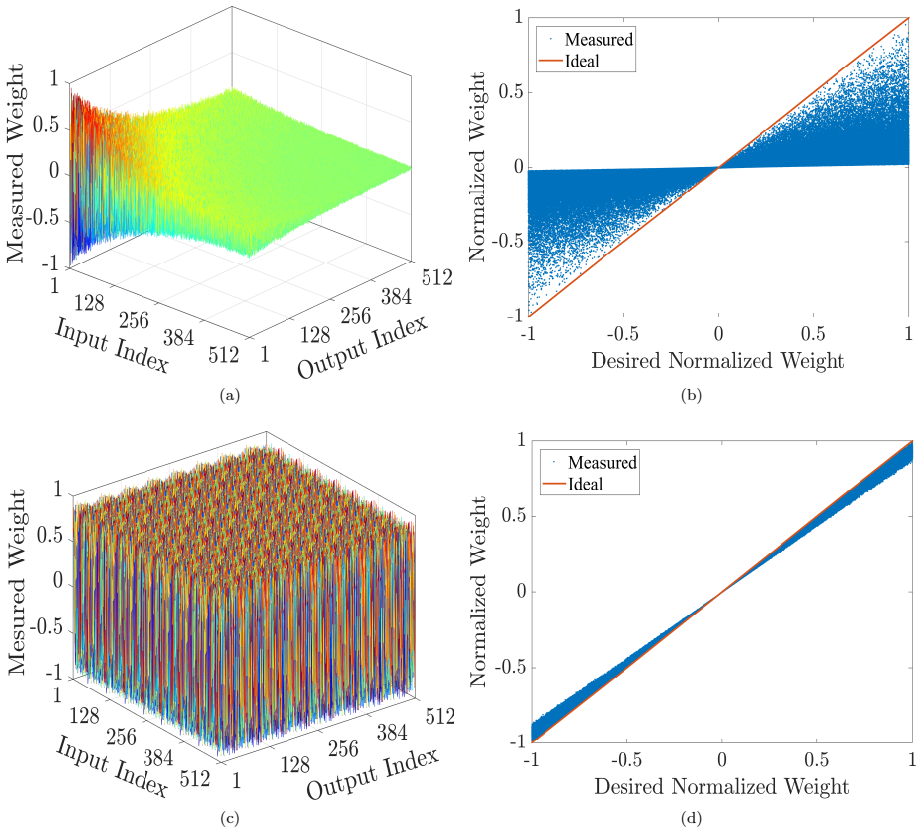
- [Sec. 3.3, around Fig. 4] The phrase 'the measured weights should be similar to the measured weights' should read 'similar to the desired weights.'
- [Sec. 5.2, modulation paragraph] The sentence beginning 'the weight update can consist in the two factors (epsilon_pre * S_j)), where M_i rho'(U_i)' is incomplete; it should express that the update is the product of (epsilon_pre * S_j) and M_i rho'(U_i).
Circularity Check
Pulse-count compensation is validated by the same fitted exponential model it inverts; the 'circuit behaves as required' claim reduces to construction.
-
self definitional
[Sec. 3.5.2, Eqs. (13)-(17), (23)-(24), Fig. 10]
"In [Fouda et al., 2019], we proposed a method to have the resistive devices behave exactly like the learning rule where the change in each weight must be proportional to the change in the RRAM’s conductance, ∆G∝ ∆w. ... By programming the RRAMs using the previous equations, the circuit behaves as required and compensates for the asymmetric nonlinearity of the devices."
Equations (23)-(24) are obtained by substituting the target update Δw into the inverse of Eq. (13), which is itself just the exponential model Eq. (8) fitted to one Mo/TiOx/TiN device (Tables 1-2). The only validation offered, Fig. 10, is a simulation 'Reproduced from [Fouda et al., 2019]' in which the same exponential model generates the conductance changes and the same inverse computes the pulse counts. The observed 'circuit behaves as required' is therefore a bookkeeping identity: any desired ΔG is realized by construction if the model and parameters are correct. It does not test the model against real devices, parameter estimation errors, or read noise; the paper itself reports 25% α variation and sneak paths that would break the inverse.
full rationale
The survey portions of the chapter are largely self-contained: the three-factor rule formalism in Sec. 4.1 is derived from gradient descent over spiking neuron models with citations to external and independent work (Pfister et al. 2006, Urbanczik and Senn 2014, Zenke and Ganguli 2017), and the learning-rule discussions (eRBP, SuperSpike, DECOLLE, EGHR) are presented with their own equations and benchmarks rather than being reduced to the chapter's inputs. No circularity appears there. The circularity is localized to Sec. 3.5.2: the pulse-count compensation is constructed by inverting the fitted exponential RRAM update model, and the only demonstration that the circuit 'behaves as required' (Fig. 10) is a simulation reproduced from the authors' own Fouda et al. 2019 that uses that same model to generate the conductance changes. Thus the compensation result is equivalent to the assumed model by construction; it cannot validate the model or the exact-realization claim independently. The paper itself identifies assumptions that would break the identity, including 25% α tolerance, device-to-device variability, and crossbar sneak paths, but does not quantify their effect on the claimed exact realization. This is a partial circularity in the validation of the central RRAM-specific design claim, not in the general learning-theoretic content. Therefore the score is 6 rather than higher: the learning-rule derivations retain independent content, while one load-bearing 'prediction' reduces to the fitted model by construction.
Assumptions & free parameters
free parameters (8)
- alpha_P (potentiation rate coefficient) =
30.58e-3, 18.23e-3, 19.19e-3 for Vp = 3V, 2.5V, 2V
- alpha_D (depression rate coefficient) =
353.4e-3, 35.29e-3, 20.55e-3 for Vp = -3V, -2.5V, -2V
- beta_P and beta_D (LTP/LTD scaling coefficients) =
beta_P: 626.8e-9, 220.22e-9, 71.7e-9; beta_D: 921.9e-9, 410.9e-9, 330.8e-9 (same voltage sets)
- Gmax and Gmin (conductance bounds) =
Gmax: 674, 252.7, 83.38 nS; Gmin: 32.95, 186.3, 340.5 nS
- Vp-interpolation functions for model coefficients =
e.g., alpha_P = 2.968 e^{1.823 Vp} - 30.4; alpha_D = 8.14e-6 e^{-5.48 Vp} + 20.5
- Variability tolerances for device variation simulation =
25% for alpha, 1% for Gmax, 5% for Gmin, lognormal beta
- ICA test bench settings =
mixture angle theta = pi/6, two Laplacian sources, 10^4 samples, scaling learning rate eta' (value not stated)
- Crossbar simulation parameters for sneak path =
wire resistance 0.1 ohm in Fig. 4; 92 ohm at 5nm node, 10 ohm/cell estimates in Sec. 3.3
assumptions (7)
- domain assumption Leaky Integrate-and-Fire dynamics (Eqs. 1-2) adequately model neuromorphic neurons.
- standard math Discrete-time LIF with step-function reset is equivalent to the continuous form.
- domain assumption RRAM conductance update follows an exponential model (Eq. 8) with constant coefficients per device and voltage.
- domain assumption Signed weights can be represented by conductance differences G = G+ - G- with bounds Gmin <= G <= Gmax and equal-pair mapping.
- domain assumption Three-factor rules derived via surrogate gradients approximate gradient descent over LIF dynamics.
- standard math EGHR converges to the ICA solution (weights proportional to A^{-1}).
- domain assumption Blank-out synapse stochasticity improves learning performance and is naturally available in memristive devices.
Cite this review
Pith. "Pith review of Spiking Neural Networks for Inference and Learning: A Memristor-based Design Perspective." pith.science (2026). https://pith.science/paper/LATT5EJV
@misc{pith2026190901771,
  author       = {Pith},
  title        = {Pith review of: Spiking Neural Networks for Inference and Learning: A Memristor-based Design Perspective},
  year         = {2026},
  howpublished = {\url{https://pith.science/paper/LATT5EJV}},
  note         = {Machine review of arXiv:1909.01771}
}
read the original abstract
On metrics of density and power efficiency, neuromorphic technologies have the potential to surpass mainstream computing technologies in tasks where real-time functionality, adaptability, and autonomy are essential. While algorithmic advances in neuromorphic computing are proceeding successfully, the potential of memristors to improve neuromorphic computing have not yet born fruit, primarily because they are often used as a drop-in replacement to conventional memory. However, interdisciplinary approaches anchored in machine learning theory suggest that multifactor plasticity rules matching neural and synaptic dynamics to the device capabilities can take better advantage of memristor dynamics and its stochasticity. Furthermore, such plasticity rules generally show much higher performance than that of classical Spike Time Dependent Plasticity (STDP) rules. This chapter reviews the recent development in learning with spiking neural network models and their possible implementation with memristor-based hardware.
Figures


Figures from the paper (8 more)


Reference graph
Works this paper leans on
-
[1]
Abbott and W.G
L.F. Abbott and W.G. Regehr. Synaptic computation. Nature, 431: 0 796--803, October 2004
2004
-
[2]
Naous, E
M Al-Shedivat, R. Naous, E. Neftci, G. Cauwenberghs, and K.N. Salama. Inherently stochastic spiking neurons for probabilistic neural computation. In IEEE EMBS Conference on Neural Engineering, Apr 2015
2015
-
[3]
Yodann: An ultra-low power convolutional neural network accelerator based on binary weights
Renzo Andri, Lukas Cavigelli, Davide Rossi, and Luca Benini. Yodann: An ultra-low power convolutional neural network accelerator based on binary weights. In 2016 IEEE Computer Society Annual Symposium on VLSI (ISVLSI), pages 236--241. IEEE, 2016
2016
-
[4]
Normad-normalized approximate descent based supervised learning rule for spiking neurons
Navin Anwani and Bipin Rajendran. Normad-normalized approximate descent based supervised learning rule for spiking neurons. In Neural Networks (IJCNN), 2015 International Joint Conference on, pages 1--8. IEEE, 2015
2015
-
[5]
Endurance/retention trade off in hfox and taox based rram
M Azzaz, E Vianello, B Sklenard, P Blaise, A Roule, C Sabbione, S Bernasconi, C Charpin, C Cagli, E Jalaguier, et al. Endurance/retention trade off in hfox and taox based rram. In 2016 IEEE 8th International Memory Workshop (IMW), pages 1--4. IEEE, 2016
2016
-
[6]
Bartolozzi and G
C. Bartolozzi and G. Indiveri. Silicon synaptic homeostasis. In Brain Inspired Cognitive Systems, BICS 2006 , pages 1--4, October 2006
2006
-
[7]
C. Bartolozzi and G. Indiveri. Synaptic dynamics in analog VLSI . Neural Computation, 19 0 (10): 0 2581--2603, Oct 2007. doi:10.1162/neco.2007.19.10.2581
-
[8]
Bartolozzi and G
C. Bartolozzi and G. Indiveri. A silicon synapse implements multiple neural computational primitives. The Neuromorphic Engineer, 2008
2008
Show all 96 references
-
[9]
Biologically inspired alternatives to backpropagation through time for learning in recurrent neural nets
Guillaume Bellec, Franz Scherr, Elias Hajek, Darjan Salaj, Robert Legenstein, and Wolfgang Maass. Biologically inspired alternatives to backpropagation through time for learning in recurrent neural nets. arXiv preprint arXiv:1901.09049, 2019
1901 arXiv
-
[10]
Neurogrid: A mixed-analog-digital multichip system for large-scale neural simulations
Ben Varkey Benjamin, Peiran Gao, Emmett McQuinn, Swadesh Choudhary, Anand R Chandrasekaran, J Bussat, Rodrigo Alvarez-Icaza, John V Arthur, PA Merolla, and Kwabena Boahen. Neurogrid: A mixed-analog-digital multichip system for large-scale neural simulations. Proceedings of the...
2014
-
[11]
Bi and M-M
G-Q. Bi and M-M. Poo. Synaptic modifications in cultured hippocampal neurons: Dependence on spike timing, synaptic strength, and postsynaptic cell type. J. Neurosci., 18 0 (24): 0 10464--10472, 1998
1998
-
[12]
Spikeprop: backpropagation for networks of spiking neurons
Sander M Bohte, Joost N Kok, and Johannes A La Poutr \'e . Spikeprop: backpropagation for networks of spiking neurons. In ESANN, pages 419--424, 2000
2000
-
[13]
The probability of neurotransmitter release: variability and feedback control at single synapses
Tiago Branco and Kevin Staras. The probability of neurotransmitter release: variability and feedback control at single synapses. Nature Reviews Neuroscience, 10 0 (5): 0 373--383, 2009
2009
-
[14]
Mitigating asymmetric nonlinear weight update effects in hardware neural network based on analog resistive synapse
Chih-Cheng Chang and et al. Mitigating asymmetric nonlinear weight update effects in hardware neural network based on analog resistive synapse. IEEE Journal on Emerging and Selected Topics in Circuits and Systems, 2017
2017
-
[15]
Physical mechanisms of endurance degradation in tmo-rram
B Chen, Y Lu, B Gao, YH Fu, FF Zhang, P Huang, YS Chen, LF Liu, XY Liu, JF Kang, et al. Physical mechanisms of endurance degradation in tmo-rram. In 2011 International Electron Devices Meeting, pages 12--3. IEEE, 2011
2011
-
[16]
Chicca, F
E. Chicca, F. Stefanini, and G. Indiveri. Neuromorphic electronic circuits for building autonomous cognitive systems. Proceedings of IEEE , 2013
2013
-
[17]
Low precision arithmetic for deep learning
Matthieu Courbariaux, Yoshua Bengio, and Jean-Pierre David. Low precision arithmetic for deep learning. arXiv preprint arXiv:1412.7024, 2014
2014 arXiv
-
[18]
Binarized neural networks: Training deep neural networks with weights and activations constrained to+ 1 or-1
Matthieu Courbariaux, Itay Hubara, Daniel Soudry, Ran El-Yaniv, and Yoshua Bengio. Binarized neural networks: Training deep neural networks with weights and activations constrained to+ 1 or-1. arXiv preprint arXiv:1602.02830, 2016
2016 arXiv
-
[19]
Davies, N
M. Davies, N. Srinivasa, T. H. Lin, G. Chinya, P. Joshi, A. Lines, A. Wild, and H. Wang. Loihi: A neuromorphic manycore processor with on-chip learning. IEEE Micro, PP 0 (99): 0 1--1, 2018. ISSN 0272-1732. doi:10.1109/MM.2018.112130359
2018
-
[20]
Contrastive hebbian learning with random feedback weights
Georgios Detorakis, Travis Bartley, and Emre Neftci. Contrastive hebbian learning with random feedback weights. Neural Networks, 2018 a . URL https://arxiv.org/abs/1806.07406. (accepted)
2018 arXiv
-
[21]
Pedroni, Nikil Dutt, Jeffrey Krichmar, Gert Cauwenberghs, and Emre Neftci
Georgios Detorakis, Sadique Sheik, Charles Augustine, Somnath Paul, Bruno U. Pedroni, Nikil Dutt, Jeffrey Krichmar, Gert Cauwenberghs, and Emre Neftci. Neural and synaptic array transceiver: A brain-inspired computing framework for embedded learning. Frontiers in Neuroscience,...
2018
-
[22]
Noise in the nervous system
A Aldo Faisal, Luc PJ Selen, and Daniel M Wolpert. Noise in the nervous system. Nature Reviews Neuroscience, 9 0 (4): 0 292--303, 2008
2008
-
[23]
M. E. Fouda , E. Neftci , A. Eltawil , and F. Kurdahi . Independent component analysis using rrams. IEEE Transactions on Nanotechnology, 18: 0 611--615, 2019. ISSN 1536-125X. doi:10.1109/TNANO.2018.2880734
2019
-
[24]
Modeling and analysis of passive switching crossbar arrays
Mohammed E Fouda, Ahmed M Eltawil, and Fadi Kurdahi. Modeling and analysis of passive switching crossbar arrays. IEEE Transactions on Circuits and Systems I: Regular Papers, 65 0 (1): 0 270--282, 2018 a
2018
-
[25]
Overcoming crossbar nonidealities in binary neural networks through learning
Mohammed E Fouda, Jongeun Lee, Ahmed M Eltawil, and Fadi Kurdahi. Overcoming crossbar nonidealities in binary neural networks through learning. In 2018 IEEE/ACM International Symposium on Nanoscale Architectures (NANOARCH), pages 1--3. IEEE, 2018 b
2018
-
[26]
On resistive memories: One step row readout technique and sensing circuitry
Mohammed E Fouda, Ahmed M Eltawil, and Fadi Kurdahi. On resistive memories: One step row readout technique and sensing circuitry. arXiv preprint arXiv:1903.01512, 2019
1903 arXiv
-
[27]
The spinnaker project
Steve B Furber, Francesco Galluppi, Sally Temple, Luis Plana, et al. The spinnaker project. Proceedings of the IEEE, 102 0 (5): 0 652--665, 2014
2014
-
[28]
Gerstner and W
W. Gerstner and W. Kistler. Spiking Neuron Models. Single Neurons, Populations, Plasticity. Cambridge University Press, 2002
2002
-
[29]
Neuronal dynamics: From single neurons to networks and models of cognition
Wulfram Gerstner, Werner M Kistler, Richard Naud, and Liam Paninski. Neuronal dynamics: From single neurons to networks and models of cognition. Cambridge University Press, 2014
2014
-
[30]
Goldberg, G
D.H. Goldberg, G. Cauwenberghs, and A.G. Andreou. Probabilistic synaptic weighting in a reconfigurable network of VLSI integrate-and-fire neurons. Neural Networks, 14 0 (6--7): 0 781--793, Sep 2001
2001
-
[31]
G \"u tig and H
R. G \"u tig and H. Sompolinsky. The tempotron: a neuron that learns spike timing--based decisions. Nature Neuroscience, 9: 0 420--428, 2006. doi:10.1038/nn1643
2006 doi
-
[32]
Training products of experts by minimizing contrastive divergence
Geoffrey E Hinton. Training products of experts by minimizing contrastive divergence. Neural computation, 14 0 (8): 0 1771--1800, 2002
2002
-
[33]
Hopfield
J.J. Hopfield. Neural networks and physical systems with emergent collective computational abilities. Proceedings of the national academy of sciences, 79 0 (8): 0 2554--2558, 1982
1982
-
[34]
Maldonado Huayaney, Stephen Nease, and Elisabetta Chicca
Frank L. Maldonado Huayaney, Stephen Nease, and Elisabetta Chicca. Learning in silicon beyond STDP : A neuromorphic implementation of multi-factor synaptic plasticity with calcium-based dynamics. IEEE Transactions on Circuits and Systems I: Regular Papers , 63 0 (12): 0 2189--...
2016
-
[35]
Gradient descent for spiking neural networks
Dongsung Huh and Terrence J Sejnowski. Gradient descent for spiking neural networks. arXiv preprint arXiv:1706.04698, 2017
2017 arXiv
-
[36]
Hyv \"a rinen
Aapo et al. Hyv \"a rinen. Independent component analysis, volume 46. John Wiley & Sons, 2004
2004
-
[37]
Brain-inspired computing with resistive switching memory (rram): Devices, synapses and neural networks
Daniele Ielmini. Brain-inspired computing with resistive switching memory (rram): Devices, synapses and neural networks. Microelectronic Engineering, 190: 0 44--53, 2018
2018
-
[38]
Indiveri, B
G. Indiveri, B. Linares-Barranco, T.J. Hamilton, A. van Schaik, R. Etienne-Cummings, T. Delbruck, S.-C. Liu, P. Dudek, P. H \"a fliger, S. Renaud, J. Schemmel, G. Cauwenberghs, J. Arthur, K. Hynna, F. Folowosele, S. Saighi, T. Serrano-Gotarredona, J. Wijekoon, Y. Wang, and K. ...
2011 arXiv
-
[39]
A local learning rule for independent component analysis
Takuya Isomura and Taro Toyoizumi. A local learning rule for independent component analysis. Scientific reports, 6: 0 28073, 2016
2016
-
[40]
Decoupled neural interfaces using synthetic gradients
Max Jaderberg, Wojciech Marian Czarnecki, Simon Osindero, Oriol Vinyals, Alex Graves, and Koray Kavukcuoglu. Decoupled neural interfaces using synthetic gradients. arXiv preprint arXiv:1608.05343, 2016
2016 arXiv
-
[41]
Rx-caffe: Framework for evaluating and training deep neural networks on resistive crossbars
Shubham Jain, Abhronil Sengupta, Kaushik Roy, and Anand Raghunathan. Rx-caffe: Framework for evaluating and training deep neural networks on resistive crossbars. arXiv preprint arXiv:1809.00072, 2018
2018 arXiv
-
[42]
Predicting spike timing of neocortical pyramidal neurons by simple threshold models
Renaud Jolivet, Alexander Rauch, Hans-Rudolf L \"u scher, and Wulfram Gerstner. Predicting spike timing of neocortical pyramidal neurons by simple threshold models. Journal of computational neuroscience, 21 0 (1): 0 35--49, 2006
2006
-
[43]
Kaiser, H
J. Kaiser, H. Mostafa, and E. Neftci. Synaptic plasticity for deep continuous local learning. arXiv preprint arXiv:1812.10766, 2018
2018 arXiv
-
[44]
Network plasticity as bayesian inference
David Kappel, Stefan Habenschuss, Robert Legenstein, and Wolfgang Maass. Network plasticity as bayesian inference. arXiv preprint arXiv:1504.05143, 2015
2015 arXiv
-
[45]
B. Katz. Nerve, muscle, and synapse. McGraw-Hill New York, 1966
1966
-
[46]
Deep neural network optimized to resistive memory with nonlinear current-voltage characteristics
Hyungjun Kim, Taesu Kim, Jinseok Kim, and Jae-Joon Kim. Deep neural network optimized to resistive memory with nonlinear current-voltage characteristics. ACM Journal on Emerging Technologies in Computing Systems (JETC), 14 0 (2): 0 15, 2018
2018
-
[47]
A memory frontier for complex synapses
Subhaneil Lahiri and Surya Ganguli. A memory frontier for complex synapses. In C.J.C. Burges, L. Bottou, M. Welling, Z. Ghahramani, and K.Q. Weinberger, editors, Advances in Neural Information Processing Systems 26, pages 1034--1042. 2013
2013
-
[48]
Energy-efficient neuronal computation via quantal synaptic failures
William B Levy and Robert A Baxter. Energy-efficient neuronal computation via quantal synaptic failures. The Journal of Neuroscience, 22 0 (11): 0 4746--4755, 2002
2002
-
[49]
Efficient and self-adaptive in-situ learning in multilayer memristor neural networks
Can Li and et al. Efficient and self-adaptive in-situ learning in multilayer memristor neural networks. Nature Communications, page 2385, 2018
2018
-
[50]
Random synaptic feedback weights support error backpropagation for deep learning
Timothy P Lillicrap, Daniel Cownden, Douglas B Tweed, and Colin J Akerman. Random synaptic feedback weights support error backpropagation for deep learning. Nature Communications, 7, 2016
2016
-
[51]
Maass, T
W. Maass, T. Natschl \"a ger, and H. Markram. Real-time computing without stable states: A new framework for neural computation based on perturbations. Neural Computation, 14 0 (11): 0 2531--2560, 2002
2002
-
[52]
C. Mead. Neuromorphic electronic systems. Proceedings of the IEEE , 78 0 (10): 0 1629--36, 1990
1990
-
[53]
A million spiking-neuron integrated circuit with a scalable communication network and interface
Paul A Merolla, John V Arthur, Rodrigo Alvarez-Icaza, Andrew S Cassidy, Jun Sawada, Filipp Akopyan, Bryan L Jackson, Nabil Imam, Chen Guo, Yutaka Nakamura, et al. A million spiking-neuron integrated circuit with a scalable communication network and interface. Science, 345 0 (6...
2014
-
[54]
Mitra, S
S. Mitra, S. Fusi, and G. Indiveri. A VLSI spike-driven dynamic synapse which learns only when necessary. In International Symposium on Circuits and Systems, ( ISCAS ), 2006 , pages 2777--2780. IEEE, May 2006. doi:10.1109/ISCAS.2006.1693200
2006 arXiv
-
[55]
Moreno-Bote
R. Moreno-Bote. Poisson-like spiking in circuits with probabilistic synapses. PLoS computational biology, 10 0 (7): 0 e1003522, 2014
2014
-
[56]
Deep supervised learning using local errors
Hesham Mostafa, Vishwajith Ramesh, and Gert Cauwenberghs. Deep supervised learning using local errors. arXiv preprint arXiv:1711.06756, 2017
2017 arXiv
-
[57]
Understanding rram endurance, retention and window margin trade-off using experimental results and simulations
C Nail, G Molas, P Blaise, G Piccolboni, B Sklenard, C Cagli, M Bernard, A Roule, M Azzaz, E Vianello, et al. Understanding rram endurance, retention and window margin trade-off using experimental results and simulations. In 2016 IEEE International Electron Devices Meeting (IE...
2016
-
[58]
Memristor-based neural networks: Synaptic versus neuronal stochasticity
Rawan Naous, Maruan AlShedivat, Emre Neftci, Gert Cauwenberghs, and Khaled Nabil Salama. Memristor-based neural networks: Synaptic versus neuronal stochasticity. Aip Advances, 6 0 (11): 0 111304, 2016
2016
-
[59]
Stochastic synapses as resource for efficient deep learning machines
Emre Neftci. Stochastic synapses as resource for efficient deep learning machines. In Electron Devices Meeting (IEDM), 2017 IEEE International, pages 11--1. IEEE, 2017
2017
-
[60]
Event-driven random back-propagation: Enabling neuromorphic deep learning machines
Emre Neftci, Charles Augustine, Somnath Paul, and Georgios Detorakis. Event-driven random back-propagation: Enabling neuromorphic deep learning machines. In 2017 IEEE International Symposium on Circuits and Systems, May 2017 a
2017
-
[61]
Emre O. Neftci. Data and power efficient intelligence with neuromorphic learning machines. iScience, 5: 0 52--68, 2018. ISSN 2589-0042. doi:https://doi.org/10.1016/j.isci.2018.06.010. URL http://www.sciencedirect.com/science/article/pii/S2589004218300865
2018 doi
-
[62]
Stochastic synapses enable efficient brain-inspired learning machines
Emre O Neftci, Bruno Umbria Pedroni, Siddharth Joshi, Maruan Al-Shedivat, and Gert Cauwenberghs. Stochastic synapses enable efficient brain-inspired learning machines. Frontiers in Neuroscience, 10 0 (241), 2016. ISSN 1662-453X. doi:10.3389/fnins.2016.00241
2016
-
[63]
Neftci, Charles Augustine, Somnath Paul, and Georgios Detorakis
Emre O. Neftci, Charles Augustine, Somnath Paul, and Georgios Detorakis. Event-driven random back-propagation: Enabling neuromorphic deep learning machines. Frontiers in Neuroscience, 11: 0 324, 2017 b . ISSN 1662-453X. doi:10.3389/fnins.2017.00324
2017
-
[64]
Surrogate gradient learning in spiking neural networks
Emre O Neftci, Hesham Mostafa, and Friedemann Zenke. Surrogate gradient learning in spiking neural networks. arXiv preprint arXiv:1901.09948, 2019
1901 arXiv
-
[65]
Gabaergic circuits control spike-timing-dependent plasticity
Vincent Paille, Elodie Fino, Kai Du, Teresa Morera-Herreras, Sylvie Perez, Jeanette Hellgren Kotaleski, and Laurent Venance. Gabaergic circuits control spike-timing-dependent plasticity. Journal of Neuroscience, 33 0 (22): 0 9353--9363, 2013. ISSN 0270-6474. doi:10.1523/JNEURO...
2013 doi
-
[66]
J. Park, S. Ha, T. Yu, E. Neftci, and G. Cauwenberghs. A 65k-neuron 73-mevents/s 22-pj/event asynchronous micro-pipelined integrate-and-fire array transceiver. In Biomedical Circuits and Systems Conference ( BioCAS ) . IEEE, Oct. 2014
2014
-
[67]
Tio x-based rram synapse with 64-levels of conductance and symmetric conductance change by adopting a hybrid pulse scheme for neuromorphic computing
Jaesung Park and et al. Tio x-based rram synapse with 64-levels of conductance and symmetric conductance change by adopting a hybrid pulse scheme for neuromorphic computing. IEEE Electron Device Letters, 37 0 (12): 0 1559--1562, 2016
2016
-
[68]
Optimal spike-timing-dependent plasticity for precise action potential firing in supervised learning
Jean-Pascal Pfister, Taro Toyoizumi, David Barber, and Wulfram Gerstner. Optimal spike-timing-dependent plasticity for precise action potential firing in supervised learning. Neural computation, 18 0 (6): 0 1318--1348, 2006
2006
-
[69]
Training and operation of an integrated neuromorphic network based on metal-oxide memristors
Mirko Prezioso and et al. Training and operation of an integrated neuromorphic network based on metal-oxide memristors. Nature, 521 0 (7550): 0 61, 2015
2015
-
[70]
Training and operation of an integrated neuromorphic network based on metal-oxide memristors
Mirko Prezioso, Farnood Merrikh-Bayat, BD Hoskins, GC Adam, Konstantin K Likharev, and Dmitri B Strukov. Training and operation of an integrated neuromorphic network based on metal-oxide memristors. Nature, 521 0 (7550): 0 61--64, 2015
2015
-
[71]
A novel program-verify algorithm for multi-bit operation in hfo 2 rram
Francesco Maria Puglisi, C Wenger, and Paolo Pavan. A novel program-verify algorithm for multi-bit operation in hfo 2 rram. IEEE Electron Device Letters, 36 0 (10): 0 1030--1032, 2015
2015
-
[72]
A reconfigurable on-line learning spiking neuromorphic processor comprising 256 neurons and 128k synapses
Ning Qiao, Hesham Mostafa, Federico Corradi, Marc Osswald, Fabio Stefanini, Dora Sumislawska, and Giacomo Indiveri. A reconfigurable on-line learning spiking neuromorphic processor comprising 256 neurons and 128k synapses. Frontiers in neuroscience, 9, 2015
2015
-
[73]
Bioinspired programming of memory devices for implementing an inference engine
Damien Querlioz, Olivier Bichler, Adrien Francis Vincent, and Christian Gamrat. Bioinspired programming of memory devices for implementing an inference engine. Proceedings of the IEEE, 103 0 (8): 0 1398--1416, 2015
2015
-
[74]
Xnor-net: Imagenet classification using binary convolutional neural networks
Mohammad Rastegari, Vicente Ordonez, Joseph Redmon, and Ali Farhadi. Xnor-net: Imagenet classification using binary convolutional neural networks. In European Conference on Computer Vision, pages 525--542. Springer, 2016
2016
-
[75]
ghi, Christian G Mayr, Teresa Serrano-Gotarredona, Heidemarie Schmidt, Gwendal Lecerf, Jean Tomas, Julie Grollier, S \
Sylvain Sa \" ghi, Christian G Mayr, Teresa Serrano-Gotarredona, Heidemarie Schmidt, Gwendal Lecerf, Jean Tomas, Julie Grollier, S \"o ren Boyn, Adrien F Vincent, Damien Querlioz, et al. Plasticity in memristive devices for spiking neural networks. Frontiers in neuroscience, 9...
2015
-
[76]
Independent component analysis in spiking neurons
Cristina Savin, Prashant Joshi, and Jochen Triesch. Independent component analysis in spiking neurons. PLoS computational biology, 6 0 (4): 0 e1000757, 2010
2010
-
[77]
Schemmel, J
J. Schemmel, J. Fieres, and K. Meier. Wafer-scale integration of analog neural networks. In Proceedings of the IEEE International Joint Conference on Neural Networks , 2008
2008
-
[78]
u derle, A. Gr\
J. Schemmel, D. Br\" u derle, A. Gr\" u bl, M. Hock, K. Meier, and S. Millner. A wafer-scale neuromorphic hardware system for large-scale neural modeling. In International Symposium on Circuits and Systems, ISCAS 2010 , pages 1947--1950. IEEE, 2010
2010
-
[79]
Getting formal with dopamine and reward
Wolfram Schultz. Getting formal with dopamine and reward. Neuron, 36 0 (2): 0 241--263, 2002
2002
-
[80]
Spike timing dependent plasticity: a consequence of more fundamental learning rules
Harel Z Shouval, Samuel S-H Wang, and Gayle M Wittenberg. Spike timing dependent plasticity: a consequence of more fundamental learning rules. Frontiers in Computational Neuroscience, 4: 0 19, 2010
2010
-
[81]
Slayer: Spike layer error reassignment in time
Sumit Bam Shrestha and Garrick Orchard. Slayer: Spike layer error reassignment in time. arXiv preprint arXiv:1810.08646, 2018
2018 arXiv
-
[82]
Fully parallel rram synaptic array for implementing binary neural network with (+ 1,- 1) weights and (+ 1, 0) neurons
Xiaoyu Sun, Xiaochen Peng, Pai-Yu Chen, Rui Liu, Jae-sun Seo, and Shimeng Yu. Fully parallel rram synaptic array for implementing binary neural network with (+ 1,- 1) weights and (+ 1, 0) neurons. In Design Automation Conference (ASP-DAC), 2018 23rd Asia and South Pacific, pag...
2018
-
[83]
Finn: A framework for fast, scalable binarized neural network inference
Yaman Umuroglu, Nicholas J Fraser, Giulio Gambardella, Michaela Blott, Philip Leong, Magnus Jahre, and Kees Vissers. Finn: A framework for fast, scalable binarized neural network inference. In Proceedings of the 2017 ACM/SIGDA International Symposium on Field-Programmable Gate...
2017
-
[84]
Learning by the dendritic prediction of somatic spiking
Robert Urbanczik and Walter Senn. Learning by the dendritic prediction of somatic spiking. Neuron, 81 0 (3): 0 521--528, 2014
2014
-
[85]
Regularization of neural networks using dropconnect
Li Wan, Matthew Zeiler, Sixin Zhang, Yann L Cun, and Rob Fergus. Regularization of neural networks using dropconnect. In Proceedings of the 30th International Conference on Machine Learning (ICML-13), pages 1058--1066, 2013
2013
-
[86]
Fully memristive neural networks for pattern classification with unsupervised learning
Zhongrui Wang, Saumil Joshi, Sergey Savelev, Wenhao Song, Rivu Midya, Yunning Li, Mingyi Rao, Peng Yan, Shiva Asapu, Ye Zhuo, et al. Fully memristive neural networks for pattern classification with unsupervised learning. Nature Electronics, 1 0 (2): 0 137, 2018
2018
-
[87]
A learning algorithm for continually running fully recurrent neural networks
Ronald J Williams and David Zipser. A learning algorithm for continually running fully recurrent neural networks. Neural computation, 1 0 (2): 0 270--280, 1989
1989
-
[88]
International technology roadmap for semiconductors
Linda Wilson. International technology roadmap for semiconductors. Semiconductor Industry Association, 2013
2013
-
[89]
Resistive memory-based analog synapse: The pursuit for linear and symmetric weight update
Jiyong Woo and Shimeng Yu. Resistive memory-based analog synapse: The pursuit for linear and symmetric weight update. IEEE Nanotechnology Magazine, 12 0 (3): 0 36--44, 2018
2018
-
[90]
Equivalence of backpropagation and contrastive hebbian learning in a layered network
Xiaohui Xie and H Sebastian Seung. Equivalence of backpropagation and contrastive hebbian learning in a layered network. Neural computation, 15 0 (2): 0 441--454, 2003
2003
-
[91]
Voltage fluctuations in neurons: signal or noise? Physiological Reviews, 91 0 (3): 0 917--929, 2011
Yosef Yarom and Jorn Hounsgaard. Voltage fluctuations in neurons: signal or noise? Physiological Reviews, 91 0 (3): 0 917--929, 2011
2011
-
[92]
Neuro-inspired computing with emerging nonvolatile memorys
Shimeng Yu. Neuro-inspired computing with emerging nonvolatile memorys. Proceedings of the IEEE, 106 0 (2): 0 260--285, 2018
2018
-
[93]
Stochastic learning in oxide binary synaptic device for neuromorphic computing
Shimeng Yu, Bin Gao, Zheng Fang, Hongyu Yu, Jinfeng Kang, and H-S Philip Wong. Stochastic learning in oxide binary synaptic device for neuromorphic computing. Frontiers in neuroscience, 7, 2013
2013
-
[94]
Fast and efficient asynchronous neural computation with adapting spiking neural networks
Davide Zambrano and Sander M Bohte. Fast and efficient asynchronous neural computation with adapting spiking neural networks. arXiv preprint arXiv:1609.02053, 2016
2016 arXiv
-
[95]
Superspike: Supervised learning in multi-layer spiking neural networks
Friedemann Zenke and Surya Ganguli. Superspike: Supervised learning in multi-layer spiking neural networks. arXiv preprint arXiv:1705.11146, 2017
2017 arXiv
-
[96]
Characterizing endurance degradation of incremental switching in analog rram for neuromorphic systems
Meiran Zhao, Huaqiang Wu, Bin Gao, Xiaoyu Sun, Yuyi Liu, Peng Yao, Yue Xi, Xinyi Li, Qingtian Zhang, Kanwen Wang, et al. Characterizing endurance degradation of incremental switching in analog rram for neuromorphic systems. In 2018 IEEE International Electron Devices Meeting (...
2018
Reviewed August 14, 2026 · model on record in the stance chip above.
Discussion (0). Continue with ORCID to comment.