REVIEW 3 major objections 4 minor 1 cited by
Learning to Double Guess: An Active Perception Approach for Estimating the Center of Mass of Arbitrary Objects
T0 review · 3 major / 4 minor · reviewed 2026-08-09 · deepseek-v4-flash
Pith's one-line read A robot can estimate an unseen object's center of mass by taking two force-torque measurements, with the second orientation picked by a learned uncertainty-guided scorer, reaching 1.47 cm average error after training on just two objects.
desk verdict Useful active-perception CoM paper with real experiments, but the fusion step in Sec III-D has a frame-consistency ambiguity that needs fixing, and the abstract overclaims relative to the limitations. read the letter →
The pith
A machine-rendered reading of the paper's core claim, the machinery that carries it, and where it could break.
The reading
What carries the argument
The framework's two load-bearing components are a Bayesian Neural Network (BNN) trained with Markov Chain Monte Carlo using the No-U-Turn Sampler, and ActiveNet, a 5-layer MLP that scores candidate second orientations. The BNN gives each prediction a mean and standard deviation, which is the uncertainty that drives action selection. ActiveNet takes the first estimate's mean and standard deviation plus a candidate second rotation, and predicts the error of the next measurement; a grid search over the continuous 2D orientation space chooses the minimum-score rotation. The final estimate is the inverse-variance-weighted mean of the two Gaussian estimates from the two orientations, treating them as independent measurements.
What would settle it
Collect a test set of objects spanning weights from 50 g to 800 g, including low-friction surfaces and shapes unlike the training plate and box, and run both U-GRAPH and the Random Rotate baseline on each. If U-GRAPH does not beat Random Rotate on the z-axis for a majority of objects, or if its average error on objects outside the 127–585 g training range exceeds 3 cm, the zero-shot generalization and uncertainty-guided action-selection claims would be contradicted.
Extended reading notes
Core claim
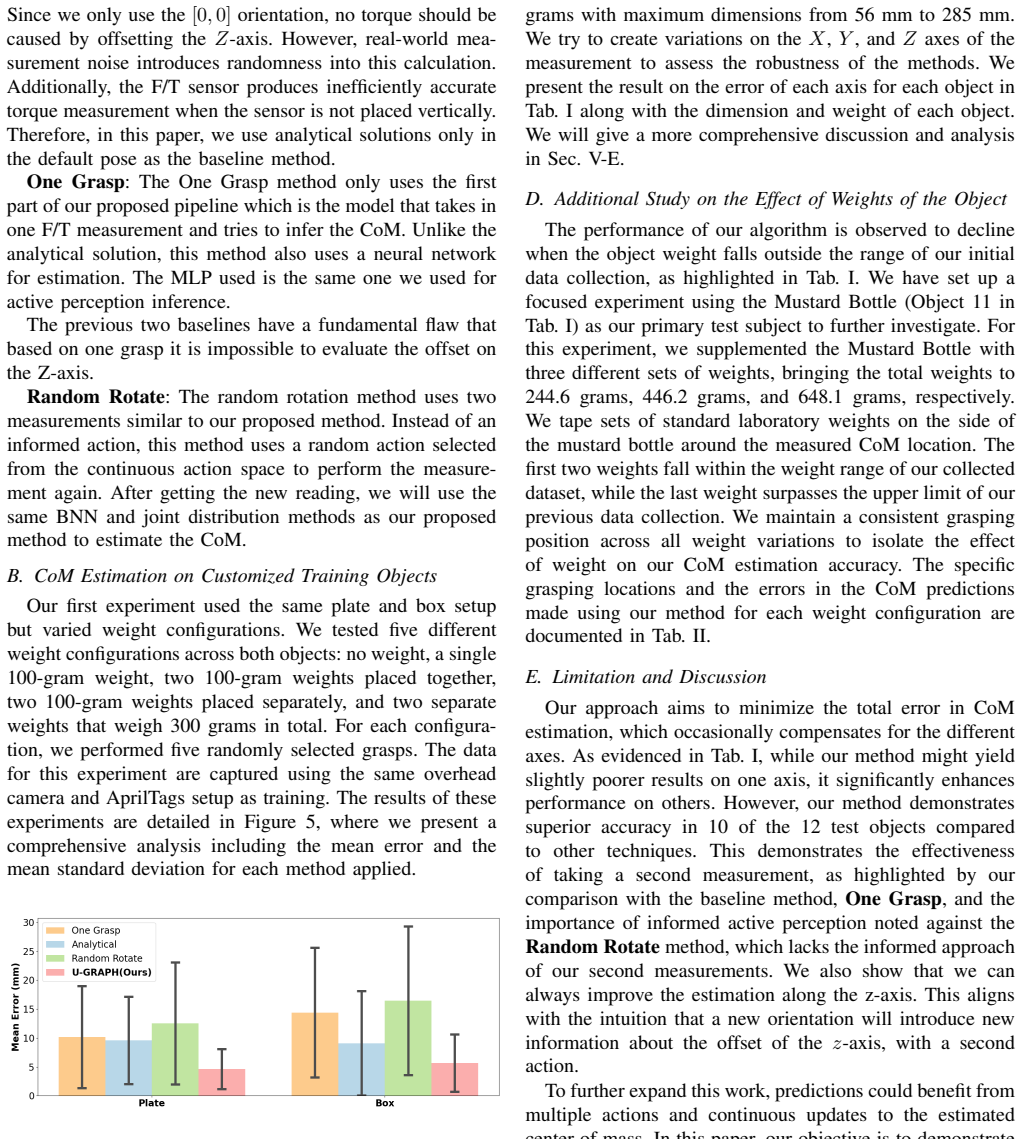
The core discovery is that a mapping from 6-axis force-torque readings and grasp orientation to the 3D center-of-mass offset can be learned on a tiny dataset with limited variation and still transfer to arbitrary rigid objects in zero-shot fashion. The model outputs a Gaussian predictive distribution, so the robot knows not only where the center of mass is but how sure it is. That uncertainty is then used to choose a second rotation angle that promises the largest information gain, and the two Gaussian estimates are combined into a posterior. Against one-measurement baselines, the second measurement is what makes z-axis estimation possible, and against a random second rotation, the uncertainty-guided choice consistently yields lower error in the paper's experiments.
Load-bearing premise
The mapping between force-torque readings and center-of-mass offsets is learned only from two custom plastic objects with laboratory weights in a narrow range, and the generalization claim assumes that this mapping transfers to arbitrary real-world objects despite differences in geometry, friction, density, and weight.
Editorial extensions
If this is right
- A single vertical grasp cannot determine the center-of-mass offset along the gravity axis; taking a second, uncertainty-guided rotation always improves the z-axis estimate in the paper's experiments.
- Objects whose weights lie inside the training range (127–585 g) are estimated with a few millimeters of error; objects outside that range show noticeably larger errors, so the learned mapping is weight-sensitive.
- The trained model transfers to objects with different contact geometry, surface friction, and density, suggesting that the force-torque-to-CoM mapping captures something general about statics rather than memorizing the training shapes.
- The two-measurement approach replaces repeated re-grasping with an in-hand rotation, which is faster and safer for delicate objects.
- Extending the pipeline to more than two actions, with recursive posterior updates, is the paper's own stated next step and would likely improve accuracy further.
Reading between the lines
- The success of uncertainty-guided action selection suggests that an ensemble of deterministic networks, which also provides predictive variance, might achieve similar gains at lower training cost; the paper's BNN provides a natural baseline for that comparison.
- The inverse-variance fusion treats the two measurements as independent Gaussians, but the second measurement is physically correlated with the first through the shared object; modelling that correlation could improve the posterior and further reduce error.
- Because the reported 1.47 cm is an average, its practical value depends on the error distribution; the paper's own data show larger errors on out-of-distribution weights, so deployment should include a weight check or an adapted training set.
- The same active-perception loop could be applied to other physical parameters that are observable only through contact, such as friction or compliance, whenever a model can output uncertainty.
Signed reviews
Editorial analysis
A structured set of objections, weighed in public.
Referee Report
Summary. This paper presents U-GRAPH, a two-measurement active perception system for estimating the 3D center of mass of grasped objects. A Bayesian neural network (BNN) maps a 6D force-torque reading and a 2D gripper orientation to a CoM offset and an uncertainty estimate; an ActiveNet, queried by grid search, scores candidate second orientations using the BNN's first-prediction mean and variance, and the system rotates to the best-scoring orientation, takes a second F/T reading, and fuses the two BNN predictions via inverse-variance weighting. The BNN is trained only on two 3D-printed objects with attached laboratory weights, yet the authors report an average error of 1.47 cm (7.6%) on 12 unseen real-world objects and claim zero-shot generalization, with U-GRAPH outperforming one-grasp, analytical, and random-rotation baselines on most objects.
Significance. If validated, this work addresses a genuine and under-explored problem: estimating the 3D CoM of arbitrary rigid objects from haptic interaction, which is useful for stable grasping and manipulation. The use of a Bayesian neural network to produce predictive uncertainty and the formulation of the second rotation as an information-gathering action are reasonable and testable. The evaluation on 12 real objects with independently measured CoM locations, including out-of-distribution weights, is a strength, and the reported OOD degradation in Table II and Sec. V-E is honest. The posterior-combination step is not circular, since the BNN is trained with ground-truth labels and evaluated on unseen objects. However, the frame convention for the fused estimates and the lack of variance reporting prevent me from accepting the quantitative claims as stated.
major comments (3)
- [Sec. III-A, Sec. III-D (Eq. 1)] The fusion in Eq. (1) assumes mu_1 and mu_2 are estimates of the same vector. Section III-A defines dx, dy, dz as world-frame displacements from the grasping point, and the paper does not state that the BNN output for a rotated pose is transformed back to the initial grasp frame before fusion. If the outputs are world-frame, after a gripper rotation R(theta) the physical CoM offset in the world frame is R(theta)*r, not r, and averaging mu_1 and mu_2 without rotating mu_2 back introduces a bias of order (R(theta)-I)*r/2, which can be several centimeters for the large angles used to make the z-offset observable. If the intended convention is that the BNN always outputs the CoM in the initial grasp frame (which the data-collection procedure in Sec. IV-B makes plausible, since labels are computed before rotation), this must be stated explicitly and the training labels must be confirmed to use that convention. As written, the ambiguity is load-bearing for the headline 1.47 cm result and for the comparison with Random Rotate; please state the convention, or apply an explicit rotation correction, and report the results under both conventions.
- [Sec. V-C, Table I] Table I reports only per-axis mean errors over five grasps, with no variance or per-grasp breakdown, and the aggregate 1.47 cm / 7.6% accuracy quoted in the abstract is not reproducible from the table. Without error bars or standard errors, the claim that U-GRAPH outperforms Random Rotate cannot be assessed statistically; several entries differ by only a few millimeters. Please report per-grasp 3D errors, standard deviations or confidence intervals, and define the denominator used for the 7.6% figure.
- [Sec. V-A] The analytical baseline formula is written as r = tau × F / |F|^2. The correct inversion of tau = r × F is r = (F × tau) / |F|^2; as written, the formula has the cross-product order reversed. If the implemented baseline used the printed formula, its errors are not meaningful; if it used the correct formula, the text should be corrected. Either way, the baseline comparison needs to be based on the correct formula.
minor comments (4)
- [Sec. I] In the Introduction, 'This work provides a framework for perceiving the CoM of an arbitrary object. object.' contains a duplicated word; please fix the typo.
- [Sec. III-A] The citation 'as illustrated in Fig. III-A' should refer to the actual figure number (Fig. 2).
- [Sec. III-D] Equation (1) is typeset awkwardly (the fraction is inline and difficult to read); consider displaying it with standard fraction formatting.
- [Sec. V-E] The claim of generalization to 'arbitrary rigid object[s]' in the abstract is stronger than the evidence: Table II and the OOD rows of Table I show clear degradation outside the training weight range (43.4 g, 76.8 g, 613.2 g). Please qualify the phrasing, e.g., 'objects within the approximate weight range of the training data'.
Circularity Check
No significant circularity: the CoM estimates and the active-rotation improvement are evaluated against external ground truth on held-out objects.
full rationale
The paper's central chain is empirical rather than definitional. The BNN is trained on F/T readings and orientation inputs with CoM labels computed from AprilTag detections on two custom objects; the test claims are evaluated on 12 unseen real-world objects whose ground-truth CoM is obtained by independent balancing, so the reported errors are not re-derivations of training labels. The ActiveNet is trained to predict the BNN's own error at candidate second orientations, but at inference it only selects an orientation; the final CoM estimate comes from the BNN posterior fusion in Eq. (1) and does not use the ActiveNet score or any ground-truth information. The comparison against Random Rotate is therefore a meaningful empirical test. The posterior Gaussian fusion is a standard combination of two independently noisy estimates. The paper's self-citations (e.g., [2], [3], [4], [6], [11], [22], [30]) appear only in related-work or future-work contexts and are not load-bearing for the central derivation. The potential world-frame versus gripper-frame inconsistency in Eq. (1) that the skeptic note raises is a correctness concern about coordinate transforms, not a circularity: it does not make the output equal to an input by construction. Hence no circular step is present.
Assumptions & free parameters
free parameters (3)
- BNN weights =
not disclosed
- ActiveNet weights =
not disclosed
- BNN initialization std =
0.5
assumptions (4)
- domain assumption The CoM of any grasped object is determined by a fixed offset (dx, dy, dz) and gravitational force, and the F/T reading at a given orientation is a noisy function of these.
- domain assumption Two measurements from different orientations are independent and Gaussian, so the posterior combination formula in Sec III-D is valid.
- domain assumption The BNN trained on two custom objects transfers to arbitrary rigid objects despite differences in geometry, friction, and density.
- domain assumption The AprilTag-based ground truth (training) and the balancing method (test) provide accurate CoM measurements.
Cite this review
Pith. "Pith review of Learning to Double Guess: An Active Perception Approach for Estimating the Center of Mass of Arbitrary Objects." pith.science (2026). https://pith.science/paper/LDRORW2H
@misc{pith2026250202663,
  author       = {Pith},
  title        = {Pith review of: Learning to Double Guess: An Active Perception Approach for Estimating the Center of Mass of Arbitrary Objects},
  year         = {2026},
  howpublished = {\url{https://pith.science/paper/LDRORW2H}},
  note         = {Machine review of arXiv:2502.02663}
}
read the original abstract
Manipulating arbitrary objects in unstructured environments is a significant challenge in robotics, primarily due to difficulties in determining an object's center of mass. This paper introduces U-GRAPH: Uncertainty-Guided Rotational Active Perception with Haptics, a novel framework to enhance the center of mass estimation using active perception. Traditional methods often rely on single interaction and are limited by the inherent inaccuracies of Force-Torque (F/T) sensors. Our approach circumvents these limitations by integrating a Bayesian Neural Network (BNN) to quantify uncertainty and guide the robotic system through multiple, information-rich interactions via grid search and a neural network that scores each action. We demonstrate the remarkable generalizability and transferability of our method with training on a small dataset with limited variation yet still perform well on unseen complex real-world objects.
Figures


Figures from the paper (2 more)

Forward citations
Cited by 1 Pith paper
-
Rapid Mismatch Estimation via Neural Network Informed Variational Inference
RME estimates end-effector mass and center-of-mass mismatches online in about 400 ms using proprioceptive feedback and a neural-network-guided variational inference.
Reference graph
Works this paper leans on
-
[1]
Kosmos-e : Learning to follow instruction for robotic grasping,
Z. Wang, X. Wu, S. Huang, L. Dong, W. Wang, S. Ma, and F. Wei, “Kosmos-e : Learning to follow instruction for robotic grasping,” in 2024 IEEE/RSJ International Conference on Intelligent Robots and Systems (IROS), 2024, pp. 9510–9517
work page 2024
-
[2]
Towards open-world interactive disambiguation for robotic grasping,
Y . Mo, H. Zhang, and T. Kong, “Towards open-world interactive disambiguation for robotic grasping,” in 2023 IEEE International Conference on Robotics and Automation (ICRA) , 2023, pp. 8061– 8067
work page 2023
-
[3]
Poseit: A visual-tactile dataset of holding poses for grasp stability analysis,
S. Kanitkar, H. Jiang, and W. Yuan, “Poseit: A visual-tactile dataset of holding poses for grasp stability analysis,” in 2022 IEEE/RSJ International Conference on Intelligent Robots and Systems (IROS) , 2022, pp. 71–78
work page 2022
-
[4]
Grasp stability prediction with sim-to-real transfer from tactile sensing,
Z. Si, Z. Zhu, A. Agarwal, S. Anderson, and W. Yuan, “Grasp stability prediction with sim-to-real transfer from tactile sensing,” in 2022 IEEE/RSJ International Conference on Intelligent Robots and Systems (IROS), 2022, pp. 7809–7816
work page 2022
-
[5]
A Practical Bayesian Framework for Backpropa- gation Networks,
D. J. C. MacKay, “A Practical Bayesian Framework for Backpropa- gation Networks,” Neural Computation, vol. 4, no. 3, pp. 448–472, 05 1992
work page 1992
-
[6]
Understanding Dynamic Tactile Sensing for Liquid Property Estimation,
H.-J. Huang, X. Guo, and W. Yuan, “Understanding Dynamic Tactile Sensing for Liquid Property Estimation,” in Proceedings of Robotics: Science and Systems , New York City, NY , USA, June 2022
work page 2022
-
[7]
Estimating properties of solid particles inside container using touch sensing,
X. Guo, H.-J. Huang, and W. Yuan, “Estimating properties of solid particles inside container using touch sensing,” in 2023 IEEE/RSJ International Conference on Intelligent Robots and Systems (IROS) , 2023, pp. 8985–8992
work page 2023
-
[8]
Haptic perception of liquids enclosed in containers,
C. Matl, R. Matthew, and R. Bajcsy, “Haptic perception of liquids enclosed in containers,” in 2019 IEEE/RSJ International Conference on Intelligent Robots and Systems (IROS) , 2019, pp. 7142–7149
work page 2019
Show all 30 references
-
[9]
Stir to pour: Efficient calibration of liquid properties for pouring actions,
T. Lopez-Guevara, R. Pucci, N. K. Taylor, M. U. Gutmann, S. Ra- mamoorthy, and K. Suhr, “Stir to pour: Efficient calibration of liquid properties for pouring actions,” in 2020 IEEE/RSJ International Con- ference on Intelligent Robots and Systems (IROS) , 2020, pp. 5351– 5357
2020
-
[10]
Kitchen artist: Precise control of liquid dispensing for gourmet plating,
H.-J. Huang, J. Xiang, and W. Yuan, “Kitchen artist: Precise control of liquid dispensing for gourmet plating,” in 2024 IEEE International Conference on Robotics and Automation (ICRA) , 2024, pp. 13 933– 13 939
2024
-
[11]
An intelligent robotic system for perceptive pancake batter stirring and precise pouring,
X. Luo, S. Jin, H.-J. Huang, and W. Yuan, “An intelligent robotic system for perceptive pancake batter stirring and precise pouring,” in 2024 IEEE/RSJ International Conference on Intelligent Robots and Systems (IROS), 2024, pp. 5970–5977
2024
-
[12]
Toss- ingbot: Learning to throw arbitrary objects with residual physics,
A. Zeng, S. Song, J. Lee, A. Rodriguez, and T. Funkhouser, “Toss- ingbot: Learning to throw arbitrary objects with residual physics,” in Proceedings of Robotics: Science and Systems (RSS) , 2019
2019
-
[13]
Swing- bot: Learning physical features from in-hand tactile exploration for dynamic swing-up manipulation,
C. Wang, S. Wang, B. Romero, F. Veiga, and E. Adelson, “Swing- bot: Learning physical features from in-hand tactile exploration for dynamic swing-up manipulation,” in 2020 IEEE/RSJ International Conference on Intelligent Robots and Systems (IROS), 2020, pp. 5633– 5640
2020
-
[14]
Simultaneous planning and estimation based on physics reasoning in robot manipulation,
M. Murooka, S. Nozawa, M. Bando, I. Yanokura, K. Okada, and M. Inaba, “Simultaneous planning and estimation based on physics reasoning in robot manipulation,” in 2018 IEEE International Confer- ence on Robotics and Automation (ICRA) , 2018, pp. 3137–3144
2018
-
[15]
Predicting center of mass by iterative pushing for object transportation and manipulation,
S. M. Hyland, J. Xiao, and C. D. Onal, “Predicting center of mass by iterative pushing for object transportation and manipulation,” in 2023 IEEE/RSJ International Conference on Intelligent Robots and Systems (IROS), 2023, pp. 1615–1620
2023
-
[16]
Learning to estimate centers of mass of arbitrary objects,
S. McGovern, H. Mao, and J. Xiao, “Learning to estimate centers of mass of arbitrary objects,” in 2019 IEEE/RSJ International Conference on Intelligent Robots and Systems (IROS) , 2019, pp. 1848–1853
2019
-
[17]
Learning and predicting center of mass through manipulation and torque sensing,
S. McGovern and J. Xiao, “Learning and predicting center of mass through manipulation and torque sensing,” in 2022 8th International Conference on Mechatronics and Robotics Engineering (ICMRE) , 2022, pp. 60–66
2022
-
[18]
Observations on active touch
J. J. Gibson, “Observations on active touch.” Psychological Review, vol. 69, pp. 477–491, 1962
1962
-
[19]
Tandem3d: Active tactile exploration for 3d object recognition,
J. Xu, H. Lin, S. Song, and M. Ciocarlie, “Tandem3d: Active tactile exploration for 3d object recognition,” in 2023 IEEE International Conference on Robotics and Automation (ICRA) , 2023, pp. 10 401– 10 407
2023
-
[20]
Active haptic exploration based on dual-stage perception for object recognition,
P. Uttayopas, X. Cheng, and E. Burdet, “Active haptic exploration based on dual-stage perception for object recognition,” in 2023 IEEE World Haptics Conference (WHC) , 2023, pp. 347–353
2023
-
[21]
Interactive learning of physical object properties through robot manipulation and database of object measurements,
A. Kruzliak, J. Hartvich, S. P. Patni, L. Rustler, J. K. Behrens, F. J. Abu-Dakka, K. Mikolajczyk, V . Kyrki, and M. Hoffmann, “Interactive learning of physical object properties through robot manipulation and database of object measurements,” in 2024 IEEE/RSJ International Co...
2024
-
[22]
Active clothing material perception using tactile sensing and deep learning,
W. Yuan, Y . Mo, S. Wang, and E. H. Adelson, “Active clothing material perception using tactile sensing and deep learning,” in 2018 IEEE International Conference on Robotics and Automation (ICRA) , 2018, pp. 4842–4849
2018
-
[23]
Active exploration for real-time haptic training,
J. Ketchum, A. Prabhakar, and T. D. Murphey, “Active exploration for real-time haptic training,” in 2024 IEEE International Conference on Robotics and Automation (ICRA) , 2024, pp. 9689–9695
2024
-
[24]
Weight uncertainty in neural networks,
C. Blundell, J. Cornebise, K. Kavukcuoglu, and D. Wierstra, “Weight uncertainty in neural networks,” in Proceedings of the 32nd Interna- tional Conference on International Conference on Machine Learning - Volume 37, ser. ICML’15, 2015, p. 1613–1622
2015
-
[25]
The no-u-turn sampler: Adaptively setting path lengths in hamiltonian monte carlo,
M. D. Hoffman and A. Gelman, “The no-u-turn sampler: Adaptively setting path lengths in hamiltonian monte carlo,” 2011. [Online]. Available: https://arxiv.org/abs/1111.4246
2011 arXiv
-
[26]
Brooks, A
S. Brooks, A. Gelman, G. Jones, and X.-L. Meng, Handbook of Markov Chain Monte Carlo . Chapman and Hall/CRC, May 2011. [Online]. Available: http://dx.doi.org/10.1201/b10905
2011 doi
-
[27]
Pyro: deep universal probabilistic programming,
E. Bingham, J. P. Chen, M. Jankowiak, F. Obermeyer, N. Pradhan, T. Karaletsos, R. Singh, P. Szerlip, P. Horsfall, and N. D. Goodman, “Pyro: deep universal probabilistic programming,” J. Mach. Learn. Res., vol. 20, no. 1, p. 973–978, jan 2019
2019
-
[28]
AprilTag: A robust and flexible visual fiducial system,
E. Olson, “AprilTag: A robust and flexible visual fiducial system,” in Proceedings of the IEEE International Conference on Robotics and Automation (ICRA). IEEE, May 2011, pp. 3400–3407
2011
-
[29]
On the variance of the adaptive learning rate and beyond,
L. Liu, H. Jiang, P. He, W. Chen, X. Liu, J. Gao, and J. Han, “On the variance of the adaptive learning rate and beyond,” in Proceedings of the Eighth International Conference on Learning Representations (ICLR 2020), April 2020
2020
-
[30]
Gelsight: High- resolution robot tactile sensors for estimating geometry and force,
W. Yuan, S. Dong, and E. H. Adelson, “Gelsight: High- resolution robot tactile sensors for estimating geometry and force,” Sensors, vol. 17, no. 12, 2017. [Online]. Available: https://www.mdpi.com/1424-8220/17/12/2762
2017
Reviewed August 9, 2026 · model on record in the stance chip above.
Discussion (0). Continue with ORCID to comment.