Shape model and dynamical state of the asteroid (300) Geraldina: Implications for its possible ancient origin
Pith reviewed 2026-06-25 21:53 UTC · model grok-4.3
The pith
Asteroid (300) Geraldina's C-type spectrum and 100-Myr dynamical stability support an ancient, unaltered origin.
A machine-rendered reading of the paper's core claim, the machinery that carries it, and where it could break.
Core claim
Integration of archival and new photometric datasets via lightcurve inversion yields a shape model and spin state confirming prograde rotation. N-body simulations demonstrate that the asteroid remains stable for at least 100 Myr near but not locked in the 2:1 mean-motion resonance with Jupiter, owing to interactions with a high-order resonance. Its C-type spectrum, primitive composition, and low albedo, when combined with this long-term dynamical stability, are consistent with the assumption that (300) Geraldina is an ancient asteroid that has undergone negligible alteration.
What carries the argument
Lightcurve inversion applied to heterogeneous dense and sparse photometry, coupled with forward N-body integrations over 100 Myr that track resonance interactions.
If this is right
- The asteroid preserves carbonaceous material representative of the early solar system.
- Its location near but outside the 2:1 resonance can be maintained by high-order resonance interactions without capture.
- Similar photometric and dynamical studies of other low-albedo C-types may identify additional long-lived survivors.
- The derived shape and pole solutions provide testable predictions for future lightcurve observations.
Where Pith is reading between the lines
- If the 100-Myr stability extends to the full 4.5-Gyr age of the solar system, Geraldina would rank among the oldest intact main-belt objects.
- The unidentified high-order resonance may stabilize other main-belt asteroids and could be mapped with longer integrations.
- Mission targets chosen for primitive composition might usefully include bodies already shown to be dynamically quiet over 100 Myr.
Load-bearing premise
Observed stability over 100 million years together with C-type classification implies the asteroid has experienced no significant collisional or thermal change since solar-system formation.
What would settle it
Future imaging or spectroscopy that reveals a fresh crater or non-primitive spectral features would falsify the claim of negligible alteration.
Figures




read the original abstract
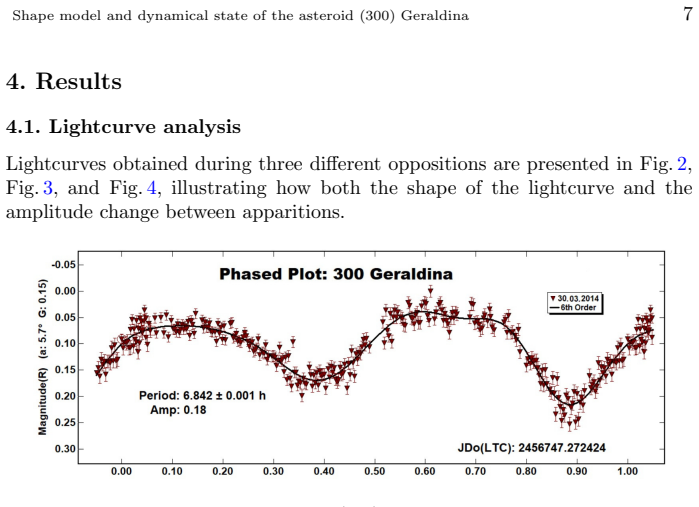
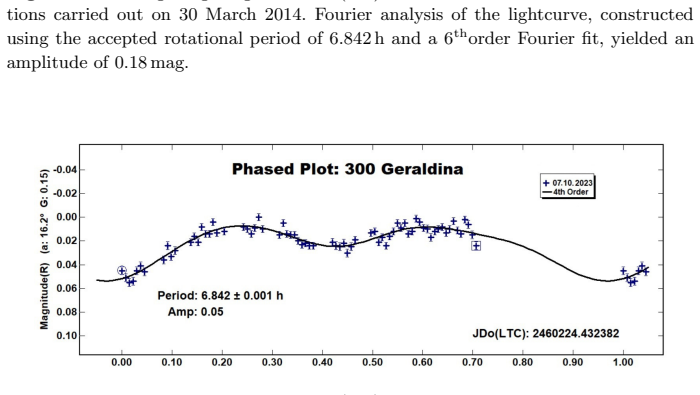
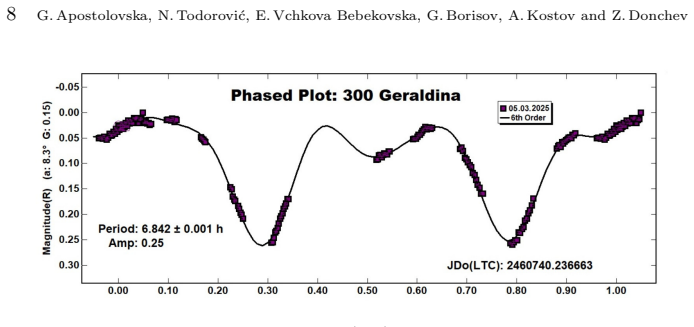
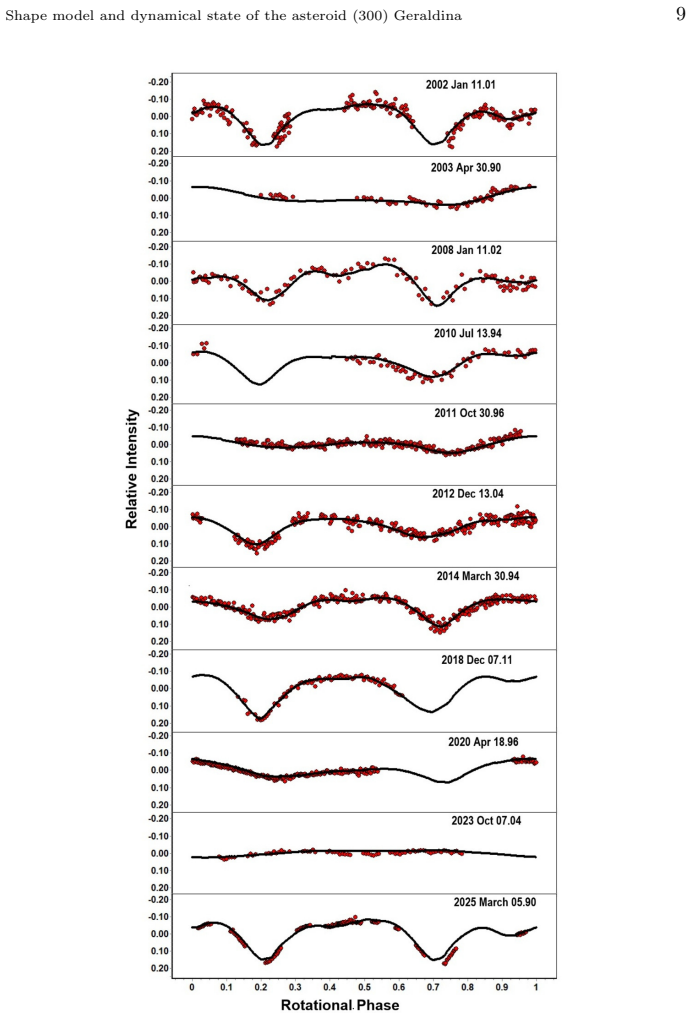
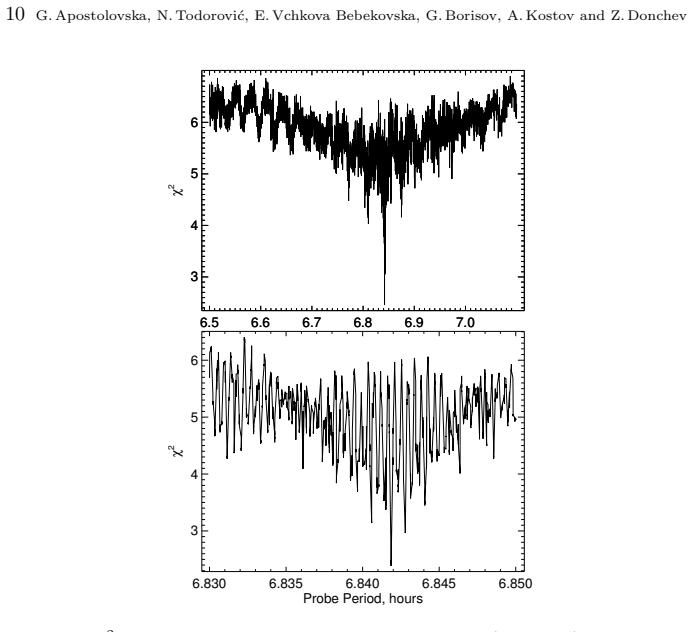
In this study, we present a comprehensive photometric and physical characterisation of the main-belt asteroid (300) Geraldina. Our analysis includes determining its sidereal rotational period, shape modelling, spin-axis orientation, as well as dynamical and spectral properties. The investigation is based on two decades of archival photometry from the Bulgarian National Astronomical Observatory (BNAO) Rozhen, complemented by dense CCD lightcurve observations obtained since 2017 at the Astronomical Station Vidojevica (ASV), dense data from ALCDEF, and augmented with sparse-in-time measurements from Gaia Data Release 3 (DR3). By combining these heterogeneous datasets within and using the lightcurve inversion method, we confirmed the asteroid's prograde sense of rotation and obtained two symmetrically mirrored pole solutions for the asteroid model. Our dynamical studies show that (300) Geraldina remains stable in 100 Myr. Although close to the 2:1 mean-motion resonance with Jupiter, it is not captured into it during the observed time. Instead, it exhibits interactions with an unidentified high-order mean-motion resonance, which appears to contribute to its long-term stability. Its spectral type (C) with a primitive carbonaceous composition, in combination with low albedo and long-term stability, is consistent with the assumption that (300) Geraldina is an ancient asteroid.
Editorial analysis
A structured set of objections, weighed in public.
Referee Report
Summary. The manuscript presents a photometric characterization of main-belt asteroid (300) Geraldina using two decades of archival lightcurves from BNAO Rozhen, ASV, ALCDEF, and Gaia DR3. Lightcurve inversion yields a shape model with two symmetrically mirrored prograde pole solutions. Forward dynamical integrations over 100 Myr show orbital stability near the 2:1 Jovian resonance, with noted interactions involving an unidentified high-order resonance. The C-type taxonomy, low albedo, and reported stability are interpreted as consistent with the asteroid being ancient and having experienced negligible collisional or thermal alteration.
Significance. The shape model and pole solutions add to the catalog of characterized main-belt objects, and the dynamical analysis identifies possible resonance interactions that may contribute to stability. These elements are useful for population studies if the inversion results are robust. However, the central interpretive claim linking the 100 Myr stability plus external C-type classification to an ancient origin lacks direct supporting tests and therefore has limited implications for models of primordial asteroid survival versus recent emplacement.
major comments (3)
- [dynamical studies section] Dynamical studies section: the reported 100 Myr stability is obtained from forward integration of the observed orbit, but no Lyapunov times, Gyr-scale integrations, or proper-element analysis for family membership are provided. This leaves open the possibility of recent resonance scattering or Yarkovsky-driven emplacement on <<100 Myr timescales, so the data do not securely support the ancient-origin inference stated in the abstract and conclusion.
- [Abstract and lightcurve inversion description] Abstract and lightcurve inversion description: the two pole solutions are presented without error bars, data-exclusion criteria, or quantitative fit statistics (e.g., reduced chi-squared or RMS residuals for the model). The absence of these metrics makes it impossible to evaluate whether the solutions are uniquely determined or whether the shape model is load-bearing for any downstream claims.
- [Spectral properties section] Spectral properties section: the C-type classification and primitive composition are adopted from external literature without new spectral data or re-analysis in the manuscript. Because the ancient-origin argument rests on combining this external taxonomy with the new dynamical result, the interpretive step is not internally generated from the paper's own observations.
minor comments (2)
- [Abstract] The abstract states that the asteroid 'remains stable in 100 Myr' but should specify the integrator, timestep, and number of clones used to quantify the robustness of that statement.
- [dynamical studies section] Notation for the unidentified high-order resonance is not defined; a brief description or reference to the resonance identification method would improve clarity.
Simulated Author's Rebuttal
We thank the referee for the careful reading and constructive comments on our manuscript. We address each major comment below, indicating where revisions will be incorporated to improve clarity and accuracy.
read point-by-point responses
-
Referee: [dynamical studies section] Dynamical studies section: the reported 100 Myr stability is obtained from forward integration of the observed orbit, but no Lyapunov times, Gyr-scale integrations, or proper-element analysis for family membership are provided. This leaves open the possibility of recent resonance scattering or Yarkovsky-driven emplacement on <<100 Myr timescales, so the data do not securely support the ancient-origin inference stated in the abstract and conclusion.
Authors: We agree that the dynamical analysis is restricted to 100 Myr forward integrations of the nominal orbit and does not include Lyapunov exponents, Gyr-scale runs, or proper-element family analysis. The manuscript presents the observed stability as consistent with an ancient origin when combined with the external C-type taxonomy and low albedo, rather than as definitive proof. We will revise the abstract and conclusion to use more cautious language, explicitly noting the 100 Myr limit and the possibility of more recent emplacement scenarios. A brief discussion of these limitations will be added to the dynamical section. revision: yes
-
Referee: [Abstract and lightcurve inversion description] Abstract and lightcurve inversion description: the two pole solutions are presented without error bars, data-exclusion criteria, or quantitative fit statistics (e.g., reduced chi-squared or RMS residuals for the model). The absence of these metrics makes it impossible to evaluate whether the solutions are uniquely determined or whether the shape model is load-bearing for any downstream claims.
Authors: The lightcurve inversion yields two symmetrically mirrored prograde poles, but the manuscript text does not report the associated chi-squared values, RMS residuals, or pole uncertainties. We will add these quantitative fit statistics, any available error estimates on the pole solutions, and details on data selection or exclusion criteria to the revised lightcurve inversion section and abstract where appropriate. revision: yes
-
Referee: [Spectral properties section] Spectral properties section: the C-type classification and primitive composition are adopted from external literature without new spectral data or re-analysis in the manuscript. Because the ancient-origin argument rests on combining this external taxonomy with the new dynamical result, the interpretive step is not internally generated from the paper's own observations.
Authors: The C-type taxonomy and primitive composition are adopted from published literature, as the study focuses on new photometric and dynamical results rather than new spectroscopy. The ancient-origin interpretation is framed as consistency between the new stability findings and the existing external classification. We will revise the spectral properties section and related discussion to explicitly state that the taxonomy is taken from external sources and to clarify the combined nature of the argument. revision: partial
Circularity Check
No circularity; stability from orbit integration and taxonomy from external data are independent of the ancient-origin interpretation
full rationale
The paper's central claim is an interpretive statement that C-type spectrum, low albedo, and 100 Myr numerical stability are 'consistent with' an ancient origin. The stability result is obtained by forward integration of an observed orbit (no fitted parameters renamed as predictions), the spectral classification is taken from external sources, and no equations, self-citations, or ansatzes reduce the conclusion to the inputs by construction. The interpretive step from these observables to 'ancient asteroid' is not a derivation that loops back on itself; it is an inference whose strength can be debated on evidentiary grounds but does not exhibit any of the enumerated circularity patterns.
Axiom & Free-Parameter Ledger
free parameters (1)
- sidereal period and pole coordinates
axioms (2)
- domain assumption Lightcurve inversion assumes a convex shape and constant albedo across the surface.
- domain assumption N-body integrations over 100 Myr capture all relevant dynamical effects for stability assessment.
Reference graph
Works this paper leans on
-
[1]
Application to the structure of the main asteroidal belt
The fast Lyapunov indicator: a simple tool to detect weak chaos. Application to the structure of the main asteroidal belt. , year = 1997, month = jul, volume =. doi:10.1016/S0032-0633(97)00058-5 , adsurl =
-
[2]
Application to Asteroidal Motion
Fast Lyapunov Indicators. Application to Asteroidal Motion. Celestial Mechanics and Dynamical Astronomy , keywords =. doi:10.1023/A:1008276418601 , adsurl =
-
[3]
Contributions of the Astronomical Observatory Skalnate Pleso , keywords =
The possible dual nature of the asteroid (12499) 1998 FR47. Contributions of the Astronomical Observatory Skalnate Pleso , keywords =. doi:10.31577/caosp.2024.54.4.57 , archivePrefix =. 2411.11994 , primaryClass =
-
[4]
The Precise and Powerful Chaos of the 5:2 Mean Motion Resonance with Jupiter
The precise and powerful chaos of the 5:2 mean motion resonance with Jupiter. , keywords =. doi:10.1093/mnras/stw3070 , archivePrefix =. 1612.00244 , primaryClass =
work page internal anchor Pith review Pith/arXiv arXiv doi:10.1093/mnras/stw3070
-
[5]
Asteroid spin-states of a 4 Gyr collisional family. , keywords =. doi:10.1051/0004-6361/202243905 , archivePrefix =. 2210.02096 , primaryClass =
-
[6]
Investigating Athor and Zita collisional families
Spin states of X-complex asteroids in the inner main belt: I. Investigating Athor and Zita collisional families. , keywords =. doi:10.1051/0004-6361/202451363 , archivePrefix =. 2409.03419 , primaryClass =
-
[7]
Asteroids, Comets, and Meteors: ACM 2002 , year = 2002, editor =
Results from photometric studies of asteroids at Rozhen National Observatory, Bulgaria. Asteroids, Comets, and Meteors: ACM 2002 , year = 2002, editor =
2002
-
[8]
Astronomical Data Analysis Software and Systems V , year = 1996, editor =
CCDPHOT---An IDL Widget Based CCD Photometry Reduction System. Astronomical Data Analysis Software and Systems V , year = 1996, editor =
1996
-
[9]
SDSS-based taxonomic classification and orbital distribution of main belt asteroids. , keywords =. doi:10.1051/0004-6361/200913322 , adsurl =
-
[10]
The origin of long-lived asteroids in the 2:1 mean-motion resonance with Jupiter
The origin of long-lived asteroids in the 2:1 mean-motion resonance with Jupiter. , keywords =. doi:10.1093/mnras/stv1109 , archivePrefix =. 1505.04329 , primaryClass =
work page internal anchor Pith review Pith/arXiv arXiv doi:10.1093/mnras/stv1109
-
[11]
IAU Colloquium 197: Dynamics of Populations of Planetary Systems , year = 2005, editor =
The population of asteroids in the 2:1 mean motion resonance with Jupiter revised. IAU Colloquium 197: Dynamics of Populations of Planetary Systems , year = 2005, editor =. doi:10.1017/S1743921304008634 , adsurl =
-
[12]
Yarkovsky origin of the unstable asteroids in the 2/1 mean motion resonance with Jupiter. , keywords =. doi:10.1111/j.1365-2966.2005.08995.x , adsurl =
-
[13]
AAS/Division for Planetary Sciences Meeting Abstracts \#50 , year = 2018, series =
The ALCDEF Database and the NASA SBN/PDS: The Perfect Merger. AAS/Division for Planetary Sciences Meeting Abstracts \#50 , year = 2018, series =
2018
-
[14]
Asteroid Light Curves from the Palomar Transient Factory Survey: Rotation Periods and Phase Functions from Sparse Photometry. , keywords =. doi:10.1088/0004-6256/150/3/75 , archivePrefix =. 1504.04041 , primaryClass =
work page internal anchor Pith review Pith/arXiv arXiv doi:10.1088/0004-6256/150/3/75
-
[15]
Minor Planet Bulletin , keywords =
Lightcurve Analysis for Eleven Main-belt Asteroids. Minor Planet Bulletin , keywords =
-
[16]
Asteroid taxonomy from cluster analysis of spectrometry and albedo. , keywords =. doi:10.1051/0004-6361/202243587 , archivePrefix =. 2203.11229 , primaryClass =
-
[17]
Summary of the content and survey properties
Gaia Data Release 3. Summary of the content and survey properties. , keywords =. doi:10.1051/0004-6361/202243940 , archivePrefix =. 2208.00211 , primaryClass =
-
[18]
Gaia Data Release 3. The Solar System survey. , keywords =. doi:10.1051/0004-6361/202243796 , archivePrefix =. 2206.05561 , primaryClass =
-
[19]
Optimization Methods for Asteroid Lightcurve Inversion. I. Shape Determination. , year = 2001, month = sep, volume =. doi:10.1006/icar.2001.6673 , adsurl =
-
[20]
Optimization Methods for Asteroid Lightcurve Inversion. II. The Complete Inverse Problem. , year = 2001, month = sep, volume =. doi:10.1006/icar.2001.6674 , adsurl =
-
[21]
DAMIT: a database of asteroid models. , keywords =. doi:10.1051/0004-6361/200912693 , adsurl =
-
[22]
Minor Planet Bulletin , keywords =
Asteroid Lightcurve Observations at Etscorn Observatory. Minor Planet Bulletin , keywords =
-
[23]
Minor Planet Bulletin , keywords =
300 Geraldina: Possibly a Binary With a Tilted Rotational Axis. Minor Planet Bulletin , keywords =
-
[24]
Minor Planet Bulletin , keywords =
Lightcurve analysis of asteroids 300 Geraldina, 573 Recha, 629 Bernardina 721 Tabora, 1547 Nele, and 1600 Vyssotsky. Minor Planet Bulletin , keywords =
-
[25]
, keywords =
An analysis of the amplitude-phase relationship among asteroids. , keywords =
-
[26]
Serbian Astronomical Journal , keywords =
The Physical and Dynamical Characteristics of the Asteroid 4940 Polenov. Serbian Astronomical Journal , keywords =. doi:10.2298/SAJ2102039V , adsurl =
-
[27]
11th International Conference of the Balkan Physical Union , year = 2023, month = oct, eid =
Lightcurve analysis on asteroids from NAO Rozhen observations in 2021. 11th International Conference of the Balkan Physical Union , year = 2023, month = oct, eid =
2021
-
[28]
11th International Conference of the Balkan Physical Union , year = 2023, month = oct, eid =
Lightcurve Analysis of Asteroids at the Astronomical Station Vidojevica for the first half of 2022. 11th International Conference of the Balkan Physical Union , year = 2023, month = oct, eid =
2022
-
[29]
10th Jubilee International Conference of the Balkan Physical Union , year = 2019, series =
Asteroid photometry in 2017 from national astronomical observatory Rozhen. 10th Jubilee International Conference of the Balkan Physical Union , year = 2019, series =. doi:10.1063/1.5091230 , adsurl =
-
[30]
IAU General Assembly , year = 2020, month = mar, pages =
Lightcurve Photometry of (2525) O'Steen with the new ``Milankovi \'c '' 1.4 m telescope. IAU General Assembly , year = 2020, month = mar, pages =. doi:10.1017/S1743921319003375 , adsurl =
-
[31]
Preliminary Analysis of WISE/NEOWISE 3-Band Cryogenic and Post-cryogenic Observations of Main Belt Asteroids. , keywords =. doi:10.1088/2041-8205/759/1/L8 , archivePrefix =. 1209.5794 , primaryClass =
work page internal anchor Pith review Pith/arXiv arXiv doi:10.1088/2041-8205/759/1/l8 2041
-
[32]
NEOWISE Reactivation Mission Year Two: Asteroid Diameters and Albedos
NEOWISE Reactivation Mission Year Two: Asteroid Diameters and Albedos. , keywords =. doi:10.3847/0004-6256/152/3/63 , archivePrefix =. 1606.08923 , primaryClass =
work page internal anchor Pith review Pith/arXiv arXiv doi:10.3847/0004-6256/152/3/63
-
[33]
Main Belt Asteroids with WISE/NEOWISE: Near-Infrared Albedos
Main-belt Asteroids with WISE/NEOWISE: Near-infrared Albedos. , keywords =. doi:10.1088/0004-637X/791/2/121 , archivePrefix =. 1406.6645 , primaryClass =
work page internal anchor Pith review Pith/arXiv arXiv doi:10.1088/0004-637x/791/2/121
-
[34]
Identification of a primordial asteroid family constrains the original planetesimal population. Science , keywords =. doi:10.1126/science.aam6036 , adsurl =
-
[35]
Identification of a 4.3 billion year old asteroid family and planetesimal population in the Inner Main Belt. , keywords =. doi:10.1051/0004-6361/202245594 , archivePrefix =. 2306.07725 , primaryClass =
-
[36]
Asteroids IV , year = 2015, editor =
Identification and Dynamical Properties of Asteroid Families. Asteroids IV , year = 2015, editor =. doi:10.2458/azu_uapress_9780816532131-ch016 , adsurl =
-
[37]
Catalog of Proper Orbits for 1.25 Million Main-belt Asteroids and Discovery of 136 New Collisional Families. , keywords =. doi:10.3847/1538-4365/ad675c , archivePrefix =. 2407.18221 , primaryClass =
discussion (0)
Sign in with ORCID, Apple, or X to comment. Anyone can read and Pith papers without signing in.