REVIEW 3 major objections 5 minor 4 cited by
Cryogenic shock exfoliation produces large-area ultrahigh-mobility rhombohedral graphene devices at 90% yield.
Reviewed by Pith at T0; open to challenge. T0 means a machine referee read the full paper against a public rubric. the ladder, T0–T4 →
T0 review · grok-4.5
2026-07-12 18:35 UTC pith:LEEFQLHY
load-bearing objection Real materials advance for RMG: cryogenic-shock exfoliation plus low-pressure assembly delivers large, high-yield, high-mobility devices with multi-probe quality metrics that look solid if stacking fidelity holds. the 3 major comments →
Cryogenic shock exfoliation for ultrahigh mobility rhombohedral graphite nanoelectronics
The pith
A machine-rendered reading of the paper's core claim, the machinery that carries it, and where it could break.
Core claim
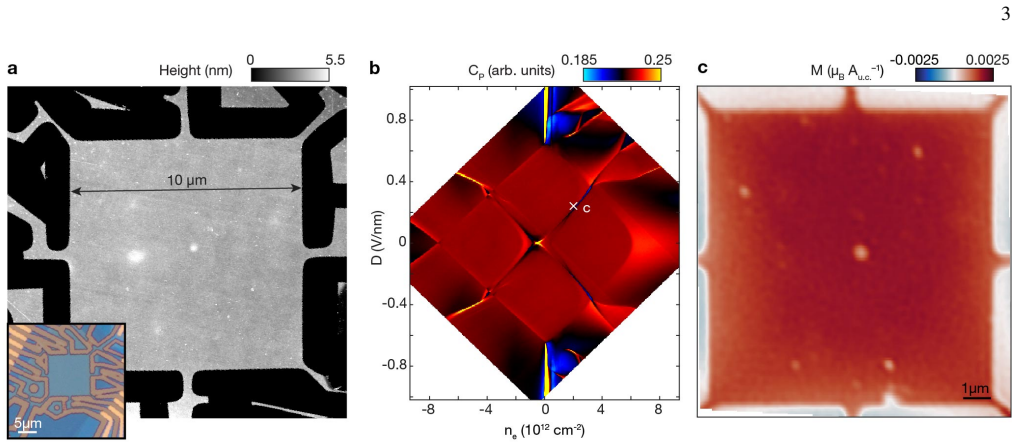
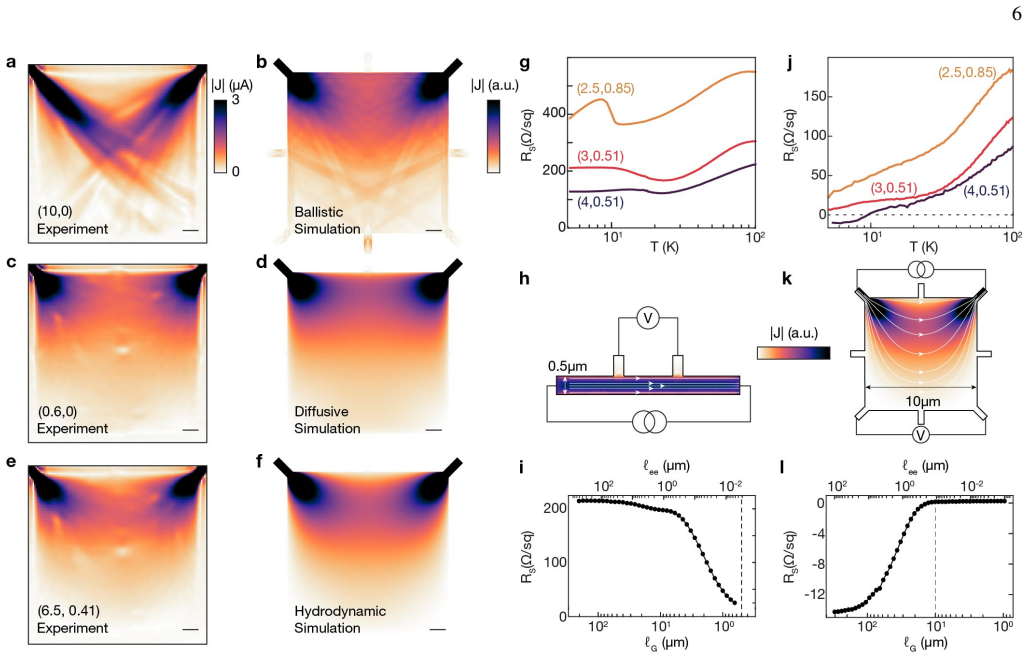
Cryogenic shock exfoliation combined with low-pressure van der Waals assembly produces highly uniform rhombohedral multilayer graphene devices larger than 1300 μm² at about 90% yield, with disorder mean free paths exceeding 200 μm at low temperature, spatially uniform spin magnetism over a full central 10×10 μm² area, and a size-driven crossover from Poiseuille to porous electron flow inside the flat surface bands.
What carries the argument
Cryogenic shock exfoliation—the process that creates large-area rhombohedral graphene flakes—together with low-pressure van der Waals assembly that preserves stacking order; these two steps jointly remove the scarcity of natural rhombohedral stacking and deliver the reported area, yield, and cleanliness.
Load-bearing premise
That the freeze-shock and gentle assembly truly keep pure rhombohedral stacking over the whole large device without hidden faults, strain, or disorder that would erase the claimed uniformity and long mean free path.
What would settle it
Full-area structural maps (Raman, TEM, or equivalent) of a claimed large device that reveal substantial non-rhombohedral stacking or faults correlated with short mean free path or patchy magnetism, or transport that fails to show the reported hydrodynamic crossover in devices of the stated size.
If this is right
- Mesoscopic RMG devices with useful area above 1000 μm² become fabricable at high yield rather than as rare finds.
- Disorder mean free paths above 200 μm and uniform magnetism over 10×10 μm² enable clean, spatially resolved studies of correlated phases.
- The size-driven Poiseuille-to-porous hydrodynamic crossover becomes an accessible transport benchmark of device quality in flat-band RMG.
- Strongly correlated magnetic, superconducting, and topological phases of RMG can be integrated into two-dimensional nanoelectronics platforms.
Where Pith is reading between the lines
- The same shock-plus-gentle-assembly route may select other rare stacking polytypes or layered crystals where thermal or mechanical shock can bias stacking.
- Large uniform areas make multi-terminal, interferometric, or multi-gate geometries that probe topology and superconductivity on the same flake practical.
- The hydrodynamic crossover itself can serve as a quantitative quality metric that other fabrication groups can adopt to compare residual disorder.
- If stacking fidelity survives further scale-up, wafer-level transfer of RMG electronics becomes a concrete materials target.
Editorial analysis
A structured set of objections, weighed in public.
Referee Report
Summary. The manuscript introduces cryogenic shock exfoliation of graphite, combined with low-pressure van der Waals assembly, as a route to large-area rhombohedral multilayer graphene (RMG) devices. It reports devices exceeding 1300 μm² with ~90% fabrication yield, spatially uniform spin magnetism over a central 10×10 μm² region (nanoSQUID-on-tip), a disorder mean free path exceeding 200 μm from transverse magnetic focusing at low T, and a size-driven crossover from Poiseuille to porous electron flow in the intermediate-temperature hydrodynamic regime of the RMG flat surface bands. The central claim is that this process overcomes the scarcity of natural rhombohedral stacking and enables mesoscopic RMG nanoelectronics of ultrahigh electronic quality.
Significance. If the stacking fidelity, yield, and quality metrics hold as stated, this is a substantial materials advance for the RMG community. Limited natural ABC abundance has constrained device area and statistics for correlated, magnetic, and topological phases; a high-yield large-area process would materially expand what is experimentally accessible. The multi-probe quality suite—uniform magnetism maps, TMF mean free path, and hydrodynamic flow signatures—is a strong experimental design and provides independent, falsifiable checks rather than a single fitted figure of merit. The hydrodynamic size-driven Poiseuille-to-porous crossover is a particularly clean quality signature when device size is the control parameter. These strengths make the work of clear interest for mesoscopic graphene and correlated 2D electronics.
major comments (3)
- [Abstract / Methods / stacking characterization] Stacking-order fidelity over the full claimed device area is load-bearing for the uniformity, mfp, and hydrodynamics claims, yet is the least explicitly secured premise in the abstract/framing. The manuscript asserts that cryogenic shock plus low-pressure assembly preserves bulk ABC order without conversion under conventional pressures. Please provide (or more clearly present) quantitative stacking verification over the full >1300 μm² devices and specifically the central 10×10 μm² nanoSQUID region: e.g., Raman ABC-mode maps with statistics, TEM/SAED or equivalent local stacking probes, and any process-parameter controls showing that residual Bernal domains, stacking faults, or strain are absent at the level needed to support mfp >200 μm and uniform spin magnetism as bulk-RMG properties. Without that, the multi-probe quality metrics remain consistent with high quality but do not uniquely
- [Transverse magnetic focusing / mean free path] The disorder mean free path >200 μm is extracted from transverse magnetic focusing. Please state explicitly the TMF geometry, contact configuration, temperature and density range used for the quoted bound, and the analysis assumptions (e.g., ballistic focusing condition, role of disorder vs. boundary scattering). A short comparison to control devices (Bernal or smaller-area RMG from conventional exfoliation) would strengthen the claim that the long mfp is a consequence of the cryogenic-shock + low-pressure process rather than contact or geometry artifacts.
- [Hydrodynamic flow / flat surface bands] The size-driven Poiseuille-to-porous crossover in the flat surface bands is presented as a further quality signature. Please clarify how device size is varied (lithographic width/length series vs. different flakes), the intermediate-T window relative to electron-electron, electron-phonon, and disorder scattering rates, and how the hydrodynamic length scales are estimated from the data. A brief comparison to the cited hydrodynamic theory [16, 25] with the measured mfp would make the crossover interpretation more quantitative and less dependent on qualitative flow-regime labels.
minor comments (5)
- [Methods / cryogenic shock exfoliation] Define process parameters for cryogenic shock (temperature, quench rate, pressure, substrate) in a compact methods table or paragraph so the named process is reproducible by other groups.
- [Yield statistics] State how the 90% fabrication yield is counted (devices per flake, flakes per crystal, electrical continuity only, or stacking-verified devices) and over what sample size.
- [nanoSQUID-on-tip imaging] In the nanoSQUID-on-tip section, specify the magnetic field, density, and temperature at which the uniform spin-magnetism map is taken, and whether edge or contact regions show any contrast.
- [Figures] Ensure figure captions for magnetism maps, TMF traces, and hydrodynamic resistance vs. size/T are self-contained (scale bars, density, T, device dimensions).
- [Introduction / references] The abstract cites a broad range [1–24]; in the main text, prioritize the most directly relevant prior RMG fabrication and hydrodynamics works so the novelty relative to existing ABC-enrichment or assembly methods is clear.
Circularity Check
No significant circularity: experimental fabrication and multi-probe characterization paper whose quality metrics are independent observables, not quantities forced by construction from fitted inputs or self-citation chains.
full rationale
The paper introduces cryogenic shock exfoliation plus low-pressure van der Waals assembly, then reports device area/yield, nanoSQUID-on-tip spin-magnetism maps, transverse magnetic focusing mean free path, and a size-driven Poiseuille-to-porous hydrodynamic crossover. These are direct experimental observables (imaging, transport, focusing) rather than predictions derived from a model whose parameters were fitted to the same data. Hydrodynamic interpretation cites external theory in the normal way; flat-band references are domain background. No self-definitional loop, no fitted parameter re-sold as prediction, no load-bearing uniqueness theorem imported from overlapping authors, and no ansatz smuggled via self-citation. The derivation chain is therefore self-contained against external benchmarks; stacking-fidelity assumptions affect correctness risk, not circularity. Score 0 with empty steps is the honest finding.
Axiom & Free-Parameter Ledger
free parameters (3)
- Cryogenic shock process parameters (T, quench rate, pressure, substrate)
- Disorder mean free path extraction from transverse magnetic focusing
- Hydrodynamic length scales (electron-electron vs disorder vs device size)
axioms (4)
- domain assumption Rhombohedral (ABC) stacking produces flat surface bands that host the correlated and hydrodynamic physics discussed.
- domain assumption Transverse magnetic focusing peak visibility and spacing report the disorder mean free path in a ballistic 2D electron system.
- domain assumption In the intermediate-T strong e-e scattering regime, size-dependent crossover from Poiseuille to porous flow diagnoses ultraclean hydrodynamic transport.
- ad hoc to paper Low-pressure van der Waals assembly preserves stacking order that would otherwise convert under conventional pressures.
invented entities (1)
-
Cryogenic shock exfoliation (as a named process)
no independent evidence
read the original abstract
Rhombohedral multilayer graphene (RMG) offers a highly tunable platform for correlated electron physics, featuring field-effect control of magnetic, superconducting, and topological phases[1-24]. The promise of these materials has been held back by the limited abundance of rhombohedral stacking in natural graphite, which constrains both sample yield and useful area. Here we introduce 'cryogenic shock exfoliation' to produce large area rhombohedral graphene flakes which, combined with a low-pressure van der Waals assembly technique that preserves stacking order, enable highly uniform devices exceeding 1300 $\mu m^2$ with fabrication yields of 90%. Using scanning nanoSQUID-on-tip imaging, we demonstrate uniform spin magnetism over the full central 10 times 10 $\mu m^2$ area of our devices. Transverse magnetic focusing reveals a disorder mean free path exceeding 200 $\mu m$ at low temperatures. Within the flat surface bands of RMG[20], we observe a size-driven crossover from Poiseuille to porous electron flow in the intermediate-temperature regime of strong electron-electron hydrodynamics[16, 25], providing a further signature of ultrahigh device quality. Our approach overcomes a key materials bottleneck in the fabrication of mesoscopic rhombohedral graphene devices, paving the way for incorporating strongly correlated phases into two-dimensional nanoelectronics.
Figures


Forward citations
Cited by 4 Pith papers
-
Visualizing orbital magnetism in electron doped rhombohedral multilayer graphene
NanoSQUID magnetometry visualizes orbital magnetism in rhombohedral multilayer graphene, showing finite orbital moment in the superconducting state and density-tuned magnetic domain switching in the metallic regime.
-
Characterizing electronic scattering rates with transport in multiterminal devices
A five-terminal geometry diagnoses ballistic-hydrodynamic-Ohmic crossovers and extracts momentum-relaxing and conserving scattering rates from current partition in electron liquids.
-
Characterizing electronic scattering rates with transport in multiterminal devices
Current partition in a five-terminal geometry diagnoses ballistic-hydrodynamic-Ohmic crossovers and extracts momentum-relaxing and conserving scattering rates in 2D electron systems.
-
Characterizing electronic scattering rates with transport in multiterminal devices
A linearized Boltzmann model in five-terminal geometry shows current partition diagnoses ballistic-hydrodynamic-Ohmic crossover and extracts momentum-relaxing and conserving scattering rates.
Reference graph
Works this paper leans on
-
[1]
��������� ����� ����������� ��� ��������� �������� ������������ �������� ��������������� ������ ��������� ��������� ������ ������ ������� ���� �� ��������� ������� �������� ������ ����� ������ ������ ��� �������� ������ ������ �� ����� �������� ������������� ����� ������� �������� �� �������� ����� �������� ������ �� ������� ������� ����������� ����� ����...
Pith/arXiv arXiv 2026
discussion (0)
Sign in with ORCID, Apple, or X to comment. Anyone can read and Pith papers without signing in.