Natural Inflation with a negative cosmological constant
Pith reviewed 2026-06-27 12:44 UTC · model grok-4.3
The pith
Inflation model with cosine potential and negative cosmological constant admits exact analytic solutions for the inflaton field.
A machine-rendered reading of the paper's core claim, the machinery that carries it, and where it could break.
Core claim
The equation of motion for the inflaton field in this cosine-type potential with negative cosmological constant can be solved analytically. The model originates from the Wheeler-DeWitt equation and yields predictions for the spectral index, tensor-to-scalar ratio, and running spectral index that are consistent with current observational constraints.
What carries the argument
Cosine-type potential with negative cosmological constant from classical Wheeler-DeWitt solution, which enables exact analytic integration of the inflaton dynamics.
If this is right
- The spectral index and tensor-to-scalar ratio can be computed precisely without slow-roll approximations.
- Model predictions align with Planck, ACT, and DESI data.
- Running of the spectral index is determined exactly from the solution.
- The negative cosmological constant modifies the potential shape for inflation.
Where Pith is reading between the lines
- This approach may bridge quantum cosmology with observable inflation parameters.
- If the negative constant is confirmed, it could imply specific boundary conditions in quantum gravity.
- Exact solvability might allow testing against future precision cosmology data more rigorously.
- The model extends natural inflation by incorporating quantum gravity origins.
Load-bearing premise
The classical solution of the Wheeler-DeWitt equation provides a physically valid cosine-type potential with negative cosmological constant suitable for describing realistic inflation.
What would settle it
A measurement showing that the observed spectral index or tensor-to-scalar ratio deviates significantly from the exact predictions of this model would falsify it.
Figures

read the original abstract
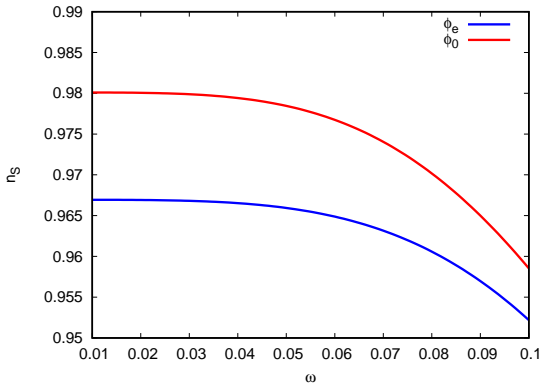
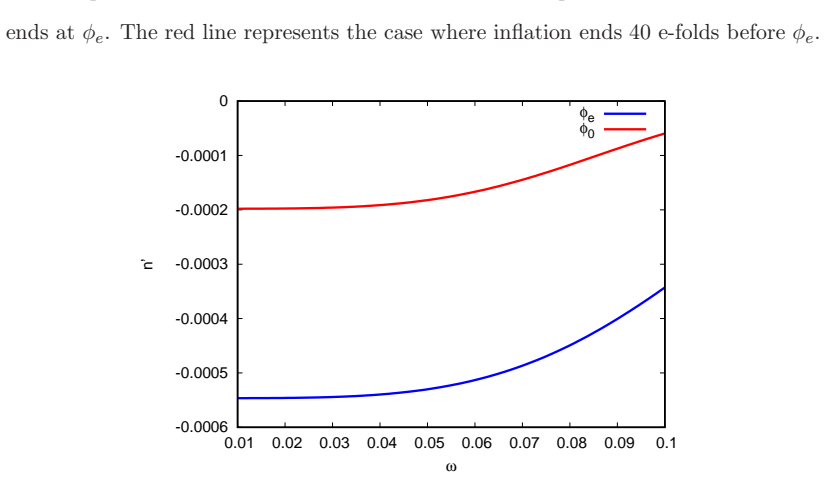
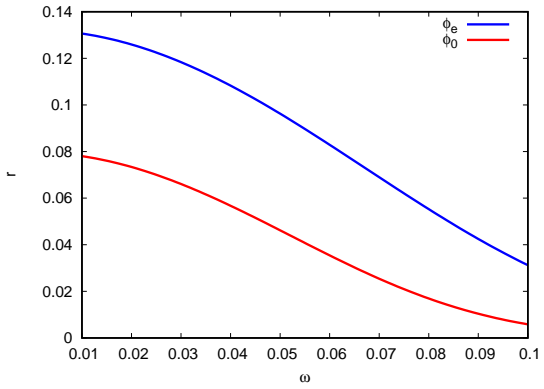
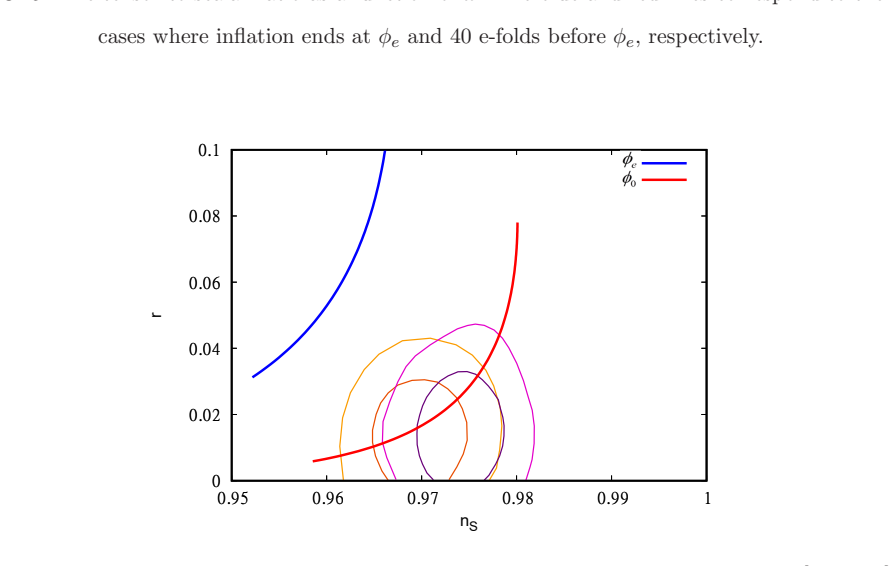
In this work, we investigate a cosmic inflation model based on a cosine-type potential with a negative cosmological constant. This model originates from a classical solution of the Wheeler-DeWitt equation. The equation of motion for the inflaton field can be solved analytically without relying on approximation schemes, such as the slow-roll conditions. The predictions of the spectral index, the tensor-to-scalar ratio, and the running spectral index are calculated and compared with experimental constraints from Planck Collaboration, Atacama Cosmology Telescope Collaboration (ACT), and Dark Energy Spectroscopic Instrument (DESI).
Editorial analysis
A structured set of objections, weighed in public.
Referee Report
Summary. The manuscript presents a natural inflation model whose cosine-type potential (with negative cosmological constant) is obtained from a classical solution of the Wheeler-DeWitt equation. It asserts that the inflaton equation of motion admits an exact analytic solution without slow-roll or other approximations, and that the resulting predictions for the spectral index n_s, tensor-to-scalar ratio r, and running α_s are consistent with Planck, ACT, and DESI constraints.
Significance. If the potential derivation is valid and the claimed analytic solution is exact and satisfies the coupled Friedmann and Klein-Gordon equations over a sufficient number of e-folds, the work would constitute a rare example of an approximation-free inflation model whose observables can be computed in closed form. The reported absence of free parameters would further strengthen the result by removing the usual tuning issues in natural inflation.
major comments (3)
- [§2] §2 (derivation of the potential): the manuscript states that a classical solution of the Wheeler-DeWitt equation supplies the cosine potential with negative cosmological constant, but provides no explicit steps showing how the WdW constraint reduces to this V(φ) or why the resulting term can be directly inserted into the classical FRW equations while preserving exact solvability. This step is load-bearing for the central claim of an analytic solution.
- [§3, Eq. (8)] §3, Eq. (8) (inflaton equation of motion): the analytic solution is asserted without slow-roll, yet the text does not exhibit the closed-form φ(t) or a(t) nor verify that both the Klein-Gordon and Friedmann equations are satisfied identically once the derived V(φ) is substituted. Without this verification the claim that the solution is exact and yields sufficient inflation remains unconfirmed.
- [§5] §5 (observables and data comparison): the reported values of n_s, r, and α_s are compared with Planck/ACT/DESI bounds, but because the model is presented as parameter-free the agreement must be shown to arise directly from the WdW-derived potential rather than from any residual choice of scale or initial conditions; the current presentation leaves this unclear.
minor comments (2)
- [Figure 2] Figure 2: axis labels and units for the potential plot are missing, making it difficult to confirm the negative cosmological constant term.
- The manuscript cites the Wheeler-DeWitt literature only sparsely; additional references to prior attempts to extract effective potentials from minisuperspace solutions would help contextualize the derivation.
Simulated Author's Rebuttal
We thank the referee for their detailed and constructive report. We address each of the major comments below, agreeing that additional details are needed to fully substantiate the claims. Revisions will be made accordingly to enhance clarity and rigor.
read point-by-point responses
-
Referee: [§2] §2 (derivation of the potential): the manuscript states that a classical solution of the Wheeler-DeWitt equation supplies the cosine potential with negative cosmological constant, but provides no explicit steps showing how the WdW constraint reduces to this V(φ) or why the resulting term can be directly inserted into the classical FRW equations while preserving exact solvability. This step is load-bearing for the central claim of an analytic solution.
Authors: We agree with the referee that the derivation from the Wheeler-DeWitt equation to the potential requires more explicit steps. In the revised manuscript, we will expand §2 to include the full reduction of the WdW constraint, detailing how the cosine potential with the negative cosmological constant term is obtained, and justify its use in the classical FRW equations while preserving the exact solvability of the inflaton dynamics. revision: yes
-
Referee: [§3, Eq. (8)] §3, Eq. (8) (inflaton equation of motion): the analytic solution is asserted without slow-roll, yet the text does not exhibit the closed-form φ(t) or a(t) nor verify that both the Klein-Gordon and Friedmann equations are satisfied identically once the derived V(φ) is substituted. Without this verification the claim that the solution is exact and yields sufficient inflation remains unconfirmed.
Authors: We acknowledge this omission. The revised manuscript will present the closed-form expressions for φ(t) and a(t) derived from Eq. (8). We will also include a verification section demonstrating that these solutions satisfy the Klein-Gordon and Friedmann equations identically when the WdW-derived V(φ) is used, thereby confirming the exact analytic nature and the production of sufficient inflation without approximations. revision: yes
-
Referee: [§5] §5 (observables and data comparison): the reported values of n_s, r, and α_s are compared with Planck/ACT/DESI bounds, but because the model is presented as parameter-free the agreement must be shown to arise directly from the WdW-derived potential rather than from any residual choice of scale or initial conditions; the current presentation leaves this unclear.
Authors: We thank the referee for this observation. To clarify, the revised §5 will explicitly trace how the values of n_s, r, and α_s are computed directly from the parameter-free WdW-derived potential and the exact solution, with no residual freedom in scale or initial conditions. This will demonstrate that the agreement with Planck, ACT, and DESI data follows solely from the model's construction. revision: yes
Circularity Check
No significant circularity; derivation chain is self-contained
full rationale
The paper states that the cosine-type potential with negative cosmological constant originates from a classical solution of the Wheeler-DeWitt equation, after which the inflaton equation of motion is solved analytically and observables are computed. No quoted step reduces the central result to a fitted parameter renamed as prediction, a self-citation chain, or an ansatz smuggled via prior work by the same authors. The analytical solvability is presented as a property of the chosen potential rather than a definitional tautology, and the comparison to Planck/ACT/DESI data occurs after the solution is obtained. The derivation therefore stands as independent content against external benchmarks.
Axiom & Free-Parameter Ledger
axioms (1)
- domain assumption A classical solution of the Wheeler-DeWitt equation yields a valid cosine-type potential with negative cosmological constant for inflation.
Reference graph
Works this paper leans on
-
[1]
( 6), this further indicates that the negative cosmological constant is small compared with the maximum of the potential
From Eq. ( 6), this further indicates that the negative cosmological constant is small compared with the maximum of the potential. Although this model originated from a study of quantum cosmology, the results obtained here may also be applied to more conventional natural inflation scen arios by introducing a suitably chosen negative cosmological constant. ...
-
[2]
A. A. Starobinsky, A New Type of Isotropic Cosmological M odels Without Singularity, Phys. Lett. B 91, 99 (1980)
1980
-
[3]
A. H. Guth, The Inflationary Universe: A Possible Solutio n to the Horizon and Flatness Problems, Phys. Rev. D 23, 347 (1981)
1981
-
[4]
A. D. Linde, A New Inflationary Universe Scenario: A Possi ble Solution of the Horizon, Flatness, Homogeneity, Isotropy and Primordi al Monopole Problems, Phys. Lett. B 108, 389 (1982)
1982
-
[5]
N. Maki, C.-M. Lin, and K. Kohri, Simple Analytical Solut ions of the Wheeler-DeWitt Equa- tion in the Classical Hamilton-Jacobi Limit (2026), arXiv:2604.25240 [hep-th] . 11
Pith/arXiv arXiv 2026
-
[6]
C.-M. Lin, Just some simple (but nontrivial) analytical solutions for de Broglie–Bohm quantum cosmology, Chin. J. Phys. 86, 344 (2023) , arXiv:2301.06088 [gr-qc]
arXiv 2023
-
[7]
Lin, Uniform rate inflation, JCAP 04, 037 , arXiv:2303.04999 [hep-ph]
C.-M. Lin, Uniform rate inflation, JCAP 04, 037 , arXiv:2303.04999 [hep-ph]
-
[8]
C.-M. Lin, R. Tamura, and K. I. Nagao, Uniform rate inflati on on the brane, JCAP 05, 105 , arXiv:2312.17409 [hep-ph]
-
[9]
Freese, J
K. Freese, J. A. Frieman, and A. V. Olinto, Natural Inflati on with Pseudo - Nambu-Goldstone Bosons, Phys. Rev. Lett. 65, 3233 (1990)
1990
-
[10]
H. N. Luu, Y.-C. Qiu, and S. H. H. Tye, Dynamical dark energ y from an ultralight axion, Phys. Rev. D 112, 023524 (2025) , arXiv:2503.18120 [hep-ph]
arXiv 2025
-
[11]
H. N. Luu, Y.-C. Qiu, and S. H. H. Tye, The lifespan of our u niverse, JCAP 09, 055 , arXiv:2506.24011 [hep-ph]
-
[12]
G. Shiu, F. Tonioni, and H. V. Tran, Bounding axion dark e nergy (2026), arXiv:2604.09141 [astro-ph.CO]
Pith/arXiv arXiv 2026
-
[13]
H. Motohashi, A. A. Starobinsky, and J. Yokoyama, Inflat ion with a constant rate of roll, JCAP 09, 018 , arXiv:1411.5021 [astro-ph.CO]
-
[14]
A. D. Linde, Hybrid inflation, Phys. Rev. D 49, 748 (1994) , arXiv:astro-ph/9307002
Pith/arXiv arXiv 1994
-
[15]
G. G. Ross, G. German, and J. A. Vazquez, Hybrid Natural I nflation, JHEP 05, 010 , arXiv:1601.03221 [astro-ph.CO]
-
[16]
M. Sasaki and E. D. Stewart, A General analytic formula f or the spectral index of the density perturbations produced during inflation, Prog. Theor. Phys. 95, 71 (1996) , arXiv:astro-ph/9507001
Pith/arXiv arXiv 1996
-
[17]
M. Sasaki and T. Tanaka, Superhorizon scale dynamics of multiscalar inflation, Prog. Theor. Phys. 99, 763 (1998) , arXiv:gr-qc/9801017
Pith/arXiv arXiv 1998
-
[18]
D. H. Lyth, K. A. Malik, and M. Sasaki, A General proof of t he conservation of the curvature perturbation, JCAP 05, 004 , arXiv:astro-ph/0411220
-
[19]
D. H. Lyth and Y. Rodriguez, The Inflationary prediction for primordial non-Gaussianity, Phys. Rev. Lett. 95, 121302 (2005) , arXiv:astro-ph/0504045
Pith/arXiv arXiv 2005
-
[20]
D. Wands, K. A. Malik, D. H. Lyth, and A. R. Liddle, A New ap proach to the evolution of cosmological perturbations on large scales, Phys. Rev. D 62, 043527 (2000) , arXiv:astro-ph/0003278
Pith/arXiv arXiv 2000
-
[21]
Y. Akrami et al. (Planck), Planck 2018 results. X. Constraints on inflation, 12 Astron. Astrophys. 641, A10 (2020) , arXiv:1807.06211 [astro-ph.CO]
Pith/arXiv arXiv 2018
-
[22]
E. Calabrese et al. (Atacama Cosmology Telescope), The Atacama Cosmology Telescope: DR6 constraints on extended cosmological models, JCAP 11, 063 , arXiv:2503.14454 [astro-ph.CO]
-
[23]
I. Abril-Cabezas et al. (Simons Observatory), The Simons Observatory: forecasted constraints on primordial gravitational waves with the expanded array o f Small Aperture Telescopes, JCAP 04, 051 , arXiv:2512.15833 [astro-ph.CO]
-
[24]
E. G. M. Ferreira, E. McDonough, L. Balkenhol, R. Kallos h, L. Knox, and A. Linde, BAO-CMB tension and implications for inflation, Phys. Rev. D 113, 043524 (2026) , arXiv:2507.12459 [astro-ph.CO] . 13
arXiv 2026
discussion (0)
Sign in with ORCID, Apple, or X to comment. Anyone can read and Pith papers without signing in.