Effects of thermochemical modelling on a hypersonic shock-wave/turbulent boundary-layer interaction
Pith reviewed 2026-06-29 02:30 UTC · model grok-4.3
The pith
Finite-rate chemistry produces a smaller separation bubble and lower wall heat flux than frozen models in a Mach 6.4 turbulent shock interaction.
A machine-rendered reading of the paper's core claim, the machinery that carries it, and where it could break.
Core claim
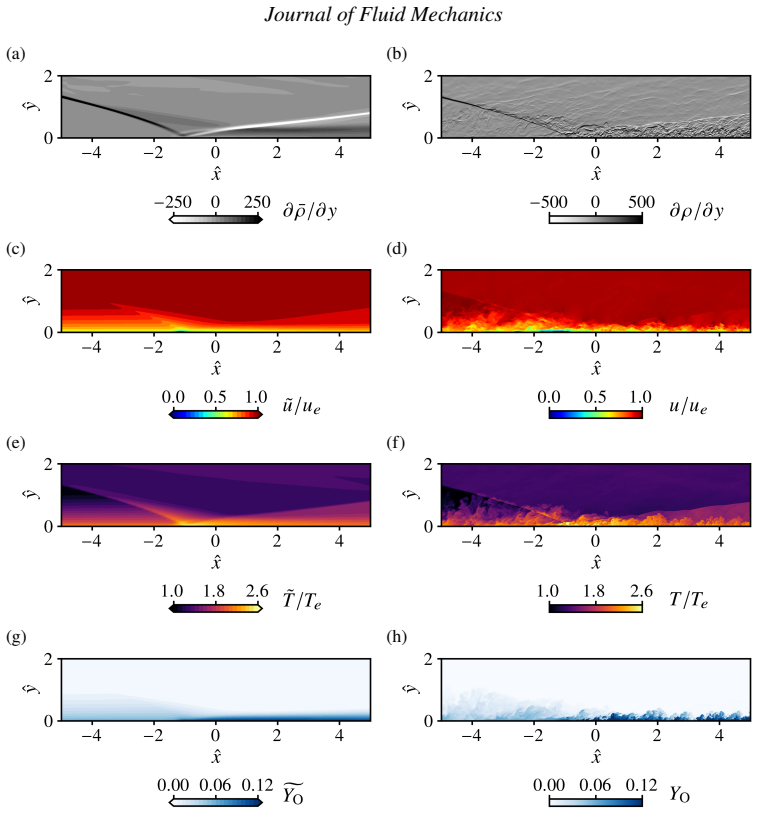
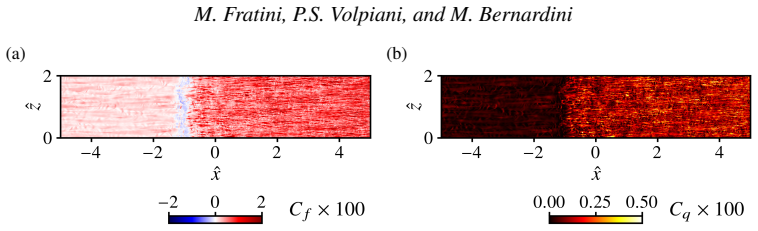
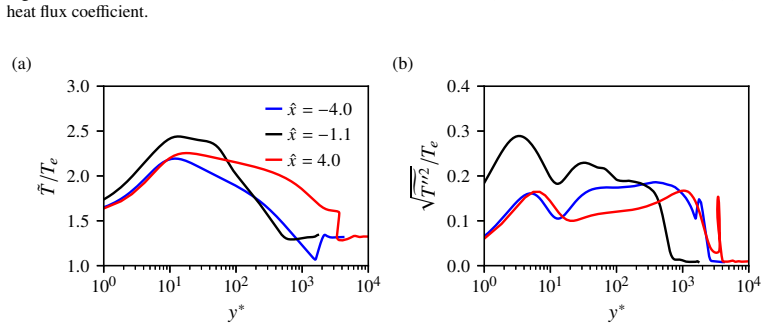
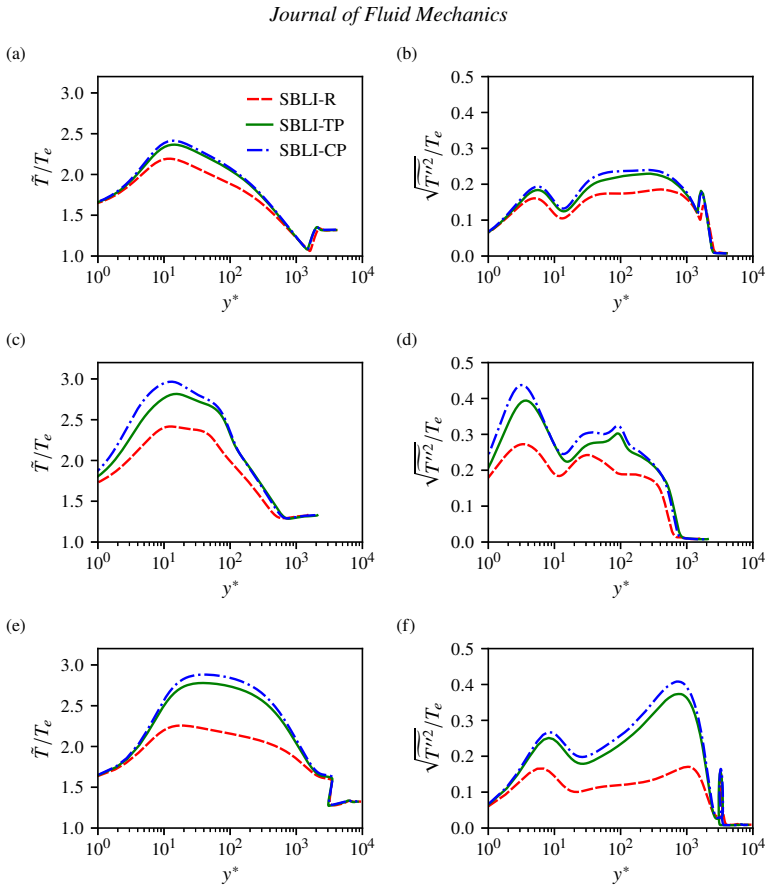
The reactive simulation shows that the shock-induced temperature rise substantially enhances chemical activity relative to the incoming boundary layer, with peak concentrations of dissociation products attained downstream of the interaction. Thus, the thermal and chemical responses are not synchronised: the composition lags the rapid thermal forcing imposed by the shock system, and turbulent Damkohler numbers reach values of order unity within the recirculation region, indicating non-negligible turbulence-chemistry interaction. The comparison among the three models shows that thermally and calorically perfect descriptions yield similar predictions, whereas finite-rate chemistry produces syst
What carries the argument
Hierarchy of three thermochemical models (finite-rate reactive, thermally perfect, calorically perfect) applied to identical oblique-shock/turbulent-boundary-layer configurations to isolate chemistry effects.
If this is right
- The shock-induced temperature rise substantially enhances chemical activity relative to the incoming boundary layer.
- Peak concentrations of dissociation products are attained downstream of the interaction.
- Thermally and calorically perfect descriptions yield similar predictions.
- Caloric-model effects play only a secondary role compared with the frozen versus reacting distinction.
- Turbulent Damkohler numbers reach order unity inside the recirculation region.
Where Pith is reading between the lines
- The lag between thermal and chemical response could require time-accurate chemistry models rather than equilibrium assumptions in regions of strong unsteadiness.
- Reduced heat flux under finite-rate chemistry might lower the required thermal-protection mass for vehicles operating near these conditions.
- The secondary role of caloric perfection suggests that simpler frozen models remain usable if chemical reactions are omitted entirely.
- Similar simulations at higher enthalpies could test whether the dominance of finite-rate effects strengthens or saturates.
Load-bearing premise
The three simulations share identical geometry and freestream conditions so that observed differences can be attributed solely to the choice of thermochemical model.
What would settle it
An additional simulation or experiment at the same Mach 6.4 and enthalpy conditions that measures the size of the separation bubble and post-interaction wall heat flux under finite-rate chemistry versus a frozen model.
Figures





read the original abstract
Thermochemical non-equilibrium can alter the structure, loads, and time scales of hypersonic shock-wave/turbulent boundary-layer interactions, yet its role in fully turbulent configurations remains largely unquantified. The present work addresses this issue by performing three direct numerical simulations of an oblique shock impinging on a turbulent high-enthalpy boundary layer at edge Mach number $M_e=6.4$ and stagnation enthalpy $H_e=16.9$ MJ/kg. The simulations share identical geometry and freestream conditions, but employ a hierarchy of progressively simplified thermochemical descriptions: a finite-rate reactive case, a single-species thermally perfect gas model, and a single-species calorically perfect model. The reactive simulation shows that the shock-induced temperature rise substantially enhances chemical activity relative to the incoming boundary layer, with peak concentrations of dissociation products attained downstream of the interaction. Thus, the thermal and chemical responses are not synchronised: the composition lags the rapid thermal forcing imposed by the shock system, and turbulent Damk\"ohler numbers reach values of order unity within the recirculation region, indicating non-negligible turbulence-chemistry interaction. The comparison among the three models shows that thermally and calorically perfect descriptions yield similar predictions, whereas finite-rate chemistry produces systematic differences: a smaller separation bubble, lower post-interaction wall heat flux, lower mean and fluctuating temperatures, and a less inclined reflected shock. In the present regime, the dominant modelling distinction is therefore between frozen and chemically reacting descriptions, with caloric-model effects playing only a secondary role.
Editorial analysis
A structured set of objections, weighed in public.
Referee Report
Summary. The manuscript performs three direct numerical simulations of an oblique shock impinging on a high-enthalpy turbulent boundary layer (Me=6.4, He=16.9 MJ/kg) that share identical geometry and freestream conditions. The simulations employ a hierarchy of thermochemical models: finite-rate multi-species chemistry, single-species thermally perfect gas, and single-species calorically perfect gas. The central claim is that finite-rate chemistry produces systematic differences relative to the frozen cases (smaller separation bubble, lower post-interaction wall heat flux, lower mean and fluctuating temperatures, less inclined reflected shock), while the distinction between the two frozen models is secondary; turbulent Damköhler numbers of order unity are reported in the recirculation region.
Significance. If the attribution of differences to finite-rate chemistry holds after addressing the model hierarchy, the work supplies controlled numerical evidence that thermochemical non-equilibrium alters loads and structure in fully turbulent hypersonic interactions, a regime where such effects have been largely unquantified.
major comments (1)
- [Abstract (simulation hierarchy)] Abstract and description of simulation hierarchy: the claim that observed differences can be attributed to finite-rate chemistry versus frozen flow is undermined by the fact that the two frozen cases are single-species while the reacting case is multi-species. At He=16.9 MJ/kg the incoming boundary layer is expected to contain dissociated species; a single-species formulation cannot reproduce the correct mixture molecular weight, partial densities, or species-specific transport properties even under frozen composition. Consequently the reported systematic differences (smaller separation bubble, lower heat flux, etc.) may arise in part from single- versus multi-species formulation rather than the presence or absence of reactions.
Simulated Author's Rebuttal
We thank the referee for the detailed and constructive report. The major comment identifies a genuine limitation in our model hierarchy that affects the strength of our attribution claims. We address it point-by-point below and will revise the manuscript accordingly.
read point-by-point responses
-
Referee: Abstract and description of simulation hierarchy: the claim that observed differences can be attributed to finite-rate chemistry versus frozen flow is undermined by the fact that the two frozen cases are single-species while the reacting case is multi-species. At He=16.9 MJ/kg the incoming boundary layer is expected to contain dissociated species; a single-species formulation cannot reproduce the correct mixture molecular weight, partial densities, or species-specific transport properties even under frozen composition. Consequently the reported systematic differences (smaller separation bubble, lower heat flux, etc.) may arise in part from single- versus multi-species formulation rather than the presence or absence of reactions.
Authors: We agree that the referee's observation is correct and that the present hierarchy does not fully isolate finite-rate chemistry from multi- versus single-species effects. The single-species frozen models were chosen because they represent standard engineering approximations, but this choice introduces a confounding variable, particularly given the expected dissociation in the incoming boundary layer at the stated enthalpy. In the revised manuscript we will (i) explicitly state this limitation in the abstract, introduction, and discussion sections, (ii) report the incoming boundary-layer species mass fractions from the multi-species simulation to quantify the degree of dissociation present, and (iii) qualify all claims regarding the source of the observed differences (smaller separation, lower heat flux, etc.) to note that they may arise from a combination of chemical activity and multi-species transport/molecular-weight effects. We will not add a new multi-species frozen simulation, as the computational cost of an additional DNS is prohibitive; the revision will therefore be textual and clarificatory rather than computational. revision: partial
Circularity Check
No circularity: results from independent DNS comparisons under fixed conditions
full rationale
The paper reports three direct numerical simulations sharing identical geometry and freestream conditions but using different thermochemical models (finite-rate reactive, single-species thermally perfect, single-species calorically perfect). The central claims—smaller separation bubble, lower heat flux, lower temperatures, less inclined shock—are direct outputs of these separate computations, not quantities obtained by fitting parameters to data within the paper or by reducing equations to self-citations. No load-bearing step matches any of the enumerated circularity patterns; the model hierarchy is an explicit experimental design choice, not a self-definitional or fitted-input construction. The skeptic concern about single- versus multi-species formulation is a question of experimental validity, not circularity.
Axiom & Free-Parameter Ledger
free parameters (1)
- chemical reaction rate coefficients
axioms (2)
- standard math The flow obeys the compressible Navier-Stokes equations augmented with species continuity and finite-rate chemistry source terms
- domain assumption The incoming boundary layer is fully developed, turbulent, and adequately resolved by the DNS grid
Reference graph
Works this paper leans on
-
[1]
, Della Posta, G
Bernardini, M. , Della Posta, G. , Salvadore, F. & Martelli, E. 2023 a\/ Unsteadiness characterisation of shock wave/turbulent boundary-layer interaction at moderate R eynolds number . Journal of Fluid Mechanics 954 , A43
2023
-
[2]
, Modesti, D
Bernardini, M. , Modesti, D. , Salvadore, F. & Pirozzoli, S. 2021 STREA m S : A high-fidelity accelerated solver for direct numerical simulation of compressible turbulent flows . Computer Physics Communications 263 , 107906
2021
-
[3]
, Modesti, D
Bernardini, M. , Modesti, D. , Salvadore, F. , Sathyanarayana, S. , Della Posta, G. & Pirozzoli, S. 2023 b\/ STREA m S -2.0: Supersonic turbulent accelerated N avier- S tokes solver version 2.0 . Computer Physics Communications 285 , 108644
2023
-
[4]
, Stewart, W.E
Bird, R.B. , Stewart, W.E. & Lightfoot, E.N. 2006 Transport Phenomena\/ . Transport Phenomena\/ v. 1. Wiley
2006
-
[5]
2019 Rate effects in hypersonic flows
Candler, G.V. 2019 Rate effects in hypersonic flows . Annual Review of Fluid Mechanics 51 (Volume 51, 2019), 379--402
2019
-
[6]
, Palumbo, A
Ceci, A. , Palumbo, A. , Larsson, J. & Pirozzoli, S. 2022 Numerical tripping of high-speed turbulent boundary layers . Theoretical and Computational Fluid Dynamics 36 (6), 865--886
2022
-
[7]
, Baù, U
Cogo, M. , Baù, U. , Chinappi, M. , Bernardini, M. & Picano, F. 2023 Assessment of heat transfer and M ach number effects on high-speed turbulent boundary layers . Journal of Fluid Mechanics 974 , A10
2023
-
[8]
& Urzay, J
Di Renzo, M. & Urzay, J. 2021 Direct numerical simulation of a hypersonic transitional boundary layer at suborbital enthalpies . Journal of Fluid Mechanics 912 , A29
2021
-
[9]
, Williams, C
Di Renzo, M. , Williams, C. T. & Pirozzoli, S. 2024 Stagnation enthalpy effects on hypersonic turbulent compression corner flow at moderate R eynolds numbers . Phys. Rev. Fluids 9 , 033401
2024
-
[10]
Dolling, D. S. 2001 Fifty years of shock-wave/boundary-layer interaction research: What next? AIAA Journal 39 (8), 1517--1531
2001
-
[11]
& Martín, M.P
Duan, L. & Martín, M.P. 2009 Effect of finite-rate chemical reactions on turbulence in hypersonic turbulence boundary layers. In 47th AIAA Aerospace Sciences Meeting Including The New Horizons Forum and Aerospace Exposition\/ , p. 588
2009
-
[12]
& Martín, M.P
Duan, L. & Martín, M.P. 2011 Direct numerical simulation of hypersonic turbulent boundary layers. P art 4. effect of high enthalpy . Journal of Fluid Mechanics 684 , 25–59
2011
-
[13]
, Ferrand, V
Ducros, F. , Ferrand, V. , Nicoud, F. , Weber, C. , Darracq, D. , Gacherieu, C. & Poinsot, T. 1999 Large-Eddy Simulation of the Shock/Turbulence Interaction . Journal of Computational Physics 152 (2), 517--549
1999
-
[14]
, Fratini, M
Forti, E. , Fratini, M. , Bernardini, M. , Stella, F. , Valorani, M. & Ciottoli, P.P. 2025 Development and validation of a compressible multicomponent reactive flow solver based on STREA m S -2.0. In 11th European Conference For Aerospace Sciences (EUCASS), 2025 (Rome)\/
2025
-
[15]
& Bernardini, M
Fratini, M. & Bernardini, M. 2026 Wall-temperature effects in a turbulent hypersonic boundary layer in chemical non-equilibrium . Journal of Fluid Mechanics Under revision
2026
-
[16]
2015 Progress in shock wave/boundary layer interactions
Gaitonde, D.V. 2015 Progress in shock wave/boundary layer interactions . Progress in Aerospace Sciences 72 , 80--99 , celebrating 60 Years of the Air Force Office of Scientific Research (AFOSR): A Review of Hypersonic Aerothermodynamics
2015
-
[17]
, Sciacovelli, L
Gibis, T. , Sciacovelli, L. , Kloker, M. & Wenzel, C. 2024 Heat-transfer effects in compressible turbulent boundary layers – a regime diagram . Journal of Fluid Mechanics 995 , A14
2024
-
[18]
, Coleman, G.N
Huang, P.G. , Coleman, G.N. & Bradshaw, P. 1995 Compressible turbulent channel flows: DNS results and modelling . Journal of Fluid Mechanics 305 , 185--218
1995
-
[19]
& Candler, G
Martín, M.P. & Candler, G. 2001 Temperature fluctuation scaling in reacting boundary layers. In 15th AIAA Computational Fluid Dynamics Conference\/ , p. 2717
2001
-
[20]
, Buttay, R
Martínez Ferrer, P.J. , Buttay, R. , Lehnasch, G. & Mura, A. 2014 A detailed verification procedure for compressible reactive multicomponent N avier– S tokes solvers . Computers & Fluids 89 , 88--110
2014
-
[21]
, Tondon, P.K
Mathur, S. , Tondon, P.K. & Saxena, S.C. 1967 Thermal conductivity of binary, ternary and quaternary mixtures of rare gases . Molecular Physics 12 (6), 569--579
1967
-
[22]
, Zehe, M.J
McBride, B.J. , Zehe, M.J. & Gordon, S. 2002 NASA G lenn coefficients for calculating thermodynamic properties of individual species . Tech. Rep. 2002-211556. NASA
2002
-
[23]
1990 Nonequilibrium Hypersonic Aerothermodynamics\/
Park, C. 1990 Nonequilibrium Hypersonic Aerothermodynamics\/ . Wiley
1990
-
[24]
, Sciacovelli, L
Passiatore, D. , Sciacovelli, L. , Cinnella, P. & Pascazio, G. 2022 Thermochemical non-equilibrium effects in turbulent hypersonic boundary layers . Journal of Fluid Mechanics 941 , A21
2022
-
[25]
, Sciacovelli, L
Passiatore, D. , Sciacovelli, L. , Cinnella, P. & Pascazio, G. 2023 Shock impingement on a transitional hypersonic high-enthalpy boundary layer . Phys. Rev. Fluids 8 , 044601
2023
-
[26]
& Veynante, D
Poinsot, T. & Veynante, D. 2005 Theoretical and Numerical Combustion\/ . R.T. Edwards
2005
-
[27]
& Bernardini, M
Quadros, R. & Bernardini, M. 2018 Numerical investigation of transitional shock-wave/boundary-layer interaction in supersonic regime . AIAA Journal 56 (7), 2712--2724
2018
-
[28]
, Parish, E
Raje, P. , Parish, E. , Hickey, J.P. , Cinnella, P. & Duraisamy, K. 2025 Recent developments and research needs in turbulence modeling of hypersonic flows . Physics of Fluids 37 (3), 031304
2025
-
[29]
, Bernardini, M
Sathyanarayana, S. , Bernardini, M. , Modesti, D. , Pirozzoli, S. & Salvadore, F. 2025 High-speed turbulent flows towards the exascale: STREA m S -2 porting and performance . Journal of Parallel and Distributed Computing 196 , 104993
2025
-
[30]
& Örlü, R
Schlatter, P. & Örlü, R. 2012 Turbulent boundary layers at moderate R eynolds numbers: inflow length and tripping effects . Journal of Fluid Mechanics 710 , 5–34
2012
-
[31]
, Passiatore, D
Sciacovelli, L. , Passiatore, D. , Cinnella, P. & Pascazio, G. 2021 Assessment of a high-order shock-capturing central-difference scheme for hypersonic turbulent flow simulations . Computers & Fluids 230 , 105134
2021
-
[32]
Volpiani, P. S. 2021 Numerical strategy to perform direct numerical simulations of hypersonic shock/boundary-layer interaction in chemical nonequilibrium . Shock Waves 31 , 361--378
2021
-
[33]
Volpiani, P. S. , Bernardini, M. & Larsson, J. 2018 Effects of a nonadiabatic wall on supersonic shock/boundary-layer interactions . Phys. Rev. Fluids 3 , 083401
2018
-
[34]
, Bernardini, Matteo & Larsson, Johan 2020 Effects of a nonadiabatic wall on hypersonic shock/boundary-layer interactions
Volpiani, Pedro S. , Bernardini, Matteo & Larsson, Johan 2020 Effects of a nonadiabatic wall on hypersonic shock/boundary-layer interactions . Phys. Rev. Fluids 5 , 014602
2020
-
[35]
Wilke, C. R. 1950 A viscosity equation for gas mixtures . The Journal of Chemical Physics 18 (4), 517--519
1950
-
[36]
Journal of Fluid Mechanics 1017 , A30
Williams, Christopher Thomas , Di Renzo, Mario & Moin, Parviz 2025 Turbulence–chemistry interaction in a non-equilibrium hypersonic boundary layer . Journal of Fluid Mechanics 1017 , A30
2025
-
[37]
, Guo, T
Zhang, J. , Guo, T. , Dang, G. & Li, X. 2024 Effects of wall temperature on hypersonic shock wave/turbulent boundary layer interactions . Journal of Fluid Mechanics 990 , A21
2024
-
[38]
Di Renzo, M. and Williams, C. T. and Pirozzoli, S. , journal =. Stagnation enthalpy effects on hypersonic turbulent compression corner flow at moderate. 2024 , month =. doi:10.1103/PhysRevFluids.9.033401 , url =
-
[39]
Volpiani, P. S. , title =. Shock Waves , year =
-
[40]
Effects of a nonadiabatic wall on supersonic shock/boundary-layer interactions , author =. Phys. Rev. Fluids , volume =. 2018 , month =. doi:10.1103/PhysRevFluids.3.083401 , url =
-
[41]
Effects of a nonadiabatic wall on hypersonic shock/boundary-layer interactions , author =. Phys. Rev. Fluids , volume =. 2020 , month =. doi:10.1103/PhysRevFluids.5.014602 , url =
-
[42]
2005 , publisher=
Theoretical and Numerical Combustion , author=. 2005 , publisher=
2005
-
[43]
and Zehe, M.J
McBride, B.J. and Zehe, M.J. and Gordon, S. , year =
-
[44]
2006 , publisher=
Transport Phenomena , author=. 2006 , publisher=
2006
-
[45]
Wilke, C. R. , title =. The Journal of Chemical Physics , volume =. 1950 , month =
1950
-
[46]
Mathur and P.K
S. Mathur and P.K. Tondon and S.C. Saxena , title =. Molecular Physics , volume =. 1967 , publisher =
1967
-
[47]
1990 , publisher=
Nonequilibrium Hypersonic Aerothermodynamics , author=. 1990 , publisher=
1990
-
[48]
Martínez Ferrer, P.J. and Buttay, R. and Lehnasch, G. and Mura, A. , keywords =. A detailed verification procedure for compressible reactive multicomponent. Computers & Fluids , volume =. 2014 , issn =. doi:https://doi.org/10.1016/j.compfluid.2013.10.014 , url =
-
[49]
Di Renzo, M. and Urzay, J. , year=. Direct numerical simulation of a hypersonic transitional boundary layer at suborbital enthalpies , volume=. doi:10.1017/jfm.2020.1144 , journal=
-
[50]
and Di Renzo, M
Urzay, J. and Di Renzo, M. , booktitle =. Engineering aspects of hypersonic turbulent flows at suborbital enthalpies , year =
-
[51]
Sciacovelli, L. and Passiatore, D. and Cinnella, P. and Pascazio, G. , keywords =. Assessment of a high-order shock-capturing central-difference scheme for hypersonic turbulent flow simulations , journal =. 2021 , issn =. doi:https://doi.org/10.1016/j.compfluid.2021.105134 , url =
-
[52]
and Fratini, M
Forti, E. and Fratini, M. and Bernardini, M. and Stella, F. and Valorani, M. and Ciottoli, P.P. , title =. 11th European Conference For Aerospace Sciences (EUCASS), 2025 (Rome) , year =
2025
-
[53]
Bernardini, M. and Modesti, D. and Salvadore, F. and Pirozzoli, S. , keywords =. Computer Physics Communications , volume =. 2021 , issn =. doi:https://doi.org/10.1016/j.cpc.2021.107906 , url =
-
[54]
Bernardini, M. and Modesti, D. and Salvadore, F. and Sathyanarayana, S. and Della Posta, G. and Pirozzoli, S. , keywords =. Computer Physics Communications , volume =. 2023 , issn =. doi:https://doi.org/10.1016/j.cpc.2022.108644 , url =
-
[55]
Sathyanarayana, S. and Bernardini, M. and Modesti, D. and Pirozzoli, S. and Salvadore, F. , keywords =. High-speed turbulent flows towards the exascale:. Journal of Parallel and Distributed Computing , volume =. 2025 , issn =. doi:https://doi.org/10.1016/j.jpdc.2024.104993 , url =
-
[56]
and Bernardini, M
Fratini, M. and Bernardini, M. , year=. Wall-temperature effects in a turbulent hypersonic boundary layer in chemical non-equilibrium , volume=. doi:, journal=
-
[57]
Journal of Computational Physics , volume =
Efficient Implementation of Weighted. Journal of Computational Physics , volume =. 1996 , issn =. doi:https://doi.org/10.1006/jcph.1996.0130 , url =
-
[58]
Ducros, F. and Ferrand, V. and Nicoud, F. and Weber, C. and Darracq, D. and Gacherieu, C. and Poinsot, T. , title = ". Journal of Computational Physics , year = 1999, month = jul, volume =. doi:10.1006/jcph.1999.6238 , adsurl =
-
[59]
Coppola, G. and Capuano, F. and Pirozzoli, S. and de Luca, L. , title =. Journal of Computational Physics , volume =. 2019 , issn =. doi:https://doi.org/10.1016/j.jcp.2019.01.007 , url =
-
[60]
and Sandham, N.D
Ala, T. and Sandham, N.D. , title =. AIAA SCITECH 2025 Forum , chapter =. 2025 , doi =
2025
-
[61]
Cogo, M. and Baù, U. and Chinappi, M. and Bernardini, M. and Picano, F. , year=. Assessment of heat transfer and. doi:10.1017/jfm.2023.791 , journal=
-
[62]
Gibis, T. and Sciacovelli, L. and Kloker, M. and Wenzel, C. , year=. Heat-transfer effects in compressible turbulent boundary layers – a regime diagram , volume=. doi:10.1017/jfm.2024.622 , journal=
-
[63]
Wenzel, C. and Gibis, T. and Kloker, M. , year=. About the influences of compressibility, heat transfer and pressure gradients in compressible turbulent boundary layers , volume=. doi:10.1017/jfm.2021.888 , journal=
-
[64]
Duan, L. and Martín, M.P. , year=. Direct numerical simulation of hypersonic turbulent boundary layers. doi:10.1017/jfm.2011.252 , journal=
-
[65]
Schlatter, P. and Örlü, R. , year=. Turbulent boundary layers at moderate. doi:10.1017/jfm.2012.324 , journal=
-
[66]
Zhang, Y.S. and Bi, W.T. and Hussain, F. and She, Z.S. , year=. A generalized. doi:10.1017/jfm.2013.620 , journal=
-
[67]
Mécanique de la Turbulence , author=
Effects of compressibility on turbulent flows , volume=. Mécanique de la Turbulence , author=. 1962 , pages=
1962
-
[68]
Smits, A. J. and Matheson, N. and Joubert, P. N. , title =. Journal of Ship Research , volume =. 1983 , month =. doi:10.5957/jsr.1983.27.3.147 , url =
-
[69]
1956 , publisher=
The problem of aerodynamic heating , author=. 1956 , publisher=
1956
-
[70]
2006 , publisher=
Viscous fluid flow , author=. 2006 , publisher=
2006
-
[71]
and Huang, Z
Lu, R. and Huang, Z. , title =. Chinese Physics B , volume =. 2023 , doi =
2023
-
[72]
and Hill, J.L
Oddo, R. and Hill, J.L. and Reeder, M.F. and Chin, D. and Embrador, J. and Komives, J. and Tufts, M. and Borg, M. and Jewell, J.S. , title =. Experiments in Fluids , volume =
-
[73]
, title =
Cary, A.M. , title =
-
[74]
4 , author=
Handbuch der Experimentalphysik, vol. 4 , author=. Geest und Portig , year=
-
[75]
L’Aerotecnica , volume=
Sulla trasmissione del calore da una lamina piana a un fluido scorrente ad alta velocita , author=. L’Aerotecnica , volume=
-
[76]
Journal of the Aeronautical Sciences , volume=
Turbulent boundary layer in compressible fluids , author=. Journal of the Aeronautical Sciences , volume=
-
[77]
Boundary layers of flow and temperature , author=
-
[78]
Passiatore, D. and Sciacovelli, L. and Cinnella, P. and Pascazio, G. , year=. Thermochemical non-equilibrium effects in turbulent hypersonic boundary layers , volume=. doi:10.1017/jfm.2022.283 , journal=
-
[79]
and Coleman, G.N
Huang, P.G. and Coleman, G.N. and Bradshaw, P. , journal=. Compressible turbulent channel flows:. 1995 , publisher=
1995
-
[80]
Physics of Fluids , volume=
Mean velocity scaling for compressible wall turbulence with heat transfer , author=. Physics of Fluids , volume=. 2016 , publisher=
2016
discussion (0)
Sign in with ORCID, Apple, or X to comment. Anyone can read and Pith papers without signing in.