Quantum computer architecture with ions in tweezer arrays
Pith reviewed 2026-06-26 04:11 UTC · model grok-4.3
The pith
Ions in optical tweezer arrays use auxiliary-state effective dipoles for Coulomb-mediated entangling gates that close motional trajectories without residual qubit-motion entanglement.
A machine-rendered reading of the paper's core claim, the machinery that carries it, and where it could break.
Core claim
The central claim is that entangling-gate mechanisms mediated by the Coulomb interaction between effective dipoles enable precise, temperature-robust closure of the center-of-mass and relative motional trajectories, leaving no residual entanglement between the qubits and the motion.
What carries the argument
Coulomb interaction between controllable effective electric dipoles generated by excitation to an auxiliary state with a displaced optical potential.
If this is right
- Supports parallel gate execution with suppressed cross-talk in multi-zone arrays.
- Enables transversal entangling gates relevant to quantum error correction protocols.
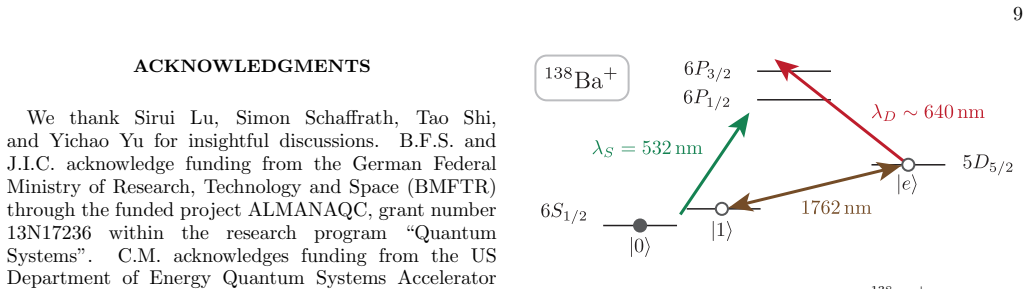
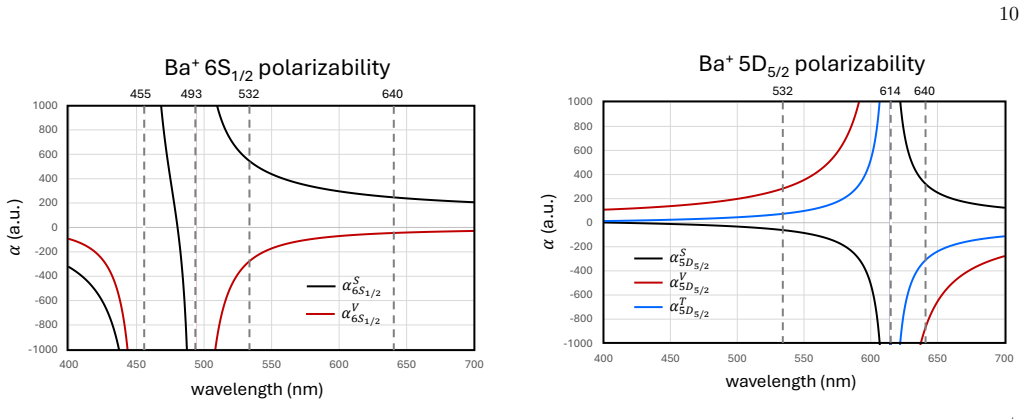
- Provides a concrete barium-ion path using state-selective polarizability for dipole control.
- Combines ion coherence times with tweezer reconfigurability for transport to local interaction zones.
Where Pith is reading between the lines
- The same dipole mechanism could reduce the shuttling overhead typical of linear ion chains by allowing local parallel operations.
- Hybrid platforms might adopt similar state-induced dipole gates to combine coherence and mobility advantages.
- Testing the temperature robustness at higher motional temperatures would directly probe the claimed independence from initial thermal state.
Load-bearing premise
That excitation to an auxiliary state with a displaced optical potential generates a controllable effective electric dipole suitable for precise Coulomb-mediated gates without unacceptable decoherence or motional heating.
What would settle it
Direct observation of residual motional entanglement or excess heating after gate operations on transported ions in tweezer arrays would falsify the trajectory-closure claim.
Figures

read the original abstract
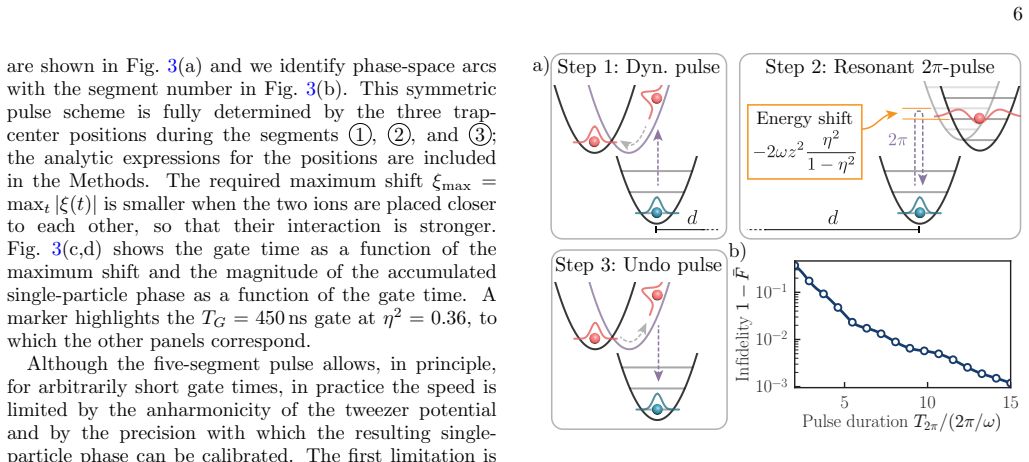
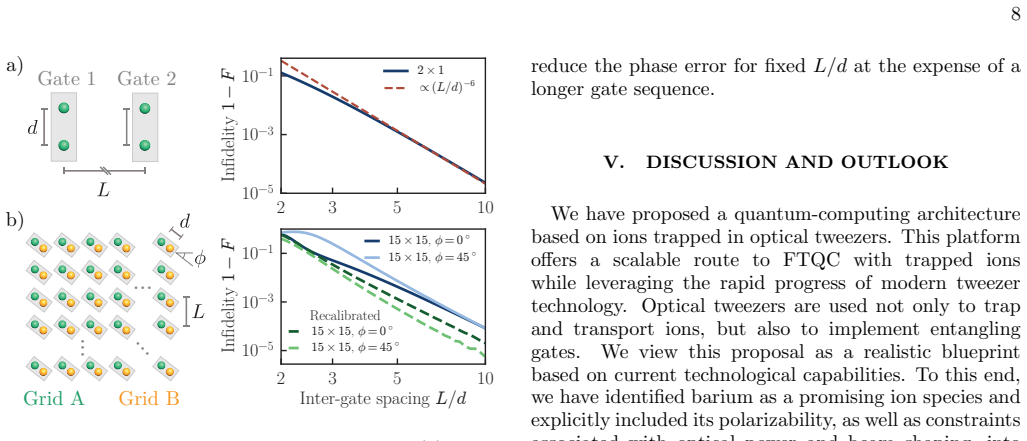
We propose a quantum computer architecture based on ions confined in optical tweezer arrays, combining the long coherence times of trapped-ion qubits with the reconfigurability and parallel operation enabled by tweezer platforms. Selected ions are transported to local interaction zones, where excitation to an auxiliary state with a displaced optical potential generates a controllable effective electric dipole. We develop and analyze entangling-gate mechanisms mediated by the Coulomb interaction between such effective dipoles, and show that they enable precise, temperature-robust closure of the center-of-mass and relative motional trajectories, leaving no residual entanglement between the qubits and the motion. We further outline a concrete implementation with barium ions based on state-selective polarizability, and study the suppression of cross-talk during parallel gate execution, with relevance to transversal gates in quantum error correction. Our results thereby establish a realistic route toward scalable ion-tweezer quantum processors.
Editorial analysis
A structured set of objections, weighed in public.
Referee Report
Summary. The manuscript proposes a quantum computer architecture based on ions in optical tweezer arrays. Ions are transported to local interaction zones where excitation to an auxiliary state with a displaced optical potential creates controllable effective electric dipoles; entangling gates are then mediated by the Coulomb interaction between these dipoles. The paper claims to develop and analyze these mechanisms, showing that they achieve precise, temperature-robust closure of center-of-mass and relative motional trajectories with no residual qubit-motion entanglement. A concrete barium-ion implementation based on state-selective polarizability is outlined, together with analysis of cross-talk suppression during parallel gate execution.
Significance. If the central claims hold, the work would combine the long coherence times of trapped-ion qubits with the reconfigurability and parallelism of optical tweezers, providing a concrete route to scalable ion-based processors and enabling transversal gates relevant to quantum error correction. The temperature-robust motional closure, if demonstrated, would be a notable technical advance.
major comments (2)
- [Abstract (and main analysis sections)] The abstract asserts that the authors 'develop and analyze entangling-gate mechanisms' and 'show that they enable precise, temperature-robust closure' of motional trajectories. However, the manuscript provides no explicit equations, force models, or numerical simulations demonstrating that the effective-dipole Coulomb interaction produces exact cancellation of all motional phases (center-of-mass and relative) once finite polarizability gradients, blackbody transitions, and tweezer-induced AC Stark shifts are included. Without these derivations the load-bearing claim of zero residual entanglement cannot be assessed.
- [Implementation outline with barium ions] The weakest assumption—that auxiliary-state excitation in Ba+ generates a clean, controllable effective dipole without unacceptable heating or decoherence during transport and parallel operation—is stated but not quantitatively bounded. No estimates or bounds appear for residual state-dependent forces that would violate the exact-closure condition.
minor comments (1)
- Notation for the effective dipole and the displaced optical potential should be defined explicitly at first use, with a clear statement of the regime in which the dipole approximation holds.
Simulated Author's Rebuttal
We thank the referee for the careful reading and constructive feedback. We address the two major comments below and will revise the manuscript accordingly to strengthen the presentation of the derivations and bounds.
read point-by-point responses
-
Referee: [Abstract (and main analysis sections)] The abstract asserts that the authors 'develop and analyze entangling-gate mechanisms' and 'show that they enable precise, temperature-robust closure' of motional trajectories. However, the manuscript provides no explicit equations, force models, or numerical simulations demonstrating that the effective-dipole Coulomb interaction produces exact cancellation of all motional phases (center-of-mass and relative) once finite polarizability gradients, blackbody transitions, and tweezer-induced AC Stark shifts are included. Without these derivations the load-bearing claim of zero residual entanglement cannot be assessed.
Authors: The main text (Sections III–IV) derives the dipole-mediated interaction and demonstrates motional closure for the ideal case using the displaced-potential force model. We agree, however, that the combined effects of finite polarizability gradients, blackbody transitions, and AC Stark shifts are not treated in a single explicit derivation. In the revised manuscript we will add a dedicated subsection containing the full force Hamiltonian, analytical cancellation conditions, and numerical trajectory simulations that confirm zero residual qubit-motion entanglement under realistic parameter values. revision: yes
-
Referee: [Implementation outline with barium ions] The weakest assumption—that auxiliary-state excitation in Ba+ generates a clean, controllable effective dipole without unacceptable heating or decoherence during transport and parallel operation—is stated but not quantitatively bounded. No estimates or bounds appear for residual state-dependent forces that would violate the exact-closure condition.
Authors: The barium-ion implementation is outlined via state-selective polarizability, but quantitative bounds on heating, decoherence, and residual state-dependent forces are indeed absent. In revision we will insert order-of-magnitude estimates and upper bounds derived from published Ba+ atomic data, showing that residual forces remain compatible with the exact-closure condition for the proposed gate durations and that heating rates stay below the threshold that would produce detectable motional entanglement. revision: yes
Circularity Check
No circularity: motional-closure analysis derives from independent physical modeling of Coulomb-mediated dipoles and trajectories
full rationale
The paper proposes an architecture and analyzes entangling gates via state-dependent effective dipoles generated by auxiliary-state excitation in tweezer arrays. The central claim of precise, temperature-robust center-of-mass and relative motional closure is presented as the outcome of developing and analyzing interaction mechanisms, not as a fit to data or a renaming of inputs. No self-definitional equations, fitted parameters called predictions, or load-bearing self-citations appear in the provided abstract or description. The derivation chain relies on standard trapped-ion and optical-tweezer physics applied to the new setup, remaining self-contained against external benchmarks without reducing to its own assumptions by construction.
Axiom & Free-Parameter Ledger
axioms (2)
- domain assumption Trapped-ion coherence times and optical tweezer reconfigurability can be combined without fundamental incompatibility.
- domain assumption State-selective polarizability allows generation of effective dipoles suitable for Coulomb gates.
invented entities (1)
-
effective electric dipole from auxiliary state excitation
no independent evidence
Reference graph
Works this paper leans on
-
[1]
The Gaussian field envelope isE(ρ) =E 0e−ρ2/w2 0, wherew 0 is the beam waist, so that the corresponding intensity profile isI(ρ) =I 0e−2ρ2/w2 0 with peak intensityI 0 = cε0E2 0 /2
Details on the experimental considerations We model each optical tweezer as a monochromatic running-wave Gaussian beam with electric field E= 1 2 E(ρ) ϵe i(k·r−ωLt) +ϵ ∗e−i(k·r−ωLt) ,(14) whereρis the transverse distance from the beam axis,k is the propagation wavevector,ω L =c|k|is the optical frequency, andϵis the polarization unit vector. The Gaussian ...
-
[2]
2, 3 and 4, with additional details on the numerical simulations included in the SI
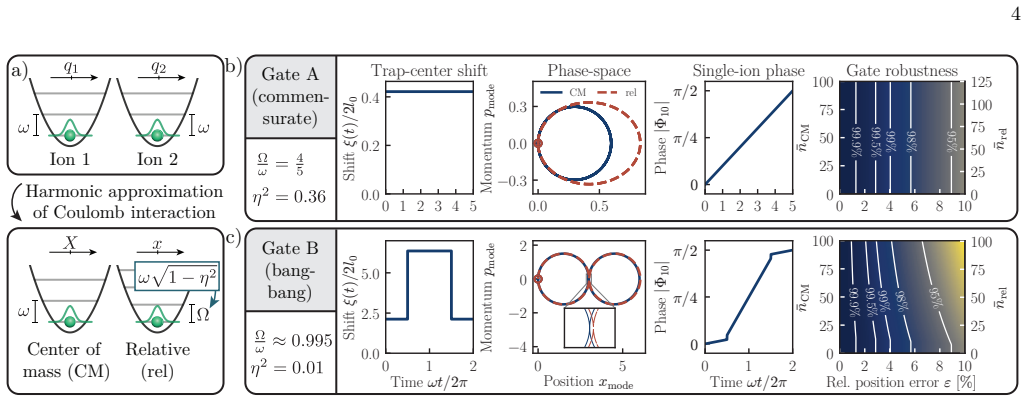
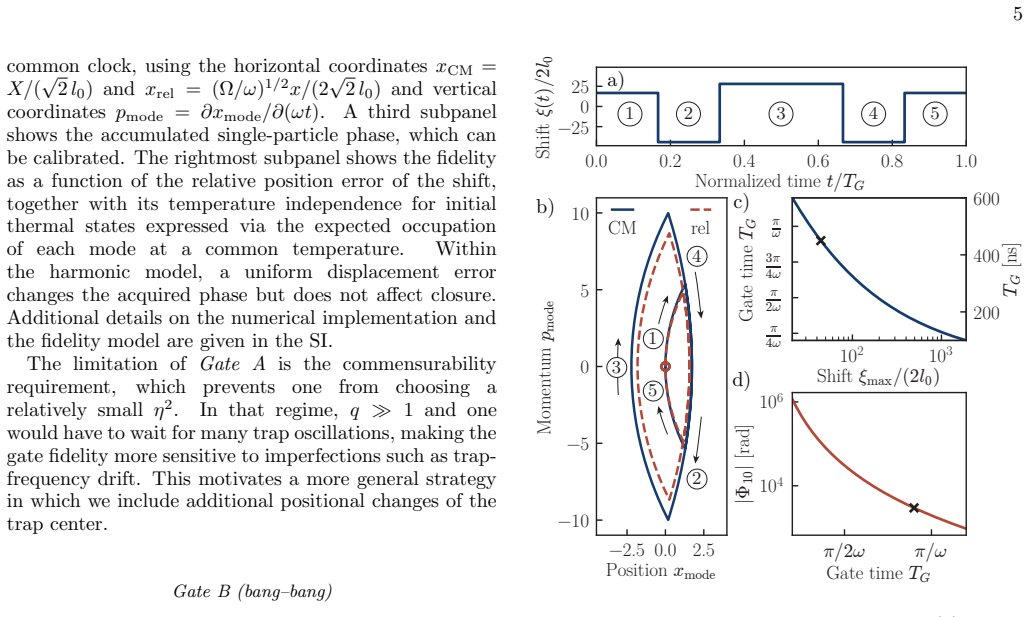
Gate descriptions We summarize the most important formulas used for the gate panels of Figs. 2, 3 and 4, with additional details on the numerical simulations included in the SI. We keep the conventions of the main text and setℏ= 1. For the perpendicular geometry we write Ω/ω= p 1−η 2. We further use the notation: l0 = r 1 2mω , ξ(t) = 2l 0zg(t), η 2 = e2 ...
-
[3]
M. A. Nielsen and I. L. Chuang,Quantum Computation and Quantum Information (10th Anniversary Edition) (Cambridge University Press, 2010)
2010
-
[4]
Preskill, Fault-tolerant quantum computation, in Introduction to Quantum Computation and Information (WORLD SCIENTIFIC, 1998) pp
J. Preskill, Fault-tolerant quantum computation, in Introduction to Quantum Computation and Information (WORLD SCIENTIFIC, 1998) pp. 213–269
1998
-
[5]
E. T. Campbell, B. M. Terhal, and C. Vuillot, Roads towards fault-tolerant universal quantum computation, Nature549, 172 (2017)
2017
-
[6]
J. I. Cirac and P. Zoller, Quantum Computations with Cold Trapped Ions, Physical Review Letters74, 4091 (1995)
1995
-
[7]
Sørensen and K
A. Sørensen and K. Mølmer, Quantum Computation with Ions in Thermal Motion, Physical Review Letters82, 1971 (1999)
1971
-
[8]
J. I. Cirac and P. Zoller, A scalable quantum computer with ions in an array of microtraps, Nature404, 579 (2000)
2000
-
[9]
Leibfried, R
D. Leibfried, R. Blatt, C. Monroe, and D. Wineland, Quantum dynamics of single trapped ions, Reviews of Modern Physics75, 281 (2003)
2003
-
[10]
H¨ affner, C
H. H¨ affner, C. F. Roos, and R. Blatt, Quantum computing with trapped ions, Physics Reports469, 155 (2008)
2008
-
[11]
C. D. Bruzewicz, J. Chiaverini, R. McConnell, and J. M. Sage, Trapped-Ion Quantum Computing: Progress and Challenges, Applied Physics Reviews6, 021314 (2019)
2019
-
[12]
Kielpinski, C
D. Kielpinski, C. Monroe, and D. J. Wineland, Architec- ture for a large-scale ion-trap quantum computer, Nature 417, 709 (2002)
2002
-
[13]
J. M. Pino, J. M. Dreiling, C. Figgatt, J. P. Gaebler, S. A. Moses, M. S. Allman, C. H. Baldwin, M. Foss-Feig, D. Hayes, K. Mayer, C. Ryan-Anderson, and B. Neyenhuis, Demonstration of the trapped-ion quantum CCD computer architecture, Nature592, 209 (2021)
2021
-
[14]
A. Ransford, M. S. Allman, J. Arkinstall, J. P. Campora, S. F. Cooper, R. D. Delaney, J. M. Dreiling, B. Estey, C. Figgatt, A. Hall, A. A. Husain, A. Isanaka, C. J. Kennedy, N. Kotibhaskar,et al., A 98-qubit trapped-ion quantum computer with all-to-all connectivity, Nature 10.1038/s41586-026-10676-4 (2026)
-
[15]
Endres, H
M. Endres, H. Bernien, A. Keesling, H. Levine, E. R. Anschuetz, A. Krajenbrink, C. Senko, V. Vuletic, M. Greiner, and M. D. Lukin, Atom-by-atom assembly of defect-free one-dimensional cold atom arrays, Science 354, 1024 (2016)
2016
-
[16]
Barredo, S
D. Barredo, S. de L´ es´ eleuc, V. Lienhard, T. Lahaye, and A. Browaeys, An atom-by-atom assembler of defect-free arbitrary two-dimensional atomic arrays, Science354, 1021 (2016)
2016
-
[17]
Browaeys and T
A. Browaeys and T. Lahaye, Many-body physics with individually-controlled Rydberg atoms, Nature Physics 16, 132 (2020)
2020
-
[18]
Bluvstein, H
D. Bluvstein, H. Levine, G. Semeghini, T. T. Wang, S. Ebadi, M. Kalinowski, A. Keesling, N. Maskara, H. Pichler, M. Greiner, V. Vuleti´ c, and M. D. Lukin, A quantum processor based on coherent transport of entangled atom arrays, Nature604, 451 (2022)
2022
-
[19]
T. M. Graham, Y. Song, J. Scott, C. Poole, L. Phut- titarn, K. Jooya, P. Eichler, X. Jiang, A. Marra, B. Grinkemeyer, M. Kwon, M. Ebert, J. Cherek, M. T. Lichtman, M. Gillette,et al., Multi-qubit entanglement and algorithms on a neutral-atom quantum computer, Nature604, 457 (2022)
2022
-
[20]
H. J. Manetsch, G. Nomura, E. Bataille, X. Lv, K. H. Leung, and M. Endres, A tweezer array with 6,100 highly coherent atomic qubits, Nature647, 60 (2025)
2025
-
[21]
Bluvstein, A
D. Bluvstein, A. A. Geim, S. H. Li, S. J. Evered, J. P. Bonilla Ataides, G. Baranes, A. Gu, T. Manovitz, M. Xu, M. Kalinowski, S. Majidy, C. Kokail, N. Maskara, E. C. Trapp,et al., A fault-tolerant neutral-atom architecture for universal quantum computation, Nature649, 39 (2026)
2026
-
[22]
Jaksch, J
D. Jaksch, J. I. Cirac, P. Zoller, S. L. Rolston, R. Cˆ ot´ e, and M. D. Lukin, Fast Quantum Gates for Neutral Atoms, Physical Review Letters85, 2208 (2000)
2000
-
[23]
Levine, A
H. Levine, A. Keesling, G. Semeghini, A. Omran, T. T. Wang, S. Ebadi, H. Bernien, M. Greiner, V. Vuleti´ c, H. Pichler, and M. D. Lukin, Parallel implementation of high-fidelity multiqubit gates with neutral atoms, Physical Review Letters123, 170503 (2019)
2019
-
[24]
M. D. Lukin, M. Fleischhauer, R. Cote, L. M. Duan, D. Jaksch, J. I. Cirac, and P. Zoller, Dipole Blockade and Quantum Information Processing in Mesoscopic Atomic Ensembles, Physical Review Letters87, 037901 (2001)
2001
-
[25]
S. J. Evered, D. Bluvstein, M. Kalinowski, S. Ebadi, T. Manovitz, H. Zhou, S. H. Li, A. A. Geim, T. T. Wang, N. Maskara, H. Levine, G. Semeghini, M. Greiner, V. Vuleti´ c, and M. D. Lukin, High-fidelity parallel entangling gates on a neutral-atom quantum computer, Nature622, 268 (2023)
2023
-
[26]
Saffman, T
M. Saffman, T. G. Walker, and K. Mølmer, Quantum information with Rydberg atoms, Reviews of Modern Physics82, 2313 (2010)
2010
-
[27]
X. L. Zhang, A. T. Gill, L. Isenhower, T. G. Walker, and M. Saffman, Fidelity of a Rydberg-blockade quantum gate from simulated quantum process tomography, Physical Review A85, 042310 (2012)
2012
-
[28]
Saffman, Quantum computing with atomic qubits and Rydberg interactions: Progress and challenges, Journal of Physics B: Atomic, Molecular and Optical Physics49, 202001 (2016)
M. Saffman, Quantum computing with atomic qubits and Rydberg interactions: Progress and challenges, Journal of Physics B: Atomic, Molecular and Optical Physics49, 202001 (2016)
2016
-
[29]
S. R. Cohen and J. D. Thompson, Quantum Computing with Circular Rydberg Atoms, PRX Quantum2, 030322 (2021)
2021
-
[30]
M. Saffman, Quantum computing with atomic qubit arrays: Confronting the cost of connectivity (2025), arXiv:2505.11218
arXiv 2025
-
[31]
S. A. Norrell, Y. Shen, M. Saffman, and M. Otten, En- tangling gate performance and fidelity limits with neutral atom F¨ orster resonances (2026), arXiv:2605.19245
Pith/arXiv arXiv 2026
-
[32]
Kielpinski, B
D. Kielpinski, B. E. King, C. J. Myatt, C. A. Sackett, Q. A. Turchette, W. M. Itano, C. Monroe, D. J. Wineland, and W. H. Zurek, Sympathetic cooling of trapped ions for quantum logic, Physical Review A61, 032310 (2000)
2000
-
[33]
Belyansky, J
R. Belyansky, J. T. Young, P. Bienias, Z. Eldredge, A. M. Kaufman, P. Zoller, and A. V. Gorshkov, Nondestructive cooling of an atomic quantum register via state-insensitive Rydberg interactions, Physical Review Letters123, 213603 (2019). 14
2019
-
[34]
Schmied, T
R. Schmied, T. Roscilde, V. Murg, D. Porras, and J. I. Cirac, Quantum phases of trapped ions in an optical lattice, New Journal of Physics10, 045017 (2008)
2008
-
[35]
Schneider, M
Ch. Schneider, M. Enderlein, T. Huber, and T. Schaetz, Optical trapping of an ion, Nature Photonics4, 772 (2010)
2010
-
[36]
Huber, A
T. Huber, A. Lambrecht, J. Schmidt, L. Karpa, and T. Schaetz, A far-off-resonance optical trap for a Ba+ ion, Nature Communications5, 5587 (2014)
2014
-
[37]
Schaetz, Trapping ions and atoms optically, Journal of Physics B: Atomic, Molecular and Optical Physics50, 102001 (2017)
T. Schaetz, Trapping ions and atoms optically, Journal of Physics B: Atomic, Molecular and Optical Physics50, 102001 (2017)
2017
-
[38]
Weckesser, F
P. Weckesser, F. Thielemann, D. Hoenig, A. Lambrecht, L. Karpa, and T. Schaetz, Trapping, shaping and isolating of ion Coulomb crystals via state-selective optical potentials, Physical Review A103, 1 (2021)
2021
-
[39]
Mazzanti, R
M. Mazzanti, R. Gerritsma, R. J. C. Spreeuw, and A. Safavi-Naini, Trapped ions quantum logic gate with optical tweezers and the Magnus effect, Physical Review Research5, 033036 (2023)
2023
-
[40]
Robalo Pereira, L
C. Robalo Pereira, L. J. Bond, M. Mazzanti, R. Ger- ritsma, and A. Safavi-Naini, Fast Quantum Gates with Electric Field Pulses and Optical Tweezers in Trapped Ions, Entropy27, 595 (2025)
2025
-
[41]
Olsacher, L
T. Olsacher, L. Postler, P. Schindler, T. Monz, P. Zoller, and L. M. Sieberer, Scalable and Parallel Tweezer Gates for Quantum Computing with Long Ion Strings, PRX Quantum1, 020316 (2020)
2020
-
[42]
Shen and G.-D
Y.-C. Shen and G.-D. Lin, Scalable quantum computing stabilised by optical tweezers on an ion crystal, New Journal of Physics22, 053032 (2020)
2020
-
[43]
Y. H. Teoh, M. Sajjan, Z. Sun, F. Rajabi, and R. Islam, Manipulating phonons of a trapped-ion system using optical tweezers, Physical Review A104, 022420 (2021)
2021
-
[44]
Weedbrook, S
C. Weedbrook, S. Pirandola, R. Garcia-Patron, N. J. Cerf, T. C. Ralph, J. H. Shapiro, and S. Lloyd, Gaussian quantum information, Reviews of Modern Physics84, 621 (2012)
2012
-
[45]
J. J. Garc´ ıa-Ripoll, P. Zoller, and J. I. Cirac, Speed optimized two-qubit gates with laser coherent control techniques for ion trap quantum computing, Physical Review Letters91, 157901 (2003)
2003
-
[46]
J. J. Garc´ ıa-Ripoll, P. Zoller, and J. I. Cirac, Coherent control of trapped ions using off-resonant lasers, Physical Review A71, 062309 (2005)
2005
-
[47]
S. J. Glaser, U. Boscain, T. Calarco, C. P. Koch, W. K¨ ockenberger, R. Kosloff, I. Kuprov, B. Luy, S. Schirmer, T. Schulte-Herbr¨ uggen, D. Sugny, and F. K. Wilhelm, Training Schr¨ odinger’s cat: Quantum optimal control, The European Physical Journal D69, 279 (2015)
2015
-
[48]
Grimm, M
R. Grimm, M. Weidem¨ uller, and Y. B. Ovchinnikov, Optical dipole traps for neutral atoms, inAdvances In Atomic, Molecular, and Optical Physics, Vol. 42 (Elsevier, 2000) pp. 95–170
2000
-
[49]
To convert from atomic units (a.u.) of polarizability to physical units, multiply by 4πε 0a3 B, wherea B = 5.29× 10⁻¹¹ m is the Bohr radius
-
[50]
Le Kien, P
F. Le Kien, P. Schneeweiss, and A. Rauschenbeutel, Dynamical polarizability of atoms in arbitrary light fields: General theory and application to cesium, The European Physical Journal D67, 92 (2013)
2013
-
[51]
Zhang, K
Z. Zhang, K. J. Arnold, S. R. Chanu, R. Kaewuam, M. S. Safronova, and M. D. Barrett, Branching fractions forP 3/2 decays in Ba +, Physical Review A101, 062515 (2020)
2020
-
[52]
Kiruga, C
A. Kiruga, C. Cheung, D. Filin, P. Barakhshan, A. Bhosale, V. Badhan, B. Arora, R. Eigenmann, and M. S. Safronova, Portal for high-precision atomic data and computation, Computer Physics Communications 319, 109951 (2026)
2026
-
[53]
I. D. Moore, W. C. Campbell, E. R. Hudson, M. J. Boguslawski, D. J. Wineland, and D. T. C. Allcock, Photon scattering errors during stimulated raman transitions in trapped-ion qubits, Phys. Rev. A107, 032413 (2023)
2023
-
[54]
Ozeri, W
R. Ozeri, W. M. Itano, R. B. Blakestad, J. Britton, J. Chiaverini, J. D. Jost, C. Langer, D. Leibfried, R. Reichle, S. Seidelin, J. H. Wesenberg, and D. J. Wineland, Errors in trapped-ion quantum gates due to spontaneous photon scattering, Phys. Rev. A75, 042329 (2007)
2007
-
[55]
Gerry and P
C. Gerry and P. Knight,Introductory Quantum Optics (Cambridge University Press, Cambridge, 2004)
2004
-
[56]
M. A. Nielsen, A simple formula for the average gate fidelity of a quantum dynamical operation, Physics Letters A303, 249 (2002). 15 SUPPLEMENT AR Y INFORMA TION This Supplement complements the main text and the Methods. It introduces the physical model for the two-ion gate in Sec. III, as well as the description and analysis of the gates in Secs. III B a...
2002
-
[57]
III for the perpendicular two-qubit gate
Two-ion Hamiltonian In this section we derive the formulas quoted in Sec. III for the perpendicular two-qubit gate. Throughout we set ℏ= 1 and use aone-dimensionalmotional model along the push direction, which is perpendicular to the gate axis. The push direction is thus the one directly affected by the state-dependent tweezer displacement and therefore t...
-
[58]
III B reduce, mode by mode, to harmonic oscillators whose equilibrium position is changed in time
Piecewise-displaced oscillators The dynamical gates in Sec. III B reduce, mode by mode, to harmonic oscillators whose equilibrium position is changed in time. The displaced-oscillator form in Eq. (53) therefore allows for a particularly simple analysis of the gate. Below, we introduce the bookkeeping to describe the evolution of an initial coherent state ...
-
[59]
Description of the two-ion gates We now provide a full description of the four gate protocols presented in the main text, starting with the three dynamical gates and then presenting the dipole-blockade gate. 19 a. Commensurate single-hold gate (Gate A). The conceptually simplest pulse is the commensurate gate, which requires only a single hold during the ...
-
[60]
1 explicit and complement the brief discussion of anharmonicity in Sec
T rap anharmonicity of the Gaussian tweezer We make the harmonic approximation used in Sec. 1 explicit and complement the brief discussion of anharmonicity in Sec. IV of the main text. The harmonic model that we consider describes each occupied branch by the local curvature of the optical trap around its minimum. For a Gaussian tweezer with minimum atq=ξ,...
-
[61]
In practice, the push tweezer might apply a residual force on the qubit manifold, and the qubit tweezer could contribute a potential for the |e⟩state
Recalibration of trap cross-talk We considered the displacement of the tweezers as perfectly state selective in the gate model. In practice, the push tweezer might apply a residual force on the qubit manifold, and the qubit tweezer could contribute a potential for the |e⟩state. Here we discuss that this does not necessarily change the structure of the gat...
-
[62]
Unless noted otherwise, we assume here a trap frequency ofω/2π= 1 MHz, an ion mass ofm≈138 u≈2.29×10 −25 kg, and a beam waistw 0 = 1µm
Experimental parameters for barium ions We collect benchmark numbers for the Ba + implementation discussed in the manuscript. Unless noted otherwise, we assume here a trap frequency ofω/2π= 1 MHz, an ion mass ofm≈138 u≈2.29×10 −25 kg, and a beam waistw 0 = 1µm. We first summarize how the geometry influences the coupling, and then discuss optical power req...
-
[63]
Gate diagnostics This section collects several formulas used in the numerical analysis of the gates. 28 a. Thermal-state fidelity We analyze the gate fidelity of the two-ion gates for initial states that are not in the motional vacuum, but have some residual temperature. The main physical point is that an exactly closed harmonic gate doesnotdecohere when ...
discussion (0)
Sign in with ORCID, Apple, or X to comment. Anyone can read and Pith papers without signing in.