REVIEW 2 major objections 5 minor 2 cited by
Topological Chiral Superconductivity in the Triangular-Lattice Hofstadter-Hubbard Model
T0 review · 2 major / 5 minor · reviewed 2026-08-05 · deepseek-v4-flash
Pith's one-line read The lightly doped triangular-lattice Hofstadter-Hubbard model forms a chiral superconductor with a quantized spin Chern number Cs=2 over a wide range of interaction strengths and hole doping.
desk verdict A solid, internally consistent DMRG/DQMC study mapping out a chiral SC dome in the doped Hofstadter-Hubbard model; the Cs=2 flux measurement is standard and defensible, though the paper should explicitly connect it to the topological invariant of the paired state. read the letter →
The pith
A machine-rendered reading of the paper's core claim, the machinery that carries it, and where it could break.
The reading
What carries the argument
The argument is carried by pairing correlation functions P_{αβ}(r) and by flux insertion in U(1)×U(1) DMRG simulations: threading spin-dependent and spin-independent boundary fluxes around the cylinder and reading the accumulated spin and charge near the edge yields the spin and charge Chern numbers. The quantized spin accumulation defines Cs=2, while the power-law decay of pair-pair correlations, extrapolated to infinite bond dimension, defines quasi-long-range superconductivity through Luttinger exponents. The underlying model uses the imaginary C6z gauge with π/2 flux per triangular plaquette, which fixes the magnetic translation antisymmetry and the −π/3 rotation phase of the pairing ord
What would settle it
A direct check would be to compute the pairing exponents and the spin Chern number on substantially wider cylinders (Ly=8 or Ly=10) and with DQMC at lower temperature: if the pair correlations become exponential or the extrapolated K_SC reaches or exceeds 1 in the two-dimensional limit, the quasi-long-range superconducting claim is falsified. Likewise, if flux insertion in a formulation that allows charge U(1) breaking yields a non-integer or non-2 spin Chern number, the topological identification fails.
Extended reading notes
Core claim
The central claim is that a robust chiral superconducting phase appears after lightly doping the Hofstadter-Hubbard model on a triangular lattice at one-quarter flux quantum per triangle. The phase is identified by spin-singlet pair-pair correlations that decay as a power law with Luttinger exponent K_SC ≈ 0.70 at U=8 and K_SC ≈ 0.95 at U=14, both smaller than the coexisting charge-density-wave exponent, indicating that superconductivity dominates. The same state carries a quantized spin Chern number Cs=2, obtained by adiabatically threading spin-dependent flux through the cylinder, while the charge Chern number vanishes. The superconducting order is odd under magnetic translations and acqui
Load-bearing premise
The topological claim rests on assuming that the spin Chern number Cs=2 read from adiabatic spin-flux insertion on a finite charge-conserving cylinder is a well-defined physical invariant of the superconducting state, even though that state does not spontaneously break charge U(1) symmetry in the finite geometry.
Editorial extensions
If this is right
- A single topological superconducting phase can be reached by doping either the integer quantum Hall or the chiral spin liquid parent, suggesting the parent state need not be a spin liquid for chiral superconductivity to appear.
- The quantized spin Chern number Cs=2 implies the superconducting state carries chiral topological edge structure, analogous to previously studied topological chiral superconductors in doped triangular Mott insulators.
- Superconductivity persists even at weak interaction, growing stronger at intermediate U near the IQH-CSL critical point, so the phase should be accessible in moiré materials without requiring very strong correlations.
- The pairing susceptibility gives a dome-shaped Tc with doping that vanishes at half filling, connecting the superconducting instability directly to the nature of the undoped parent state.
- In the quasi-1D cylinder geometry superconductivity coexists with a subdominant charge-density wave, but the pairing exponent decreases with cylinder width, indicating superconductivity wins in the two-dimensional limit.
Reading between the lines
- If the same phase persists in wider cylinders and in the thermodynamic limit, the DMRG and DQMC signatures together predict that twisted TMD moiré systems under moderate magnetic fields should show chiral superconducting behavior, detectable through edge transport or Josephson interference.
- The paper's picture of two distinct normal states—a Fermi liquid at small U and a doped chiral spin liquid at large U—suggests the topological superconductor may arise by two different mechanisms (weak-coupling interband pairing versus anyon condensation) that are stitched together by the same topological criticality; comparing quasiparticle signatures across U would test this unification.
- A testable extension is to check whether the single TSC phase remains connected when the flux per plaquette is varied away from π/2; the symmetry arguments would predict that the pairing phase pattern and the value of Cs=2 change together, offering a sharper experimental fingerprint.
- The finding that charge U(1) symmetry is unbroken in the finite DMRG cylinder, while the spin Chern number is quantized, raises the question of whether Cs=2 survives once long-range superconducting order actually develops; a variational or embedding calculation allowing symmetry breaking could settle this.
Editorial analysis
A structured set of objections, weighed in public.
Referee Report
Summary. The manuscript studies the lightly doped triangular-lattice Hofstadter-Hubbard model with π/2 flux per triangle, using DMRG on cylinders (Ly = 3, 4, 6, 8) and DQMC on tori. It reports a chiral superconducting (SC) phase over a broad range of U and hole doping, evidenced by power-law pair-pair correlations with K_SC ≈ 0.70–0.95 after extrapolation to infinite bond dimension, dominance over CDW correlations, a finite spin gap, electron binding, and a pairing phase pattern that is antisymmetric under magnetic translations and transforms by −π/3 under the magnetic C6 rotation. The 'topological' label rests on a DMRG spin-flux insertion measurement reporting a quantized spin transfer Cs = 2, together with a nonzero spin chiral order. A second-order Kohn–Luttinger calculation in the Supplemental Material independently yields the same pairing symmetry and a unique attractive channel, and DQMC shows growing low-temperature pairing susceptibility. The paper concludes that a single topological chiral SC phase emerges from doping both the IQH and CSL parent states.
Significance. If the conclusions hold, this is a significant numerical result: it provides evidence for topological superconductivity in a realistic strong-correlation model relevant to TMD moiré systems, starting from both Chern insulator and chiral spin liquid parents. The DMRG evidence is unusually thorough: large bond dimensions up to M = 24000, M → ∞ extrapolations, multiple cylinder widths, and consistency between DMRG and DQMC pairing phase patterns. The perturbative Kohn–Luttinger calculation is parameter-free in the sense that it contains no fitted constants and predicts the same pairing symmetry as the numerics. The main weakness is the identification of the flux-insertion spin transfer as a topological invariant of a superconducting state; this step is not presently justified and is load-bearing for the claim of topological SC.
major comments (2)
- [Fig. 5 and section 'Quantized spin Chern number'] The claim Cs = 2 is not established as a topological invariant of the superconducting state. The flux-insertion argument of Refs. [16,47] applies to gapped phases with conserved currents. Here the DMRG cylinder conserves charge U(1) and the ground state has only quasi-long-range pairing correlations (K_SC ≈ 0.70–0.95); it is a paired Luther–Emery liquid, not a 2D broken-symmetry superconductor. The paper does not show that ΔQs measured via spin-dependent boundary conditions equals the spin Chern number of the BdG bands of the eventual 2D SC. This matters because the central 'topological' label rests precisely on Fig. 5(c). I recommend adding a BdG mean-field check: construct the d+id pairing state obtained from the derived order parameter on the same cylinder and verify that spin-flux pumping gives the BdG spin Chern number, and also test whether a topologically trivial spin-gapped paire
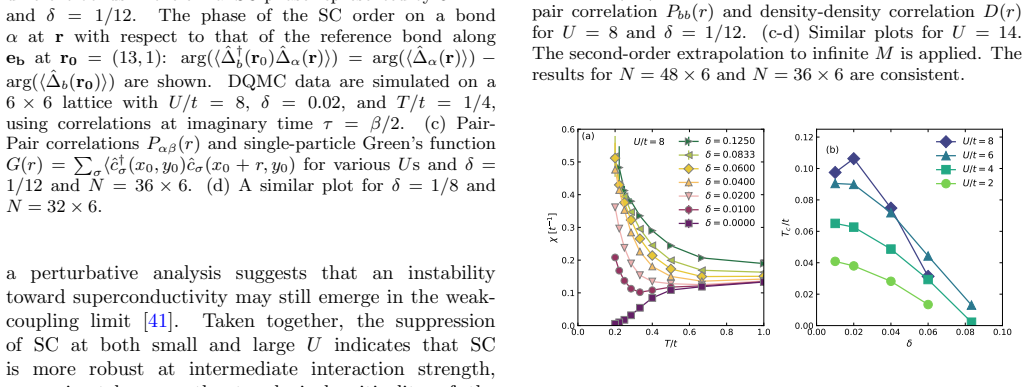
- [Fig. 4 and section 'DQMC supplementary data' (Figs. S14–S16)] The quantity called Tc is obtained by linearly extrapolating [χ(τ = β/2)]^{-1} to zero. This is not the standard static susceptibility divergence, and the linear extrapolation is an uncontrolled functional form on finite 6×6 lattices. The text acknowledges that Tc is a 'characteristic temperature,' but the abstract-level and figure-level presentation treats it as a superconducting critical temperature. The finite-temperature claim would be better worded as a heuristic pairing scale (e.g., T_pair) with an explicit caveat that the extrapolation has no known rigorous relation to the thermodynamic Tc. This issue does not invalidate the zero-temperature DMRG evidence, but it does affect the quantitative conclusions drawn from Fig. 4(b).
minor comments (5)
- [Equation (1)] The Hamiltonian sum is written as ∑_{⟨xy⟩}, but the operators use indices i and j. Please use a consistent index label such as ⟨ij⟩.
- [Supplemental Eq. (S4) and main-text definition of χ(β/2)] The normalization appears inconsistent: the main text defines χ(β/2) ≡ β⟨O†(τ=β/2)O⟩/N, while Eq. (S4) defines χ(τ)/β ≡ ⟨O†(τ)O⟩. Please unify the convention so the reader can follow the derivation of Eq. (S12).
- [Summary and Fig. S10] The Summary states 'long-range spin chiral order,' but Fig. S10 shows only local expectation values ⟨χ⟩, not spatial chiral–chiral correlation functions. Please either provide decay/correlation data or qualify the statement as a nonzero local chiral order.
- [Fig. 5(c)] The spin Chern number is reported as quantized with 'm = 10000' convergence, but no numerical values, error bars, or comparison across bond dimensions are shown. A small table or a convergence plot would strengthen the claim.
- [Fig. 1(c) and 'Quantum phase diagram'] The text says Cc 'vanishes (or nearly zero)' in the TSC phase. Please give the actual numerical range and define the tolerance used to distinguish zero from small non-zero values.
Circularity Check
No load-bearing circularity: the pairing symmetry is independently derived by second-order perturbation theory and confirmed by two unbiased numerics; the flux-insertion Cs=2 is a direct response measurement, not a fitted output.
full rationale
The derivation chain is numerically self-contained. The central claims—dominant power-law pairing correlations and a quantized spin Chern number Cs=2—come from independent DMRG and DQMC simulations. Luttinger exponents are extracted from correlation functions but serve as characterizations, not as inputs that force the conclusion. The supplement's pairing-symmetry analysis is a parameter-free second-order Kohn-Luttinger calculation (Eqs. S20-S31): its inputs are the noninteracting band structure and U, and it yields a unique negative eigenvalue whose eigenvector is then compared with DMRG and DQMC patterns; no fitted constant from the numerics is used. The flux-insertion measurement of Cs is a direct response calculation (Fig. 5); while the paper does not rigorously derive that the measured Delta Qs equals the 2D BdG spin Chern number of the broken-symmetry superconductor, this is a methodological caveat rather than a circular step, because the target result is not defined into the measurement equation. Self-citations (e.g., Refs. [26,27,35,36]) are used for context, for the undoped parent-state phase diagram, and for the anyon-SC interpretation, but they do not supply the numerical result itself. The paper also openly reports limitations (Ly=8 convergence, small-U ground-state uncertainty), which do not indicate an attempt to hide a circular step. Overall, the core derivation is not circular; the score reflects only minor self-citation and an unproven but non-circular topological identification.
Assumptions & free parameters
assumptions (4)
- domain assumption The single-band Hubbard-Hofstadter model with imaginary C6z gauge and π/2 flux per triangle captures the low-energy physics of twisted TMD moiré materials.
- domain assumption Cylinder DMRG with Ly = 6 and width scaling from Ly = 3, 4, 6 is representative of the 2D thermodynamic limit for the SC order.
- ad hoc to paper The spin Chern number measured via U(1)×U(1) flux insertion in a charge-conserving DMRG cylinder is a valid topological invariant for the superconducting state.
- standard math Second-order perturbation theory in U provides a valid effective pairing vertex in the dilute doping regime.
Cite this review
Pith. "Pith review of Topological Chiral Superconductivity in the Triangular-Lattice Hofstadter-Hubbard Model." pith.science (2026). https://pith.science/paper/LJSALFAZ
@misc{pith2026250902757,
  author       = {Pith},
  title        = {Pith review of: Topological Chiral Superconductivity in the Triangular-Lattice Hofstadter-Hubbard Model},
  year         = {2026},
  howpublished = {\url{https://pith.science/paper/LJSALFAZ}},
  note         = {Machine review of arXiv:2509.02757}
}
read the original abstract
Moir\'e materials provide exciting platforms for studying the interplay of strong electronic correlation and large magnetic flux effects. We study the lightly doped Hofstadter-Hubbard model on a triangular lattice through large-scale density matrix renormalization group and determinantal quantum Monte Carlo simulations. We find strong evidence for a robust chiral superconducting (SC) phase with dominant power-law pairing correlations and a quantized spin Chern number. The SC phase emerges at very weak interaction and grows stronger at intermediate interaction strengths (U ) for a wide range of hole doping. We also discuss the possible distinct nature of the normal state in different U regimes. Our work provides theoretical insights into the emergence of topological superconductivity from doping topological Chern bands or magnetic flux induced chiral spin liquid states of Moir\'e materials.
Figures


Figures from the paper (2 more)


Forward citations
Cited by 2 Pith papers
-
Thermodynamic-Limit Evidence for Chiral Superconductivity Induced by Doping Chiral Topological Phases
Chiral superconductivity with finite pairing order and nearly universal phase winding emerges in the thermodynamic limit upon doping the chiral topological phases of the triangular Hofstadter-Hubbard model, per fermio...
-
Topology and compact molecular orbitals in twisted bilayer WSe$_2$
The top two moiré valence bands of twisted WSe2, computed from first principles, carry Chern number C=+1 each and decompose into a compact f-orbital plus a topological c-orbital, giving ab initio parameters for effect...
Reference graph
Works this paper leans on
-
[54]
Chiral Topological Superconductivity in the Triangular-Lattice Hofstadter-Hubbard Model
Clemens Kuhlenkamp, Stefan Divic, Michael P. Zaletel, Tomohiro Soejima, and Ashvin Vishwanath, Robust superconductivity upon doping chiral spin liquid and Chern insulators in a Hubbard-Hofstadter model. To appear. 8 (a) (b) (c) (d) FIG. S1. Pairing phase structures when different reference bonds are chosen. Black bond lines represent the reference bonds. ...
- [1]
-
[2]
P. A. Lee, N. Nagaosa, and X.-G. Wen, Doping a mott insulator: Physics of high-temperature superconductivity, Rev. Mod. Phys. 78, 17 (2006)
work page 2006
-
[3]
P. W. Anderson, The resonating valence bond state in la2cuo4 and superconductivity, Science 235, 1196 (1987)
1987
-
[4]
M. Fabrizio, Superconductivity from doping a spin-liquid insulator: A simple one-dimensional example, Phys. Rev. B 54, 10054 (1996)
work page 1996
-
[5]
R. M. Konik, T. M. Rice, and A. M. Tsvelik, Doped Spin Liquid: Luttinger Sum Rule and Low Temperature Order, Phys. Rev. Lett. 96, 086407 (2006)
work page 2006
-
[6]
D. S. Rokhsar, Pairing in doped spin liquids: Anyon versus d-wave superconductivity, Phys. Rev. Lett. 70, 493 (1993)
work page 1993
-
[7]
Z. A. Kelly, M. J. Gallagher, and T. M. McQueen, Electron Doping a Kagome Spin Liquid, Phys. Rev. X 6, 041007 (2016)
work page 2016
Show all 55 references
-
[8]
Senthil and P
T. Senthil and P. A. Lee, Cuprates as doped $U(1)$ spin liquids, Phys. Rev. B 71, 174515 (2005)
2005
-
[9]
Sigrist, T
M. Sigrist, T. M. Rice, and F. C. Zhang, Superconductivity in a quasi-one-dimensional spin liquid, Phys. Rev. B 49, 12058 (1994)
1994
-
[10]
Kalmeyer and R
V. Kalmeyer and R. B. Laughlin, Equivalence of the resonating-valence-bond and fractional quantum hall states, Phys. Rev. Lett. 59, 2095 (1987)
-
[11]
R. B. Laughlin, Superconducting ground state of noninteracting particles obeying fractional statistics, Phys. Rev. Lett. 60, 2677 (1988)
1988
-
[12]
X. G. Wen, F. Wilczek, and A. Zee, Chiral spin states and superconductivity, Phys. Rev. B 39, 11413 (1989)
1989
-
[13]
Lee and M
D.-H. Lee and M. P. A. Fisher, Anyon superconductivity and the fractional quantum hall effect, Phys. Rev. Lett. 63, 903 (1989)
1989
-
[14]
Balents, Spin liquids in frustrated magnets, Nature 464, 199 (2010)
L. Balents, Spin liquids in frustrated magnets, Nature 464, 199 (2010)
2010
-
[15]
Y.-C. He, D. N. Sheng, and Y. Chen, Chiral spin liquid in a frustrated anisotropic kagome heisenberg model, Phys. Rev. Lett. 112, 137202 (2014)
2014
-
[16]
S.-S. Gong, W. Zhu, and D. N. Sheng, Emergent chiral spin liquid: Fractional quantum hall effect in a kagome heisenberg model, Scientific Reports 4, 6317 (2014)
2014
-
[17]
Bauer, L
B. Bauer, L. Cincio, B. P. Keller, M. Dolfi, G. Vidal, S. Trebst, and A. W. W. Ludwig, Chiral spin liquid and emergent anyons in a kagome lattice mott insulator, Nature Communications 5, 5137 (2014)
2014
-
[18]
S.-S. Gong, W. Zhu, L. Balents, and D. N. Sheng, Global phase diagram of competing ordered and quantum spin- liquid phases on the kagome lattice, Phys. Rev. B 91, 075112 (2015)
2015
-
[19]
Szasz, J
A. Szasz, J. Motruk, M. P. Zaletel, and J. E. Moore, Chiral spin liquid phase of the triangular lattice hubbard model: A density matrix renormalization group study, Phys. Rev. X 10, 021042 (2020)
2020
-
[20]
B.-B. Chen, Z. Chen, S.-S. Gong, D. N. Sheng, W. Li, and A. Weichselbaum, Quantum spin liquid with emergent chiral order in the triangular-lattice hubbard model, Phys. Rev. B 106, 094420 (2022)
2022
-
[21]
Wietek, R
A. Wietek, R. Rossi, F. ˇSimkovic, M. Klett, P. Hansmann, M. Ferrero, E. M. Stoudenmire, T. Sch¨ afer, and A. Georges, Mott insulating states with competing orders in the triangular lattice hubbard model, Phys. Rev. X 11, 041013 (2021)
2021
-
[22]
Y. Zhou, D. N. Sheng, and E.-A. Kim, Quantum phases of transition metal dichalcogenide moir´ e systems, Phys. Rev. Lett. 128, 157602 (2022)
2022
-
[23]
Peng, Y.-F
C. Peng, Y.-F. Jiang, D.-N. Sheng, and H.-C. Jiang, Doping quantum spin liquids on the kagome lattice, Advanced Quantum Technologies 4, 2000126 (2021)
2021
-
[24]
Z. Zhu, D. N. Sheng, and A. Vishwanath, Doped mott insulators in the triangular-lattice hubbard model, Phys. Rev. B 105, 205110 (2022)
2022
-
[25]
Jiang and H.-C
Y.-F. Jiang and H.-C. Jiang, Topological superconductivity in the doped chiral spin liquid on the triangular lattice, Phys. Rev. Lett. 125, 157002 (2020)
2020
-
[26]
Huang and D
Y. Huang and D. N. Sheng, Topological chiral and nematic superconductivity by doping mott insulators on triangular lattice, Phys. Rev. X 12, 031009 (2022)
2022
-
[27]
Huang, S.-S
Y. Huang, S.-S. Gong, and D. N. Sheng, Quantum Phase Diagram and Spontaneously Emergent Topological Chiral Superconductivity in Doped Triangular-Lattice Mott Insulators, Phys. Rev. Lett. 130, 136003 (2023)
2023
-
[28]
Fradkin, S
E. Fradkin, S. A. Kivelson, and J. M. Tranquada, Colloquium: Theory of intertwined orders in high temperature superconductors, Rev. Mod. Phys. 87, 457 (2015)
2015
-
[29]
X.-Y. Song, A. Vishwanath, and Y.-H. Zhang, Doping the chiral spin liquid: Topological superconductor or chiral metal, Phys. Rev. B 103, 165138 (2021)
2021
-
[30]
Khatua, B
J. Khatua, B. Sana, A. Zorko, M. Gomilˇ sek, K. Sethupathi, M. S. R. Rao, M. Baenitz, B. Schmidt, and P. Khuntia, Experimental signatures of quantum and topological states in frustrated magnetism, Physics Reports Experimental Signatures of Quantum and Topological States in Fru...
2023
-
[31]
Knolle and R
J. Knolle and R. Moessner, A Field Guide to Spin Liquids, Annual Review of Condensed Matter Physics 10, 451 (2019)
2019
-
[32]
F. Wu, T. Lovorn, E. Tutuc, and A. H. MacDonald, Hubbard model physics in transition metal dichalcogenide moir´ e bands, Physical review letters 121, 026402 (2018)
2018
-
[33]
Y. Tang, L. Li, T. Li, Y. Xu, S. Liu, K. Barmak, K. Watanabe, T. Taniguchi, A. H. MacDonald, J. Shan, and K. F. Mak, Simulation of hubbard model physics in wse2/ws2 moir´ e superlattices, Nature579, 353 (2020)
2020
-
[34]
Kuhlenkamp, W
C. Kuhlenkamp, W. Kadow, A. Imamo˘ glu, and M. Knap, Chiral Pseudospin Liquids in Moir \’e Heterostructures, Phys. Rev. X 14, 021013 (2024)
2024
-
[35]
Divic, T
S. Divic, T. Soejima, V. Cr´ epel, M. P. Zaletel, and A. Millis, Chiral spin liquid and quantum phase transition in the triangular lattice hofstadter-hubbard model (2024), arXiv:2406.15348 [cond-mat.str-el]
2024
-
[36]
Divic, V
S. Divic, V. Cr´ epel, T. Soejima, X.-Y. Song, A. Millis, M. P. Zaletel, and A. Vishwanath, Anyon superconductivity from topological criticality in a 7 hofstadter-hubbard model (2024), arXiv:2410.18175 [cond-mat.str-el]
2024 arXiv
-
[37]
Pichler, C
F. Pichler, C. Kuhlenkamp, M. Knap, and A. Vishwanath, Microscopic mechanism of anyon superconductivity emerging from fractional chern insulators (2025), arXiv:2506.08000 [cond-mat.str-el]
2025
-
[38]
S. R. White, Density matrix formulation for quantum renormalization groups, Physical review letters 69, 2863 (1992)
1992
-
[39]
Blankenbecler, D
R. Blankenbecler, D. J. Scalapino, and R. L. Sugar, Monte Carlo calculations of coupled boson-fermion systems. I, Phys. Rev. D 24, 2278 (1981)
1981
-
[40]
S. R. White, D. J. Scalapino, R. L. Sugar, E. Y. Loh, J. E. Gubernatis, and R. T. Scalettar, Numerical study of the two-dimensional Hubbard model, Phys. Rev. B40, 506 (1989)
1989
-
[41]
See Supplemental Materials at [URL will be inserted by publisher] for detailed numerical results and discussions
-
[42]
I. P. McCulloch, From density-matrix renormalization group to matrix product states, Journal of Statistical Mechanics: Theory and Experiment 2007, P10014 (2007)
2007
-
[43]
Shaffer, J
D. Shaffer, J. Wang, and L. H. Santos, Unconventional self-similar Hofstadter superconductivity from repulsive interactions, Nat Commun 13, 7785 (2022)
2022
-
[44]
Shaffer, J
D. Shaffer, J. Wang, and L. H. Santos, Theory of Hofstadter superconductors, Phys. Rev. B 104, 184501 (2021)
2021
-
[45]
Schollw¨ ock, The density-matrix renormalization group in the age of matrix product states, Annals of physics 326, 96 (2011)
U. Schollw¨ ock, The density-matrix renormalization group in the age of matrix product states, Annals of physics 326, 96 (2011)
2011
-
[46]
Jiang, Superconductivity in the doped quantum spin liquid on the triangular lattice, npj Quantum Materials 6, 1 (2021)
H.-C. Jiang, Superconductivity in the doped quantum spin liquid on the triangular lattice, npj Quantum Materials 6, 1 (2021)
2021
-
[47]
M. P. Zaletel, R. S. Mong, and F. Pollmann, Flux insertion, entanglement, and quantized responses, Journal of Statistical Mechanics: Theory and Experiment 2014, P10007 (2014)
2014
-
[48]
Cr´ epel, T
V. Cr´ epel, T. Cea, L. Fu, and F. Guinea, Unconventional superconductivity due to interband polarization, Phys. Rev. B 105, 094506 (2022)
2022
-
[49]
A. A. Markov, G. Rohringer, and A. N. Rubtsov, Robustness of the topological quantization of the hall conductivity for correlated lattice electrons at finite temperatures, Phys. Rev. B 100, 115102 (2019)
2019
-
[50]
X. Kou, L. Pan, J. Wang, Y. Fan, E. Choi, W.-L. Lee, T. Nie, K. Murata, Q. Shao, S.-C. Zhang, and K. Wang, Metal-to-insulator switching in quantum anomalous hall states, Nature Communications 6, 8474 (2015)
2015
-
[51]
Z. D. Shi and T. Senthil, Doping a fractional quantum anomalous hall insulator (2024), arXiv:2409.20567 [cond- mat.str-el]
2024
-
[52]
M. Kim, A. Timmel, L. Ju, and X.-G. Wen, Topological chiral superconductivity beyond pairing in a fermi liquid, Phys. Rev. B 111, 014508 (2025)
2025
-
[53]
Z. D. Shi and T. Senthil, Anyon delocalization transitions out of a disordered fqah insulator (2025), arXiv:2506.02128 [cond-mat.str-el]
2025 arXiv
-
[55]
(S14) and the sublattice coordinates are dA = (0, 0), d B = (1, 0), d C = 1 2 , √ 3 2 ! , d D = 3 2 , √ 3 2 ! (S15) With the imaginary C6 gauge, the free Hamiltonian is given by: H0 = i X ij τijc† iσcjσ + H. C. + µ X i c† iσciσ = X kσ X m=−,−′ ξ−(k)c† kmσckmσ + X m=+,+′ ξ+...
Reviewed August 5, 2026 · model on record in the stance chip above.
Discussion (0). Continue with ORCID to comment.