Partially-Blind Single-Qubit Classification over a Prototype Hybrid Quantum Network
Pith reviewed 2026-07-03 11:51 UTC · model grok-4.3
The pith
A framework for partially-blind single-qubit classification enables quantum-secured data classification over a hybrid quantum network link.
A machine-rendered reading of the paper's core claim, the machinery that carries it, and where it could break.
Core claim
The authors develop and simulate a PB-SQC protocol on a heterogeneous quantum network link, demonstrating through simulation that classification performance on real-world fraud data can approach classical levels while keeping data and outcomes hidden from the server, with an extension to two qubits enabling verification.
What carries the argument
The PB-SQC framework integrated with the heterogeneous quantum network link featuring multiplexed solid-state quantum memory and entanglement swapping.
If this is right
- Integrates into quantum networks to deliver quantum-secured classifications to remote clients.
- Supports scaling toward many-qubit quantum classifiers with potential advantage.
- A two-qubit classifier enables verification of the delegated computation.
- Paves the way for short- to mid-term quantum networks with practical applications.
Where Pith is reading between the lines
- If the hardware model is accurate, deploying this on actual devices would provide information-theoretically secure machine learning classifications.
- This approach could extend to other quantum machine learning tasks requiring privacy.
- Real-world testing on the prototype would validate the simulation results directly.
Load-bearing premise
The simulation with realistic hardware parameters accurately models the noise, loss, and timing of the multiplexed solid-state quantum memory and entanglement swapping link.
What would settle it
Running the PB-SQC protocol on the physical prototype network and comparing the resulting classification accuracy on the credit card database to the simulated accuracy.
Figures




read the original abstract
In the NISQ era, there is a need for resource-efficient proof-of-principle experiments that can be built up to genuine utility. Single-qubit classifiers (SQCs) are small-scale hybrid quantum-classical machines capable of performing a basic machine learning task: classifying data. In principle, these can be scaled up to many-qubit quantum classifiers capable of quantum computational advantage. Another type of quantum advantage is enabled by blind quantum computation (BQC), wherein a client may run delegated quantum computations on an untrusted server with information-theoretic security. In this paper, we develop a framework and propose a prototype experiment for a SQC where it is known to the server that a classification is being performed, but the data and outcome stay hidden, i.e., it performs partially-blind SQC (PB-SQC). This can be integrated into a quantum network to deliver quantum-secured classifications to remote clients; we study this for a heterogeneous quantum network link in which entanglement is shared between a server and a client equipped with a multiplexed solid-state quantum memory using entanglement swapping. The framework we develop for PB-SQC on this setup is tested in a simulation with realistic hardware parameters on a real-world credit card transaction fraud database with classification outcomes approaching those of its equivalent classical deep-belief network. In addition, we show how a two-qubit classifier (TQC) instead of a SQC enables verification of the computation. These results pave the way towards a short- to mid-term quantum network offering use-case-ready quantum applications.
Editorial analysis
A structured set of objections, weighed in public.
Referee Report
Summary. The paper develops a framework for partially-blind single-qubit classification (PB-SQC) on a heterogeneous quantum network link that uses entanglement swapping between a server and a client equipped with a multiplexed solid-state quantum memory. The framework is tested via numerical simulation with realistic hardware parameters on a real-world credit-card transaction fraud database; the reported classification outcomes approach those of an equivalent classical deep-belief network. The manuscript also shows that replacing the single-qubit classifier with a two-qubit classifier enables verification of the delegated computation.
Significance. If the simulation results hold under realistic noise models, the work supplies a concrete, resource-efficient route toward quantum-secured delegated classification on near-term hybrid networks. The use of a real-world dataset and the explicit integration of blind-quantum-computation primitives with a machine-learning task are strengths; the two-qubit verification protocol is a useful addition for practical deployment.
major comments (1)
- [Simulation section (paragraph on prototype experiment)] Simulation section (paragraph on prototype experiment): The central performance claim—that PB-SQC outcomes approach classical deep-belief-network accuracy—rests on a numerical simulation that injects “realistic hardware parameters” for the multiplexed solid-state quantum memory and entanglement-swapping link. No calibration data, measured decoherence rates, loss probabilities, timing-jitter distributions, or sensitivity analysis are supplied to show that the modeled values lie within the experimentally determined ranges of the cited prototype hardware. Any systematic optimism in these parameters would directly affect the reported quantum-classical performance gap.
Simulated Author's Rebuttal
We thank the referee for the careful reading and constructive feedback. The single major comment is addressed below; we agree it identifies a genuine gap in the presentation of the simulation and will revise the manuscript accordingly.
read point-by-point responses
-
Referee: Simulation section (paragraph on prototype experiment): The central performance claim—that PB-SQC outcomes approach classical deep-belief-network accuracy—rests on a numerical simulation that injects “realistic hardware parameters” for the multiplexed solid-state quantum memory and entanglement-swapping link. No calibration data, measured decoherence rates, loss probabilities, timing-jitter distributions, or sensitivity analysis are supplied to show that the modeled values lie within the experimentally determined ranges of the cited prototype hardware. Any systematic optimism in these parameters would directly affect the reported quantum-classical performance gap.
Authors: We agree that the manuscript does not supply the underlying calibration data, explicit experimental ranges, or a sensitivity analysis for the injected hardware parameters. In the revised version we will (i) add a table in the simulation section that lists every parameter together with its numerical value, the source reference, and the experimentally reported range from the cited prototype work, and (ii) include a brief sensitivity study that varies the dominant parameters (memory decoherence, channel loss, timing jitter) across their documented experimental uncertainties and shows that the reported classification performance remains within the stated margin of the classical deep-belief network. These additions will make the simulation claims traceable and will directly mitigate the concern about possible optimism. revision: yes
Circularity Check
No significant circularity; simulation framework is self-contained
full rationale
The paper proposes a PB-SQC framework for a hybrid quantum network and validates it through numerical simulation using realistic hardware parameters drawn from cited prototype experiments plus a standard external credit-card fraud dataset. No equations, derivations, or load-bearing steps are shown that reduce any claimed prediction or result to the inputs by construction, self-definition, or self-citation chain. The performance comparison to a classical deep-belief network is presented as an empirical outcome of the simulation rather than a fitted or renamed quantity, satisfying the criteria for an independent, externally benchmarked result.
Axiom & Free-Parameter Ledger
Reference graph
Works this paper leans on
-
[1]
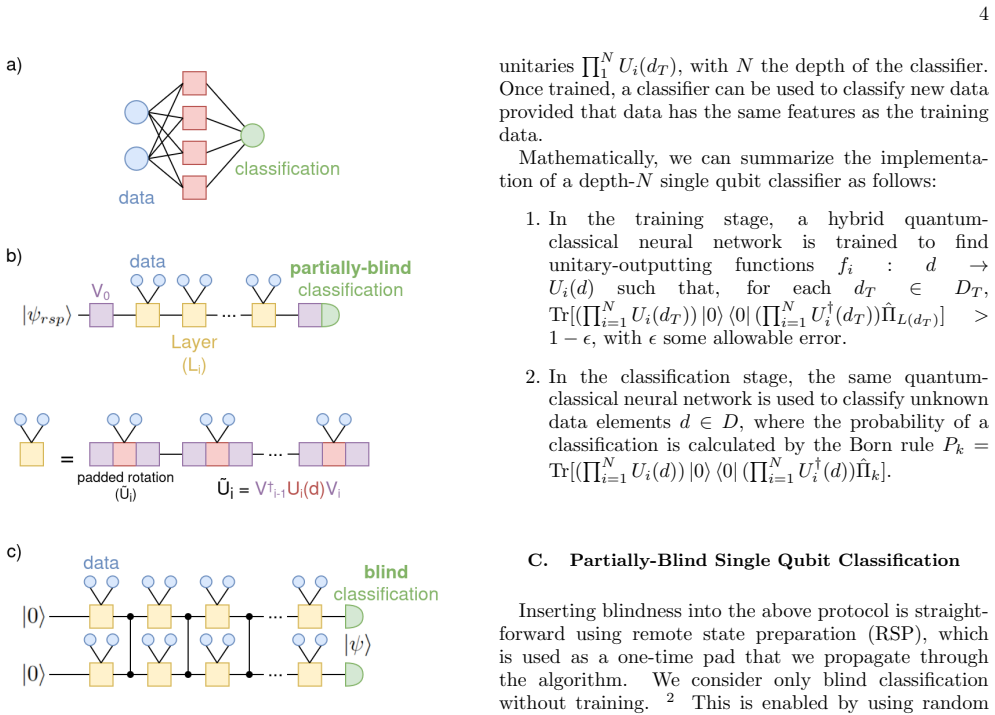
In the training stage, a hybrid quantum- classical neural network is trained to find unitary-outputting functionsf i :d→ Ui(d) such that, for eachd T ∈D T , Tr[(QN i=1 Ui(dT ))|0⟩ ⟨0|(QN i=1 U † i (dT ))ˆΠL(dT )]> 1−ϵ, withϵsome allowable error
-
[2]
nY i=1 ˜Ui(d) ! ˜|0⟩ ˜⟨0| nY i=1 ˜U † i (d) ! ˜ˆΠk # = Tr
In the classification stage, the same quantum- classical neural network is used to classify unknown data elementsd∈D, where the probability of a classification is calculated by the Born ruleP k = Tr[(QN i=1 Ui(d))|0⟩ ⟨0|(QN i=1 U † i (d))ˆΠk]. C. Partially-Blind Single Qubit Classification Inserting blindness into the above protocol is straight- forward u...
-
[3]
Two-laser transitions (red and blue upwards arrows in Fig
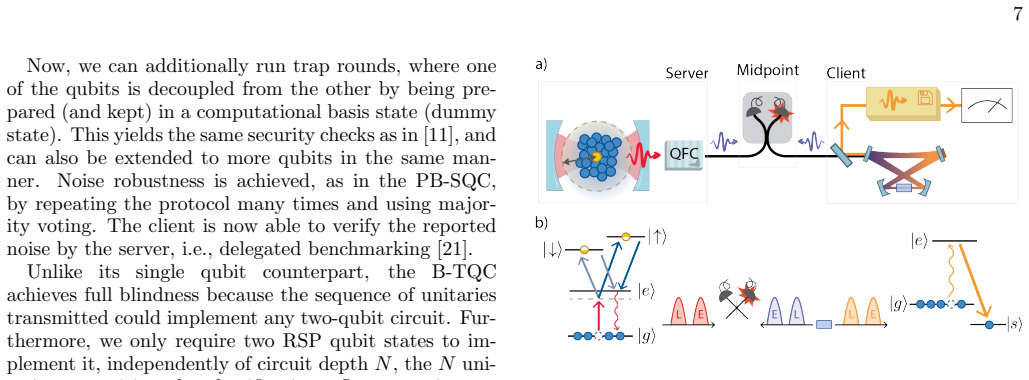
to generate entanglement between a superposition of collective atomic states and time-bin degrees of free- dom of a photon. Two-laser transitions (red and blue upwards arrows in Fig. 3b) couple the ground state to two Rydberg states (|g⟩and|↑/↓⟩, respectively) and are used to prepare the ensemble in a superposition. First, a de-excitation control pulse (d...
-
[4]
Classification Metrics We use a dataset [76] provided by a Brazilian fin- tech, composed of the metadata of financial transactions (name, civil identifier number, time, location, etc.) be- tween December 2023 and March 2024. The goal is to label the past data based on operator knowledge as fraud- ulent and non-fraudulent so thatsupervised learningcan be i...
2023
-
[5]
Training As detailed in Ref. [85], it follows from the Univer- sal Approximation Theorem and the Universal Quantum Circuit Approximation Theorem that a quantum circuit can approximate a continuous classification function. In other words, it is possible to reconstruct any continuous function that represents a neural network with a single hidden layer ofNne...
-
[6]
Theoretical model and methods Let us estimate the expected entanglement generation performance of the quantum link. Starting from the quantum states defined in equations 8 and 6, we can write the joint state of the server and client before the mid-point station as |ψ0⟩=|ψ server⟩ ⊗ |ψSPDC⟩.(22) We introduce losses by applying a beam splitter opera- tion t...
-
[7]
This is the case for an atomic cloud that is smaller than the 17 Figure 10
Impact of noise and multiphoton components in the Rydberg Superatom In this model, we have considered the Rydberg superatom as a perfect single-photon emitter. This is the case for an atomic cloud that is smaller than the 17 Figure 10. Performance of the entanglement generation in the hybrid client-server link. (Top left) Sweep of the SPDC brightnessξ, fo...
-
[8]
IV B, we use the pa- rameters in Table II
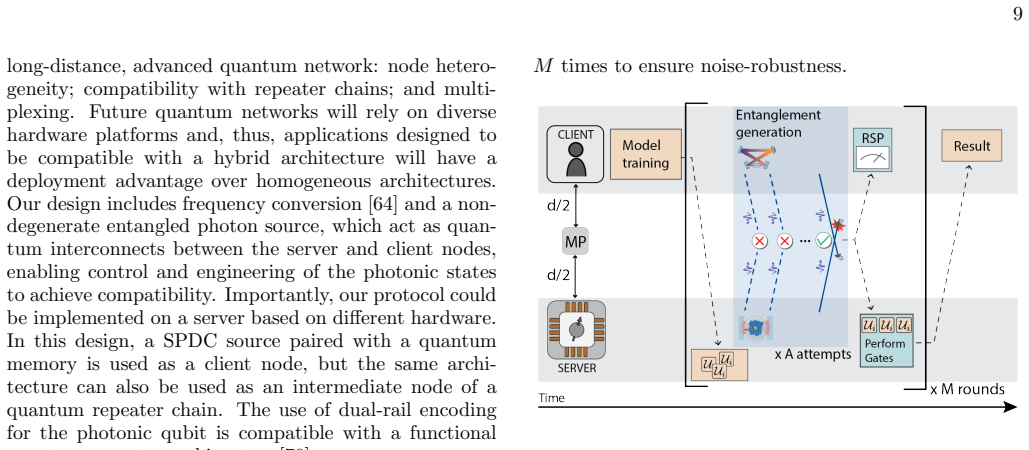
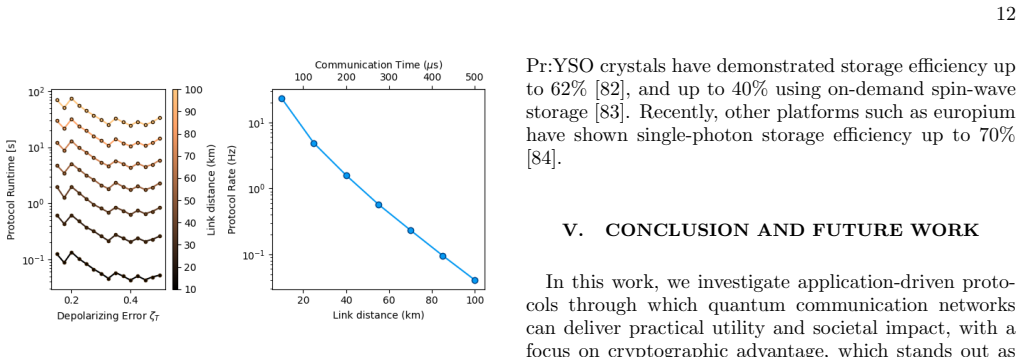
Parameters for Use Case Performance Simulation For the simulations in Sec. IV B, we use the pa- rameters in Table II. Note that, in the timings of the entanglement generation and PB-SQC protocol imple- mentation, we do not take into account the reduced duty cycle of the Rydberg-based server due to atom cooling and trapping. Thus, the reported protocol rat...
-
[9]
Towards experimental demonstration of quan- tum position verification using single photons,
Kirsten Kanneworff, Mio Poortvliet, Dirk Bouwmeester, Rene Allerstorfer, Philip Verduyn Lunel, Florian Speel- man, Harry Buhrman, Petr Steindl, and Wolfgang L¨ offler, “Towards experimental demonstration of quan- tum position verification using single photons,” Quantum Science and Technology10, 045004 (2025)
2025
-
[10]
Towards satellite-based quantum-secure time transfer,
Hui Dai, Qi Shen, Chao-Ze Wang, Shuang-Lin Li, Wei- Yue Liu, Wen-Qi Cai, Sheng-Kai Liao, Ji-Gang Ren, Juan Yin, Yu-Ao Chen,et al., “Towards satellite-based quantum-secure time transfer,” Nature Physics16, 848– 852 (2020)
2020
-
[11]
Ex- perimental demonstration of long-distance continuous- variable quantum key distribution,
Paul Jouguet, S´ ebastien Kunz-Jacques, Anthony Lev- errier, Philippe Grangier, and Eleni Diamanti, “Ex- perimental demonstration of long-distance continuous- variable quantum key distribution,” Nature photonics7, 378–381 (2013)
2013
-
[12]
Overcoming the rate–distance limit of quantum key distribution without quantum re- peaters,
Marco Lucamarini, Zhiliang L Yuan, James F Dynes, and Andrew J Shields, “Overcoming the rate–distance limit of quantum key distribution without quantum re- peaters,” Nature557, 400–403 (2018)
2018
-
[13]
Proof- of-principle demonstration of measurement-device- independent quantum key distribution using polarization qubits,
T Ferreira da Silva, D Vitoreti, GB Xavier, GC do Ama- ral, GP Tempor˜ ao, and JP von der Weid, “Proof- of-principle demonstration of measurement-device- independent quantum key distribution using polarization qubits,” Physical Review A—Atomic, Molecular, and Optical Physics88, 052303 (2013)
2013
-
[14]
Real-world two- photon interference and proof-of-principle¡? format?¿ quantum key distribution immune to detector attacks,
Allison Rubenok, Joshua A Slater, Philip Chan, Itzel Lucio-Martinez, and Wolfgang Tittel, “Real-world two- photon interference and proof-of-principle¡? format?¿ quantum key distribution immune to detector attacks,” Physical review letters111, 130501 (2013)
2013
-
[15]
Device-independent quantum key distribution over 100 km with single atoms,
Bo-Wei Lu, Chao-Wei Yang, Run-Qi Wang, Bo-Feng Gao, Yi-Zheng Zhen, Zhen-Gang Wang, Jia-Kai Shi, Zhong-Qi Ren, Thomas A Hahn, Ernest Y-Z Tan,et al., “Device-independent quantum key distribution over 100 km with single atoms,” Science391, 592–597 (2026)
2026
-
[16]
Quantum clock synchronization based on shared prior entanglement,
Richard Jozsa, Daniel S Abrams, Jonathan P Dowling, and Colin P Williams, “Quantum clock synchronization based on shared prior entanglement,” Physical Review Letters85, 2010 (2000)
2010
-
[17]
Quantum internet: A vision for the road ahead,
Stephanie Wehner, David Elkouss, and Ronald Hanson, “Quantum internet: A vision for the road ahead,” Science 362, eaam9288 (2018)
2018
-
[18]
Entanglement-assisted non-local op- tical interferometry in a quantum network,
P-J Stas, Y-C Wei, M Sirotin, YQ Huan, U Yazlar, F Abdo Arias, E Knyazev, G Baranes, B Machielse, S Grandi,et al., “Entanglement-assisted non-local op- tical interferometry in a quantum network,” Nature651, 326–332 (2026)
2026
-
[19]
Universal blind quantum computation,
Anne Broadbent, Joseph Fitzsimons, and Elham Kashefi, “Universal blind quantum computation,” in 2009 50th annual IEEE symposium on foundations of computer science(IEEE, 2009) pp. 517–526
2009
-
[20]
Verification of quantum computation: An overview of existing approaches,
Alexandru Gheorghiu, Theodoros Kapourniotis, and El- ham Kashefi, “Verification of quantum computation: An overview of existing approaches,” Theory of Computing Systems63, 715–808 (2018)
2018
-
[22]
R. Fleur,Blind Quantum Machine Learning: Transpi- lation, Resource Estimation, and Experimental Outlook, Master’s thesis, Delft University of Technology (2025), tU Delft Repository record; full text under embargo un- til 2026-08-20
2025
-
[23]
Data re-uploading for a universal quantum classifier,
Adri´ an P´ erez-Salinas, Alba Cervera-Lierta, Elies Gil- Fuster, and Jos´ e I. Latorre, “Data re-uploading for a universal quantum classifier,” Quantum4, 226 (2020)
2020
-
[24]
Minimum classical bit for remote prepa- ration and measurement of a qubit,
Arun K. Pati, “Minimum classical bit for remote prepa- ration and measurement of a qubit,” Physical Review A 63(2000), 10.1103/physreva.63.014302
-
[25]
Charles H. Bennett, David P. DiVincenzo, Peter W. Shor, John A. Smolin, Barbara M. Terhal, and William K. Wootters, “Remote state preparation,” Physical Review Letters87(2001), 10.1103/physrevlett.87.077902
-
[26]
Oblivious remote state preparation,
Debbie W. Leung and Peter W. Shor, “Oblivious remote state preparation,” Physical Review Letters90(2003), 10.1103/physrevlett.90.127905
-
[27]
Computationally-secure and composable remote state preparation,
Alexandru Gheorghiu and Thomas Vidick, “Computationally-secure and composable remote state preparation,” (2019)
2019
-
[28]
Nontraditional deterministic remote state preparation using a non-maximally entangled channel without addi- 19 tional quantum resources,
Xuanxuan Xin, Shiwen He, Yongxing Li, and Chong Li, “Nontraditional deterministic remote state preparation using a non-maximally entangled channel without addi- 19 tional quantum resources,” Entropy25, 768 (2023)
2023
-
[29]
Preparing remote states for genuine quantum networks,
Shih-Hsuan Chen, Chan Hsu, Yu-Chien Kao, Bing- Yuan Lee, Yuan-Sung Liu, Yueh-Nan Chen, and Che-Ming Li, “Preparing remote states for genuine quantum networks,” Communications Physics7(2024), 10.1038/s42005-024-01844-x
-
[30]
Verifi- able blind quantum computing with trapped ions and single photons,
P. Drmota, D.P. Nadlinger, D. Main, B.C. Nichol, E.M. Ainley, D. Leichtle, A. Mantri, E. Kashefi, R. Srinivas, G. Araneda, C.J. Ballance, and D.M. Lucas, “Verifi- able blind quantum computing with trapped ions and single photons,” Physical Review Letters132(2024), 10.1103/physrevlett.132.150604
-
[31]
Hardware requirements for trapped-ion-based verifiable blind quantum computing with a measurement- only client,
Janice van Dam, Tzula B. Propp, Francesco Ferreira da Silva, Joshua A. Slater, Tracy E. Northup, and Stephanie Wehner, “Hardware requirements for trapped-ion-based verifiable blind quantum computing with a measurement- only client,” Quantum Science and Technology9, 045031 (2024)
2024
-
[32]
Single-click protocols for re- mote state preparation using weak coherent pulses,
Janice van Dam, Emil R. Hellebek, Tzula B. Propp, Junior R. Gonzales-Ureta, Anders S. Sørensen, and Stephanie D. C. Wehner, “Single-click protocols for re- mote state preparation using weak coherent pulses,” arXiv (2025), 10.48550/ARXIV.2508.14857
-
[33]
Remotely Preparing Many Qubits with a Single Photon
Tzula B. Propp, A. Tissor, B. Sørensen, and S. Wehner, “Remotely preparing many qubits with a single photon,” (2026), arXiv:2604.03495v1 Search... [quant-ph]
work page internal anchor Pith review Pith/arXiv arXiv 2026
-
[34]
Teleporting an unknown quantum state via dual clas- sical and einstein-podolsky-rosen channels,
Charles H Bennett, Gilles Brassard, Claude Cr´ epeau, Richard Jozsa, Asher Peres, and William K Wootters, “Teleporting an unknown quantum state via dual clas- sical and einstein-podolsky-rosen channels,” Physical re- view letters70, 1895 (1993)
1993
-
[35]
Entanglement distribu- tion in multi-platform buffered-router-assisted frequency- multiplexed automated repeater chains,
Mohsen Falamarzi Askarani, Kaushik Chakraborty, and Gustavo Castro Do Amaral, “Entanglement distribu- tion in multi-platform buffered-router-assisted frequency- multiplexed automated repeater chains,” New Journal of Physics23, 063078 (2021)
2021
-
[36]
Metropolitan- scale heralded entanglement of solid-state qubits,
Arian J Stolk, Kian L van der Enden, Marie-Christine Slater, Ingmar te Raa-Derckx, Pieter Botma, Joris Van Rantwijk, JJ Benjamin Biemond, Ronald AJ Hagen, Rodolf W Herfst, Wouter D Koek,et al., “Metropolitan- scale heralded entanglement of solid-state qubits,” Sci- ence advances10, eadp6442 (2024)
2024
-
[37]
Telecom- heralded entanglement between multimode solid-state quantum memories,
Dario Lago-Rivera, Samuele Grandi, Jelena V Rakonjac, Alessandro Seri, and Hugues De Riedmatten, “Telecom- heralded entanglement between multimode solid-state quantum memories,” Nature594, 37–40 (2021)
2021
-
[38]
Entanglement of two quan- tum memories via fibres over dozens of kilometres,
Yong Yu, Fei Ma, Xi-Yu Luo, Bo Jing, Peng-Fei Sun, Ren-Zhou Fang, Chao-Wei Yang, Hui Liu, Ming-Yang Zheng, Xiu-Ping Xie,et al., “Entanglement of two quan- tum memories via fibres over dozens of kilometres,” Na- ture578, 240–245 (2020)
2020
-
[39]
Photonic quantum state transfer between a cold atomic gas and a crystal,
Nicolas Maring, Pau Farrera, Kutlu Kutluer, Margherita Mazzera, Georg Heinze, and Hugues de Riedmatten, “Photonic quantum state transfer between a cold atomic gas and a crystal,” Nature551, 485–488 (2017)
2017
-
[40]
Cavity-enhanced atom-photon entanglement with sub- second lifetime,
Xu-Jie Wang, Sheng-Jun Yang, Peng-Fei Sun, Bo Jing, Jun Li, Ming-Ti Zhou, Xiao-Hui Bao, and Jian-Wei Pan, “Cavity-enhanced atom-photon entanglement with sub- second lifetime,” Physical Review Letters126, 090501 (2021)
2021
-
[41]
Quantum repeaters with photon pair sources and multimode memories,
Christoph Simon, Hugues De Riedmatten, Mikael Afzelius, Nicolas Sangouard, Hugo Zbinden, and Nicolas Gisin, “Quantum repeaters with photon pair sources and multimode memories,” Physical review letters98, 190503 (2007)
2007
-
[42]
Multimode quantum mem- ory based on atomic frequency combs,
Mikael Afzelius, Christoph Simon, Hugues De Riedmat- ten, and Nicolas Gisin, “Multimode quantum mem- ory based on atomic frequency combs,” Physical Review A—Atomic, Molecular, and Optical Physics79, 052329 (2009)
2009
-
[43]
Non-classical correlations over 1250 modes between tele- com photons and 979-nm photons stored in 171yb3+: Y2sio5,
Moritz Businger, Louis Nicolas, T Sanchez Mejia, Al- ban Ferrier, Philippe Goldner, and Mikael Afzelius, “Non-classical correlations over 1250 modes between tele- com photons and 979-nm photons stored in 171yb3+: Y2sio5,” Nature communications13, 6438 (2022)
2022
-
[44]
Long-lived solid-state optical mem- ory for high-rate quantum repeaters,
Mohsen Falamarzi Askarani, Antariksha Das, Jacob H Davidson, Gustavo C Amaral, Neil Sinclair, Joshua A Slater, Sara Marzban, Charles W Thiel, Rufus L Cone, Daniel Oblak,et al., “Long-lived solid-state optical mem- ory for high-rate quantum repeaters,” Physical review letters127, 220502 (2021)
2021
-
[45]
David D Awschalom, Hannes Bernien, Rex Brown, Aashish Clerk, Eric Chitambar, Alan Dibos, Jennifer Dionne, Mark Eriksson, Bill Fefferman, Greg David Fuchs,et al.,A roadmap for quantum interconnects, Tech. Rep. (Argonne National Laboratory (ANL), Argonne, IL (United States), 2022)
2022
-
[46]
A hybrid quantum network link- ing telecom-wavelength atomic and solid-state nodes,
Yuzhou Chai, Dahlia Ghoshal, Nayana P. Tiwari, Alexander Kolar, Benjamin Pingault, Hannes Bernien, and Tian Zhong, “A hybrid quantum network link- ing telecom-wavelength atomic and solid-state nodes,” (2026), arXiv:2602.02653 [quant-ph]
-
[47]
Heterogeneous entanglement between a trapped ion and a solid-state quantum memory,
Chen-Xu Wang, Yi-Yang Wang, Tian-Xiang Zhu, Qing- Quan Yao, Peng-Jun Liang, Yuan-Cong Li, Zi-Peng Liu, Ran He, Yong-Jian Han, Jin-Ming Cui, Zong- Quan Zhou, Yun-Feng Huang, Chuan-Feng Li, and Guang-Can Guo, “Heterogeneous entanglement between a trapped ion and a solid-state quantum memory,” (2026), arXiv:2603.05836 [quant-ph]
-
[48]
Shin Sun, Daniel Bhatti, Shaobo Gao, David Elkouss, and Hiroki Takahashi, “Hybrid quantum repeater chains with atom-based quantum processing units and quantum memory multiplexers,” (2025), arXiv:2512.21655 [quant- ph]
-
[49]
Hybrid Single-Ion Atomic-Ensemble Node for High-Rate Remote Entanglement Generation
Benedikt Tissot, Soubhadra Maiti, Emil R. Helle- bek, and Anders Søndberg Sørensen, “Hybrid single-ion atomic-ensemble node for high-rate remote entanglement generation,” (2026), arXiv:2511.04488 [quant-ph]
work page internal anchor Pith review Pith/arXiv arXiv 2026
-
[50]
Uniting quantum process- ing nodes of cavity-coupled ions with rare-earth quan- tum repeaters using single-photon pulse shaping based on atomic frequency comb,
P. Cussenot, B. Grivet, L. Feldmann, S. Wengerowsky, B. P. Lanyon, T. E. Northup, H. de Riedmatten, A. S. Sørensen, and N. Sangouard, “Uniting quantum process- ing nodes of cavity-coupled ions with rare-earth quan- tum repeaters using single-photon pulse shaping based on atomic frequency comb,” Phys. Rev. Lett.135, 240803 (2025)
2025
-
[51]
Universal distributed blind quantum computing with solid-state qubits,
Y. C. Wei, P. J. Stas, A. Suleymanzade, G. Baranes, F. Machado, Y. Q. Huan, C. M. Knaut, S. W. Ding, M. Merz, E. N. Knall, U. Yazlar, M. Sirotin, I. W. Wang, B. Machielse, S. F. Yelin, J. Borregaard, H. Park, M. Lonˇ car, and M. D. Lukin, “Universal distributed blind quantum computing with solid-state qubits,” Sci- ence388, 509–513 (2025)
2025
-
[52]
Blind quantum compu- tation,
Pablo Arrighi and Louis Salvail, “Blind quantum compu- tation,” International Journal of Quantum Information 4, 883–898 (2006)
2006
-
[53]
Quantum cryptography,
Nicolas Gisin, Gr´ egoire Ribordy, Wolfgang Tittel, and Hugo Zbinden, “Quantum cryptography,” Reviews of modern physics74, 145 (2002). 20
2002
-
[54]
Universal blind quantum computation,
Anne Broadbent, Joseph Fitzsimons, and Elham Kashefi, “Universal blind quantum computation,” in 2009 50th Annual IEEE Symposium on Foundations of Computer Science(IEEE, 2009) p. 517–526
2009
-
[55]
Active learning on a programmable photonic quantum processor,
Chen Ding, Xiao-Yue Xu, Yun-Fei Niu, Shuo Zhang, He- Liang Huang, and Wan-Su Bao, “Active learning on a programmable photonic quantum processor,” Quantum Science and Technology8, 035030 (2023)
2023
-
[56]
swap test and hong-ou-mandel effect are equiv- alent,
Juan Carlos Garcia-Escartin and Pedro Chamorro- Posada, “swap test and hong-ou-mandel effect are equiv- alent,” Physical Review A87(2013), 10.1103/phys- reva.87.052330
-
[57]
Verifying bqp computations on noisy devices with minimal overhead,
Dominik Leichtle, Luka Music, Elham Kashefi, and Harold Ollivier, “Verifying bqp computations on noisy devices with minimal overhead,” PRX Quantum2, 040302 (2021)
2021
-
[58]
Unifying quan- tum verification and error-detection: theory and tools for optimisations,
Theodoros Kapourniotis, Elham Kashefi, Dominik Leich- tle, Luka Music, and Harold Ollivier, “Unifying quan- tum verification and error-detection: theory and tools for optimisations,” Quantum Science and Technology9, 035036 (2024)
2024
-
[59]
Verifiable end-to-end delegated variational quantum al- gorithms,
Matteo Inajetovic, Petros Wallden, and Anna Pappa, “Verifiable end-to-end delegated variational quantum al- gorithms,” (2025)
2025
-
[60]
Evenly dis- tributed unitaries: On the structure of unitary de- signs,
D. Gross, K. Audenaert, and J. Eisert, “Evenly dis- tributed unitaries: On the structure of unitary de- signs,” Journal of Mathematical Physics48(2007), 10.1063/1.2716992
-
[61]
Composable security of delegated quantum computation
Vedran Dunjko, Joseph F. Fitzsimons, Christopher Port- mann, and Renato Renner, “Composable security of delegated quantum computation,” inAdvances in Cryp- tology – ASIACRYPT 2014, Lecture Notes in Com- puter Science, Vol. 8874 (Springer, 2014) pp. 406–425, arXiv:1301.3662
work page internal anchor Pith review Pith/arXiv arXiv 2014
-
[62]
Abstract cryptogra- phy,
Ueli Maurer and Renato Renner, “Abstract cryptogra- phy,” inThe Second Symposium on Innovations in Com- puter Science (ICS 2011), edited by Bernard Chazelle (Tsinghua University Press, 2011) pp. 1–21
2011
-
[63]
Multiparty Delegated Quantum Computing
Elham Kashefi and Anna Pappa, “Multiparty dele- gated quantum computing,” Cryptography1, 12 (2017), arXiv:1606.09200
work page internal anchor Pith review Pith/arXiv arXiv 2017
-
[64]
Robust control and entanglement of qudits in neutral atom arrays,
Amir Burshtein, Shachar Fraenkel, Moshe Goldstein, and Ran Finkelstein, “Robust control and entanglement of qudits in neutral atom arrays,” Physical Review Re- search8(2026), 10.1103/4xcd-wyxx
-
[65]
Quantum optics with rydberg superatoms
Jan Kumlin, Christoph Braun, Christoph Tresp, Nina Stiesdal, Sebastian Hofferberth, and Asaf Paris- Mandoki, “Quantum optics with rydberg superatoms”,” J. Phys. Commun.7, 052001 (2023)
2023
-
[66]
Coherence and rydberg blockade of atomic ensemble qubits,
M. Ebert, M. Kwon, T. G. Walker, and M. Saffman, “Coherence and rydberg blockade of atomic ensemble qubits,” Phys. Rev. Lett.115, 093601 (2015)
2015
-
[67]
Collectively encoded rydberg qubit,
Nicholas L. R. Spong, Yuechun Jiao, Oliver D. W. Hughes, Kevin J. Weatherill, Igor Lesanovsky, and Charles S. Adams, “Collectively encoded rydberg qubit,” Phys. Rev. Lett.127, 063604 (2021)
2021
-
[68]
Entangling two rydberg superatoms via heralded storage,
Zi-Ye An, Bo-Wei Lu, Jun Li, Chao-Wei Yang, Li Li, Xiao-Hui Bao, and Jian-Wei Pan, “Entangling two rydberg superatoms via heralded storage,” (2025), arXiv:2504.05021 [quant-ph]
-
[69]
Deterministic time-bin entanglement between a single photon and an atomic ensemble,
Peng-Fei Sun, Yong Yu, Zi-Ye An, Jun Li, Chao-Wei Yang, Xiao-Hui Bao, and Jian-Wei Pan, “Deterministic time-bin entanglement between a single photon and an atomic ensemble,” Phys. Rev. Lett.128, 060502 (2022)
2022
-
[70]
Quantum repeaters based on rydberg- blockade-coupled atomic ensembles,
Yang Han, Bing He, Khabat Heshami, Cheng Zu Li, and Christoph Simon, “Quantum repeaters based on rydberg- blockade-coupled atomic ensembles,” Physical Review A 81, 052311 (2010)
2010
-
[71]
Single photonic qutrit in a collective rydberg polariton,
Yuechun Jiao, Oliver D. W. Hughes, Max Z. Festenstein, Zhengyang Bai, Jianming Zhao, Weibin Li, Kevin J. Weatherill, and C. Stuart Adams, “Single photonic qutrit in a collective rydberg polariton,” Phys. Rev. Res. 7, 033267 (2025)
2025
-
[72]
A waveguide frequency converter connecting rubidium- based quantum memories to the telecom c-band,
Boris Albrecht, Pau Farrera, Xavier Fernandez- Gonzalvo, Matteo Cristiani, and Hugues de Riedmatten, “A waveguide frequency converter connecting rubidium- based quantum memories to the telecom c-band,” Nature Communications5, 3376 (2014)
2014
-
[73]
Characterization of the multimode nature of single-photon sources based on spontaneous parametric down-conversion,
Emil R. Hellebek, Klaus Mølmer, and Anders S. Sørensen, “Characterization of the multimode nature of single-photon sources based on spontaneous parametric down-conversion,” Phys. Rev. A110, 023728 (2024)
2024
-
[74]
Heralded entanglement of on-demand spin-wave solid- state quantum memories for multiplexed quantum net- work links,
Jonathan H¨ anni, Alberto E. Rodr´ ıguez-Moldes, F´ elicien Appas, Soeren Wengerowsky, Dario Lago-Rivera, Markus Teller, Samuele Grandi, and Hugues De Riedmatten, “Heralded entanglement of on-demand spin-wave solid- state quantum memories for multiplexed quantum net- work links,” Physical Review X15, 041003 (2025)
2025
-
[75]
Spin- wave storage using chirped control fields in atomic fre- quency comb-based quantum memory,
Jiˇ r´ ı Min´ aˇ r, Nicolas Sangouard, Mikael Afzelius, Hugues De Riedmatten, and Nicolas Gisin, “Spin- wave storage using chirped control fields in atomic fre- quency comb-based quantum memory,” Physical Review A - Atomic, Molecular, and Optical Physics82, 042309 (2010)
2010
-
[76]
Entanglement between a telecom pho- ton and an on-demand multimode solid-state quantum memory,
Jelena V. Rakonjac, Dario Lago-Rivera, Alessandro Seri, Margherita Mazzera, Samuele Grandi, and Hugues de Riedmatten, “Entanglement between a telecom pho- ton and an on-demand multimode solid-state quantum memory,” Phys. Rev. Lett.127, 210502 (2021)
2021
-
[77]
Benedikt Tissot, Soubhadra Maiti, Emil R. Hellebek, and Anders Søndberg Sørensen, “Single and double- click high-rate entanglement generation between dis- tant ions using multiplexed atomic ensembles,” (2025), arXiv:2511.04987 [quant-ph]
work page internal anchor Pith review Pith/arXiv arXiv 2025
-
[78]
Functional quantum nodes for entanglement distribution over scalable quan- tum networks,
Chin-Wen Chou, Julien Laurat, Hui Deng, Kyung Soo Choi, Hugues de Riedmatten, Daniel Felinto, and H. Jeff Kimble, “Functional quantum nodes for entanglement distribution over scalable quan- tum networks,” Science316, 1316–1320 (2007), https://www.science.org/doi/pdf/10.1126/science.1140300
-
[79]
Nicol` o Lo Piparo, William J. Munro, and Kae Nemoto, “Quantum multiplexing,” Physical Review A99(2019), 10.1103/physreva.99.022337
-
[80]
Quantum mul- tiplexing for error correction codes,
Nicolo Lo Piparo, Michael Hanks, Claude Gravel, William J Munro, and Kae Nemoto, “Quantum mul- tiplexing for error correction codes,” inConference on Lasers and Electro-Optics/Pacific Rim(Optica Publish- ing Group, 2020) p. C12C 4
2020
-
[81]
Heralded quantum multiplexing entangle- ment between stationary qubits via distribution of high- dimensional optical entanglement,
Zhihao Xie, Guanyu Wang, Zehui Guo, Zhenhua Li, and Tao Li, “Heralded quantum multiplexing entangle- ment between stationary qubits via distribution of high- dimensional optical entanglement,” Optics Express31, 37802 (2023)
2023
discussion (0)
Sign in with ORCID, Apple, or X to comment. Anyone can read and Pith papers without signing in.