REVIEW 3 major objections 4 minor 41 references
Machine Learning Guided Optimal Transmission Switching to Mitigate Wildfire Ignition Risk
T0 review · 3 major / 4 minor · reviewed 2026-08-04 · deepseek-v4-flash
Pith's one-line read For the Optimal Power Shutoff problem on a realistic California-scale network, an ML-guided hybrid method yields near-optimal line de-energization plans within 30 minutes—quality that a general-purpose solver reaches only with up to 24 hour
desk verdict A genuine ML-guided MILP extension to OPS with a plausible speedup, but a sign error in the written objective undermines the domain-informed bound; fix that and it is a solid paper. read the letter →
The pith
A machine-rendered reading of the paper's core claim, the machinery that carries it, and where it could break.
The reading
What carries the argument
The load-bearing mechanism is the domain-informed split of the Predict-and-Search constraint into two separate flip budgets, B0 and B1. B0 uses the derived bounds N_min_0 ≤ number of de-energized lines ≤ N_max_0 to choose k0 = N_max_0 and allow at most Delta0 = N_max_0 − N_min_0 flips among the predicted-de-energized set; B1 fixes (or nearly fixes) the predicted-energized set, with a lower-bound-derived flip allowance that acts as a safety net. This converts the raw ML prediction into a small, feasible neighborhood of the original MILP, and it is what lets the solver find high-quality solutions quickly rather than exploring the full space.
What would settle it
For each hard test instance, record the best-known solution and check whether any truly de-energized line falls outside the top k0 = N_max_0 predicted-de-energized set; if this happens on instances where PaS+ND's final gap is nonzero or where it fails to find the best-known solution, the central claim's premise is violated. Simpler: compute 0-class recall—the fraction of optimal de-energized lines that the model predicts de-energized—on the held-out test split; if it is well below 1, the bound-based neighborhood can exclude optima.
Extended reading notes
Core claim
The central discovery is that the structure of OPS—most lines stay energized, and the number of de-energized lines is bounded between a minimum N_min_0 and maximum N_max_0—can be baked into the inference-time refinement of an ML prediction. A graph attention network trained on historically high-quality incumbents predicts each switchable line's energization probability. Instead of using one budget on all flips, the method splits it: lines predicted de-energized can flip up to N_max_0 minus N_min_0 times, while lines predicted energized are fixed (or nearly fixed) to 1, with a feasibility-restoring buffer when the fixed set is too large. The paper shows this restricted MILP is solved to an av
Load-bearing premise
Everything rests on the assumption that the machine-learning model ranks the truly de-energized lines high enough that none of the bounds-based restrictions ever cuts off the optimal shutdown plan.
Editorial extensions
If this is right
- Utilities could run near-optimal OPS decisions within a 30-minute operational window for hard days, instead of treating a day-ahead solve as the limiting step.
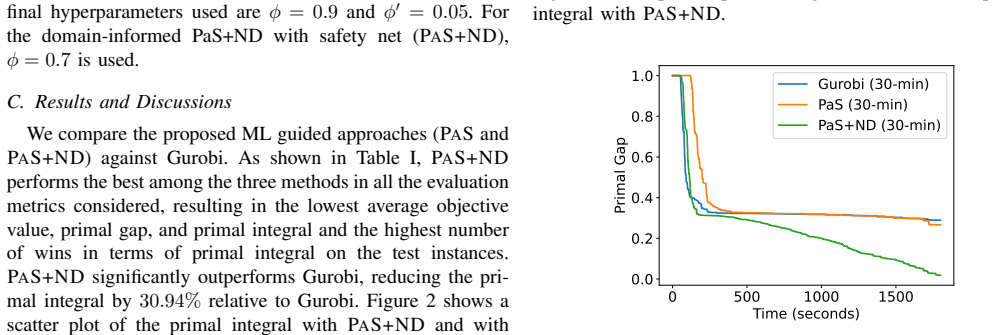
- Average load shed on the 54 hard test instances is substantially lower than a same-timeout generic solver, because the primal gap at 30 minutes drops from 0.29 to 0.02.
- The 30-minute ML-guided objective distribution is close to the 24-hour solver distribution, so offline training time can be traded for day-of speed.
- The same domain bounds on the number of de-energized lines can be reused when the OPS formulation is extended to multiple periods, restoration, or security constraints.
- Class imbalance (most lines energized) is handled explicitly by separate flip budgets; this is a transferable design for other switching problems with skewed binary solutions.
Reading between the lines
- The paper leaves untested whether the 30-minute advantage persists on other networks or seasons; that depends on whether the predictor's ranking accuracy transfers beyond the one synthetic California grid.
- A testable extension is to replace the fixed k0 = N_max_0 cutoff with a confidence-based cutoff using predicted probabilities; if the model is well calibrated, this could tighten the neighborhood without sacrificing the optimum.
- Only 1-class recall (98.99%) is reported; computing 0-class precision and recall on the true de-energized lines would directly quantify the risk of excluding the optimal shutoff plan from the restricted search.
- Because OPS instances recur daily, the approach suggests a closed-loop operational loop where each day's high-quality solution is added to the training pool, potentially improving future predictions—though the paper does not test this.
Editorial analysis
A structured set of objections, weighed in public.
Referee Report
Summary. The paper proposes an ML-guided MILP framework for the Optimal Power Shutoff (OPS) problem, which selects transmission lines to de-energize in order to reduce wildfire ignition risk while limiting load shed. The authors extend Predict-and-Search (PaS) and Neural Diving (ND) by introducing separate neighborhood parameters for predicted-0 and predicted-1 variables, informed by domain knowledge on the minimum and maximum number of de-energized lines. They evaluate on a realistic synthetic California test system (CATS) with daily wildfire risk data, training on Gurobi 24-hour incumbents and testing on 54 hard held-out instances against a 30-minute Gurobi limit. The headline result is that the proposed PaS+ND hybrid reduces the average primal integral by 30.94% and the average primal gap from 0.29 to 0.02 compared to Gurobi at the same 30-minute cutoff, with qualitative case-study illustrations of switching decisions.
Significance. If the results hold, this is a practical and novel application of ML-guided MILP solving to power-system wildfire mitigation, with clear operational relevance. The paper's main strengths are the use of a realistic, geographically accurate test system; an externally benchmarked evaluation against Gurobi; and a sensible domain-specific adaptation of existing ML-guided methods. The reported improvements are large and internally consistent with the summary statistics in Table I. However, the manuscript contains a load-bearing formulation inconsistency in the OPS objective, and the safety of the domain-informed constraints is not supported by the reported ML metrics. These issues must be resolved before the central claims can be accepted.
major comments (3)
- [II.A, Model 1, Eq. (1a)] The objective in (1a) is min Σ p_ls + ε Σ_{ℓ∈L_switch} z_ℓ. As stated after (1d), z_ℓ=0 means de-energized and z_ℓ=1 means energized. Thus ε Σ z_ℓ rewards de-energization, which is the opposite of the text's claim that the penalty 'minimizes the number of lines de-energized.' This is not a cosmetic issue: the derivation of N_max0 in Section II.A as an upper bound on the number of de-energized lines in an optimal solution relies on an objective that discourages de-energization. Under the written objective, an optimal solution may de-energize extra lines to collect the ε reward, so the statement in Section III.C.1 that setting k0=N_max0 'does not exclude the optimal solution' is not justified. Please correct the sign in (1a) or the prose, and state explicitly which objective was implemented in Gurobi; all reported objective values, primal gaps, and primal integrals inherit this choice.
- [III.C.1 and V.B] The claim that k0=N_max0 'does not exclude the optimal solution' is only valid if the true zero set is sufficiently aligned with I0; it is not a mathematical consequence of the risk bounds alone. With Δ0=N_max0−N_min0, constraint (5a) forces at least N_min0 zeros among I0, so the optimal remains feasible iff at least N_min0 of the truly de-energized lines are in the top-N_max0 predicted-0 set. The paper reports only the class-1 recall (98.99%) and never reports precision/recall for the 0 class, nor verifies constraint satisfaction on the validation set. Since PaS+ND sets Δ1 to its lower bound (often 0), false positives among I1 are also unexamined. Please add 0-class metrics or an explicit verification that the restricted search space (5a)–(5b) contains the best known solutions on validation/test instances.
- [V.C, Table I, Fig. 3] The main claim that PaS+ND 'significantly outperforms' Gurobi is based on a single test set of 54 instances, with no variance, confidence intervals, or significance test. The improvements in PI and PG could be driven by a few hard outliers, as the scatter plot in Figure 2 suggests. Report per-instance variability, paired significance tests (e.g., Wilcoxon signed-rank), and ideally multiple training/validation splits before claiming statistical significance.
minor comments (4)
- [Throughout] The method is referred to inconsistently as 'PAS' and 'PaS' (also 'PAS+ND' vs 'PaS+ND'). Please standardize the notation.
- [IV] The easy/hard classification threshold of 100 MWh of load shed is described as based on 'prior experience'; please justify this choice or report sensitivity to the threshold.
- [V.B] Hyperparameters φ and φ' are selected on the validation set; report the selected values and ideally sensitivity of test performance to these parameters. No code or data availability statement is provided, which limits reproducibility.
- [Fig. 3] The average primal gap as a function of time is shown without confidence bands or quantiles; adding these would strengthen the claim that PaS+ND is consistently faster, not just on average.
Circularity Check
No significant circularity; evaluation is externally benchmarked against Gurobi on held-out instances.
full rationale
The derivation chain is not circular. The ML policy is trained on Gurobi 24-hour incumbents from training instances and evaluated on held-out test instances against a fresh 30-minute Gurobi run, so the reported speed and primal-integral improvement is an external empirical comparison rather than a quantity forced by construction. The domain-informed bounds N_min0/N_max0 come from constraint (1j), not from the ML outputs, and the PaS/ND framework is an extension of published methods; self-citations to [8] and [18] provide the OPS model and base PaS framework but are not invoked as an unverified uniqueness theorem. Two caveats are correctness risks rather than circularity: (i) the written objective (1a) penalizes Sigma z_l (energized lines) while the text claims a penalty minimizing de-energizations, which invalidates the stated interpretation of the N_min0/N_max0 bounds; (ii) the claim that k0=N_max0 'does not exclude the optimal solution' requires an unreported 0-class precision property of the ML ranking. Neither caveat makes the speed comparison equivalent to the training input or to a self-citation.
Assumptions & free parameters
free parameters (5)
- epsilon (de-energization penalty in objective 1a) =
0.01 per unit
- phi (fraction of switchable lines assigned to 1 in I1) =
0.9 (PaS), 0.7 (PaS+ND)
- phi' (offset fraction for Delta1) =
0.05 (PaS); 0 for PaS+ND (Delta1 at its lower bound)
- easy/hard instance classification threshold =
100 MWh of thresholded-problem load shed
- R_PSPS (system-wide acceptable risk) =
set to match threshold-method residual risk
assumptions (5)
- domain assumption The B-theta DC power flow approximation with big-M linearization adequately represents line flows and feasibility for OPS decisions.
- domain assumption The optimal number of de-energized lines lies between N_min_0 and N_max_0 computed from the risk constraint (1j) alone.
- domain assumption The ten best Gurobi 24-hour incumbent solutions saved per instance are representative of true optimal solutions.
- standard math Conditional independence of line-status predictions pi(z_l | omega, M).
- ad hoc to paper The single hour with the most thresholded load shed is a representative daily instance for evaluating operational OPS decisions.
Cite this review
Pith. "Pith review of Machine Learning Guided Optimal Transmission Switching to Mitigate Wildfire Ignition Risk." pith.science (2026). https://pith.science/paper/LK6Z325H
@misc{pith2026251025147,
  author       = {Pith},
  title        = {Pith review of: Machine Learning Guided Optimal Transmission Switching to Mitigate Wildfire Ignition Risk},
  year         = {2026},
  howpublished = {\url{https://pith.science/paper/LK6Z325H}},
  note         = {Machine review of arXiv:2510.25147}
}
read the original abstract
To mitigate acute wildfire ignition risks, utilities de-energize power lines in high-risk areas. The Optimal Power Shutoff (OPS) problem optimizes line energization statuses to manage wildfire ignition risks through de-energizations while reducing load shedding. OPS problems are computationally challenging Mixed-Integer Linear Programs (MILPs) that must be solved rapidly and frequently in operational settings. For a particular power system, OPS instances share a common structure with varying parameters related to wildfire risks, loads, and renewable generation. This motivates the use of Machine Learning (ML) for solving OPS problems by exploiting shared patterns across instances. In this paper, we develop an ML-guided framework that quickly produces high-quality de-energization decisions by extending existing ML-guided MILP solution methods while integrating domain knowledge on the number of energized and de-energized lines. Results on a large-scale realistic California-based synthetic test system show that the proposed ML-guided method produces high-quality solutions faster than traditional optimization methods.
Figures


Figures from the paper (2 more)


Reference graph
Works this paper leans on
-
[1]
The potential for fuel reduction to reduce wildfire intensity in a warming california,
P. T. Brown, S. J. Strenfel, R. B. Bagley, and C. B. Clements, “The potential for fuel reduction to reduce wildfire intensity in a warming california,”Environmental Research Letters, vol. 20, no. 2, 2025
2025
-
[2]
Landscape op- timization for prescribed burns in wildfire mitigation planning,
W. Chen, E. P. Sivaramakrishnan, and B. Dilkina, “Landscape op- timization for prescribed burns in wildfire mitigation planning,” in Proceedings of the 5th ACM SIGCAS/SIGCHI Conference on Computing and Sustainable Societies, 2022, pp. 429–438
2022
-
[3]
Top 20 destructive california wildfires,
California Department of Forestry and Fire Protection (CalFire), “Top 20 destructive california wildfires,” July 2025. [Online]. Available: https://34c031f8-c9fd-4018-8c5a-4159cdff6b0d-cdn-endpoint. azureedge.net/-/media/calfire-website/our-impact/fire-statistics/top20 destruction 072525.pdf
2025
-
[4]
Location, timing and extent of wildfire vary by cause of ignition,
A. D. Syphard and J. E. Keeley, “Location, timing and extent of wildfire vary by cause of ignition,”International Journal of Wildland Fire, vol. 24, no. 1, pp. 37–47, 2015
2015
-
[5]
Support for public safety power shutoffs in California: Wildfire-related perceived exposure and negative outcomes, prior and current health, risk appraisal and worry,
G. Wong-Parodi, “Support for public safety power shutoffs in California: Wildfire-related perceived exposure and negative outcomes, prior and current health, risk appraisal and worry,”Energy Research & Social Science, vol. 88, p. 102495, 2022
2022
-
[6]
Wildfire mitigation plans in power systems: A literature review,
D. A. Z. Vazquez, F. Qiu, N. Fan, and K. Sharp, “Wildfire mitigation plans in power systems: A literature review,”IEEE Transactions on Power Systems, vol. 37, no. 5, pp. 3540–3551, 2022
2022
-
[7]
Balancing wildfire risk and power outages through optimized power shut-offs,
N. Rhodes, L. Ntaimo, and L. Roald, “Balancing wildfire risk and power outages through optimized power shut-offs,”IEEE Transactions on Power Systems, vol. 36, no. 4, 2021
2021
-
[8]
Quantifying metrics for wildfire ignition risk from geographic data in power shutoff decision-making,
R. Piansky, S. Taylor, N. Rhodes, D. K. Molzahn, L. A. Roald, and J.-P. Watson, “Quantifying metrics for wildfire ignition risk from geographic data in power shutoff decision-making,”58th Hawaii International Conference on System Sciences (HICSS), January 2025
2025
Show all 41 references
-
[9]
PG&E wildfire mitigation plan R1 (2026–2028), volume 1: Base WMP,
Pacific Gas and Electric Company, “PG&E wildfire mitigation plan R1 (2026–2028), volume 1: Base WMP,” Pacific Gas and Electric Company, Tech. Rep. V ol. 1, February 2026. [Online]. Available: https://www.pge.com/assets/pge/docs/outages-and-safety/ outage-preparedness-and-suppo...
2026
-
[10]
Distributional MIPLIB: A multi-domain library for advancing ML-guided MILP meth- ods,
W. Huang, T. Huang, A. M. Ferber, and B. Dilkina, “Distributional MIPLIB: A multi-domain library for advancing ML-guided MILP meth- ods,”arXiv:2406.06954, 2024
2024 arXiv
-
[11]
Machine learn- ing augmented branch and bound for mixed integer linear programming,
L. Scavuzzo, K. Aardal, A. Lodi, and N. Yorke-Smith, “Machine learn- ing augmented branch and bound for mixed integer linear programming,” Mathematical Programming, pp. 1–44, 2024
2024
-
[12]
Long solution times or low solution quality: On trade-offs in choosing a power flow formulation for the optimal power shutoff problem,
E. Haag, N. Rhodes, and L. Roald, “Long solution times or low solution quality: On trade-offs in choosing a power flow formulation for the optimal power shutoff problem,”Electric Power Systems Research, vol. 234, p. 110713, 2024,23rd Power Systems Computation Conference (PSCC)
2024
-
[13]
United States Geological Sur- vey fire science: Fire danger monitoring and forecasting,
J. C. Eidenshink and S. M. Howard, “United States Geological Sur- vey fire science: Fire danger monitoring and forecasting,”US Ge- ological Survey, 2012, https://www.usgs.gov/publications/united-states- geological-survey-fire-science-fire-danger-monitoring-and-forecasting
2012
-
[14]
Probabilistic electric load forecasting: A tutorial review,
T. Hong and S. Fan, “Probabilistic electric load forecasting: A tutorial review,”International Journal of Forecasting, vol. 32, no. 3, pp. 914– 938, 2016
2016
-
[15]
Spatio-temporal wildfire prediction using multi-modal data,
C. Xu, Y . Xie, D. A. Z. Vazquez, R. Yao, and F. Qiu, “Spatio-temporal wildfire prediction using multi-modal data,”IEEE Journal on Selected Areas in Information Theory, vol. 4, pp. 302–313, 2023
2023
-
[16]
Solv- ing mixed integer programs using neural networks,
V . Nair, S. Bartunov, F. Gimeno, I. V on Glehn, P. Lichocki, I. Lobov, B. O’Donoghue, N. Sonnerat, C. Tjandraatmadja, P. Wanget al., “Solv- ing mixed integer programs using neural networks,”arXiv:2012.13349, 2020
2012 arXiv
-
[17]
A GNN-guided predict-and-search framework for mixed- integer linear programming,
Q. Han, L. Yang, Q. Chen, X. Zhou, D. Zhang, A. Wang, R. Sun, and X. Luo, “A GNN-guided predict-and-search framework for mixed- integer linear programming,” in11th International Conference on Learn- ing Representations (ICLR), 2023
2023
-
[18]
Contrastive predict-and-search for mixed integer linear programs,
T. Huang, A. M. Ferber, A. Zharmagambetov, Y . Tian, and B. Dilkina, “Contrastive predict-and-search for mixed integer linear programs,” in 41st International Conference on Machine Learning (ICML), July 2024
2024
-
[19]
Searching large neighborhoods for integer linear programs with contrastive learn- ing,
T. Huang, A. M. Ferber, Y . Tian, B. Dilkina, and B. Steiner, “Searching large neighborhoods for integer linear programs with contrastive learn- ing,” in40th International Conference on Machine Learning (ICML), 2023, pp. 13 869–13 890
2023
-
[20]
Optimizing transmission infrastructure investments to support line de-energization for mitigating wildfire ignition risk,
A. Kody, R. Piansky, and D. K. Molzahn, “Optimizing transmission infrastructure investments to support line de-energization for mitigating wildfire ignition risk,” in11th IREP Symposium on Bulk Power System Dynamics and Control, July 2022
2022
-
[21]
Long duration battery sizing, siting, and operation under wildfire risk using progressive hedging,
R. Piansky, G. Stinchfield, A. Kody, D. K. Molzahn, and J. P. Watson, “Long duration battery sizing, siting, and operation under wildfire risk using progressive hedging,”Electric Power Systems Research, vol. 235, Oct 2024,23rd Power Systems Computation Conference (PSCC)
2024
-
[22]
Optimizing battery and line undergrounding investments for transmission systems under wildfire risk scenarios: A Benders decomposition approach,
R. Piansky, R. K. Gupta, and D. K. Molzahn, “Optimizing battery and line undergrounding investments for transmission systems under wildfire risk scenarios: A Benders decomposition approach,”Sustainable Energy, Grids and Networks, vol. 43, no. 101838, September 2025,12th IREP B...
2025
-
[23]
A framework for risk assessment and optimal line upgrade selection to mitigate wildfire risk,
S. Taylor and L. A. Roald, “A framework for risk assessment and optimal line upgrade selection to mitigate wildfire risk,”Electric Power Systems Research, vol. 213, 2022,22nd Power Systems Computation Conference (PSCC)
2022
-
[24]
Managing wildfire risk and promoting equity through optimal configuration of networked microgrids,
S. Taylor, G. Setyawan, B. Cui, A. Zamzam, and L. A. Roald, “Managing wildfire risk and promoting equity through optimal configuration of networked microgrids,” inACM e-Energy, June 2023, pp. 189–199
2023
-
[25]
Equitably allocating wildfire resilience investments for power grids—The curse of aggregation and vulnerability indices,
M. Pollack, R. Piansky, S. Gupta, and D. K. Molzahn, “Equitably allocating wildfire resilience investments for power grids—The curse of aggregation and vulnerability indices,”Applied Energy, vol. 388, p. 125511, 2025
2025
-
[26]
Predicting electricity infrastructure induced wildfire risk in California,
M. Yao, M. Bharadwaj, Z. Zhang, B. Jin, and D. S. Callaway, “Predicting electricity infrastructure induced wildfire risk in California,”Environ- mental Research Letters, vol. 17, no. 9, p. 094035, 9 2022
2022
-
[27]
Data- driven power system optimal decision making strategy under wildfire events,
W. Hong, B. Wang, M. Yao, D. Callaway, L. Dale, and C. Huang, “Data- driven power system optimal decision making strategy under wildfire events,” in55th Hawaii International Conference on System Sciences (HICSS), January 2022
2022
-
[28]
California test system (CATS): A geographically accurate test system based on the California grid,
S. Taylor, A. Rangarajan, N. Rhodes, J. Snodgrass, B. Lesieutre, and L. A. Roald, “California test system (CATS): A geographically accurate test system based on the California grid,”IEEE Transactions on Energy Markets, Policy and Regulation, vol. 2, no. 1, pp. 107–118, 2024
2024
-
[29]
How attentive are graph attention networks?
S. Brody, U. Alon, and E. Yahav, “How attentive are graph attention networks?”arXiv:2105.14491, 2021
2021 arXiv
-
[30]
Exact combinatorial optimization with graph convolutional neural networks,
M. Gasse, D. Ch ´etelat, N. Ferroni, L. Charlin, and A. Lodi, “Exact combinatorial optimization with graph convolutional neural networks,” Advances in neural information processing systems, vol. 32, 2019
2019
-
[31]
Wildland Fire Potential Index,
U.S. Geological Survey, “Wildland Fire Potential Index,”
-
[32]
Gurobi Optimizer Reference Manual,
Gurobi Optimization, LLC, “Gurobi Optimizer Reference Manual,”
-
[33]
Measuring the impact of primal heuristics,
T. Berthold, “Measuring the impact of primal heuristics,”Operations Research Letters, vol. 41, no. 6, pp. 611–614, 2013
2013
-
[34]
Adam: A method for stochastic optimization,
D. P. Kingma and J. Ba, “Adam: A method for stochastic optimization,” arXiv:1412.6980, 2014
2014 arXiv
-
[35]
Multi- period power system risk minimization under wildfire disruptions,
H. Yang, N. Rhodes, H. Yang, L. Roald, and L. Ntaimo, “Multi- period power system risk minimization under wildfire disruptions,”IEEE Transactions on Power Systems, vol. 39, no. 5, pp. 6305–6318, 2024
2024
-
[36]
Co-optimization of power line shutoff and restoration under high wildfire ignition risk,
N. Rhodes and L. A. Roald, “Co-optimization of power line shutoff and restoration under high wildfire ignition risk,” inIEEE Belgrade PowerTech, 2023
2023
-
[37]
Security constrained optimal power shutoff for wildfire risk mitigation,
N. Rhodes, C. Coffrin, and L. Roald, “Security constrained optimal power shutoff for wildfire risk mitigation,”IET Generation, Transmis- sion & Distribution, vol. 18, no. 18, pp. 2972–2986, 2024
2024
-
[38]
A general large neighborhood search framework for solving integer linear programs,
J. Song, R. Lanka, Y . Yue, and B. Dilkina, “A general large neighborhood search framework for solving integer linear programs,”33rd Advances in Neural Information Processing Systems (NeurIPS), pp. 20 012–20 023, 2020
2020
-
[39]
Evaluat- ing undergrounding decisions for wildfire ignition risk mitigation across multiple hazards,
R. Piansky, D. K. Molzahn, N. D. Jackson, and J. K. Skolfield, “Evaluat- ing undergrounding decisions for wildfire ignition risk mitigation across multiple hazards,”IEEE Kiel PowerTech, June 2025
2025
-
[2024]
Available: https://www.usgs.gov/fire-danger-forecast/ wildland-fire-potential-index-wfpi
[Online]. Available: https://www.usgs.gov/fire-danger-forecast/ wildland-fire-potential-index-wfpi
-
[2025]
Available: www.gurobi.com
[Online]. Available: www.gurobi.com
Reviewed August 4, 2026 · model on record in the stance chip above.
Discussion (0). Continue with ORCID to comment.