Spectral Gap Informed Ramp QAOA
Pith reviewed 2026-05-08 04:04 UTC · model grok-4.3
The pith
Spectral gap informed ramps improve QAOA performance over linear schedules on Grover's problem and maximum independent set.
A machine-rendered reading of the paper's core claim, the machinery that carries it, and where it could break.
Core claim
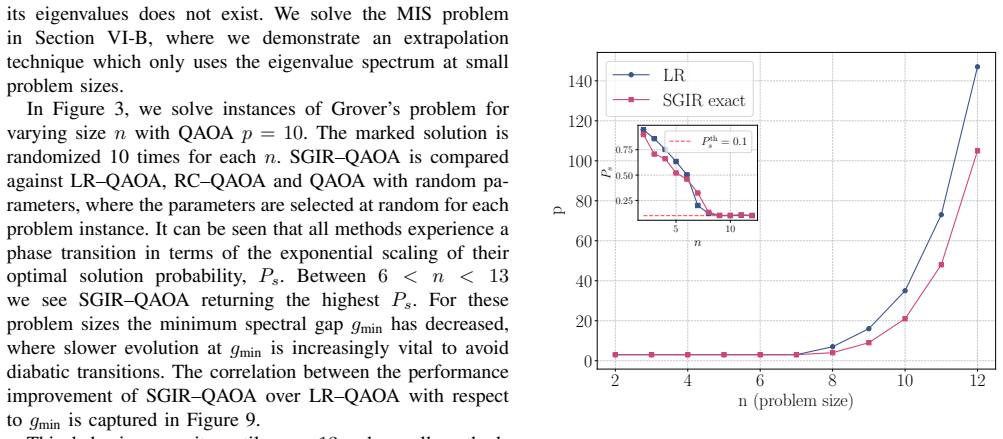
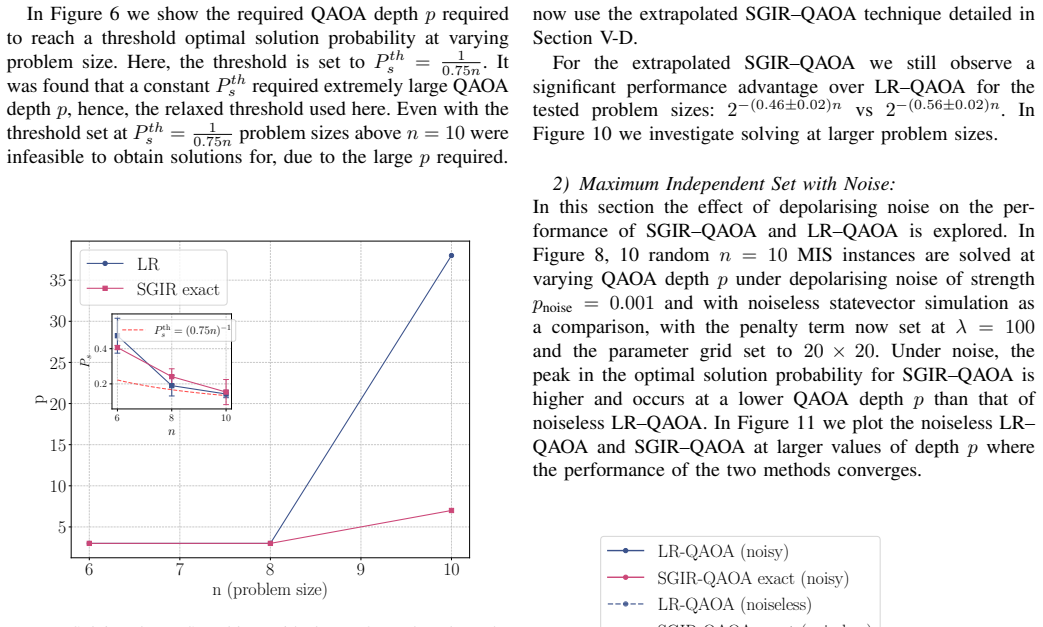
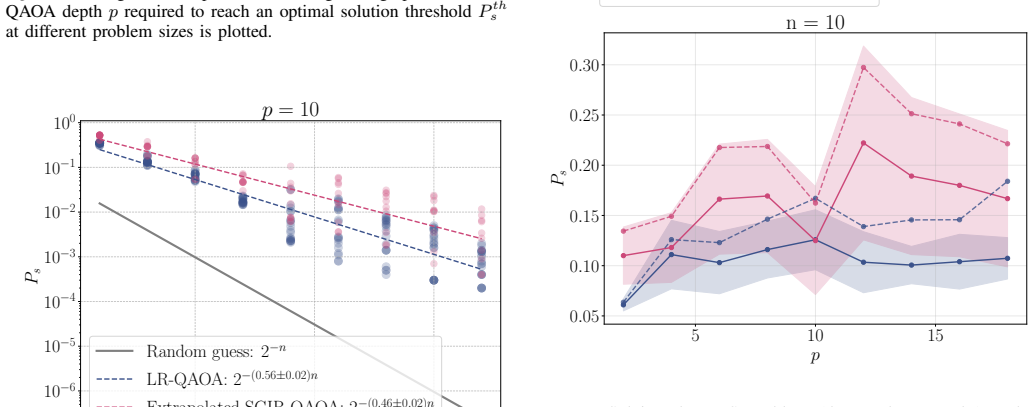
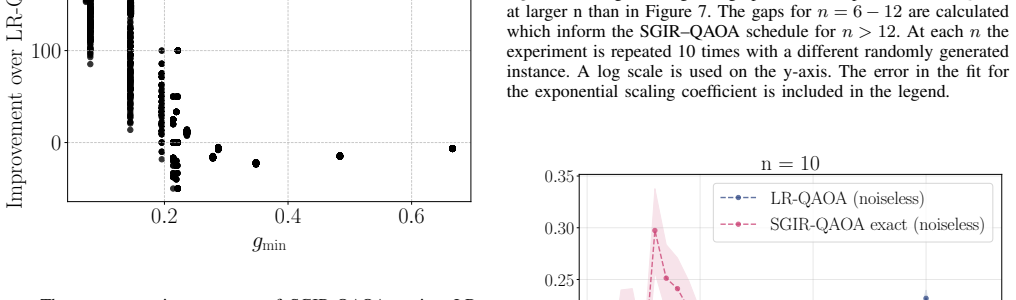
We propose Spectral Gap Informed Ramps for QAOA (SGIR-QAOA) that use the spectral gap of the adiabatic Hamiltonian, with the QAOA mixer as initial Hamiltonian, to create smooth parameter schedules that evolve slowly where the gap is small. We demonstrate that SGIR-QAOA outperforms Linear Ramp QAOA on Grover's problem at constant depth and requires shorter depths for equivalent performance. These benefits extend to the Maximum Independent Set problem. Using extrapolated spectral gaps allows scaling to larger instances, and the performance advantage persists under mild depolarising noise.
What carries the argument
Spectral Gap Informed Ramps (SGIR-QAOA), smooth parameter schedules derived from the spectral gaps of the adiabatic Hamiltonian that adjust evolution speed to avoid regions of small gaps.
If this is right
- SGIR-QAOA achieves performance improvements over LR-QAOA on Grover's at constant depth.
- SGIR-QAOA requires shorter depths to reach the same optimal solution probability.
- Performance benefits extend to the Maximum Independent Set problem.
- The method remains effective with extrapolated spectral gap information for larger scales.
- The advantage persists under mild depolarising noise.
Where Pith is reading between the lines
- The extrapolation technique could enable SGIR-QAOA schedules for problem sizes beyond exact diagonalization.
- Similar gap-based scheduling may connect QAOA to other adiabatic-inspired variational methods on combinatorial tasks.
- The persistence of gains under mild noise points toward potential use on near-term devices with realistic error rates.
Load-bearing premise
Spectral gap information from the adiabatic Hamiltonian produces effective ramps when extrapolated to problem sizes where exact gaps cannot be computed, and observed improvements are not limited to the tested instances or noise models.
What would settle it
Finding that on a larger Grover instance or different MIS graph, the extrapolated SGIR-QAOA yields lower solution probability than LR-QAOA or fails to maintain advantage under the depolarizing noise model.
Figures







read the original abstract
A challenge with the Quantum Approximate Optimisation Algorithm (QAOA), and variational algorithms in general, is finding good variational parameters, a task which in itself can be NP-hard. Recent work has sought to de-variationalise QAOA by picking well-informed guesses for the variational parameters. The Linear Ramp QAOA (LR-QAOA) achieves this by using parameter schedules inspired by the quantum adiabatic algorithm. In this work, we propose Spectral Gap Informed Ramp QAOA (SGIR-QAOA), a new QAOA variant that incorporates spectral gap information from an adiabatic Hamiltonian, with the QAOA mixer Hamiltonian as the initial Hamiltonian, to construct smooth parameter schedules. SGIR-QAOA performs slow evolution where the spectral gap of the adiabatic Hamiltonian is small. We show that SGIR-QAOA has performance improvements over the LR-QAOA on Grover's problem at constant depth and that SGIR-QAOA requires shorter depths to achieve the same optimal solution probability. We then show that these performance benefits extend to a problem with potential practical applications - the Maximum Independent Set (MIS) problem. Finally, we demonstrate the scalability of the SGIR-QAOA method using extrapolated spectral gap information for scales that the spectral gap cannot be exactly evaluated, and show that the advantage appears to persist under mild depolarising noise.
Editorial analysis
A structured set of objections, weighed in public.
Referee Report
Summary. The manuscript introduces Spectral Gap Informed Ramps QAOA (SGIR-QAOA), which constructs QAOA parameter schedules using spectral gap information from an adiabatic Hamiltonian (with the QAOA mixer as initial Hamiltonian) to slow evolution where the gap is small. It claims performance improvements over Linear Ramp QAOA (LR-QAOA) on Grover's problem at constant depth, shorter depths to reach the same optimal solution probability, extension of these benefits to the Maximum Independent Set (MIS) problem, and persistence of the advantages when using extrapolated spectral gaps for larger scales together with resilience under mild depolarizing noise.
Significance. If the central claims hold after validation, the work provides a concrete, non-variational method for selecting QAOA schedules that exploits spectral properties of the adiabatic path, yielding measurable gains on both a canonical problem (Grover) and a practically relevant one (MIS). The explicit use of gap information to shape the ramp, combined with the noise test and the attempt at extrapolation, strengthens the case for de-variationalizing QAOA and could guide future parameter-selection strategies.
major comments (2)
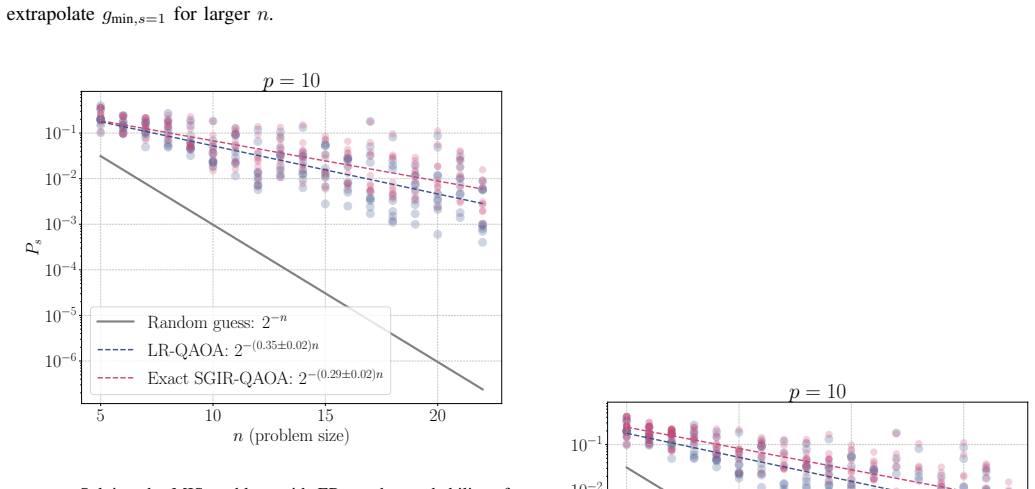
- [scalability demonstration using extrapolated spectral gaps] The scalability section claims that advantages persist when spectral gaps are extrapolated to sizes where exact diagonalization is impossible, yet no cross-validation is reported that compares exact-gap and extrapolated-gap schedules on the same intermediate-size instances. Because the method deliberately slows evolution near the minimal gap, even modest extrapolation error can shift the slow-evolution region and violate the adiabatic condition at the chosen depth; this directly undermines the central scalability claim.
- [Grover's problem results] In the Grover's problem results, performance improvements and depth reductions relative to LR-QAOA are asserted without accompanying quantitative metrics, error bars, or an explicit equation showing how the gap values are mapped onto the ramp parameters. The absence of these details makes it impossible to verify that the reported gains are not artifacts of the specific small instances or the particular gap-to-schedule mapping chosen.
minor comments (2)
- [methods] The construction of the adiabatic Hamiltonian (mixer as initial Hamiltonian) is described only at a high level; an explicit Hamiltonian expression or pseudocode would clarify how the gap is computed and used.
- [figures] Figure captions and axis labels for the probability-vs-depth plots should explicitly state the number of instances, the extrapolation ansatz, and whether error bars represent standard deviation or standard error.
Simulated Author's Rebuttal
We thank the referee for their careful and insightful review of our manuscript. We have carefully considered each major comment and provide point-by-point responses below, along with our plans for revisions.
read point-by-point responses
-
Referee: [scalability demonstration using extrapolated spectral gaps] The scalability section claims that advantages persist when spectral gaps are extrapolated to sizes where exact diagonalization is impossible, yet no cross-validation is reported that compares exact-gap and extrapolated-gap schedules on the same intermediate-size instances. Because the method deliberately slows evolution near the minimal gap, even modest extrapolation error can shift the slow-evolution region and violate the adiabatic condition at the chosen depth; this directly undermines the central scalability claim.
Authors: We recognize the importance of validating the extrapolation procedure. To address this, we will perform and report cross-validation on intermediate system sizes (where exact diagonalization remains feasible) by comparing the performance of schedules based on exact gaps versus extrapolated gaps. This will confirm that any extrapolation errors do not compromise the adiabaticity at the depths used, thereby supporting the scalability demonstration. The revised manuscript will include these results. revision: yes
-
Referee: [Grover's problem results] In the Grover's problem results, performance improvements and depth reductions relative to LR-QAOA are asserted without accompanying quantitative metrics, error bars, or an explicit equation showing how the gap values are mapped onto the ramp parameters. The absence of these details makes it impossible to verify that the reported gains are not artifacts of the specific small instances or the particular gap-to-schedule mapping chosen.
Authors: We agree that additional details are necessary for full transparency and reproducibility. In the revision, we will provide the explicit mapping (equation or algorithm) used to translate spectral gap information into the QAOA parameter schedule. We will also include quantitative metrics for the performance improvements, such as success probabilities at various depths, accompanied by error bars derived from multiple independent runs or statistical analysis. These additions will allow independent verification of the reported advantages on Grover's problem. revision: yes
Circularity Check
No circularity: parameter schedules constructed from independently computed spectral gaps
full rationale
The paper's core derivation begins with the adiabatic Hamiltonian (mixer as initial, problem as final) and extracts its spectral gaps via direct diagonalization or computation. These gaps are used to construct the SGIR-QAOA ramps by slowing evolution where the gap is minimal. Performance is then evaluated separately on Grover and MIS instances. No equation reduces a claimed QAOA improvement to a quantity defined by the authors' own prior results, a fit to QAOA success probabilities, or a self-citation chain. Extrapolation of gaps for larger instances is presented as a practical extension rather than a load-bearing premise that collapses the central claims; benefits are shown where exact gaps are available, keeping the method externally falsifiable.
Axiom & Free-Parameter Ledger
axioms (1)
- domain assumption The adiabatic Hamiltonian formed by interpolating the QAOA mixer and problem Hamiltonian has spectral gaps that can be used to guide a non-adiabatic but still effective QAOA schedule.
Forward citations
Cited by 1 Pith paper
-
Feasibility-driven QAOA with penalty scheduling
Introduces Λ-lr-QAOA and piecewise-ramp QAOA that promote penalty schedules to variational parameters and use a feasibility-driven loss on budget-constrained MWIS satellite planning instances.
discussion (0)
Sign in with ORCID, Apple, or X to comment. Anyone can read and Pith papers without signing in.