Next-Generation Atmosphere Models for Giant Planets with Application to Coupled Interior Composition and Spectral Evolution I: Cloudless Models with Equilibrium Chemistry
Pith reviewed 2026-06-27 05:17 UTC · model grok-4.3
The pith
On-the-fly interpolation of atmospheric composition boundary conditions changes the timing of helium rain in giant planet evolution.
A machine-rendered reading of the paper's core claim, the machinery that carries it, and where it could break.
Core claim
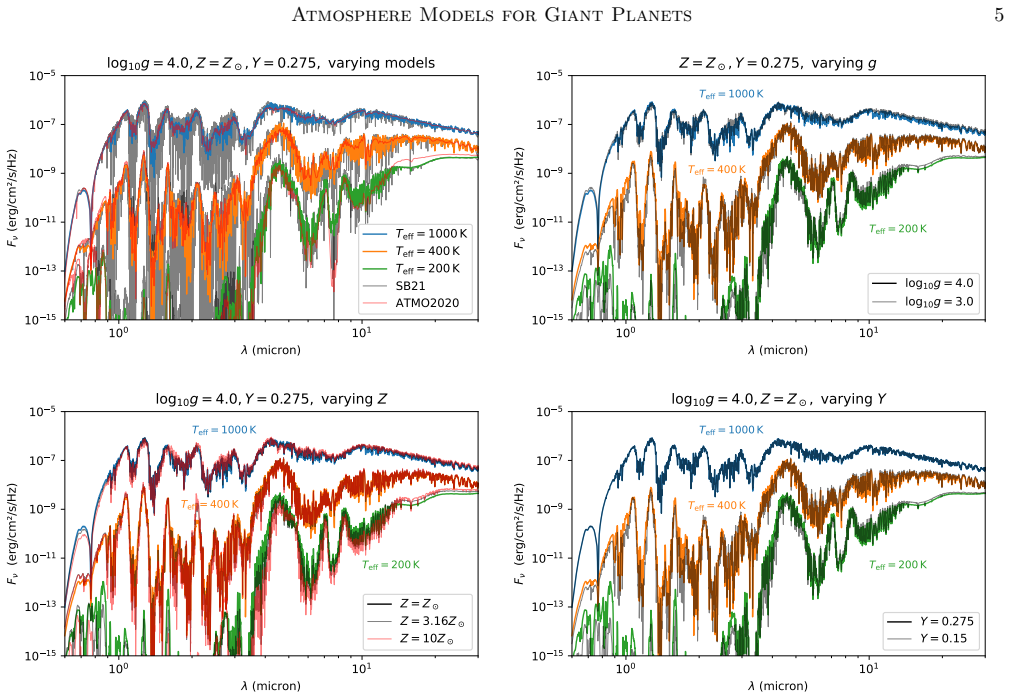
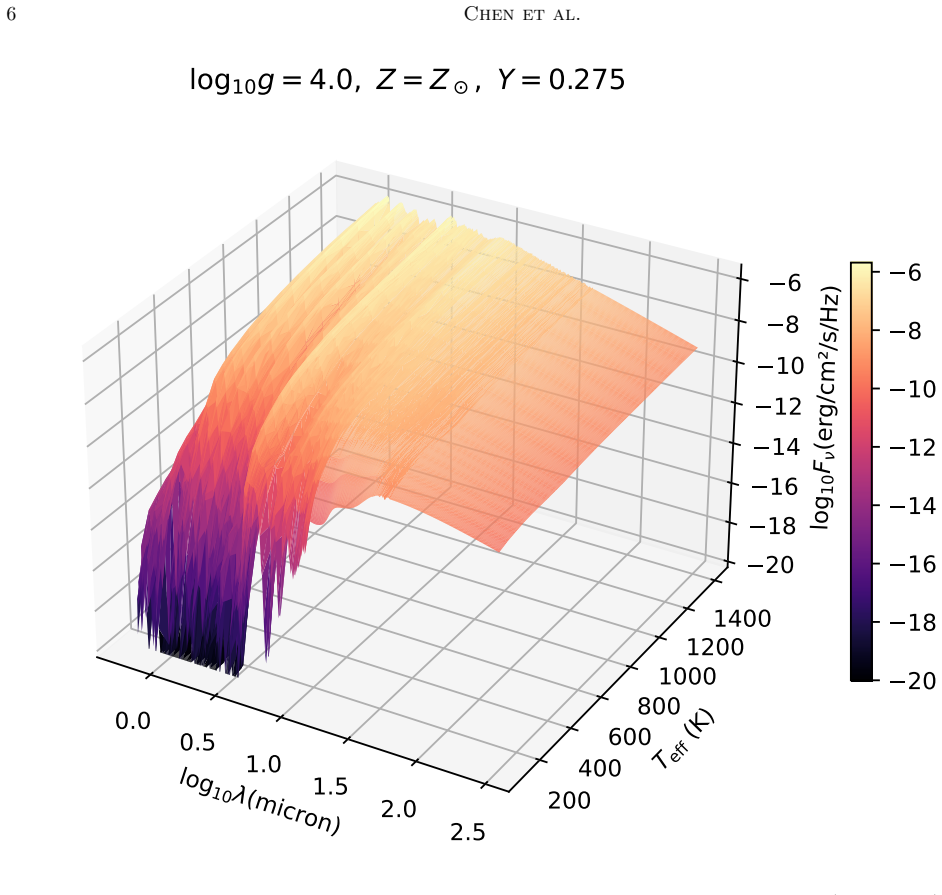
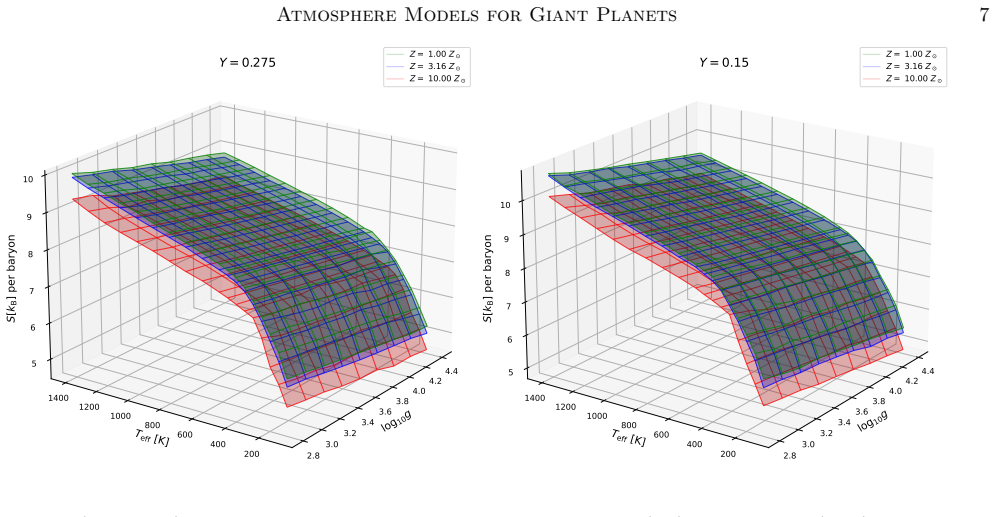
Cloudless atmosphere models computed with CoolTLusty supply entropy values at the convective base, temperature-pressure profiles, and emergent spectra for T_eff from 100 to 1400 K and log g from 2.8 to 4.4 at metallicities Z = 1, 3.16, 10 Z_sun and helium fractions Y = 0.15, 0.275. Adoption of a metal-inclusive EOS keeps heavy-element treatment consistent between opacity and equation of state. Direct comparison of evolutionary tracks demonstrates that on-the-fly interpolation of composition-dependent boundary conditions alters the timing of helium rain and therefore the cooling curve and atmospheric helium depletion.
What carries the argument
The 4D interpolation toolkit over the parameter space (T_eff, log10 g, Y, Z) that supplies time-dependent boundary conditions and spectra for coupling to interior evolution calculations.
If this is right
- Tables accommodate both helium-fraction changes from rain and metallicity variations during envelope evolution.
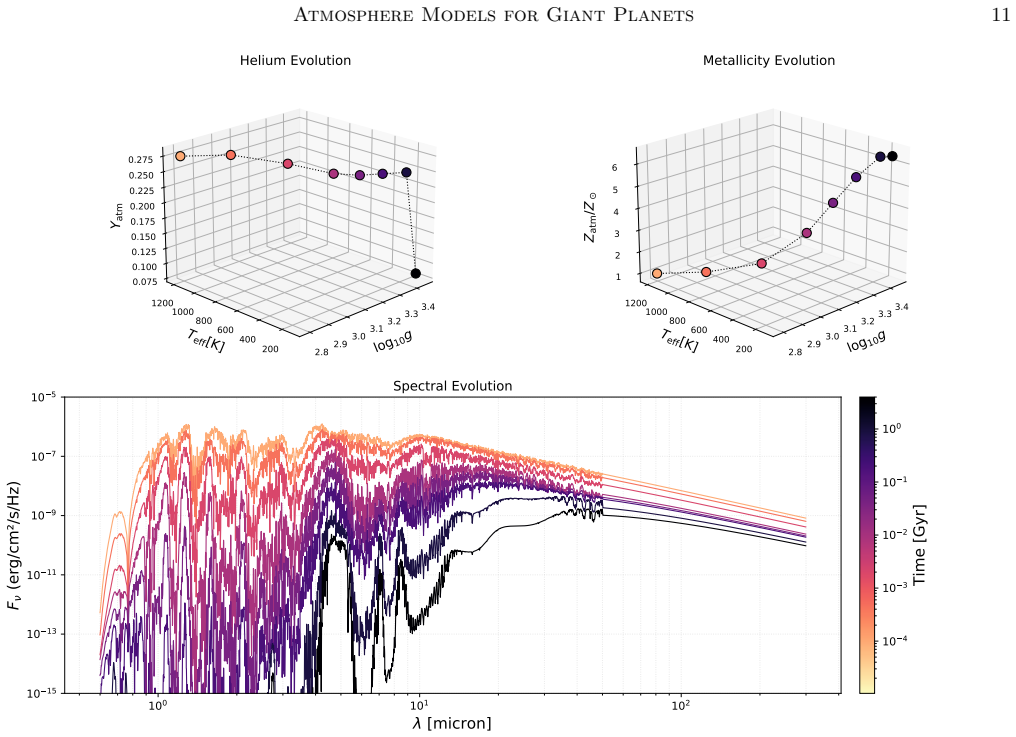
- Evolutionary tracks can be post-processed to yield fully time-resolved spectral sequences.
- The consistent Y and Z treatment improves coupling between atmosphere and interior models.
- The models span the full mass range 0.3-10 M_J with updated opacities.
Where Pith is reading between the lines
- The revised cooling histories may shift inferred ages for directly imaged exoplanets when helium depletion is used as a clock.
- Extending the interpolation framework to include disequilibrium chemistry would test how much the reported timing shift depends on the equilibrium assumption.
- Coupling these boundary conditions to interior models that also track metal redistribution could reveal whether composition gradients amplify or damp the helium-rain effect.
Load-bearing premise
Equilibrium chemistry together with the chosen line-by-line opacities and metal-inclusive EOS accurately represent real cloudless giant planet atmospheres across the full temperature, gravity, and composition range.
What would settle it
Comparison of the predicted timing of helium rain and resulting atmospheric helium abundance against direct spectroscopic measurements of helium in a mature giant planet or brown dwarf.
Figures



read the original abstract
We present updated atmosphere models designed for calculating the post-formation evolution and cooling of giant planets with masses between $0.3$ and $10$ $M_J$. Our tables provide the entropy in the convective region at the base of the atmosphere, temperature ($T$)pressure ($P$) profiles, and emergent spectra for atmospheres calculated using the radiative transfer code \texttt{CoolTLusty} for $T_{\mathrm{eff}}$s over the range 100 to 1400 Kelvin and log$_{10}$($g$) from 2.8 to 4.4 ($cgs$) with the latest opacities and equations of state. Each spectrum and thermal profile is calculated using line-by-line opacity sampling. We construct tables at 3 different metallicities ($Z = 1, 3.16, 10 Z_\odot$) and 2 different helium fractions ($Y=0.15, 0.275$), with the improvement that we adopt a metal-inclusive EOS that treats heavy elements consistently with the opacity metallicity (rather than folding it into an effective $Y$). The result is tables that accommodate both changes in $Y$ due to helium rain and potential variations in $Z$ during envelope evolution. We present a comparison between TP profiles, modeled spectra, and evolutionary tracks, and find that on-the-fly interpolation of boundary conditions in atmospheric composition has a notable impact on the late stages of giant planet evolution, altering the timing of helium rain and therefore the subsequent cooling history and atmospheric helium depletion. We also provide an available toolkit that generates spectra and boundary conditions via efficient interpolation across the 4D parameter space $(T_{\rm eff}, \log_{10} g, Y, Z)$, which is useful for post processing evolutionary tracks to produce fully time-resolved spectral evolutions.
Editorial analysis
A structured set of objections, weighed in public.
Referee Report
Summary. The paper presents updated cloudless atmosphere models for giant planets (0.3-10 MJ) computed with CoolTLusty using line-by-line opacities and a metal-inclusive EOS. Tables supply convective entropy, TP profiles, and spectra over Teff = 100-1400 K and log g = 2.8-4.4 at three metallicities (Z = 1, 3.16, 10 Z⊙) and two helium fractions (Y = 0.15, 0.275). A 4D interpolation toolkit is provided, and the central claim is that on-the-fly interpolation of these composition-dependent boundary conditions produces a notable change in late-stage evolutionary tracks, specifically shifting the onset of helium rain and the subsequent cooling and atmospheric helium depletion.
Significance. If the reported evolutionary differences are shown to arise from physical changes in boundary conditions rather than numerical artifacts, the work supplies improved, publicly usable tables and interpolation tools that couple atmospheric composition variations (including helium rain) directly to interior evolution and time-resolved spectra. This addresses a recognized limitation in prior models that treated Y and Z as fixed or decoupled.
major comments (1)
- [description of the interpolation toolkit and evolutionary-track comparison] The central claim that on-the-fly 4D interpolation alters helium-rain timing rests on the assumption that differences between tracks are physical rather than interpolation artifacts. The manuscript constructs tables on a discrete (Teff, log g, Y, Z) grid (3 Z values, 2 Y values) and supplies an interpolation toolkit, but reports neither the interpolation scheme (linear, spline, etc.), grid density, nor quantitative error metrics such as hold-out tests on entropy or TP profiles. Without these, it is not demonstrated that interpolation error is smaller than the physical signal from composition change.
minor comments (2)
- [methods] The abstract states that spectra and thermal profiles are calculated with line-by-line opacity sampling; the methods section should explicitly state the wavelength grid and sampling strategy used for the line-by-line calculations.
- [abstract] Notation for effective temperature appears as T_{\mathrm{eff}}s in the abstract; consistent use of T_eff throughout would improve readability.
Simulated Author's Rebuttal
We thank the referee for their careful reading and constructive comments. We address the major comment on the interpolation toolkit and validation of evolutionary differences below.
read point-by-point responses
-
Referee: The central claim that on-the-fly 4D interpolation alters helium-rain timing rests on the assumption that differences between tracks are physical rather than interpolation artifacts. The manuscript constructs tables on a discrete (Teff, log g, Y, Z) grid (3 Z values, 2 Y values) and supplies an interpolation toolkit, but reports neither the interpolation scheme (linear, spline, etc.), grid density, nor quantitative error metrics such as hold-out tests on entropy or TP profiles. Without these, it is not demonstrated that interpolation error is smaller than the physical signal from composition change.
Authors: We agree that the interpolation scheme, grid details, and quantitative error metrics are not reported in the current manuscript and should be included to support the central claim. In the revised manuscript we will add a dedicated subsection describing the interpolation method used by the toolkit, the grid spacing in each dimension, and results from hold-out validation tests on entropy and TP profiles. These additions will quantify the interpolation errors and show they are smaller than the composition-driven differences, confirming that the reported shifts in helium-rain timing are physical. revision: yes
Circularity Check
No circularity detected; derivation is self-contained
full rationale
The paper computes TP profiles, spectra, and base entropies directly via the external CoolTLusty radiative-transfer code using line-by-line opacity sampling and a metal-inclusive EOS for discrete (Teff, logg, Y, Z) points. Tables are populated from these calculations at fixed metallicities and helium fractions; evolutionary tracks are then compared with versus without on-the-fly 4D interpolation of those tabulated boundary conditions. No equation reduces a claimed result to a fitted parameter or self-citation by construction, no ansatz is smuggled via prior work, and the helium-rain timing shift is presented as an output of the comparison rather than an input. The chain therefore rests on independent radiative-transfer computations and external opacities/EOS rather than self-referential fitting or renaming.
Axiom & Free-Parameter Ledger
free parameters (2)
- Metallicity values =
1, 3.16, 10 Z_sun
- Helium fractions =
0.15, 0.275
axioms (2)
- standard math Plane-parallel radiative transfer with line-by-line opacity sampling
- domain assumption Local thermodynamic equilibrium and equilibrium chemistry
Reference graph
Works this paper leans on
-
[1]
Achterberg , R. K., & Flasar , F. M. 2020, , 1, 30, 10.3847/PSJ/ab9cb6
-
[2]
Ackerman , A. S., & Marley , M. S. 2001, , 556, 872, 10.1086/321540
-
[3]
2021, , 593, 517, 10.1038/s41586-021-03516-0
Brygoo , S., Loubeyre , P., Millot , M., et al. 2021, , 593, 517, 10.1038/s41586-021-03516-0
-
[4]
2008, , 678, 1436, 10.1086/533518
Burrows , A., Budaj , J., & Hubeny , I. 2008, , 678, 1436, 10.1086/533518
-
[5]
Burrows , A., Hubbard , W. B., Lunine , J. I., & Liebert , J. 2001, Reviews of Modern Physics, 73, 719, 10.1103/RevModPhys.73.719
-
[6]
Burrows , A., & Sharp , C. M. 1999, , 512, 843, 10.1086/306811
-
[7]
Burrows , A., Sudarsky , D., & Hubbard , W. B. 2003, , 594, 545, 10.1086/376897
-
[8]
2006 a , , 650, 1140, 10.1086/507269
Burrows , A., Sudarsky , D., & Hubeny , I. 2006 a , , 650, 1140, 10.1086/507269
-
[9]
2006 b , , 640, 1063, 10.1086/500293
---. 2006 b , , 640, 1063, 10.1086/500293
-
[10]
Burrows , A., Marley , M., Hubbard , W. B., et al. 1997, , 491, 856, 10.1086/305002
-
[11]
2021, ApJ, 917, 6pp, 10.3847/1538-4357/abfc48
Chabrier, G., & Debras, F. 2021, ApJ, 917, 6pp, 10.3847/1538-4357/abfc48
-
[12]
2019, , 872, 51, 10.3847/1538-4357/aaf99f
Chabrier , G., Mazevet , S., & Soubiran , F. 2019, , 872, 51, 10.3847/1538-4357/aaf99f
-
[13]
Chen , Y.-X., Burrows , A., Sur , A., & Arevalo , R. T. 2023, , 957, 36, 10.3847/1538-4357/acf456
-
[14]
Chinchilla , P., B \'e jar , V. J. S., Lodieu , N., et al. 2020, , 633, A152, 10.1051/0004-6361/201936130
-
[15]
L., Rocchetto , M., Yurchenko , S
Chubb , K. L., Rocchetto , M., Yurchenko , S. N., et al. 2021, , 646, A21, 10.1051/0004-6361/202038350
-
[16]
Dupuy , T. J., Liu , M. C., Allers , K. N., et al. 2018, , 156, 57, 10.3847/1538-3881/aacbc2
-
[17]
Fortney , J. J., & Hubbard , W. B. 2003, , 164, 228, 10.1016/S0019-1035(03)00130-1
-
[18]
2004, , 608, 1039, 10.1086/420765
---. 2004, , 608, 1039, 10.1086/420765
-
[19]
J., Ikoma , M., Nettelmann , N., Guillot , T., & Marley , M
Fortney , J. J., Ikoma , M., Nettelmann , N., Guillot , T., & Marley , M. S. 2011, , 729, 32, 10.1088/0004-637X/729/1/32
-
[20]
Fortney , J. J., Marley , M. S., & Barnes , J. W. 2007, , 659, 1661, 10.1086/512120
-
[21]
1981, , 86, 8713, 10.1029/JA086iA10p08713
Gautier , D., Conrath , B., Flasar , M., et al. 1981, , 86, 8713, 10.1029/JA086iA10p08713
-
[22]
Gharib-Nezhad , E., Iyer , A. R., Line , M. R., et al. 2021, , 254, 34, 10.3847/1538-4365/abf504
-
[23]
Graboske , H. C., J., Pollack , J. B., Grossman , A. S., & Olness , R. J. 1975, , 199, 265, 10.1086/153689
-
[24]
2020, Astrophysics A & A, 643, 105, 10.1051/0004-6361/202038367
Haldemann, J., Alibert, Y., Mordasini, C., & Benz, W. 2020, Astrophysics A & A, 643, 105, 10.1051/0004-6361/202038367
-
[25]
2023, , 672, L1, 10.1051/0004-6361/202244851
Howard , S., & Guillot , T. 2023, , 672, L1, 10.1051/0004-6361/202244851
-
[26]
2024, , 689, A15, 10.1051/0004-6361/202450629
Howard , S., M \"u ller , S., & Helled , R. 2024, , 689, A15, 10.1051/0004-6361/202450629
-
[27]
Huang , H., Ormel , C. W., & Min , M. 2024, , 691, A291, 10.1051/0004-6361/202451112
-
[28]
Hubbard , W. B. 1977, , 30, 305, 10.1016/0019-1035(77)90164-6
-
[29]
Hubbard , W. B., Guillot , T., Marley , M. S., et al. 1999, , 47, 1175, 10.1016/S0032-0633(99)00042-2
-
[30]
2007, , 669, 1248, 10.1086/522107
Hubeny , I., & Burrows , A. 2007, , 669, 1248, 10.1086/522107
-
[31]
1995, , 439, 875, 10.1086/175226
Hubeny , I., & Lanz , T. 1995, , 439, 875, 10.1086/175226
-
[32]
2025, Nature Astronomy, 9, 211, 10.1038/s41550-024-02420-7
Hyder , A., Li , C., Chanover , N., & Bjoraker , G. 2025, Nature Astronomy, 9, 211, 10.1038/s41550-024-02420-7
-
[33]
1994, , 111, 174, 10.1006/icar.1994.1139
Karkoschka , E. 1994, , 111, 174, 10.1006/icar.1994.1139
-
[34]
2025, Astronomy & Astrophysics, 10.1051/0004-6361/202556984
Knierim, H., Batygin, K., Helled, R., Morf, L., & Adams, F. 2025, Astronomy & Astrophysics, 10.1051/0004-6361/202556984
-
[35]
Knierim, H., & Helled, R. 2024, ApJ, 227, 13. http://arxiv.org/abs/2407.09341
-
[36]
2023, arXiv e-prints, arXiv:2303.16295, 10.48550/arXiv.2303.16295
Lacy , B., & Burrows , A. 2023, arXiv e-prints, arXiv:2303.16295, 10.48550/arXiv.2303.16295
-
[37]
2010, Science, 329, 57, 10.1126/science.1187187
Lagrange , A.-M., Bonnefoy , M., Chauvin , G., et al. 2010, Science, 329, 57, 10.1126/science.1187187
-
[38]
B., Scholz , A., Mu z i \'c , K., et al
Langeveld , A. B., Scholz , A., Mu z i \'c , K., et al. 2024, , 168, 179, 10.3847/1538-3881/ad6f0c
-
[39]
2020, Nature Astronomy, 4, 609, 10.1038/s41550-020-1009-3
Li , C., Ingersoll , A., Bolton , S., et al. 2020, Nature Astronomy, 4, 609, 10.1038/s41550-020-1009-3
-
[40]
2009, Physical Review Letters, 102, 10.1103/PhysRevLett.102.115701
Lorenzen, W., Holst, B., & Redmer, R. 2009, Physical Review Letters, 102, 10.1103/PhysRevLett.102.115701
-
[41]
2011, Physical Review B, 84, 10.1103/PhysRevB.84.235109
---. 2011, Physical Review B, 84, 10.1103/PhysRevB.84.235109
-
[42]
Macintosh , B., Graham , J. R., Barman , T., et al. 2015, Science, 350, 64, 10.1126/science.aac5891
-
[43]
E., Morley, C
Mang, J., Batalha, N. E., Morley, C. V., et al. 2026, The Astrophysical Journal, 1000, 98
2026
-
[44]
Mankovich , C., Fortney , J. J., & Moore , K. L. 2016, , 832, 113, 10.3847/0004-637X/832/2/113
-
[45]
S., Saumon , D., & Goldblatt , C
Marley , M. S., Saumon , D., & Goldblatt , C. 2010, , 723, L117, 10.1088/2041-8205/723/1/L117
-
[46]
S., Saumon , D., Visscher , C., et al
Marley , M. S., Saumon , D., Visscher , C., et al. 2021, , 920, 85, 10.3847/1538-4357/ac141d
-
[47]
2008, Science, 322, 1348, 10.1126/science.1166585
Marois , C., Macintosh , B., Barman , T., et al. 2008, Science, 322, 1348, 10.1126/science.1166585
-
[48]
1995, , 378, 355, 10.1038/378355a0
Mayor , M., & Queloz , D. 1995, , 378, 355, 10.1038/378355a0
-
[49]
Militzer, B., & Hubbard, W. B. 2013, The Astrophysical Journal, 774, 148, 10.1088/0004-637X/774/2/148
-
[50]
V., Mukherjee , S., Marley , M
Morley , C. V., Mukherjee , S., Marley , M. S., et al. 2024, , 975, 59, 10.3847/1538-4357/ad71d5
-
[51]
2020, , 638, A121, 10.1051/0004-6361/201937376
M \"u ller , S., Helled , R., & Cumming , A. 2020, , 638, A121, 10.1051/0004-6361/201937376
-
[52]
J., Moore , K., & Mankovich , C
Nettelmann , N., Fortney , J. J., Moore , K., & Mankovich , C. 2015, , 447, 3422, 10.1093/mnras/stu2634
-
[53]
W., Tremblin , P., Baraffe , I., et al
Phillips , M. W., Tremblin , P., Baraffe , I., et al. 2020, , 637, A38, 10.1051/0004-6361/201937381
-
[54]
Pollack , J. B., Grossman , A. S., Moore , R., & Graboske , H. C., J. 1977, , 30, 111, 10.1016/0019-1035(77)90126-9
-
[55]
Pollack , J. B., & Ohring , G. 1973, , 19, 34, 10.1016/0019-1035(73)90137-1
-
[56]
Saumon , D., & Marley , M. S. 2008, , 689, 1327, 10.1086/592734
-
[57]
Sharp , C. M., & Burrows , A. 2007, , 168, 140, 10.1086/508708
-
[58]
2003, , 588, 1121, 10.1086/374331
Sudarsky , D., Burrows , A., & Hubeny , I. 2003, , 588, 1121, 10.1086/374331
-
[59]
2005, , 627, 520, 10.1086/430206
Sudarsky , D., Burrows , A., Hubeny , I., & Li , A. 2005, , 627, 520, 10.1086/430206
-
[60]
2000, , 538, 885, 10.1086/309160
Sudarsky , D., Burrows , A., & Pinto , P. 2000, , 538, 885, 10.1086/309160
-
[61]
T., Burrows , A., & Chen , Y.-X
Sur , A., Arevalo , R. T., Burrows , A., & Chen , Y.-X. 2026, , 998, 305, 10.3847/1538-4357/ae3a85
-
[62]
Sur , A., Burrows , A., Arevalo , R. T., & Su , Y. 2025 a , , 994, 186, 10.3847/1538-4357/ae16a3
-
[63]
2024, , 971, 104, 10.3847/1538-4357/ad57c3
Sur , A., Su , Y., Tejada Arevalo , R., Chen , Y.-X., & Burrows , A. 2024, , 971, 104, 10.3847/1538-4357/ad57c3
-
[64]
2025 b , , 980, L5, 10.3847/2041-8213/adad62
Sur , A., Tejada Arevalo , R., Su , Y., & Burrows , A. 2025 b , , 980, L5, 10.3847/2041-8213/adad62
-
[65]
2024, , 274, 34, 10.3847/1538-4365/ad6cd7
Tejada Arevalo , R., Su , Y., Sur , A., & Burrows , A. 2024, , 274, 34, 10.3847/1538-4365/ad6cd7
-
[66]
2025, , 979, 243, 10.3847/1538-4357/ada030
Tejada Arevalo , R., Sur , A., Su , Y., & Burrows , A. 2025, , 979, 243, 10.3847/1538-4357/ada030
-
[67]
2018, , 610, L14, 10.1051/0004-6361/201732522
Vazan , A., Helled , R., & Guillot , T. 2018, , 610, L14, 10.1051/0004-6361/201732522
-
[68]
2016, , 829, 118, 10.3847/0004-637X/829/2/118
Vazan , A., Helled , R., Podolak , M., & Kovetz , A. 2016, , 829, 118, 10.3847/0004-637X/829/2/118
-
[69]
Yurchenko , S. N., & Tennyson , J. 2014, , 440, 1649, 10.1093/mnras/stu326
discussion (0)
Sign in with ORCID, Apple, or X to comment. Anyone can read and Pith papers without signing in.