Improving the Angular Resolution of IBD Events Using Neutron Capture Information in Super-Kamiokande
Pith reviewed 2026-06-27 09:08 UTC · model grok-4.3
The pith
Neutron capture positions correlate with initial neutrino momentum enough to statistically improve IBD angular resolution from 10 MeV to hundreds of MeV.
A machine-rendered reading of the paper's core claim, the machinery that carries it, and where it could break.
Core claim
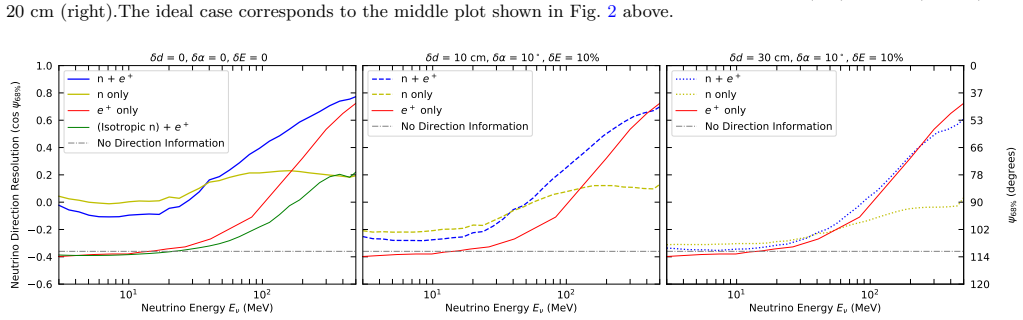
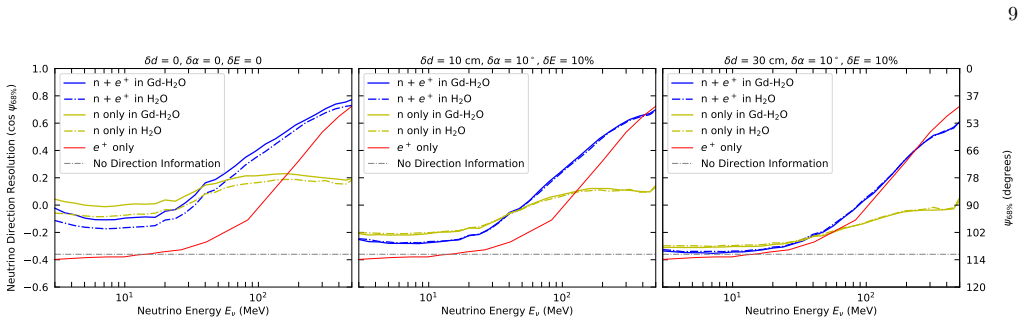
Simulations demonstrate that the final neutron capture position in IBD events remains correlated with the initial neutrino momentum sufficiently to produce a statistical improvement in neutrino angular resolution compared with positron-only inference, for energies from about 10 MeV to several hundred MeV, even when neutron diffusion in water is included.
What carries the argument
The statistical correlation between neutron capture position after diffusion and the initial neutrino momentum, which supplies directional information usable in ensemble reconstruction.
If this is right
- Statistical direction reconstruction becomes feasible for low-energy neutrino sources such as supernovae.
- Gadolinium doping supplies both background rejection and an additional handle on directionality.
- Gains in vertex reconstruction accuracy are required before the statistical benefit can be realized in data.
- The improvement applies across the stated energy window even after diffusion is modeled.
Where Pith is reading between the lines
- The same correlation could be examined in other water-based detectors that tag neutron captures.
- Accumulated events might allow crude localization of a galactic supernova direction.
- Detector designs that prioritize position resolution would amplify any gain from this method.
- Direct comparison with Super-K data recorded after gadolinium loading would test the simulation predictions.
Load-bearing premise
The directional correlation between neutron capture position and initial neutrino momentum survives diffusion and can be measured accurately enough with achievable vertex resolutions to produce a net statistical gain.
What would settle it
A simulation or data set in which the angular resolution metric shows no improvement or a degradation once neutron capture positions are added after realistic vertex-resolution smearing is applied.
Figures





read the original abstract
One of the most important neutrino interactions is the Inverse Beta Decay (IBD). However, the IBD events typically carry no directional information in water Cherenkov detectors as the positron directions are mostly isotropic at low energies, such as those in supernova studies. As Gadolinium is being added to Super-Kamiokande, the improved neutron capture efficiency not only allows better background rejection, but the neutron capture information could potentially provide additional information that allows better event reconstruction. Due to neutron diffusion in water, event-by-event reconstruction is difficult. However, if the final neutron capture position is correlated with the initial neutrino momentum, it may be possible that neutrino directionality could be reconstructed statistically, with or without using the positron information. In this work, we use Geant4 to simulate neutron propagation in water. We show that in a wide range of neutrino energies from about 10 MeV to several hundred MeV, neutron capture information could statistically enhance the neutrino directionality, compared to positron-only inference, even with neutron diffusion considered. However, practical application of this technique depends crucially on detection effects, especially the vertex reconstruction resolutions. Our work therefore motivates developments of better reconstruction algorithms and techniques, as well as detector upgrades.
Editorial analysis
A structured set of objections, weighed in public.
Referee Report
Summary. The manuscript presents Geant4 simulations of neutron propagation following inverse beta decay (IBD) in water. It claims that the final neutron capture position retains a statistical correlation with the initial neutrino direction even after diffusion, enabling an improvement in angular resolution over positron-only reconstruction for neutrino energies from approximately 10 MeV to several hundred MeV. The work explicitly caveats that practical use depends on vertex reconstruction resolutions and therefore motivates improved reconstruction algorithms and detector upgrades.
Significance. If the simulation results are robust, the work identifies a potential additional statistical handle on directionality in Gd-loaded water Cherenkov detectors, which could be relevant for supernova neutrino analyses where directional information is otherwise limited at low energies. The forward-simulation approach with an explicit caveat on detection effects is a strength, as it avoids overclaiming and focuses attention on the need for better vertex resolution.
major comments (2)
- [Abstract] Abstract: The central claim that 'neutron capture information could statistically enhance the neutrino directionality' is stated without any quantitative metrics (e.g., improvement factor in angular resolution, correlation coefficient, or statistical significance), error bars, or tabulated results from the Geant4 runs. This is load-bearing because the result rests entirely on unshown simulation outputs.
- [Simulation and Results] Simulation description: No details are supplied on the modeling of neutron diffusion (e.g., diffusion length, time scales, or Geant4 physics lists used) or on how finite vertex reconstruction resolutions are folded into the capture-position distributions. This directly affects evaluation of the assumption that the correlation remains usable after diffusion.
minor comments (1)
- [Abstract] The abstract would benefit from a single sentence summarizing the magnitude of the reported improvement (even if approximate) to allow readers to gauge the effect size without reading the full results section.
Simulated Author's Rebuttal
We thank the referee for the constructive comments, which help strengthen the clarity and completeness of the manuscript. We address each major point below.
read point-by-point responses
-
Referee: [Abstract] Abstract: The central claim that 'neutron capture information could statistically enhance the neutrino directionality' is stated without any quantitative metrics (e.g., improvement factor in angular resolution, correlation coefficient, or statistical significance), error bars, or tabulated results from the Geant4 runs. This is load-bearing because the result rests entirely on unshown simulation outputs.
Authors: We agree that the abstract would be improved by including quantitative metrics. The full manuscript presents the Geant4 results via figures that demonstrate the statistical correlation between neutron capture position and neutrino direction. We will revise the abstract to incorporate key quantitative measures from the simulations, such as correlation strengths or resolution improvement factors with uncertainties. revision: yes
-
Referee: [Simulation and Results] Simulation description: No details are supplied on the modeling of neutron diffusion (e.g., diffusion length, time scales, or Geant4 physics lists used) or on how finite vertex reconstruction resolutions are folded into the capture-position distributions. This directly affects evaluation of the assumption that the correlation remains usable after diffusion.
Authors: We agree that additional technical details are required for full evaluation and reproducibility. We will revise the simulation section to specify the Geant4 physics lists, the modeling of neutron diffusion (including lengths and timescales), and how finite vertex reconstruction resolutions are accounted for in the capture-position analysis. revision: yes
Circularity Check
No significant circularity; forward simulation study
full rationale
The paper conducts Geant4 Monte Carlo simulations of neutron propagation to evaluate statistical correlations between capture position and neutrino direction after diffusion. No analytical derivations, parameter fits, or self-citations form the load-bearing chain; results are direct simulation outputs. The abstract and text explicitly caveat practical use on external factors like vertex resolution, with no reduction of any 'prediction' to fitted inputs or self-referential definitions.
Axiom & Free-Parameter Ledger
Reference graph
Works this paper leans on
-
[1]
The parameterp 2 represents the neutron capture time constant
Neutron Capture Time The fitting function for the neutron capture time is given by [37], f(t) =p 0 ·(1−e − t p1 )·e − t p2 +p 3,(A1) where the thermalization time constantp 1, fixed to be 4.3µs, is obtained from a combined analysis of the mea- surements [37], andp 0,p 2, andp 3 are fitting parameters. The parameterp 2 represents the neutron capture time c...
-
[2]
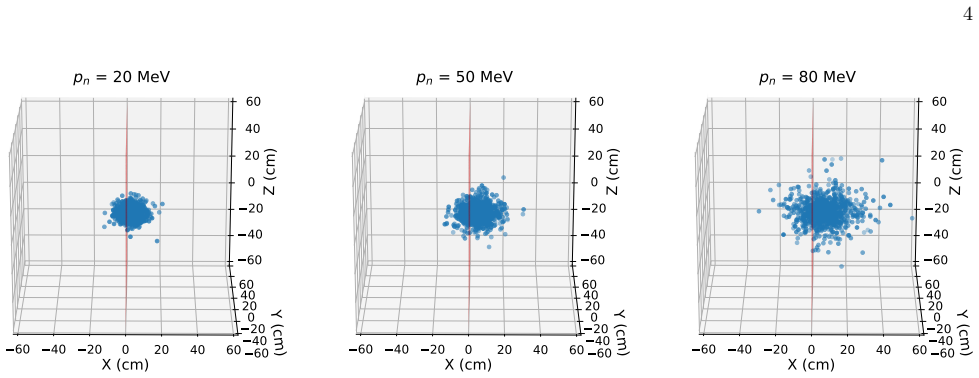
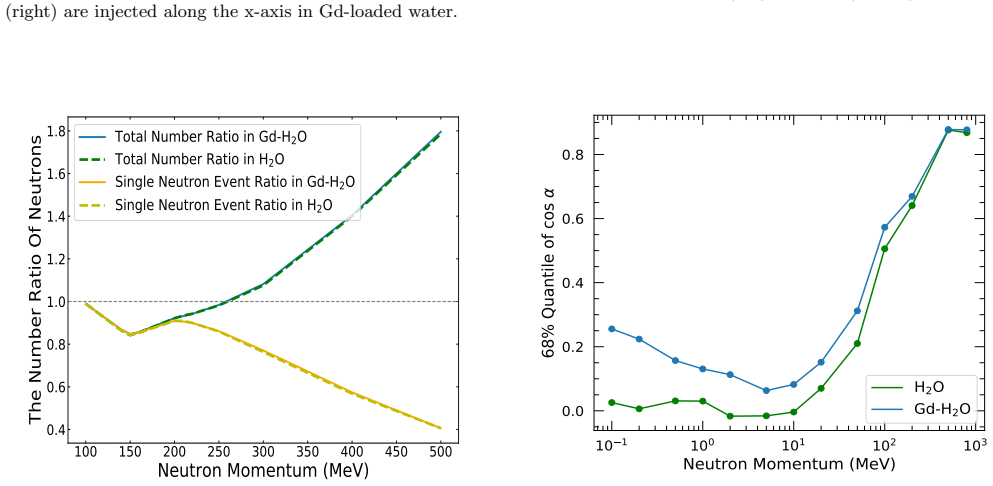
Neutron Capture Distance The average capture distance for neutrons with a mo- mentum of 30 MeV is approximately 10.6 cm in pure wa- ter, which is slightly longer than the average capture dis- tance of 7.5 cm in Gd-loaded water, as shown in Fig. 11. Figure 13 shows the distributions of neutron capture distances for several momentum values. There is clearly...
2000
-
[3]
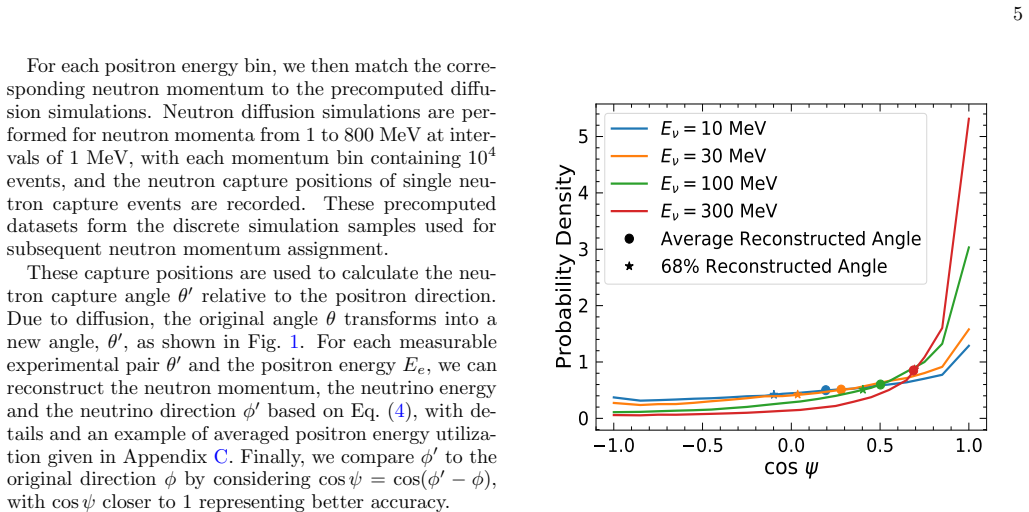
Positron Angular Resolution The 1σangular resolution refers to the angular range that encompasses 68% of events in the distribution of the angular difference between the reconstructed direc- tion and the true direction of an event [53]. Positrons with MeV-level kinetic energy typically travel a few cen- timeters in water before annihilation and we assume ...
-
[4]
For simpli- fication, we consider a constant positron energy resolu- tionδEof 10%
Positron Energy Resolution In experimental settings, the positron energy resolu- tionδEdepends on the positron energy [53]. For simpli- fication, we consider a constant positron energy resolu- tionδEof 10%. Similar to above, we modify the positron energy according to the energy resolution for each neu- Eν cosψ 68% δα=0◦ δα=10◦ 10 MeV -0.097 -0.10 30 MeV 0...
-
[5]
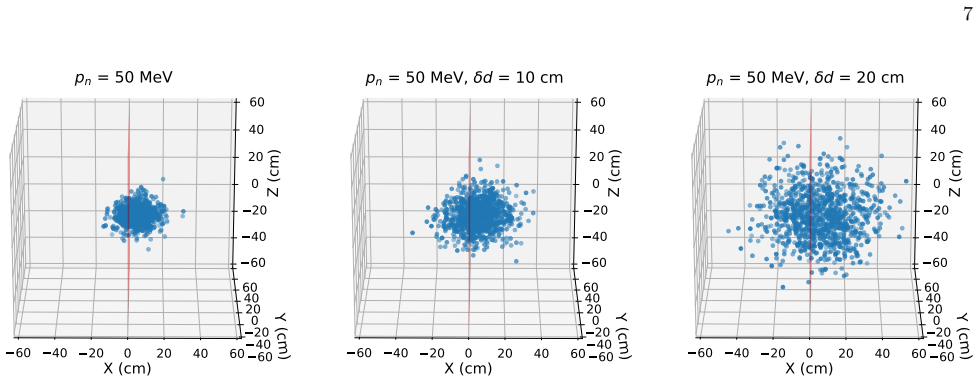
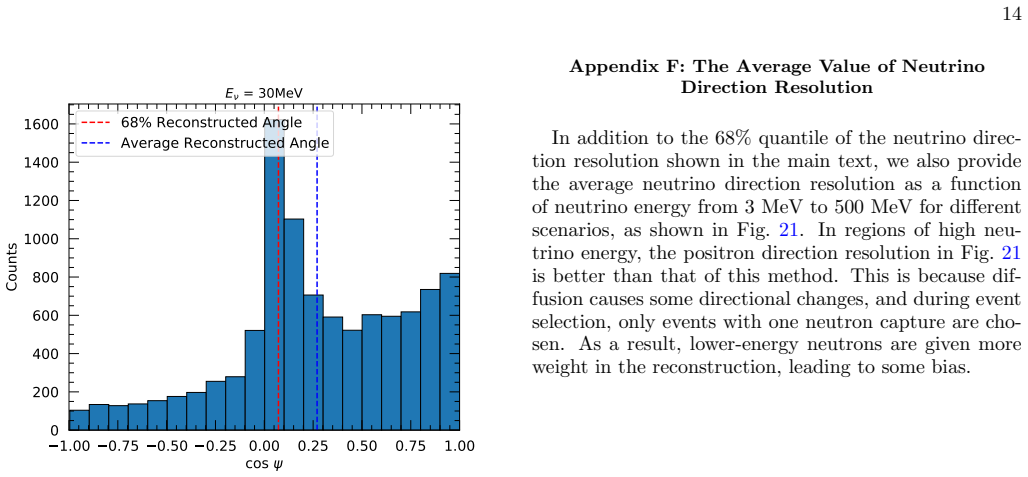
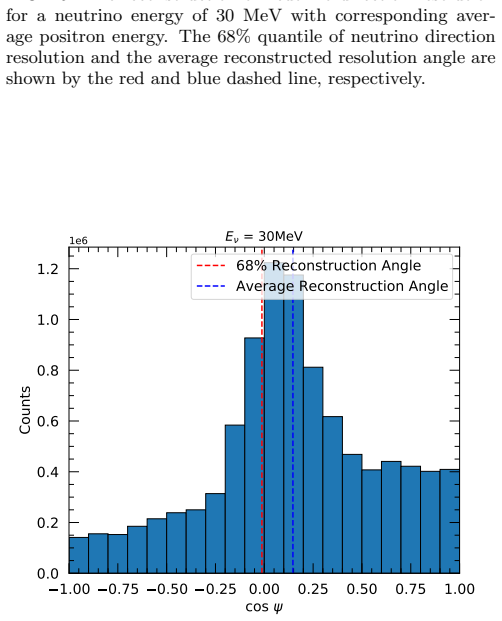
Reconstruction Using the Fixed Positron Energy with Detector Resolutions Consider a scenario where a neutron capture and IBD vertex resolution of 10 cm, a positron angular resolution of 10 ◦, and a positron energy resolution of 10% are in- corporated. Fig. 20 illustrates the reconstructed neutrino direction and corresponding mean positron energy for 30 Me...
-
[6]
Solar Models, Neutrino Experiments and Helioseismology,
John N. Bahcall and Roger K. Ulrich, “Solar Models, Neutrino Experiments and Helioseismology,” Rev. Mod. Phys.60, 297–372 (1988)
1988
-
[7]
Observation of a Neu- trino Burst from the Supernova SN 1987a,
K. Hirataet al.(Kamiokande-II), “Observation of a Neu- trino Burst from the Supernova SN 1987a,” Phys. Rev. Lett.58, 1490–1493 (1987)
1987
-
[8]
Observation in the Kamiokande- II Detector of the Neutrino Burst from Supernova SN 1987a,
K. S. Hirataet al., “Observation in the Kamiokande- II Detector of the Neutrino Burst from Supernova SN 1987a,” Phys. Rev. D38, 448–458 (1988)
1988
-
[9]
Observation of a Neutrino Burst in Coincidence with Supernova SN 1987a in the Large Magellanic Cloud,
R. M. Biontaet al., “Observation of a Neutrino Burst in Coincidence with Supernova SN 1987a in the Large Magellanic Cloud,” Phys. Rev. Lett.58, 1494 (1987)
1987
-
[10]
Angular Distribution of Events From Sn1987a,
C. B. Brattonet al.(IMB), “Angular Distribution of Events From Sn1987a,” Phys. Rev. D37, 3361 (1988)
1988
-
[11]
Detection of the Neutrino Signal From SN1987A in the LMC Using the Inr Baksan Under- ground Scintillation Telescope,
E. N. Alekseev, L. N. Alekseeva, I. V. Krivosheina, and V. I. Volchenko, “Detection of the Neutrino Signal From SN1987A in the LMC Using the Inr Baksan Under- ground Scintillation Telescope,” Phys. Lett. B205, 209– 214 (1988)
1988
-
[12]
Physics with Reac- tor Neutrinos,
Xin Qian and Jen-Chieh Peng, “Physics with Reac- tor Neutrinos,” Rept. Prog. Phys.82, 036201 (2019), arXiv:1801.05386 [hep-ex]
Pith/arXiv arXiv 2019
-
[13]
Geo-neutrinos and Earth’s interior,
Gianni Fiorentini, Marcello Lissia, and Fabio Mantovani, “Geo-neutrinos and Earth’s interior,” Phys. Rept.453, 117–172 (2007), arXiv:0707.3203 [physics.geo-ph]
Pith/arXiv arXiv 2007
-
[14]
Evidence for os- cillation of atmospheric neutrinos,
Y. Fukudaet al.(Super-Kamiokande), “Evidence for os- cillation of atmospheric neutrinos,” Phys. Rev. Lett.81, 1562–1567 (1998), arXiv:hep-ex/9807003
Pith/arXiv arXiv 1998
-
[15]
ATMOSPHERIC NEUTRINOS AND DISCOVERY OF NEUTRINO OSCILLATIONS,
Takaaki Kajita, “ATMOSPHERIC NEUTRINOS AND DISCOVERY OF NEUTRINO OSCILLATIONS,” Proc. Japan Acad. B86, 303–321 (2010)
2010
-
[16]
Bei Zhou and John F. Beacom, “First detailed calculation of atmospheric neutrino foregrounds to the diffuse super- nova neutrino background in Super-Kamiokande,” Phys. Rev. D109, 103003 (2024), arXiv:2311.05675 [hep-ph]
arXiv 2024
-
[17]
Revisiting the Triangulation Method for Point- ing to Supernova and Failed Supernova with Neutrinos,
T. M¨ uhlbeier, H. Nunokawa, and R. Zukanovich Fun- chal, “Revisiting the Triangulation Method for Point- ing to Supernova and Failed Supernova with Neutrinos,” Phys. Rev. D88, 085010 (2013), arXiv:1304.5006 [astro- ph.HE]
Pith/arXiv arXiv 2013
-
[18]
Neu- trino astronomy with supernova neutrinos,
Vedran Brdar, Manfred Lindner, and Xun-Jie Xu, “Neu- trino astronomy with supernova neutrinos,” JCAP04, 025 (2018), arXiv:1802.02577 [hep-ph]
Pith/arXiv arXiv 2018
-
[19]
Timing the neutrino signal of a Galac- tic supernova,
Rasmus S. L. Hansen, Manfred Lindner, and Oliver Scholer, “Timing the neutrino signal of a Galac- tic supernova,” Phys. Rev. D101, 123018 (2020), arXiv:1904.11461 [hep-ph]
arXiv 2020
-
[20]
Can a supernova be lo- cated by its neutrinos?
John F. Beacom and P. Vogel, “Can a supernova be lo- cated by its neutrinos?” Phys. Rev. D60, 033007 (1999), arXiv:astro-ph/9811350
Pith/arXiv arXiv 1999
-
[21]
Gadolinium in wa- ter Cherenkov detectors improves detection of supernova νe,
Ranjan Laha and John F. Beacom, “Gadolinium in wa- ter Cherenkov detectors improves detection of supernova νe,” Phys. Rev. D89, 063007 (2014), arXiv:1311.6407 [astro-ph.HE]
Pith/arXiv arXiv 2014
-
[22]
Observing the Next Galactic Supernova,
Scott M. Adams, C. S. Kochanek, John F. Beacom, Mark R. Vagins, and K. Z. Stanek, “Observing the Next Galactic Supernova,” Astrophys. J.778, 164 (2013), arXiv:1306.0559 [astro-ph.HE]
Pith/arXiv arXiv 2013
-
[23]
From eV to EeV: Neu- trino Cross Sections Across Energy Scales,
J. A. Formaggio and G. P. Zeller, “From eV to EeV: Neu- trino Cross Sections Across Energy Scales,” Rev. Mod. Phys.84, 1307–1341 (2012), arXiv:1305.7513 [hep-ex]
Pith/arXiv arXiv 2012
-
[24]
An accurate evaluation of electron (anti- )neutrino scattering on nucleons,
Giulia Ricciardi, Natascia Vignaroli, and Francesco Vissani, “An accurate evaluation of electron (anti- )neutrino scattering on nucleons,” JHEP08, 212 (2022), arXiv:2206.05567 [hep-ph]
arXiv 2022
-
[25]
Supernova Neutrinos: Production, Oscillations and Detection,
Alessandro Mirizzi, Irene Tamborra, Hans-Thomas Janka, Ninetta Saviano, Kate Scholberg, Robert Bollig, Lorenz Hudepohl, and Sovan Chakraborty, “Supernova Neutrinos: Production, Oscillations and Detection,” Riv. Nuovo Cim.39, 1–112 (2016), arXiv:1508.00785 [astro- ph.HE]
Pith/arXiv arXiv 2016
-
[26]
Experimental investigation of geologi- cally produced antineutrinos with KamLAND,
T. Arakiet al., “Experimental investigation of geologi- cally produced antineutrinos with KamLAND,” Nature 436, 499–503 (2005)
2005
-
[27]
First measurement of reactor neutrino oscillations at JUNO,
Angel Abuslemeet al.(JUNO), “First measurement of reactor neutrino oscillations at JUNO,” (2025), arXiv:2511.14593 [hep-ex]
arXiv 2025
-
[28]
Fengpeng Anet al.(JUNO), “Neutrino Physics with JUNO,” J. Phys. G43, 030401 (2016), arXiv:1507.05613 [physics.ins-det]
Pith/arXiv arXiv 2016
-
[29]
Neutrino Constraints on the Dark Matter Total Annihilation Cross Section,
Hasan Yuksel, Shunsaku Horiuchi, John F. Beacom, and Shin’ichiro Ando, “Neutrino Constraints on the Dark Matter Total Annihilation Cross Section,” Phys. Rev. D 76, 123506 (2007), arXiv:0707.0196 [astro-ph]
Pith/arXiv arXiv 2007
-
[30]
Testing MeV dark matter with neutrino detectors,
Sergio Palomares-Ruiz and Silvia Pascoli, “Testing MeV dark matter with neutrino detectors,” Phys. Rev. D77, 025025 (2008), arXiv:0710.5420 [astro-ph]
Pith/arXiv arXiv 2008
-
[31]
Sensitivity floor for primordial black holes in neutrino searches,
Qishan Liu and Kenny C. Y. Ng, “Sensitivity floor for primordial black holes in neutrino searches,” Phys. Rev. D110, 063024 (2024), arXiv:2312.06108 [hep-ph]
arXiv 2024
-
[32]
Strong New Limits on Light Dark Matter from Neutrino Ex- periments,
Christopher V. Cappiello and John F. Beacom, “Strong New Limits on Light Dark Matter from Neutrino Ex- periments,” Phys. Rev. D100, 103011 (2019), [Erratum: Phys.Rev.D 104, 069901 (2021)], arXiv:1906.11283 [hep- ph]
arXiv 2019
-
[33]
Dark matter annihilation to neutrinos,
Carlos A. Arg¨ uelles, Alejandro Diaz, Ali Kheiran- dish, Andr´ es Olivares-Del-Campo, Ibrahim Safa, and Aaron C. Vincent, “Dark matter annihilation to neutrinos,” Rev. Mod. Phys.93, 035007 (2021), arXiv:1912.09486 [hep-ph]
arXiv 2021
-
[34]
Angular distribution of neutron inverse beta decay, anti-neutrino(e) + p —> e+ + n,
P. Vogel and John F. Beacom, “Angular distribution of neutron inverse beta decay, anti-neutrino(e) + p —> e+ + n,” Phys. Rev. D60, 053003 (1999), arXiv:hep- ph/9903554
arXiv 1999
-
[35]
M. Apollonioet al.(CHOOZ), “Determination of neu- trino incoming direction in the CHOOZ experiment and supernova explosion location by scintillator detectors,” Phys. Rev. D61, 012001 (2000), arXiv:hep-ex/9906011
Pith/arXiv arXiv 2000
-
[36]
V. Fischeret al., “Prompt directional detection of galac- tic supernova by combining large liquid scintillator neu- trino detectors,” JCAP08, 032 (2015), arXiv:1504.05466 [astro-ph.IM]
Pith/arXiv arXiv 2015
-
[37]
Presupernova neutrinos: di- rectional sensitivity and prospects for progenitor identifi- cation,
Mainak Mukhopadhyay, Cecilia Lunardini, F. X. Timmes, and Kai Zuber, “Presupernova neutrinos: di- rectional sensitivity and prospects for progenitor identifi- cation,” Astrophys. J.899, 153 (2020), arXiv:2004.02045 [astro-ph.HE]
arXiv 2020
-
[38]
Prospects for Pre-supernova Neutrino Obser- vation in Future Large Liquid-scintillator Detectors,
Hui-Ling Li, Yu-Feng Li, Liang-Jian Wen, and Shun Zhou, “Prospects for Pre-supernova Neutrino Obser- vation in Future Large Liquid-scintillator Detectors,” JCAP05, 049 (2020), arXiv:2003.03982 [astro-ph.HE]. 17
arXiv 2020
-
[39]
GADZOOKS! Anti-neutrino spectroscopy with large water Cherenkov detectors,
John F. Beacom and Mark R. Vagins, “GADZOOKS! Anti-neutrino spectroscopy with large water Cherenkov detectors,” Phys. Rev. Lett.93, 171101 (2004), arXiv:hep-ph/0309300
Pith/arXiv arXiv 2004
-
[40]
The Super-Kamiokande experiment,
Yoichiro Suzuki, “The Super-Kamiokande experiment,” Eur. Phys. J. C79, 298 (2019)
2019
-
[41]
Recent oscilla- tion results and future prospects of Super-Kamiokande,
Yasuo Takeuchi (Super-Kamiokande), “Recent oscilla- tion results and future prospects of Super-Kamiokande,” PoSNOW2022, 004 (2023)
2023
-
[42]
First gadolinium loading to Super-Kamiokande,
K. Abeet al.(Super-Kamiokande), “First gadolinium loading to Super-Kamiokande,” Nucl. Instrum. Meth. A 1027, 166248 (2022), arXiv:2109.00360 [physics.ins-det]
arXiv 2022
-
[43]
Second gadolinium loading to Super- Kamiokande,
K. Abeet al., “Second gadolinium loading to Super- Kamiokande,” (2024), arXiv:2403.07796 [physics.ins- det]
arXiv 2024
-
[44]
Upgrade of Super-Kamiokande with Gadolinium,
Yusuke Koshio, Masayuki Nakahata, Hiroyuki Sekiya, and Mark R. Vagins, “Upgrade of Super-Kamiokande with Gadolinium,” (2025), arXiv:2511.03921 [physics.ins-det]
arXiv 2025
-
[45]
The Super- Kamiokande detector,
Y. Fukudaet al.(Super-Kamiokande), “The Super- Kamiokande detector,” Nucl. Instrum. Meth. A501, 418–462 (2003)
2003
-
[46]
Shirley Weishi Li and John F. Beacom, “First calcula- tion of cosmic-ray muon spallation backgrounds for MeV astrophysical neutrino signals in Super-Kamiokande,” Phys. Rev. C89, 045801 (2014), arXiv:1402.4687 [hep- ph]
Pith/arXiv arXiv 2014
-
[47]
Robust measurement of supernovaν e spectra with fu- ture neutrino detectors,
Alex Nikrant, Ranjan Laha, and Shunsaku Horiuchi, “Robust measurement of supernovaν e spectra with fu- ture neutrino detectors,” Phys. Rev. D97, 023019 (2018), arXiv:1711.00008 [astro-ph.HE]
Pith/arXiv arXiv 2018
-
[48]
Neutron tagging can greatly reduce spallation back- grounds in Super-Kamiokande,
Obada Nairat, John F. Beacom, and Shirley Weishi Li, “Neutron tagging can greatly reduce spallation back- grounds in Super-Kamiokande,” Phys. Rev. D111, 023014 (2025), arXiv:2409.10611 [hep-ph]
arXiv 2025
-
[49]
M. Haradaet al.(Super-Kamiokande), “Search for As- trophysical Electron Antineutrinos in Super-Kamiokande with 0.01% Gadolinium-loaded Water,” Astrophys. J. Lett.951, L27 (2023), arXiv:2305.05135 [astro-ph.HE]
arXiv 2023
-
[50]
Future Prospects of Super- kamiokande and Hyper-kamiokande,
Masayuki Nakahata, “Future Prospects of Super- kamiokande and Hyper-kamiokande,” Phys. Procedia61, 568–575 (2015)
2015
-
[51]
Research and Development for a Gadolinium Doped Water Cherenkov Detector,
Andrew Renshaw (Super-Kamiokande), “Research and Development for a Gadolinium Doped Water Cherenkov Detector,” Phys. Procedia37, 1249–1256 (2012), arXiv:1201.1017 [physics.ins-det]
Pith/arXiv arXiv 2012
-
[52]
First Study of Neutron Tagging with a Water Cherenkov Detector,
H. Watanabeet al.(Super-Kamiokande), “First Study of Neutron Tagging with a Water Cherenkov Detector,” As- tropart. Phys.31, 320–328 (2009), arXiv:0811.0735 [hep- ex]
Pith/arXiv arXiv 2009
-
[53]
Recent developments in Geant4,
J. Allisonet al., “Recent developments in Geant4,” Nucl. Instrum. Meth. A835, 186–225 (2016)
2016
-
[54]
GEANT4–a simulation toolkit,
S. Agostinelliet al.(GEANT4), “GEANT4–a simulation toolkit,” Nucl. Instrum. Meth. A506, 250–303 (2003)
2003
-
[55]
Modification on thermal motion in Geant4 for neutron capture simulation in Gadolinium loaded water,
Y. Hinoet al., “Modification on thermal motion in Geant4 for neutron capture simulation in Gadolinium loaded water,” (2024), arXiv:2412.04186 [hep-ex]
arXiv 2024
-
[56]
Solar neutrino measurements in Super-Kamiokande-II,
J. P. Cravenset al.(Super-Kamiokande), “Solar neutrino measurements in Super-Kamiokande-II,” Phys. Rev. D 78, 032002 (2008), arXiv:0803.4312 [hep-ex]
Pith/arXiv arXiv 2008
-
[57]
Solar neutrino re- sults in Super-Kamiokande-III,
K. Abeet al.(Super-Kamiokande), “Solar neutrino re- sults in Super-Kamiokande-III,” Phys. Rev. D83, 052010 (2011), arXiv:1010.0118 [hep-ex]
Pith/arXiv arXiv 2011
-
[58]
Solar neutrino measurements using the full data period of Super- Kamiokande-IV,
K. Abeet al.(Super-Kamiokande), “Solar neutrino measurements using the full data period of Super- Kamiokande-IV,” Phys. Rev. D109, 092001 (2024), arXiv:2312.12907 [hep-ex]
arXiv 2024
-
[59]
Solar Neutrino Mea- surements in Super-Kamiokande-IV,
K. Abeet al.(Super-Kamiokande), “Solar Neutrino Mea- surements in Super-Kamiokande-IV,” Phys. Rev. D94, 052010 (2016), arXiv:1606.07538 [hep-ex]
arXiv 2016
-
[60]
Liz Kneale, Michael Smy, and Matthew Malek, “Coincidence-based reconstruction for reactor antineu- trino detection in gadolinium-doped Cherenkov detec- tors,” Nucl. Instrum. Meth. A1053, 168375 (2023), arXiv:2210.10576 [physics.ins-det]
arXiv 2023
-
[61]
Hyper-Kamiokande Design Report,
K. Abeet al.(Hyper-Kamiokande), “Hyper-Kamiokande Design Report,” (2018), arXiv:1805.04163 [physics.ins- det]
Pith/arXiv arXiv 2018
-
[62]
M. Askinset al.(WATCHMAN), “The Physics and Nu- clear Nonproliferation Goals of WATCHMAN: A WA- ter CHerenkov Monitor for ANtineutrinos,” (2015), arXiv:1502.01132 [physics.ins-det]
Pith/arXiv arXiv 2015
-
[63]
Measurement of the 2200 m/sec neutron-proton capture cross section,
D. Cokinos and E. Melkonian, “Measurement of the 2200 m/sec neutron-proton capture cross section,” Phys. Rev. C15, 1636–1643 (1977)
1977
-
[64]
Precise quasielastic neutrino/nucleon cross-section,
Alessandro Strumia and Francesco Vissani, “Precise quasielastic neutrino/nucleon cross-section,” Phys. Lett. B564, 42–54 (2003), arXiv:astro-ph/0302055
Pith/arXiv arXiv 2003
-
[65]
Theory of inverse beta decay for reactor antineutrinos,
Oleksandr Tomalak, “Theory of inverse beta decay for reactor antineutrinos,” (2025), arXiv:2512.07956 [hep- ph]
arXiv 2025
-
[66]
Vector and Axial Nucleon Form Factors:A Duality Constrained Parameterization,
A. Bodek, S. Avvakumov, R. Bradford, and Howard Scott Budd, “Vector and Axial Nucleon Form Factors:A Duality Constrained Parameterization,” Eur. Phys. J. C53, 349–354 (2008), arXiv:0708.1946 [hep-ex]
Pith/arXiv arXiv 2008
discussion (0)
Sign in with ORCID, Apple, or X to comment. Anyone can read and Pith papers without signing in.