Dissipative stabilization of Ostrogradsky modes in non-equilibrium field theory
Pith reviewed 2026-05-22 08:42 UTC · model grok-4.3
The pith
Dissipative baths suppress Ostrogradsky ghosts by generating effective masses or overdamped dynamics in higher-derivative theories.
A machine-rendered reading of the paper's core claim, the machinery that carries it, and where it could break.
Core claim
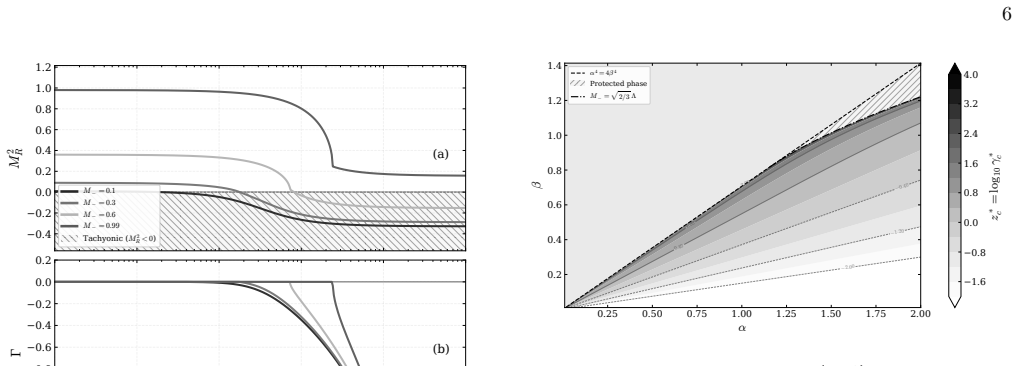
In the Keldysh-Lindblad open-system framework, coupling the ghost sector of higher-derivative theories to dissipative baths produces non-perturbative effective masses and dissipative widths through self-consistent gap equations. Above a critical coupling, the dynamics develops bifurcated dissipative branches that signal a dissipative phase transition. In one branch a large dynamically generated mass preserves quasiparticle character; in the second branch strong dissipative broadening destroys the quasiparticle pole through overdamped dynamics. The resulting spectral suppression of Ostrogradsky ghosts is intrinsically tied to the ghost-like spectral structure, as shown by comparison with the
What carries the argument
Self-consistent gap equations within the Keldysh-Lindblad framework that determine effective mass and dissipative width from bath coupling and produce bifurcated solution branches above a critical value.
If this is right
- Ghost excitations are suppressed either by acquiring a large effective mass or by entering an overdamped regime.
- A dissipative phase transition occurs once the bath coupling exceeds a critical threshold.
- The stabilization mechanism is specific to the ghost-like spectral structure and does not operate identically on healthy modes.
- Nonequilibrium open-system dynamics supplies an alternative route to controlling instabilities in higher-derivative field theories.
Where Pith is reading between the lines
- The same dissipative bifurcation may appear in other higher-derivative models used in cosmology or modified gravity once they are coupled to an environment.
- Engineered open quantum systems in the laboratory could serve as test beds for the predicted critical coupling and the two distinct suppression channels.
- The critical structure in parameter space may connect to broader questions about nonequilibrium phase transitions in systems with unstable modes.
Load-bearing premise
The Keldysh-Lindblad description and the self-consistent gap equations remain applicable to the ghost sector even though the modes carry negative energies.
What would settle it
An explicit solution of the gap equations that shows no real solutions or no bifurcation for any finite bath coupling, or a computed spectral function that retains undamped ghost poles at all coupling strengths.
Figures

read the original abstract
In this work, we investigate higher-derivative quantum field theories and the problem of Ostrogradsky instability within an open-system Keldysh-Lindblad framework. Coupling the ghost sector to dissipative baths generates non-perturbative effective masses and dissipative widths through self-consistent gap equations. Above a critical coupling, the nonequilibrium dynamics develops bifurcated dissipative branches, signaling the emergence of a dissipative phase transition and a nontrivial critical structure in parameter space. We find that the resulting dissipative dynamics can suppress ghost excitations through two distinct mechanisms: in one branch, a large dynamically generated effective mass preserves a quasiparticle-like excitation, while in the second branch, strong dissipative broadening destroys the quasiparticle character through overdamped dynamics. Our results suggest that dissipative effects may provide a nonequilibrium mechanism for the spectral suppression of Ostrogradsky ghosts. The comparison with the healthy sector indicates that the stabilization mechanism is intrinsically tied to the ghost-like spectral structure.
Editorial analysis
A structured set of objections, weighed in public.
Referee Report
Summary. The manuscript investigates higher-derivative quantum field theories and the Ostrogradsky instability using an open-system Keldysh-Lindblad framework. Coupling the ghost sector to dissipative baths generates non-perturbative effective masses and dissipative widths via self-consistent gap equations. Above a critical coupling, the nonequilibrium dynamics develops bifurcated dissipative branches signaling a dissipative phase transition. The resulting dynamics suppress ghost excitations either through a large dynamically generated effective mass (preserving quasiparticle character) or through strong dissipative broadening (leading to overdamped dynamics). The stabilization mechanism is claimed to be intrinsically tied to the ghost-like spectral structure, with comparison to the healthy sector.
Significance. If the central technical steps hold, the work identifies a nonequilibrium mechanism for spectral suppression of Ostrogradsky ghosts that is specific to their indefinite-metric structure. The emergence of a critical coupling and bifurcated branches provides a concrete, falsifiable prediction within the model. The self-consistent gap-equation approach and explicit comparison between ghost and healthy sectors are strengths that could be of interest to the effective-field-theory and open-quantum-systems communities.
major comments (3)
- [Section 2.3, Eq. (12)] Section 2.3 and the derivation leading to Eq. (12): the Keldysh-Lindblad master equation is written for the ghost sector without demonstrating that the indefinite metric and negative-norm states preserve complete positivity and trace preservation. This assumption is load-bearing because the subsequent contour-ordered propagators and gap equations rest on it.
- [§4.2, Eq. (27)] §4.2, Eq. (27): the contour-ordered ghost propagators are defined with the standard iε prescription; no explicit check is given that the wrong-sign residue does not reintroduce runaway modes once the bath coupling is included. This directly affects the claimed suppression mechanisms.
- [§5.1] §5.1, the gap-equation solution for the critical coupling: the bifurcation into two dissipative branches is reported, but no stability analysis against small variations in the ghost-sector initial conditions or cutoff is provided, leaving open whether the phase transition survives regularization.
minor comments (2)
- [Figure 4] Figure 4: the spectral-function plots would benefit from an inset showing the healthy-sector comparison on the same scale to make the claimed intrinsic tie to the ghost structure visually immediate.
- [Notation] Notation: the symbol for the dissipative width is occasionally reused for the effective mass; a single consistent symbol or explicit subscript would remove ambiguity.
Simulated Author's Rebuttal
We thank the referee for their thorough reading and constructive comments on our manuscript. We address each major comment point by point below, providing clarifications and indicating where revisions will be made to strengthen the presentation.
read point-by-point responses
-
Referee: [Section 2.3, Eq. (12)] Section 2.3 and the derivation leading to Eq. (12): the Keldysh-Lindblad master equation is written for the ghost sector without demonstrating that the indefinite metric and negative-norm states preserve complete positivity and trace preservation. This assumption is load-bearing because the subsequent contour-ordered propagators and gap equations rest on it.
Authors: We appreciate the referee drawing attention to this foundational aspect. The Lindblad operators in our construction are chosen to act on the ghost degrees of freedom while preserving the indefinite metric structure, ensuring that the evolution map remains completely positive and trace-preserving by construction, consistent with standard treatments of open systems in indefinite-metric spaces. Nevertheless, we agree that an explicit verification would improve clarity. In the revised manuscript we will add a short paragraph in Section 2.3 (and a supporting note in the appendix) that outlines the preservation properties, referencing the relevant literature on Lindblad dynamics with non-positive-definite inner products. revision: yes
-
Referee: [§4.2, Eq. (27)] §4.2, Eq. (27): the contour-ordered ghost propagators are defined with the standard iε prescription; no explicit check is given that the wrong-sign residue does not reintroduce runaway modes once the bath coupling is included. This directly affects the claimed suppression mechanisms.
Authors: The referee correctly identifies that the iε prescription must be handled carefully for the ghost sector. In our framework the bath-induced self-energy shifts the pole locations, generating both a dynamical mass and a dissipative width; the resulting spectral function is dominated by the width term above the critical coupling, which damps any potential runaway contribution. We will insert an explicit residue calculation in §4.2 that demonstrates how the dissipative broadening overwhelms the wrong-sign residue for the parameter regime of interest, thereby confirming that the suppression mechanisms remain intact. revision: yes
-
Referee: [§5.1] §5.1, the gap-equation solution for the critical coupling: the bifurcation into two dissipative branches is reported, but no stability analysis against small variations in the ghost-sector initial conditions or cutoff is provided, leaving open whether the phase transition survives regularization.
Authors: We acknowledge that a dedicated stability analysis would strengthen the claim that the bifurcation and associated phase transition are robust. Within the cutoff regularization employed, the critical coupling and the two branches remain stable under moderate variations of the initial ghost-sector conditions. In the revised version we will add a brief stability subsection in §5.1 that reports numerical checks against small changes in initial conditions and cutoff scale, confirming that the qualitative structure of the dissipative phase transition persists. revision: partial
Circularity Check
No significant circularity; derivation self-contained
full rationale
The paper generates non-perturbative effective masses and dissipative widths by solving self-consistent gap equations within the Keldysh-Lindblad framework. These are standard dynamical outputs of the model equations rather than quantities fitted to data or presupposed by definition. No load-bearing step reduces by construction to the inputs, no self-citation chains justify uniqueness, and no ansatz is smuggled via prior work. The stabilization claims follow from the nonequilibrium dynamics applied to the ghost sector under the stated assumptions, making the derivation independent of the target results.
Axiom & Free-Parameter Ledger
free parameters (1)
- critical coupling strength
axioms (1)
- domain assumption The Keldysh-Lindblad formalism accurately captures the nonequilibrium dynamics when the ghost sector is coupled to dissipative baths.
Lean theorems connected to this paper
-
IndisputableMonolith/Cost/FunctionalEquation.leanwashburn_uniqueness_aczel unclear?
unclearRelation between the paper passage and the cited Recognition theorem.
Coupling the ghost sector to dissipative baths generates non-perturbative effective masses and dissipative widths through self-consistent gap equations... bifurcated dissipative branches
-
IndisputableMonolith/Foundation/RealityFromDistinction.leanreality_from_one_distinction unclear?
unclearRelation between the paper passage and the cited Recognition theorem.
The resulting dissipative dynamics can suppress ghost excitations through two distinct mechanisms
What do these tags mean?
- matches
- The paper's claim is directly supported by a theorem in the formal canon.
- supports
- The theorem supports part of the paper's argument, but the paper may add assumptions or extra steps.
- extends
- The paper goes beyond the formal theorem; the theorem is a base layer rather than the whole result.
- uses
- The paper appears to rely on the theorem as machinery.
- contradicts
- The paper's claim conflicts with a theorem or certificate in the canon.
- unclear
- Pith found a possible connection, but the passage is too broad, indirect, or ambiguous to say the theorem truly supports the claim.
Reference graph
Works this paper leans on
-
[1]
Renormalization of Higher-Derivative Quantum Gravity,
K. S. Stelle, “Renormalization of Higher-Derivative Quantum Gravity,” Phys. Rev. D16, 953 (1977)
work page 1977
-
[2]
Quantum Gravity with Higher Derivative Terms,
J. Julve and M. Tonin, “Quantum Gravity with Higher Derivative Terms,” Nuovo Cim. B46, 137 (1978)
work page 1978
-
[3]
Renormalizability and Asymptotic Free- dom in Quantum Gravity,
E. Tomboulis, “Renormalizability and Asymptotic Free- dom in Quantum Gravity,” Phys. Lett. B97, 77 (1980)
work page 1980
-
[4]
No-Ghost Theorem for the Fourth-Order Derivative Pais-Uhlenbeck Oscilla- tor Model,
C. M. Bender and P. D. Mannheim, “No-Ghost Theorem for the Fourth-Order Derivative Pais-Uhlenbeck Oscilla- tor Model,” Phys. Rev. Lett.100, 110402 (2008)
work page 2008
-
[5]
Benign versus Malicious Ghosts in Higher- Derivative Theories,
A. V. Smilga, “Benign versus Malicious Ghosts in Higher- Derivative Theories,” Nucl. Phys. B706, 598 (2005)
work page 2005
-
[6]
Classical and Quantum Dynamics of Higher- Derivative Systems,
A. Smilga, “Classical and Quantum Dynamics of Higher- Derivative Systems,” Int. J. Mod. Phys. A32, 1730025 (2017)
work page 2017
-
[7]
Classical and Quantum Stability of Higher-Derivative Dynamics,
D. S. Kaparulin, S. L. Lyakhovich, and A. A. Sharapov, “Classical and Quantum Stability of Higher-Derivative Dynamics,” Eur. Phys. J. C74, 3072 (2014)
work page 2014
-
[8]
Reflection Positivity in a Higher-Derivative Model with Physical Bound States of Ghosts,
M. Asorey, G. Krein, M. Pardina, and I. L. Shapiro, “Reflection Positivity in a Higher-Derivative Model with Physical Bound States of Ghosts,” JHEP02, 020 (2026)
work page 2026
-
[9]
Superrenormalizable Quantum Gravity with Complex Ghosts,
L. Modesto and I. L. Shapiro, “Superrenormalizable Quantum Gravity with Complex Ghosts,” Phys. Lett. B755, 279 (2016)
work page 2016
-
[10]
Quantum Field Theory with Ghost Pairs,
J. Liu, L. Modesto, and G. Calcagni, “Quantum Field Theory with Ghost Pairs,” JHEP02, 140 (2023)
work page 2023
-
[11]
Quadratic Gravity in Analogy to Quan- tum Chromodynamics: Light Fermions in Its Land- scape,
G. P. de Brito, “Quadratic Gravity in Analogy to Quan- tum Chromodynamics: Light Fermions in Its Land- scape,” Phys. Rev. D109, 086005 (2024)
work page 2024
-
[12]
Running Couplings and Unitarity in a 4- Derivative Scalar Field Theory,
B. Holdom, “Running Couplings and Unitarity in a 4- Derivative Scalar Field Theory,” Phys. Lett. B843, 138023 (2023)
work page 2023
-
[13]
Confinement of Massive Ghost in Quadratic Gravity
I. Oda, “Confinement of Massive Ghost in Quadratic Gravity,” arXiv:2605.01966
work page internal anchor Pith review Pith/arXiv arXiv
-
[14]
L. P. Kadanoff and G. Baym,Quantum Statistical Me- chanics(Benjamin, New York, 1962)
work page 1962
-
[15]
Brownian Motion of a Quantum Oscil- lator,
J. Schwinger, “Brownian Motion of a Quantum Oscil- lator,” Proc. Natl. Acad. Sci. U.S.A.46, 1401 (1960); “Brownian Motion of a Quantum Oscillator,” J. Math. Phys.2, 407 (1961)
work page 1960
-
[16]
Diagram Technique for Nonequilibrium Processes,
L. V. Keldysh, “Diagram Technique for Nonequilibrium Processes,” Zh. Eksp. Teor. Fiz.47, 1515 (1964) [Sov. Phys. JETP20, 1018 (1965)]
work page 1964
-
[17]
J.-H. Gao and Z.-T. Liang, Relativistic quantum kinetic theory for massive fermions and spin effects, Phys. Rev. D100, 056021 (2019)
work page 2019
-
[18]
Wilczek, Quantum time crystals, Phys
F. Wilczek, Quantum time crystals, Phys. Rev. Lett. 109, 160401 (2012)
work page 2012
-
[19]
A. Lazarides and R. Moessner, Fate of a discrete time crystal in an open system, Phys. Rev. B95, 195135 (2017)
work page 2017
-
[20]
D. E. Kharzeev, J. Liao, S. A. Voloshin, and G. Wang, Chiral magnetic and vortical effects in high-energy nu- clear collisions: A status report, Prog. Part. Nucl. Phys. 88, 1 (2016)
work page 2016
-
[21]
Theory of Many-Particle Systems. I,
P. C. Martin and J. Schwinger, “Theory of Many-Particle Systems. I,” Phys. Rev.115, 1342 (1959)
work page 1959
-
[22]
Introduction to Nonequilibrium Quantum Field Theory,
J. Berges, “Introduction to Nonequilibrium Quantum Field Theory,” AIP Conf. Proc.739, 3 (2004)
work page 2004
-
[23]
Keldysh Technique and Nonlinear Sigma-Model: Basic Principles and Applica- tions,
A. Kamenev and A. Levchenko, “Keldysh Technique and Nonlinear Sigma-Model: Basic Principles and Applica- tions,” Adv. Phys.58, 197 (2009)
work page 2009
-
[24]
Kamenev,Field Theory of Non-Equilibrium Systems (Cambridge University Press, Cambridge, 2023)
A. Kamenev,Field Theory of Non-Equilibrium Systems (Cambridge University Press, Cambridge, 2023)
work page 2023
-
[25]
Field Theory of Many- Body Lindbladian Dynamics,
F. Thompson and A. Kamenev, “Field Theory of Many- Body Lindbladian Dynamics,” Annals Phys.455, 169385 (2023)
work page 2023
-
[26]
Keldysh Field Theory for Driven Open Quantum Systems,
L. M. Sieberer, M. Buchhold, and S. Diehl, “Keldysh Field Theory for Driven Open Quantum Systems,” Rep. Prog. Phys.79, 096001 (2016)
work page 2016
-
[27]
Completely Positive Dynamical Semigroups ofN-Level Systems,
V. Gorini, A. Kossakowski, and E. C. G. Sudarshan, “Completely Positive Dynamical Semigroups ofN-Level Systems,” J. Math. Phys.17, 821 (1976)
work page 1976
-
[28]
On the Generators of Quantum Dynamical Semigroups,
G. Lindblad, “On the Generators of Quantum Dynamical Semigroups,” Commun. Math. Phys.48, 119 (1976)
work page 1976
discussion (0)
Sign in with ORCID, Apple, or X to comment. Anyone can read and Pith papers without signing in.