The shear viscosity of quark-gluon matter calculated with parton transport and comparisons with the Chapman-Enskog results
Pith reviewed 2026-06-26 13:24 UTC · model grok-4.3
The pith
The numerical Green-Kubo shear viscosity of quark-gluon matter exceeds the leading Chapman-Enskog value by an average of 3 to 9 percent.
A machine-rendered reading of the paper's core claim, the machinery that carries it, and where it could break.
Core claim
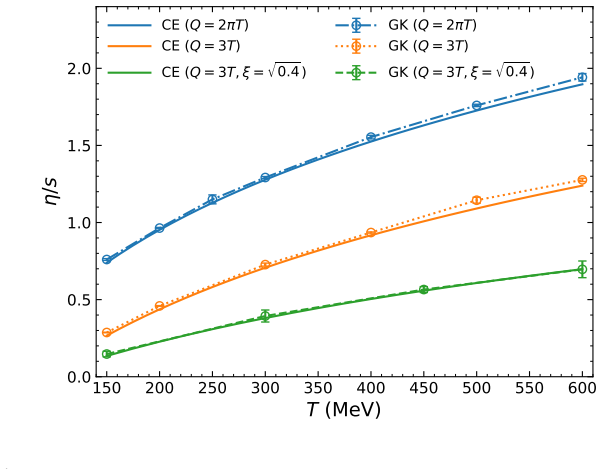
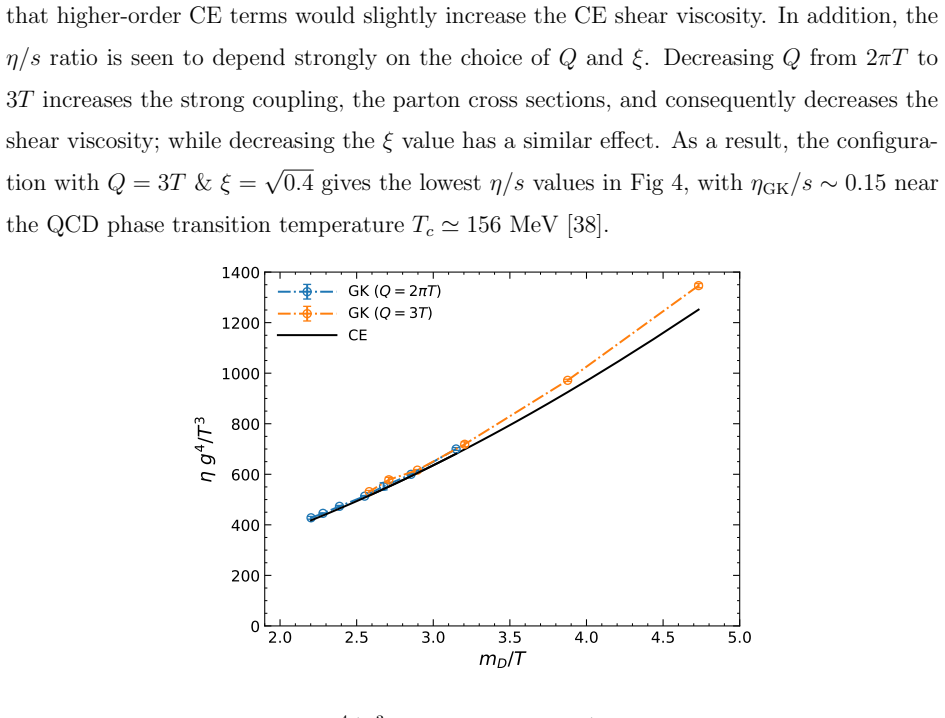
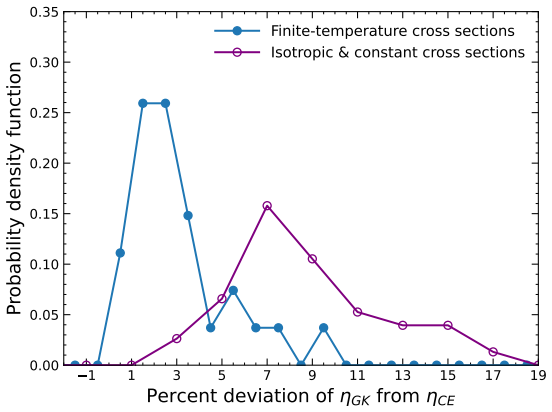
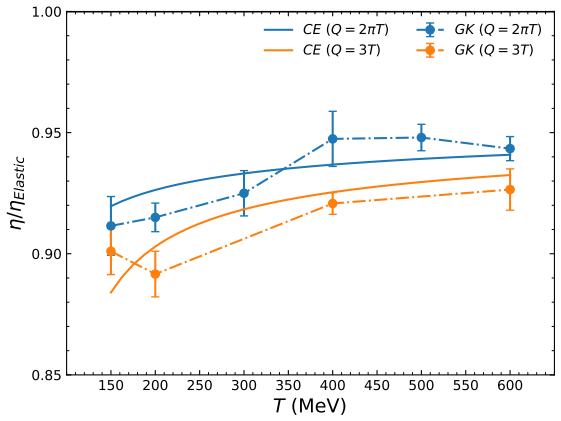
The Green-Kubo results for shear viscosity are greater than the Chapman-Enskog results by an average of ∼9% for isotropic and constant cross sections and by an average of ∼3% for finite-temperature pQCD cross sections, where the difference is presumably due to higher-order corrections to the leading-order Chapman-Enskog results.
What carries the argument
The Green-Kubo relation applied to stress-energy tensor fluctuations inside a parton cascade simulation that includes all 2↔2 scatterings screened by thermal masses.
If this is right
- The two methods agree rather well over the temperature range 150-600 MeV for both classes of cross sections.
- Higher-order terms in the Chapman-Enskog expansion would account for most of the observed 3-9 percent difference.
- The close agreement holds specifically for the massless Boltzmann case in chemical equilibrium.
- The numerical method can be applied directly to other temperature-dependent cross sections without changing the comparison framework.
Where Pith is reading between the lines
- Switching to Fermi-Dirac or Bose-Einstein statistics would likely alter both sets of viscosity values and possibly their relative difference.
- Adding finite parton masses could increase the discrepancy between the two methods because the collision integrals change.
- In hydrodynamic modeling of heavy-ion collisions the Chapman-Enskog values would produce slightly lower viscosity, affecting predicted flow harmonics by a few percent.
Load-bearing premise
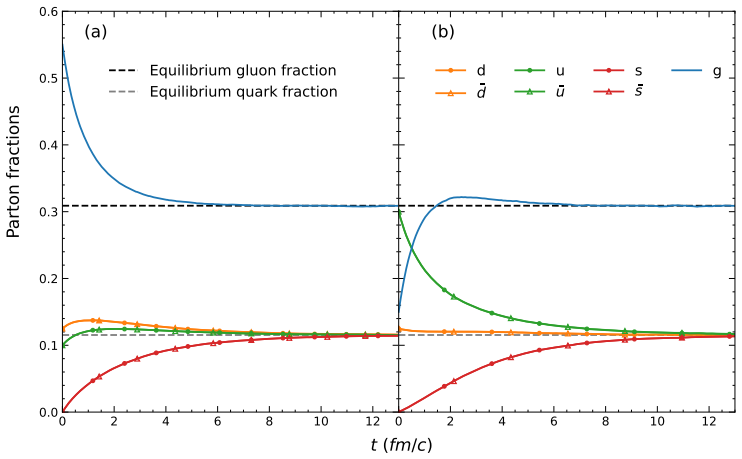
The systems consist of massless quarks and gluons obeying Boltzmann statistics in chemical equilibrium.
What would settle it
A Green-Kubo calculation at 300 MeV that includes quantum statistics or finite parton masses and yields a difference from Chapman-Enskog larger than 15 percent would show the reported agreement does not hold under those conditions.
Figures
read the original abstract
We numerically calculate the shear viscosity of quark-gluon matter via the Green-Kubo relation with an improved ZPC model. We include all $2\leftrightarrow 2$ parton cross sections at finite temperature, which are based on perturbative QCD and screened with thermal masses, and consider massless quark-gluon systems with Boltzmann statistics in chemical equilibrium. We then compare the Green-Kubo results with the analytical results from the leading-order Chapman-Enskog method for the same parton cross sections over the temperature range $150-600$ MeV. We also examine the simpler case of isotropic and constant parton cross sections. Overall, we find that the two methods agree rather well. Specifically, the Green-Kubo results are greater than the Chapman-Enskog results by an average of $\sim 9\%$ for isotropic and constant cross sections and by an average of $\sim 3\%$ for finite-temperature pQCD cross sections, where the difference between the two methods is presumably due to higher-order corrections to the leading-order Chapman-Enskog results.
Editorial analysis
A structured set of objections, weighed in public.
Referee Report
Summary. The manuscript numerically computes the shear viscosity of quark-gluon matter via the Green-Kubo relation in an improved ZPC parton transport model for massless quarks and gluons obeying Boltzmann statistics in chemical equilibrium. It incorporates all 2↔2 pQCD cross sections at finite temperature screened by thermal masses, and compares the results to leading-order Chapman-Enskog analytical expressions using identical cross sections over 150-600 MeV. The Green-Kubo values exceed the Chapman-Enskog results by averages of ∼9% (constant isotropic cross sections) and ∼3% (pQCD cross sections), with the differences attributed to higher-order corrections in the Chapman-Enskog expansion.
Significance. If the implementation details hold, the work supplies a direct numerical benchmark of the leading-order Chapman-Enskog method against an independent transport calculation for the same microscopic cross sections. This quantifies the truncation error in an analytically tractable limit and strengthens in the approximation for QGP transport coefficients used in hydrodynamic modeling of heavy-ion collisions. The identical-input design of the comparison is a clear methodological strength.
minor comments (3)
- [Abstract] Abstract: the phrase 'improved ZPC model' is used without definition or citation; the improvements relative to the original ZPC should be stated explicitly in the introduction or methods with a reference to prior work.
- The reported average percentage differences (∼9% and ∼3%) lack accompanying statistical uncertainties or details on how the averages are computed (e.g., temperature weighting, number of independent runs); inclusion of error estimates on the Green-Kubo results would allow assessment of whether the differences are statistically significant.
- The manuscript should clarify how chemical equilibrium is enforced or maintained in the parton transport simulation, particularly when using finite-temperature pQCD cross sections that may drive deviations from equilibrium.
Simulated Author's Rebuttal
We thank the referee for the positive and accurate summary of our manuscript, as well as for recognizing the methodological strength of comparing Green-Kubo and leading-order Chapman-Enskog results using identical cross sections. The recommendation for minor revision is noted.
Circularity Check
No significant circularity identified
full rationale
The paper computes shear viscosity numerically via the Green-Kubo relation in an improved ZPC parton transport model and directly compares those results to independent leading-order Chapman-Enskog analytical expressions evaluated on identical input cross sections (both isotropic-constant and finite-temperature pQCD). This supplies an external benchmark rather than any self-referential loop. No derivation step reduces by construction to its own fitted inputs or to a self-citation chain; the reported 3-9% differences are attributed to higher-order corrections outside the leading-order truncation. The explicit restrictions to massless Boltzmann partons in chemical equilibrium are stated assumptions, not circular definitions. The central claim therefore remains self-contained against the external analytical benchmark.
Axiom & Free-Parameter Ledger
axioms (3)
- domain assumption Boltzmann statistics for partons
- domain assumption Chemical equilibrium
- domain assumption Massless quarks and gluons
Reference graph
Works this paper leans on
-
[1]
Gyulassy and L
M. Gyulassy and L. McLerran, Nucl. Phys. A750, 30 (2005)
2005
-
[2]
Kovtun, D
P. Kovtun, D. T. Son, and A. O. Starinets, Phys. Rev. Lett.94, 111601 (2005). 17
2005
-
[3]
Romatschke and U
P. Romatschke and U. Romatschke, Phys. Rev. Lett.99, 172301 (2007)
2007
-
[4]
Sch¨ afer and D
T. Sch¨ afer and D. Teaney, Rept. Prog. Phys.72, 126001 (2009)
2009
-
[5]
H. Song, S. A. Bass, U. Heinz, T. Hirano, and C. Shen, Phys. Rev. Lett.106, 192301 (2011), [Erratum: Phys.Rev.Lett. 109, 139904 (2012)]
2011
-
[6]
J. E. Bernhard, J. S. Moreland, and S. A. Bass, Nature Phys.15, 1113 (2019)
2019
-
[7]
J. E. Parkkila, A. Onnerstad, and D. J. Kim, Phys. Rev. C104, 054904 (2021)
2021
-
[8]
Zhang, Comput
B. Zhang, Comput. Phys. Commun.109, 193 (1998)
1998
-
[9]
Molnar and M
D. Molnar and M. Gyulassy, Phys. Rev. C62, 054907 (2000)
2000
-
[10]
Xu and C
Z. Xu and C. Greiner, Phys. Rev. C71, 064901 (2005)
2005
-
[11]
Z.-W. Lin, C. M. Ko, B.-A. Li, B. Zhang, and S. Pal, Phys. Rev. C72, 064901 (2005)
2005
-
[12]
Cassing and E
W. Cassing and E. L. Bratkovskaya, Nucl. Phys. A831, 215 (2009)
2009
-
[13]
Kurkela, R
A. Kurkela, R. T¨ ornkvist, and K. Zapp, Eur. Phys. J. C84, 74 (2024)
2024
-
[14]
Kurkela, A
A. Kurkela, A. Mazeliauskas, J.-F. Paquet, S. Schlichting, and D. Teaney, Phys. Rev. C99, 034910 (2019)
2019
-
[15]
Chapman, T
S. Chapman, T. G. Cowling, and D. Park,The mathematical theory of non-uniform gases (Cambridge University Press, 1939)
1939
-
[16]
S. R. de Groot, W. A. van Leeuwen, and C. G. van Weert,Relativistic Kinetic Theory: Principles and Applications(North-Holland Pub. Co., 1980)
1980
-
[17]
Wiranata and M
A. Wiranata and M. Prakash, Phys. Rev. C85, 054908 (2012)
2012
-
[18]
Plumari, A
S. Plumari, A. Puglisi, M. Colonna, F. Scardina, and V. Greco, J. Phys. Conf. Ser.420, 012029 (2013)
2013
-
[19]
N. M. MacKay and Z.-W. Lin, Eur. Phys. J. C82, 918 (2022)
2022
-
[20]
Wiranata, V
A. Wiranata, V. Koch, M. Prakash, and X. N. Wang, Phys. Rev. C88, 044917 (2013)
2013
- [21]
- [22]
-
[23]
Green, J
M. Green, J. Comput. Phys.22, 398 (1954)
1954
-
[24]
R. Kubo, J. Phys. Soc. Jap.12, 570 (1957)
1957
-
[25]
Zhao, G.-L
X.-L. Zhao, G.-L. Ma, Y.-G. Ma, and Z.-W. Lin, Phys. Rev. C102, 024904 (2020)
2020
-
[26]
Parisi, V
G. Parisi, V. Nugara, S. Plumari, and V. Greco, Phys. Rev. D113, 014001 (2026)
2026
-
[27]
Mendenhall and Z.-W
T. Mendenhall and Z.-W. Lin, Nucl. Phys. B1022, 117242 (2026)
2026
-
[28]
Muronga, Phys
A. Muronga, Phys. Rev. C69, 044901 (2004). 18
2004
-
[29]
Demir and S
N. Demir and S. A. Bass, Phys. Rev. Lett.102, 172302 (2009)
2009
-
[30]
C. Wesp, A. El, F. Reining, Z. Xu, I. Bouras, and C. Greiner, Phys. Rev. C84, 054911 (2011)
2011
-
[31]
P. B. Arnold, G. D. Moore, and L. G. Yaffe, JHEP11, 001 (2000)
2000
-
[32]
P. B. Arnold, G. D. Moore, and L. G. Yaffe, JHEP05, 051 (2003)
2003
-
[33]
M. C. Abraao York, A. Kurkela, E. Lu, and G. D. Moore, Phys. Rev. D89, 074036 (2014)
2014
-
[34]
Boguslavski, A
K. Boguslavski, A. Kurkela, T. Lappi, F. Lindenbauer, and J. Peuron, Phys. Rev. D110, 034019 (2024)
2024
-
[35]
K. A. Olive et al. (Particle Data Group), Chin. Phys. C38, 090001 (2014)
2014
-
[36]
Ghiglieri, G
J. Ghiglieri, G. D. Moore, and D. Teaney, JHEP03, 179 (2018)
2018
-
[37]
Blaizot, Nucl
J.-P. Blaizot, Nucl. Phys. A702, 99 (2002)
2002
-
[38]
Bazavov et al
A. Bazavov et al. (HotQCD), Phys. Lett. B795, 15 (2019). 19
2019
discussion (0)
Sign in with ORCID, Apple, or X to comment. Anyone can read and Pith papers without signing in.