REVIEW 4 major objections 5 minor 68 references
Decoding Consumer Preferences Using Attention-Based Language Models
T0 review · 4 major / 5 minor · reviewed 2026-08-06 · deepseek-v4-flash
Pith's one-line read The paper claims that a two-stage attention-based language model, fine-tuned on auction outcomes and then projected into a structural English-auction model, can recover the private-valuation and market-size distributions that generate…
desk verdict A useful two-stage training result undermined by an identification gap: the paper predicts bids well but doesn't establish that it recovers demand primitives. read the letter →
The pith
A machine-rendered reading of the paper's core claim, the machinery that carries it, and where it could break.
The reading
What carries the argument
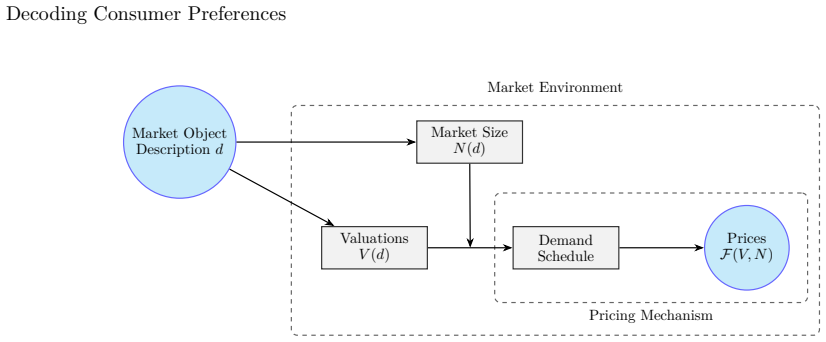
The load-bearing object is the Demand Embedding Vector (DEV), the [CLS] token's embedding after Stage 1, which compresses the entire listing description into a numerical fingerprint that carries auction outcomes. Stage 2 projects that fingerprint through a feedforward network into the parameter space of the two demand primitives, using the squared Hermite-polynomial density of equation (3) for valuations and the softmax mass function of equation (4) for bidder counts, and the structural model $F$ computes expected order statistics so that the loss $L_2$ matches predicted bids to observed second-through-fifth highest bids. This mechanism is what allows the paper to claim economically interpretable, counterfactually usable demand primitives rather than a black-box price predictor.
What would settle it
Take the withheld validation auctions and split them by the size of the gap between consecutively submitted final bids near the end: if $b_j = v_j$ holds, prediction errors on the second through fifth bids should be uncorrelated with the size of the preceding bid gap, while a systematic overprediction of bids that follow large jumps would indicate jump-bidding contamination.
Extended reading notes
Core claim
On the paper's own terms, the discovery is that the [CLS] token's embedding, after Stage 1 fine-tuning, contains enough information to identify the two stochastic primitives of demand for each vehicle listing: the valuation distribution $F_V(v)$ and the market-size distribution $F_N(n)$. Stage 2 freezes that embedding and trains a small network $H_2$ to output parameters of a squared Hermite-polynomial (semi-nonparametric) density for valuations and a softmax probability mass function over bidder counts; the structural model $F$ then maps those primitives through English-auction order statistics to predict the second through fifth highest bids. The paper reports out-of-sample $R^2$ of 0.779 and RMSE of 0.4418 on the price-setting second bid, compared with 0.597 and 0.5940 for OLS and -0.055 and 0.9649 for direct estimation, with the direct estimator's validation predictions nearly flat. It also reports that withheld DMC DeLorean auctions are predicted with stable error dispersion but systematic undervaluation, and that counterfactual mileage edits produce a monotonic price decline consistent with depreciation.
Load-bearing premise
The load-bearing premise is that the second through fifth highest final bids, submitted by five unique bidders in the final hours of an auction, are exact reports of those bidders' private valuations; if jump bidding, intermittent participation, or strategic bidder behavior across multiple auctions makes any of those bids fall short of the true valuation, the recovered demand distributions inherit that bias.
Editorial extensions
If this is right
- If the central claim holds, valuation and market-size distributions can be recovered directly from listing text, so counterfactuals such as varying mileage or introducing an unseen listing category can be run without re-engineering features.
- The two-stage protocol is doing real work for generalization: the direct single-loss estimator fits the training set as well but produces near-constant validation predictions, so any extension that skips Stage 1 supervision should expect the same collapse.
- Because Stage 1 also targets views, watchers, active bidders, and reserve-met status, the same embedding is a general description-to-market-outcome encoder, not just a price predictor.
- The zero-shot DeLorean results imply the pretrained model carries enough knowledge of a culturally iconic vehicle to forecast its auction outcomes, with a systematic undervaluation premium the fine-tuning cannot explain.
Reading between the lines
- A direct test of the structural interpretation would compare the implied valuation distributions with prices from a different market mechanism, such as posted-price sales of closely comparable vehicles; if the recovered primitives are truly demand primitives, they should also rationalize those prices.
- The token-level attribution method used for a single Porsche listing could be aggregated over thousands of listings to build a phrase-level hedonic index and checked against the OLS coefficients, revealing where nonlinear context matters most.
- The systematic DeLorean undervaluation is a falsifiable pattern: vehicles whose value is driven by cultural or collectible status should be underpriced systematically, while utilitarian vehicles should not; testing that contrast across other iconic vehicles would sharpen the boundary of the method.
Editorial analysis
A structured set of objections, weighed in public.
Referee Report
Summary. The paper proposes a two-stage demand estimation pipeline. In Stage 1 an mGTE encoder is fine-tuned to map vehicle descriptions to embeddings that predict auction outcomes (b2–b5, views, watchers, active bidders, reserve met). In Stage 2 the frozen [CLS] embedding is decoded into parameters of a semi-nonparametric valuation density and a softmax market-size distribution; the structural model F computes expected top order statistics, and H2 is trained to match observed b2–b5 under the assumption that these bids equal the corresponding private valuations. The empirical application to Bring a Trailer data reports out-of-sample R2 = 0.779 for the second-highest bid versus 0.597 for OLS and -0.055 for direct estimation, plus a zero-shot DeLorean test and mileage counterfactuals.
Significance. Conditional on resolving the identification and selection concerns below, the paper offers a promising template for combining language-model representations with structural auction models. Strengths include the stark contrast between two-stage and direct estimation, the use of a genuinely unseen vehicle category, and the transparent discussion of the bid-equals-valuation caveats. The out-of-sample predictive comparisons are internally consistent and the reported gains are large. What is not yet established is that the estimated (FV,FN) pair is the structural demand primitive rather than one of many parameterizations that reproduce expected order statistics.
major comments (4)
- [§3.3.2, Eq. (7)] The loss function fits only four conditional expectations of the order statistics b2,...,b5 through Eqs. (5)–(6); the observed number of unique bidders, which is directly informative about FN, is not used in L2, and the parameter spaces in Eqs. (3)–(4) leave the Hermite order κ and the market-size grid bounds {n,n} unreported. The paper provides no injectivity or consistency argument for this moment-based mapping, so many pairs (FV,FN) can deliver the same expected b2–b5. The out-of-sample R2 of 0.779 in Table 4 validates predictive fit for expected ranks but does not validate the structural decomposition into FV and FN. I would like to see either a formal identification argument, a sensitivity analysis across κ and grid choices, or a reparameterization in which FN is identified from bidder-count data.
- [§3.3.1 and §5.1] Section 3.3.1 states that bj = vj for j = 2,...,n, while acknowledging that jump bidding, intermittent participation, and multi-auction strategies break this equality; Section 5.1 then imposes the inclusion rule that the final bids of five unique bidders arrive within three hours of auction end, dropping 10.5% of auctions. The paper asserts that this rule decreased the likelihood of bias but offers no evidence that the rule removes or even attenuates it, and selection on late final bids may itself induce correlation between valuation draws and participation. Please report the sensitivity of the estimated FV and FN to alternative inclusion windows, and show that the b2/b1 and b3/b2 ratios are stable across included and excluded auctions.
- [§4, Eq. (2)] Because Stage 1 already trains the [CLS] embedding directly on b2 through b5, the Stage 2 success in matching those same bids may be partly a reparameterization of the Stage-1 predictions rather than independent structural recovery. To support the paper's central claim, the authors should demonstrate that the structural model adds information beyond Stage-1 reduced-form predictions, for example by testing whether the estimated (FV,FN) predicts the winning bid b1 or the number of active bidders out of sample better than a Stage-1 baseline.
- [§6.3] The mileage counterfactual replaces mileage values using LLAMA 3.1 70B-generated descriptions, but no check is reported that only the mileage changed, and the normalized curves in Figure 7 lack error bars and raw magnitudes. More importantly, monotone depreciation is a property of the prediction function, not a test of the structural interpretation of FV and FN; this should be framed as a consistency check rather than evidence for identification.
minor comments (5)
- [§6.1] There is a typo in 'direct estiamation' in the paragraph introducing Table 4, and 'vehcile' appears later in the same section.
- [§5] The phrase 'minimizesnipe bidding' is missing a space and should read 'minimize snipe bidding'.
- [Appendix B] The OLS benchmark is estimated on 17,695 records while the language model uses 74,605 training auctions; the paper should clarify how this disparity affects the comparability of the RMSE and R2 numbers in Table 4.
- [Table 4] OLS results are reported only for the second-highest bid; please either extend the OLS benchmark to the third through fifth bids or explain why it is omitted.
- [Table 4 and Appendix C] The out-of-sample R2 is not formally defined; please state whether it is computed relative to the validation sample mean and clarify the denominator used for the direct-estimation comparison.
Circularity Check
No significant circularity: the two-stage estimator is trained on observed bids and validated on held-out auctions; no load-bearing self-citations or definitional equivalences.
full rationale
The paper's central derivation chain is not circular. Stage 1 fine-tunes an encoder-only language model to predict observed auction outcomes (bids and engagement metrics) from text descriptions, with a standard MSE loss (Eq. 2). Stage 2 freezes the resulting [CLS] embedding and trains a network H2 to map it into parameters of semi-nonparametric density families for valuations (Eq. 3) and market size (Eq. 4); the structural model F then produces expected order-statistic bid predictions, and the loss L2 (Eq. 7) compares those predictions to held-out bids b2 through b5. This is a genuine estimation procedure: the structural parameters are fitted to data, not defined as the predictions, and the reported out-of-sample R2 (Table 4) is evaluated on 5,000 withheld auctions, so the predictive claim is not forced by construction. The paper contains no load-bearing self-citations; references to SNP density estimators [52-54], mGTE [46], Sobol sequences [60], and universal approximation theorems [65,67] are external and do not smuggle in the paper's conclusions. The 'zero-shot' DeLorean test uses a make/model absent from training, and the mileage counterfactual is a robustness check, not a derivation of the primitives. The skeptical concern about identification—that four expected order statistics may not uniquely recover both FV and FN—is a substantive econometric identification question, but it is not circularity: underidentification would mean the estimated primitives are not uniquely determined by the data, not that the paper's predictions equal its inputs by construction. Accordingly, no circular step can be exhibited from the paper's own equations, and the appropriate score is 0.
Assumptions & free parameters
free parameters (5)
- Hermite polynomial order kappa
- Market-size grid bounds {n, n}
- Three-hour inclusion window and five-bidder requirement =
3 hours; 5 unique bidders
- Gaussian noise level added to targets
- Sobol sequence size for QMC integration
assumptions (5)
- domain assumption In an English auction, bidders' weakly dominant strategy is to bid up to their valuation, so the 2nd through 5th highest final bids equal the corresponding order statistics of private valuations (b_j = v_j for j=2..5).
- domain assumption Valuations V(d) and market size N(d) are independent for every description d.
- domain assumption All consumers have unitary demand.
- domain assumption The [CLS] embedding after Stage 1 fine-tuning contains enough information to recover the structural demand parameters via H2.
- standard math Universal approximation theorems for transformers and feed-forward networks apply to the text-to-outcome mapping (Proposition 1).
Cite this review
Pith. "Pith review of Decoding Consumer Preferences Using Attention-Based Language Models." pith.science (2026). https://pith.science/paper/LSCNBGGX
@misc{pith2026250717564,
  author       = {Pith},
  title        = {Pith review of: Decoding Consumer Preferences Using Attention-Based Language Models},
  year         = {2026},
  howpublished = {\url{https://pith.science/paper/LSCNBGGX}},
  note         = {Machine review of arXiv:2507.17564}
}
read the original abstract
This paper proposes a new demand estimation method using attention-based language models. An encoder-only language model is trained in a two-stage process to analyze the natural language descriptions of used cars from a large US-based online auction marketplace. The approach enables semi-nonparametrically estimation for the demand primitives of a structural model representing the private valuations and market size for each vehicle listing. In the first stage, the language model is fine-tuned to encode the target auction outcomes using the natural language vehicle descriptions. In the second stage, the trained language model's encodings are projected into the parameter space of the structural model. The model's capability to conduct counterfactual analyses within the trained market space is validated using a subsample of withheld auction data, which includes a set of unique "zero shot" instances.
Figures


Figures from the paper (7 more)


Reference graph
Works this paper leans on
-
[1]
Sherwin Rosen. Hedonic prices and implicit markets: product differentiation in pure competition.Journal of Political Economy, 82(1):34–55, 1974
work page 1974
-
[2]
Jens Ludwig and Sendhil Mullainathan. Machine learning as a tool for hypothesis generation.Quarterly Journal of Economics, 139(2):751–827, 2024
work page 2024
-
[3]
Maureen L Cropper, Leland B Deck, and Kenenth E McConnell. On the choice of funtional form for hedonic price functions.Review of Economics and Statistics, pages 668–675, 1988
work page 1988
-
[4]
Linguistic regularities in continuous space word representations
Tomáš Mikolov, Wen-tau Yih, and Geoffrey Zweig. Linguistic regularities in continuous space word representations. In Proceedings of the 2013 conference of the north american chapter of the association for computational linguistics: Human language technologies, pages 746–751, 2013
work page 2013
-
[5]
Xipeng Qiu, Tianxiang Sun, Yige Xu, Yunfan Shao, Ning Dai, and Xuanjing Huang. Pre-trained models for natural language processing: A survey.Science China Technological Sciences, 63(10):1872–1897, 2020
work page 2020
-
[6]
Jacob Devlin, Ming-Wei Chang, Kenton Lee, and Kristina Toutanova. Bert: Pre-training of deep bidirectional transformers for language understanding.arXiv preprint arXiv:1810.04805, 2018
arXiv 2018
-
[7]
The impact of machine learning on economics
Susan Athey. The impact of machine learning on economics. InThe economics of artificial intelligence: An agenda, pages 507–547. University of Chicago Press, 2018
work page 2018
-
[8]
Sameer Mehta, Milind Dawande, Ganesh Janakiraman, and Vijay Mookerjee. How to sell a data set? pricing policies for data monetization.Information Systems Research, 32(4):1281–1297, 2021
work page 2021
Show all 68 references
-
[9]
Overcoming the pitfalls and perils of algorithms: A classification of machine learning biases and mitigation methods.Journal of Business Research, 144:93–106, 2022
Benjamin Van Giffen, Dennis Herhausen, and Tobias Fahse. Overcoming the pitfalls and perils of algorithms: A classification of machine learning biases and mitigation methods.Journal of Business Research, 144:93–106, 2022
2022
-
[10]
Pathways for design research on artificial intelligence.Information Systems Research, 35(2):441–459, 2024
Ahmed Abbasi, Jeffrey Parsons, Gautam Pant, Olivia R Liu Sheng, and Suprateek Sarker. Pathways for design research on artificial intelligence.Information Systems Research, 35(2):441–459, 2024
2024
-
[11]
Suprateek Sarker, Hillol Bala, Yili Hong, Atreyi Kankanhalli, Matti Rossi, Bin Gu, and Gal Oestreicher- Singer. Advancing next-generation multimethod research in information systems: A framework and some recommendations for authors and evaluators.Information Systems Research, ...
2025
-
[12]
Attention is all you need.Advances in Neural Information Processing Systems, 30, 2017
Ashish Vaswani, Noam Shazeer, Niki Parmar, Jakob Uszkoreit, Llion Jones, Aidan N Gomez, Łukasz Kaiser, and Illia Polosukhin. Attention is all you need.Advances in Neural Information Processing Systems, 30, 2017
2017
-
[13]
Language models are unsupervised multitask learners.OpenAI blog, 1(8):9, 2019
Alec Radford, Jeffrey Wu, Rewon Child, David Luan, Dario Amodei, Ilya Sutskever, et al. Language models are unsupervised multitask learners.OpenAI blog, 1(8):9, 2019
2019
-
[14]
Highly accurate protein structure prediction with alphafold.Nature, 596(7873):583–589, 2021
John Jumper, Richard Evans, Alexander Pritzel, Tim Green, Michael Figurnov, Olaf Ronneberger, Kathryn Tunyasuvunakool, Russ Bates, Augustin Žídek, Anna Potapenko, et al. Highly accurate protein structure prediction with alphafold.Nature, 596(7873):583–589, 2021
2021
-
[15]
Transunet: Transformers make strong encoders for medical image segmentation.arXiv preprint arXiv:2102.04306, 2021
Jieneng Chen, Yongyi Lu, Qihang Yu, Xiangde Luo, Ehsan Adeli, Yan Wang, Le Lu, Alan L Yuille, and Yuyin Zhou. Transunet: Transformers make strong encoders for medical image segmentation.arXiv preprint arXiv:2102.04306, 2021. 17 Decoding Consumer Preferences
2021 arXiv
-
[16]
Large language model in creative work: The role of collaboration modality and user expertise.Management Science, 70(12):3450–3472, 2024
Zenan Chen and Jason Chan. Large language model in creative work: The role of collaboration modality and user expertise.Management Science, 70(12):3450–3472, 2024
2024
-
[17]
Automated analysis of changes in privacy policies: A structured self-attentive sentence embedding approach.MIS Quarterly, 48(4), 2024
Fangyu Lin, Sagar Samtani, Hongyi Zhu, Brandimarte Laura, and Hsinchun Chen. Automated analysis of changes in privacy policies: A structured self-attentive sentence embedding approach.MIS Quarterly, 48(4), 2024
2024
-
[18]
Can chatgpt perform a grounded theory approach to do risk analysis? an empirical study.Journal of Management Information Systems, 41(4):982–1015, 2024
Yaxian Zhou, Yufei Yuan, Kai Huang, and Xiangpei Hu. Can chatgpt perform a grounded theory approach to do risk analysis? an empirical study.Journal of Management Information Systems, 41(4):982–1015, 2024
2024
-
[19]
Predicting instructor performance in online education: An interpretable hierarchical transformer with contextual attention.Information Systems Research, 2025
Wen Wang, Mi Zhou, Beibei Li, and Honglei Zhuang. Predicting instructor performance in online education: An interpretable hierarchical transformer with contextual attention.Information Systems Research, 2025
2025
-
[20]
Text as data.Journal of Economic Literature, 57(3):535–574, 2019
Matthew Gentzkow, Bryan Kelly, and Matt Taddy. Text as data.Journal of Economic Literature, 57(3):535–574, 2019
2019
-
[21]
Moe, Oded Netzer, and David A
Jonah Berger, Ashlee Humphreys, Stefan Ludwig, Wendy W. Moe, Oded Netzer, and David A. Schweidel. Uniting the tribes: Using text for marketing insight.Journal of Marketing, 84(1):1–25, 2020
2020
-
[22]
Text algorithms in economics.Annual Review of Economics, 15:659–688, 2023
Elliott Ash and Stephen Hansen. Text algorithms in economics.Annual Review of Economics, 15:659–688, 2023
2023
-
[23]
Chatgpt for textual analysis? how to use generative llms in accounting research.Management Science, 71(1):123–145, 2025
Ties de Kok. Chatgpt for textual analysis? how to use generative llms in accounting research.Management Science, 71(1):123–145, 2025
2025
-
[24]
The impact of increase in minimum wages on consumer perceptions of service: A transformer model of online restaurant reviews.Marketing Science, 40(5):985–1004, 2021
Dinesh Puranam, Vrinda Kadiyali, and Vithala Narayan. The impact of increase in minimum wages on consumer perceptions of service: A transformer model of online restaurant reviews.Marketing Science, 40(5):985–1004, 2021
2021
-
[25]
Getting personal: A deep learning artifact for text-based measurement of personality.Information Systems Research, 34(1):194–222, 2023
Kai Yang, Raymond YK Lau, and Ahmed Abbasi. Getting personal: A deep learning artifact for text-based measurement of personality.Information Systems Research, 34(1):194–222, 2023
2023
-
[26]
Liye Ma and Lan Luo. Beyond fake or genuine–the effect of large language models (llms) on the content and sentiment of product reviews.USC Marshall School of Business Research Paper Sponsored by iORB, No. Forthcoming, 2023
2023
-
[27]
Consumer risk preferences elicitation from large language models
Liying Qiu, Param Vir Singh, and Kannan Srinivasan. Consumer risk preferences elicitation from large language models. Available at SSRN 4526072, 2023
2023
-
[28]
Fin-alice: Artificial linguistic intelligence causal econometrics
Shawn McCarthy and Gita Alaghband. Fin-alice: Artificial linguistic intelligence causal econometrics. Journal of Risk and Financial Management, 17(12):537, 2024
2024
-
[29]
Anna Timoshenko and John R. Hauser. Identifying customer needs from user-generated content. Marketing Science, 38(1):1–20, 2019
2019
-
[30]
Deep learning in marketing: a review and research agenda.Artificial Intelligence in Marketing, pages 239–271, 2023
Xiao Liu. Deep learning in marketing: a review and research agenda.Artificial Intelligence in Marketing, pages 239–271, 2023
2023
-
[31]
Large language models for market research: A data-augmentation approach.arXiv preprint arXiv:2412.19363, 2024
Mengxin Wang, Dennis J Zhang, and Heng Zhang. Large language models for market research: A data-augmentation approach.arXiv preprint arXiv:2412.19363, 2024
2024 arXiv
-
[32]
Conversation analytics: Can machines read between the lines in real-time strategic conversations?Information Systems Research, 36(1):440–455, 2025
Yanzhen Chen, Huaxia Rui, and Andrew B Whinston. Conversation analytics: Can machines read between the lines in real-time strategic conversations?Information Systems Research, 36(1):440–455, 2025
2025
-
[33]
Machine learning methods that economists should know about
Susan Athey and Guido W Imbens. Machine learning methods that economists should know about. Annual Review of Economics, 11(1):685–725, 2019
2019
-
[34]
Machine learning for demand estimation in long tail markets
Hammaad Adam, Pu He, and Fanyin Zheng. Machine learning for demand estimation in long tail markets. Management Science, 70(8):5040–5065, 2024
2024
-
[35]
Mobilizing conceptual spaces: How word embedding models can inform measurement and theory within organization science.Organization Science, 35(3):788–814, 2024
Pedro Aceves and James A Evans. Mobilizing conceptual spaces: How word embedding models can inform measurement and theory within organization science.Organization Science, 35(3):788–814, 2024
2024
-
[36]
Can ai language models replace human participants? Trends in Cognitive Sciences, 27(7):597–600, 2023
Danica Dillion, Niket Tandon, Yuling Gu, and Kurt Gray. Can ai language models replace human participants? Trends in Cognitive Sciences, 27(7):597–600, 2023
2023
-
[37]
Large language models can be used to estimate the latent positions of politicians.arXiv preprint arXiv:2303.12057, 2023
Patrick Y Wu, Jonathan Nagler, Joshua A Tucker, and Solomon Messing. Large language models can be used to estimate the latent positions of politicians.arXiv preprint arXiv:2303.12057, 2023
2023 arXiv
-
[38]
Frontiers: Can large language models capture human preferences? Marketing Science, 43(4):709–722, 2024
Ali Goli and Amandeep Singh. Frontiers: Can large language models capture human preferences? Marketing Science, 43(4):709–722, 2024. 18 Decoding Consumer Preferences
2024
-
[39]
Language models trained to do arithmetic predict human risky and intertemporal choice.arXiv preprint arXiv:2405.19313, 2024
Jian-Qiao Zhu, Haijiang Yan, and Thomas L Griffiths. Language models trained to do arithmetic predict human risky and intertemporal choice.arXiv preprint arXiv:2405.19313, 2024
2024 arXiv
-
[40]
Zoom in: An introduction to circuits.Distill, 5(3):e00024–001, 2020
Chris Olah, Nick Cammarata, Ludwig Schubert, Gabriel Goh, Michael Petrov, and Shan Carter. Zoom in: An introduction to circuits.Distill, 5(3):e00024–001, 2020
2020
-
[41]
Toy models of superposition.arXiv preprint arXiv:2209.10652, 2022
Nelson Elhage, Tristan Hume, Catherine Olsson, Nicholas Schiefer, Tom Henighan, Shauna Kravec, Zac Hatfield-Dodds, Robert Lasenby, Dawn Drain, Carol Chen, et al. Toy models of superposition.arXiv preprint arXiv:2209.10652, 2022
2022 arXiv
-
[42]
Scaling monosemanticity: Extracting interpretable features from claude 3 sonnet
Adly Templeton. Scaling monosemanticity: Extracting interpretable features from claude 3 sonnet. Anthropic, 2024
2024
-
[43]
Counterfactual explanations and algorithmic recourses for machine learning: A review.ACM Computing Surveys, 56(12):1–42, 2024
Sahil Verma, Varich Boonsanong, Minh Hoang, Keegan Hines, John Dickerson, and Chirag Shah. Counterfactual explanations and algorithmic recourses for machine learning: A review.ACM Computing Surveys, 56(12):1–42, 2024
2024
-
[44]
Finetuned language models are zero-shot learners.arXiv preprint arXiv:2109.01652, 2021
Jason Wei, Maarten Bosma, Vincent Y Zhao, Kelvin Guu, Adams Wei Yu, Brian Lester, Nan Du, Andrew M Dai, and Quoc V Le. Finetuned language models are zero-shot learners.arXiv preprint arXiv:2109.01652, 2021
2021 arXiv
-
[45]
Estimating wage disparities using foundation models
Keyon Vafa, Susan Athey, and David M Blei. Estimating wage disparities using foundation models. arXiv preprint arXiv:2409.09894, 2024
2024 arXiv
-
[46]
Towards general text embeddings with multi-stage contrastive learning, 2023
Zehan Li, Xin Zhang, Yanzhao Zhang, Dingkun Long, Pengjun Xie, and Meishan Zhang. Towards general text embeddings with multi-stage contrastive learning, 2023
2023
-
[47]
Word representations: a simple and general method for semi-supervised learning
Joseph Turian, Lev Ratinov, and Yoshua Bengio. Word representations: a simple and general method for semi-supervised learning. InProceedings of the 48th annual meeting of the association for computational linguistics, pages 384–394, 2010
2010
-
[48]
Take and took, gaggle and goose, book and read: Evaluating the utility of vector differences for lexical relation learning.arXiv preprint arXiv:1509.01692, 2015
Ekaterina Vylomova, Laura Rimell, Trevor Cohn, and Timothy Baldwin. Take and took, gaggle and goose, book and read: Evaluating the utility of vector differences for lexical relation learning.arXiv preprint arXiv:1509.01692, 2015
2015 arXiv
-
[49]
On the sentence embeddings from pre-trained language models.arXiv preprint arXiv:2011.05864, 2020
Bohan Li, Hao Zhou, Junxian He, Mingxuan Wang, Yiming Yang, and Lei Li. On the sentence embeddings from pre-trained language models.arXiv preprint arXiv:2011.05864, 2020
2011 arXiv
-
[50]
Machine learning: an applied econometric approach.Journal of Economic Perspectives, 31(2):87–106, 2017
Sendhil Mullainathan and Jann Spiess. Machine learning: an applied econometric approach.Journal of Economic Perspectives, 31(2):87–106, 2017
2017
-
[51]
Machine learning and structural econometrics: contrasts and synergies.The Econometrics Journal, 23(3):S81–S124, 2020
Fedor Iskhakov, John Rust, and Bertel Schjerning. Machine learning and structural econometrics: contrasts and synergies.The Econometrics Journal, 23(3):S81–S124, 2020
2020
-
[52]
Semi-nonparametric maximum likelihood estimation
A Ronald Gallant and Douglas W Nychka. Semi-nonparametric maximum likelihood estimation. Econometrica, pages 363–390, 1987
1987
-
[53]
Convergence rates of snp density estimators.Econometrica, pages 719–727, 1996
Victor M Fenton and A Ronald Gallant. Convergence rates of snp density estimators.Econometrica, pages 719–727, 1996
1996
-
[54]
Qualitative and asymptotic performance of snp density estimators
Victor M Fenton and A Ronald Gallant. Qualitative and asymptotic performance of snp density estimators. Journal of Econometrics, 74(1):77–118, 1996
1996
-
[55]
Deep learning for individual heterogeneity: An automatic inference framework.arXiv preprint arXiv:2010.14694, 2020
Max H Farrell, Tengyuan Liang, and Sanjog Misra. Deep learning for individual heterogeneity: An automatic inference framework.arXiv preprint arXiv:2010.14694, 2020
2010 arXiv
-
[56]
Auctions: an introduction.Journal of Economic Surveys, 10(4):367–420, 1996
Elmar Wolfstetter. Auctions: an introduction.Journal of Economic Surveys, 10(4):367–420, 1996
1996
-
[57]
Information transparency in business-to- business auction markets: The role of winner identity disclosure.Management Science, 65(9):4261–4279, 2019
Yixin Lu, Alok Gupta, Wolfgang Ketter, and Eric Van Heck. Information transparency in business-to- business auction markets: The role of winner identity disclosure.Management Science, 65(9):4261–4279, 2019
2019
-
[58]
Strategic jump bidding in english auctions
Christopher Avery. Strategic jump bidding in english auctions. The Review of Economic Studies, 65(2):185–210, 1998
1998
-
[59]
Jump bidding strategies in internet auctions.Management Science, 50(10):1407–1419, 2004
Robert F Easley and Rafael Tenorio. Jump bidding strategies in internet auctions.Management Science, 50(10):1407–1419, 2004
2004
-
[60]
Preserving bidder privacy in assignment auctions: design and measurement
De Liu and Adib Bagh. Preserving bidder privacy in assignment auctions: design and measurement. Management Science, 66(7):3162–3182, 2020
2020
-
[61]
Quasi-monte carlo integration.Journal of Computational Physics, 122(2):218–230, 1995
William J Morokoff and Russel E Caflisch. Quasi-monte carlo integration.Journal of Computational Physics, 122(2):218–230, 1995. 19 Decoding Consumer Preferences
1995
-
[62]
John Wiley & Sons, 2002
Peter Jäckel.Monte Carlo methods in finance, volume 5. John Wiley & Sons, 2002
2002
-
[63]
Axiomatic attribution for deep networks
Mukund Sundararajan, Ankur Taly, and Qiqi Yan. Axiomatic attribution for deep networks. In International conference on machine learning, pages 3319–3328. PMLR, 2017
2017
-
[64]
Research commentary—designing smart markets
Martin Bichler, Alok Gupta, and Wolfgang Ketter. Research commentary—designing smart markets. Information Systems Research, 21(4):688–699, 2010
2010
-
[65]
Are trans- formers universal approximators of sequence-to-sequence functions?arXiv preprint arXiv:1912.10077, 2019
Chulhee Yun, Srinadh Bhojanapalli, Ankit Singh Rawat, Sashank J Reddi, and Sanjiv Kumar. Are trans- formers universal approximators of sequence-to-sequence functions?arXiv preprint arXiv:1912.10077, 2019
1912 arXiv
-
[66]
A universal approximation theorem of deep neural networks for expressing probability distributions
Yulong Lu and Jianfeng Lu. A universal approximation theorem of deep neural networks for expressing probability distributions. Advances in Neural Information Processing Systems, 33:3094–3105, 2020
2020
-
[67]
Multilayer feedforward networks are universal approximators
Kurt Hornik, Maxwell Stinchcombe, and Halbert White. Multilayer feedforward networks are universal approximators. Neural Networks, 2(5):359–366, 1989
1989
-
[68]
A reconsideration of hedonic price indexes with an application to pc’s.American Economic Review, 93(5):1578–1596, 2003
Ariel Pakes. A reconsideration of hedonic price indexes with an application to pc’s.American Economic Review, 93(5):1578–1596, 2003. A Proofs of Propositions A.1 Proposition 1 Let d denote a text description and⃗ y∈ Rm represent the vector ofm economic outcomes associated with...
2014
Reviewed August 6, 2026 · model on record in the stance chip above.
Discussion (0). Continue with ORCID to comment.