A Homogeneous Catalog of Rossiter-McLaughlin Systems: Distinct e-λ Trends in Three Gas-Giant Mass Regimes
Pith reviewed 2026-06-29 09:39 UTC · model grok-4.3
The pith
Planet mass divides close-in gas giants into three groups with distinct eccentricity and obliquity patterns.
A machine-rendered reading of the paper's core claim, the machinery that carries it, and where it could break.
Core claim
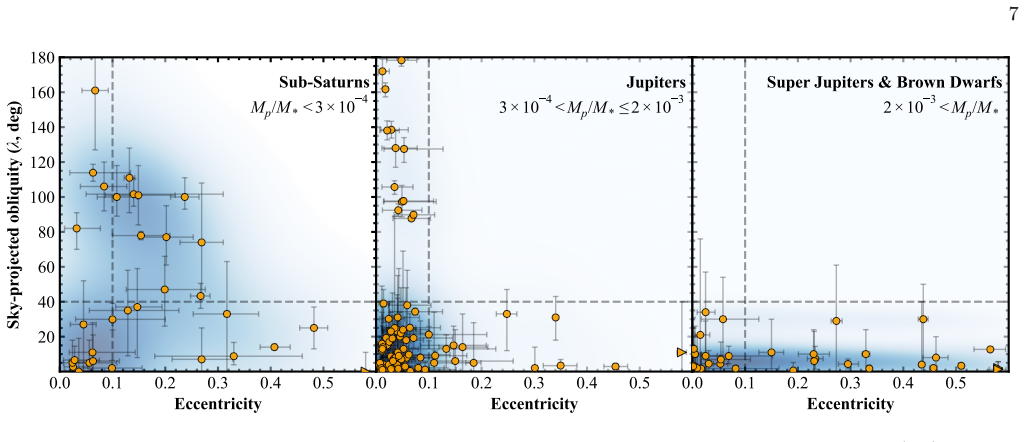
The joint (e, λ) distributions in three planet-mass regimes are distinct: sub-Saturns (Mp ≤ ~0.3 MJ) occupy the full range of eccentricity and misalignment, Jupiters (~0.3 MJ < Mp ≤ ~3 MJ) are misaligned only when e is near zero, and super-Jupiters and brown dwarfs (Mp > ~3 MJ) are aligned for all eccentricities. These patterns emerge from self-consistent posteriors obtained via global fits to spectral energy distributions, transit photometry, timing, and radial velocities.
What carries the argument
Homogeneous joint global fit to spectral energy distributions, transit light curves, mid-transit times, and in-transit plus out-of-transit radial velocities that yields self-consistent posteriors for stellar and planetary parameters, followed by division into three mass regimes and comparison with a two-dimensional Kolmogorov-Smirnov test on the (e, λ) plane.
If this is right
- Obliquity depends jointly on eccentricity and planet mass rather than on either quantity alone.
- Obliquity is not a unique tracer of evolutionary history for close-in giant planets.
- A unified theoretical framework is required to explain the differing origins of spin-orbit misalignment across the three mass regimes.
- The joint (e, λ) distributions of the three mass groups differ at high statistical significance according to the two-dimensional Kolmogorov-Smirnov test.
Where Pith is reading between the lines
- The observed mass-dependent patterns suggest that any complete migration or dynamical-interaction model must include pathways whose efficiency or outcome changes across the 0.3 MJ and 3 MJ thresholds.
- Extending the catalog to include multi-star systems or planets near the mass boundaries would test whether the reported divisions remain sharp.
- The trends imply that eccentricity and obliquity measurements must be interpreted together when reconstructing individual system histories.
Load-bearing premise
The joint global fits produce unbiased eccentricity and obliquity posteriors across the original heterogeneous datasets, and the chosen mass boundaries plus the single-star restriction do not create artificial trends.
What would settle it
Finding even one misaligned super-Jupiter on a significantly eccentric orbit, or a sub-Saturn that is both highly misaligned and circular, would contradict the reported separation of the three regimes.
Figures

read the original abstract
Stellar obliquity ($\lambda$) and orbital eccentricity ($e$) trace the dynamical histories of close-in giant planets, but the current observational picture is assembled from heterogeneous analyses that have obscured population-level trends. In this work, we homogeneously refit systems with Rossiter-McLaughlin (RM) measurements by performing a joint global fit to spectral energy distributions, transit light curves, mid-transit times, out-of-transit and in-transit radial velocities, yielding self-consistent posterior distributions for the physical and orbital parameters of both stars and planets across 255 systems. Restricting to 145 single-star systems with reliable planet-mass measurements, we uncover pronounced structure in the $e-\lambda$ plane that depends on planet mass: (i) sub-Saturns ($M_{\rm p} \leq \sim0.3M_{\rm J}$) can be both eccentric and misaligned; (ii) Jupiters ($\sim0.3M_{\rm J}<M_{\rm p} \leq \sim3 M_{\rm J}$) are misaligned only on circular orbits; and (iii) super Jupiters and brown dwarfs ($M_{\rm p}>\sim3M_{\rm J}$) are aligned across the full eccentricity range. A two-dimensional Kolmogorov-Smirnov test shows that the joint $(e,\lambda)$ distributions differ significantly among these three mass regimes. These trends demonstrate that $\lambda$ depends jointly on eccentricity and planet mass, implying that obliquity alone is not a unique tracer of evolutionary history and underscoring the need for a unified framework for the origins of spin-orbit misalignment. The full catalog from this work is publicly available at https://www.stellarobliquity.com .
Editorial analysis
A structured set of objections, weighed in public.
Referee Report
Summary. The manuscript presents a homogeneous reanalysis of 255 Rossiter-McLaughlin systems via joint global fits to SEDs, transit light curves, mid-transit times, and RVs, producing self-consistent posteriors. After restricting to 145 single-star systems with reliable planet masses, it reports three distinct regimes in the joint (e, λ) distribution: sub-Saturns (Mp ≲ 0.3 MJ) that can be both eccentric and misaligned; Jupiters (0.3 MJ ≲ Mp ≲ 3 MJ) that are misaligned only when circular; and super-Jupiters/brown dwarfs (Mp ≳ 3 MJ) that remain aligned across all eccentricities. A two-dimensional Kolmogorov-Smirnov test is used to establish that the three mass-binned distributions differ significantly.
Significance. If the reported trends survive validation, the work supplies a publicly released homogeneous catalog that strengthens the empirical basis for mass-dependent migration and dynamical histories. The demonstration that λ is not independent of e within each mass bin directly challenges the common practice of treating obliquity as a standalone tracer and motivates a unified theoretical framework.
major comments (2)
- [Fitting procedure (abstract and §2–3)] Fitting procedure (abstract and §2–3): the central claim that the joint global fits yield unbiased λ and e posteriors across all 145 systems rests on an untested assumption. Because RV semi-amplitude scales with Mp, sub-Saturn systems have systematically lower-SNR RVs; no injection-recovery tests, recovery of injected λ/e values, or per-system comparison of new vs. literature posteriors are described to rule out SNR-dependent bias that could artificially produce the reported mass trends.
- [Mass-boundary definition and sample selection (§4)] Mass-boundary definition and sample selection (§4): the boundaries at ~0.3 MJ and ~3 MJ and the restriction to single-star systems with “reliable” masses are load-bearing for the three-regime claim. No justification is given for why these particular cuts were chosen, nor are robustness checks (e.g., varying the boundaries by ±0.1 MJ or relaxing the single-star criterion) reported to show that the KS-test significance is insensitive to the selection.
minor comments (2)
- [Abstract] Abstract: the phrase “self-consistent posterior distributions” is used without quantifying how consistency was verified across the heterogeneous input datasets.
- [Data availability] The public catalog URL is given, but the manuscript does not state which posterior quantiles or derived quantities are included in the release.
Simulated Author's Rebuttal
We thank the referee for their constructive comments. We respond to each major point below and indicate the revisions we will incorporate.
read point-by-point responses
-
Referee: Fitting procedure (abstract and §2–3): the central claim that the joint global fits yield unbiased λ and e posteriors across all 145 systems rests on an untested assumption. Because RV semi-amplitude scales with Mp, sub-Saturn systems have systematically lower-SNR RVs; no injection-recovery tests, recovery of injected λ/e values, or per-system comparison of new vs. literature posteriors are described to rule out SNR-dependent bias that could artificially produce the reported mass trends.
Authors: We agree that systematic validation is important for confirming that our posteriors are unbiased, particularly given the SNR variation with planet mass. Our joint global fitting follows established methods, and we compared new posteriors to literature values for overlapping systems with generally good agreement. However, the original manuscript did not include injection-recovery tests. In the revised manuscript we will add a new subsection in §3 presenting injection-recovery tests performed on a representative subset of systems spanning the full mass range (including low-SNR sub-Saturns) to explicitly demonstrate recovery of injected λ and e values without bias. revision: yes
-
Referee: Mass-boundary definition and sample selection (§4): the boundaries at ~0.3 MJ and ~3 MJ and the restriction to single-star systems with “reliable” masses are load-bearing for the three-regime claim. No justification is given for why these particular cuts were chosen, nor are robustness checks (e.g., varying the boundaries by ±0.1 MJ or relaxing the single-star criterion) reported to show that the KS-test significance is insensitive to the selection.
Authors: The boundaries were selected to mark the locations where the joint (e, λ) behavior visibly changes, consistent with the canonical sub-Saturn, Jupiter, and super-Jupiter mass divisions in the broader exoplanet population. The single-star restriction is required to ensure clean λ measurements. The submitted manuscript did not provide explicit justification or robustness tests. In revision we will expand the relevant section to justify the boundaries with reference to the observed distribution and to population studies, and we will report the results of robustness checks in which the boundaries are shifted by ±0.1 MJ and the single-star criterion is relaxed, confirming that the KS-test significance and three-regime structure remain unchanged. revision: yes
Circularity Check
No significant circularity; empirical catalog with external statistical test
full rationale
The paper performs joint global fits to heterogeneous observational datasets (SEDs, light curves, RVs, transit times) to produce self-consistent posteriors for e and λ across 145 systems, then applies a 2D KS test to compare the joint (e, λ) distributions in three mass bins. No load-bearing step reduces by construction to a fitted input, self-citation chain, or ansatz; the reported trends emerge from the data and the external nonparametric test. The analysis is self-contained against external benchmarks with no derivation that is equivalent to its inputs.
Axiom & Free-Parameter Ledger
free parameters (1)
- mass boundaries (~0.3 MJ and ~3 MJ)
axioms (2)
- domain assumption Joint global fit to SEDs, light curves, transit times, and RVs produces unbiased posteriors for λ and e
- domain assumption Single-star systems with reliable planet masses form an unbiased subsample
Reference graph
Works this paper leans on
-
[1]
Addison, B. C., Tinney, C. G., Wright, D. J., & Bayliss, D. 2016, ApJ, 823, 29, doi: 10.3847/0004-637X/823/1/29
-
[2]
Addison, B. C., Tinney, C. G., Wright, D. J., et al. 2013, ApJL, 774, L9, doi: 10.1088/2041-8205/774/1/L9
-
[3]
Addison, B. C., Wang, S., Johnson, M. C., et al. 2018, AJ, 156, 197, doi: 10.3847/1538-3881/aade91
-
[4]
C., Knudstrup, E., Wong, I., et al
Addison, B. C., Knudstrup, E., Wong, I., et al. 2021, AJ, 162, 292, doi: 10.3847/1538-3881/ac224e
-
[5]
L., Chen, X., Ciardi, D., et al
Akeson, R. L., Chen, X., Ciardi, D., et al. 2013, PASP, 125, 989, doi: 10.1086/672273
-
[6]
2007, in Astronomical Society of the Pacific Conference Series, Vol
Snellen, I. 2007, in Astronomical Society of the Pacific Conference Series, Vol. 370, Solar and Stellar Physics Through Eclipses, ed. O. Demircan, S. O. Selam, & B. Albayrak, 218
2007
-
[7]
Albrecht, S., Winn, J. N., Butler, R. P., et al. 2012a, ApJ, 744, 189, doi: 10.1088/0004-637X/744/2/189
-
[8]
Albrecht, S., Winn, J. N., Johnson, J. A., et al. 2011, ApJ, 738, 50, doi: 10.1088/0004-637X/738/1/50
-
[9]
Albrecht, S., Winn, J. N., Johnson, J. A., et al. 2012b, ApJ, 757, 18, doi: 10.1088/0004-637X/757/1/18
-
[10]
Albrecht, S. H., Dawson, R. I., & Winn, J. N. 2022, PASP, 134, 082001, doi: 10.1088/1538-3873/ac6c09
-
[11]
Almenara, J. M., H´ ebrard, G., D´ ıaz, R. F., et al. 2022, A&A, 663, A134, doi: 10.1051/0004-6361/202142964
-
[12]
Alonso, R., Brown, T. M., Torres, G., et al. 2004, ApJL, 613, L153, doi: 10.1086/425256
-
[13]
2008, A&A, 482, L21, doi: 10.1051/0004-6361:200809431
Alonso, R., Auvergne, M., Baglin, A., et al. 2008, A&A, 482, L21, doi: 10.1051/0004-6361:200809431
-
[14]
Alsubai, K., Mislis, D., Tsvetanov, Z. I., et al. 2017, AJ, 153, 200, doi: 10.3847/1538-3881/aa6340
-
[15]
Alsubai, K., Tsvetanov, Z. I., Latham, D. W., et al. 2018, AJ, 155, 52, doi: 10.3847/1538-3881/aaa000
-
[16]
Alsubai, K., Tsvetanov, Z. I., Latham, D. W., et al. 2019, AJ, 157, 74, doi: 10.3847/1538-3881/aaf80a
-
[17]
Alsubai, K. A., Parley, N. R., Bramich, D. M., et al. 2011, MNRAS, 417, 709, doi: 10.1111/j.1365-2966.2011.19316.x
-
[18]
R., Hellier, C., Gillon, M., et al
Anderson, D. R., Hellier, C., Gillon, M., et al. 2010, ApJ, 709, 159, doi: 10.1088/0004-637X/709/1/159
-
[19]
R., Collier Cameron, A., Hellier, C., et al
Anderson, D. R., Collier Cameron, A., Hellier, C., et al. 2011a, A&A, 531, A60, doi: 10.1051/0004-6361/201016208
-
[20]
R., Collier Cameron, A., Gillon, M., et al
Anderson, D. R., Collier Cameron, A., Gillon, M., et al. 2011b, A&A, 534, A16, doi: 10.1051/0004-6361/201117597
-
[21]
R., Collier Cameron, A., Hellier, C., et al
Anderson, D. R., Collier Cameron, A., Hellier, C., et al. 2011c, ApJL, 726, L19, doi: 10.1088/2041-8205/726/2/L19
-
[22]
Anderson, D. R., Collier Cameron, A., Gillon, M., et al. 2012, MNRAS, 422, 1988, doi: 10.1111/j.1365-2966.2012.20635.x
-
[23]
R., Collier Cameron, A., Delrez, L., et al
Anderson, D. R., Collier Cameron, A., Delrez, L., et al. 2014a, MNRAS, 445, 1114, doi: 10.1093/mnras/stu1737
-
[24]
Anderson, D. R., Brown, D. J. A., Collier Cameron, A., et al. 2014b, arXiv e-prints, arXiv:1410.3449, doi: 10.48550/arXiv.1410.3449
work page internal anchor Pith review Pith/arXiv arXiv doi:10.48550/arxiv.1410.3449
-
[25]
R., Collier Cameron, A., Hellier, C., et al
Anderson, D. R., Collier Cameron, A., Hellier, C., et al. 2015a, A&A, 575, A61, doi: 10.1051/0004-6361/201423591
-
[26]
Anderson, D. R., Triaud, A. H. M. J., Turner, O. D., et al. 2015b, ApJL, 800, L9, doi: 10.1088/2041-8205/800/1/L9
-
[27]
R., Collier Cameron, A., Delrez, L., et al
Anderson, D. R., Collier Cameron, A., Delrez, L., et al. 2017, A&A, 604, A110, doi: 10.1051/0004-6361/201730439
-
[28]
A low-density hot Jupiter in a near-aligned, 4.5-day orbit around a $V$ = 10.8, F5V star
Anderson, D. R., Bouchy, F., Brown, D. J. A., et al. 2018a, arXiv e-prints, arXiv:1809.07709, doi: 10.48550/arXiv.1809.07709
work page internal anchor Pith review Pith/arXiv arXiv doi:10.48550/arxiv.1809.07709
-
[29]
Anderson, D. R., Bouchy, F., Brown, D. J. A., et al. 2018b, arXiv e-prints, arXiv:1812.09264, doi: 10.48550/arXiv.1812.09264
work page internal anchor Pith review Pith/arXiv arXiv doi:10.48550/arxiv.1812.09264
-
[30]
2022, AJ, 163, 227, doi: 10.3847/1538-3881/ac6094
Angelo, I., Naoz, S., Petigura, E., et al. 2022, AJ, 163, 227, doi: 10.3847/1538-3881/ac6094
-
[31]
2009, A&A, 506, 411, doi: 10.1051/0004-6361/200810860
Auvergne, M., Bodin, P., Boisnard, L., et al. 2009, A&A, 506, 411, doi: 10.1051/0004-6361/200810860
-
[32]
´A., Knutson, H., Pont, F., et al
Bakos, G. ´A., Knutson, H., Pont, F., et al. 2006, ApJ, 650, 1160, doi: 10.1086/506316
-
[33]
´A., Torres, G., P´ al, A., et al
Bakos, G. ´A., Torres, G., P´ al, A., et al. 2010, ApJ, 710, 1724, doi: 10.1088/0004-637X/710/2/1724
-
[34]
´A., Hartman, J., Torres, G., et al
Bakos, G. ´A., Hartman, J., Torres, G., et al. 2011, ApJ, 742, 116, doi: 10.1088/0004-637X/742/2/116
-
[35]
Bakos, G. ´A., Hartman, J. D., Torres, G., et al. 2012, AJ, 144, 19, doi: 10.1088/0004-6256/144/1/19
-
[36]
2009, A&A, 503, 601, doi: 10.1051/0004-6361/200811466
Barbieri, M., Alonso, R., Desidera, S., et al. 2009, A&A, 503, 601, doi: 10.1051/0004-6361/200811466
-
[37]
Barkaoui, K., Pozuelos, F. J., Hellier, C., et al. 2024, Nature Astronomy, 8, 909, doi: 10.1038/s41550-024-02259-y Barrag´ an, O., Gandolfi, D., Smith, A. M. S., et al. 2018, MNRAS, 475, 1765, doi: 10.1093/mnras/stx3207
-
[38]
Barros, S. C. C., Faedi, F., Collier Cameron, A., et al. 2011, A&A, 525, A54, doi: 10.1051/0004-6361/201015800
-
[39]
Bate, M. R. 2018, MNRAS, 475, 5618, doi: 10.1093/mnras/sty169
-
[40]
2009, MNRAS, 400, 1029, doi: 10.1111/j.1365-2966.2009.15519.x
Bate, M. R., Lodato, G., & Pringle, J. E. 2010, MNRAS, 401, 1505, doi: 10.1111/j.1365-2966.2009.15773.x
-
[41]
2012, Nature, 491, 418, doi: 10.1038/nature11560 13
Batygin, K. 2012, Nature, 491, 418, doi: 10.1038/nature11560 13
-
[42]
2025, ApJ, 985, 87, doi: 10.3847/1538-4357/adccc4
Batygin, K. 2025, ApJ, 985, 87, doi: 10.3847/1538-4357/adccc4
-
[43]
Batygin, K., Bodenheimer, P. H., & Laughlin, G. P. 2016, ApJ, 829, 114, doi: 10.3847/0004-637X/829/2/114
-
[44]
2013, AJ, 146, 113, doi: 10.1088/0004-6256/146/5/113 Beaug´ e, C., & Nesvorn´ y, D
Bayliss, D., Zhou, G., Penev, K., et al. 2013, AJ, 146, 113, doi: 10.1088/0004-6256/146/5/113 Beaug´ e, C., & Nesvorn´ y, D. 2012, ApJ, 751, 119, doi: 10.1088/0004-637X/751/2/119
-
[45]
Becker, J. C., Vanderburg, A., Adams, F. C., Rappaport, S. A., & Schwengeler, H. M. 2015, ApJL, 812, L18, doi: 10.1088/2041-8205/812/2/L18
-
[46]
2019, A&A, 630, A81, doi: 10.1051/0004-6361/201935598
Benatti, S., Nardiello, D., Malavolta, L., et al. 2019, A&A, 630, A81, doi: 10.1051/0004-6361/201935598
-
[47]
2021, A&A, 650, A66, doi: 10.1051/0004-6361/202140416
Benatti, S., Damasso, M., Borsa, F., et al. 2021, A&A, 650, A66, doi: 10.1051/0004-6361/202140416
-
[48]
Benni, P., Burdanov, A. Y., Krushinsky, V. V., et al. 2021, MNRAS, 505, 4956, doi: 10.1093/mnras/stab1567
-
[49]
2025, Nature, 644, 356, doi: 10.1038/s41586-025-09324-0
Wu, Y.-L. 2025, Nature, 644, 356, doi: 10.1038/s41586-025-09324-0
-
[50]
Bieryla, A., Hartman, J. D., Bakos, G. ´A., et al. 2014, AJ, 147, 84, doi: 10.1088/0004-6256/147/4/84
-
[51]
Bieryla, A., Collins, K., Beatty, T. G., et al. 2015, AJ, 150, 12, doi: 10.1088/0004-6256/150/1/12
-
[52]
2024, MNRAS, 527, 10955, doi: 10.1093/mnras/stad3785
Bieryla, A., Zhou, G., Garc´ ıa-Mej´ ıa, J., et al. 2024, MNRAS, 527, 10955, doi: 10.1093/mnras/stad3785
-
[53]
2014, A&A, 566, A98, doi: 10.1051/0004-6361/201323153
Blanco-Cuaresma, S., Soubiran, C., Jofr´ e, P., & Heiter, U. 2014, A&A, 566, A98, doi: 10.1051/0004-6361/201323153
-
[54]
J., Southworth, J., Ginski, C., et al
Bohn, A. J., Southworth, J., Ginski, C., et al. 2020, A&A, 635, A73, doi: 10.1051/0004-6361/201937127
-
[55]
Boley, A. C., Granados Contreras, A. P., & Gladman, B. 2016, ApJL, 817, L17, doi: 10.3847/2041-8205/817/2/L17
-
[56]
2012, A&A, 546, A27, doi: 10.1051/0004-6361/201219623
Bonfils, X., Gillon, M., Udry, S., et al. 2012, A&A, 546, A27, doi: 10.1051/0004-6361/201219623
-
[57]
S., Desidera, S., Benatti, S., et al
Bonomo, A. S., Desidera, S., Benatti, S., et al. 2017, A&A, 602, A107, doi: 10.1051/0004-6361/201629882
work page internal anchor Pith review doi:10.1051/0004-6361/201629882 2017
-
[58]
Borsa, F., Lanza, A. F., Raspantini, I., et al. 2021, A&A, 653, A104, doi: 10.1051/0004-6361/202140559
-
[59]
J., Koch, D., Basri, G., et al
Borucki, W. J., Koch, D., Basri, G., et al. 2010, Science, 327, 977, doi: 10.1126/science.1185402
-
[60]
Bouchy, F., Hebb, L., Skillen, I., et al. 2010, A&A, 519, A98, doi: 10.1051/0004-6361/201014817 Bou´ e, G., Montalto, M., Boisse, I., Oshagh, M., & Santos, N. C. 2013, A&A, 550, A53, doi: 10.1051/0004-6361/201220146
-
[61]
2015, A&A, 579, A55, doi: 10.1051/0004-6361/201525750
Bourrier, V., Lecavelier des Etangs, A., H´ ebrard, G., et al. 2015, A&A, 579, A55, doi: 10.1051/0004-6361/201525750
-
[62]
2018, A&A, 619, A1, doi: 10.1051/0004-6361/201833154
Bourrier, V., Dumusque, X., Dorn, C., et al. 2018, A&A, 619, A1, doi: 10.1051/0004-6361/201833154
-
[63]
2020, A&A, 635, A205, doi: 10.1051/0004-6361/201936640
Bourrier, V., Ehrenreich, D., Lendl, M., et al. 2020, A&A, 635, A205, doi: 10.1051/0004-6361/201936640
-
[64]
2021, A&A, 654, A152, doi: 10.1051/0004-6361/202141527
Bourrier, V., Lovis, C., Cretignier, M., et al. 2021, A&A, 654, A152, doi: 10.1051/0004-6361/202141527
-
[65]
Bourrier, V., Zapatero Osorio, M. R., Allart, R., et al. 2022a, A&A, 663, A160, doi: 10.1051/0004-6361/202142559
-
[66]
2022b, A&A, 668, A31, doi: 10.1051/0004-6361/202243778
Bourrier, V., Deline, A., Krenn, A., et al. 2022b, A&A, 668, A31, doi: 10.1051/0004-6361/202243778
-
[67]
2023, A&A, 669, A63, doi: 10.1051/0004-6361/202245004
Bourrier, V., Attia, M., Mallonn, M., et al. 2023, A&A, 669, A63, doi: 10.1051/0004-6361/202245004
-
[68]
Braak, C. J. T. 2006, Statistics and Computing, 16, 239
2006
-
[69]
Brady, M., Bean, J. L., Stef´ ansson, G., et al. 2025, AJ, 169, 64, doi: 10.3847/1538-3881/ad9c66
-
[70]
Brady, M. T., Petigura, E. A., Knutson, H. A., et al. 2018, AJ, 156, 147, doi: 10.3847/1538-3881/aad773
-
[71]
2016, PASP, 128, 124402, doi: 10.1088/1538-3873/128/970/124402
Brahm, R., Jones, M., Espinoza, N., et al. 2016, PASP, 128, 124402, doi: 10.1088/1538-3873/128/970/124402
-
[72]
2018, MNRAS, 477, 2572, doi: 10.1093/mnras/sty795
Brahm, R., Espinoza, N., Jord´ an, A., et al. 2018, MNRAS, 477, 2572, doi: 10.1093/mnras/sty795
-
[73]
Brahm, R., Nielsen, L. D., Wittenmyer, R. A., et al. 2020, AJ, 160, 235, doi: 10.3847/1538-3881/abba3b
-
[74]
Brothwell, R. D., Watson, C. A., H´ ebrard, G., et al. 2014, MNRAS, 440, 3392, doi: 10.1093/mnras/stu520
-
[75]
Brown, D. J. A., Collier Cameron, A., D´ ıaz, R. F., et al. 2012a, ApJ, 760, 139, doi: 10.1088/0004-637X/760/2/139
-
[76]
Brown, D. J. A., Cameron, A. C., Anderson, D. R., et al. 2012b, MNRAS, 423, 1503, doi: 10.1111/j.1365-2966.2012.20973.x
-
[77]
Brown, D. J. A., Anderson, D. R., Doyle, A. P., et al. 2014, arXiv e-prints, arXiv:1412.7761, doi: 10.48550/arXiv.1412.7761
work page internal anchor Pith review Pith/arXiv arXiv doi:10.48550/arxiv.1412.7761 2014
-
[78]
Brown, D. J. A., Triaud, A. H. M. J., Doyle, A. P., et al. 2017, MNRAS, 464, 810, doi: 10.1093/mnras/stw2316
-
[79]
M., Charbonneau, D., Gilliland, R
Brown, T. M., Charbonneau, D., Gilliland, R. L., Noyes, R. W., & Burrows, A. 2001, ApJ, 552, 699, doi: 10.1086/320580
-
[80]
Bruntt, H., Bedding, T. R., Quirion, P. O., et al. 2010, MNRAS, 405, 1907, doi: 10.1111/j.1365-2966.2010.16575.x
discussion (0)
Sign in with ORCID, Apple, or X to comment. Anyone can read and Pith papers without signing in.