REVIEW 2 major objections 4 minor 1 cited by
Nebular spectra of kilonovae with detailed recombination rates -- I. Light r-process composition
T0 review · 2 major / 4 minor · reviewed 2026-08-09 · deepseek-v4-flash
Pith's one-line read This paper shows that replacing the constant recombination rate with element-specific, temperature-dependent dielectronic recombination rates for five light r-process elements changes the predicted late-time kilonova spectra: zirconium…
desk verdict New DR rate tables for five light r-process elements really do change nebular kilonova model spectra; the central sensitivity claim holds, but the headline Rb-line weakening rests on an uncalculated RR rate and needs a caveat. read the letter →
The pith
A machine-rendered reading of the paper's core claim, the machinery that carries it, and where it could break.
The reading
What carries the argument
The central machinery is the dielectronic recombination (DR) rate coefficient, a two-step resonant process in which a free electron excites a bound electron and is captured, with radiative stabilization competing against autoionization. The authors compute these rates with the HULLAC atomic-structure code for the five elements, resolve energy levels within 2 eV of each ion's ionization threshold, and sum over autoionizing levels using the Burgess–Nussbaumer–Storey branching-ratio formula. The DR rates feed, together with an Axelrod-formula radiative recombination proxy, into the SUMO non-LTE spectral synthesis code, where they change the ionization balance, temperature, and emergent spectrum.
What would settle it
Compute or measure the radiative recombination rate of Rb II at roughly 3,000–10,000 K: if it exceeds about $10^{-11}$ $cm^{3}$ $s^{-1}$, an order of magnitude above the iron proxy, the model's Rb I 7802/7949 Å weakening collapses. Alternatively, obtain a nebular kilonova spectrum at about 10–25 days with enough sensitivity to check whether the 5.03 μm [Se I] line appears while the 4.55 μm [Se III] line is absent.
Extended reading notes
Core claim
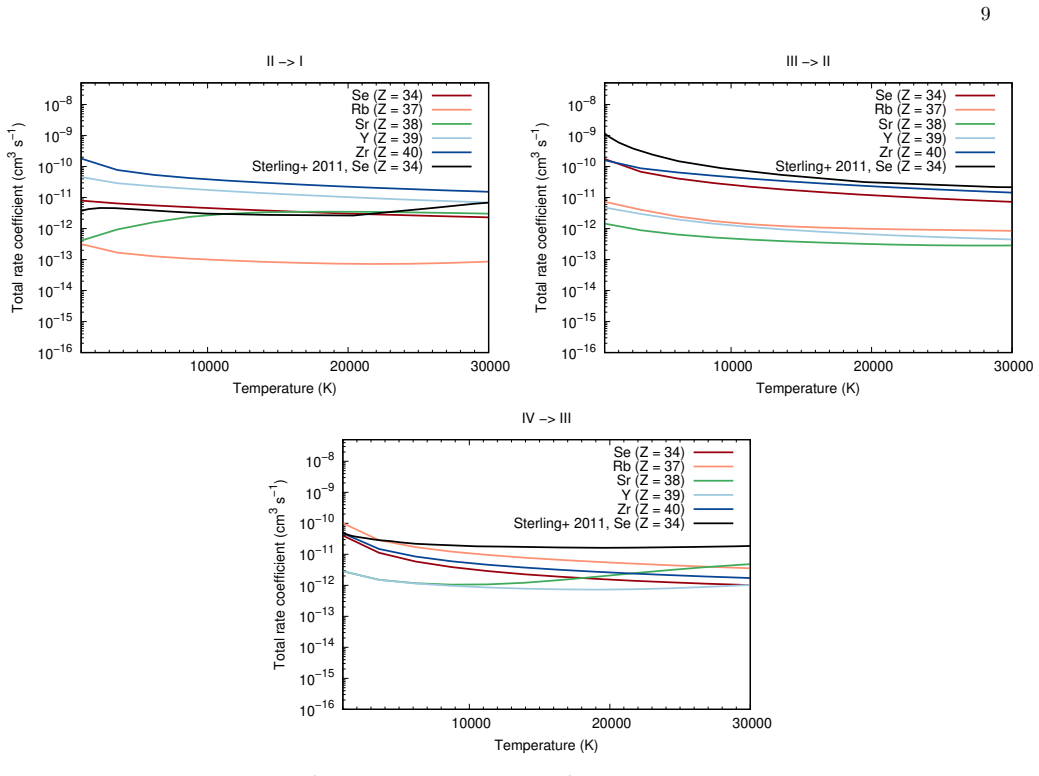
The paper establishes that the constant total recombination rate of $10^{-11}$ $cm^{3}$ $s^{-1}$ used in earlier nebular-phase kilonova models is a poor stand-in for the element-dependent, temperature-dependent dielectronic recombination rates of Se, Rb, Sr, Y, and Zr. Computed rates at 10,000 K span roughly 2×$10^{-12}$ to 5×$10^{-11}$ $cm^{3}$ $s^{-1}$ for II→I, $10^{-13}$ to 5×$10^{-11}$ for III→II, and 2×$10^{-15}$ to $10^{-11}$ for IV→III. Zr stands out with relatively high rates because its 4d-shell gives a dense, low-lying level structure; Rb II's DR is negligible below 15,000 K. In SUMO models at 10 and 25 days, the new rates lower ionization and temperature, make Zr I a strong coolant and line-blanketing agent, suppress the Rb I and [Se III] features, and bring out [Se I] 5.03 μm. The paper concludes that detailed recombination rates are required to correctly interpret t≳10-day kilonova spectra.
Load-bearing premise
The total recombination rate used in the spectral models sums new dielectronic rates with radiative recombination rates taken from an iron formula (Axelrod 1980) that is assumed to hold for all heavier elements; for rubidium this proxy sets the Rb I abundance, and if the true Rb II radiative recombination rate were an order of magnitude higher, the predicted weakening of the Rb I lines would not occur.
Editorial extensions
If this is right
- Late-time kilonova spectral identification must be redone with element-specific, temperature-dependent recombination rates, not a single constant.
- Zirconium's role in light-r-process kilonova spectra is more prominent than previous models suggested, with Zr I blanketing optical flux.
- The [Se I] 5.03 μm line becomes a candidate diagnostic for selenium, replacing the [Se III] 4.55 μm prediction, and is testable with JWST if a kilonova occurs within about 100 Mpc.
- The Rb I lines at 7802 and 7949 Å are weakened, lowering confidence in rubidium as the cause of the AT2017gfo 7500–7900 Å feature.
- Other r-process elements outside Se, Rb, Sr, Y, and Zr also need detailed DR rates before nebular kilonova spectra can be reliably interpreted.
Reading between the lines
- If the same strong element dependence holds for heavier r-process elements such as Ce and Nd, the nebular spectra of heavy-r-process kilonovae may also reshuffle, meaning current line identifications for those elements rest on the same constant-rate assumption.
- Because the paper shows recombination rates affect temperature indirectly through the cooling abilities of the ions that become abundant, any temperature-sensitive observable, such as line ratios within a single ion, could serve as an indirect probe of recombination microphysics.
- A testable extension would be to apply the same HULLAC DR calculations to Ba, La, and Ce, the next r-process peak, and check whether zirconium-like dominance shifts to another element, which would change predicted near-infrared spectra at 25–40 days.
- Since the steady-state approximation used here breaks down beyond about 100 days, and recombination rates are already this influential at 25 days, the ionization balance at later epochs could shift even more; time-series modeling could quantify that drift.
Editorial analysis
A structured set of objections, weighed in public.
Referee Report
Summary. The paper computes dielectronic recombination (DR) rate coefficients with HULLAC for the light r-process elements Se, Rb, Sr, Y, and Zr, for the recombination stages II-I, III-II, and IV-III, and combines them with Fe-based radiative recombination (RR) rates from the Axelrod (1980) formula. It benchmarks the Se results against NIST threshold energies and against the independent total recombination rates of Sterling & Witthoeft (2011). These rates are then used in the SUMO non-LTE spectral synthesis code to compute kilonova nebular spectra at 10 and 25 days for a light r-process composition, comparing with a model that uses the previous constant recombination rate of 1e-11 cm3 s-1. The authors report that the new rates lower the ionization fraction and temperature, make Zr a more dominant spectral actor through line blanketing, weaken the Rb I 7802/7949 A lines and the [Se III] 4.55 micron line, and bring out a [Se I] 5.03 micron feature. The central conclusion is that detailed recombination rates substantially change modeled nebular spectra.
Significance. If the results hold, this is an important step for kilonova nebular-phase modeling. The paper provides new, physically motivated DR rates for five elements that have not been available before, benchmarks them where possible, and demonstrates that the previously used constant recombination rate is inadequate. The spectral comparison is clean in the sense that the new rates are not fitted to the target spectra; the differences between old and new models are emergent. The paper also makes explicit, falsifiable line predictions, notably the [Se I] 5.03 micron feature and the weakening of Rb I lines, which can be tested with future JWST or ground-based observations. However, one headline result, the Rb I line weakening, rests on an uncalculated and explicitly acknowledged RR proxy for Rb, and the paper does not quantify the sensitivity of that prediction to the proxy. This limits the strength of the advertised spectral conclusions even though the broader claim about the importance of detailed recombination rates is well supported.
major comments (2)
- [Section 3.2 and Section 4.3] The predicted weakening of the Rb I 7802/7949 A lines is load-bearing for the abstract and for the discussion of the AT2017gfo 7500-7900 A feature, but it rests almost entirely on the Fe radiative recombination proxy of Axelrod (1980). As the authors state, the DR rate for Rb II is negligible at the relevant temperatures (Section 3.1 and Figure 2), so the total Rb II-I rate is set by the Fe-based RR rate. Section 4.3 notes that this proxy places Rb II-I about two orders of magnitude below the old constant rate, and that the Rb I abundance drops proportionally. The authors also explicitly state that the true Rb RR rate is unknown. A factor-of-ten higher true RR rate would raise the new-model Rb I fraction from 3.3e-4 to roughly 3e-3 in the innermost zone; this is still below the old-model value of 0.017, but line strength is not linear in abundance because of optical depth effects and the competing Zr I blanketing. I ask the authors to supply a sensitivity test with the RR proxy varied by at least an order of magnitude, or to reframe the abstract and Section 4.3 so that the Rb line weakening is presented as conditional on this untested assumption.
- [Section 4 and Table 2] The new model applies the detailed recombination rates only to Se, Rb, Sr, Y, and Zr; the remaining elements in the composition, including Kr, which contributes roughly 25 percent of the electron population in Table 2, retain the old constant recombination rate. The comparison between old and new models is therefore not a test of replacing all constant rates with detailed rates. This is a legitimate scoping choice for a first paper in a series, but the broader statements in Section 5 that accurate recombination rates are critical for interpreting t >~ 10 day kilonova spectra should be accompanied by an explicit statement that, for the present model, five of the ten composition elements still use the previous constant treatment. Please clarify this limitation at the point where the conclusions are drawn.
minor comments (4)
- [Introduction, page 2] The text refers to 'Te (Z= 34)'; tellurium has Z=52, while Z=34 is selenium. Please correct this typo.
- [Section 4, models] It would be helpful to state explicitly whether the 'old' model uses the same updated collision strengths and NIST energy-level corrections as the 'new' model. The current wording implies that the old model is identical to Pognan et al. (2023), but the collision-strength scaling and level updates appear to apply to both models; clarifying this will avoid misattributing the spectral differences.
- [Section 5 and Section 4] The composition is described as Z=31-40 in Section 4 but as Z=30-40 in the Summary; please make these consistent.
- [Figure 10 caption] The caption says 'Detailed ionization structure changes (innermost zone)' but could specify that this is for the five elements with new recombination rates, and the legend I-II-III-IV should be defined in the caption.
Circularity Check
No significant circularity: the new recombination rates are computed from atomic structure and benchmarked against independent codes; the acknowledged Rb RR proxy is an uncertainty, not a fitted or self-referential input.
full rationale
The paper's claimed derivation chain is self-contained in the relevant sense. The new DR rates are produced from HULLAC structure calculations (Eqs. 2-3) with stated configuration sets, benchmarked against NIST threshold energies (Fig. 1) and independently against AUTOSTRUCTURE calculations of Sterling & Witthoeft (2011) for Se (Sec. 3.3, Fig. 6). No parameter is fitted to the target spectra; the old constant rate and the new total rates are both inputs to the SUMO NLTE solver, and the ionization, temperature, and emergent spectra (Figs. 8-12) are computed consequences. The RR rates are taken from the Axelrod (1980) Fe analytical formula and applied to heavier elements (Sec. 3.2); this is an acknowledged assumption and limitation, and for Rb II to I it is the dominant determinant of the predicted weakening of the Rb I lines (Sec. 4.3). That makes the Rb result sensitivity-dependent, but not circular: the Fe proxy is an external empirical input, not a fitted or redefined version of the predicted Rb I abundance, and the authors explicitly flag the unknown Rb RR rate. The self-citations to prior work by the same group (Pognan et al. 2023 for the old model and SUMO modelling, Banerjee et al. 2022/2024 for HULLAC setup) are contextual and are not used to force the central claim; the central claim is supported by the independent code comparison and by the model-to-model response. No load-bearing step reduces, by construction, to its inputs.
Assumptions & free parameters
free parameters (3)
- Collision strength scaling factor =
10 (multiplicative on Axelrod 1980 values)
- Autoionizing state energy window =
2 eV
- Baseline constant recombination rate (old model) =
1e-11 cm3 s-1
assumptions (6)
- ad hoc to paper RR rates for all elements are approximated by Fe rates from Axelrod (1980)
- domain assumption Photoionization cross-sections are hydrogenic for all elements
- domain assumption Steady-state approximation holds at t=10 and 25 days
- domain assumption HULLAC central-field atomic structure is accurate to about 5% in thresholds
- domain assumption Light r-process composition from Wanajo et al. (2014) Ye=0.35 trajectory
- ad hoc to paper Collision strengths scaled by 10 times Axelrod values
Cite this review
Pith. "Pith review of Nebular spectra of kilonovae with detailed recombination rates -- I. Light r-process composition." pith.science (2026). https://pith.science/paper/LXJ4E3FY
@misc{pith2026250118345,
  author       = {Pith},
  title        = {Pith review of: Nebular spectra of kilonovae with detailed recombination rates -- I. Light r-process composition},
  year         = {2026},
  howpublished = {\url{https://pith.science/paper/LXJ4E3FY}},
  note         = {Machine review of arXiv:2501.18345}
}
read the original abstract
To investigate spectra of kilonovae in the NLTE phase (t>= 1 week), we perform atomic calculations for dielectronic recombination (DR) rates for the light r-process elements Se (Z = 34), Rb (Z = 37), Sr (Z = 38), Y (Z = 39), and Zr (Z = 40) using the HULLAC code. For the different elements, our results for the DR rate coefficients for recombining from the ionization states of II to I, III to II, and IV to III vary between 2x10^{-12} - 5x10^{-11} cm^3/s, 10^{-13} - 5x10^{-11} cm^3/s and 2x10^{-15} - 10^{-11} cm^3/s, respectively, at a temperature of T = 10,000 K. Using this new atomic data (DR), we study the impact on kilonova model spectra at phases of t = 10 days and t = 25 days after the merger using the spectral synthesis code SUMO. Compared to models using the previous treatment of recombination as a constant rate, the new models show significant changes in ionization and temperature, and correspondingly, in emergent spectra. With the new rates, we find that Zr (Z = 40) plays a yet more dominant role in kilonova spectra for light r-process compositions. Further, we show that previously predicted mid-infrared (e.g. [Se III] 4.55 mum) and optical (e.g. Rb I 7802, 7949 {\AA}) lines weaken in the new model. Instead [Se I] 5.03 mum emerges as a signature. These results demonstrate the importance of considering the detailed microphysics for modelling and interpreting the late-time kilonova spectra.
Figures


Figures from the paper (9 more)




Forward citations
Cited by 1 Pith paper
-
Multi-Peaked Non-Thermal Light Curves from Magnetar-Powered Gamma-Ray Bursts
Magnetar-powered GRBs should show three separate non-thermal emission peaks, with a pulsar wind nebula dominating radio emission for years (SN/LGRBs) or days (KN/SGRBs) after the burst.
Reference graph
Works this paper leans on
-
[1]
, " * write output.state after.block = add.period write newline
ENTRY address archivePrefix author booktitle chapter doi edition editor eprint howpublished institution journal key month number organization pages publisher school series title misctitle type volume year version url label extra.label sort.label short.list INTEGERS output.state before.all mid.sentence after.sentence after.block FUNCTION init.state.consts ...
-
[2]
write newline
" write newline "" before.all 'output.state := FUNCTION format.url url empty "" new.block "" url * "" * if FUNCTION format.eprint eprint empty "" archivePrefix empty "" archivePrefix "arXiv" = new.block " " eprint * " " * new.block " " eprint * " " * if if if FUNCTION format.doi doi empty "" " " doi * " " * if FUNCTION format.pid doi empty eprint empty ur...
-
[3]
, Oɰ6җ̕fRu F P@g iӉL2g9k plɁ_m ęF +HyP
thebibliography [1] 20pt to REFERENCES 6pt =0pt 10pt plus 3pt =0pt =0pt =1pt plus 1pt =0pt =0pt -12pt =13pt plus 1pt =20pt =13pt plus 1pt \@M =10000 =-1.0em =0pt =0pt 0pt =0pt =1.0em @enumiv\@empty 10000 10000 `\.\@m \@noitemerr \@latex@warning Empty `thebibliography' environment \@ifnextchar \@reference \@latexerr Missing key on reference command Each re...
arXiv 2019
-
[4]
Abbott , B. P., Abbott , R., Abbott , T. D., et al. 2017, , 119, 161101, 10.1103/PhysRevLett.119.161101
-
[5]
Axelrod , T. S. 1980, Late time optical spectra from the Nickel(56) Model for type I supernovae
work page 1980
-
[6]
Badnell , N. R. 1986, Journal of Physics B Atomic Molecular Physics, 19, 3827, 10.1088/0022-3700/19/22/023
-
[7]
R., Petrini , D., & Stoica , S
Badnell , N. R., Petrini , D., & Stoica , S. 1997, Journal of Physics B Atomic Molecular Physics, 30, L665, 10.1088/0953-4075/30/19/006
-
[8]
2024, , 968, 64, 10.3847/1538-4357/ad4029
Banerjee , S., Tanaka , M., Kato , D., & Gaigalas , G. 2024, , 968, 64, 10.3847/1538-4357/ad4029
Show all 65 references
-
[9]
2022, arXiv e-prints, arXiv:2204.06861
Banerjee , S., Tanaka , M., Kato , D., et al. 2022, arXiv e-prints, arXiv:2204.06861. 2204.06861
2022 arXiv
-
[10]
2020, , 901, 29, 10.3847/1538-4357/abae61
Banerjee , S., Tanaka , M., Kawaguchi , K., Kato , D., & Gaigalas , G. 2020, , 901, 29, 10.3847/1538-4357/abae61
2020 doi
-
[11]
2001, , 71, 169, 10.1016/S0022-4073(01)00066-8
Bar-Shalom , A., Klapisch , M., & Oreg , J. 2001, , 71, 169, 10.1016/S0022-4073(01)00066-8
2001 doi
-
[12]
J., McCann , M., Loch , S
Bromley , S. J., McCann , M., Loch , S. D., & Ballance , C. P. 2023, , 268, 22, 10.3847/1538-4365/ace5a1
2023 doi
- [13]
-
[14]
A., Foley , R
Coulter , D. A., Foley , R. J., Kilpatrick , C. D., et al. 2017, Science, 358, 1556, 10.1126/science.aap9811
2017 doi
-
[15]
S., Berger , E., Villar , V
Cowperthwaite , P. S., Berger , E., Villar , V. A., et al. 2017, , 848, L17, 10.3847/2041-8213/aa8fc7
2017 doi
-
[16]
2022, , 939, 8, 10.3847/1538-4357/ac8c36
Domoto , N., Tanaka , M., Kato , D., et al. 2022, , 939, 8, 10.3847/1538-4357/ac8c36
2022 doi
-
[17]
R., Piro , A
Drout , M. R., Piro , A. L., Shappee , B. J., et al. 2017, Science, 358, 1570, 10.1126/science.aaq0049
2017 doi
-
[18]
Eichler , D., Livio , M., Piran , T., & Schramm , D. N. 1989, , 340, 126, 10.1038/340126a0
1989 doi
-
[19]
Freiburghaus , C., Rosswog , S., & Thielemann , F. K. 1999, , 525, L121, 10.1086/312343
1999 doi
-
[20]
2019, Computer Physics Communications, 237, 184, 10.1016/j.cpc.2018.10.032
Froese Fischer , C., Gaigalas , G., J \"o nsson , P., & Biero \'n , J. 2019, Computer Physics Communications, 237, 184, 10.1016/j.cpc.2018.10.032
2019 doi
-
[21]
H., Smartt , S
Gillanders , J. H., Smartt , S. J., Sim , S. A., Bauswein , A., & Goriely , S. 2022, , 515, 631, 10.1093/mnras/stac1258
2022 doi
-
[22]
Gu , M. F. 2008, Canadian Journal of Physics, 86, 675, 10.1139/P07-197
2008 doi
-
[23]
2021, , 506, 5863, 10.1093/mnras/stab1975
Hotokezaka , K., Tanaka , M., Kato , D., & Gaigalas , G. 2021, , 506, 5863, 10.1093/mnras/stab1975
2021 doi
- [24]
- [25]
-
[26]
2017, in Handbook of Supernovae, ed
Jerkstrand , A. 2017, in Handbook of Supernovae, ed. A. W. Alsabti & P. Murdin , 795, 10.1007/978-3-319-21846-5_29
2017 doi
-
[27]
2011, , 530, A45, 10.1051/0004-6361/201015937
Jerkstrand , A., Fransson , C., & Kozma , C. 2011, , 530, A45, 10.1051/0004-6361/201015937
2011 doi
-
[28]
2019, , 876, 128, 10.3847/1538-4357/ab06c2
Kasen , D., & Barnes , J. 2019, , 876, 128, 10.3847/1538-4357/ab06c2
2019 doi
-
[29]
2017, , 551, 80, 10.1038/nature24453
Kasen , D., Metzger , B., Barnes , J., Quataert , E., & Ramirez-Ruiz , E. 2017, , 551, 80, 10.1038/nature24453
2017 doi
-
[30]
2018, , 865, L21, 10.3847/2041-8213/aade02
Kawaguchi , K., Shibata , M., & Tanaka , M. 2018, , 865, L21, 10.3847/2041-8213/aade02
2018 doi
- [31]
-
[32]
2012, , 426, 1940, 10.1111/j.1365-2966.2012.21859.x
Korobkin , O., Rosswog , S., Arcones , A., & Winteler , C. 2012, , 426, 1940, 10.1111/j.1365-2966.2012.21859.x
2012
-
[33]
T., Fryer , C
Korobkin , O., Wollaeger , R. T., Fryer , C. L., et al. 2021, , 910, 116, 10.3847/1538-4357/abe1b5
2021 doi
-
[34]
Ralchenko , Reader, J., & and NIST ASD Team
Kramida, A., Yu. Ralchenko , Reader, J., & and NIST ASD Team . 2020, NIST Atomic Spectra Database (ver. 5.8), [Online]. Available: https://physics.nist.gov/asd [2021, April 15]. National Institute of Standards and Technology, Gaithersburg, MD
2020
-
[35]
Kulkarni , S. R. 2005, arXiv e-prints, astro. astro-ph/0510256
2005 arXiv
- [36]
-
[37]
1998, , 507, L59, 10.1086/311680
Li , L.-X., & Paczy \'n ski , B. 1998, , 507, L59, 10.1086/311680
1998 doi
-
[38]
D., Mart \' nez-Pinedo , G., Darbha , S., et al
Metzger , B. D., Mart \' nez-Pinedo , G., Darbha , S., et al. 2010, , 406, 2650, 10.1111/j.1365-2966.2010.16864.x
2010
-
[39]
Moore , C. E. 1971, in Bulletin of the American Astronomical Society, Vol. 3, 154--155
1971
-
[40]
E., Johansson , S., & Kurucz , R
Nilsson , A. E., Johansson , S., & Kurucz , R. L. 1991, , 44, 226, 10.1088/0031-8949/44/3/003
1991 doi
-
[41]
Nussbaumer , H., & Storey , P. J. 1983, , 126, 75
1983
-
[42]
Palmer , B. A. 1977, PhD thesis, Purdue University, Indiana
1977
-
[43]
2017, , 850, L37, 10.3847/2041-8213/aa9ab9
Perego , A., Radice , D., & Bernuzzi , S. 2017, , 850, L37, 10.3847/2041-8213/aa9ab9
2017 doi
-
[44]
2023, , 526, 5220, 10.1093/mnras/stad3106
Pognan , Q., Grumer , J., Jerkstrand , A., & Wanajo , S. 2023, , 526, 5220, 10.1093/mnras/stad3106
2023 doi
-
[45]
2022 a , , 510, 3806, 10.1093/mnras/stab3674
Pognan , Q., Jerkstrand , A., & Grumer , J. 2022 a , , 510, 3806, 10.1093/mnras/stab3674
2022 doi
-
[46]
2022 b , , 513, 5174, 10.1093/mnras/stac1253
---. 2022 b , , 513, 5174, 10.1093/mnras/stac1253
2022 doi
-
[47]
P., Badnell , N
Preval , S. P., Badnell , N. R., & O'Mullane , M. G. 2019, Journal of Physics B Atomic Molecular Physics, 52, 025201, 10.1088/1361-6455/aaf3f4
2019 doi
-
[48]
1997, , 55, 310, 10.1088/0031-8949/55/3/009
Reader , J., & Acquista , N. 1997, , 55, 310, 10.1088/0031-8949/55/3/009
1997 doi
-
[49]
2018, , 615, A132, 10.1051/0004-6361/201732117
Rosswog , S., Sollerman , J., Feindt , U., et al. 2018, , 615, A132, 10.1051/0004-6361/201732117
2018 doi
-
[50]
2017, , 96, 123012, 10.1103/PhysRevD.96.123012
Shibata , M., Fujibayashi , S., Hotokezaka , K., et al. 2017, , 96, 123012, 10.1103/PhysRevD.96.123012
2017 doi
-
[51]
J., Chen , T
Smartt , S. J., Chen , T. W., Jerkstrand , A., et al. 2017, , 551, 75, 10.1038/nature24303
2017 doi
-
[52]
2024, , 690, A398, 10.1051/0004-6361/202450317
Sneppen , A., Watson , D., Damgaard , R., et al. 2024, , 690, A398, 10.1051/0004-6361/202450317
2024 doi
- [53]
-
[54]
Sterling , N. C. 2011, , 533, A62, 10.1051/0004-6361/201117471
2011 doi
-
[55]
C., & Witthoeft , M
Sterling , N. C., & Witthoeft , M. C. 2011, , 529, A147, 10.1051/0004-6361/201116718
2011 doi
-
[56]
A., et al
Tanaka , M., Utsumi , Y., Mazzali , P. A., et al. 2017, , 69, 102, 10.1093/pasj/psx121
2017 doi
-
[57]
2018, , 852, 109, 10.3847/1538-4357/aaa0cb
Tanaka , M., Kato , D., Gaigalas , G., et al. 2018, , 852, 109, 10.3847/1538-4357/aaa0cb
2018 doi
-
[58]
2017, , 69, 101, 10.1093/pasj/psx118
Utsumi , Y., Tanaka , M., Tominaga , N., Yoshida , M., & et al. 2017, , 69, 101, 10.1093/pasj/psx118
2017 doi
-
[59]
J., Yang , S., et al
Valenti , S., Sand , D. J., Yang , S., et al. 2017, , 848, L24, 10.3847/2041-8213/aa8edf
2017 doi
-
[60]
2014, , 789, L39, 10.1088/2041-8205/789/2/L39
Wanajo , S., Sekiguchi , Y., Nishimura , N., & et al. 2014, , 789, L39, 10.1088/2041-8205/789/2/L39
2014 doi
-
[61]
J., Selsing , J., et al
Watson , D., Hansen , C. J., Selsing , J., et al. 2019, , 574, 497, 10.1038/s41586-019-1676-3
2019 doi
-
[62]
O., & Kushnir , D
Waxman , E., Ofek , E. O., & Kushnir , D. 2019, , 878, 93, 10.3847/1538-4357/ab1f71
2019 doi
-
[63]
T., Fryer , C
Wollaeger , R. T., Fryer , C. L., Fontes , C. J., et al. 2019, , 880, 22, 10.3847/1538-4357/ab25f5
2019 doi
-
[64]
T., Fryer , C
Wollaeger , R. T., Fryer , C. L., Chase , E. A., et al. 2021, , 918, 10, 10.3847/1538-4357/ac0d03
2021 doi
-
[65]
2017, , 851, L48, 10.3847/2041-8213/aaa07d
Yang , S., Valenti , S., Cappellaro , E., et al. 2017, , 851, L48, 10.3847/2041-8213/aaa07d
2017 doi
Reviewed August 9, 2026 · model on record in the stance chip above.
Discussion (0). Continue with ORCID to comment.