REVIEW 3 major objections 5 minor 3 references
Adaptive Social Learning using Theory of Mind
T0 review · 3 major / 5 minor · reviewed 2026-08-06 · deepseek-v4-flash
Pith's one-line read This paper argues that people decide whether to learn socially by weighing the expected utility of observing another agent, computed by Bayesian theory-of-mind inference, against the utility of exploring on their own, and shows the model…
desk verdict A solid cognitive-science paper that makes the decision to observe another agent a computed utility trade-off; the r=0.83 result is compelling but currently hostage to unreported parameter values. read the letter →
The pith
A machine-rendered reading of the paper's core claim, the machinery that carries it, and where it could break.
The reading
What carries the argument
The load-bearing object is the utility comparison in Eq. 11, $U(\text{Obs}, b^m_t, g_m) > U(\text{Act}, b^m_t, g_m)$. Social observation utility is computed by inverting a generative model of the other agent's goal-directed behavior (Eq. 7): the observer maintains a posterior over the other agent's goal and beliefs via a softmax policy (Eq. 6) with temperature $\beta$, simulates the other agent's future actions under each plausible goal, updates its own belief about the environment accordingly, and prices the resulting plan improvement against the observation cost. Non-social utility is simply the estimated cost of the observer's own optimal plan. When the expected saving from social observation exceeds the observation cost, the model chooses to observe; otherwise it acts. The A* planner carries out the forward plan simulations.
What would settle it
Set the observation cost, movement cost, and softmax temperature in Eq. 6 as fixed, preregistered constants, then run the model on freshly designed maps and collect new human choices on those maps; if the predicted observe/act switch points do not track the observed stopping times, the claim of quantitative capture is refuted.
Extended reading notes
Core claim
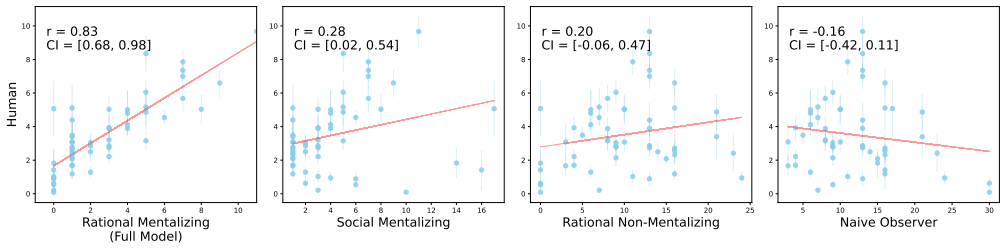
The central claim is that humans decide whether to engage in social learning by estimating the utility of observing another agent through Bayesian theory-of-mind inference over the other's goals and future actions, then comparing that utility with the utility of acting independently. The paper formalizes this as a Dec-POMDP, computes $U(\text{Obs}, b, g)$ by simulating the other agent's likely goal-conditioned plan and its informational effect on the observer's belief, and selects Observe only when $U(\text{Obs}, b, g) > U(\text{Act}, b, g)$. Across 27 maps each with two goal-variants, the model predicts the average number of observation steps per trial with correlation r = 0.83 against 222 online participants, and it reproduces qualitative patterns such as stopping observation early when the other agent's trajectory becomes uninformative or skipping observation entirely when self-exploration is cheaper. Ablations removing mentalizing, utility comparison, or both yield substantially worse fits, which the authors take as evidence that both components are indispensable.
Load-bearing premise
The model's quantitative match rests on the observation cost, the action cost, and the softmax temperature used in Eq. 6, and the manuscript does not report what values these took or whether they were fixed before seeing the human data.
Editorial extensions
If this is right
- If the central claim is correct, social-learning decisions are computable from the environment layout and the observer's model of the other agent, rather than from fixed copying heuristics.
- The model predicts that people will forgo even an expert informant when self-exploration is cheaper, as in the paper's example D, and will stop observing early once the other agent's trajectory becomes uninformative.
- The r = 0.83 correlation over 54 variants implies one shared utility comparison can account for when and for how long people watch others, without needing separate mechanisms for different goal structures.
- The model's superior efficiency in the game, matching human step counts and costs more closely than all baselines, implies that mentalizing-based utility comparison is also a better normative strategy in this domain.
- The ablation results imply that both mentalizing and utility maximization are jointly necessary; removing either component reduces the fit toward chance.
Reading between the lines
- A natural extension the paper does not explore: the same utility comparison could decide when to query an expert versus run one's own experiments in laboratory or real-world information search, since the core currency is expected time saved.
- Because the model watches a single expert, it leaves open a portfolio question the authors do not address: if several agents with different goals are observable, a rational observer should allocate observation steps to whoever maximizes expected belief sharpening per unit cost.
- The authors note humans observe one or two steps longer than the model, hinting at a confirmation bias; an explicit extension would add a small prior that the other agent might act suboptimally, which should produce later stopping times and may close the residual gap.
- A testable prediction not drawn in the paper: the model's per-step stopping rule implies that observation should end at the precise moment the posterior over the other agent's goal becomes concentrated on the relevant wizard; recording participants' stopping times at each step on new maps would test this directly.
Editorial analysis
A structured set of objections, weighed in public.
Referee Report
Summary. The paper proposes a rational mentalizing model of social learning, in which an observer estimates the expected utility of observing another agent by performing Bayesian theory-of-mind inference over the other agent's goals and future actions, and compares this utility with the utility of self-exploration. The model is tested in a two-agent treasure-hunt game with 54 game-level variants using data from 222 human participants. The full model correlates with human mean observation counts at r = 0.83, close to the reported split-half human reliability of 0.8, while three ablation models (naive observer, rational non-mentalizing, social mentalizing) fit substantially worse. The authors argue that both mentalizing and utility maximization are necessary to explain flexible human social learning.
Significance. If the central quantitative claim survives scrutiny, this is a valuable contribution: it provides a principled, mechanism-level account of when humans choose to learn socially, moving beyond heuristic copying rules. The empirical design is a strength: 54 carefully varied stimuli, a new human dataset, and three ablation baselines that isolate the two model components. The model also generates falsifiable predictions about how observation counts depend on goal overlap, informational value, and relative costs, and the reported correlation matching human split-half reliability is an appropriate benchmark. The main caveats are that parameter values and the fitting procedure are not reported, and one equation's notation is ambiguous; these must be resolved before the predictive claim is fully supported.
major comments (3)
- [Computational Model, Eqs. (6), (9), (11)] The model's observe-versus-act decision depends critically on the softmax temperature β (Eq. 6), the observation cost C(Obs) relative to action costs C(a_m) (Eq. 9), and the observation cap T_max (Baselines). The manuscript reports none of these values, and it does not state whether they were set a priori, estimated from the data, or chosen by hand. If β and the cost ratio were tuned to maximize agreement with the 54 human level means, the reported correlation r = 0.83 reflects in-sample fitting rather than prediction, and the comparison with the ablation models is not a fair test. Please report all parameter values, describe the fitting procedure (if any), and provide a sensitivity analysis or cross-validation to demonstrate that the qualitative conclusions do not depend on specific parameter choices.
- [Computational Model, Eq. (8)] Equation (8) weights each possible other-agent goal by P(g_o), which the surrounding text identifies as the posterior inferred from Eq. (7) given the observed action sequence. As written, P(g_o) is the prior, and if the implementation used the prior, the model would not update its beliefs about the other agent's goal from observed actions, contradicting the qualitative examples in Fig. 4 and the claim that mentalizing drives adaptive observation. Please clarify whether the weighting term is the posterior P(g_o | a^o_{1:t}) and correct the notation in Eq. (8) and the accompanying text.
- [Results, Quantitative analysis] The paper compares the model-human correlation (r = 0.83, CI [0.68, 0.98]) with a 'split-half correlation among human participants' of 0.8, but it does not describe how this split-half reliability was computed (e.g., random split of participants, correlation between halves' mean counts) or report a confidence interval for it. Because this comparison is used to argue that the model's error is comparable to human measurement noise, please specify the computation, report the uncertainty, and state whether the difference between 0.83 and 0.8 is statistically meaningful.
minor comments (5)
- [Qualitative analysis] The text contains a duplicated word in 'different different contexts'; please fix this typo.
- [Qualitative analysis, Example B] In Example B of Fig. 4, the text says 'red key from the red wizard,' but the game uses amulets, not keys; please make the terminology consistent.
- [Results, Quantitative analysis] The method used to compute the 95% confidence interval for the correlation (e.g., bootstrap, Fisher z-transform) is not stated; please add this detail.
- [Introduction] There is a missing comma after the citation 'goals Witt et al., 2024' — the sentence reads awkwardly; please insert a comma.
- [Computational Model / Baselines] The model's observation cap is stated as 15 steps in the Baselines section, but it is not mentioned in the model definition; please state the cap in the model section and discuss its influence on the results.
Circularity Check
No significant circularity: the model's predictions are evaluated against new human data with ablations, and the reused Bayesian theory-of-mind and inverse-planning machinery is independently established rather than load-bearing.
full rationale
The paper's derivation chain is self-contained with respect to its central empirical claim. The forward planning model (Eqs. 1-6) is a standard bounded-rational policy formulation, explicitly written out rather than imported by citation alone. Goal inference in Eq. 7 is an application of Bayes' rule to that forward model. The novel contribution, utility estimation for social versus non-social learning (Eqs. 8-11), is defined directly in terms of the model's own quantities: the inferred goal distribution, simulated future observations, costs, and the observer's planner. Human observing behavior is an external dataset collected for this study, and the model's fit (r = 0.83) is compared against three ablation baselines that remove the model's components, so the central claim does not reduce to a fitted parameter or a renamed prior result. The paper does reuse Bayesian theory-of-mind and inverse-planning machinery from prior work by the same group (e.g., Baker et al. 2017; Ying et al. 2023; Zhi-Xuan et al. 2024), but that machinery is not the target result here, is explicitly formalized in the paper, and is independently established in the literature. The lack of reported values for the temperature β and the cost ratio C(Obs)/C(Am) is a reporting and reproducibility concern, but the manuscript does not state that these parameters were fitted to the human data, so on the evidence provided there is no demonstrated circular step. No equation in the paper is equivalent by construction to the empirical result, and no load-bearing argument reduces to a self-citation. Therefore the appropriate finding is no significant circularity.
Assumptions & free parameters
free parameters (3)
- softmax temperature β =
unreported
- cost function C(Obs) and per-action costs =
unreported
- observation cap T_max =
15 steps
assumptions (4)
- domain assumption The observed agent is a bounded-rational planner who chooses actions via the softmax policy in Eq. 6 with known temperature β.
- domain assumption The observer knows that the other agent has full knowledge of the maze and amulet locations (expert level).
- domain assumption Human action choice follows the deterministic rule 'observe iff U(Obs) > U(Act)' in Eq. 11.
- standard math A* search provides optimal plans for the simulated agents.
Cite this review
Pith. "Pith review of Adaptive Social Learning using Theory of Mind." pith.science (2026). https://pith.science/paper/LZU74L5T
@misc{pith2026250709409,
  author       = {Pith},
  title        = {Pith review of: Adaptive Social Learning using Theory of Mind},
  year         = {2026},
  howpublished = {\url{https://pith.science/paper/LZU74L5T}},
  note         = {Machine review of arXiv:2507.09409}
}
read the original abstract
Social learning is a powerful mechanism through which agents learn about the world from others. However, humans don't always choose to observe others, since social learning can carry time and cognitive resource costs. How do people balance social and non-social learning? In this paper, we propose a rational mentalizing model of the decision to engage in social learning. This model estimates the utility of social learning by reasoning about the other agent's goal and the informativity of their future actions. It then weighs the utility of social learning against the utility of self-exploration (non-social learning). Using a multi-player treasure hunt game, we show that our model can quantitatively capture human trade-offs between social and non-social learning. Furthermore, our results indicate that these two components allow agents to flexibly apply social learning to achieve their goals more efficiently.
Figures


Figures from the paper (1 more)

Reference graph
Works this paper leans on
-
[1]
L., Jara-Ettinger, J., Saxe, R., & Tenenbaum, J
Baker, C. L., Jara-Ettinger, J., Saxe, R., & Tenenbaum, J. B. (2017). Rational quantitative attribution of beliefs, desires and percepts in human mentalizing. Nature Human Be- haviour, 1(4), 1–10. Bonawitz, E., & Shafto, P. (2016). Computational models of development, social influences. Current Opinion in Behav- ioral Sciences, 7, 95–100. Dutemple, E., Ha...
work page 2017
-
[33]
Zhi-Xuan, T., Ying, L., Mansinghka, V ., & Tenenbaum, J. B. (2024). Pragmatic instruction following and goal assis- tance via cooperative language guided inverse plan search. Proceedings of the 23rd International Conference on Au- tonomous Agents and Multiagent Systems
work page 2024
-
[193]
Horner, V ., & Whiten, A. (2005). Causal knowledge and imitation/emulation switching in chimpanzees (Pan troglodytes) and children (Homo sapiens). Animal Cogni- tion, 8, 164–181. Jara-Ettinger, J. (2019). Theory of mind as inverse reinforce- ment learning. Current Opinion in Behavioral Sciences, 29, 105–110. Kameda, T., & Nakanishi, D. (2003). Does social...
work page Pith review arXiv 2005
Reviewed August 6, 2026 · model on record in the stance chip above.
Discussion (0). Continue with ORCID to comment.