REVIEW 3 major objections 5 minor 18 references
Beyond Fine-Tuning: A Systematic Study of Sampling Techniques in Personalized Image Generation
T0 review · 3 major / 5 minor · reviewed 2026-08-08 · deepseek-v4-flash
Pith's one-line read The paper establishes that integrating superclass trajectories into diffusion sampling improves prompt adherence while keeping concept-identity loss controllable, independent of the fine-tuning method.
desk verdict A useful fine-tuning-independent comparison of sampling methods, but the universal recommendations rest on a single outcome-selected base model. read the letter →
The pith
A machine-rendered reading of the paper's core claim, the machinery that carries it, and where it could break.
The reading
What carries the argument
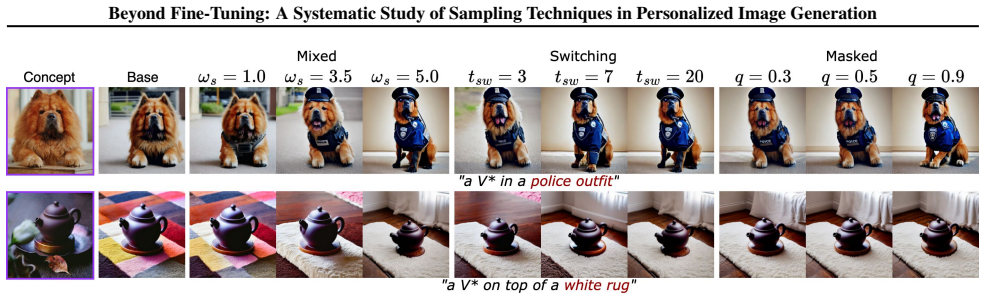
The load-bearing mechanism is the noise-prediction difference of classifier-free guidance. The concept prompt and the superclass prompt produce two directions, $\Delta\varepsilon^C_\theta$ and $\Delta\varepsilon^S_\theta$, one pulling the latent toward the learned object and the other toward the context described in the prompt. Each sampling method is a schedule for combining these directions: Mixed adds both guidance terms with weights $\omega_c$ and $\omega_s$; Switching uses only the superclass direction for the first $t_{sw}$ denoising steps and the concept direction afterward; Multi-stage layers the two; Masked restricts the concept direction to binarized cross-attention mask regions; ProFusion interleaves extra forward-backward diffusion steps with intensity $r$. Pareto frontiers in image-similarity and text-similarity space are the measuring device that turns these schedules into a selection rule.
What would settle it
Run the full sampling comparison on a non-SVDiff base model with a short or atypical Pareto frontier and check whether the ordering of Mixed, Switching, and ProFusion persists; if Switching ever beats Mixed on both metrics, or the claim that all sampling methods improve the fine-tuned model fails, the transferability of the framework is refuted. A cheaper check is to recompute the user-study win rates using the DreamBooth fine-tuned model instead of SVDiff and see whether Mixed's advantage over Switching vanishes.
Extended reading notes
Core claim
On its own terms, the discovery is that the sampling procedure, not the fine-tuning strategy, carries much of the fidelity-editability balance in personalized diffusion models. For a fine-tuned model, the concept prompt and the superclass prompt define two classifier-free-guidance directions, $\Delta\varepsilon^C_\theta$ and $\Delta\varepsilon^S_\theta$, and every method in the study is a way of blending those directions across denoising steps. Blending consistently moves outputs along a Pareto frontier between CLIP Image Similarity and CLIP Text Similarity: Mixed sampling gives the best-balanced frontier, Switching matches ordinary sampling's compute but sacrifices more concept identity, Multi-stage and Masked sit between the two, Photoswap is nearly indistinguishable from Switching, and ProFusion trades four times the compute for the highest concept fidelity. The paper reports that all sampling methods improve the fine-tuned model in either concept or context preservation, and that the qualitative ranking survives changes in fine-tuning method, prompt-trajectory choice, and backbone.
Load-bearing premise
The framework assumes the sampling-method ranking transfers from the SVDiff fine-tuned model, chosen because its Mixed-sampling Pareto frontier is the longest and best balanced, to other fine-tuning schemes and backbones.
Editorial extensions
If this is right
- A practitioner with an already fine-tuned model can improve prompt adherence with zero additional training by changing only the sampling schedule; Mixed sampling is the recommended default because its Pareto frontier is the longest and best balanced.
- Switching sampling delivers most of the text-similarity gain at the same U-Net call count as ordinary sampling, making it the cheap option when compute is fixed.
- The Photoswap attention-replacement procedure can be replaced by the simpler Switching strategy with nearly identical results on this benchmark.
- ProFusion is the right choice only when concept fidelity is the priority, since it requires four times the U-Net calls and careful hyperparameter tuning.
- The same ordering of methods holds across the tested fine-tuning methods and backbones (SD2-base, SD-XL, PixArt-alpha), so the decision rule is not tied to one training setup.
Reading between the lines
- Implicit in the paper's monotone trade-off is a continuous dial: the relative weight of the superclass direction in Mixed sampling could be exposed as a user-facing slider in generation tools, letting users choose identity-versus-context per image rather than per method.
- The paper's trajectory logic suggests a testable extension: replacing the superclass prompt with a style, scene, or motion prompt should produce the same kind of monotone trade-off, which would generalize the selection rule beyond subject-driven personalization.
- A direct experiment the paper's setup enables but does not run is combining Mixed sampling with each fine-tuning baseline and asking whether a well-chosen sampling schedule can close the quality gap to a more expensive fine-tuning method.
Editorial analysis
A structured set of objections, weighed in public.
Referee Report
Summary. This paper presents a systematic study of sampling-time strategies for personalized text-to-image generation, decoupling sampling from fine-tuning. It defines and analyzes Mixed, Switching, Multi-stage, and Masked sampling, compares them with ProFusion and Photoswap, and proposes a decision framework that selects among these methods based on text alignment, concept fidelity, and compute. The experiments use Stable Diffusion 2-base, five fine-tuning methods (SVDiff, Dreambooth, Custom Diffusion, Textual Inversion, ELITE), 30 DreamBooth concepts, 25 prompts per concept, and 7,500 generated images, supplemented by a user study with 48,864 responses. The paper's main claim is that integrating superclass trajectories into sampling improves either concept preservation or context preservation, and that the recommended defaults (Mixed, Switching, ProFusion) transfer across fine-tuning schemes and backbones.
Significance. If the claims hold, the paper is a useful empirical contribution: it provides a common protocol for evaluating sampling strategies independently of fine-tuning, a large-scale comparison, and practical guidance for practitioners. The strengths are real: 7,500 generated images across 30 concepts, DINO-based corroboration of CLIP-IS, a 48,864-response user study, and public code release. The main limitation is that the deepest comparisons, the hyperparameter choices, and the user study all use a single base model, SVDiff, which was selected after inspecting its own Mixed-sampling Pareto frontier. The paper's own Appendix G shows that some method orderings change on a Dreambooth base, so the central fine-tuning-independence claim is not fully established.
major comments (3)
- [Sections 3.5, 4; Appendices G, H, K] The paper's central claim, stated in the abstract and conclusion, is that the sampling framework is training-free and generalizes across fine-tuning methods and architectures. However, the base model for all deep quantitative comparisons and for the user study is SVDiff, which is selected in Section 4 precisely because its Mixed-sampling Pareto frontier is the longest and best balanced. This is an outcome-based selection: the model is chosen after inspecting the very curves that are then used to compare sampling methods. Appendix G directly shows that on a Dreambooth base, Multi-stage and Masked sampling 'struggle to provide an additional improvement over the simple baseline,' so the method ordering is not invariant to the fine-tuning scheme. Appendix H and Appendix K use additional backbones or metrics, but they do not re-run the full hyperparameter-selection and user-study protocol on a second fine-tuning method. To support the fine-tuning-independence claim, the authors should either repeat the complete protocol on at least one other fine-tuning scheme, or revise the claim to state the scope as SVDiff-specific and treat Appendix G as a boundary condition. As written, the recommended rankings may reflect a property of SVDiff rather than a general property of trajectory combinations.
- [Section 4, Evaluation Metrics; Figures 3, 4, 5, 7] The CLIP Pareto curves are reported as means over 30 concepts and 750 prompt-image pairs, but no error bars, confidence intervals, or significance tests are provided. Several comparisons that the framework depends on are close or visually overlapping: Photoswap versus Switching in Figure 7, Multi-stage curves near the Mixed frontier at high switching steps in Figure 3, and Masked curves between the Mixed and Switching frontiers in Figure 4. Without variance estimates or pairwise tests, the claimed orderings cannot be assessed. Please report per-concept standard errors or bootstrap intervals for the key curves and significance tests for the comparisons that determine the framework's recommendations, or explicitly state which ordering claims rest only on the user study.
- [Section 4, User Study; Table 1] The user study is pairwise against a Mixed baseline and is run only on SVDiff. Table 1 reports win rates but no confidence intervals or significance tests, so statements such as 'Mixed, Switching, Multi-stage, and Masked sampling all achieve comparable text similarity' are not supported by any equivalence or non-inferiority analysis. In addition, the table compares each sampling method against the Mixed baseline, not against Base sampling, so the general claim that 'all sampling methods improve the performance of the fine-tuned model in either concept or context preservation' is not directly read from the table; it relies on Figure 8 and on hand-selected optimal points. Please add statistical analyses for the user-study proportions and clarify which table entries support which part of the framework.
minor comments (5)
- [Section 3.3, Eqs. (9)-(10)] Equation (9) applies the same mask to both the concept and superclass trajectories, which is inconsistent with the text saying the mask is applied to the concept trajectory so it 'only influences relevant regions.' If the superclass term should act on the complement of the mask, please write M_t and 1-M_t explicitly in both equations.
- [Table 1 caption] The caption says 'SVDDiff' while the text and figures use 'SVDiff'; unify the spelling.
- [Appendix F] The long-prompt listing is formatted as two concatenated code strings named 'livelong' and 'objectlong'; this should be a readable list of ten prompts for each concept category.
- [Section 4, User Study] The relationship between 16,000 pairs and 48,864 responses is not explained; if three questions per pair were asked, the expected total would be 48,000, so please clarify whether some pairs were evaluated by multiple users or whether some questions were skipped.
- [References] The reference list contains duplicated entries for Rombach et al. (2022a/2022b) and some inconsistent citation ordering in the introduction; please clean up the bibliography.
Circularity Check
No circularity: the sampling formulas are defined independently of the evaluation metrics, and the decision framework is an empirical summary, not a quantity predicted from its own fitted inputs.
full rationale
The paper's derivation chain is not circular. The sampling equations (Mixed, Eq. 6; Switching, Eq. 7; Multi-stage, Eq. 8; Masked, Eqs. 9-11) are explicit algebraic combinations of concept and superclass classifier-free guidance terms, and none of them is defined in terms of the CLIP IS/TS metrics, DINO similarity, or the user-study questions used for evaluation. The reported rankings are computed from external measurements (CLIP embeddings, DINO embeddings, crowd responses) on generated images, not from fitted parameters that reappear as predictions. The choice of SVDiff as the base model (Section 3.5: 'It is crucial to select a model whose Pareto frontier is of sufficient length'; Section 4: 'The Pareto frontier obtained from the SVDiff model achieves a favorable balance... therefore, this model was chosen') is an outcome-informed model selection that limits generalizability, but it does not make the subsequent comparisons logically forced or define the recommended ordering; Appendix G, Appendix H, and Appendix K provide independent checks on other fine-tuning schemes, backbones, and metrics. The decision framework in Section 4 is a recommendation built by summarizing the same experiments rather than a prospective validation, which is a scientific generality limitation, not circular reasoning. No load-bearing self-citation, imported uniqueness theorem, or ansatz smuggled in via citation is present. Therefore the circularity score is 0.
Assumptions & free parameters
free parameters (5)
- Superclass guidance scale omega_s =
varied 0.0 to 7.0; often omega_c = 7.0 - omega_s
- Concept guidance scale omega_c =
7.0 - omega_s in main Mixed experiments
- Switching step t_sw =
grid [1, 3, 5, 7, 10, 20, 30, 40]
- Mask quantile q =
grid [0.3, 0.5, 0.7, 0.9]
- ProFusion fusion step intensity r =
grid [0.05, 0.1, 0.15, 0.2, 0.3, 0.4, 0.5, 0.7, 1.0]
assumptions (4)
- domain assumption CLIP image similarity and CLIP text similarity are valid proxies for concept fidelity and prompt adherence.
- domain assumption The 30-concept Dreambooth dataset with 25 contextual prompts and 10 images per prompt is representative of personalized image generation workloads.
- ad hoc to paper SVDiff, selected because its Mixed-sampling Pareto frontier is longest and most balanced, is representative of fine-tuned personalized models.
- domain assumption Replacing a concept token V* with a superclass token preserves enough semantic alignment for trajectory mixing to work.
Cite this review
Pith. "Pith review of Beyond Fine-Tuning: A Systematic Study of Sampling Techniques in Personalized Image Generation." pith.science (2026). https://pith.science/paper/M4PKF3UX
@misc{pith2026250205895,
  author       = {Pith},
  title        = {Pith review of: Beyond Fine-Tuning: A Systematic Study of Sampling Techniques in Personalized Image Generation},
  year         = {2026},
  howpublished = {\url{https://pith.science/paper/M4PKF3UX}},
  note         = {Machine review of arXiv:2502.05895}
}
read the original abstract
Personalized text-to-image generation aims to create images tailored to user-defined concepts and textual descriptions. Balancing the fidelity of the learned concept with its ability for generation in various contexts presents a significant challenge. Existing methods often address this through diverse fine-tuning parameterizations and improved sampling strategies that integrate superclass trajectories during the diffusion process. While improved sampling offers a cost-effective, training-free solution for enhancing fine-tuned models, systematic analyses of these methods remain limited. Current approaches typically tie sampling strategies with fixed fine-tuning configurations, making it difficult to isolate their impact on generation outcomes. To address this issue, we systematically analyze sampling strategies beyond fine-tuning, exploring the impact of concept and superclass trajectories on the results. Building on this analysis, we propose a decision framework evaluating text alignment, computational constraints, and fidelity objectives to guide strategy selection. It integrates with diverse architectures and training approaches, systematically optimizing concept preservation, prompt adherence, and resource efficiency. The source code can be found at https://github.com/ControlGenAI/PersonGenSampler.
Figures


Figures from the paper (18 more)


Reference graph
Works this paper leans on
-
[1]
Disenbooth: Identity-preserving disentan- gled tuning for subject-driven text-to-image generation
Chen, H., Zhang, Y ., Wu, S., Wang, X., Duan, X., Zhou, Y ., and Zhu, W. Disenbooth: Identity-preserving disentan- gled tuning for subject-driven text-to-image generation. In The Twelfth International Conference on Learning Representations, 2023a. Chen, J., Yu, J., Ge, C., Yao, L., Xie, E., Wu, Y ., Wang, Z., Kwok, J., Luo, P., Lu, H., and Li, Z. Pixart- ...
-
[6]
Qiu, Z., Liu, W., Feng, H., Xue, Y ., Feng, Y ., Liu, Z., Zhang, D., Weller, A., and Sch ¨olkopf, B
URL https://arxiv.org/abs/ 2307.01952. Qiu, Z., Liu, W., Feng, H., Xue, Y ., Feng, Y ., Liu, Z., Zhang, D., Weller, A., and Sch ¨olkopf, B. Controlling text-to- image diffusion by orthogonal finetuning. Advances in Neural Information Processing Systems, 36,
-
[7]
Hierarchical text-conditional image generation with clip latents
Ramesh, A., Dhariwal, P., Nichol, A., Chu, C., and Chen, M. Hierarchical text-conditional image generation with clip latents. arXiv preprint arXiv:2204.06125, 1(2):3,
-
[8]
High-resolution image synthesis with latent diffusion models
Rombach, R., Blattmann, A., Lorenz, D., Esser, P., and Ommer, B. High-resolution image synthesis with latent diffusion models. In Proceedings of the IEEE/CVF con- ference on computer vision and pattern recognition, pp. 10684–10695, 2022a. Rombach, R., Blattmann, A., Lorenz, D., Esser, P., and Ommer, B. High-resolution image synthesis with latent diffusion...
work page 2015
-
[9]
Denoising diffusion implicit models
Song, J., Meng, C., and Ermon, S. Denoising diffusion implicit models. arXiv preprint arXiv:2010.02502,
arXiv 2010
-
[11]
Zhou, Y ., Zhang, R., Sun, T., and Xu, J. Enhancing de- tail preservation for customized text-to-image genera- tion: A regularization-free approach. arXiv preprint arXiv:2305.13579,
-
[12]
10 Beyond Fine-Tuning: A Systematic Study of Sampling Techniques in Personalized Image Generation A. Related Work Personalized Generation Due to the considerable success of large text-to-image models (Ramesh et al., 2022; 2021; Saharia et al., 2022; Rombach et al., 2022a), the field of personalized generation has been actively developed. The challenge is ...
work page 2022
-
[13]
have been proposed to solve this problem and can be divided into the following groups: pseudo-token optimization (Gal et al., 2022; Zhou et al., 2023; Chen et al., 2023a; Tewel et al., 2023), diffusion fune-tuning (Ruiz et al., 2023; Kumari et al., 2023; Zhou et al., 2023), and encoder-based (Wei et al., 2023). The pseudo-token paradigm adjusts the text e...
work page 2022
Show all 18 references
-
[14]
Such approaches usually require a small number of parameters to optimize but lose the visual features of the target concept
or can be generated by other neural networks (Chen et al., 2023a; Zhou et al., 2023). Such approaches usually require a small number of parameters to optimize but lose the visual features of the target concept. Diffusion fine-tuning-based methods optimize almost all (Ruiz et al.,
2023
-
[15]
This allows the model to learn the input concept with high accuracy, but the model due to overfitting may lose the ability to edit it when generated with different text prompts
of the model to reconstruct the training images of the concept. This allows the model to learn the input concept with high accuracy, but the model due to overfitting may lose the ability to edit it when generated with different text prompts. To reduce overfitting and memory us...
2023
-
[16]
considered one way of combining these trajectories (Mixed sampling), which we analyze in detail in our paper (see Section 3.1) and show its properties and problems. In ProFusion, authors additionally proposed a more complex sampling procedure, which we observed to be redundant...
2024
-
[17]
We observe that Base sampling may struggle to preserve all the features specified by the prompts, whereas advanced sampling techniques effectively restore them. The overall 14 Beyond Fine-Tuning: A Systematic Study of Sampling Techniques in Personalized Image Generation arrang...
2023
-
[18]
Figure 25: The overall results of different sampling methods against main personalized generation baselines
and ProFusion (Zhou et al., 2023). Figure 25: The overall results of different sampling methods against main personalized generation baselines. 21
2023
-
[2020]
Key-locked rank one editing for text-to-image personalization
Tewel, Y ., Gal, R., Chechik, G., and Atzmon, Y . Key-locked rank one editing for text-to-image personalization. In ACM SIGGRAPH 2023 Conference Proceedings, pp. 1– 11,
2023
-
[2021]
Multi-concept customization of text-to-image diffusion
Kumari, N., Zhang, B., Zhang, R., Shechtman, E., and Zhu, J.-Y . Multi-concept customization of text-to-image diffusion. In Proceedings of the IEEE/CVF Conference on Computer Vision and Pattern Recognition, pp. 1931– 1941,
1931
-
[2022]
J., Shen, Y ., Wallis, P., Allen-Zhu, Z., Li, Y ., Wang, S., Wang, L., and Chen, W
Hu, E. J., Shen, Y ., Wallis, P., Allen-Zhu, Z., Li, Y ., Wang, S., Wang, L., and Chen, W. Lora: Low-rank adaptation of large language models. arXiv preprint arXiv:2106.09685,
-
[2023]
and Salimans, T
Ho, J. and Salimans, T. Classifier-free diffusion guidance. arXiv preprint arXiv:2207.12598,
-
[2024]
Podell, D., English, Z., Lacey, K., Blattmann, A., Dockhorn, T., M ¨uller, J., Penna, J., and Rombach, R
URL https://arxiv.org/abs/2304.07193. Podell, D., English, Z., Lacey, K., Blattmann, A., Dockhorn, T., M ¨uller, J., Penna, J., and Rombach, R. Sdxl: Im- proving latent diffusion models for high-resolution image synthesis,
Reviewed August 8, 2026 · model on record in the stance chip above.
Discussion (0). Continue with ORCID to comment.