REVIEW 4 major objections 7 minor 68 references
ALADE-SNN: Adaptive Logit Alignment in Dynamically Expandable Spiking Neural Networks for Class Incremental Learning
T0 review · 4 major / 7 minor · reviewed 2026-08-11 · deepseek-v4-flash
Pith's one-line read A spiking neural network that aligns logits across tasks reaches 75.42% average incremental accuracy on CIFAR100 class-incremental learning.
desk verdict A plausible DER-based SNN CIL method with an adaptive logit alignment, but the 'surpasses SOTA SNN' claim hinges on one unmatched baseline; worth refereeing after the claims are reined in. read the letter →
The pith
A machine-rendered reading of the paper's core claim, the machinery that carries it, and where it could break.
The reading
What carries the argument
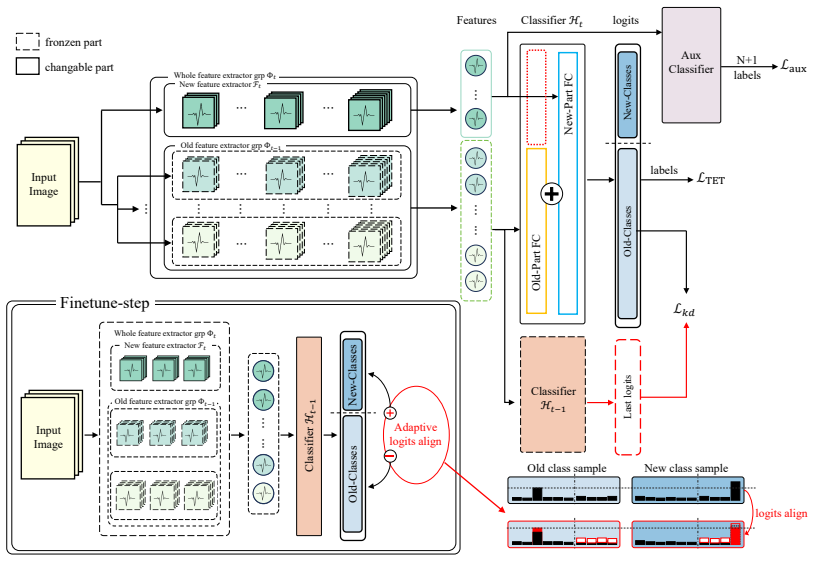
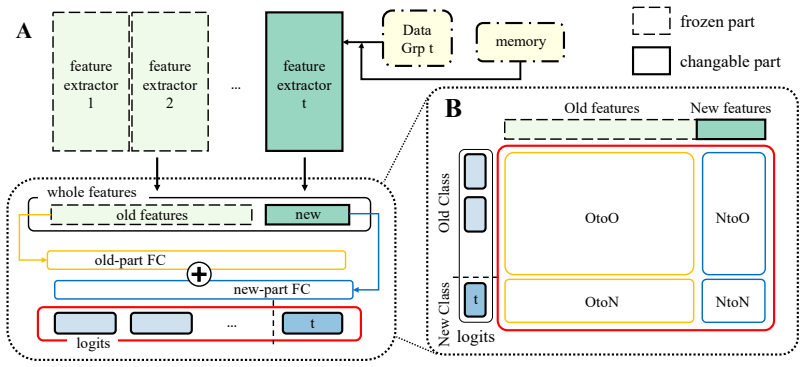
The load-bearing objects are the adaptive logit-alignment correction and the Old-to-New (OtoN) weight suppression, operating inside the DER-style dynamic expansion. The correction is a scalar $\gamma$ added only to new-class logits via $O = \mathcal{H}_s(\Phi_s(x)) + \gamma \cdot \mathrm{mask}_s$ during the classifier fine-tuning stage; $\gamma$ is updated from the measured difference $\Delta_e$ between average new-class and old-class logits, with two hyper-parameters that decide when the correction has taken effect. OtoN suppression zeros the classifier weights connecting frozen old features to new classes while the new extractor is trained, then releases them during fine-tuning. Together they rebalance the gradient and the final predictions between old and new tasks without adding new network structure or a new loss term.
What would settle it
Re-run each ANN baseline that the paper cites, such as DER, Dytox, and TCIL, on the same CIFAR100-B0 splits, memory budgets, and training schedules used for ALADE-SNN without changing the baseline methods; if their average incremental accuracy stays above 75.42% under matched conditions, the claimed parity with DNN-based methods would be contradicted, and if it falls below, the claim would be supported.
Extended reading notes
Core claim
The central claim is that catastrophic forgetting in class-incremental learning is substantially a logit-imbalance problem, and that a spiking network built on dynamic expansion plus two targeted corrections can solve it. On each new task, ALADE-SNN freezes the previous set of feature extractors, appends a new Spiking ResNet-19 extractor, and trains it with TET classification loss, an auxiliary task-prediction loss, and a knowledge-distillation loss. During this representation stage, the weights that map frozen old features to new classes are zeroed to stop old representations from misleading the new extractor; in the subsequent classifier fine-tuning stage those weights are released and an adaptive scalar $\gamma$ is added to the new-class logits so that the average ground-truth logits of old and new tasks converge. The paper reports this yields 75.42±0.74% average incremental accuracy on CIFAR100-B0 with 10 incremental steps, 78.67% with 5 steps, and 72.73% with 20 steps, surpassing the compared SNN continual-learning baseline and sitting close to the ANN methods it cites.
Load-bearing premise
The claim that ALADE-SNN matches DNN-based methods assumes that published accuracy numbers from different backbones and training setups can be compared directly with the SNN results; if the ANN baselines were re-run under identical conditions, the parity result could change.
Editorial extensions
If this is right
- ALADE-SNN raises average incremental accuracy on CIFAR100-B0-10steps to 75.42%, about 15 points above the published DSD-SNN result it compares against.
- On CIFAR100-B0-5steps the method scores 78.67%, about 1.8 points above the cited DER result, and on CIFAR100-B50-5steps it also surpasses the ANN baselines listed.
- Ablations attribute roughly one percentage point of the gain to adaptive logit alignment, with smaller contributions from OtoN suppression and knowledge distillation.
- The gap to attention-based ANN methods grows as the number of incremental steps increases, which the paper attributes to the limited time window of SNNs.
Reading between the lines
- The authors do not test this, but the adaptive logit-alignment correction should transfer to non-spiking dynamic-expansion methods, since it only modifies logits and adds no structure or loss.
- One testable extension the paper leaves open is whether OtoN suppression generalizes to a broader rule, such as blocking all cross-task classifier mappings during representation learning and releasing them during fine-tuning.
- Because the gap to ANN methods widens with more steps and the paper attributes it to the short time window, a concrete follow-up would be to vary the spike time window or backbone depth and measure whether the degradation flattens.
Editorial analysis
A structured set of objections, weighed in public.
Referee Report
Summary. The paper proposes ALADE-SNN, a class-incremental learning (CIL) method for spiking neural networks built on the DER dynamic-expansion framework. It introduces three components: adaptive logit alignment (a correction term gamma applied to new-class logits during classifier fine-tuning), OtoN suppression (zeroing weights from frozen old features to new classes while training the new feature extractor), and knowledge distillation. The main experiments are on CIFAR100-B0 and CIFAR100-B50 benchmarks, reporting an average incremental accuracy of 75.42±0.74% on CIFAR100-B0-10steps. The paper claims that ALADE-SNN matches DNN-based methods and surpasses state-of-the-art SNN continual learning algorithms.
Significance. If the results are properly supported, ALADE-SNN would be a meaningful advance in SNN continual learning: it proposes a simple, plug-in logit-alignment mechanism with an 'adaptive' update rule, validates on standard CIFAR100 protocols with three seeds and standard deviations, and is implemented in an open-source framework. The observation that imbalanced replay data biases logit distributions is a useful empirical finding. However, the strength of the central claims is currently limited by uncontrolled cross-paper comparisons and an internally inconsistent ablation result, so the significance of the work is not fully established in this version.
major comments (4)
- [Results / Implementation Details (Table 3)] The abstract's claim that ALADE-SNN 'surpasses state-of-the-art SNN-based continual learning algorithms' is not established by Table 3, which compares against a single SNN baseline, DSD-SNN, whose results are 'directly taken from their respective papers' (Implementation Details). No evidence is provided that DSD-SNN was evaluated under the same protocol: ALADE-SNN uses a fixed memory of 2000 exemplars with herding and a Spiking ResNet-19 with T=4, while DSD-SNN's memory budget, backbone, timestep, and rehearsal strategy are not reported in the table. The +14.95-point gap on CIFAR100-B0-10steps may therefore reflect protocol differences rather than algorithmic superiority. Moreover, other SNN CIL methods mentioned in the paper (SOR-SNN, SSA-SNN, ESL-SNN) are absent from the comparison, so the 'surpasses SOTA' claim is not supported by the evidence presented.
- [Results, Tables 3-4 and Implementation Details] The claim that ALADE-SNN 'matches the performance of DNN-based methods' rests on an uncontrolled cross-paper comparison. Table 3 and Table 4 compare ALADE-SNN (Spiking ResNet-19, T=4, herding memory) with ANN results from other papers (ResNet18/ViT, different training protocols), and the Implementation Details state that these numbers are taken verbatim. Differences in backbone, timestep, memory selection, training epochs, and hyperparameters can easily account for several accuracy points. To support the 'comparable to DNN' claim, the authors should run matched-setting ANN baselines (e.g., DER with ResNet18 under the same memory and data-order protocol) in their own framework, or at least explicitly restrict the claim to a qualitative comparison.
- [Results, Table 5 (Ablation experiment)] The ablation results do not support the statement that knowledge distillation 'brings a slight gain.' In Table 5, removing knowledge distillation from ALADE-SNN increases average incremental accuracy from 75.42%±0.74 to 75.51%±1.31 and final accuracy from 63.13%±0.40 to 63.60%±0.75; adding knowledge distillation to the DER-SNN baseline gives 74.47%±1.85 versus 74.22%±1.06, a difference well within one standard deviation. The text's claim of a gain is therefore inconsistent with the reported numbers, and the authors should either provide a statistical significance test or revise the claim. This is load-bearing because the paper lists knowledge distillation as one of its three components.
- [Dynamically Expandable SNNs with Adaptive Logits Alignment, Algorithm 1 and Eq. (1)] The adaptive update of the correction term gamma in Algorithm 1 appears to have a sign/stability issue that should be clarified. In Table 1, the authors observe that new-task ground-truth logits are higher than old-task logits in DER (e.g., 13.32 vs 10.45 at step 3). With Eq. (1) adding gamma only to new-class logits, the measured difference Delta_e = s_new/n_new - s_old/n_old is inflated by gamma. The update gamma_e <- gamma_{e-1} + Delta_e then increases gamma whenever new logits are higher, which can cause gamma to grow without bound unless the fine-tuning dramatically reduces the true new-class logits. The paper does not report gamma's initialization, a clipping mechanism, or observed gamma trajectories. The authors should demonstrate that the update converges (or is bounded) and provide empirical gamma values, or the central logit-alignment mechanism's reproducibility is in doubt.
minor comments (7)
- [Introduction] There is a typo in 'biogical comuting processes'; it should read 'biological computing processes'.
- [Table 1] The column header '3st avg/std acc' should be '3rd avg/std acc'.
- [Eq. (1) and Algorithm 1] The initial value of the correction term gamma is not specified; please state the initialization used in all experiments (e.g., gamma_0 = 0).
- [Algorithm 1] The variables 'Delta_st' and 'delta_Delta' are used before being explicitly defined; please clarify their roles or rename them to avoid confusion.
- [Results, energy estimation] The sentence containing '1.7625µJ vs 3.367pJ' is confusingly written and the unit comparison is unclear; please rewrite or remove it.
- [Table 5 caption] The caption should explicitly state that '-' denotes removing a component from ALADE-SNN and '+' denotes adding it to DER-SNN*.
- [OtoN Suppression] The acronym 'OtoN' is not defined at first use; please define it (e.g., 'old-to-new suppression').
Circularity Check
No significant circularity: ALADE-SNN's adaptive logit correction is an online training mechanism, not a fitted prediction, and the central results are empirically evaluated against external benchmarks.
full rationale
ALADE-SNN's central claim is an empirical performance result, not a derivation from a fitted quantity. The adaptive correction term gamma in Eq. (1) is not fit to test-set outcomes; Algorithm 1 sets it online from the logits difference between old and new classes on the balanced memory subset during classifier fine-tuning, and its effect is then evaluated on held-out test accuracy. The hyper-parameters alpha=8 and beta=4 are hand-set and control only the update schedule, and the ablation in Table 5 shows the components contribute at the 0.4-1.0% level, consistent with an incremental algorithmic improvement rather than a forced identity. The method builds on externally published components (DER, TET loss, herding exemplar selection), and citations to the authors' own earlier SNN continual-learning papers appear only as related work, not as load-bearing justification. No uniqueness theorem is imported, and no known result is renamed. The strongest concern, that the 'surpasses SOTA SNN' comparison rests on a single cross-paper baseline (DSD-SNN) with unverified protocol match, is a validity/control concern about empirical comparison rather than circularity of the derivation chain. The paper therefore exhibits no reduction of a claimed prediction to its own inputs.
Assumptions & free parameters
free parameters (3)
- Adaptive logit correction gamma =
updated per epoch via Algorithm 1 (no fixed value)
- alpha =
8
- beta =
4
assumptions (4)
- domain assumption Surrogate gradient training with LIF neurons approximates gradients well enough for supervised learning.
- ad hoc to paper Logit imbalance on the training set is the main correctable cause of forgetting under the DER framework.
- domain assumption The balanced exemplar subset selected by herding is representative enough to tune gamma and fine-tune the classifier.
- domain assumption Accuracy numbers from prior papers (DER, DSD-SNN, etc.) are directly comparable to results from this paper's SNN ResNet-19.
Cite this review
Pith. "Pith review of ALADE-SNN: Adaptive Logit Alignment in Dynamically Expandable Spiking Neural Networks for Class Incremental Learning." pith.science (2026). https://pith.science/paper/M5T5GOKH
@misc{pith2026241212696,
  author       = {Pith},
  title        = {Pith review of: ALADE-SNN: Adaptive Logit Alignment in Dynamically Expandable Spiking Neural Networks for Class Incremental Learning},
  year         = {2026},
  howpublished = {\url{https://pith.science/paper/M5T5GOKH}},
  note         = {Machine review of arXiv:2412.12696}
}
read the original abstract
Inspired by the human brain's ability to adapt to new tasks without erasing prior knowledge, we develop spiking neural networks (SNNs) with dynamic structures for Class Incremental Learning (CIL). Our comparative experiments reveal that limited datasets introduce biases in logits distributions among tasks. Fixed features from frozen past-task extractors can cause overfitting and hinder the learning of new tasks. To address these challenges, we propose the ALADE-SNN framework, which includes adaptive logit alignment for balanced feature representation and OtoN suppression to manage weights mapping frozen old features to new classes during training, releasing them during fine-tuning. This approach dynamically adjusts the network architecture based on analytical observations, improving feature extraction and balancing performance between new and old tasks. Experiment results show that ALADE-SNN achieves an average incremental accuracy of 75.42 on the CIFAR100-B0 benchmark over 10 incremental steps. ALADE-SNN not only matches the performance of DNN-based methods but also surpasses state-of-the-art SNN-based continual learning algorithms. This advancement enhances continual learning in neuromorphic computing, offering a brain-inspired, energy-efficient solution for real-time data processing.
Figures

Reference graph
Works this paper leans on
-
[1]
, " * write output.state after.block = add.period write newline
ENTRY address archivePrefix author booktitle chapter edition editor eid eprint howpublished institution isbn journal key month note number organization pages publisher school series title type volume year label extra.label sort.label short.list INTEGERS output.state before.all mid.sentence after.sentence after.block FUNCTION init.state.consts #0 'before.a...
-
[2]
write newline
" write newline "" before.all 'output.state := FUNCTION n.dashify 't := "" t empty not t #1 #1 substring "-" = t #1 #2 substring "--" = not "--" * t #2 global.max substring 't := t #1 #1 substring "-" = "-" * t #2 global.max substring 't := while if t #1 #1 substring * t #2 global.max substring 't := if while FUNCTION word.in bbl.in capitalize " " * FUNCT...
-
[3]
Abbott, L. F. 1999. Lapicque’s introduction of the integrate-and-fire model neuron (1907). Brain research bulletin, 50(5-6): 303--304
work page 1907
-
[4]
Bassett, D. S.; Wymbs, N. F.; Porter, M. A.; Mucha, P. J.; Carlson, J. M.; and Grafton, S. T. 2011. Dynamic reconfiguration of human brain networks during learning. Proceedings of the National Academy of Sciences, 108(18): 7641--7646
work page 2011
-
[5]
M.; Mar \' n-Jim \'e nez, M
Castro, F. M.; Mar \' n-Jim \'e nez, M. J.; Guil, N.; Schmid, C.; and Alahari, K. 2018. End-to-end incremental learning. In Proceedings of the European conference on computer vision (ECCV), 233--248
2018
-
[6]
Chen, Y.; Yu, Z.; Fang, W.; Ma, Z.; Huang, T.; and Tian, Y. 2022. State transition of dendritic spines improves learning of sparse spiking neural networks. In International Conference on Machine Learning, 3701--3715. PMLR
work page 2022
-
[7]
Deng, S.; Li, Y.; Zhang, S.; and Gu, S. 2021. Temporal Efficient Training of Spiking Neural Network via Gradient Re-weighting. In International Conference on Learning Representations
work page 2021
-
[8]
Deng, X.; and Zhang, Z. 2021. Comprehensive knowledge distillation with causal intervention. Advances in Neural Information Processing Systems, 34: 22158--22170
work page 2021
Show all 68 references
-
[9]
Douillard, A.; Cord, M.; Ollion, C.; Robert, T.; and Valle, E. 2020. Podnet: Pooled outputs distillation for small-tasks incremental learning. In Computer vision--ECCV 2020: 16th European conference, Glasgow, UK, 86--102. Springer
2020
-
[10]
Douillard, A.; Ram \'e , A.; Couairon, G.; and Cord, M. 2022. Dytox: Transformers for continual learning with dynamic token expansion. In Proceedings of the IEEE/CVF Conference on Computer Vision and Pattern Recognition, 9285--9295
2022
-
[11]
K.; Merolla, P
Esser, S. K.; Merolla, P. A.; Arthur, J. V.; Cassidy, A. S.; Appuswamy, R.; Andreopoulos, A.; Berg, D. J.; McKinstry, J. L.; Melano, T.; Barch, D. R.; et al. 2016. From the cover: Convolutional networks for fast, energy-efficient neuromorphic computing. Proceedings of the Nati...
2016
-
[12]
Fang, W.; Yu, Z.; Chen, Y.; Huang, T.; Masquelier, T.; and Tian, Y. 2021. Deep residual learning in spiking neural networks. Advances in Neural Information Processing Systems, 34: 21056--21069
2021
-
[13]
Fang, W. e. a. 2023. SpikingJelly: An open-source machine learning infrastructure platform for spike-based intelligence. Science Advances, 9(40): eadi1480
2023
-
[14]
A.; Pritzel, A.; and Wierstra, D
Fernando, C.; Banarse, D.; Blundell, C.; Zwols, Y.; Ha, D.; Rusu, A. A.; Pritzel, A.; and Wierstra, D. 2017. Pathnet: Evolution channels gradient descent in super neural networks. arXiv preprint arXiv:1701.08734
2017 arXiv
-
[15]
French, R. M. 1999. Catastrophic forgetting in connectionist networks. Trends in cognitive sciences, 3(4): 128--135
1999
-
[16]
Golkar, S.; Kagan, M.; and Cho, K. 2019. Continual learning via neural pruning
2019
-
[17]
Han, B.; Zhao, F.; Pan, W.; Zhao, Z.; Li, X.; Kong, Q.; and Zeng, Y. 2023 a . Adaptive Reorganization of Neural Pathways for Continual Learning with Spiking Neural Networks. arXiv e-prints, arXiv--2309
2023
-
[18]
Han, B.; Zhao, F.; Zeng, Y.; and et al. 2023 b . Enhancing efficient continual learning with dynamic structure development of spiking neural networks. In Proceedings of the Thirty-Second International Joint Conference on Artificial Intelligence, 2993--3001
2023
-
[19]
L.; Kafle, K.; Shrestha, R.; Acharya, M.; and Kanan, C
Hayes, T. L.; Kafle, K.; Shrestha, R.; Acharya, M.; and Kanan, C. 2020. Remind your neural network to prevent catastrophic forgetting. In European Conference on Computer Vision, 466--483. Springer
2020
-
[20]
Hinton, G.; Vinyals, O.; and Dean, J. 2015. Distilling the knowledge in a neural network. arXiv preprint arXiv:1503.02531
2015 arXiv
-
[21]
C.; Wang, Z.; and Lin, D
Hou, S.; Pan, X.; Loy, C. C.; Wang, Z.; and Lin, D. 2019. Learning a unified classifier incrementally via rebalancing. In Proceedings of the IEEE/CVF conference on computer vision and pattern recognition, 831--839
2019
-
[22]
Hu, Z.; Li, Y.; Lyu, J.; Gao, D.; and Vasconcelos, N. 2023. Dense network expansion for class incremental learning. In Proceedings of the IEEE/CVF Conference on Computer Vision and Pattern Recognition, 11858--11867
2023
-
[23]
Huang, B. e. a. 2023. Resolving task confusion in dynamic expansion architectures for class incremental learning. In Proceedings of the AAAI Conference on Artificial Intelligence, volume 37, 908--916
2023
-
[24]
Imam, N.; and Cleland, T. A. 2020. Rapid online learning and robust recall in a neuromorphic olfactory circuit. Nature Machine Intelligence, 2(3): 181--191
2020
-
[25]
Iscen, A.; Zhang, J.; Lazebnik, S.; and Schmid, C. 2020. Memory-efficient incremental learning through feature adaptation. In Computer Vision--ECCV 2020: 16th European Conference, Glasgow, UK, August 23--28, 2020, Proceedings, Part XVI 16, 699--715. Springer
2020
-
[26]
Kang, H.; Mina, R. J. L.; Madjid, S. R. H.; Yoon, J.; Hasegawa-Johnson, M.; Hwang, S. J.; and Yoo, C. D. 2022. Forget-free continual learning with winning subnetworks. In International Conference on Machine Learning, 10734--10750. PMLR
2022
-
[27]
Kang, M.; Park, J.; and Han, B. 2022. Class-incremental learning by knowledge distillation with adaptive feature consolidation. In Proceedings of the IEEE/CVF conference on computer vision and pattern recognition, 16071--16080
2022
-
[28]
Kim, D.; and Han, B. 2023. On the stability-plasticity dilemma of class-incremental learning. In Proceedings of the IEEE/CVF Conference on Computer Vision and Pattern Recognition, 20196--20204
2023
-
[29]
A.; Milan, K.; Quan, J.; Ramalho, T.; Grabska-Barwinska, A.; et al
Kirkpatrick, J.; Pascanu, R.; Rabinowitz, N.; Veness, J.; Desjardins, G.; Rusu, A. A.; Milan, K.; Quan, J.; Ramalho, T.; Grabska-Barwinska, A.; et al. 2017. Overcoming catastrophic forgetting in neural networks. Proceedings of the national academy of sciences, 114(13): 3521--3526
2017
-
[30]
Krizhevsky, A.; Hinton, G.; et al. 2009. Learning multiple layers of features from tiny images
2009
-
[31]
P.; Chakravarthi Raja, S.; Cheney, N.; Clune, J.; et al
Kudithipudi, D.; Aguilar-Simon, M.; Babb, J.; Bazhenov, M.; Blackiston, D.; Bongard, J.; Brna, A. P.; Chakravarthi Raja, S.; Cheney, N.; Clune, J.; et al. 2022. Biological underpinnings for lifelong learning machines. Nature Machine Intelligence, 4(3): 196--210
2022
-
[32]
Lesort, T.; Caselles-Dupr \'e , H.; Garcia-Ortiz, M.; Stoian, A.; and Filliat, D. 2019. Generative models from the perspective of continual learning. In 2019 International Joint Conference on Neural Networks (IJCNN), 1--8. IEEE
2019
-
[33]
Li, Z.; Zhong, C.; Liu, S.; Wang, R.; and Zheng, W.-S. 2021. Preserving earlier knowledge in continual learning with the help of all previous feature extractors. arXiv preprint arXiv:2104.13614
2021 arXiv
-
[34]
Luo, Z.; Liu, Y.; Schiele, B.; and Sun, Q. 2023. Class-incremental exemplar compression for class-incremental learning. In Proceedings of the IEEE/CVF Conference on Computer Vision and Pattern Recognition, 11371--11380
2023
-
[35]
Maass, W. 1997. Networks of spiking neurons: the third generation of neural network models. Neural networks, 10(9): 1659--1671
1997
-
[36]
Pei, J.; Deng, L.; Song, S.; Zhao, M.; Zhang, Y.; Wu, S.; Wang, G.; Zou, Z.; Wu, Z.; He, W.; et al. 2019. Towards artificial general intelligence with hybrid Tianjic chip architecture. Nature, 572(7767): 106--111
2019
-
[37]
Petit, G.; Popescu, A.; Schindler, H.; Picard, D.; and Delezoide, B. 2023. Fetril: Feature translation for exemplar-free class-incremental learning. In Proceedings of the IEEE/CVF Winter Conference on Applications of Computer Vision, 3911--3920
2023
-
[38]
Qiao, N.; Mostafa, H.; Corradi, F.; Osswald, M.; Stefanini, F.; Sumislawska, D.; and Indiveri, G. 2015. A reconfigurable on-line learning spiking neuromorphic processor comprising 256 neurons and 128K synapses. Frontiers in neuroscience, 9: 141
2015
-
[39]
H.; Khan, F
Rajasegaran, J.; Hayat, M.; Khan, S. H.; Khan, F. S.; and Shao, L. 2019. Random path selection for continual learning. Advances in neural information processing systems, 32
2019
-
[40]
Rathi, N.; and Roy, K. 2020. Diet-snn: Direct input encoding with leakage and threshold optimization in deep spiking neural networks. arXiv preprint arXiv:2008.03658
2020 arXiv
-
[41]
Rebuffi, S.-A.; Kolesnikov, A.; Sperl, G.; and Lampert, C. H. 2017. icarl: Incremental classifier and representation learning. In Proceedings of the IEEE conference on Computer Vision and Pattern Recognition, 2001--2010
2017
-
[42]
Shen, J.; Ni, W.; Xu, Q.; and Tang, H. 2024. Efficient spiking neural networks with sparse selective activation for continual learning. In Proceedings of the AAAI Conference on Artificial Intelligence, volume 38, 611--619
2024
-
[43]
K.; and et al
Shen, J.; Xu, Q.; Liu, J. K.; and et al. 2023. Esl-snns: An evolutionary structure learning strategy for spiking neural networks. In Proceedings of the AAAI Conference on Artificial Intelligence, volume 37, 86--93
2023
-
[44]
K.; and Wang, Y
Shen, J.; Zhao, Y.; Liu, J. K.; and Wang, Y. 2021. HybridSNN: Combining bio-machine strengths by boosting adaptive spiking neural networks. IEEE Transactions on Neural Networks and Learning Systems, 34(9): 5841--5855
2021
-
[45]
Shi, X.; Ding, J.; Hao, Z.; and Yu, Z. 2024. Towards energy efficient spiking neural networks: An unstructured pruning framework. In The Twelfth International Conference on Learning Representations
2024
-
[46]
Shi, X.; Hao, Z.; and Yu, Z. 2024. SpikingResformer: Bridging ResNet and Vision Transformer in Spiking Neural Networks. In Proceedings of the IEEE/CVF Conference on Computer Vision and Pattern Recognition, 5610--5619
2024
-
[47]
K.; Kim, J.; and Kim, J
Shin, H.; Lee, J. K.; Kim, J.; and Kim, J. 2017. Continual learning with deep generative replay. Advances in neural information processing systems, 30
2017
-
[48]
Subbulakshmi R, S.; Sebastian, A.; Oberoi, A.; Das, S.; and Das, S. 2021. A biomimetic neural encoder for spiking neural network. Nature communications, 12(1): 2143
2021
-
[49]
M.; Siegelmann, H
Van de Ven, G. M.; Siegelmann, H. T.; and Tolias, A. S. 2020. Brain-inspired replay for continual learning with artificial neural networks. Nature communications, 11(1): 4069
2020
-
[50]
M.; and Tolias, A
Van de Ven, G. M.; and Tolias, A. S. 2019. Three scenarios for continual learning. arXiv preprint arXiv:1904.07734
2019 arXiv
-
[51]
Wang, F.-Y.; Zhou, D.-W.; Ye, H.-J.; and Zhan, D.-C. 2022. Foster: Feature boosting and compression for class-incremental learning. In European conference on computer vision, 398--414. Springer
2022
-
[52]
Wang, Y.; Shi, K.; Lu, C.; Liu, Y.; Zhang, M.; and Qu, H. 2023. Spatial-Temporal Self-Attention for Asynchronous Spiking Neural Networks. In IJCAI, 3085--3093
2023
-
[53]
Welling, M. 2009. Herding dynamical weights to learn. In Proceedings of the 26th annual international conference on machine learning, 1121--1128
2009
-
[54]
Wu, J.; Chua, Y.; Zhang, M.; Li, G.; Li, H.; and Tan, K. C. 2021. A tandem learning rule for effective training and rapid inference of deep spiking neural networks. IEEE Transactions on Neural Networks and Learning Systems, 34(1): 446--460
2021
-
[55]
Wu, Y.; Chen, Y.; Wang, L.; Ye, Y.; Liu, Z.; Guo, Y.; and Fu, Y. 2019. Large scale incremental learning. In Proceedings of the IEEE/CVF conference on computer vision and pattern recognition, 374--382
2019
-
[56]
Wu, Y.; Deng, L.; Li, G.; and Shi, L. 2018. Spatio-temporal backpropagation for training high-performance spiking neural networks. Frontiers in neuroscience, 12: 323875
2018
-
[57]
Xu, Q.; Gao, Y.; Shen, J.; and et al. 2024 a . Enhancing adaptive history reserving by spiking convolutional block attention module in recurrent neural networks. Advances in Neural Information Processing Systems, 36
2024
-
[58]
Xu, Q.; Li, Y.; Fang, X.; Shen, J.; Zhang, Q.; and Pan, G. 2024 b . Reversing Structural Pattern Learning with Biologically Inspired Knowledge Distillation for Spiking Neural Networks. In Proceedings of the 32nd ACM International Conference on Multimedia, 3431--3439
2024
-
[59]
K.; Tang, H.; and Pan, G
Xu, Q.; Li, Y.; Shen, J.; Liu, J. K.; Tang, H.; and Pan, G. 2023. Constructing deep spiking neural networks from artificial neural networks with knowledge distillation. In Proceedings of the IEEE/CVF Conference on Computer Vision and Pattern Recognition, 7886--7895
2023
-
[60]
Yan, S.; Xie, J.; and He, X. 2021. DER: Dynamically Expandable Representation for Class Incremental Learning. In 2021 IEEE/CVF Conference on Computer Vision and Pattern Recognition (CVPR), 3013--3022. IEEE
2021
-
[61]
Yang, G.; Pan, F.; and Gan, W.-B. 2009. Stably maintained dendritic spines are associated with lifelong memories. Nature, 462(7275): 920--924
2009
-
[62]
Yang, S.; and Cai, Z. 2023. Cross domain lifelong learning based on task similarity. IEEE transactions on pattern analysis and machine intelligence
2023
-
[63]
Yang, Z.; Guo, S.; Fang, Y.; Yu, Z.; and Liu, J. K. 2024. Spiking Variational Policy Gradient for Brain Inspired Reinforcement Learning. IEEE Transactions on Pattern Analysis and Machine Intelligence
2024
-
[64]
Yoon, J.; Yang, E.; Lee, J.; and Hwang, S. J. 2017. Lifelong learning with dynamically expandable networks. arXiv preprint arXiv:1708.01547
2017 arXiv
-
[65]
Zenke, F.; Poole, B.; and Ganguli, S. 2017. Continual learning through synaptic intelligence. In International conference on machine learning, 3987--3995. PMLR
2017
-
[66]
Zhang, M.; Wang, J.; Wu, J.; Belatreche, A.; Amornpaisannon, B.; Zhang, Z.; Miriyala, V. P. K.; Qu, H.; Chua, Y.; Carlson, T. E.; et al. 2021. Rectified linear postsynaptic potential function for backpropagation in deep spiking neural networks. IEEE transactions on neural netw...
2021
-
[67]
Zhao, B.; Xiao, X.; Gan, G.; Zhang, B.; and Xia, S.-T. 2020. Maintaining discrimination and fairness in class incremental learning. In Proceedings of the IEEE/CVF conference on computer vision and pattern recognition, 13208--13217
2020
-
[68]
Zhu, K.; Zhai, W.; Cao, Y.; Luo, J.; and Zha, Z.-J. 2022. Self-sustaining representation expansion for non-exemplar class-incremental learning. In Proceedings of the IEEE/CVF Conference on Computer Vision and Pattern Recognition, 9296--9305
2022
Reviewed August 11, 2026 · model on record in the stance chip above.
Discussion (0). Continue with ORCID to comment.