REVIEW 3 major objections 5 minor 4 cited by
A Galaxy with an Extremely Blue UV Slope $\beta=-3$ at $z=9.25$ Identified by JWST Spectroscopy: Evidence for a Weak Nebular Continuum and Efficient Ionizing Photon Escape?
T0 review · 3 major / 5 minor · reviewed 2026-08-12 · deepseek-v4-flash
Pith's one-line read The paper identifies a galaxy at z=9.25, EBG-1, with a rest-frame UV slope of -2.99 ± 0.15, below the zero-escape model floor, and argues that reaching such a blue continuum requires an ionizing-photon escape fraction of at least about…
desk verdict A credible spectroscopic beta measurement for a z=9.25 galaxy, but the high escape-fraction conclusion rests on a model grid that excludes the galaxy's own best-fit metallicity. read the letter →
The pith
A machine-rendered reading of the paper's core claim, the machinery that carries it, and where it could break.
The reading
What carries the argument
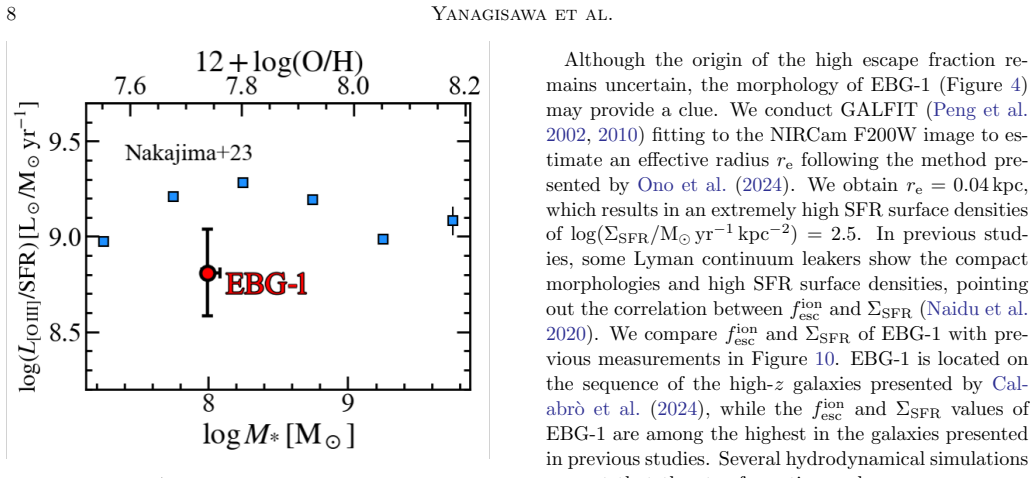
The main diagnostic is the ultraviolet continuum slope β, defined by f(λ) ∝ λ^β, measured over rest-frame 1268–2580 Å windows from prism spectra and fit with a Markov-chain Monte Carlo method. The argument hinges on a photoionization-model grid that computes β for zero and nonzero ionizing-photon escape fractions across different incident stellar spectra, establishing β=-2.6 as the floor for f_esc=0; the observed β ≈ -3 then forces f_esc^ion ≳ 0.5. A second, independent probe is the ratio of [O III] λ5007 luminosity to star-formation rate, whose value about 0.5 dex below the average of a comparison sample implies f_esc^ion ∼ 0.7 if the comparison galaxies are not themselves leakers.
What would settle it
Deep spectroscopy that detects Hβ with rest-frame equivalent width above the range predicted for f_esc^ion ≳ 0.5 would contradict the weak-nebular picture, as would a direct Lyman-continuum escape-fraction measurement below roughly 0.3. Equivalently, a stellar-population synthesis model that reproduces both β ≈ -3 and the detected [O III] lines with f_esc=0 at the very low metallicity indicated by SED fitting would remove the need for photon escape.
Extended reading notes
Core claim
The core claim is that EBG-1's rest-frame UV slope is genuinely β=-2.99±0.15, robust across five fitting schemes and two independent data reductions, and that such a blue slope requires the escape of ionizing photons rather than simply extreme stellar populations. In the paper's modeling, even very young, very metal-poor, or top-heavy stellar populations produce a nebular continuum from the gas they ionize, reddening the slope to β ≥ -2.6 when no photons escape; the only way to reach β ≈ -3 is to suppress that nebular continuum by letting more than half of the ionizing photons leave the galaxy. The galaxy also shows [O III] emission lines that are detected but about three times fainter than expected for a galaxy of its stellar mass and star-formation rate, which independently points to f_esc^ion ∼ 0.7, and it is compact with a high star-formation surface density, a property shared by low-redshift Lyman-continuum leakers. The authors stop short of a definitive measurement because Hβ is not detected and the spectrum is shallow, so they frame EBG-1 as evidence for, not proof of, efficient escape.
Load-bearing premise
The argument depends on the model-grid floor: with no photon escape, no stellar population considered can make the UV slope as blue as -3 once the nebular continuum is added; if an extremely metal-poor stellar population can do that, the high escape fraction is not needed.
Editorial extensions
If this is right
- The blue slope of EBG-1 is not an artifact of reduction or fitting: five masking schemes and two independent reductions all give β below -2.6 at roughly the 2σ level or more.
- If the escape-fraction interpretation holds, EBG-1 is among the most efficient ionizing-photon leakers known at z>8 and a concrete contributor to reionization.
- The detected but weak [O III] lines independently favor a density-bounded nebula with holes over an extremely metal-poor stellar population, since line emission is still present.
- Current data cannot break the degeneracy between escape fraction and ionizing-spectrum shape because Hβ is undetected; deeper spectroscopy is needed to confirm f_esc^ion ≥ 0.5.
Reading between the lines
- Editorial inference: the same β<-2.6 screening could be pushed into the noisier part of the sample; several galaxies have best-fit slopes this blue but uncertainties above 0.5, so deeper spectra might turn EBG-1 into a population rather than an outlier.
- Editorial inference: the slit may be sampling a gas-poor region near the galaxy's northwest tail, so the measured β could be bluer than the galaxy's integrated light; slit-position spectroscopy across the tail would test this.
- Editorial inference: a testable prediction of the weak-nebular-continuum picture is a very small or absent Balmer jump; detecting a strong Balmer jump in deeper data would point to a metal-poor stellar origin instead of high escape.
Signed reviews
Editorial analysis
A structured set of objections, weighed in public.
Referee Report
Summary. The paper searches 863 galaxies at z=4-14 from JWST/NIRSpec PRISM spectra in the DAWN JWST Archive, fits UV continuum slopes beta, and identifies EBG-1 at z=9.25 with beta = -2.99 +/- 0.15. This value is robust to fitting windows, masking, and an independent reduction, and is consistent with NIRCam photometry. The authors compare beta with Cloudy models and argue that beta < -2.6 cannot be achieved with f_esc = 0, concluding that a high ionizing photon escape fraction f_esc^ion >~ 0.5 is required. They also measure weak [O III] emission, inferring f_esc ~ 0.7 from the L[OIII]/SFR ratio relative to the Nakajima et al. (2023) sample.
Significance. If the escape-fraction interpretation holds, EBG-1 would be a direct spectroscopic example of efficient ionizing photon escape at z=9.25, with implications for reionization. The measurement itself is valuable: the authors demonstrate robustness of an extremely blue beta through multiple fitting methods, an independent reduction, and consistency with photometry. These checks are a strength. The theoretical inference, however, hinges on the coverage of the Cloudy grid, and the current grid does not sample the low stellar metallicities allowed by the SED fit.
major comments (3)
- [Section 2.1 / Figure 1] The f_esc = 0 lower limit beta = -2.6 is derived from Cloudy models with fixed stellar metallicity log Z_star/Zsun = -2 (Kroupa IMF) or Z_star = 0 (top-heavy) and nebular metallicity log Z_neb/Zsun = -2. The Prospector SED fit in Section 3.2 (Table 1) returns log Z/Zsun = -3.94, roughly two orders of magnitude lower than the grid's stellar metallicity. Because the grid does not cover the stellar metallicity range allowed by the data, the statement in the Abstract and Section 4 that the observed beta cannot be reproduced by stellar models with f_esc = 0 is not established over the full allowed parameter space; in fact, the paper itself cites Bouwens et al. (2010) models reaching beta ~ -3 with f_esc = 0 for extremely metal-poor populations.
- [Sections 3.3 and 4] The only quantitative discriminator against the low-metallicity, f_esc = 0 scenario is the [O III] lambda5007 detection at 1.46 +/- 0.32 x 10^-18 erg s^-1 cm^-2. However, [O III] luminosity scales strongly with oxygen abundance, and the paper does not present the Cloudy-predicted [O III] strength for the low-metallicity f_esc = 0 case. A moderate-significance detection therefore does not rule out the degenerate solution. Similarly, the H beta upper limit (log EW(H beta) < 2.8, i.e., EW < 630 A) provides no leverage because the expected EW for a low-metallicity f_esc = 0 model is not computed. A self-consistent comparison of beta, EW(H beta), and L[OIII] over the Prospector posterior would be needed to break this degeneracy.
- [Section 3.3 / Figure 8] The f_esc ~ 0.7 estimate based on L[OIII]/SFR assumes the Nakajima et al. (2023) comparison sample has f_esc = 0; if those galaxies have nonzero escape fractions, the inferred f_esc for EBG-1 would be larger, and if EBG-1's metallicity is not on the assumed mass-metallicity relation, the estimate changes. The value should be presented as a model-dependent secondary constraint rather than as an independent measurement.
minor comments (5)
- [Section 2.3, Eq. (2)] The likelihood includes a log(sigma^2) term that is constant for fixed uncertainties; this is harmless but unusual, and the fitting description would be clearer if the authors noted that this term drops out of the parameter estimation.
- [Section 3.2, final paragraph] The sentence 'Because f_esc^ion = 0 is assumed in our SED fitting, the weak emission line feature of EBG-1 indicates a low metallicity, which compensates for the effect of nonzero f_esc^ion' is confusing; the SED fit does not use emission lines, and the weak lines are used later to infer f_esc. Please clarify the intended argument.
- [Figures 4 and 6] The two-dimensional spectra and extraction apertures are not labeled with the spatial and spectral directions; adding axis labels and marking the extraction window would improve reproducibility.
- [Section 4, GALFIT analysis] Report the uncertainty on the effective radius (r_e = 0.04 kpc) and state whether the source is resolved; the extremely high Sigma_SFR depends sensitively on this value.
- [Section 2.3] The phrase 'we fit a spectra' should be 'we fit a spectrum' or 'we fit spectra'; a careful grammar pass throughout the manuscript would improve readability.
Circularity Check
No significant circularity: the beta measurement is an external observable and the f_esc inference is a forward Cloudy model comparison; the only overlapping-author baseline (Nakajima et al. 2023) is a secondary, conditional empirical comparison.
full rationale
The central derivation is a forward-model comparison, not a fit of the target quantity. The UV slope beta = -2.99 +/- 0.15 is measured directly from the DJA and independently re-reduced NIRSpec spectra (Sections 2.3 and 3.1) and cross-checked against photometry (Cullen et al. 2024). The f_esc >= 0.5 inference is obtained by comparing this observed beta with a Cloudy grid (Sections 2.1 and 3.3, Figure 9) computed for f_esc = 0 and f_esc = 1; no parameter of that grid is fitted to EBG-1, and the beta = -2.6 floor is a model output, not an input criterion defined by the target. The paper explicitly acknowledges the low-metallicity/f_esc = 0 degeneracy and cites an external model (Bouwens et al. 2010) that reaches beta ~ -3, arguing against it with the [O III] detection; that is a scientific argument, not a circular reduction. The secondary f_esc ~ 0.7 estimate compares L_[O III]/SFR with the Nakajima et al. (2023) sample; although several authors overlap with the present paper, that sample is an empirical compilation of 126 external galaxies and the comparison is explicitly conditional, supporting rather than defining the main claim. Remaining concerns, such as the Cloudy grid being fixed at log Z/Z_sun = -2 while the Prospector fit returns log Z/Z_sun = -3.94, are model-coverage and scientific-validity issues that should be evaluated as correctness risk, not as evidence that the derivation reduces to its own inputs.
Assumptions & free parameters
free parameters (9)
- Nebular hydrogen density ne =
10^2 cm^-3
- Nebular metallicity log Z_neb/Zsun =
-2
- Ionizing photon rate Q(H) =
10^50 s^-1
- Cloudy inner radius =
10^14 cm
- Stellar mass M* =
10^7.98 Msun
- Star formation rate SFR =
3.0 Msun/yr (UV), 5.5 Msun/yr (Prospector)
- Stellar metallicity Z =
log Z/Zsun = -3.94
- Dust optical depth tau_dust(5500 A) =
0.01
- Ionization parameter log U =
-3.25
assumptions (6)
- domain assumption The power-law form f(lambda)=A lambda^beta adequately represents the UV continuum over 1268-2580 Angstrom.
- domain assumption Cloudy models with BPASS Kroupa, top-heavy Yggdrasil, and blackbody incident spectra bracket the possible stellar populations.
- domain assumption The f_esc parameter in Cloudy captures the relevant effect of ionizing photon escape on the nebular continuum.
- ad hoc to paper SED fitting with f_esc=0 is valid for deriving stellar parameters.
- domain assumption Lensing magnification mu=2.75 from McLeod et al. (2024) is correct.
- domain assumption The comparison galaxy sample of Nakajima et al. (2023) has f_esc=0.
Cite this review
Pith. "Pith review of A Galaxy with an Extremely Blue UV Slope $\beta=-3$ at $z=9.25$ Identified by JWST Spectroscopy: Evidence for a Weak Nebular Continuum and Efficient Ionizing Photon Escape?." pith.science (2026). https://pith.science/paper/MA3RCOXU
@misc{pith2026241119893,
  author       = {Pith},
  title        = {Pith review of: A Galaxy with an Extremely Blue UV Slope $\beta=-3$ at $z=9.25$ Identified by JWST Spectroscopy: Evidence for a Weak Nebular Continuum and Efficient Ionizing Photon Escape?},
  year         = {2026},
  howpublished = {\url{https://pith.science/paper/MA3RCOXU}},
  note         = {Machine review of arXiv:2411.19893}
}
abstract
We investigate UV continuum slopes $\beta$ of 863 galaxies at $z=4-14$ using archival JWST/NIRSpec PRISM spectra obtained from major JWST GTO, ERS, and GO programs, including JADES, CEERS, and UNCOVER. Among these galaxies, we identify a remarkable galaxy at $z=9.25$, dubbed EBG-1, with a significantly blue UV slope $\beta=-2.99\pm0.15$, unlike the rest of the galaxies that exhibit red continua or ambiguous blue continua hindered by large uncertainties. We confirm that the $\beta$ value negligibly changes by the data reduction and fitting wavelength ranges for UV emission/absorption line masking. The extreme blue slope, $\beta=-3.0$, rules out significant contributions from dust extinction or AGN activity. Comparing with stellar and nebular emission models, we find that such a blue UV slope cannot be reproduced solely by stellar models even with very young, metal-poor, or top-heavy contiguous star formation associated with strong nebular continua making the UV slopes red, but with a high ionizing photon escape fraction, $f_\mathrm{esc}^\mathrm{ion} \gtrsim 0.5$, for a weak nebular continuum. While the H$\beta$ emission line is not detected, likely due to the limited sensitivity of the spectrum, we find moderately weak [O III] $\lambda\lambda$4959,5007 emission lines for the given star-formation rate ($3\, \mathrm{M_\odot}$ yr$^{-1}$) and stellar mass ($10^{8.0} \, \mathrm{M_\odot}$) that are about three times weaker than the average emission lines, again suggestive of the high ionizing photon escape fraction, $f_\mathrm{esc}^\mathrm{ion} \sim 0.7$ or more. EBG-1 would provide crucial insights into stellar and nebular continuum emission in high-redshift galaxies, serving as an example of the ionizing photon escaping site at the epoch of reionization.
Figures


Figures from the paper (7 more)




Forward citations
Cited by 4 Pith papers
-
Redshift evolution of Lyman continuum escape fraction after JWST
Average Lyman continuum escape fraction rises from 0.007 at z=0 to 0.6 at z=20, driven by radiation-powered outflows in high-sSFR galaxies.
-
SAPPHIRES: Extremely Metal-Poor Galaxy Candidates with $12+{\rm log(O/H)}<7.0$ at $z\sim5-7$ from Deep JWST/NIRCam Grism Observations
Seven candidate galaxies at z~5-7 show [OIII]/Hbeta ratios implying metallicities below 2% solar, with two below 1% solar, potentially breaking the high-redshift metallicity floor.
-
Morphological Demographics of Galaxies at $z\sim 10-16$: Log-Normal Size Distribution and Exponential Profiles Consistent with the Disk Formation Scenario
Galaxies at z=10-16 have a log-normal size distribution with sigma 0.52, nearly uniform axis ratios, and exponential profiles, consistent with early disk formation.
-
Zapped then Napped? A rapidly quenched remnant leaker candidate with a steep spectroscopic $\beta_{UV}$ slope at z=8.5
JADES-GS8-RL-1 is a z=8.5, low-mass galaxy that appears to have formed stars in a short burst and then rapidly quenched, with a steep blue UV slope and a tentative [OII] detection consistent with a high escape fraction.
Reference graph
Works this paper leans on
-
[1]
, " * write output.state after.block = add.period write newline
ENTRY address archivePrefix author booktitle chapter doi edition editor eprint howpublished institution journal key month number organization pages publisher school series title misctitle type volume year version url label extra.label sort.label short.list INTEGERS output.state before.all mid.sentence after.sentence after.block FUNCTION init.state.consts ...
-
[2]
write newline
" write newline "" before.all 'output.state := FUNCTION format.url url empty "" new.block "" url * "" * if FUNCTION format.eprint eprint empty "" archivePrefix empty "" archivePrefix "arXiv" = new.block " " eprint * " " * new.block " " eprint * " " * if if if FUNCTION format.doi doi empty "" " " doi * " " * if FUNCTION format.pid doi empty eprint empty ur...
-
[3]
B@ ! B@ !
thebibliography [1] 20pt to REFERENCES 6pt =0pt -12pt 10pt plus 3pt =0pt =0pt =1pt plus 1pt =0pt =0pt -12pt =13pt plus 1pt =20pt =13pt plus 1pt \@M =10000 =-1.0em =0pt =0pt 0pt =0pt =1.0em @enumiv\@empty 10000 10000 `\.\@m \@noitemerr \@latex@warning Empty `thebibliography' environment \@ifnextchar \@reference \@latexerr Missing key on reference command E...
2021
-
[4]
Astropy Collaboration , Robitaille , T. P., Tollerud , E. J., et al. 2013, , 558, A33, 10.1051/0004-6361/201322068
-
[5]
Astropy Collaboration , Price-Whelan , A. M., Sip o cz , B. M., et al. 2018, , 156, 123, 10.3847/1538-3881/aabc4f
-
[6]
Astropy Collaboration , Price-Whelan , A. M., Lim , P. L., et al. 2022, , 935, 167, 10.3847/1538-4357/ac7c74
-
[7]
Bouwens , R. J., Illingworth , G. D., Oesch , P. A., et al. 2010, , 708, L69, 10.1088/2041-8205/708/2/L69
-
[8]
2012, , 754, 83, 10.1088/0004-637X/754/2/83
---. 2012, , 754, 83, 10.1088/0004-637X/754/2/83
Show all 59 references
-
[9]
2023, msaexp: NIRSpec analyis tools, 0.6.17, Zenodo, 10.5281/zenodo.8319596
Brammer, G. 2023, msaexp: NIRSpec analyis tools, 0.6.17, Zenodo, 10.5281/zenodo.8319596
2023 doi
-
[10]
2024, JWST Calibration Pipeline, 1.16.1, Zenodo, 10.5281/zenodo.14153298
Bushouse, H., Eisenhamer, J., Dencheva, N., et al. 2024, JWST Calibration Pipeline, 1.16.1, Zenodo, 10.5281/zenodo.14153298
2024 doi
-
[11]
2024, , 690, A290, 10.1051/0004-6361/202449768
Calabr \`o , A., Pentericci , L., Santini , P., et al. 2024, , 690, A290, 10.1051/0004-6361/202449768
2024 doi
-
[12]
C., et al
Calzetti , D., Armus , L., Bohlin , R. C., et al. 2000, , 533, 682, 10.1086/308692
2000 doi
-
[13]
L., & Storchi-Bergmann , T
Calzetti , D., Kinney , A. L., & Storchi-Bergmann , T. 1994, , 429, 582, 10.1086/174346
1994 doi
-
[14]
J., Katz , H., Witten , C., et al
Cameron , A. J., Katz , H., Witten , C., et al. 2024, , 534, 523, 10.1093/mnras/stae1547
2024 doi
-
[15]
2022, , 517, 5104, 10.1093/mnras/stac2874
Chisholm , J., Saldana-Lopez , A., Flury , S., et al. 2022, , 517, 5104, 10.1093/mnras/stac2874
2022 doi
-
[16]
2013, , 762, 32, 10.1088/0004-637X/762/1/32
Coe , D., Zitrin , A., Carrasco , M., et al. 2013, , 762, 32, 10.1088/0004-637X/762/1/32
2013 doi
-
[17]
J., McLeod , D
Cullen , F., McLure , R. J., McLeod , D. J., et al. 2023, , 520, 14, 10.1093/mnras/stad073
2023 doi
-
[18]
J., McLure , R
Cullen , F., McLeod , D. J., McLure , R. J., et al. 2024, , 531, 997, 10.1093/mnras/stae1211
2024 doi
- [19]
- [20]
-
[21]
J., Stanway , E
Eldridge , J. J., Stanway , E. R., Xiao , L., et al. 2017, , 34, e058, 10.1017/pasa.2017.51
2017 doi
-
[22]
J., Porter , R
Ferland , G. J., Porter , R. L., van Hoof , P. A. M., et al. 2013, , 49, 137. 1302.4485
2013 arXiv
-
[23]
L., Papovich , C., Salmon , B., et al
Finkelstein , S. L., Papovich , C., Salmon , B., et al. 2012, , 756, 164, 10.1088/0004-637X/756/2/164
2012 doi
-
[24]
R., Jaskot , A
Flury , S. R., Jaskot , A. E., Ferguson , H. C., et al. 2022, , 930, 126, 10.3847/1538-4357/ac61e4
2022 doi
-
[25]
2016, The Journal of Open Source Software, 1, 24, 10.21105/joss.00024
Foreman-Mackey , D. 2016, The Journal of Open Source Software, 1, 24, 10.21105/joss.00024
2016 doi
-
[26]
W., Lang , D., & Goodman , J
Foreman-Mackey , D., Hogg , D. W., Lang , D., & Goodman , J. 2013, , 125, 306, 10.1086/670067
2013 doi
-
[27]
J., Hewett , P
Francis , P. J., Hewett , P. C., Foltz , C. B., et al. 1991, , 373, 465, 10.1086/170066
1991 doi
-
[28]
M., van Hoof , P
Gunasekera , C. M., van Hoof , P. A. M., Chatzikos , M., & Ferland , G. J. 2023, Research Notes of the American Astronomical Society, 7, 246, 10.3847/2515-5172/ad0e75
2023 doi
-
[29]
R., Millman , K
Harris , C. R., Millman , K. J., van der Walt , S. J., et al. 2020, , 585, 357, 10.1038/s41586-020-2649-2
2020 doi
-
[30]
E., Watson , D., Brammer , G., et al
Heintz , K. E., Watson , D., Brammer , G., et al. 2024, Science, 384, 890, 10.1126/science.adj0343
2024 doi
-
[31]
Y.-Y., Coe , D., Abdurro'uf , et al
Hsiao , T. Y.-Y., Coe , D., Abdurro'uf , et al. 2023, , 949, L34, 10.3847/2041-8213/acc94b
2023 doi
-
[32]
Hunter , J. D. 2007, Computing in Science and Engineering, 9, 90, 10.1109/MCSE.2007.55
2007 doi
-
[34]
2021 b , , 254, 22, 10.3847/1538-4365/abef67
---. 2021 b , , 254, 22, 10.3847/1538-4365/abef67
2021 doi
-
[35]
2018, , 478, 4986, 10.1093/mnras/sty1225
Katz , H., Kimm , T., Haehnelt , M., et al. 2018, , 478, 4986, 10.1093/mnras/sty1225
2018 doi
- [36]
-
[37]
1998, , 36, 189, 10.1146/annurev.astro.36.1.189
Kennicutt , Robert C., J. 1998, , 36, 189, 10.1146/annurev.astro.36.1.189
1998 doi
-
[38]
2001, , 322, 231, 10.1046/j.1365-8711.2001.04022.x
Kroupa , P. 2001, , 322, 231, 10.1046/j.1365-8711.2001.04022.x
2001
-
[39]
2013, , 553, A106, 10.1051/0004-6361/201118370
Leitet , E., Bergvall , N., Hayes , M., Linn \'e , S., & Zackrisson , E. 2013, , 553, A106, 10.1051/0004-6361/201118370
2013 doi
-
[40]
2022, , 517, 2972, 10.1093/mnras/stac2893
Marques-Chaves , R., Schaerer , D., \'A lvarez-M \'a rquez , J., et al. 2022, , 517, 2972, 10.1093/mnras/stac2893
2022 doi
-
[41]
2024, , 691, A87, 10.1051/0004-6361/202451667
Marques-Chaves , R., Schaerer , D., Vanzella , E., et al. 2024, , 691, A87, 10.1051/0004-6361/202451667
2024 doi
-
[42]
2017, , 465, 3637, 10.1093/mnras/stw2973
Matthee , J., Sobral , D., Best , P., et al. 2017, , 465, 3637, 10.1093/mnras/stw2973
2017 doi
-
[43]
J., Donnan , C
McLeod , D. J., Donnan , C. T., McLure , R. J., et al. 2024, , 527, 5004, 10.1093/mnras/stad3471
2024 doi
-
[44]
M., Finkelstein , S
Morales , A. M., Finkelstein , S. L., Leung , G. C. K., et al. 2024, , 964, L24, 10.3847/2041-8213/ad2de4
2024 doi
-
[45]
B., Mirocha , J., Chisholm , J., Furlanetto , S
Mu \ n oz , J. B., Mirocha , J., Chisholm , J., Furlanetto , S. R., & Mason , C. 2024, , 535, L37, 10.1093/mnrasl/slae086
2024 doi
-
[46]
P., Tacchella , S., Mason , C
Naidu , R. P., Tacchella , S., Mason , C. A., et al. 2020, , 892, 109, 10.3847/1538-4357/ab7cc9
2020 doi
-
[47]
2023, , 269, 33, 10.3847/1538-4365/acd556
Nakajima , K., Ouchi , M., Isobe , Y., et al. 2023, , 269, 33, 10.3847/1538-4365/acd556
2023 doi
-
[48]
P., Finkelstein , S
Narayanan , D., Stark , D. P., Finkelstein , S. L., et al. 2025, , 982, 7, 10.3847/1538-4357/adb41c
2025 doi
-
[49]
2024, , 76, 219, 10.1093/pasj/psae004
Ono , Y., Harikane , Y., Ouchi , M., et al. 2024, , 76, 219, 10.1093/pasj/psae004
2024 doi
-
[50]
Y., Ho , L
Peng , C. Y., Ho , L. C., Impey , C. D., & Rix , H.-W. 2002, , 124, 266, 10.1086/340952
2002 doi
-
[51]
2010, , 139, 2097, 10.1088/0004-6256/139/6/2097
---. 2010, , 139, 2097, 10.1088/0004-6256/139/6/2097
2010 doi
- [52]
-
[53]
M., Wallin , J
Schombert , J. M., Wallin , J. F., & Struck-Marcell , C. 1990, , 99, 497, 10.1086/115346
1990 doi
-
[54]
R., & Eldridge , J
Stanway , E. R., & Eldridge , J. J. 2018, , 479, 75, 10.1093/mnras/sty1353
2018 doi
-
[55]
W., Stark , D
Topping , M. W., Stark , D. P., Endsley , R., et al. 2022, , 941, 153, 10.3847/1538-4357/aca522
2022 doi
- [56]
-
[57]
E., et al
Virtanen , P., Gommers , R., Oliphant , T. E., et al. 2020, Nature Methods, 17, 261, 10.1038/s41592-019-0686-2
2020 doi
-
[58]
2011, , 740, 13, 10.1088/0004-637X/740/1/13
Zackrisson , E., Rydberg , C.-E., Schaerer , D., \"O stlin , G., & Tuli , M. 2011, , 740, 13, 10.1088/0004-637X/740/1/13
2011 doi
-
[59]
2017, , 836, 78, 10.3847/1538-4357/836/1/78
Zackrisson , E., Binggeli , C., Finlator , K., et al. 2017, , 836, 78, 10.3847/1538-4357/836/1/78
2017 doi
-
[60]
2015, , 801, 44, 10.1088/0004-637X/801/1/44
Zitrin , A., Fabris , A., Merten , J., et al. 2015, , 801, 44, 10.1088/0004-637X/801/1/44
2015 doi
Reviewed August 12, 2026 · model on record in the stance chip above.
Discussion (0). Continue with ORCID to comment.