REVIEW 3 major objections 4 minor 1 cited by
Efficient Langevin sampling with position-dependent diffusion
T0 review · 3 major / 4 minor · reviewed 2026-08-10 · deepseek-v4-flash
Pith's one-line read This paper introduces PVD-2, a numerical integrator for Brownian dynamics with position-dependent diffusion that is second-order accurate for sampling the invariant measure while evaluating the force only once per timestep.
desk verdict A genuinely useful new integrator for variable-diffusion Brownian dynamics, with a mostly solid proof that leans on an algebraic extension the authors should be asked to spell out. read the letter →
The pith
A machine-rendered reading of the paper's core claim, the machinery that carries it, and where it could break.
The reading
What carries the argument
The load-bearing object is the exotic aromatic Butcher-series calculus: differential operators generated by $F$, $\Sigma$, and Gaussian increments are encoded as rooted forests with grafted vertices, some paired, and multiplied using the Grossman-Larson product. The method itself is a post-processed integrator, $$X_{n+1}=X_n+hF(\bar X_n)+\hat\Phi^\Sigma_h(X_n+\tfrac14 hF(X_{n-1})),\qquad \bar X_n=X_n+\tfrac12\sqrt h\,\$\sigma$\Sigma(X_n)R_n,$$ where $\Phi^\Sigma_h$ is any weak-order-two integrator for the pure-noise SDE. The proof converts the invariant-measure order condition into a tree identity, uses integration by parts on exotic forests to cancel unwanted terms, and extends the formalism to grafted vertices appearing inside the tree. This extension is what makes the analysis tractable; solving the order conditions directly would require handling 93 of them.
What would settle it
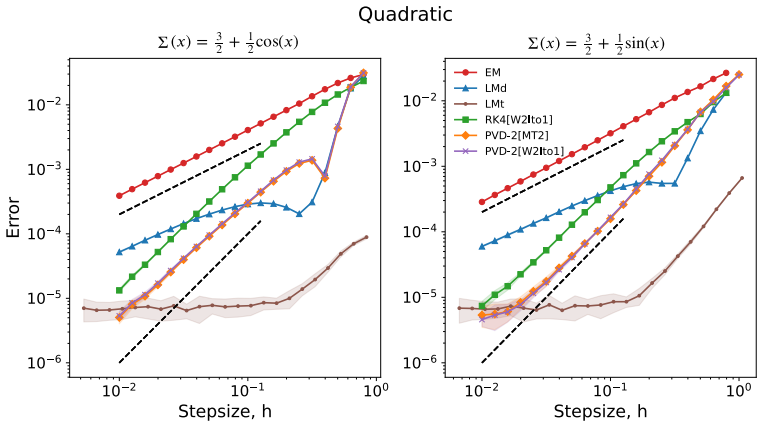
Implement PVD-2 on a one-dimensional target such as $V(x)=x^2/2$ with $\Sigma(x)=\tfrac32+\tfrac12\cos x$, measure the invariant-measure error for $h=10^{-1},10^{-1.25},10^{-1.5}$: a log-log slope of 1 rather than 2 would falsify the order claim. Independently, substituting a weak-order-one noise integrator for $\Phi^\Sigma_h$ should destroy the second-order sampling if the proof's mechanism is correct.
Extended reading notes
Core claim
The paper's central claim is Theorem 3.1: under smoothness and global Lipschitz assumptions, the method (14), called PVD-2, applied to the Brownian dynamics (11) has order two with respect to the invariant measure. Concretely, for smooth test functions $\varphi$, the long-time average of $\varphi(\bar X_n)$ and the expectation $\mathbb E[\varphi(\bar X_n)]$ are both accurate to $O(h^2)$, the latter up to an exponentially decaying term $C e^{-ct_n}$. The method needs only one evaluation per step of the modified force $F=-\Sigma^T\Sigma\nabla V + \tfrac{\sigma^2}{2}\operatorname{div}(\Sigma^T\Sigma)$, plus a weak-order-two integrator for the auxiliary pure-noise equation $dX = \sigma\Sigma(X)dW$. It reduces to the established one-force-evaluation second-order sampler of the constant-diffusion case and is consistent in arbitrary dimension for variable $\Sigma$.
Load-bearing premise
The proof rests on an extended symbolic bookkeeping system for Taylor terms with grafted vertices inside the tree; if that extension miscounts any higher-order term, the claimed order collapses.
Editorial extensions
If this is right
- Position-dependent diffusion tensors designed to accelerate mixing can now be paired with a cheap second-order sampler rather than a first-order one.
- PVD-2 reduces exactly to the constant-diffusion one-force-evaluation second-order sampler when the diffusion tensor is constant, so it is a strict generalization.
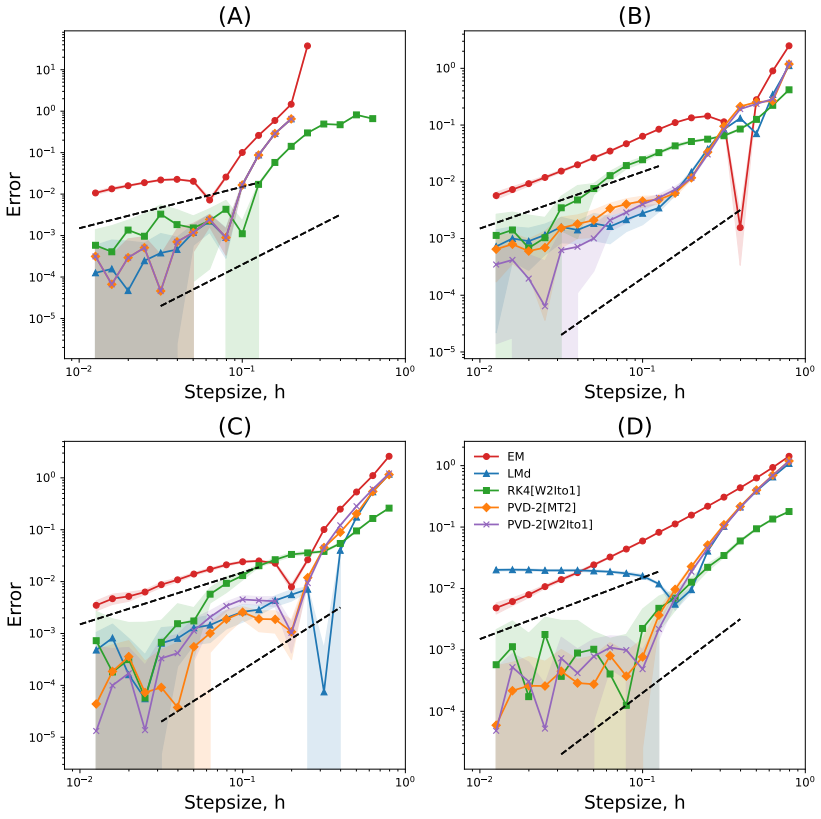
- Reported experiments show second-order convergence in dimensions 1, 2, 10, and 100, including a non-globally-Lipschitz quartic potential, with fewer force evaluations than a reference method using eight per step.
- The proposed stability modifications enlarge the mean-square stability region without changing the sampling order, which matters for stiff problems.
- The order-condition framework can in principle be reused to build higher-order one-force-evaluation samplers for variable diffusion.
Reading between the lines
- Because only the pure-noise integrator needs weak order two, other weak-order-two noise integrators could be swapped into PVD-2 to trade diffusion-tensor evaluations for stability or simplicity.
- The same calculus could plausibly yield order-three or higher one-force-evaluation samplers for variable diffusion, with the combinatorial order conditions handled by the exotic-forest algebra rather than by hand.
- The clean second-order curves observed for a diffusion tensor that is non-smooth at the origin suggest the smoothness assumptions in Theorem 3.1 may be relaxable for targets whose invariant measure avoids the singularity.
- The stability modifications (28) and (29) define a family of variants worth benchmarking on stiff molecular-dynamics problems, where the paper reports only modest improvements over the original PVD-2.
Editorial analysis
A structured set of objections, weighed in public.
Referee Report
Summary. This paper introduces PVD-2, a postprocessed numerical method for Brownian dynamics with a position-dependent diffusion tensor, and claims that it achieves second-order accuracy for sampling the invariant measure while requiring only one force evaluation per timestep. The method is a generalization of the Leimkuhler-Matthews scheme to multiplicative noise, using a weak second-order noise integrator and a postprocessor. The convergence analysis is carried out with the exotic aromatic Butcher-series framework, extended in the paper to grafted trees with internal grafted (×) vertices. Numerical experiments in one, two, and high dimensions are presented to confirm the claimed second-order sampling order and to compare efficiency against existing methods.
Significance. If the claims are correct, the paper provides a practically valuable integrator for overdamped Langevin dynamics with position-dependent diffusion, a problem relevant to molecular dynamics and sampling. The use of exotic aromatic B-series to derive order conditions for invariant-measure accuracy is a strength, and the numerical results support the stated order of convergence on the tested problems. However, two load-bearing points require attention: the algebraic framework is extended to a larger tree class without proof of the needed structural properties, and the stated evaluation cost contradicts the method as written. Because these issues bear directly on the paper's central claims, the manuscript cannot be accepted in its present form, though the underlying construction appears plausible and likely repairable.
major comments (3)
- [§3.3, Proposition 3.9 and Theorem 3.10] The paper extends the grafted-tree formalism to trees with internal grafted (×) vertices (Definitions 3.5–3.8), but Proposition 3.9 (the Grossman-Larson morphism property) and Theorem 3.10 (the integration-by-parts identity) are quoted from [10, 21, 42], where × appears only as a grafted leaf. The proof of Lemma 3.11 and the derivation of the order condition (21) require these properties to hold for the extended tree class, yet no proof or explicit citation is provided for that extension. This is a gap in the proof of Theorem 3.1; the authors should either prove the morphism and IBP properties for internal × vertices or demonstrate that the specific forests appearing in (21) lie within the originally established class.
- [§2, Eq. (14); Table 1; Abstract] The method (14) requires the evaluation of F at both X̄_n (for the drift term hF(X̄_n)) and at X_{n-1} (for the argument X_n + (1/4)hF(X_{n-1}) inside the noise integrator). Since F(X_{n-1}) is not an evaluation made in the previous step—the previous step evaluates F at X̄_{n-1}—the stated method uses two force evaluations per timestep, contradicting the claim of one evaluation per timestep made in the abstract, Section 2, and Table 1. The proof of Theorem 3.1 itself notes that the auxiliary method (20) requires two force evaluations, and the actual method (19) has the same structure with F(X_{n-1}) in place of F(X_n). The authors must either correct the evaluation count, revise the method (for example, using a stored F(X̄_{n-1}) with appropriate analysis), or clearly state that the method requires two force evaluations.
- [§3.4, Proposition 3.12] The expression for the second-order operator AΣ_2 of the composed noise integrator Φ̂Σ_h(X_n + (1/4)hF(X_n)) is stated without derivation. The identity AΣ_2 = F(...) is used directly to verify condition (21); a supporting calculation or a reference that covers this composition should be supplied, since this step is essential to the verification of the order condition.
minor comments (4)
- [Theorem 3.1] There is a typo: "Lipchitz" should be "Lipschitz."
- [§5.2, Figure 7(B)] The paper explains the loss of apparent convergence for the isotropic-I diffusion tensor by metastability and short simulation time; it would be helpful to include a short quantitative statement (e.g., the estimated spectral gap or a longer-time experiment) to support this explanation.
- [§3.2] The worked integration-by-parts examples are hard to follow in the ASCII rendering; a table or figure with the tree diagrams would improve readability.
- [§5] The numerical experiments use potentials and diffusion coefficients that are outside the global Lipschitz and smoothness assumptions of Theorem 3.1 (quartic potential, non-smooth Σ at x=0). The authors acknowledge this, but a sentence summarizing the limitations of the theory relative to the experiments would be appropriate.
Circularity Check
No significant circularity: the order-2 claim is verified against external Talay-Tubaro/postprocessor theorems; the unproved extension of the exotic B-series framework to internal crosses is a correctness gap, not a circular reduction.
full rationale
The paper's central result, Theorem 3.1, is a convergence theorem for a new scheme, and it is not obtained by fitting or by renaming a known result. The proof checks the invariant-measure order condition (21) for PVD-2. That condition is inherited from Theorems 3.2 [4] and 3.3 [42], which are general Talay-Tubaro and postprocessor criteria, not statements about this specific method. The subsequent verification uses the exotic aromatic B-series calculus: Proposition 3.9 (the Grossman-Larson morphism property) and Theorem 3.10 (the integration-by-parts formula) are cited from [10, 21]; although two of these works share authors with the present paper, they are published, parameter-free algebraic results whose assumptions do not include PVD-2 or its claimed order, so under the review rules they count as real evidence and do not create circularity. PVD-2 contains no fitted free parameters, and its claimed sampling order is checked against external integrators in Section 5, so there is no 'prediction' that reduces to an input by construction. The only flagged weakness is a supporting-proof gap: Section 3.3 extends the grafted-tree setting to internal × vertices (Definitions 3.5–3.8) and then invokes Propositions 3.9/3.10 for the enlarged class without giving a proof of that extension; Lemma 3.11 and Proposition 3.12 depend on it. That is an omitted-proof/correctness risk, not a circular reduction, so it does not raise the circularity score.
Assumptions & free parameters
assumptions (5)
- standard math Exotic aromatic B-series framework applies to variable-diffusion SDEs, including the extension to grafted trees with internal × vertices (Definitions 3.5-3.8, Proposition 3.9, Theorem 3.10).
- standard math Order-condition theorems for invariant-measure accuracy (Theorem 3.2 of [4], Theorem 3.3 of [42]).
- domain assumption Smoothness and growth assumptions in Theorem 3.1: V, Σ are C∞ with polynomial-growth partial derivatives; F and Σ are globally Lipschitz; the method is ergodic with invariant measure ρ∞ proportional to exp(-2V/σ²).
- domain assumption Weak order 2 noise integrators MT2 [3] and W2Ito1 [40] have the stated one-step expansion with the given AΣ_2 term.
- standard math Integration-by-parts identities in Lemma 3.4 (divergence of Σ² and Σ²f) and the relation ∂ρ∞/∂x_i = (2/σ²) F_i ρ∞.
Cite this review
Pith. "Pith review of Efficient Langevin sampling with position-dependent diffusion." pith.science (2026). https://pith.science/paper/MFDLNR6W
@misc{pith2026250102943,
  author       = {Pith},
  title        = {Pith review of: Efficient Langevin sampling with position-dependent diffusion},
  year         = {2026},
  howpublished = {\url{https://pith.science/paper/MFDLNR6W}},
  note         = {Machine review of arXiv:2501.02943}
}
read the original abstract
We introduce a numerical method for Brownian dynamics with position dependent diffusion tensor which is second order accurate for sampling the invariant measure while requiring only one force evaluation per timestep. Analysis of the sampling bias is performed using the algebraic framework of exotic aromatic Butcher-series. Numerical experiments confirm the theoretical order of convergence and illustrate the efficiency of the new method.
Figures


Figures from the paper (5 more)



Forward citations
Cited by 1 Pith paper
-
Backward error analysis for matrix discretizations of 2-D Euler equations
ISOSYRK methods on Zeitlin’s Euler–Zeitlin system admit n-independent exponentially small modified-Hamiltonian errors for times exp(c/ε) when h = ε ℏ_n.
Reference graph
Works this paper leans on
- [10]
-
[21]
A. Laurent and G. Vilmart. Exotic aromatic B-series for the study of long time integrators for a class of ergodic SDEs. Math. Comp. , 89(321):169–202, 2020
work page 2020
-
[42]
G. Vilmart. Postprocessed integrators for the high order integration of ergodic SDEs. SIAM J. Sci. Comput. , 37(1):A201–A220, 2015
work page 2015
-
[1]
A. Abdulle, I. Almuslimani, and G. Vilmart. Optimal explicit stabilized integrator of weak order 1 for stiff and ergodic stochastic differential equations. SIAM/ASA J. Uncertain. Quantif. , 6(2):937–964, 2018
work page 2018
-
[2]
A. Abdulle, G. A. Pavliotis, and G. Vilmart. Accelerated convergence to equilib- rium and reduced asymptotic variance for Langevin dynamics using Stratonovich perturbations. C. R. Math. Acad. Sci. Paris , 357(4):349–354, 2019
work page 2019
-
[3]
A. Abdulle, G. Vilmart, and K. C. Zygalakis. Weak second order explicit stabi- lized methods for stiff stochastic differential equations. SIAM J. Sci. Comput. , 35(4):A1792–A1814, 2013
work page 2013
-
[4]
A. Abdulle, G. Vilmart, and K. C. Zygalakis. High order numerical approximation of the invariant measure of ergodic SDEs. SIAM J. Numer. Anal. , 52(4):1600–1622, 2014
work page 2014
-
[5]
A. Abdulle, G. Vilmart, and K. C. Zygalakis. Long time accuracy of Lie-Trotter splitting methods for Langevin dynamics. SIAM J. Numer. Anal., 53(1):1–16, 2015
work page 2015
Show all 43 references
-
[6]
R. B. Best and G. Hummer. Coordinate-dependent diffusion in protein folding. Proc. Natl. Acad. Sci. U.S.A. , 107(3):1088–1093, 2010
2010
-
[7]
Bou-Rabee and H
N. Bou-Rabee and H. Owhadi. Long-run accuracy of variational integrators in the stochastic context. SIAM J. Numer. Anal. , 48(1):278–297, 2010
2010
-
[8]
Br´ ehier, A
C.-E. Br´ ehier, A. Debussche, A. Laurent, and G. Vilmart. Analysis of precondi- tioned schemes for SPDEs invariant distribution sampling. In preparation, 2025
2025
-
[9]
Br´ ehier and G
C.-E. Br´ ehier and G. Vilmart. High order integrator for sampling the invariant distribution of a class of parabolic stochastic PDEs with additive space-time noise. SIAM J. Sci. Comput. , 38(4):A2283–A2306, 2016
2016
-
[11]
Burrage, P
K. Burrage, P. M. Burrage, and T. Tian. Numerical methods for strong solutions of stochastic differential equations: an overview. In Stochastic analysis with appli- cations to mathematical finance , volume 460, pages 373–402. Proc. R. Soc. Lond. Ser. A Math. Phys. Eng. Sci., 2004
2004
-
[12]
J. C. Butcher. The effective order of Runge-Kutta methods. In Conf. on Numerical Solution of Differential Equations (Dundee, 1969) , volume Vol. 109 of Lecture Notes in Math. , pages 133–139. Springer, Berlin-New York, 1969
1969
-
[13]
T. Cui, X. Tong, and O. Zahm. Optimal Riemannian metric for Poincar´ e in- equalities and how to ideally precondition Langevin dymanics. Preprint, 2024. arXiv:2404.02554 (28 pages)
2024 arXiv
-
[14]
A. B. Duncan, T. Leli` evre, and G. A. Pavliotis. Variance reduction using nonre- versible Langevin samplers. J. Stat. Phys. , 163(3):457–491, 2016
2016
-
[15]
A. B. Duncan, N. N¨ usken, and G. A. Pavliotis. Using perturbed underdamped Langevin dynamics to efficiently sample from probability distributions. J. Stat. Phys., 169(6):1098–1131, 2017
2017
-
[16]
Girolami and B
M. Girolami and B. Calderhead. Riemann manifold Langevin and Hamiltonian Monte Carlo methods. J. R. Stat. Soc. Ser. B Stat. Methodol. , 73(2):123–214, 2011. With discussion and a reply by the authors
2011
-
[17]
M. M. Graham, A. H. Thiery, and A. Beskos. Manifold Markov chain Monte Carlo methods for Bayesian inference in diffusion models. J. R. Stat. Soc. Ser. B. Stat. Methodol., 84(4):1229–1256, 2022
2022
-
[18]
D. J. Higham. Mean-square and asymptotic stability of the stochastic theta method. SIAM J. Numer. Anal. , 38(3):753–769, 2000
2000
-
[19]
G. Hummer. Position-dependent diffusion coefficients and free energies from bayesian analysis of equilibrium and replica molecular dynamics simulations. New J. of Phys. , 7:34 – 34, 2005
2005
-
[20]
G. Hummer. Private communication to B. Leimkuhler, October 2018. Unpublished
2018
-
[22]
Leimkuhler and C
B. Leimkuhler and C. Matthews. Rational construction of stochastic numerical methods for molecular sampling. Appl. Math. Res. Express. AMRX , (1):34–56, 2013
2013
-
[23]
Leimkuhler, C
B. Leimkuhler, C. Matthews, and M. V. Tretyakov. On the long-time integration of stochastic gradient systems. Proc. R. Soc. Lond. Ser. A Math. Phys. Eng. Sci. , 470(2170):20140120, 16, 2014. 29
2014
-
[24]
Leli` evre, F
T. Leli` evre, F. Nier, and G. A. Pavliotis. Optimal non-reversible linear drift for the convergence to equilibrium of a diffusion. J. Stat. Phys. , 152(2):237–274, 2013
2013
-
[25]
Leli` evre, G
T. Leli` evre, G. A. Pavliotis, G. Robin, R. Santet, and G. Stoltz. Optimiz- ing the diffusion coefficient of overdamped Langevin dynamics. Preprint, 2024. arXiv:2404.12087 (76 pages)
2024 arXiv
-
[26]
Leli` evre, R
T. Leli` evre, R. R. Santet, and G. Stoltz. Improving sampling by modifying the effective diffusion. Preprint, 2024. arXiv:2410.00525 (33 pages)
2024 arXiv
-
[27]
Leli` evre, R
T. Leli` evre, R. Santet, and G. Stoltz. Unbiasing Hamiltonian Monte Carlo al- gorithms for a general Hamiltonian function. Found. Comput. Math. (published electronically, to appear), 2024. arXiv:2303.15918, 63 pages
2024 arXiv
-
[28]
Lu and K
J. Lu and K. Spiliopoulos. Analysis of multiscale integrators for multiple attrac- tors and irreversible Langevin samplers. Multiscale Model. Simul., 16(4):1859–1883, 2018
2018
-
[29]
J. C. Mattingly, A. M. Stuart, and D. J. Higham. Ergodicity for SDEs and approx- imations: locally Lipschitz vector fields and degenerate noise. Stochastic Process. Appl., 101(2):185–232, 2002
2002
-
[30]
G. N. Milstein and M. V. Tretyakov. Stochastic numerics for Mathematical Physics. Scientific Computing. Springer-Verlag, Berlin and New York, 2004
2004
-
[31]
G. J. Moro and F. Cardin. Saddle point avoidance due to inhomogeneous friction. Chem. Phys. , 235(1):189–200, Sept. 1998
1998
-
[32]
G. A. Pavliotis. Stochastic processes and applications, volume 60 of Texts in Applied Mathematics. Springer, New York, 2014. Diffusion processes, the Fokker-Planck and Langevin equations
2014
-
[33]
Phillips, B
D. Phillips, B. Leimkuhler, and C. Matthews. Numerics with coordinate transforms for efficient Brownian dynamics simulations. Mol. Phys. , 0(0):e2347546, 2024
2024
-
[34]
Rey-Bellet and K
L. Rey-Bellet and K. Spiliopoulos. Improving the convergence of reversible samplers. J. Stat. Phys. , 164(3):472–494, 2016
2016
-
[35]
G. O. Roberts and O. Stramer. Langevin diffusions and Metropolis-Hastings algo- rithms. volume 4, pages 337–357. Methodol. Comput. Appl. Probab., 2002. Inter- national Workshop in Applied Probability (Caracas, 2002)
2002
-
[36]
R¨ oßler
A. R¨ oßler. Second order Runge-Kutta methods for Itˆ o stochastic differential equa- tions. SIAM J. Numer. Anal. , 47(3):1713–1738, 2009
2009
-
[37]
Saito and T
Y. Saito and T. Mitsui. Mean-square stability of numerical schemes for stochastic differential systems. Vietnam J. Math. , 30:551–560, 2002. 30
2002
-
[38]
J. M. Sanz-Serna. Markov chain Monte Carlo and numerical differential equations. In Current challenges in stability issues for numerical differential equations , volume 2082 of Lecture Notes in Math. , pages 39–88. Springer, Cham, 2014
2014
-
[39]
Talay and L
D. Talay and L. Tubaro. Expansion of the global error for numerical schemes solving stochastic differential equations. Stochastic Anal. Appl. , 8(4):483–509, 1990
1990
-
[40]
Tang and A
X. Tang and A. Xiao. Efficient weak second-order stochastic Runge-Kutta methods for Itˆ o stochastic differential equations.BIT, 57(1):241–260, 2017
2017
-
[41]
A. Tocino. Mean-square stability of second-order Runge-Kutta methods for stochas- tic differential equations. J. Comput. Appl. Math. , 175(2):355–367, 2005
2005
-
[43]
B. J. Zhang, Y. M. Marzouk, and K. Spiliopoulos. Geometry-informed irreversible perturbations for accelerated convergence of Langevin dynamics. Stat. Comput. , 32(5):Paper No. 78, 22, 2022. 31
2022
Reviewed August 10, 2026 · model on record in the stance chip above.
Discussion (0). Continue with ORCID to comment.