REVIEW 3 major objections 6 minor 95 references
Impact of hyperons on structural properties of neutron stars and hybrid stars within the regularized four-dimensional Einstein-Gauss-Bonnet gravity
T0 review · 3 major / 6 minor · reviewed 2026-08-11 · deepseek-v4-flash
Pith's one-line read In regularized 4D Einstein-Gauss-Bonnet gravity, positive values of the Gauss-Bonnet coupling increase neutron-star maximum mass and radius enough for hyperon- and quark-core equations of state to satisfy the 2-solar-mass and NICER…
desk verdict Competent 4DEGB application with a new EoS combination, but the abstract overstates consistency with NICER: the alpha=+5 hybrid radius violates the J0437-4715 bound the paper itself cites. read the letter →
The pith
A machine-rendered reading of the paper's core claim, the machinery that carries it, and where it could break.
The reading
What carries the argument
The central object is the modified Tolman-Oppenheimer-Volkoff system, Eqs. (19)-(20), derived from the regularized 4DEGB action with a spherically symmetric metric and the scalar-field ansatz $\phi(r)=\int^r (1-e^{\Lambda(\tilde r)})/\tilde r\,d\tilde r$. The coupling $\alpha$ enters the pressure-gradient equation through $\Gamma=\sqrt{1+8\alpha m(r)/r^3}$, while the enclosed-mass equation keeps its general-relativistic form, and taking $\alpha\to 0$ recovers the standard TOV equations. The other half of the machinery is the equation-of-state input: the DDME2 density-dependent relativistic mean-field model with the baryon octet, the density-dependent quark-mass model for deconfined quarks, a Maxwell first-order phase transition joining the two phases, and the Baym-Pethick-Sutherland crust. Running this system across central pressures and over the chosen $\alpha$ range produces the mass-radius curves, the fitted $M_{\max}(\alpha)$ and $R_{\max}(\alpha)$ functions, and the anisotropy contour plots.
What would settle it
A precise NICER-style measurement of the radius of a $2\,M_\odot$ pulsar would settle the central claim: if the radius were pinned below about 13 km with narrow uncertainty, the paper's positive-$\alpha$ branch, which is the branch that keeps hyperonic and hybrid stars above $2\,M_\odot$, would be ruled out, whereas a radius above about 14 km would disfavor general relativity and the negative-$\alpha$ branch.
Extended reading notes
Core claim
The paper claims that within the regularized 4DEGB gravity, the sign and magnitude of the Gauss-Bonnet coupling $\alpha$ control the mass-radius relation of neutron stars. For all four equations of state considered, nucleonic, hyperonic, and their Maxwell-constructed hybrid counterparts with quark matter, the maximum mass and radius increase monotonically with positive $\alpha$ and decrease with negative $\alpha$ relative to general relativity. Consequently, positive values around $+5\,\mathrm{km}^2$ keep the $2\,M_\odot$ constraint and the NICER radius measurements satisfied even when hyperons or a quark phase soften the equation of state, while values such as $-5\,\mathrm{km}^2$ produce maximum masses below $2\,M_\odot$ for hyperonic and hybrid stars, making those branches incompatible with observed massive pulsars. The authors therefore propose that astrophysical mass-radius data can be used to constrain the allowed range of $\alpha$.
Load-bearing premise
The calculation stands on the assumption that the regularized 4D Einstein-Gauss-Bonnet scalar-tensor theory, together with the scalar-field ansatz $\phi(r)=\int (1-e^{\Lambda})/r\,dr$, correctly describes the interior of a spherically symmetric neutron star; if that theory is inconsistent or the ansatz omits the scalar field's backreaction, every $\alpha$-dependent conclusion changes.
Editorial extensions
If this is right
- Positive $\alpha$ up to $+5\,\mathrm{km}^2$ raises the maximum stellar mass above its general-relativistic value for all four equations of state, so hyperon-softened or phase-transition-softened stars can still satisfy the $2\,M_\odot$ pulsar constraint.
- Negative $\alpha$ lowers both maximum mass and radius; for the hyperonic hadronic equation of state and both hybrid equations of state, $\alpha\lesssim -2.5\,\mathrm{km}^2$ gives maximum masses below $2\,M_\odot$, so those models are ruled out by massive-pulsar measurements.
- The mass-radius relation becomes an observational probe of the Gauss-Bonnet coupling: within the explored window, radius measurements near $1.4\,M_\odot$ disfavor large positive $\alpha$ because it inflates radii past NICER bounds, while mass measurements disfavor negative $\alpha$ for soft equations of state.
- The degeneracy between $\alpha$ and the anisotropy parameter $\kappa$ means a given maximum mass can be produced by compensating a negative $\alpha$ with repulsive pressure anisotropy, so constraints on modified gravity from masses alone require simultaneous knowledge of internal pressure structure.
Reading between the lines
- If the paper's picture is right, positive $\alpha$ inflates radii at fixed mass, so gravitational-wave tidal deformability should be a sharper test than mass-radius alone: a future precise measurement of $\Lambda_{1.4}$ would either confirm the positive-$\alpha$ branch or exclude it, and the paper itself names tidal-deformability calculations as the next step.
- The conclusion that negative $\alpha$ fails the mass constraint is tied to the DDME2 hadronic baseline; a stiffer hadronic equation of state within current nuclear-matter uncertainties would likely shift the $\alpha$ window at which $2\,M_\odot$ is reached, so the quoted bound on $\alpha$ should be read as equation-of-state dependent.
- The fitted $M_{\max}(\alpha)$ and $R_{\max}(\alpha)$ functions grow with positive $\alpha$, and extrapolating beyond $+5\,\mathrm{km}^2$ would push the $1.4\,M_\odot$ radius past the NICER upper limits, suggesting the allowed window is not much wider than the range explored here.
- A direct calculational check would be to recompute the same four mass-radius curves in the original non-regularized Glavan-Lin prescription; agreement would support the scalar-tensor regularization as the correct description, while disagreement would expose the regularization procedure as the controlling assumption behind the claimed constraints on $\alpha$.
Editorial analysis
A structured set of objections, weighed in public.
Referee Report
Summary. The paper studies neutron-star and hybrid-star structure in regularized four-dimensional Einstein-Gauss-Bonnet (4DEGB) gravity. It constructs hadronic equations of state with the DDME2 density-dependent relativistic mean-field model (with and without hyperons) and hybrid equations of state using the density-dependent quark mass model with a Maxwell phase transition, then solves the modified Tolman-Oppenheimer-Volkoff equations of refs. [45-47] for the Gauss-Bonnet coupling alpha in [-5, +5] km^2. The main results are that positive alpha raises and negative alpha lowers the maximum mass and radius relative to general relativity, that positive alpha permits satisfaction of the 2 M_sun pulsar and NICER constraints, and that negative alpha fails to reach 2 M_sun for the softer hyperonic and hybrid EoSs. The paper additionally fits quadratic functions to M_max(alpha) and R_max(alpha) and studies the effect of the Bowers-Liang anisotropy parameter on the maximum mass.
Significance. If the modified TOV equations are correct, the paper gives a clear, quantitative demonstration of how the sign of the Gauss-Bonnet coupling changes neutron-star mass-radius relations across a range of physically motivated EoSs, including hyperons and quark phase transitions. This is a useful addition to the applied modified-gravity literature, and the anisotropy analysis (Fig. 7) usefully highlights the alpha-kappa degeneracy. The numerical implementation is standard and the alpha->0 limit recovers GR, which is a good consistency check. However, the central observational claim is not supported by the paper's own numbers: the hybrid nucleonic model at alpha=+5 km^2 gives R_1.4=14.13 km, outside the PSR J0437-4715 NICER measurement cited by the authors; and the branch uniqueness of the scalar-field ansatz underlying Eqs. (19)-(20) is not discussed. The paper is therefore promising but requires substantial revision before the stated conclusions can be accepted.
major comments (3)
- [Sec. 2.2, Eqs. (16)-(20)] The modified TOV equations (19)-(20) are obtained by inserting the scalar-field ansatz phi' = (1 - e^Lambda)/r into the field equations, which is only a particular branch of the second-order scalar-field equation (5). The manuscript does not establish that this is the unique regular, asymptotically flat interior branch, nor does it discuss whether other branches (e.g., scalarized solutions known in comparable Horndeski theories) could produce different mass-radius relations. Since every alpha-dependent curve in Figs. 3-7 and the abstract's central claim rest on this ansatz, the authors should supply a self-contained derivation or a precise citation with a uniqueness argument, or alternatively state explicitly that the results apply only to this branch and temper the conclusions accordingly.
- [Sec. 4 (Fig. 4) and Sec. 5] The claim that positive alpha values are consistent with all NICER measurements is contradicted by the paper's own numbers. For the hybrid nucleonic EoS N(0.90, 125) at alpha = +5 km^2, the text reports a radius of 14.13 km at 1.4 M_sun, while the cited PSR J0437-4715 measurement [62] gives R = 11.36^{+0.95}_{-0.63} km at M = 1.418 +/- 0.037 M_sun, and Fig. 4 adopts the same constraint set as Fig. 3. The abstract's statement that 'positive values of alpha support massive stars consistent with the 2 M_sun constraint and NICER measurements' and the summary's claim that 'all positive values are consistent with both the 2 M_sun limit and the NICER radius constraints at 1.4 M_sun' are therefore too strong and must be qualified or corrected.
- [Sec. 3.1.2 and Sec. 5] The quark-model parameters (C, D^{1/2}) = (0.90, 125) and (0.65, 133) are taken from ref. [83] by the same group, where they were chosen to satisfy the same astrophysical constraints (2 M_sun and radius measurements) that are later used to constrain alpha. As a result, the alpha=0 hybrid baselines already incorporate a preference for those constraints, so the derived 'allowed range' of alpha is not an independent constraint from the observations. The authors should test the sensitivity of the alpha-dependent conclusions to variations of C and D^{1/2} over a plausible range, or explicitly state that the alpha bounds are conditional on the chosen EoS set and not robust.
minor comments (6)
- [Sec. 3.1.2] 'hypersonic EoS' should be 'hyperonic EoS'.
- [Sec. 3.1.1] 'obtained rom the fundamental relation' should be 'obtained from the fundamental relation'.
- [Fig. 3 caption] The caption 'Left: Mass-Radius relation for the nucleonic matter (left) and nucleons with hyperons (right)' has a redundant 'Left:' at the beginning and should be rephrased.
- [References] Reference [74] is incomplete: the entry ends with '2 2023.' without a title or journal name.
- [Sec. 2.2 and Sec. 4] The statement that the range [-5,+5] km^2 is chosen for illustrative purposes is inconsistent with the later use of this same range to define an 'allowed range' of alpha; these statements should be reconciled.
- [Tables 4 and 5] The fit coefficients in Tables 4 and 5 are given without uncertainties or goodness-of-fit measures; adding the maximum deviation, chi^2, or R^2 would improve the reproducibility of the fits.
Circularity Check
The alpha-scan is theory-driven and not circular, but the hybrid-EoS baselines are imported from a self-cited fit to the same astrophysical constraints later used to constrain alpha, making part of the negative-alpha exclusion inherited.
-
self citation load bearing
[Section 3.1.2 (Phase transition) and Abstract]
"In this study, we used a particular set of (C, D1/2) for pure nucleonic EoS and another set for hypersonic EoS. The choice of these parameters is explained in [83]. ... to construct hadronic and hybrid equations-of-state (EoSs) that are consistent with the astrophysical constraints."
The hybrid EoS baselines are fixed by the DDQM parameters (C, D^1/2), whose selection is delegated to ref. [83], a paper by the same group (including both present authors). The abstract states that these EoSs are already 'consistent with the astrophysical constraints', and the same 2 M_sun and NICER constraints are then used to argue that negative alpha is disfavored 'particularly for EoSs involving phase transitions'. Thus the quantitative exclusion of negative alpha for the hybrid cases is partly a restatement of the self-cited baseline selection rather than an independent new constraint on alpha. The qualitative alpha-dependence itself does not reduce to this fit, which is why the circularity is partial.
full rationale
The core alpha-dependence is not circular: the mass-radius curves follow from integrating the modified TOV equations (19)-(20) for each fixed EoS over a scanned alpha grid, and the fitted polynomials (45)-(46) are explicitly descriptive fits. The scalar-field ansatz (16) is an imported branch choice from refs. [45-47], which are not self-citations; whether that branch is unique is a validity concern, not a definitional circularity. The only partial circularity is the hybrid-EoS baseline: the quark-model parameters are taken from ref. [83] by the same authors, and the abstract announces the resulting EoSs as 'consistent with the astrophysical constraints'. Those same constraints are then used to conclude that negative alpha fails for phase-transition EoSs, so part of the constraint on alpha is inherited from the self-cited parameter selection rather than independently tested. The central qualitative statement - positive alpha increases maximum mass and radius, negative alpha decreases them - is shown for all four EoSs and stands on its own, so the paper does not reduce entirely to its inputs.
Assumptions & free parameters
free parameters (5)
- Gauss-Bonnet coupling alpha =
Scanned by hand over [-5, +5] km^2
- DDQM model constants (C, D^1/2) =
N: (0.90, 125 MeV); N+H: (0.65, 133 MeV)
- Hyperon coupling ratio parameter alpha_V =
1.0 (unbroken SU(6))
- Anisotropy parameter kappa (Bowers-Liang) =
Scanned in [-1, 1]
- Fit coefficients a, b, c, k in Eqs. (45)-(46) =
Tables 4 and 5
assumptions (5)
- domain assumption Regularized 4DEGB gravity (Horndeski action, Eq. 3) is a consistent 4D theory of gravity and its stellar solutions follow from TOV Eqs. (19)-(20).
- domain assumption DDME2 density-dependent RMF model with SU(6)/SU(3) hyperon couplings describes hadronic matter up to the quark transition density.
- domain assumption The hadron-quark transition is a first-order Maxwell transition with local charge neutrality.
- domain assumption The DDQM model is thermodynamically consistent via the rearrangement corrections in Eqs. (33)-(41).
- domain assumption BPS and Thomas-Fermi crust equations of state are matched to the core equation of state.
Cite this review
Pith. "Pith review of Impact of hyperons on structural properties of neutron stars and hybrid stars within the regularized four-dimensional Einstein-Gauss-Bonnet gravity." pith.science (2026). https://pith.science/paper/MK4VSN6U
@misc{pith2026241203348,
  author       = {Pith},
  title        = {Pith review of: Impact of hyperons on structural properties of neutron stars and hybrid stars within the regularized four-dimensional Einstein-Gauss-Bonnet gravity},
  year         = {2026},
  howpublished = {\url{https://pith.science/paper/MK4VSN6U}},
  note         = {Machine review of arXiv:2412.03348}
}
abstract
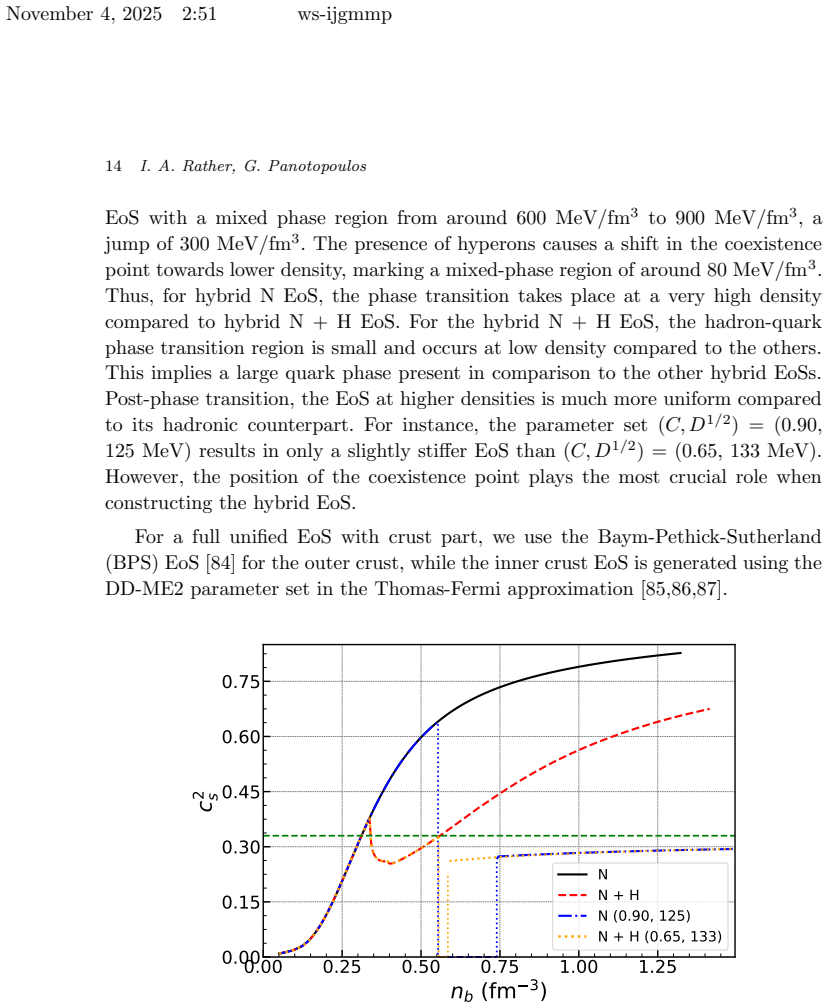
We investigate the impact of hyperons and phase transition to quark matter on the structural properties of neutron stars within the regularized four-dimensional Einstein-Gauss-Bonnet gravity (4DEGB). We employ the density-dependent relativistic mean-field model (DDME2) for the hadronic phase and the density-dependent quark mass (DDQM) model for the quark phase to construct hadronic and hybrid equations-of-state (EoSs) that are consistent with the astrophysical constraints. The presence of hyperons softens the EoS and with a phase transition, the EoS further softens, and the speed of sound squared drops to around 0.2 for the maximum mass configuration, which lies in the pure quark phase. Adjusting the Gauss-Bonnet coupling constant, $\alpha$, within its allowed range results in a decrease in the mass-radius relationship for negative $\alpha$, and an increase for positive $\alpha$. In addition, functions are fitted to the maximum mass and its associated radius as a function of the constant $\alpha$ to observe its impact on these properties. We find that positive values of $\alpha$ support massive stars consistent with the 2\,$M_{\odot}$ constraint and NICER measurements, while negative values, although compatible with low-mass radius observations, fail to reach the observed maximum mass, particularly for EoSs involving phase transitions. Therefore, astrophysical observations may be used to effectively constrain the allowed range of $\alpha$.
Figures


Figures from the paper (4 more)


Reference graph
Works this paper leans on
-
[83]
Ishfaq Ahmad Rather, Kauan D. Marquez, Betania C. Backes, Grigoris Panotopoulos, and Ilidio Lopes. Radial oscillations of hybrid stars and neutron stars including delta baryons: the effect of a slow quark phase transition.JCAP, 05:130, 2024
work page 2024
-
[62]
A NICER View of the Nearest and Brightest Millisecond Pulsar: PSR J0437-4715
Devarshi Choudhury et al. A NICER View of the Nearest and Brightest Millisecond Pulsar: PSR J0437-4715. 7 2024
work page 2024
-
[1]
T. Kaluza, Sitzungsber. Preuss. Akad. Wiss. Berlin (Math. Phys. )1921, 966-972 (1921) [arXiv:1803.08616 [physics.hist-ph]]. November 4, 2025 2:51 ws-ijgmmp 24I. A. Rather, G. Panotopoulos
arXiv 1921
-
[2]
Klein, Z
O. Klein, Z. Phys.37, 895-906 (1926)
1926
-
[3]
H. P. Nilles, Phys. Rept.110, 1-162 (1984)
1984
-
[4]
M. B. Green, J. H. Schwarz and E. Witten,Superstring Theory, Vol. 1 & 2, Cam- bridge Monographs on Mathematical Physics (Cambridge University Press, Cam- bridge, England, 2012)
2012
-
[5]
Polchinski,String Theory, Vol
J. Polchinski,String Theory, Vol. 1 & 2, Cambridge Monographs on Mathematical Physics (Cambridge University Press, Cambridge, England, 2005)
2005
-
[6]
Lovelock, J
D. Lovelock, J. Math. Phys.12, 498-501 (1971)
1971
Show all 95 references
-
[7]
Corley, D
S. Corley, D. A. Lowe and S. Ramgoolam, JHEP07, 030 (2001) [arXiv:hep- th/0106067 [hep-th]]
2001
-
[8]
Glavan and C
D. Glavan and C. Lin, Phys. Rev. Lett.124, 081301 (2020)
2020
-
[9]
R. P. Woodard, Scholarpedia10, 32243 (2015). [arXiv:1506.02210 [hep-th]]
2015 arXiv
-
[10]
Generating black holes in 4DEinstein-Gauss-Bonnet gravity,
S. G. Ghosh and R. Kumar, “Generating black holes in 4DEinstein-Gauss-Bonnet gravity,” Class. Quant. Grav.37, 245008 (2020). [arXiv:2003.12291 [gr-qc]]
2020 arXiv
-
[11]
(In)stability of black holes in the 4DEin- stein–Gauss–Bonnet and Einstein–Lovelock gravities,
R. A. Konoplya and A. Zhidenko, “(In)stability of black holes in the 4DEin- stein–Gauss–Bonnet and Einstein–Lovelock gravities,” Phys. Dark Univ.30, 100697 (2020). [arXiv:2003.12492 [gr-qc]]
2020 arXiv
-
[12]
Thermodynamics and P-v criticality of Bardeen-AdS Black Hole in 4DEinstein-Gauss-Bonnet Gravity,
D. V. Singh and S. Siwach, “Thermodynamics and P-v criticality of Bardeen-AdS Black Hole in 4DEinstein-Gauss-Bonnet Gravity,” Phys. Lett. B808, 135658 (2020). [arXiv:2003.11754 [gr-qc]]
2020 arXiv
-
[13]
Thermodynamic geometry of the novel 4-D Gauss Bonnet AdS Black Hole,
S. A. Hosseini Mansoori, “Thermodynamic geometry of the novel 4-D Gauss Bonnet AdS Black Hole,” Phys. Dark Univ.31, 100776 (2021). [arXiv:2003.13382 [gr-qc]]
2021 arXiv
-
[14]
Clouds of strings in 4DEin- stein–Gauss–Bonnet black holes,
D. V. Singh, S. G. Ghosh and S. D. Maharaj, “Clouds of strings in 4DEin- stein–Gauss–Bonnet black holes,” Phys. Dark Univ.30, 100730 (2020)
2020
-
[15]
Extended thermodynamics and microstructures of four- dimensional charged Gauss-Bonnet black hole in AdS space,
S. W. Wei and Y. X. Liu, “Extended thermodynamics and microstructures of four- dimensional charged Gauss-Bonnet black hole in AdS space,” Phys. Rev. D101, 104018 (2020)
2020
-
[16]
Born–Infeld black holes in 4D Einstein–Gauss–Bonnet gravity,
K. Yang, B. M. Gu, S. W. Wei and Y. X. Liu, “Born–Infeld black holes in 4D Einstein–Gauss–Bonnet gravity,” Eur. Phys. J. C80, 662 (2020)
2020
-
[17]
Charged Black Holes in AdS Spaces in 4DEinstein Gauss- Bonnet Gravity,
P. G. S. Fernandes, “Charged Black Holes in AdS Spaces in 4DEinstein Gauss- Bonnet Gravity,” Phys. Lett. B805, 135468 (2020)
2020
-
[18]
Superradiance and stability of the regularized 4D charged Einstein-Gauss-Bonnet black hole,
C. Y. Zhang, S. J. Zhang, P. C. Li and M. Guo, “Superradiance and stability of the regularized 4D charged Einstein-Gauss-Bonnet black hole,” JHEP2008, 105 (2020)
2020
-
[19]
Nonlinear magnetically charged black holes in 4D Einstein-Gauss-Bonnet gravity,
K. Jusufi, “Nonlinear magnetically charged black holes in 4D Einstein-Gauss-Bonnet gravity,” Annals Phys.421, 168285 (2020)
2020
-
[20]
Dynamics of magnetized particles around 4-D Einstein Gauss–Bonnet black hole,
A. Abdujabbarov, J. Rayimbaev, B. Turimov and F. Atamurotov, “Dynamics of magnetized particles around 4-D Einstein Gauss–Bonnet black hole,” Phys. Dark Univ.30, 100715 (2020)
2020
-
[21]
Optical features of AdS black holes in the novel 4D Einstein-Gauss-Bonnet gravity coupled to nonlinear electrody- namics,
K. Jafarzade, M. Kord Zangeneh and F. S. N. Lobo, “Optical features of AdS black holes in the novel 4D Einstein-Gauss-Bonnet gravity coupled to nonlinear electrody- namics,” arXiv:2009.12988 [gr-qc]
2009 arXiv
-
[22]
Gravitational lensing by black holes in the 4DEinstein-Gauss-Bonnet gravity,
S. U. Islam, R. Kumar and S. G. Ghosh, “Gravitational lensing by black holes in the 4DEinstein-Gauss-Bonnet gravity,” JCAP2009, 030 (2020)
2020
-
[23]
Strong gravitational lensing of a 4-dimensional Einstein–Gauss–Bonnet black hole in homogeneous plasma,
X. H. Jin, Y. X. Gao and D. J. Liu, “Strong gravitational lensing of a 4-dimensional Einstein–Gauss–Bonnet black hole in homogeneous plasma,” Int. J. Mod. Phys. D 29, 2050065 (2020)
2020
-
[24]
Quasinormal modes of the Dirac field in the novel 4D Einstein- Gauss-Bonnet gravity,
M. S. Churilova, “Quasinormal modes of the Dirac field in the novel 4D Einstein- Gauss-Bonnet gravity,” Phys. Dark Univ.31, 100748 (2021)
2021
-
[25]
Perturbative and nonpertur- bative quasinormal modes of 4D Einstein–Gauss–Bonnet black holes,
A. Aragon, R. Becar, P. A. Gonzalez and Y. Vasquez, “Perturbative and nonpertur- bative quasinormal modes of 4D Einstein–Gauss–Bonnet black holes,” Eur. Phys. J. November 4, 2025 2:51 ws-ijgmmp 4D EGB with hyperons and phase transition25 C80, 773 (2020)
2020
-
[26]
Quasinormal modes, stability and shadows of a black hole in the 4D Einstein–Gauss–Bonnet gravity,
R. A. Konoplya and A. F. Zinhailo, “Quasinormal modes, stability and shadows of a black hole in the 4D Einstein–Gauss–Bonnet gravity,” Eur. Phys. J. C80, 1049 (2020)
2020
-
[27]
Innermost stable circular orbit and shadow of the 4DEin- stein–Gauss–Bonnet black hole,
M. Guo and P. C. Li, “Innermost stable circular orbit and shadow of the 4DEin- stein–Gauss–Bonnet black hole,” Eur. Phys. J. C80, 588 (2020)
2020
-
[28]
Shadows and photon spheres with spherical accretions in the four-dimensional Gauss–Bonnet black hole,
X. X. Zeng, H. Q. Zhang and H. Zhang, “Shadows and photon spheres with spherical accretions in the four-dimensional Gauss–Bonnet black hole,” Eur. Phys. J. C80, 872 (2020)
2020
-
[29]
Wormholes in 4D Einstein–Gauss–Bonnet gravity,
K. Jusufi, A. Banerjee and S. G. Ghosh, “Wormholes in 4D Einstein–Gauss–Bonnet gravity,” Eur. Phys. J. C80, 698 (2020)
2020
-
[30]
Traversable Thin-shell Wormhole in the Novel 4D Einstein-Gauss-Bonnet Theory,
P. Liu, C. Niu, X. Wang and C. Y. Zhang, “Traversable Thin-shell Wormhole in the Novel 4D Einstein-Gauss-Bonnet Theory,” arXiv:2004.14267 [gr-qc]
2004 arXiv
-
[31]
On the ”Einstein-Gauss-Bonnet Gravity in Four Dimen- sion
L. M. Cao and L. B. Wu, “On the ”Einstein-Gauss-Bonnet Gravity in Four Dimen- sion”,” [arXiv:2103.09612 [gr-qc]]
-
[32]
4D Gauss–Bonnet gravity: Cosmological constraints, H0 tension and large scale structure,
D. Wang and D. Mota, “4D Gauss–Bonnet gravity: Cosmological constraints, H0 tension and large scale structure,” Phys. Dark Univ.32, 100813 (2021). [arXiv:2103.12358 [astro-ph.CO]]
2021 arXiv
-
[33]
A note on the novel 4D Einstein–Gauss–Bonnet gravity,
W. Y. Ai, “A note on the novel 4D Einstein–Gauss–Bonnet gravity,” Commun. Theor. Phys.72, no.9, 095402 (2020) [arXiv:2004.02858 [gr-qc]]
2020 arXiv
-
[34]
Is there a novel Einstein–Gauss–Bonnet theory in four dimensions?,
M. G¨ urses, T. C ¸ . S ¸i¸ sman and B. Tekin, “Is there a novel Einstein–Gauss–Bonnet theory in four dimensions?,” Eur. Phys. J. C80, no.7, 647 (2020) [arXiv:2004.03390 [gr-qc]]
2020 arXiv
-
[35]
Vacua in novel 4D Einstein-Gauss-Bonnet Gravity: pathology and in- stability?,
F. W. Shu, “Vacua in novel 4D Einstein-Gauss-Bonnet Gravity: pathology and in- stability?,” Phys. Lett. B811, 135907 (2020) [arXiv:2004.09339 [gr-qc]]
2020 arXiv
-
[36]
Comment on
M. Gurses, T. C ¸ . S ¸i¸ sman and B. Tekin, “Comment on ”Einstein-Gauss-Bonnet Grav- ity in 4-Dimensional Space-Time”,” Phys. Rev. Lett.125, no.14, 149001 (2020) [arXiv:2009.13508 [gr-qc]]
2020 arXiv
-
[37]
Comment on “Einstein-Gauss- Bonnet Gravity in Four-Dimensional Spacetime
J. Arrechea, A. Delhom and A. Jim´ enez-Cano, “Comment on “Einstein-Gauss- Bonnet Gravity in Four-Dimensional Spacetime”,” Phys. Rev. Lett.125, no.14, 149002 (2020) [arXiv:2009.10715 [gr-qc]]
2020 arXiv
-
[38]
Derivation of Regu- larized Field Equations for the Einstein-Gauss-Bonnet Theory in Four Dimensions,
P. G. S. Fernandes, P. Carrilho, T. Clifton and D. J. Mulryne, “Derivation of Regu- larized Field Equations for the Einstein-Gauss-Bonnet Theory in Four Dimensions,” Phys. Rev. D102, no.2, 024025 (2020) [arXiv:2004.08362 [gr-qc]]
2020 arXiv
-
[39]
On taking the D →4 limit of Gauss-Bonnet gravity: theory and solutions,
R. A. Hennigar, D. Kubizˇ n´ ak, R. B. Mann and C. Pollack, “On taking the D →4 limit of Gauss-Bonnet gravity: theory and solutions,” JHEP07, 027 (2020) [arXiv:2004.09472 [gr-qc]]
2020 arXiv
-
[40]
The D —>2 limit of general relativity,
R. B. Mann and S. F. Ross, “The D —>2 limit of general relativity,” Class. Quant. Grav.10, 1405-1408 (1993) [arXiv:gr-qc/9208004 [gr-qc]]
1993 arXiv
-
[41]
Gravitational lensing by charged black hole in regularized 4DEinstein–Gauss–Bonnet gravity,
R. Kumar, S. U. Islam and S. G. Ghosh, “Gravitational lensing by charged black hole in regularized 4DEinstein–Gauss–Bonnet gravity,” Eur. Phys. J. C80, 1128 (2020)
2020
-
[42]
Quasinormal modes and strong cosmic censorship in the regularised 4D Einstein–Gauss–Bonnet gravity,
A. K. Mishra, “Quasinormal modes and strong cosmic censorship in the regularised 4D Einstein–Gauss–Bonnet gravity,” Gen. Rel. Grav.52, 106 (2020)
2020
-
[43]
Observational Con- straints on the Regularized 4D Einstein-Gauss-Bonnet Theory of Gravity,
T. Clifton, P. Carrilho, P. G. S. Fernandes and D. J. Mulryne, “Observational Con- straints on the Regularized 4D Einstein-Gauss-Bonnet Theory of Gravity,” Phys. Rev. D102, 084005 (2020). [arXiv:2006.15017 [gr-qc]]
2020 arXiv
-
[44]
Theoretical and observational constraints on regularized 4DEinstein-Gauss-Bonnet gravity,
J. X. Feng, B. M. Gu and F. W. Shu, “Theoretical and observational constraints on regularized 4DEinstein-Gauss-Bonnet gravity,” Phys. Rev. D103, 064002 (2021). [arXiv:2006.16751 [gr-qc]]
2021 arXiv
-
[45]
Quark stars with a unified interacting November 4, 2025 2:51 ws-ijgmmp 26I. A. Rather, G. Panotopoulos equation of state in regularized 4D Einstein-Gauss-Bonnet gravity,
M. Gammon, S. Rourke and R. B. Mann, “Quark stars with a unified interacting November 4, 2025 2:51 ws-ijgmmp 26I. A. Rather, G. Panotopoulos equation of state in regularized 4D Einstein-Gauss-Bonnet gravity,” Phys. Rev. D 109, no.2, 024026 (2024) [arXiv:2309.00703 [gr-qc]]
2024 arXiv
-
[46]
Charged quark stars and extreme compact objects in regularized 4D Einstein-Gauss-Bonnet gravity,
M. Gammon, R. B. Mann and S. Rourke, “Charged quark stars and extreme compact objects in regularized 4D Einstein-Gauss-Bonnet gravity,” Phys. Rev. D111, no.4, 043034 (2025) [arXiv:2406.12933 [gr-qc]]
2025 arXiv
-
[47]
White dwarfs in reg- ularized 4D Einstein-Gauss-Bonnet gravity,
J. M. Z. Pretel, T. Tangphati, ˙I. Sakallı and A. Banerjee, “White dwarfs in reg- ularized 4D Einstein-Gauss-Bonnet gravity,” Phys. Lett. B866, 139581 (2025) [arXiv:2505.08153 [gr-qc]]
2025 arXiv
-
[48]
N. K. Glendenning.Compact stars: Nuclear physics, particle physics, and general relativity. 1997
1997
-
[49]
The Hyperon Puzzle in Neutron Stars
Ignazio Bombaci. The Hyperon Puzzle in Neutron Stars. InProceedings of the 12th International Conference on Hypernuclear and Strange Particle Physics (HYP2015, page 101002, January 2017
2017
-
[50]
B. P. Abbott and R. Abbottet al. Phys. Rev. Lett., 119:161101, Oct 2017
2017
-
[51]
Capano, Ingo Tews, Stephanie M
Collin D. Capano, Ingo Tews, Stephanie M. Brown, Ben Margalit, Soumi De, Sumit Kumar, Duncan A. Brown, Badri Krishnan, and Sanjay Reddy. Stringent constraints on neutron-star radii from multimessenger observations and nuclear theory.Nature Astronomy, 4(6):625–632, Jun 2020
2020
-
[52]
Shapiro Delay Measurement of A Two Solar Mass Neutron Star.Nature, 467:1081– 1083, 2010
Paul Demorest, Tim Pennucci, Scott Ransom, Mallory Roberts, and Jason Hessels. Shapiro Delay Measurement of A Two Solar Mass Neutron Star.Nature, 467:1081– 1083, 2010
2010
-
[53]
A Massive Pulsar in a Compact Relativistic Binary.Science, 340:6131, 2013
John Antoniadis et al. A Massive Pulsar in a Compact Relativistic Binary.Science, 340:6131, 2013
2013
-
[54]
Fonseca et al
E. Fonseca et al. Refined Mass and Geometric Measurements of the High-mass PSR J0740+6620.Astrophys. J. Lett., 915(1):L12, 2021
2021
-
[55]
Riley et al
Thomas E. Riley et al. A NICER View of the Massive Pulsar PSR J0740+6620 Informed by Radio Timing and XMM-Newton Spectroscopy.Astrophys. J. Lett., 918(2):L27, 2021
2021
-
[56]
M. C. Miller et al. The radius of PSR J0740+6620 from nicer and xmm-newton data. The Astrophysical Journal Letters, 918(2):L28, sep 2021
2021
-
[57]
The Radius of the High-mass Pulsar PSR J0740+6620 with 3.6 yr of NICER Data.Astrophys
Tuomo Salmi et al. The Radius of the High-mass Pulsar PSR J0740+6620 with 3.6 yr of NICER Data.Astrophys. J., 974:294, 2024
2024
-
[58]
Dittmann et al
Alexander J. Dittmann et al. A more precise measurement of the radius of PSR J0740+6620 using updated nicer data. 2024
2024
-
[59]
M. C. Milleret al.PSR J0030+0451 mass and radius from NICER data and im- plications for the properties of neutron star matter.Astrophys. J., 887(1):L24, dec 2019
2019
-
[60]
T. E. Rileyet al.A NICER view of PSR J0030+0451: Millisecond pulsar parameter estimation.Astrophys. J., 887(1):L21, dec 2019
2019
-
[61]
An Updated Mass–Radius Analysis of the 2017–2018 NICER Data Set of PSR J0030+0451.Astrophys
Serena Vinciguerra et al. An Updated Mass–Radius Analysis of the 2017–2018 NICER Data Set of PSR J0030+0451.Astrophys. J., 961(1):62, 2024
2017
-
[63]
A strangely light neutron star within a supernova remnant.Nature Astronomy, 6(12):1444–1451, Dec 2022
Victor Doroshenko, Valery Suleimanov, Gerd P¨ uhlhofer, and Andrea Santangelo. A strangely light neutron star within a supernova remnant.Nature Astronomy, 6(12):1444–1451, Dec 2022
2022
-
[64]
Constraining the Properties of the Thermonuclear Burst Oscillation Source XTE J1814-338 Through Pulse Profile Modelling
Yves Kini et al. Constraining the Properties of the Thermonuclear Burst Oscillation Source XTE J1814-338 Through Pulse Profile Modelling. 5 2024
2024
-
[65]
Second-order scalar-tensor field equations in a four-dimensional space,
G. W. Horndeski, “Second-order scalar-tensor field equations in a four-dimensional space,” Int. J. Theor. Phys.10, 363-384 (1974). November 4, 2025 2:51 ws-ijgmmp 4D EGB with hyperons and phase transition27
1974
-
[66]
Horndeski gravity asD→4 limit of Gauss-Bonnet,
H. Lu and Y. Pang, “Horndeski gravity asD→4 limit of Gauss-Bonnet,” Phys. Lett. B809, 135717 (2020) [arXiv:2003.11552 [gr-qc]]
2020 arXiv
-
[67]
Effective scalar-tensor description of regularized Lovelock gravity in four dimensions,
T. Kobayashi, “Effective scalar-tensor description of regularized Lovelock gravity in four dimensions,” JCAP07, 013 (2020) [arXiv:2003.12771 [gr-qc]]
2020 arXiv
-
[68]
On the gravitational field of a mass point according to Einstein’s theory,
“On the gravitational field of a mass point according to Einstein’s theory,” Sitzungsber. Preuss. Akad. Wiss. Berlin (Math. Phys. )1916, 189-196 (1916) [arXiv:physics/9905030 [physics]]
1916 arXiv
-
[69]
Quark Stars in 4D Ein- stein–Gauss–Bonnet Gravity with an Interacting Quark Equation of State,
A. Banerjee, T. Tangphati, D. Samart and P. Channuie, “Quark Stars in 4D Ein- stein–Gauss–Bonnet Gravity with an Interacting Quark Equation of State,” Astro- phys. J.906, no.2, 114 (2021) [arXiv:2007.04121 [gr-qc]]
2021 arXiv
-
[70]
Brockmann and H
R. Brockmann and H. Toki. Relativistic density-dependent hartree approach for finite nuclei.Phys. Rev. Lett., 68:3408–3411, Jun 1992
1992
-
[71]
Relativistic mean-field hadronic models under nuclear matter constraints.Physical Review C, 90(5):055203, 2014
M Dutra, O Louren¸ co, SS Avancini, BV Carlson, A Delfino, DP Menezes, C Providˆ encia, S Typel, and JR Stone. Relativistic mean-field hadronic models under nuclear matter constraints.Physical Review C, 90(5):055203, 2014
2014
-
[72]
Oertel, M
M. Oertel, M. Hempel, T. Kl¨ ahn, and S. Typel. Equations of state for supernovae and compact stars.Rev. Mod. Phys., 89(1):015007, 2017
2017
-
[73]
Baryon coupling scheme in a unified su (3) and su (6) symmetry formalism.Physical Review D, 107(3):036011, 2023
Luiz L Lopes, Kauan D Marquez, and D´ ebora P Menezes. Baryon coupling scheme in a unified su (3) and su (6) symmetry formalism.Physical Review D, 107(3):036011, 2023
2023
-
[74]
Marquez, Mateus R
Adamu Issifu, Kauan D. Marquez, Mateus R. Pelicer, and D´ ebora P. Menezes. 2 2023
2023
-
[75]
Typel and H
S. Typel and H. H. Wolter. Relativistic mean field calculations with density dependent meson nucleon coupling.Nucl. Phys. A, 656:331–364, 1999
1999
-
[76]
Fuchs, H
C. Fuchs, H. Lenske, and H. H. Wolter. Density dependent hadron field theory.Phys. Rev. C, 52:3043–3060, Dec 1995
1995
-
[77]
Effects of strong magnetic fields on the hadron-quark deconfinement transition.The European Physical Journal A, 57(7):1–9, 2021
Betˆ ania CT Backes, Kauan D Marquez, and D´ ebora P Menezes. Effects of strong magnetic fields on the hadron-quark deconfinement transition.The European Physical Journal A, 57(7):1–9, 2021
2021
-
[78]
C. J. Xia, G. X. Peng, S. W. Chen, Z. Y. Lu, and J. F. Xu. Thermodynamic consis- tency, quark mass scaling, and properties of strange matter.Phys. Rev. D, 89:105027, May 2014
2014
-
[79]
Quark deconfinement transition in neutron stars with the field correlator method.Phys
Domenico Logoteta and Ignazio Bombaci. Quark deconfinement transition in neutron stars with the field correlator method.Phys. Rev. D, 88:063001, Sep 2013
2013
-
[80]
Glendenning
Norman K. Glendenning. First order phase transitions with more than one conserved charge: Consequences for neutron stars.Phys. Rev. D, 46:1274–1287, 1992
1992
-
[81]
I. A. Rather, A. A. Usmani, and S. K. Patra. Hadron–quark phase transition in the context of GW190814.J. Phys. G, 48(8):085201, 2021
2021
-
[82]
I. A. Rather, Usuf Rahaman, M. Imran, H. C. Das, A. A. Usmani, and S. K. Patra. Rotating Neutron stars with Quark cores.Phys. Rev. C, 103(5):055814, 2021
2021
-
[84]
J., 170:299– 317, 1971
Gordon Baym, Christopher Pethick, and Peter Sutherland.Astrophys. J., 170:299– 317, 1971
1971
-
[85]
S. S. Avancini, L. Brito, J. R. Marinelli, D. P. Menezes, M. M. W. de Moraes, C. Providˆ encia, and A. M. Santos.Phys. Rev. C, 79:035804, Mar 2009
2009
-
[86]
Helena Pais and Constan ¸ ca Providˆ encia.Phys. Rev. C, 94:015808, Jul 2016
2016
-
[87]
Rather, A.A
Ishfaq A. Rather, A.A. Usmani, and S.K. Patra. Effect of inner crust eos on neutron star properties.Nuclear Physics A, 1010:122189, 2021. November 4, 2025 2:51 ws-ijgmmp 28I. A. Rather, G. Panotopoulos
2021
-
[88]
Paulo Bedaque and Andrew W. Steiner. Sound velocity bound and neutron stars. Phys. Rev. Lett., 114:031103, Jan 2015
2015
-
[89]
Ch. C. Moustakidis, T. Gaitanos, Ch. Margaritis, and G. A. Lalazissis. Bounds on the speed of sound in dense matter, and neutron star structure.Phys. Rev. C, 95:045801, Apr 2017
2017
-
[90]
I. Tews, J. Carlson, S. Gandolfi, and S. Reddy. Constraining the speed of sound inside neutron stars with chiral effective field theory interactions and observations. The Astrophys. J., 860(2):149, jun 2018
2018
-
[91]
Rather, Kauan D
Ishfaq A. Rather, Kauan D. Marquez, Grigoris Panotopoulos, and Il ´ ıdio Lopes. Radial oscillations in neutron stars with delta baryons.Phys. Rev. D, 107(12):123022, 2023
2023
-
[92]
Abbott et al
R. Abbott et al. GW190814: Gravitational Waves from the Coalescence of a 23 So- lar Mass Black Hole with a 2.6 Solar Mass Compact Object.Astrophys. J. Lett., 896(2):L44, 2020
2020
-
[93]
Romani, D
Roger W. Romani, D. Kandel, Alexei V. Filippenko, Thomas G. Brink, and WeiKang Zheng. PSR J0952-0607: The Fastest and Heaviest Known Galactic Neutron Star. Astrophys. J. Lett., 934(2):L17, 2022
2022
-
[94]
Riley et al
Thomas E. Riley et al. A nicer view of the massive pulsar psr j0740+6620 informed by radio timing and xmm-newton spectroscopy.The Astrophysical Journal Letters, 918(2):L27, sep 2021
2021
-
[95]
and Liang, E
Bowers, Richard L. and Liang, E. P. T. Anisotropic Spheres in General Relativity. Astrophys. J., 188, 657–665, 1974
1974
Reviewed August 11, 2026 · model on record in the stance chip above.
Discussion (0). Continue with ORCID to comment.