REVIEW 3 major objections 3 minor 50 references
Abstraction-Based Proof Production in Formal Verification of Neural Networks
T0 review · 3 major / 3 minor · reviewed 2026-08-07 · deepseek-v4-flash
Pith's one-line read An abstract proof—a proof that an abstracted network is UNSAT together with a proof that the abstraction over-approximates the original—is a sound end-to-end certificate for a DNN verification query, and the paper supplies the first…
desk verdict A genuinely useful modular proof framework, but the CORA compositionality argument has a real gap that needs fixing before the formalization is credible. read the letter →
The pith
A machine-rendered reading of the paper's core claim, the machinery that carries it, and where it could break.
The reading
What carries the argument
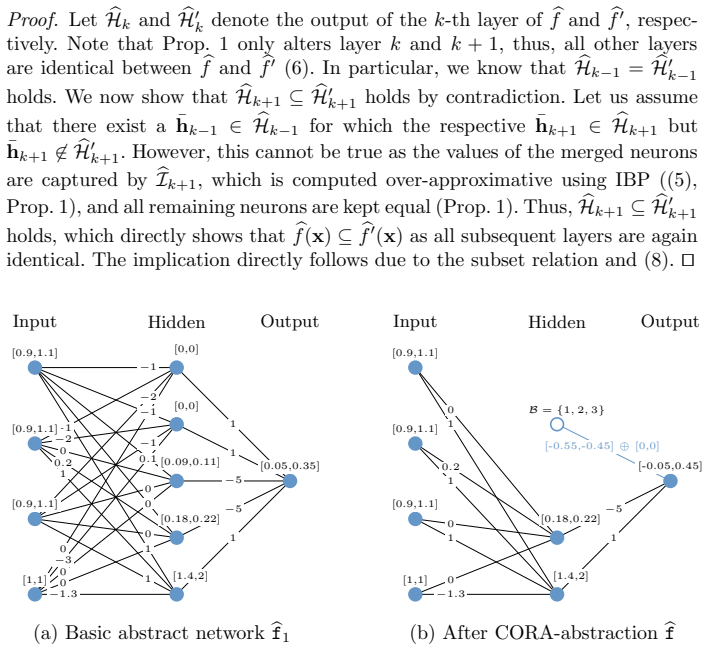
The machinery is the neuron-merging over-approximation paired with its proof-rule scheme. The abstraction first computes interval bounds $I_k$ for each layer using interval bound propagation, then selects buckets of neurons with similar bounds; merging bucket $B$ removes those neurons and rewrites layer $k+1$'s bias as the interval $\widehat{b}I_{k+1}=W_{k+1}(\cdot,B) I_k(B)$ while keeping all other layers intact. The proof rules triv-abs, base-abs, $l_k$-abs, and CORA-L convert each such merge into a formal statement $\forall x\in P: \widehat{f}_k(x) \subseteq \widehat{f}_{k+1}(x)$, and CORA-L composes the chain into the implication $\mathrm{unsat}(\langle \widehat{f},P,Q\rangle) \Rightarrow \mathrm{unsat}(\langle f,P,Q\rangle)$. A checker can reconstruct the intermediate abstract networks from the original and final networks and validate each rule without re-running the abstraction tool.
What would settle it
A reader could settle it by taking a small network, merging two adjacent layers' neuron buckets as Corollary 1 allows, and checking by exhaustive enumeration over the input hyperrectangle whether every output of the original network lies in the abstract network's output set; one violation would refute the abstraction-soundness chain, while none would support it.
Extended reading notes
Core claim
The paper establishes an end-to-end proof rule for abstraction-based DNN verification. It claims that if a proof-producing verifier shows the abstract query $\langle \widehat{f}, P, Q \rangle$ is UNSAT, and a separately generated proof shows $\mathrm{unsat}(\langle \widehat{f}, P, Q \rangle) \Rightarrow \mathrm{unsat}(\langle f, P, Q \rangle)$, then the pair is a sound certificate that the original query is UNSAT. The new part is the second component: a chain of proof rules (triv-abs, base-abs, $l_k$-abs, CORA-L) that turns the CORA neuron-merging abstraction into formal containment lemmas, one merge at a time. The key containment lemma is that after deleting a bucket $B$ of neurons in layer $k$, the abstract network's output contains the original network's output for every input, with the removed neurons' effect absorbed as the interval bias $\widehat{b}I_{k+1}=W_{k+1}(\cdot,B) I_k(B)$. The paper's Corollary 1 lifts this containment from a single merge to the full chain of merges used by the abstraction.
Load-bearing premise
The whole construction leans on the imported claim that merging any group of neurons is a sound over-approximation: the interval bias added to the next layer exactly accounts for the removed neurons' influence, and later layers are untouched. If that containment fails, say, when interval bounds are coarse or when merges happen in consecutive layers, the certified proof would certify a false result.
Editorial extensions
If this is right
- The paper's rule scheme means an existing proof-producing verifier can be dropped into the loop unchanged for the abstract query; only the new abstraction-soundness proofs must be generated.
- Proof attempts are skipped on non-UNSAT iterations of the refinement loop, so the expensive proof generation only happens once an abstract query is already known UNSAT.
- A complete certificate consists of the small abstract network's proof plus the merge-chain proof; if abstract networks are smaller, certificate size and checking effort should shrink accordingly.
- Because the abstraction proof is independent of the output property, the same certified abstraction can be reused across multiple properties on the same network.
Reading between the lines
- If Proposition 1 is formalized independently and found correct, the same two-part proof pattern should extend to any abstraction that can be stated as an output-containment lemma, making the modular rule a general template rather than a single-tool certificate.
- A stress test specifically targeting consecutive merges in adjacent layers is not analyzed in the paper's short sketch of Corollary 1; that is where a hidden interaction between interval biases would most likely break the chain.
- The authors report no benchmark numbers, so the predicted gains in proof size and checking time are still an open empirical question rather than an established result.
- Since the abstraction certificate is built for the input region $P$ only once, a large family of safety queries over the same $P$ could share the same abstraction-soundness file, amortizing its cost.
Editorial analysis
A structured set of objections, weighed in public.
Referee Report
Summary. This work-in-progress paper proposes a modular framework for proof-producing DNN verification with abstraction. The verification task is split into an UNSAT proof for an abstract query and a proof that the abstraction over-approximates the original network; an abstraction-refinement algorithm (Alg. 1) wraps the two proof components. The paper specializes the framework to CORA's neuron-merging abstraction: it defines an extended network syntax with interval biases, gives encodings of abstract queries for Marabou, and presents a proof-rule scheme (Fig. 6) intended to certify the CORA abstraction chain. The paper explicitly positions itself as preliminary and does not include an implementation or evaluation.
Significance. The modular separation of abstraction proofs from verification proofs is a useful conceptual contribution, and the proposed encoding of interval biases for Marabou is concrete and plausible. If the proof-rule scheme can be made formally sound and implemented, the approach would address a real gap in DNN verifier proof production. At present, however, the central compositional lemma is only sketched, and the rule scheme as printed is ill-formed for sequential merges, so the significance is conditional on a substantive repair.
major comments (3)
- [Section 5.2, Fig. 6 (l_k-abs)] The l_k-abs rule is ill-formed for k >= 2 once previous merges have occurred. After a merge at layer k-1, the current abstract network's weight matrix at layer k is a restriction of the original W_k to the surviving columns, and an interval bias bI_k from that earlier merge is already present. The rule as printed sets cW_k = W_k(bar B, .), bb_k = b_k(bar B), and bI_{k+1} = W_{k+1}(., B) I_k(B) using the original network's matrices; for k >= 2 this gives cW_k the wrong number of columns and makes I_k refer to an unspecified quantity, since no side condition states that I_k is a sound outer bound of the current layer's reachable set. The chain f ⊆ bf_0 ⊆ ... ⊆ bf_L therefore does not follow from the displayed rules, and the CORA-L conclusion is unsupported. The rule must either be stated over the current abstract state, with explicit side conditions on I_k, or be replaced by a compositional lemma proved by induction over layers.
- [Corollary 1 (Section 4)] The proof sketch of Corollary 1 only argues that Prop. 1 alters layers k and k+1 and that all other layers are identical between bf and bf'. This is insufficient for sequential composition: one must show that the interval bounds I_k used for the merge at layer k are computed from the current abstract network after merges at layers less than k, and that the current matrices in bf agree with the transformed original matrices. The sketch does not analyze the interaction of multiple merges or the dependence of the over-approximation on the quality of I_k, although those are exactly what the soundness claim rests on. Since the central soundness of the paper depends on Prop. 1, which is imported from the technical report [31], plus Corollary 1, a complete proof or a machine-checked formalization is needed.
- [Section 5.2 / Section 1 contributions] The paper calls this a 'formalization' and contribution 3 says 'We formalize a verifiable proof of the abstraction process itself.' What is actually provided is a proof-rule scheme with no machine-checked proof, no checker implementation, no meta-theorem establishing the soundness of the rule scheme, and no evaluation; the paper explicitly defers implementation to future work. For the claims made, either the rules should be accompanied by a formal soundness proof, or the claims should be softened to 'proposal of a proof-rule scheme.'
minor comments (3)
- [Section 4, Eq. (6)] The Minkowski sum definition says s_2 ∈ S_1 but should say s_2 ∈ S_2.
- [Throughout] There are several typos, including 'netrowk' in Sec. 3.1, 'private case' for 'special case' in Sec. 3.1, 'hyperractangles' in Sec. 4, and 'Abtract Proof Production' in the Sec. 5 heading.
- [Fig. 6] The proof-rule figures would be easier to check if every rule explicitly listed all side conditions (e.g., k ∈ [L-1], B ⊂ [n_k], I_k ⊇ H*_k, and soundness of the current bI_k), and if W_k and b_k were consistently marked as original or current matrices.
Circularity Check
No circularity: the abstraction proof composes an external abstraction-soundness theorem with a definitional base case; the noted l_k-abs typing problem is a correctness/presentation gap, not a circular reduction.
full rationale
The paper's derivation chain is modular and does not reduce to its own inputs. The central proof rule (Fig. 3) is modus ponens, which the paper explicitly acknowledges as 'a private case of implication elimination'. The soundness of the CORA neuron-merging abstraction is imported as Proposition 1 from the authors' prior technical report [31]; this is an ordinary external theorem dependency, not a self-referential derivation. Proposition 1 has explicit assumptions (a layer index, a merge bucket, interval bounds) and does not assume the paper's target conclusion; its use is analogous to citing a previously proved lemma. Corollary 1 and the proof-rule scheme in Fig. 6 instantiate that theorem sequentially; the 'triv-abs' rule is true by definition of bf0 (Eq. 7), and the chain from bf0 to bf is transitivity of set inclusion. No fitted parameter is renamed as a prediction, no uniqueness theorem is imported to forbid alternatives, and no ansatz is smuggled in via citation: the CORA interval-bias construction is openly attributed to [31] rather than presented as a first-principles result. The main caveat is a correctness/typing issue, not circularity: the l_k-abs rule as printed uses original matrices W_k, b_k even after earlier merges have changed the dimension of layer k-1, and Corollary 1's induction proof is only a sketch. That is a soundness or presentation gap, not an equation-level reduction of the claimed result to its inputs.
Assumptions & free parameters
assumptions (4)
- domain assumption Prop. 1 from [31]: merging a bucket B of neurons in a nonlinear hidden layer with the interval bias bI_{k+1}=W_{k+1}(.,B) I_k(B) yields an abstract network that over-approximates the original network.
- domain assumption Marabou's proof-producing verifier is sound: its UNSAT proofs for queries over abstract networks are valid witnesses for unsat(<bf,P,Q>).
- domain assumption The proof checker can reconstruct intermediate abstract networks fbk from the original network f, the final abstract network bf, and the proof witness, and can verify the containment chain f(x) subset bf0(x) subset ... subset bf(x) with arbitrary-precision arithmetic.
- domain assumption Interval bound propagation computes sound interval bounds I_k that contain the exact layer outputs H*_k.
Cite this review
Pith. "Pith review of Abstraction-Based Proof Production in Formal Verification of Neural Networks." pith.science (2026). https://pith.science/paper/MKLAPTKT
@misc{pith2026250609455,
  author       = {Pith},
  title        = {Pith review of: Abstraction-Based Proof Production in Formal Verification of Neural Networks},
  year         = {2026},
  howpublished = {\url{https://pith.science/paper/MKLAPTKT}},
  note         = {Machine review of arXiv:2506.09455}
}
read the original abstract
Modern verification tools for deep neural networks (DNNs) increasingly rely on abstraction to scale to realistic architectures. In parallel, proof production is becoming a critical requirement for increasing the reliability of DNN verification results. However, current proofproducing verifiers do not support abstraction-based reasoning, creating a gap between scalability and provable guarantees. We address this gap by introducing a novel framework for proof-producing abstraction-based DNN verification. Our approach modularly separates the verification task into two components: (i) proving the correctness of an abstract network, and (ii) proving the soundness of the abstraction with respect to the original DNN. The former can be handled by existing proof-producing verifiers, whereas we propose the first method for generating formal proofs for the latter. This preliminary work aims to enable scalable and trustworthy verification by supporting common abstraction techniques within a formal proof framework.
Figures


Figures from the paper (4 more)



Reference graph
Works this paper leans on
-
[31]
Ladner, T., Althoff, M.: Fully Automatic Neural Network Reduction for Formal Verification (2023), Technical Report.http://arxiv.org/abs/2305.01932
work page Pith review arXiv 2023
- [1]
- [2]
- [3]
- [4]
-
[5]
Barbosa, H., Reynolds, A., Kremer, G., Lachnitt, H., Niemetz, A., N¨ otzli, A., Ozdemir, A., Preiner, M., Viswanathan, A., Viteri, S., Zohar, Y., Tinelli, C., Bar- rett, C.: Flexible Proof Production in an Industrial-Strength SMT Solver. In: Proc. 11th Int. Joint Conf. on Automated Reasoning (IJCAR). pp. 15–35 (2022)
work page 2022
-
[6]
In: All about Proofs, Proofs for All, pp
Barrett, C., de Moura, L., Fontaine, P.: Proofs in Satisfiability Modulo Theories. In: All about Proofs, Proofs for All, pp. 23–44. College Publications (2015)
work page 2015
-
[7]
Brix, C., M¨ uller, M., Bak, S., Johnson, T., Liu, C.: First Three Years of the Inter- national Verification of Neural Networks Competition (VNN-COMP). Int. Journal on Software Tools for Technology Transfer (STTT) pp. 1–11 (2023)
work page 2023
Show all 50 references
-
[8]
Macmillan (1983)
Chv´ atal, V.: Linear Programming. Macmillan (1983)
1983
-
[9]
In: Proc
Clarke, E., Grumberg, O., Jha, S., Lu, Y., Veith, H.: Counterexample-Guided Ab- straction Refinement. In: Proc. 12th Int. Conf. on Computer Aided Verification (CA V). pp. 154–169 (2000)
2000
-
[10]
ACM Trans- actions on Programming Languages and Systems (TOPLAS) p
Clarke, E., Grumberg, O., Long, D.: Model Checking and Abstraction. ACM Trans- actions on Programming Languages and Systems (TOPLAS) p. 1512–1542 (1994)
1994
-
[11]
In: Proc
Cohen, E., Elboher, Y.Y., Barrett, C., Katz, G.: Tighter Abstract Queries in Neu- ral Network Verification. In: Proc. of 24th Int. Conf. on Logic for Programming, Artificial Intelligence and Reasoning (LPAR). pp. 124–143 (2023) Abtract Proof Production 15
2023
-
[12]
In: Proc
Cousot, P., Cousot, R.: Abstract Interpretation: a Unified Lattice Model for Static Analysis of Programs by Construction or Approximation of Fixpoints. In: Proc. 4th ACM SIGACT-SIGPLAN Symposium on Principles of Programming Languages (POPL). p. 238–252 (1977)
1977
-
[13]
In: Proc
Ehlers, R.: Formal Verification of Piece-Wise Linear Feed-Forward Neural Net- works. In: Proc. 15th Int. Symp. on Automated Technology for Verification and Analysis (ATV A). pp. 269–286 (2017)
2017
-
[14]
In: Proc
Elboher, Y., Gottschlich, J., Katz, G.: An Abstraction-Based Framework for Neural Network Verification. In: Proc. 32nd Int. Conf. on Computer Aided Verification (CA V). pp. 43–65 (2020)
2020
-
[15]
In: Proc
Elboher, Y.Y., Cohen, E., Katz, G.: Neural Network Verification Using Residual Reasoning. In: Proc. 20th Int. Conf. on Software Engineering and Formal Methods (SEFM). pp. 173–189 (2022)
2022
-
[16]
In: Proc
Elsaleh, R., Katz, G.: DelBugV: Delta-Debugging Neural Network Verifiers. In: Proc. 23rd Int. Conf. Formal Methods in Computer-Aided Design (FMCAD). pp. 34–43 (2023)
2023
-
[17]
In: Proc
Gehr, T., Mirman, M., Drachsler-Cohen, D., Tsankov, E., Chaudhuri, S., Vechev, M.: AI2: Safety and Robustness Certification of Neural Networks with Abstract Interpretation. In: Proc. 39th IEEE Symposium on Security and Privacy (S&P). pp. 3–18 (2018)
2018
-
[18]
MIT press Cambridge (2016)
Goodfellow, I., Bengio, Y., Courville, A.: Deep Learning. MIT press Cambridge (2016)
2016
-
[19]
Gowal, S., Dvijotham, K., Stanforth, R., Bunel, R., Qin, C., Uesato, J., Arand- jelovic, R., Mann, T., Kohli, P.: On the Effectiveness of Interval Bound Propa- gation for Training Verifiably Robust Models (2019), Technical Report.https: //arxiv.org/abs/1810.12715
2019 arXiv
-
[20]
Formal Methods in System Design (FMSD) pp
Griggio, A., Roveri, M., Tonetta, S.: Certifying Proofs for SAT-Based Model Check- ing. Formal Methods in System Design (FMSD) pp. 178–210 (2021)
2021
-
[21]
Gurobi Optimization, LLC: Gurobi Optimizer Reference Manual (2024),https: //www.gurobi.com
2024
-
[22]
In: Proc
Henzinger, T., Jhala, R., Majumdar, R., McMillan, K.: Abstractions from Proofs. In: Proc. 31st ACM SIGACT-SIGPLAN Symposium on Principles of Programming Languages (POPL). p. 232–244 (2004)
2004
-
[23]
In: Proc
Isac, O., Barrett, C., Zhang, M., Katz, G.: Neural Network Verification with Proof Production. In: Proc. 22nd Int. Conf. on Formal Methods in Computer-Aided Design (FMCAD). pp. 38–48 (2022)
2022
-
[24]
Isac, O., Refaeli, I., Wu, H., Barrett, C., Katz, G.: Proof-Driven Clause Learning in Neural Network Verification (2025), Technical Report.http://arxiv.org/abs/ 2503.12083
2025
-
[25]
In: Proc
Jia, K., Rinard, M.: Exploiting Verified Neural Networks via Floating Point Nu- merical Error. In: Proc. 28th Int. Static Analysis Symposium (SAS). pp. 191–205 (2021)
2021
-
[26]
In: Proc
Katz, G., Barrett, C., Dill, D., Julian, K., Kochenderfer, M.: Reluplex: An Efficient SMT Solver for Verifying Deep Neural Networks. In: Proc. 29th Int. Conf. on Computer Aided Verification (CA V). pp. 97–117 (2017)
2017
-
[27]
Formal Methods in System Design (FMSD) (2021)
Katz, G., Barrett, C., Dill, D., Julian, K., Kochenderfer, M.: Reluplex: a Calculus for Reasoning about Deep Neural Networks. Formal Methods in System Design (FMSD) (2021)
2021
-
[28]
In: Proc
Kochdumper, N., Schilling, C., Althoff, M., Bak, S.: Open- and Closed-Loop Neural Network Verification Using Polynomial Zonotopes. In: Proc. 15th NASA Formal Methods Symposium (NFM). pp. 16–36 (2023) 16 YY. Elboher, O. Isac, G. Katz, T. Ladner, H. Wu
2023
-
[29]
In: Proc
Krizhevsky, A., Sutskever, I., Hinton, G.: Imagenet Classification with Deep Con- volutional Neural Networks. In: Proc. Advances in neural information processing systems (NeuRIPS) (2012)
2012
-
[30]
In: Proc
Ladner, T., Althoff, M.: Automatic Abstraction Refinement in Neural Network Verification using Sensitivity Analysis. In: Proc. 26th ACM Int. Conf. on Hybrid Systems: Computation and Control (HSCC). pp. 1–13 (2023)
2023
-
[32]
Nature pp
LeCun, Y., Bengio, Y., Hinton, G.: Deep Learning. Nature pp. 436–444 (2015)
2015
-
[33]
Queue pp
Lipton, Z.: The mythos of model interpretability: In machine learning, the concept of interpretability is both important and slippery. Queue pp. 31–57 (2018)
2018
-
[34]
Foundations and Trends in Optimiza- tion pp
Liu, C., Arnon, T., Lazarus, C., Strong, C., Barrett, C., Kochenderfer, M.: Algo- rithms for Verifying Deep Neural Networks. Foundations and Trends in Optimiza- tion pp. 244–404 (2021)
2021
-
[35]
ACM Transactions on Software Engineering and Methodology (TOSEM) pp
Liu, J., Xing, Y., Shi, X., Song, F., Xu, Z., Ming, Z.: Abstraction and Refinement: Towards Scalable and Exact Verification of Neural Networks. ACM Transactions on Software Engineering and Methodology (TOSEM) pp. 1–35 (2024)
2024
-
[36]
In: Proc
Liu, Z., Yang, P., Zhang, L., Huang, X.: DeepCDCL: A CDCL-based Neural Net- work Verification Framework. In: Proc. 18th Int. Symposium on Theoretical As- pects of Software Engineering (TASE). pp. 343–355 (2024)
2024
-
[37]
In: Proc
Lopez, D., Choi, S., Tran, H.D., Johnson, T.: NNV 2.0: The Neural Network Ner- ification Tool. In: Proc. 35th Int. Conf. on Computer Aided Verification (CA V). pp. 397–412 (2023)
2023
-
[38]
In: Proc
Nair, V., Hinton, G.: Rectified Linear Units Improve Restricted Boltzmann Ma- chines. In: Proc. 27th Int. Conf. on Machine Learning (ICML). p. 807–814 (2010)
2010
-
[39]
In: Proc
Niemetz, A., Preiner, M., Reynolds, A., Zohar, Y., Barrett, C., Tinelli, C.: To- wards Bit-Width-Independent Proofs in SMT Solvers. In: Proc. 27th Int. Conf. on Automated Deduction (CADE). pp. 366–384 (2019)
2019
-
[40]
In: Proc
Ostrovsky, M., Barrett, C., Katz, G.: An Abstraction-Refinement Approach to Verifying Convolutional Neural Networks. In: Proc. 20th Int. Symposium on Au- tomated Technology for Verification and Analysis (ATV A). pp. 391–396 (2022)
2022
-
[41]
In: Proc
Radford, A., Kim, J., Hallacy, C., Ramesh, A., Goh, G., Agarwal, S., Sastry, G., Askell, A., Mishkin, P., Clark, J., Krueger, G., Sutskever, I.: Learning Transferable Visual Models From Natural Language Supervision. In: Proc. 38th Int. Conf. on Machine Learning (ICML) (2021)
2021
-
[42]
In: Proc
Radford, A., Kim, J.W., Xu, T., Brockman, G., McLeavey, C., Sutskever, I.: Robust Speech Recognition via Large-Scale Weak Supervision. In: Proc. 40th Int. Conf. on Machine Learning (ICML) (2023)
2023
-
[43]
Nature Machine Intelligence pp
Rudin, C.: Stop Explaining Black Box Machine Learning Models for High Stakes Decisions and Use Interpretable Models Instead. Nature Machine Intelligence pp. 206–215 (2019)
2019
-
[44]
In: Proc
S¨ alzer, M., Lange, M.: Reachability Is NP-Complete Even for the Simplest Neural Networks. In: Proc. 15th Int. Conf. on Reachability Problems (RP). pp. 149–164 (2021)
2021
-
[45]
Singh, A., Sarita, Y., Mendis, C., Singh, G.: Automated Verification of Soundness of DNN Certifiers. Proc. ACM on Programming Languages (PACMPL) (2025)
2025
-
[46]
In: Proc
Singh, G., Gehr, T., P¨ uschel, M., Vechev, M.: An Abstract Domain for Certifying Neural Networks. In: Proc. 46th ACM SIGACT-SIGPLAN Symposium on Princi- ples of Programming Languages (POPL). pp. 1–30 (2019)
2019
-
[47]
In: Proc
van den Oord, A., Dieleman, S., Zen, H., Simonyan, K., Vinyals, O., Graves, A., Kalchbrenner, N., Senior, A., Kavukcuoglu, K.: WaveNet: A Generative Model for Raw Audio. In: Proc. 9th ISCA Workshop on Speech Synthesis Workshop (SSW). p. 125 (2016) Abtract Proof Production 17
2016
-
[48]
In: Proc
Vaswani, A., Shazeer, N., Parmar, N., Uszkoreit, J., Jones, L., Gomez, A., Kaiser, L., Polosukhin, I.: Attention is All You Need. In: Proc. 31st Conf. on Advances in Neural Information Processing Systems (NeuRIPS) (2017)
2017
-
[49]
In: Proc
Wu, H., Isac, O., Zelji´ c, A., Tagomori, T., Daggitt, M., Kokke, W., Refaeli, I., Amir, G., Julian, K., Bassan, S., Huang, P., Lahav, O., Wu, M., Zhang, M., Komen- dantskaya, E., Katz, G., Barrett, C.: Marabou 2.0: A Versatile Formal Analyzer of Neural Networks. In: Proc. 36t...
2024
-
[50]
In: Proc
Zombori, D., B´ anhelyi, B., Csendes, T., Megyeri, I., Jelasity, M.: Fooling a Com- plete Neural Network Verifier. In: Proc. 9th Int. Conf. on Learning Representations (ICLR) (2021)
2021
Reviewed August 7, 2026 · model on record in the stance chip above.
Discussion (0). Continue with ORCID to comment.