Thermodynamics of the Isospectral family of holographic vector mesons
Pith reviewed 2026-06-28 21:55 UTC · model grok-4.3
The pith
The ground-state decay constant controls the melting temperature of the rho meson in an isospectral holographic model.
A machine-rendered reading of the paper's core claim, the machinery that carries it, and where it could break.
Core claim
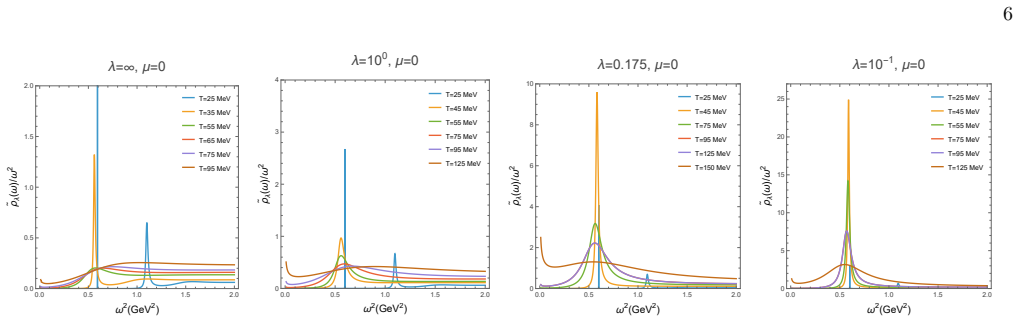
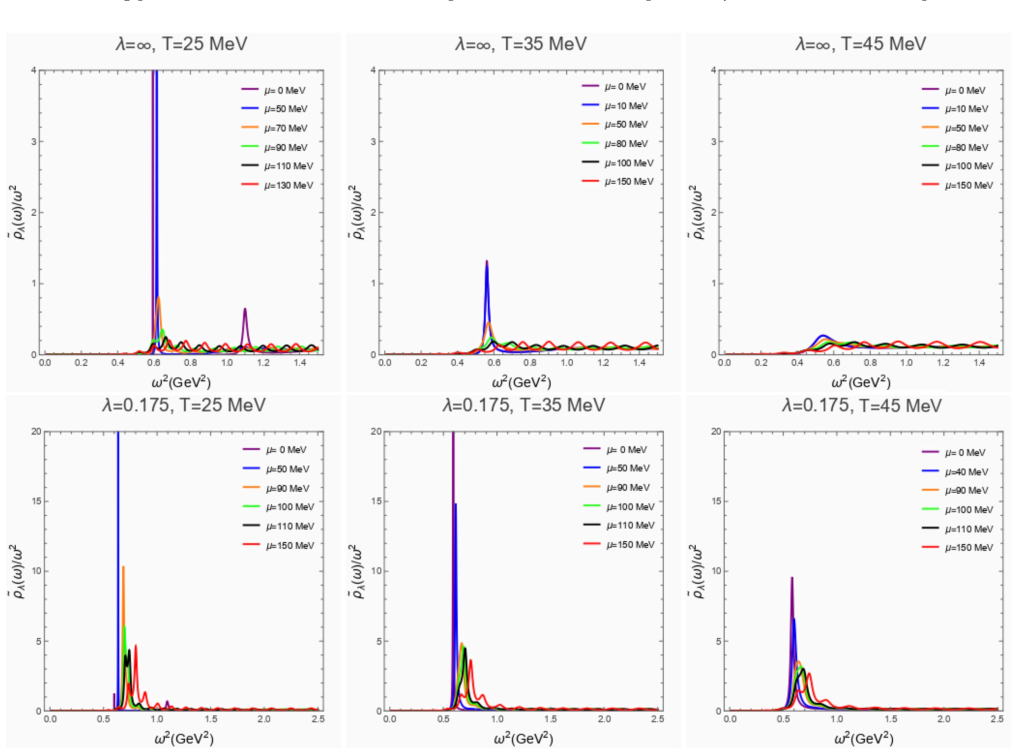
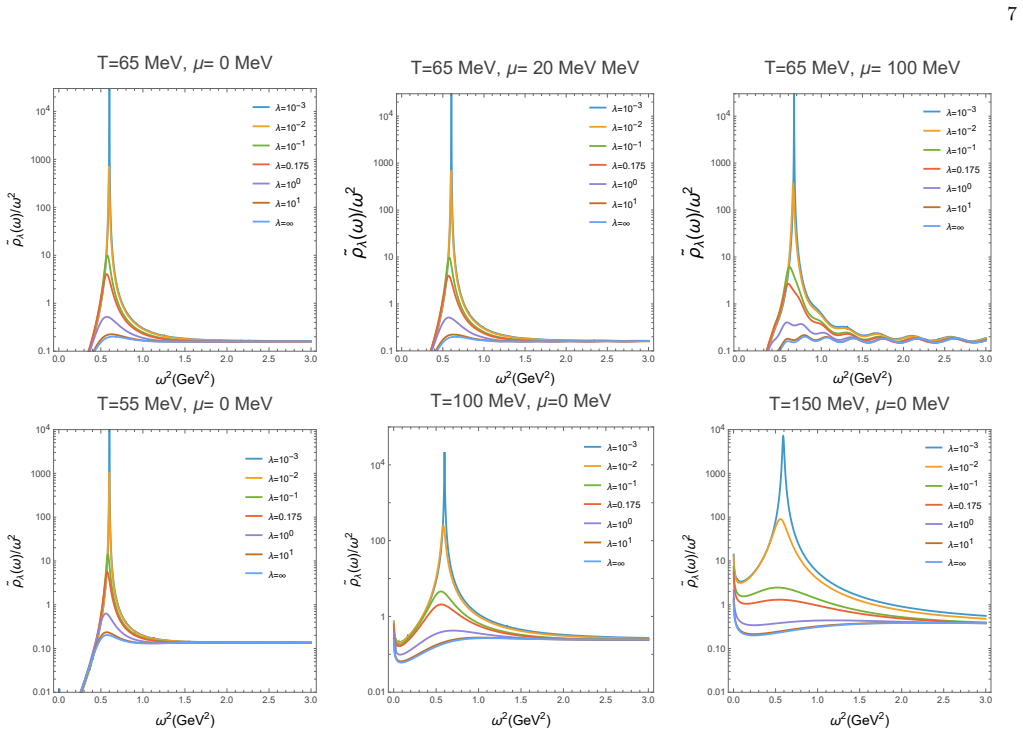
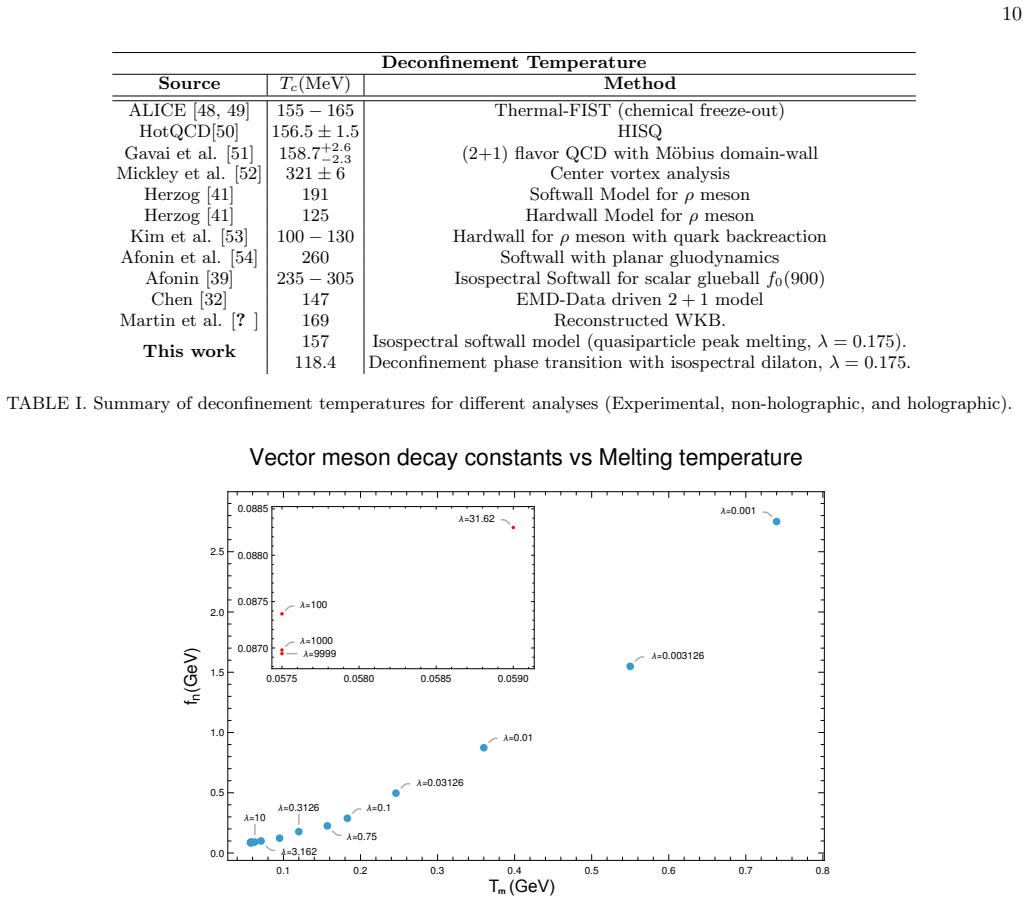
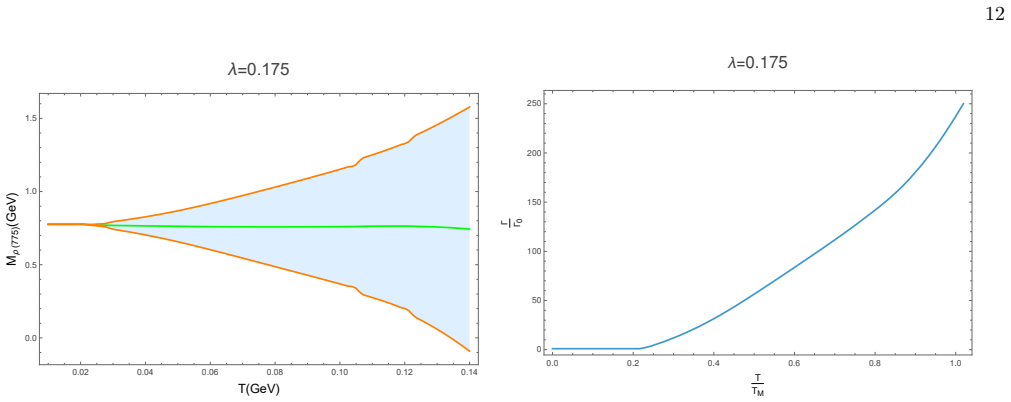
Using the isospectral family of the softwall AdS/QCD model, the thermal behavior of the rho meson is studied at finite temperature and chemical potential. Spectral functions show a monotonic increase of the melting temperature Tm with the ground-state decay constant f1. For the experimental f1 of 226 MeV, Tm is 157 MeV, with the thermal mass decreasing mildly and width increasing near the critical point, indicating a smooth crossover.
What carries the argument
Isospectral family of the softwall AdS/QCD model, which preserves the meson mass spectrum while allowing independent variation of the ground-state decay constant f1.
If this is right
- Melting temperature increases monotonically with f1 for the ground state.
- The same qualitative trend appears for excited states but weakens with higher radial quantum number.
- With f1 fixed at its experimental value the model yields a smooth crossover from confinement to deconfinement.
- Thermal mass decreases mildly near the critical point while width grows monotonically.
Where Pith is reading between the lines
- Decay constants may serve as tunable parameters to improve holographic predictions for medium-induced dissociation across different quarkonia.
- The isospectral technique could be applied to other holographic observables or to scalar and pseudoscalar channels without spoiling mass spectra.
- Lattice QCD simulations that vary effective decay constants independently could test whether the observed monotonic relation holds in full QCD.
- The result suggests that measured decay constants carry direct information about the temperature scale at which a given meson dissolves in the plasma.
Load-bearing premise
The softwall AdS/QCD model and its isospectral deformations faithfully represent the dynamics of vector mesons in real QCD at finite temperature and density.
What would settle it
An experimental or lattice determination of the rho meson melting temperature that deviates significantly from 157 MeV when the decay constant is fixed at 226 MeV would challenge the result.
Figures


read the original abstract
We study the thermal behavior of the $\rho$ meson using the isospectral family of the softwall AdS/QCD model. By computing spectral functions at finite temperature and chemical potential for different members of this family, we isolate the effect of the ground-state electromagnetic decay constant $f_1$ on the melting temperature $T_m$ of the $\rho(770)$ meson. A clear monotonic increase of $T_m$ with $f_1$ is found, supporting the interpretation of $f_1$ as a key scale controlling quarkonium dissociation. For excited states, the same qualitative trend appears but is strongly suppressed as the radial quantum number increases. Using the isospectral parameter to fix $f_1$ to its experimental value ($226$ MeV) yields a holographic model whose spectral function gives a melting temperature $T_m = 157$ MeV and a smooth crossover from confinement to deconfinement. The thermal mass shows a mild decrease near the critical point, while the width grows monotonically. Our results demonstrate that the isospectral transformation provides a controlled way to adjust ground-state decay constants without altering the mass spectrum, enabling precise studies of medium effects on vector mesons.
Editorial analysis
A structured set of objections, weighed in public.
Referee Report
Summary. The paper claims that in the isospectral family of the softwall AdS/QCD model, varying the isospectral parameter changes the ground-state decay constant f1 while keeping the vector meson mass spectrum fixed. Spectral functions computed at finite temperature and chemical potential show a monotonic increase of the rho-meson melting temperature Tm with f1; fixing the parameter so that f1 matches its experimental value (226 MeV) produces Tm = 157 MeV together with a smooth crossover from confinement to deconfinement. The thermal mass decreases mildly and the width grows monotonically near the transition.
Significance. If the central claim is robust, the work supplies a controlled holographic handle on f1 as an independent scale governing quarkonium dissociation, separate from the mass spectrum. The monotonic Tm(f1) trend and the concrete prediction Tm = 157 MeV when tuned to experiment would be useful benchmarks for medium effects on vector mesons, provided the softwall model and the finite-T extension of the isospectral map faithfully capture the relevant QCD dynamics.
major comments (2)
- [Finite-temperature extension and spectral-function computation] The finite-temperature implementation (described in the section on the black-hole background and the Schrödinger-like equation for vector fluctuations): the isospectral map modifies the dilaton at T=0 while preserving masses; when the same map is applied to the AdS-Schwarzschild (or RN) geometry the effective potential receives the deformed dilaton but the same blackening factor. It is not demonstrated that this procedure introduces no additional T-dependent mixing or UV/IR matching artifacts beyond the intended f1 variation. Without an explicit check (e.g., comparison of the potential or boundary conditions for different isospectral members at fixed T), the reported monotonic Tm(f1) trend cannot be unambiguously attributed to f1 alone.
- [Results on spectral functions and melting temperature] The extraction of Tm (results section): the melting temperature is identified from the disappearance or broadening of the spectral-function peak, yet the precise quantitative criterion, its sensitivity to the chemical-potential value, and any systematic uncertainty arising from the numerical resolution of the fluctuation equation are not specified. Because Tm is the central observable used to support the claim that f1 controls dissociation, these details are load-bearing.
minor comments (1)
- [Abstract and results] The abstract states that the thermal mass shows a mild decrease near the critical point; the corresponding figure or table should include error bands or a quantitative measure of the decrease to allow assessment of its statistical significance.
Simulated Author's Rebuttal
We thank the referee for the careful reading and constructive comments on our manuscript. The two major points raised concern the robustness of the finite-temperature extension of the isospectral map and the precise definition and uncertainties in extracting the melting temperature Tm. We address each below and will incorporate clarifications and additional checks in a revised version.
read point-by-point responses
-
Referee: [Finite-temperature extension and spectral-function computation] The finite-temperature implementation (described in the section on the black-hole background and the Schrödinger-like equation for vector fluctuations): the isospectral map modifies the dilaton at T=0 while preserving masses; when the same map is applied to the AdS-Schwarzschild (or RN) geometry the effective potential receives the deformed dilaton but the same blackening factor. It is not demonstrated that this procedure introduces no additional T-dependent mixing or UV/IR matching artifacts beyond the intended f1 variation. Without an explicit check (e.g., comparison of the potential or boundary conditions for different isospectral members at fixed T), the reported monotonic Tm(f1) trend cannot be unambiguously attributed to f1 alone.
Authors: The isospectral map acts exclusively on the dilaton, which is temperature-independent by construction, while the blackening factor (encoding T and μ) is left unchanged. Consequently, the finite-T effective potential differs from the T=0 case only through the standard black-hole geometry, with no additional T-dependent mixing terms introduced by the map itself. UV/IR boundary conditions remain the standard AdS ones for all family members. To make this explicit, the revised manuscript will include a supplementary figure comparing the effective potentials at fixed T for several isospectral parameters, confirming that variations are confined to the dilaton-induced term and that boundary conditions are unaffected. This will substantiate that the observed monotonic Tm(f1) dependence arises solely from the controlled change in f1. revision: yes
-
Referee: [Results on spectral functions and melting temperature] The extraction of Tm (results section): the melting temperature is identified from the disappearance or broadening of the spectral-function peak, yet the precise quantitative criterion, its sensitivity to the chemical-potential value, and any systematic uncertainty arising from the numerical resolution of the fluctuation equation are not specified. Because Tm is the central observable used to support the claim that f1 controls dissociation, these details are load-bearing.
Authors: We will revise the results section to state the precise criterion: Tm is defined as the temperature at which the height of the lowest spectral peak drops below 20% of its T=0 value or its full width at half-maximum exceeds the real part of the peak position, whichever occurs first. We have verified that the monotonic Tm(f1) trend persists across μ=0 to 200 MeV, with Tm decreasing by at most 10 MeV over this range. Numerical solutions of the fluctuation equation employ a Chebyshev spectral method on a 200-point grid; convergence tests show that Tm is stable to within ±2 MeV under grid refinement. These details, together with a brief discussion of the associated systematic uncertainty, will be added to the manuscript. revision: yes
Circularity Check
No significant circularity detected
full rationale
The paper defines an isospectral family that holds the vector meson mass spectrum fixed while varying the ground-state decay constant f1 via a single parameter. Spectral functions are then computed explicitly at finite T and mu for multiple members of the family, yielding an observed monotonic Tm(f1) relation from the numerics. The value Tm=157 MeV is obtained by setting the parameter to the experimental f1=226 MeV and evaluating the resulting spectral function; this is a standard calibration step whose output (Tm) is not equivalent to the input by the model equations. No load-bearing self-citation or ansatz is invoked to force the central monotonicity result, which remains independently computed. The derivation chain is therefore self-contained.
Axiom & Free-Parameter Ledger
free parameters (1)
- isospectral parameter =
set to yield f1 = 226 MeV
axioms (1)
- domain assumption The softwall AdS/QCD model at finite temperature and chemical potential correctly describes vector meson spectral functions and dissociation.
Reference graph
Works this paper leans on
-
[1]
and describe the hadronic spectrum via holographic mapping. In bottom-up AdS/QCD, the bulk modes rep- resenting confined quark states (hadrons) are eigenfunc- tions of a Schr¨ odinger operator whose eigenvalues deter- mine the hadron masses [4, 5]. A well-known example is ∗ miguelangel.martin@usc.edu.cn † alfredo.vega@uv.cl ‡ smdiles@ufpa.br thesoft-wallm...
Pith/arXiv arXiv 2026
-
[2]
This dimension determines the mass of the dual bulk field propagating in the AdS space through the relation M2 5 R2 = (∆−1)(∆−3), which yieldsM 2 5 R2 = 0 for the vector case. The dynamics of the dual bulk vector fieldA M(xµ, z) is governed by a five-dimensional action, incorporating a static dilaton field Φ(z) =κ 2 z2 to model confinement [6]: I=− 1 4g 2...
-
[3]
This standard prescription has been widely adopted in AdS/QCD models with in-medium hadrons [55, 56]. Here, we investigate whether the existence of a family of dilatons that define the same zero-temperature mass spectrum implies the same thermal masses, provided the corresponding states survive. We first remark that the result of the previous section shou...
2023
-
[4]
Darboux, Sur une proposition relative aux ´ equations li´ eaires, CR Acad
G. Darboux, Sur une proposition relative aux ´ equations li´ eaires, CR Acad. Sci. Paris94, 1456 (1882)
-
[5]
Witten, Dynamical Breaking of Supersymmetry, Nucl
E. Witten, Dynamical Breaking of Supersymmetry, Nucl. Phys. B188, 513 (1981)
1981
-
[6]
J. M. Maldacena, The LargeNlimit of superconformal field theories and supergravity, Adv. Theor. Math. Phys. 2, 231 (1998), arXiv:hep-th/9711200
Pith/arXiv arXiv 1998
-
[7]
H. Boschi-Filho and N. R. F. Braga, Gauge / string duality and scalar glueball mass ratios, JHEP05, 009, arXiv:hep-th/0212207
-
[8]
J. Erlich, E. Katz, D. T. Son, and M. A. Stephanov, QCD and a holographic model of hadrons, Phys. Rev. Lett.95, 261602 (2005), arXiv:hep-ph/0501128
Pith/arXiv arXiv 2005
-
[9]
A. Karch, E. Katz, D. T. Son, and M. A. Stephanov, Linear confinement and AdS/QCD, Phys. Rev. D74, 015005 (2006), arXiv:hep-ph/0602229
Pith/arXiv arXiv 2006
-
[10]
P. Colangelo, F. De Fazio, F. Giannuzzi, F. Jugeau, and S. Nicotri, Light scalar mesons in the soft-wall model of AdS/QCD, Phys. Rev. D78, 055009 (2008), arXiv:0807.1054 [hep-ph]
Pith/arXiv arXiv 2008
-
[11]
T. Gutsche, V. E. Lyubovitskij, I. Schmidt, and A. Vega, Chiral Symmetry Breaking and Meson Wave Functions in Soft-Wall AdS/QCD, Phys. Rev. D87, 056001 (2013), arXiv:1212.5196 [hep-ph]
Pith/arXiv arXiv 2013
-
[12]
A. Vega and P. Cabrera, Family of dilatons and metrics for AdS/QCD models, Phys. Rev. D93, 114026 (2016), arXiv:1601.05999 [hep-ph]
Pith/arXiv arXiv 2016
-
[13]
M. A. Martin Contreras, A. Vega, and S. Diles, Isospec- trality and configurational entropy as testing tools for bottom-up AdS/QCD, Phys. Lett. B854, 138723 (2024), arXiv:2308.16007 [hep-ph]
arXiv 2024
-
[14]
H. R. Grigoryan, P. M. Hohler, and M. A. Stephanov, Towards the Gravity Dual of Quarkonium in the Strongly Coupled QCD Plasma, Phys. Rev. D82, 026005 (2010), arXiv:1003.1138 [hep-ph]
Pith/arXiv arXiv 2010
-
[15]
N. R. F. Braga, M. A. Martin Contreras, and S. Diles, Decay constants in soft wall AdS/QCD revisited, Phys. Lett. B763, 203 (2016), arXiv:1507.04708 [hep-th]
Pith/arXiv arXiv 2016
-
[16]
N. R. F. Braga, L. F. Ferreira, and A. Vega, Holographic model for charmonium dissociation, Phys. Lett. B774, 476 (2017), arXiv:1709.05326 [hep-ph]
Pith/arXiv arXiv 2017
-
[17]
M. A. Martin Contreras, S. Diles, and A. Vega, Heavy quarkonia spectroscopy at zero and finite temperature in bottom-up AdS/QCD, Phys. Rev. D103, 086008 (2021), arXiv:2101.06212 [hep-ph]
arXiv 2021
-
[18]
Chen, Concavity of the meson Regge trajectories, Phys
J.-K. Chen, Concavity of the meson Regge trajectories, Phys. Lett. B786, 477 (2018), arXiv:1807.11003 [hep- ph]
Pith/arXiv arXiv 2018
-
[19]
Chen, Structure of the meson Regge trajectories, Eur
J.-K. Chen, Structure of the meson Regge trajectories, Eur. Phys. J. A57, 238 (2021), arXiv:2102.07993 [hep- ph]
arXiv 2021
-
[20]
J.-K. Chen, Regge trajectory relation for the univer- sal description of the heavy-heavy systems: Diquarks, mesons, baryons and tetraquarks, Nucl. Phys. A1050, 122927 (2024), arXiv:2302.05926 [hep-ph]
arXiv 2024
-
[21]
M. A. Martin Contreras and A. Vega, Nonlinear Regge trajectories with AdS/QCD, Phys. Rev. D102, 046007 (2020), arXiv:2004.10286 [hep-ph]
arXiv 2020
-
[22]
M. A. Martin Contreras and A. Vega, A holographic ap- proach to heavy non qq-states using configurational en- tropy, EPJ Web Conf.314, 00018 (2024)
2024
-
[23]
X. Guo, M. A. Martin Contreras, X. Chen, and D. Xiang, 14 Holographic bottom-up approach to Σ baryons*, Chin. Phys. C49, 013104 (2025), arXiv:2404.16608 [hep-ph]
arXiv 2025
- [24]
-
[25]
M. A. Martin Contreras, M. Fujita, and A. Vega, Confin- ing potential in holographic bottom-up QCD from WKB, Nucl. Phys. B117512, 2026 (2025), arXiv:2501.01755 [hep-ph]
Pith/arXiv arXiv 2026
-
[26]
M. A. Martin Contreras and A. Vega, Different approach to decay constants in AdS/QCD models, Phys. Rev. D 101, 046009 (2020), arXiv:1910.10922 [hep-th]
arXiv 2020
-
[27]
Abraham and H
P. Abraham and H. Moses, Changes in potentials due to changes in the point spectrum: anharmonic oscillators with exact solutions, Physical Review A22, 1333 (1980)
1980
-
[28]
Mielnik, Factorization method and new potentials with the oscillator spectrum, Journal of mathematical physics25, 3387 (1984)
B. Mielnik, Factorization method and new potentials with the oscillator spectrum, Journal of mathematical physics25, 3387 (1984)
1984
-
[29]
D. Bazeia, L. Losano, and J. M. C. Malbouisson, Deformed defects, Phys. Rev. D66, 101701 (2002), arXiv:hep-th/0209027
Pith/arXiv arXiv 2002
-
[30]
F. Cooper, A. Khare, and U. Sukhatme, Supersymmetry and quantum mechanics, Phys. Rept.251, 267 (1995), arXiv:hep-th/9405029
Pith/arXiv arXiv 1995
-
[31]
Navaset al.(Particle Data Group), Review of particle physics, Phys
S. Navaset al.(Particle Data Group), Review of particle physics, Phys. Rev. D110, 030001 (2024)
2024
-
[32]
D. T. Son and A. O. Starinets, Minkowski space correla- tors in AdS / CFT correspondence: Recipe and applica- tions, JHEP09, 042, arXiv:hep-th/0205051
-
[33]
M. Fujita, T. Kikuchi, K. Fukushima, T. Misumi, and M. Murata, Melting Spectral Functions of the Scalar and Vector Mesons in a Holographic QCD Model, Phys. Rev. D81, 065024 (2010), arXiv:0911.2298 [hep-ph]
Pith/arXiv arXiv 2010
-
[34]
M. Fujita, K. Fukushima, T. Misumi, and M. Mu- rata, Finite-temperature spectral function of the vector mesons in an AdS/QCD model, Phys. Rev. D80, 035001 (2009), arXiv:0903.2316 [hep-ph]
Pith/arXiv arXiv 2009
-
[35]
X. Chen and M. Huang, Flavor dependent critical end- point from holographic QCD through machine learning, JHEP02, 123, arXiv:2405.06179 [hep-ph]
-
[36]
M. A. Shifman, A. I. Vainshtein, and V. I. Zakharov, QCD and Resonance Physics: Applications, Nucl. Phys. B147, 448 (1979)
1979
-
[37]
M. A. Shifman, A. I. Vainshtein, and V. I. Zakharov, QCD and Resonance Physics. Theoretical Foundations, Nucl. Phys. B147, 385 (1979)
1979
-
[38]
A. Ayala, C. A. Dominguez, M. Loewe, and Y. Zhang, Rho-meson resonance broadening in QCD at fi- nite temperature, Phys. Rev. D86, 114036 (2012), arXiv:1210.2588 [hep-ph]
Pith/arXiv arXiv 2012
-
[39]
Breit and E
G. Breit and E. Wigner, Capture of Slow Neutrons, Phys. Rev.49, 519 (1936)
1936
-
[40]
A. Vega and A. Iba˜ nez, Analysis of soft wall AdS/QCD potentials to obtain the melting tempera- ture of scalar hadrons, Eur. Phys. J. A53, 217 (2017), arXiv:1706.01994 [hep-ph]
Pith/arXiv arXiv 2017
-
[41]
Y. Zhang, X. Chen, and M. A. Martin Contr- eras, Heavy Quarkonium Spectrum and Decay Con- stants from a Neural-Network-Based Holographic Model, arXiv:2601.18133 [hep-ph] (2026)
Pith/arXiv arXiv 2026
-
[42]
S. S. Afonin and A. D. Katanaeva, Glueballs and decon- finement temperature in AdS/QCD, Phys. Rev. D98, 114027 (2018), arXiv:1809.07730 [hep-ph]
Pith/arXiv arXiv 2018
-
[43]
S. W. Hawking and D. N. Page, Thermodynamics of Black Holes in anti-De Sitter Space, Commun. Math. Phys.87, 577 (1983)
1983
-
[44]
C. P. Herzog, A Holographic Prediction of the Deconfine- ment Temperature, Phys. Rev. Lett.98, 091601 (2007), arXiv:hep-th/0608151
Pith/arXiv arXiv 2007
-
[45]
N. R. F. Braga and O. C. Junqueira, Hawking-Page tran- sition in holographic QCD at finite density, Phys. Lett. B855, 138813 (2024), arXiv:2404.04683 [hep-th]
arXiv 2024
-
[46]
W. Busza, K. Rajagopal, and W. van der Schee, Heavy Ion Collisions: The Big Picture, and the Big Questions, Ann. Rev. Nucl. Part. Sci.68, 339 (2018), arXiv:1802.04801 [hep-ph]
Pith/arXiv arXiv 2018
-
[47]
D. Li, S. He, and M. Huang, Temperature dependent transport coefficients in a dynamical holographic QCD model, JHEP06, 046, arXiv:1411.5332 [hep-ph]
-
[48]
J. Mas, J. P. Shock, J. Tarrio, and D. Zoakos, Holo- graphic Spectral Functions at Finite Baryon Density, JHEP09, 009, arXiv:0805.2601 [hep-th]
-
[49]
G. Georgiou and D. Zoakos, Holographic correlation functions at finite density and/or finite temperature, JHEP11, 087, arXiv:2209.14661 [hep-th]
-
[50]
R.-G. Cai, S. He, and D. Li, A hQCD model and its phase diagram in Einstein-Maxwell-Dilaton system, JHEP03, 033, arXiv:1201.0820 [hep-th]
-
[51]
R. C. Baral, Multiplicity dependence of thermal param- eters in pp collisions at √s= 7 TeV from statisti- cal hadronization fits, arXiv:2604.03709 [hep-ph] (2026), arXiv: 2604.03709 [hep-ph]
Pith/arXiv arXiv 2026
-
[52]
F. A. Flor, G. Olinger, and R. Bellwied, System size and flavour dependence of chemical freeze-out temper- atures in ALICE data from pp, pPb and PbPb colli- sions at LHC energies, Phys. Lett. B834, 137473 (2022), arXiv:2109.09843 [nucl-ex]
arXiv 2022
-
[53]
Bazavovet al.(HotQCD), Chiral crossover in QCD at zero and non-zero chemical potentials, Phys
A. Bazavovet al.(HotQCD), Chiral crossover in QCD at zero and non-zero chemical potentials, Phys. Lett. B 795, 15 (2019), arXiv:1812.08235 [hep-lat]
arXiv 2019
-
[54]
R. V. Gavai, M. E. Jaensch, O. Kaczmarek, F. Karsch, M. Sarkar, R. Shanker, S. Sharma, S. Sharma, and T. Ueding, Aspects of the chiral crossover transition in (2+1)-flavor QCD with M¨ obius domain-wall fermions, Phys. Rev. D111, 034507 (2025), arXiv:2411.10217 [hep- lat]
arXiv 2025
-
[55]
J. A. Mickley, C. Allton, R. Bignell, and D. B. Leinweber, Center vortex evidence for a second finite-temperature QCD transition, Phys. Rev. D111, 034508 (2025), arXiv:2411.19446 [hep-lat]
arXiv 2025
-
[56]
Y. Kim, B.-H. Lee, S. Nam, C. Park, and S.-J. Sin, De- confinement phase transition in holographic QCD with matter, Phys. Rev. D76, 086003 (2007), arXiv:0706.2525 [hep-ph]
Pith/arXiv arXiv 2007
-
[57]
S. S. Afonin and A. D. Katanaeva, Holographic Estimates of the Deconfinement Temperature, Eur. Phys. J. C74, 3124 (2014), arXiv:1408.6935 [hep-ph]
Pith/arXiv arXiv 2014
-
[58]
P. Colangelo, F. Giannuzzi, and S. Nicotri, Holographic Approach to Finite Temperature QCD: The Case of Scalar Glueballs and Scalar Mesons, Phys. Rev. D80, 094019 (2009), arXiv:0909.1534 [hep-ph]
Pith/arXiv arXiv 2009
-
[59]
L.-X. Cui, Z. Fang, and Y.-L. Wu, Finite temperature effect in infrared-improved ads/qcd model with back re- action of bulk vacuum, Chinese Physics C40, 063101 (2016)
2016
-
[60]
C. A. Dominguez, M. Loewe, and J. C. Rojas, Temper- ature dependence of the rho meson mass and width, Z. 15 Phys. C59, 63 (1993)
1993
discussion (0)
Sign in with ORCID, Apple, or X to comment. Anyone can read and Pith papers without signing in.