REVIEW 5 major objections 4 minor 13 references
UniJEPA: A Unified Joint-Embedding Predictive Architecture for Task-Agnostic Visual World Modeling
T0 review · 5 major / 4 minor · reviewed 2026-08-10 · deepseek-v4-flash
Pith's one-line read A single JEPA objective unifies photometric and temporal world modeling in one latent space.
desk verdict A worthwhile unification of JEPA objectives with a promising empirical recipe, but the advertised anti-collapse theorem is false as stated and the empirical evaluation is thinner than the claims. read the letter →
The pith
A machine-rendered reading of the paper's core claim, the machinery that carries it, and where it could break.
The reading
What carries the argument
The load-bearing object is the Gaussian regularizer $R(\theta)=\mathbb{E}_{x,u}[\chi^2_1((u^Tz)^2)]$, an expectation over random unit vectors $u$ of the squared deviation of the projected latent $u^Tz$ from a standard normal. The regularizer is what is supposed to prevent the latent distribution from collapsing to a low-rank or constant state, and it is what lets the unified objective avoid the EMA, stop-gradient, and frozen-encoder heuristics that prior JEPAs rely on. Photometric and temporal prediction share both the encoder and the predictor, differing only in the conditioning signal (a transformation $\tau$ versus an action $a_t$) and the target, which is what makes the two tasks instances of the same latent prediction problem; the regularizer acting on the shared latent distribution is the mechanism that keeps this single pipeline trainable end-to-end.
What would settle it
Train UniJEPA exactly as described and record both the regularizer value $R$ and the minimum eigenvalue $\lambda_{\min}$ (or rank) of the empirical latent covariance on a held-out batch across training. If $R$ can be driven to a small $\epsilon$ while $\lambda_{\min}$ falls well below $1-O(\epsilon)$ (or the rank drops toward a small constant), Theorem 3.1's conclusion is false, even if full collapse does not occur and the method still works empirically.
Extended reading notes
Core claim
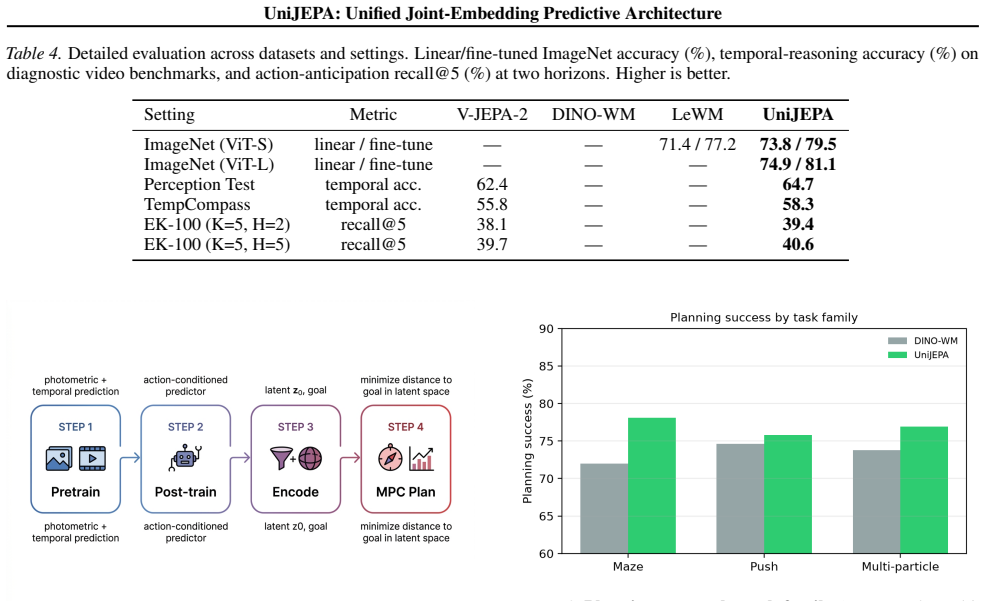
The central claim is that a single joint-embedding predictive architecture can learn both image-level and video-level world models in one shared latent space by optimizing $L = L_{\text{photo}} + L_{\text{temp}} + \alpha R$, where $L_{\text{photo}}$ matches a predictor's output to the embedding of a photometrically transformed image, $L_{\text{temp}}$ matches it to the next video frame's embedding, and $R(\theta) = \mathbb{E}_{x,u}[\chi^2_1((u^T z)^2)]$ is a Gaussian regularizer over random projections of the latent. The paper argues that minimizing $R$ rules out collapse: Theorem 3.1 claims that if $R \le \epsilon$, the encoder cannot be constant and the latent covariance has minimum eigenvalue at least $1-O(\epsilon)$. On this basis it asserts that raw-pixel, end-to-end training works without EMA, stop-gradient, or pre-trained encoders, that the same latent space provides controllable abstraction, and that after freezing the encoder and post-training only the predictor on offline trajectories, model-predictive control can reach goal features without rewards. Empirically, the paper reports 74.9 ImageNet linear probe, 78.1 SSv2 top-1, 40.6 EK-100 recall@5, 75.8% planning success, and a 44$\times$ planning speedup.
Load-bearing premise
The proof's load-bearing step is the claim that keeping every random projection of the latent close to a standard normal, on average, forces each projection's variance to be near 1 and therefore forces the latent covariance's smallest eigenvalue to stay above $1-O(\epsilon)$; the paper asserts this implication without deriving it, and on that assertion rests the 'provably anti-collapse' guarantee.
Editorial extensions
If this is right
- A single pretrained model can produce representations for image recognition, video understanding, and control without changing the objective or the encoder, eliminating the current fragmentation of JEPA recipes.
- JEPA training becomes a one-hyperparameter problem: a scalar regularizer weight $\alpha$ replaces tuned recipes of momentum targets, stop-gradients, and loss weights.
- Planning can be done by latent-space rollouts, making zero-shot goal-reaching substantially cheaper than pixel-generating world models at comparable success rates.
- The invariance–equivariance balancing knob (weighting $L_{\text{photo}}$ versus $L_{\text{temp}}$) gives a practical way to control the abstraction level of a representation for a given downstream task.
- The anti-collapse claim, if correct, extends beyond vision: the same regularizer could stabilize any joint-embedding predictive training from raw inputs without collapse heuristics.
Reading between the lines
- The paper's theory and its empirical check of the regularizer are separable: the ablation with $\alpha=0$ collapses the latent to rank 3, which supports the regularizer's practical necessity, but the exact covariance lower bound claimed by Theorem 3.1 is a stronger statement that the paper does not actually verify by measuring $\lambda_{\min}$.
- If the unification holds, the natural next step is to add a textual or categorical conditioning channel to the same shared latent space, which the paper lists as future work and which would move UniJEPA toward vision-language-action agents.
- The reported 44$\times$ planning speedup suggests that making the world model latent, rather than pixel-based, is the main efficiency lever; the same benefit should transfer to longer-horizon tasks as long as predictor error stays low, which the paper's qualitative failure analysis indicates is the key limitation.
Editorial analysis
A structured set of objections, weighed in public.
Referee Report
Summary. UniJEPA proposes a unified Joint-Embedding Predictive Architecture trained end-to-end from raw pixels with a single objective combining photometric prediction (image-level transformations) and temporal prediction (video-level next-state dynamics) plus a Gaussian regularizer. After action-conditioned post-training on offline trajectories, the same latent space is used for zero-shot goal-conditioned planning via latent-space MPC. The paper claims a provable anti-collapse guarantee (Theorem 3.1), a controllable invariance–equivariance spectrum, and benchmark results matching or exceeding task-specific JEPAs (e.g., 74.9 ImageNet linear probe, 78.1 Something-Something-v2, 40.6 EK-100 recall@5, and 75.8% planning success with a 44× speedup).
Significance. If the empirical results are robust, the main contribution is a genuinely useful simplification: one shared encoder–predictor trained with one loss hyperparameter that supports image-level invariance, video-level equivariance, and planning, without EMA or stop-gradient. The evaluation spans image, video, and control, and the writing is clear. The paper's strength is the unified objective; its weakness is that the advertised theoretical guarantee (Theorem 3.1) is not supported by the proof as written, and the empirical claims lack uncertainty quantification. The significance is therefore conditional on a major revision that corrects the theorem and strengthens the evaluation protocol.
major comments (5)
- [§3.3, Eq. (3), Appendix C] Section 3.3, Eq. (3), and Appendix C: the proof of Theorem 3.1 jumps from a small average χ² divergence over random unit vectors u to a uniform lower bound on every projection, but the conclusion does not follow from the stated assumption. For z∼N(0,Σ) with Σ=diag(1,…,1,0) in dimension d, the average squared deviation E_u[(Var(u^T z)−1)^2] equals E[u_d^4] = 3/[d(d+2)] = O(1/d^2), so R can be arbitrarily small in large d while λ_min(Σ)=0, directly contradicting the claimed λ_min≥1−O(ε). The sentence in Appendix C—'therefore any finite R≤ε implies all projections have variance bounded away from zero'—is exactly the invalid pointwise inference. The theorem must be removed, weakened to an average-projection statement, or proved under a stronger assumption such as a supremum over u.
- [Appendix A] Appendix A: the regularizer is estimated on only 512 random projections per batch, so even a corrected pointwise-in-u theorem would not apply to the trained encoder; R≤ε says nothing about directions outside this finite set. To connect theory and practice, the paper should either state the guarantee in terms of the average over the sampled projections or provide a covering argument that makes the finite-sample bound explicit.
- [§4.1, Tables 1–4] Section 4.1 and Appendix A: all experiments use a single fixed random seed and Tables 1–4 report point estimates without error bars. The headline margins over strong baselines are small (78.1 vs 77.3 on SSv2, 40.6 vs 39.7 on EK-100), so the 'matches or surpasses' claim is not yet supported. Report means and standard deviations over at least three seeds, and specify the seed.
- [§4.4, Table 3] Section 4.4, Table 3: the MPC horizon H=5 and candidate count C=64 used in the headline Table 1 results are selected on the same planning benchmark as the reported 75.8% success, making the number partially a test-set artifact. Report the selection procedure or validate the chosen configuration on held-out tasks.
- [Table 2] Table 2 and the surrounding text: the α=0 collapse is presented as empirical validation of Theorem 3.1, but removing the regularizer does not test the theorem's premise R≤ε. More importantly, the α=0.5α* row reports latent rank 0.6d, which shows that the regularizer does not always prevent partial collapse in the regime used for the main results; this tension should be discussed and reconciled with the claimed guarantee.
minor comments (4)
- [Eq. (3)] Equation (3): the notation χ²_1((u^T z)^2) is unclear; χ²_1 should be applied to a standardized random variable or distribution, not to the squared projection. Please define the divergence explicitly.
- [§4.4, §4.6] The manuscript contains two unresolved figure placeholders ('Figure ??' in Section 4.4 and Section 4.6); these should be filled before publication.
- [Table 4] Table 4: the ViT-Large row for UniJEPA repeats the full-model numbers (74.9/81.1, 78.1, 75.8), which appears to be a typo; if ViT-Large is the full model, state so explicitly.
- [Appendix A] Appendix A says the random seed is fixed but does not report its value or how many seeds were used; include this information for reproducibility.
Circularity Check
No significant circularity: the empirical results are externally benchmarked, the regularizer is adopted from a non-overlapping prior work, and the theorem's flaw is a proof gap rather than a reduction-by-construction.
full rationale
UniJEPA's central empirical claims—ImageNet linear probe, SSv2/EK-100 accuracy, planning success and speed—are compared against external baselines and datasets, and the ablations (Table 2) include collapse and under-regularization conditions, so the headline results are not fitted inputs masquerading as predictions. The Gaussian regularizer R(theta) is adopted from LeWorldModel (Maes et al., 2026), which has no author overlap with this paper; introducing it by citation is therefore not a self-citation chain. No load-bearing premise is justified solely by this paper's own prior work, and no uniqueness theorem is imported from the authors. Theorem 3.1 is not circular in the reduction-to-input sense: the proof contains an apparent quantifier gap (R is an expectation over u, while the conclusion requires a uniform bound over all u; Appendix A's 512-projection estimator further weakens any pointwise guarantee), but that is a mathematical-rigor/correctness problem, not an equivalence-by-construction or fitted-parameter-as-prediction problem. The invariance-equivariance discussion simply names what each loss term encourages, rather than hiding an input inside an output. Since no circular step can be quoted and exhibited, the appropriate finding is no significant circularity.
Assumptions & free parameters
free parameters (4)
- regularizer weight α =
α* (exact value not reported; ablated as 0.5α* and 2α*)
- MPC horizon H =
5
- candidate rollouts C =
64
- random projections for regularizer =
512
assumptions (4)
- standard math Minimizing the average χ² divergence of random projections suffices to make the latent distribution approximately standard Gaussian (Cramér-Wold-type argument from LeWorldModel).
- domain assumption The predictor gψ has bounded Lipschitz constant and the encoder is continuous (Theorem 3.1 assumptions).
- domain assumption Photometric and temporal prediction objectives can be combined by simple summation without harmful interference.
- domain assumption Offline trajectories and visual-goal protocol match DINO-WM's setup, making planning success comparable to prior work.
Cite this review
Pith. "Pith review of UniJEPA: A Unified Joint-Embedding Predictive Architecture for Task-Agnostic Visual World Modeling." pith.science (2026). https://pith.science/paper/MMRA2ANM
@misc{pith2026260807409,
  author       = {Pith},
  title        = {Pith review of: UniJEPA: A Unified Joint-Embedding Predictive Architecture for Task-Agnostic Visual World Modeling},
  year         = {2026},
  howpublished = {\url{https://pith.science/paper/MMRA2ANM}},
  note         = {Machine review of arXiv:2608.07409}
}
read the original abstract
Joint-Embedding Predictive Architectures (JEPAs) have emerged as a principled framework for self-supervised learning of world models in compact latent spaces, yet existing methods are fragmented: some predict masked parts of a single image in latent space (I-JEPA), others learn to predict global photometric transformations (Image World Models), while video-scale JEPAs predict future temporal states and are post-trained for action-conditioned planning (V-JEPA~2, DINO-World, DINO-WM). These objectives are treated as distinct recipes with separate encoders, predictors, and anti-collapse regularizers, hindering a single model from unifying image-level and video-level world modeling. We present UniJEPA, a unified JEPA that jointly learns photometric prediction (image-level transformations) and temporal prediction (video-level next-state dynamics) in one shared latent space. A single end-to-end objective, composed of a next-embedding prediction loss and a Gaussian regularizer, yields a provably anti-collapse encoder-predictor pair trainable from raw pixels without EMA, stop-gradient, or pre-trained encoders. We show that the same latent space supports controllable abstraction: photometric prediction learns invariant structure while temporal prediction learns equivariant dynamics. After action-conditioned post-training on offline trajectories, UniJEPA enables zero-shot planning by treating goal features as prediction targets. On image, video, and control benchmarks, UniJEPA matches or surpasses task-specific JEPAs while requiring a single loss hyperparameter, and plans up to tens of times faster than generative world models at comparable accuracy.
Figures


Figures from the paper (3 more)


Reference graph
Works this paper leans on
-
[4]
Brohan, A., Brown, N., Carbajal, J., et al. Rt-2: Vision- language-action models transfer web knowledge to robotic control.arXiv preprint arXiv:2307.15818,
-
[6]
Garrido, Q., Assran, M., Ballas, N., Bardes, A., Najman, L., and LeCun, Y . Learning and leveraging world mod- els in visual representation learning.arXiv preprint arXiv:2403.00504,
-
[9]
Maes, L., Le Lidec, Q., Scieur, D., LeCun, Y ., and Balestriero, R. Leworldmodel: Stable end-to-end joint- embedding predictive architecture from pixels.arXiv preprint arXiv:2603.19312,
-
[11]
Yang, P., Jing, H., Chao, J., Xiang, T., Lin, L., Hu, Y ., Luo, Y ., and Ma, Y . Muse: Resolving manifold misalignment in visual tokenization via topological orthogonality.arXiv preprint arXiv:2605.05646, 2026a. Yang, P., Jing, H., Zheng, N., and Ma, Y . Instrucrobo: Object-centric multi-instruction decoupling model for ex- plainable robotic manipulation....
-
[12]
Zhou, G., Pan, H., LeCun, Y ., and Pinto, L. Dino-wm: World models on pre-trained visual features enable zero- shot planning.arXiv preprint arXiv:2411.04983,
-
[13]
10 UniJEPA: Unified Joint-Embedding Predictive Architecture A. Implementation Details We use a ViT-Small/16 encoder (15M parameters) for control and ViT-Large for large-scale image/video representation. The predictor is a lightweight MLP/ViT. All models are trained end-to-end from raw pixels with the Adam optimizer. For photometric prediction we use brigh...
work page 2023
-
[2017]
Yang, L. et al. World model on million-length video and language with ring attention.arXiv preprint arXiv:2402.08268,
-
[2019]
Mastering diverse domains through world models.arXiv preprint arXiv:2301.04104,
Hafner, D., Pasukonis, J., Ba, J., and Lillicrap, T. Mastering diverse domains through world models.arXiv preprint arXiv:2301.04104,
Show all 13 references
- [2020]
-
[2021]
8 UniJEPA: Unified Joint-Embedding Predictive Architecture Chen, H. et al. Openvla: An open-source vision-language- action model.arXiv preprint arXiv:2406.09246,
-
[2022]
Back to the features: Dino as a foundation for video world models.arXiv preprint arXiv:2507.19468,
Baldassarre, F., Szafraniec, M., Terver, B., Khalidov, V ., Massa, F., LeCun, Y ., Labatut, P., Seitzer, M., and Bo- janowski, P. Back to the features: Dino as a foundation for video world models.arXiv preprint arXiv:2507.19468,
-
[2023]
V-jepa 2: Self-supervised video models enable understanding, prediction and planning.arXiv preprint arXiv:2506.09985,
Assran, M., Bardes, A., Fan, D., Garrido, Q., Howes, R., Komeili, M., Muckley, M., Rizvi, A., Roberts, C., Sinha, K., et al. V-jepa 2: Self-supervised video models enable understanding, prediction and planning.arXiv preprint arXiv:2506.09985,
-
[2024]
Blattmann, A. et al. Stable video diffusion: Scaling latent video diffusion models to large datasets.arXiv preprint arXiv:2311.15127,
Reviewed August 10, 2026 · model on record in the stance chip above.
Discussion (0). Continue with ORCID to comment.