Dynamical quasinormal mode excitation II: propagation and convergence in Schwarzschild
Pith reviewed 2026-05-20 16:21 UTC · model grok-4.3
The pith
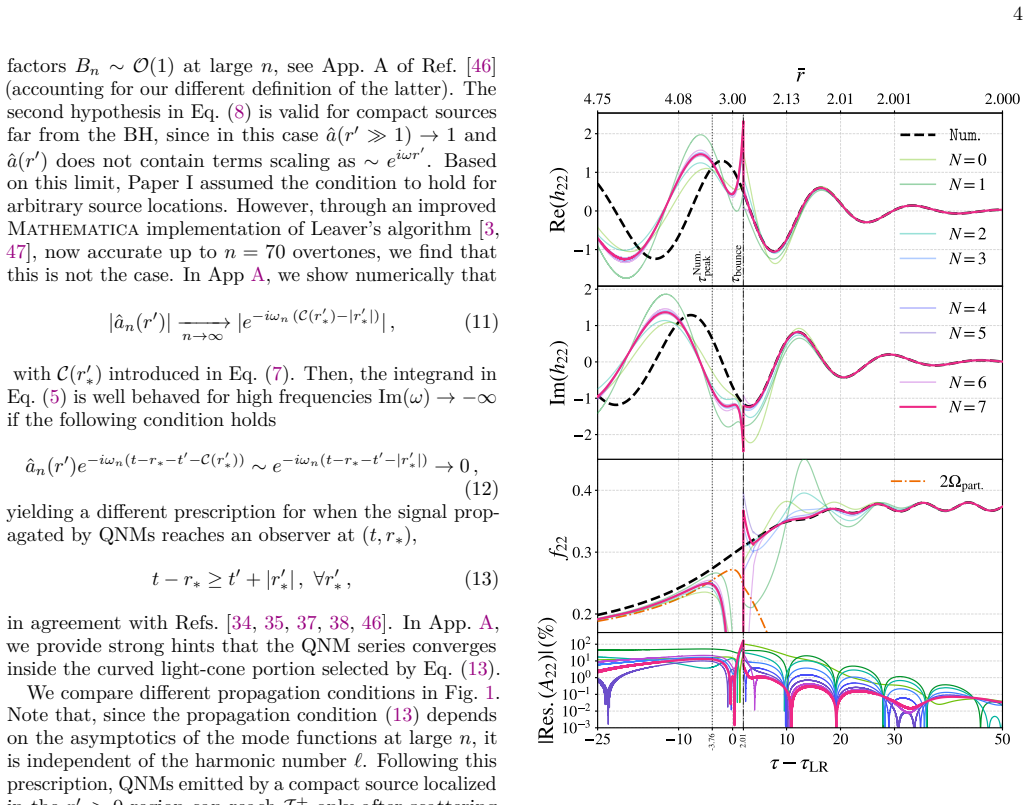
Refined propagation rule for quasinormal modes lets their sum match the oscillatory waveform after a particle crosses the bounce radius during a Schwarzschild plunge.
A machine-rendered reading of the paper's core claim, the machinery that carries it, and where it could break.
Core claim
Investigating the high-frequency behavior of Leaver's QNM solutions yields a more accurate and general prescription for their propagation. Applying the formalism of Paper I to inspiralling particles with this refined prescription produces a QNM signal that accurately reproduces the oscillatory component of the waveform after the bounce crossing, yielding an essentially complete first-principles description of the waveform from shortly after the signal peak. The dynamical QNM signal undergoes a transition as the particle crosses the bounce radius: from a quasi-resonant regime, where successive overtones are driven in counter-phase and interfere destructively, to a free-oscillator regime where
What carries the argument
The bounce radius r_* = 0, the characteristic radius for QNM excitation that decides whether the signal scatters before reaching the observer or propagates directly on the light cone.
If this is right
- The QNM signal accurately reproduces the oscillatory component of the waveform after the bounce crossing.
- This supplies an essentially complete first-principles description of the waveform from shortly after the signal peak.
- The dynamical QNM signal transitions from a quasi-resonant regime with destructive overtone interference to a free-oscillator regime with rapid convergence upon crossing the bounce radius.
- Successive overtones are driven in counter-phase before the crossing and in phase afterward.
- The results furnish a clear physical interpretation of collective QNM behavior during the plunge and a theoretical foundation for ringdown modelling.
Where Pith is reading between the lines
- The same propagation prescription and regime transition may apply to spinning black holes once the corresponding Leaver solutions are analyzed.
- The rapid convergence after the bounce suggests that accurate late-time ringdown models need fewer overtones once the particle has crossed r_* = 0.
- Direct tests against numerical-relativity waveforms for extreme-mass-ratio inspirals could validate the predicted change in interference pattern at the bounce radius.
Load-bearing premise
The high-frequency behavior of Leaver's QNM solutions supplies a more accurate and general prescription for their propagation that can be applied directly to inspiralling particles.
What would settle it
A direct numerical comparison of the summed QNM waveform (using the refined high-frequency propagation rule) against the exact computed waveform for a specific inspiralling trajectory, testing whether the oscillatory components match immediately after the bounce radius crossing.
Figures



read the original abstract
We study the dynamical excitation of quasinormal modes (QNMs) during the plunge of a particle into a Schwarzschild black hole, building on the framework of Phys. Rev. D 113 (2026) 2, 024048 (Paper I). Investigating the high-frequency behavior of Leaver's QNM solutions, we obtain a more accurate and general prescription for their propagation. We confirm the existence of a new "characteristic radius" for QNM excitation, the bounce radius $r_*=0$, in agreement with recent literature. To its right, the QNM signal scatters off this point before reaching the observer; to its left, it propagates directly on the light-cone. Applying the formalism of Paper I to inspiralling particles, and using this refined prescription, we obtain a QNM signal that accurately reproduces the oscillatory component of the waveform after the bounce crossing, yielding an essentially complete first-principles description of the waveform from shortly after the signal peak. The dynamical QNM signal undergoes a transition as the particle crosses the bounce radius: from a quasi-resonant regime, where successive overtones are driven in counter-phase and interfere destructively, to a free-oscillator one, where they are in phase and the QNM sum converges rapidly. These results provide a clear physical interpretation of the collective QNM behavior during the plunge, and a firm theoretical foundation for accurate ringdown modelling.
Editorial analysis
A structured set of objections, weighed in public.
Referee Report
Summary. This paper extends the dynamical QNM excitation framework of Paper I to the plunge of a particle into a Schwarzschild black hole. By analyzing the high-frequency asymptotics of Leaver's QNM solutions, the authors derive a refined propagation rule centered on a characteristic 'bounce radius' at r_*=0: QNMs scatter off this radius when excited to its right and propagate on the light cone when excited to its left. Applying the updated prescription to inspiralling sources, they report that the resulting QNM sum accurately reproduces the oscillatory part of the waveform after the bounce crossing, furnishing an essentially complete first-principles description from shortly after the peak. They further identify a dynamical transition from a quasi-resonant regime (destructive overtone interference) to a free-oscillator regime (constructive interference and rapid convergence) as the particle crosses r_*=0.
Significance. If the central claims are substantiated, the work supplies a concrete physical mechanism for QNM excitation and propagation during the late inspiral-plunge, including the role of the bounce radius and the collective behavior of overtones. This interpretation could improve ringdown templates for gravitational-wave astronomy and offers a clear route toward first-principles waveform modeling beyond the peak. The confirmation of r_*=0 aligns with independent recent results, and the regime-transition picture is a useful conceptual advance.
major comments (3)
- [§4 and abstract] §4 (Application to inspiralling particles) and the abstract: the central assertion that the QNM signal 'accurately reproduces the oscillatory component' and yields an 'essentially complete first-principles description' is not supported by any quantitative metric (overlap integrals, L2 residuals, phase or amplitude errors, or convergence plots versus full numerical waveforms). Without such diagnostics the strength of the claim cannot be assessed.
- [§3] §3 (High-frequency behavior of Leaver's solutions): the refined propagation prescription is obtained from the high-frequency limit. The manuscript does not demonstrate that the dominant overtones excited by the finite-frequency plunge source satisfy |ω|M ≫ 1, nor does it quantify the size of frequency-dependent corrections to the Green's function or phase accumulation. This directly affects the reported transition from destructive to constructive overtone summation.
- [§5] §5 (Regime transition): the description of the shift from quasi-resonant (counter-phase) to free-oscillator (in-phase) behavior is central to the physical interpretation, yet the explicit phase relations or interference terms in the overtone sum are not written out. An equation showing how the source trajectory crossing r_*=0 flips the relative phases would make the claim verifiable.
minor comments (2)
- [Introduction] The notation r_* for the tortoise coordinate and the precise definition of the bounce radius should be introduced with an equation in the first section rather than assumed from Paper I.
- [Figures] Figure captions should explicitly state which curves correspond to the full waveform, the QNM sum, and the individual overtones so that the visual comparison can be assessed without reference to the text.
Simulated Author's Rebuttal
We thank the referee for the careful reading and constructive comments on our manuscript. We address each major comment in turn below, indicating the revisions we will implement to strengthen the presentation and support for our claims.
read point-by-point responses
-
Referee: [§4 and abstract] §4 (Application to inspiralling particles) and the abstract: the central assertion that the QNM signal 'accurately reproduces the oscillatory component' and yields an 'essentially complete first-principles description' is not supported by any quantitative metric (overlap integrals, L2 residuals, phase or amplitude errors, or convergence plots versus full numerical waveforms). Without such diagnostics the strength of the claim cannot be assessed.
Authors: We agree that quantitative diagnostics would strengthen the central claim. In the revised manuscript we will add overlap integrals, L2 residuals, and pointwise amplitude/phase error measures between the QNM sum and the full numerical waveform for the post-bounce interval. These will appear in §4 together with a supplementary convergence plot versus the number of overtones retained. revision: yes
-
Referee: [§3] §3 (High-frequency behavior of Leaver's solutions): the refined propagation prescription is obtained from the high-frequency limit. The manuscript does not demonstrate that the dominant overtones excited by the finite-frequency plunge source satisfy |ω|M ≫ 1, nor does it quantify the size of frequency-dependent corrections to the Green's function or phase accumulation. This directly affects the reported transition from destructive to constructive overtone summation.
Authors: We acknowledge the need for explicit verification. In the revision we will compute the complex frequencies of the leading overtones excited by the plunge trajectory and show that the dominant contributors satisfy |ω|M ≳ 8. We will also estimate the magnitude of the first sub-leading correction to the phase accumulation from the high-frequency expansion of Leaver's solutions, confirming that it remains small enough not to change the reported interference transition. revision: yes
-
Referee: [§5] §5 (Regime transition): the description of the shift from quasi-resonant (counter-phase) to free-oscillator (in-phase) behavior is central to the physical interpretation, yet the explicit phase relations or interference terms in the overtone sum are not written out. An equation showing how the source trajectory crossing r_*=0 flips the relative phases would make the claim verifiable.
Authors: We thank the referee for this helpful suggestion. We will insert in §5 an explicit expression for the relative phase of each overtone, derived from the sign of the retarded time measured from the bounce radius r_*=0. The added equation will show how the propagation rule produces counter-phase driving to the right of the bounce and in-phase driving to the left, thereby making the transition from destructive to constructive summation directly verifiable. revision: yes
Circularity Check
No significant circularity; extension builds on prior framework but adds independent high-frequency analysis and validation
full rationale
The derivation introduces a new investigation of the high-frequency asymptotics of Leaver's QNM solutions to obtain a refined propagation prescription (scattering at r_*=0 vs. direct light-cone), which is then applied to the Paper I formalism for inspiralling particles. This yields a computed QNM sum that is compared against the waveform's oscillatory part for reproduction, serving as an external check rather than a definitional output. The confirmation of the bounce radius, the quasi-resonant to free-oscillator transition, and the rapid convergence of the overtone sum constitute independent physical content. The self-citation to Paper I is for the base excitation framework but does not reduce the central claims to a tautology or fitted input; the new propagation rule and its application are derived from standard Leaver solutions and numerically validated.
Axiom & Free-Parameter Ledger
axioms (2)
- domain assumption The high-frequency behavior of Leaver's QNM solutions provides a basis for a more accurate and general prescription for their propagation.
- domain assumption The formalism developed in Paper I applies directly to the plunge and inspiralling of particles into a Schwarzschild black hole.
Reference graph
Works this paper leans on
-
[1]
Black hole spectroscopy: from theory to experiment
E. Berti, V. Cardoso, G. Carullo, et al., (2025), arXiv:2505.23895 [gr-qc]
work page internal anchor Pith review Pith/arXiv arXiv 2025
-
[2]
S. Chandrasekhar and S. L. Detweiler, Proc. Roy. Soc. Lond. A344, 441 (1975)
work page 1975
-
[3]
E. W. Leaver, Proc. Roy. Soc. Lond. A402, 285 (1985)
work page 1985
-
[4]
E. W. Leaver, Phys. Rev. D34, 384 (1986)
work page 1986
- [5]
-
[6]
Quasinormal modes of black holes and black branes
E. Berti, V. Cardoso, and A. O. Starinets, Class. Quant. Grav.26, 163001 (2009), arXiv:0905.2975 [gr-qc]
work page internal anchor Pith review Pith/arXiv arXiv 2009
- [7]
-
[8]
Is black-hole ringdown a memory of its progenitor?
I. Kamaretsos, M. Hannam, and B. Sathyaprakash, Phys. Rev. Lett.109, 141102 (2012), arXiv:1207.0399 [gr-qc]
work page internal anchor Pith review Pith/arXiv arXiv 2012
- [9]
-
[10]
V. Baibhav, M. H.-Y. Cheung, E. Berti, V. Cardoso, G. Carullo, R. Cotesta, W. Del Pozzo, and F. Duque, Phys. Rev. D 108, 104020 (2023), arXiv:2302.03050 [gr-qc]
-
[11]
K. Mitman et al., Phys. Rev. D112, 064016 (2025), arXiv:2503.09678 [gr-qc]
-
[12]
S. Albanesi, S. Bernuzzi, T. Damour, A. Nagar, and A. Placidi, Phys. Rev. D108, 084037 (2023), arXiv:2305.19336 [gr-qc]
-
[13]
G. Faggioli, A. Buonanno, M. van de Meent, and G. Khanna, (2026), arXiv:2603.19913 [gr-qc]
-
[14]
S. Albanesi, S. Bernuzzi, and A. Nagar, (2026), arXiv:2603.19413 [gr-qc]
-
[15]
A new effective-one-body description of coalescing nonprecessing spinning black-hole binaries
T. Damour and A. Nagar, Phys. Rev. D90, 044018 (2014), arXiv:1406.6913 [gr-qc]
work page internal anchor Pith review Pith/arXiv arXiv 2014
-
[16]
A. Boh´ eet al., Phys. Rev. D95, 044028 (2017), arXiv:1611.03703 [gr-qc]
work page internal anchor Pith review Pith/arXiv arXiv 2017
-
[17]
A. Nagar et al., Phys. Rev. D98, 104052 (2018), arXiv:1806.01772 [gr-qc]
work page internal anchor Pith review Pith/arXiv arXiv 2018
-
[18]
R. Cotesta, A. Buonanno, A. Boh´ e, A. Taracchini, I. Hinder, and S. Ossokine, Phys. Rev. D98, 084028 (2018), arXiv:1803.10701 [gr-qc]
- [19]
- [20]
-
[21]
H. Estell´ es, A. Ramos-Buades, S. Husa, C. Garc´ia-Quir´ os, M. Colleoni, L. Haegel, and R. Jaume, Phys. Rev. D103, 124060 (2021), arXiv:2004.08302 [gr-qc]
-
[22]
H. Estell´ es, S. Husa, M. Colleoni, D. Keitel, M. Mateu-Lucena, C. Garc´ia-Quir´ os, A. Ramos-Buades, and A. Borchers, Phys. Rev. D105, 084039 (2022), arXiv:2012.11923 [gr-qc]
- [23]
-
[24]
L. Pompili et al., Phys. Rev. D108, 124035 (2023), arXiv:2303.18039 [gr-qc]
- [25]
- [26]
- [27]
-
[28]
L. K¨ uchler, G. Comp` ere, and A. Pound, (2025), arXiv:2506.02189 [gr-qc]
-
[29]
M. De Amicis, E. Cannizzaro, G. Carullo, and L. Sberna, Phys. Rev. D113, 024048 (2026), arXiv:2506.21668 [gr-qc]
-
[30]
Gravitational Radiation from Plunging Orbits - Perturbative Study -
Y. Mino and J. Brink, Phys. Rev. D78, 124015 (2008), arXiv:0809.2814 [gr-qc]
work page internal anchor Pith review Pith/arXiv arXiv 2008
-
[31]
New Generic Ringdown Frequencies at the Birth of a Kerr Black Hole
A. Zimmerman and Y. Chen, Phys. Rev. D84, 084012 (2011), arXiv:1106.0782 [gr-qc]
work page internal anchor Pith review Pith/arXiv arXiv 2011
- [32]
- [33]
-
[34]
Green function of the P\"{o}schl-Teller potential
A. Kuntz, SciPost Phys.20, 120 (2026), arXiv:2510.17954 [gr-qc]
work page internal anchor Pith review Pith/arXiv arXiv 2026
-
[35]
Beyond quasinormal modes: a complete mode decomposition of black hole perturbations,
P. Arnaudo, J. Carballo, and B. Withers, (2025), arXiv:2510.18956 [gr-qc]
- [36]
- [37]
-
[38]
The Branch Cut and Quasi-normal Modes at Large Imaginary Frequency in Schwarzschild Space-time
M. Casals and A. Ottewill, Phys. Rev. D86, 024021 (2012), arXiv:1112.2695 [gr-qc]
work page internal anchor Pith review Pith/arXiv arXiv 2012
-
[39]
Binary black hole merger in the extreme mass ratio limit
A. Nagar, T. Damour, and A. Tartaglia, Class. Quant. Grav.24, S109 (2007), arXiv:gr-qc/0612096
work page internal anchor Pith review Pith/arXiv arXiv 2007
-
[40]
Binary black hole merger in the extreme-mass-ratio limit: a multipolar analysis
S. Bernuzzi and A. Nagar, Phys. Rev. D81, 084056 (2010), arXiv:1003.0597 [gr-qc]
work page internal anchor Pith review Pith/arXiv arXiv 2010
-
[41]
S. Bernuzzi, A. Nagar, and A. Zenginoglu, Phys. Rev. D84, 084026 (2011), arXiv:1107.5402 [gr-qc]
work page internal anchor Pith review Pith/arXiv arXiv 2011
-
[42]
M. De Amicis, S. Albanesi, and G. Carullo, Phys. Rev. D110, 104005 (2024), arXiv:2406.17018 [gr-qc]
-
[43]
M. De Amicis and E. Cannizzaro, (2026), arXiv:2601.11706 [gr-qc]
-
[44]
R. H. Price, Phys. Rev. D5, 2419 (1972)
work page 1972
-
[45]
An analytical computation of asymptotic Schwarzschild quasinormal frequencies
L. Motl, Adv. Theor. Math. Phys.6, 1135 (2003), arXiv:gr-qc/0212096
work page internal anchor Pith review Pith/arXiv arXiv 2003
-
[46]
Quasinormal ringing of Kerr black holes: The excitation factors
E. Berti and V. Cardoso, Phys. Rev. D74, 104020 (2006), arXiv:gr-qc/0605118
work page internal anchor Pith review Pith/arXiv arXiv 2006
- [47]
-
[48]
Prompt Response from Plunging Sources in Schwarzschild Spacetime
S. Ma, (2026), arXiv:2604.08680 [gr-qc]
work page internal anchor Pith review Pith/arXiv arXiv 2026
-
[49]
M. Giesler, M. Isi, M. A. Scheel, and S. Teukolsky, Phys. Rev. X9, 041060 (2019), arXiv:1903.08284 [gr-qc]
-
[50]
M. Giesler et al., Phys. Rev. D111, 084041 (2025), arXiv:2411.11269 [gr-qc]
- [51]
-
[52]
SFI,https://www.sfi.org.bm/
-
[53]
SF,https://www.simonsfoundation.org/
discussion (0)
Sign in with ORCID, Apple, or X to comment. Anyone can read and Pith papers without signing in.