REVIEW 2 major objections 6 minor 47 references
Moat hyperons in cold neutron stars
T0 review · 2 major / 6 minor · reviewed 2026-08-06 · deepseek-v4-flash
Pith's one-line read In the NLD model of dense matter, Sigma^- hyperons fill a high-momentum moat rather than a Fermi sphere, which suppresses Lambda hyperons and flattens the speed of sound.
desk verdict A genuinely new treatment of fragmented Fermi spheres in the NLD model, but the headline moat-hyperon phenomenon rests on a ~0.2 MeV threshold window while the calculation omits muons, which shift chemical potentials by tens of MeV. read the letter →
The pith
A machine-rendered reading of the paper's core claim, the machinery that carries it, and where it could break.
The reading
What carries the argument
The machinery is the momentum-dependent regulator form factor $D(p)=\Lambda_2^2/(\Lambda_1^2+\vec p^{\,2})$ that enters the NLD mean-field self-energies. It makes the effective mass and the single-particle energy $E_b(p)=\sqrt{m_b^{*2}(p)+p^2}+V_b(p)$ momentum dependent in a way that can turn the dispersion non-monotonic. The paper then replaces the single Fermi momentum with the set of crossings between $E_b(p)$ and the species chemical potential, integrating the occupied momentum intervals as in Eqs. (10)–(11). For the Sigma^- this yields a moat: the lowest-energy state lies at finite momentum, and all occupied states form a narrow high-momentum shell.
What would settle it
Recompute $\beta$-stable matter with the lower-limit parameter set of the same NLD model: if the Sigma^- dispersion remains monotonic there, the moat and its predicted Lambda suppression and flat speed of sound vanish. A neutron-star constraint that forces the speed of sound to keep rising through the densities near $0.8$ fm$^{-3}$ would similarly contradict the flat segment.
Extended reading notes
Core claim
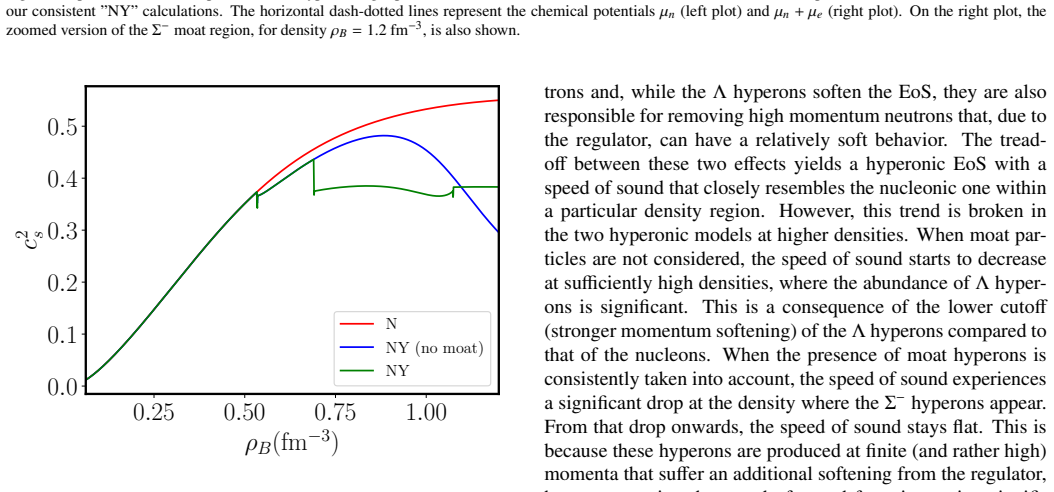
The central claim is that in the NLD model, the single-particle energy of the Sigma^- hyperon in $\beta$-stable matter is non-monotonic in momentum: $E_{\Sigma^-}(p)$ falls from $p=0$, reaches a minimum at $p \gtrsim 500$ MeV, and then rises. Once the threshold $\mu_n+\mu_e$ crosses this spectrum, the occupied states form a narrow interval of finite momenta, not a filled sphere from zero up to a Fermi momentum. At $\rho_B\sim 1.2$ fm$^{-3}$ this moat layer is less than 50 MeV wide in momentum and spans only about 0.2 MeV in energy, yet it can hold up to 20% of the baryons. The same non-monotonicity also gives the Lambda hyperon an onion-like occupation with alternating filled and empty momentum regions. Accounting for this fragmentation reverses the naive composition: the Sigma^- appears and the Lambda, which dominates under the standard Fermi-sphere treatment, is driven out of matter. The paper further shows that the speed of sound then stays flat from the Sigma^- onset upward, and that mass-radius curves remain almost unchanged below about 1.9 solar masses.
Load-bearing premise
The moat appears because the adopted cutoff parameters make the Sigma^- single-particle energy non-monotonic; if the true in-medium hyperon-meson cutoffs or couplings differ from that set, the finite-momentum minimum and the associated composition changes could disappear.
Editorial extensions
If this is right
- The usual onset condition $E_Y(p=0)=\mu_Y$ is not reliable for momentum-dependent interactions; it can both miss moat states and predict spurious abundances.
- In the consistent NLD calculation the Sigma^- appears at $\rho_B\simeq 0.75$\u2013$0.8$ fm$^{-3}$ and reaches about 20% of the baryons at $1.2$ fm$^{-3}$, while Lambda hyperons are suppressed and gone by that density.
- The speed of sound drops at the Sigma^- onset and then stays flat, a distinctive signature that separates the consistent treatment from both the nucleonic and the no-moat hyperonic equations of state.
- Mass-radius relations stay almost unchanged below about 1.9 solar masses, so static neutron star observations alone will not easily reveal the moat composition.
- The fragmented-Fermi-sea integration method is transferable: any framework with momentum-dependent self-energies should apply it when solving for the composition of dense matter.
Reading between the lines
- A systematic scan over the allowed cutoff band of the NLD model would show whether the Sigma^- moat is generic or an artifact of the upper-limit parameter set adopted here; the paper does not perform that scan.
- Because the moat shell spans only about 0.2 MeV in energy, these hyperons form a nearly degenerate layer whose thermal and transport response (specific heat, conductivity, neutrino emissivity) should differ markedly from a conventional Fermi sea; this is a testable extension.
- Finite-temperature generalization, which the paper calls for, could make the moat visible in merger or proto-neutron-star signals, since thermal broadening of a thin momentum shell produces different thermodynamics than a filled sphere.
- If the moat is real, hyperon 'onset density' statements should be replaced by occupation-topology statements: a species can be abundant even when its zero-momentum state is forbidden.
Editorial analysis
A structured set of objections, weighed in public.
Referee Report
Summary. The paper studies the hyperonic equation of state in the Non-Linear Derivative (NLD) model, where baryon self-energies are momentum dependent. It formulates the zero-temperature occupation rule for non-monotonic single-particle spectra, obtaining fragmented Fermi-sea integrals (Eqs. 10-11), and applies this to beta-stable matter containing Lambda and Sigma^- hyperons, with electrons as the only leptons. Three calculations are compared: nucleons only, hyperons treated with the standard Fermi-sphere prescription, and hyperons with the consistent fragmented occupation. The central finding is that Sigma^- hyperons appear as 'moat particles' at finite momentum p >~ 500 MeV in a narrow energy window (about 0.2 MeV at rho_B = 1.2 fm^-3), which suppresses Lambda hyperons, flattens the speed of sound, and leaves the mass-radius relation largely unchanged.
Significance. If the result holds, it would be a novel and conceptually interesting ground-state phenomenon: a hyperonic species occupying a finite-momentum shell while low-momentum states are empty, with nontrivial consequences for the composition and equation of state of neutron star matter. The methodological point that Fermi-sea fragmentation must be treated consistently when dispersion relations are non-monotonic is sound and transferable beyond the NLD model. The three-way comparison (N, NY-no-moat, NY) is a clean way to isolate the effect, and the paper is concise. However, the quantitative claim is currently tied to one adopted parameter set and to an electron-only treatment of leptons; as a statement about real cold neutron stars, its significance is not yet established.
major comments (2)
- [Sec. 2 (leptonic sector) and Fig. 3] The central physical claim is that Sigma^- hyperons appear as moat particles only when mu_n + mu_e falls within the narrow energy window around the finite-momentum minimum of E_Sigma(p), which is only about 0.2 MeV wide at rho_B = 1.2 fm^-3 (Fig. 3 inset). The calculation explicitly treats electrons as the only leptons. At the densities considered (rho_B ~ 0.75-1.2 fm^-3), mu_e is far above the muon mass, so muons are certainly present; including them changes the charge-neutrality condition to n_p = n_e + n_mu + n_Sigma and can shift mu_e by tens of MeV relative to the electron-only calculation for a given proton fraction. That shift is orders of magnitude larger than the 0.2 MeV moat window, so with muons the threshold mu_n + mu_e could lie below the dispersion minimum (no Sigma^-) or above E_Sigma(0) (Sigma^- filled from p = 0, no moat). The manuscript provides neither a muon-included calculation nor a rough estimate of the threshold shift, so the moat-hyperon composition claim is not demonstrated for the physical system the paper claims to describe.
- [Sec. 2 (model parameters) and Fig. 3] The non-monotonic Sigma^- dispersion that produces the moat is inherited from a single parameter set (SET I of Ref. [23], specifically the upper-limit band), and no sensitivity study is performed. Because the moat occupies an energy window of only ~0.2 MeV and a momentum layer of less than 50 MeV, modest changes in the cutoff parameters Lambda_1 and Lambda_2 or in the hyperon couplings could either move the threshold outside the window or restore a monotonic spectrum. Since the paper's central compositional prediction hinges on this narrow crossing, the authors should quantify how robust the moat is across the parameter band of the NLD model, or at minimum state clearly that the result is a single-parameter-set prediction rather than a robust model feature.
minor comments (6)
- [Sec. 2] The sentence 'In matter we consider electrons as the only leptons present' should be flagged as an approximation, with a discussion of its expected impact, especially because the title and abstract make claims about cold neutron stars.
- [Fig. 1 caption] The statement that the electron abundance differs from the proton abundance only when Sigma^- is present is true only in the electron-only calculation; it should be rephrased to avoid implying that this is a general property of beta-stable matter.
- [Throughout] The text contains several rendering artifacts and typos, including 'fm□3', 'di fferent', and 'tread-off'; these should be corrected in the final version.
- [Sec. 3] The discussion comparing the 'NY (no moat)' results with Ref. [23] would be clearer if the difference above rho_B ~ 0.95 fm^-3 were attributed explicitly to the different treatment of the Fermi surface rather than presented as an unexplained inconsistency in the earlier work.
- [Sec. 3 and Fig. 5] The conclusion that mass-radius observations cannot help distinguish the compositions should be explicitly restricted to the NLD model with the chosen parameter set, as other hyperonic equations of state may produce larger deviations.
- [Sec. 2] The paper would benefit from a short table or appendix listing the SET I parameters and the numerical method used to solve the self-consistent equations, since no code or data repository is provided.
Circularity Check
No significant circularity: the moat-hyperon result is an emergent consequence of the adopted NLD model with externally sourced parameters; self-citations are not load-bearing.
full rationale
The central derivation is self-contained once the NLD model is specified. The non-monotonic baryon dispersion E_b(p) = sqrt((m_b - S_b(p))^2 + p^2) + V_b(p) follows from the regulator form factor D(p) = Lambda_2^2/(Lambda_1^2 + p^2) (Eqs. 3-7), with the parameters adopted from the external SET I model of Ref. [23], itself tuned to chiral-EFT results [27], not to the moat abundance. The fragmented occupation integrals (Eqs. 10-11) are derived from the zero-temperature condition that states with E_b(p) < mu_b are filled, so they are a mathematical consequence of a non-monotonic spectrum rather than an input engineered to produce the Sigma^- moat. Beta equilibrium (Eq. 8), charge neutrality, and baryon number conservation then determine the composition; the finite-momentum occupation of Sigma^- emerges from the self-consistent solution. Self-citations (Refs. [28], [39], [40], [42]) appear only for standard stress-energy-tensor expressions, the M(R) integration software, and suggested future merger/thermal studies; none carries the load of the moat claim. Concerns about the very narrow 0.2 MeV window, the electron-only lepton approximation, or the lack of a parameter sensitivity study are physical robustness and completeness issues, not circularity. No prediction here is equivalent to an input by construction.
Assumptions & free parameters
free parameters (1)
- NLD SET I model parameters (couplings g_sigma,b, g_omega,b, g_rho,b and cutoffs Lambda_1, Lambda_2 for all baryons… =
From Ref [23], SET I, upper limit of the EoS band
assumptions (5)
- domain assumption Mean-field approximation: meson fields are replaced by their classical expectation values in infinite nuclear matter.
- domain assumption The single-particle dispersion E_b(p) = sqrt(m*_b^2 + p^2) + V_b(p) determines the zero-temperature occupation: states with E_b(p) < mu_b are filled.
- domain assumption Weak equilibrium relations (8) and charge neutrality, with electrons as the only leptons.
- domain assumption Only Lambda and Sigma^- hyperons are included; Xi hyperons are excluded.
- ad hoc to paper The parameters of SET I from Ref [23] are adopted without re-fitting or sensitivity analysis, specifically the upper-limit band.
Cite this review
Pith. "Pith review of Moat hyperons in cold neutron stars." pith.science (2026). https://pith.science/paper/MQZMZTRX
@misc{pith2026250707556,
  author       = {Pith},
  title        = {Pith review of: Moat hyperons in cold neutron stars},
  year         = {2026},
  howpublished = {\url{https://pith.science/paper/MQZMZTRX}},
  note         = {Machine review of arXiv:2507.07556}
}
read the original abstract
We investigate the hyperonic equation of state within the non-linear derivative model that incorporates a momentum dependence on the interactions, with a special emphasis on properly establishing the conditions for hyperon appearance in neutron star matter. We demonstrate that hyperons can appear at finite momentum, forming a so-called ``moat" region, even when they are absent at lower momenta. Our study shows that this phenomenon significantly alters the composition and equation of state of hyperonic matter as compared to the cases when it is disregarded, highlighting the importance of accurately treating the momentum dependence of the baryon fields in dense matter.
Figures


Figures from the paper (2 more)

Reference graph
Works this paper leans on
-
[23]
A. Chorozidou, T. Gaitanos, Momentum dependence of in-medium po- tentials: A solution to the hyperon puzzle in neutron stars, Physical Re- view C 109 (2024) L032801. doi:10.1103/PhysRevC.109.L032801. URL https://link.aps.org/doi/10.1103/PhysRevC.109.L032 801
-
[1]
Scha ffner-Bielich, Compact Star Physics, Cambridge University Press,
J. Scha ffner-Bielich, Compact Star Physics, Cambridge University Press,
-
[2]
V . A. Ambartsumyan, G. S. Saakyan, The degenerate superdense gas of elementary particles, Soviet Astronomy 4 (1960) 187
work page 1960
-
[3]
A. Sedrakian, The physics of dense hadronic matter and compact stars, Progress in Particle and Nuclear Physics 58 (1) (2007) 168–246. doi: https://doi.org/10.1016/j.ppnp.2006.02.002. URL https://www.sciencedirect.com/science/article/pii/ S0146641006000226
- [4]
-
[5]
D. Chatterjee, I. Vida ˜na, Do hyperons exist in the interior of neutron stars?, The European Physical Journal A 52 (2) (2016) 29. doi:10.1 140/epja/i2016-16029-x . URL https://doi.org/10.1140/epja/i2016-16029-x
- [6]
-
[7]
Logoteta, Hyperons in Neutron Stars, Universe 7 (11) (2021) 408
D. Logoteta, Hyperons in Neutron Stars, Universe 7 (11) (2021) 408. do i:10.3390/universe7110408
Show all 47 references
-
[8]
Burgio, H.-J
G. Burgio, H.-J. Schulze, I. Vida ˜na, J.-B. Wei, Neutron stars and the nuclear equation of state, Progress in Particle and Nuclear Physics 120 (2021) 103879. doi:https://doi.org/10.1016/j.ppnp.2021.10 3879. URL https://www.sciencedirect.com/science/article/pii/ S0146641021000338
2021 doi
-
[9]
Demorest, T
P. Demorest, T. Pennucci, S. Ransom, M. Roberts, J. Hessels, Shapiro delay measurement of a two solar mass neutron star, Nature 467 (7319) (2010) 1081–1083. doi:10.1038/nature09466. URL http://arxiv.org/abs/1010.5788http://dx.doi.org/1 0.1038/nature09466
2010 arXiv
-
[10]
Antoniadis, et al., A Massive Pulsar in a Compact Relativistic Binary, Science 340 (2013) 6131
J. Antoniadis, et al., A Massive Pulsar in a Compact Relativistic Binary, Science 340 (2013) 6131. arXiv:1304.6875 , doi:10.1126/scienc e.1233232
2013 arXiv
-
[11]
Fonseca, et al., The NANOGrav Nine-year Data Set: Mass and Geo- metric Measurements of Binary Millisecond Pulsars, The Astrophysical Journal 832 (2) (2016) 167
E. Fonseca, et al., The NANOGrav Nine-year Data Set: Mass and Geo- metric Measurements of Binary Millisecond Pulsars, The Astrophysical Journal 832 (2) (2016) 167. arXiv:1603.00545, doi:10.3847/0004 -637X/832/2/167
2016 arXiv
-
[12]
H. T. Cromartie, et al., Relativistic Shapiro delay measurements of an extremely massive millisecond pulsar, Nature Astronomy 4 (1) (2019) 72–76. arXiv:1904.06759, doi:10.1038/s41550-019-0880-2
2019 arXiv
-
[13]
R. W. Romani, D. Kandel, A. V . Filippenko, T. G. Brink, W. Zheng, PSR J0952−0607: The Fastest and Heaviest Known Galactic Neutron Star, The Astrophysical Journal Letter 934 (2) (2022) L17. arXiv:2207.051 24, doi:10.3847/2041-8213/ac8007
2022 doi
-
[14]
Zimanyi, S
J. Zimanyi, S. A. Moszkowski, Nuclear equation of state with derivative scalar coupling, Physical Review C 42 (1990) 1416–1421. doi:10.110 3/PhysRevC.42.1416. URL https://link.aps.org/doi/10.1103/PhysRevC.42.1416
1990 doi
-
[15]
Typel, T
S. Typel, T. v. Chossy, H. H. Wolter, Relativistic mean field model with generalized derivative nucleon-meson couplings, Physical Review C 67 (2003) 034002. doi:10.1103/PhysRevC.67.034002. URL https://link.aps.org/doi/10.1103/PhysRevC.67.03400 2
2003 doi
-
[16]
Typel, Relativistic model for nuclear matter and atomic nuclei with momentum-dependent self-energies, Physical Review C 71 (2005) 064301
S. Typel, Relativistic model for nuclear matter and atomic nuclei with momentum-dependent self-energies, Physical Review C 71 (2005) 064301. doi:10.1103/PhysRevC.71.064301. URL https://link.aps.org/doi/10.1103/PhysRevC.71.06430 1
2005 doi
-
[17]
Gaitanos, M
T. Gaitanos, M. Kaskulov, U. Mosel, Non-linear derivative interactions in relativistic hadrodynamics, Nuclear Physics A 828 (1) (2009) 9–28. doi:https://doi.org/10.1016/j.nuclphysa.2009.06.019. URL https://www.sciencedirect.com/science/article/pii/ S0375947409004229
2009 doi
-
[18]
Gaitanos, M
T. Gaitanos, M. Kaskulov, H. Lenske, How deep is the antinucleon optical potential at fair energies, Physics Letters B 703 (2) (2011) 193–198. URL https://www.sciencedirect.com/science/article/pii/ S0370269311008896
2011
-
[19]
Gaitanos, M
T. Gaitanos, M. Kaskulov, Energy dependent isospin asymmetry in mean- field dynamics, Nuclear Physics A 878 (2012) 49–66. doi:https: //doi.org/10.1016/j.nuclphysa.2012.01.013. URL https://www.sciencedirect.com/science/article/pii/ S0375947412000449
2012 doi
-
[20]
Gaitanos, M
T. Gaitanos, M. Kaskulov, Momentum dependent mean-field dynamics of compressed nuclear matter and neutron stars, Nuclear Physics A 899 (2013) 133–169. doi:https://doi.org/10.1016/j.nuclphysa. 2013.01.002. URL https://www.sciencedirect.com/science/article/pii/ S0375947413000067
2013 doi
-
[21]
Gaitanos, M
T. Gaitanos, M. Kaskulov, Toward relativistic mean-field description of n¯–nucleus reactions, Nuclear Physics A 940 (2015) 181–193. doi:ht tps://doi.org/10.1016/j.nuclphysa.2015.04.006. URL https://www.sciencedirect.com/science/article/pii/ S0375947415001025
2015 doi
-
[22]
Gaitanos, A
T. Gaitanos, A. Chorozidou, Momentum dependent mean-fields of (anti) hyperons, Nuclear Physics A 1008 (2021) 122153
2021
-
[24]
Chorozidou, T
A. Chorozidou, T. Gaitanos, A novel solution to the hyperon-puzzle in neutron stars, EPJ Web of Conferences 304 (2024) 01007. doi:10.105 1/epjconf/202430401007. URL https://doi.org/10.1051/epjconf/202430401007
2024
-
[25]
Duerr, Relativistic e ffects in nuclear forces, Physical Review 103 (1956) 469–480
H.-P. Duerr, Relativistic e ffects in nuclear forces, Physical Review 103 (1956) 469–480. doi:10.1103/PhysRev.103.469. URL https://link.aps.org/doi/10.1103/PhysRev.103.469
1956 doi
-
[26]
Walecka, A theory of highly condensed matter, Annals of Physics 83 (2) (1974) 491–529
J. Walecka, A theory of highly condensed matter, Annals of Physics 83 (2) (1974) 491–529. doi:https://doi.org/10.1016/0003-4916(74 )90208-5. URL https://www.sciencedirect.com/science/article/pii/ 0003491674902085
1974 doi
-
[27]
Petschauer, J
S. Petschauer, J. Haidenbauer, N. Kaiser, U.-G. Meißner, W. Weise, Hy- perons in nuclear matter from su(3) chiral e ffective field theory, The Eu- ropean Physical Journal A 52 (1) (2016) 15
2016
-
[28]
Kochankovski, A
H. Kochankovski, A. Ramos, L. Tolos, Equation of state for hot hyperonic neutron star matter, Monthly Notices of the Royal Astronomical Society 517 (1) (2022) 507–517. arXiv:https://academic.oup.com/mnr as/article- pdf/517/1/507/47997968/stac2671.pdf , doi: 10.1093/mnras/stac2...
2022 doi
-
[29]
R. D. Pisarski, F. Rennecke, Signatures of moat regimes in heavy-ion collisions, Physical Review Letters 127 (2021) 152302. doi:10.1103/ PhysRevLett.127.152302. URL https://link.aps.org/doi/10.1103/PhysRevLett.127.1 52302
2021 doi
-
[30]
Rennecke, R
F. Rennecke, R. D. Pisarski, D. H. Rischke, Particle interferometry in a moat regime, Physical Review D 107 (2023) 116011. doi:10.1103/Ph ysRevD.107.116011. URL https://link.aps.org/doi/10.1103/PhysRevD.107.1160 11
2023 doi
-
[31]
Motta, P
T. Motta, P. Guichon, A. Thomas, On the sound speed in hyperonic stars, Nuclear Physics A 1009 (2021) 122157. doi:https://doi.org/10.1 016/j.nuclphysa.2021.122157. URL https://www.sciencedirect.com/science/article/pii/ S0375947421000221
2021
-
[32]
R. M. Aguirre, Hyperons, deconfinement, and the speed of sound in neu- tron stars, Physical Review D 105 (2022) 116023. doi:10.1103/Phys RevD.105.116023. URL https://link.aps.org/doi/10.1103/PhysRevD.105.1160 23
2022 doi
-
[33]
P. J. Davis, H. Dinh Thi, A. F. Fantina, F. Gulminelli, M. Oertel, L. Suleiman, Cuter (crust unified tool for equation of-state reconstruc- tion) (Mar. 2024, https://doi.org/10.5281/zenodo.10781539). doi:10.5 281/zenodo.10781539. URL https://doi.org/10.5281/zenodo.10781539
2024 doi
-
[34]
J., Dinh Thi, H., Fantina, A
Davis, P. J., Dinh Thi, H., Fantina, A. F., Gulminelli, F., Oertel, M., Suleiman, L., Inference of neutron-star properties with unified crust- core equations of state for parameter estimation, Astron. Astrophys. 687 7 (2024) A44. doi:10.1051/0004-6361/202348402. URL https://do...
2024 doi
-
[35]
J. R. Oppenheimer, G. M. V olko ff, On massive neutron cores, Physical Review 55 (1939) 374–381. doi:10.1103/PhysRev.55.374. URL https://link.aps.org/doi/10.1103/PhysRev.55.374
1939 doi
-
[36]
Banik, Probing the metastability of a protoneutron star with hyperons in a core-collapse supernova, Physical Review C 89 (3) (Mar
S. Banik, Probing the metastability of a protoneutron star with hyperons in a core-collapse supernova, Physical Review C 89 (3) (Mar. 2014).doi: 10.1103/physrevc.89.035807. URL http://dx.doi.org/10.1103/PhysRevC.89.035807
2014 doi
-
[37]
Malik, C
T. Malik, C. Provid ˆencia, Bayesian inference of signatures of hyperons inside neutron stars, Physical Review D 106 (2022) 063024. doi:10.1 103/PhysRevD.106.063024. URL https://link.aps.org/doi/10.1103/PhysRevD.106.0630 24
2022 doi
-
[38]
V . Tran, S. Ghosh, N. Lozano, D. Chatterjee, P. Jaikumar, g-mode os- cillations in neutron stars with hyperons, Physical Review C 108 (2023) 015803. doi:10.1103/PhysRevC.108.015803. URL https://link.aps.org/doi/10.1103/PhysRevC.108.0158 03
2023 doi
-
[39]
Blacker, H
S. Blacker, H. Kochankovski, A. Bauswein, A. Ramos, L. Tolos, Thermal behavior as indicator for hyperons in binary neutron star merger remnants, Physical Review D 109 (2024) 043015. doi:10.1103/PhysRevD.109 .043015. URL https://link.aps.org/doi/10.1103/PhysRevD.109.0430 15
2024 doi
-
[40]
Kochankovski, G
H. Kochankovski, G. Lioutas, S. Blacker, A. Bauswein, A. Ramos, L. Tolos, The impact of hyperons on neutron star mergers: grav- itational waves, mass ejection and black hole formation (2025, https://arxiv.org/abs/2501.12905). arXiv:2501.12905. URL https://arxiv.org/abs/2501.12905
2025 arXiv
-
[41]
Zheng, T
Z.-Y . Zheng, T. ting Sun, H. Chen, J.-B. Wei, X.-P. Zheng, G. F. Bur- gio, H. J. Schulze, f -mode oscillations of protoneutron stars (2025, https://arxiv.org/abs/2505.10133). arXiv:2505.10133. URL https://arxiv.org/abs/2505.10133
2025
-
[42]
Fischer, J
T. Fischer, J. M. Camalich, H. Kochankovski, L. Tolos, Hyperons during proto-neutron star deleptonization and the emission of dark flavoured par- ticles, Journal of Cosmology and Astroparticle Physics 2025 (01) (2025)
2025
-
[43]
Barman, D
N. Barman, D. Chatterjee, f -mode oscillations in hot neu- tron stars: E ffect of hyperons and neutrino trapping (2025, https://arxiv.org/abs/2506.0328). arXiv:2506.03288. URL https://arxiv.org/abs/2506.03288
2025
-
[44]
Ferreira, C
M. Ferreira, C. Provid ˆencia, Identifying hyperons in neutron star matter from the slope of the mass-radius diagram (2025, https://arxiv.org/abs/2506.00550). arXiv:2506.00550. URL https://arxiv.org/abs/2506.00550
2025
-
[45]
A. R. Raduta, Equations of state for hot neutron stars-ii. the role of ex- otic particle degrees of freedom, The European Physical Journal A 58 (6) (2022) 115. doi:10.1140/epja/s10050-022-00772-0 . URL https://doi.org/10.1140/epja/s10050-022-00772-0 8
2022 doi
-
[61]
URL https://dx.doi.org/10.1088/1475-7516/2025/01/061
doi:10.1088/1475-7516/2025/01/061. URL https://dx.doi.org/10.1088/1475-7516/2025/01/061
2025 doi
-
[2020]
doi:10.1017/9781316848357. 6
Reviewed August 6, 2026 · model on record in the stance chip above.
Discussion (0). Continue with ORCID to comment.