REVIEW 3 major objections 5 minor 188 references
Neutrino oscillations in a neutrino-dominated accretion disk around a Kerr BH
T0 review · 3 major / 5 minor · reviewed 2026-08-14 · deepseek-v4-flash
Pith's one-line read Neutrino flavor mixing inside a GRB accretion disk cuts the pair-annihilation power by 3 to 5 times.
desk verdict A serious first step, but the factor 3–5 reduction in neutrino annihilation luminosity is imposed via an imported flavor-equipartition assumption, not derived from the paper's own oscillation calculation. read the letter →
The pith
A machine-rendered reading of the paper's core claim, the machinery that carries it, and where it could break.
The reading
What carries the argument
The central object is the two-flavor neutrino density matrix, expanded as a polarization vector in flavor space, whose evolution is governed by the Hamiltonian $H = H_{\rm vac} + H_{\rm matter} + H_{\nu\nu}$. The load-bearing mechanism is the pendulum analogy in flavor space: with the self-interaction potential $\mu$ much larger than the vacuum frequency $\omega$ but smaller than the matter potential $\lambda$, and with symmetric neutrino-antineutrino initial conditions, the inverted hierarchy puts the pendulum at an unstable point, producing full bipolar flavor conversion with oscillation time $t_{\rm osc}\approx 2\pi/k + \tau$. The paper then invokes kinematic decoherence from the multi-angle term—the same effect shown for supernova neutrino gases—to argue that neighboring, differently oscillating disk regions make the averaged survival probability decay to $0.5$, which is implemented as flavor equipartition in the disk equations.
What would settle it
A time-dependent, multi-angle neutrino transport simulation of a neutrino-dominated Kerr accretion disk with realistic radial density and neutrino-flux gradients, run with the same microphysics, would settle it: if the angle-averaged electron-neutrino survival probability at the disk surface stays above 0.5, or the decoherence time exceeds the neutrino crossing time of the disk, flavor equipartition—and the factor 3 to 5 reduction—does not occur. A measurement of the $\nu_e:\nu_x$ flavor ratio in the roughly 1 Mpc neutrino signal from a nearby binary-driven hypernova would directly test the equipartition prediction.
Extended reading notes
Core claim
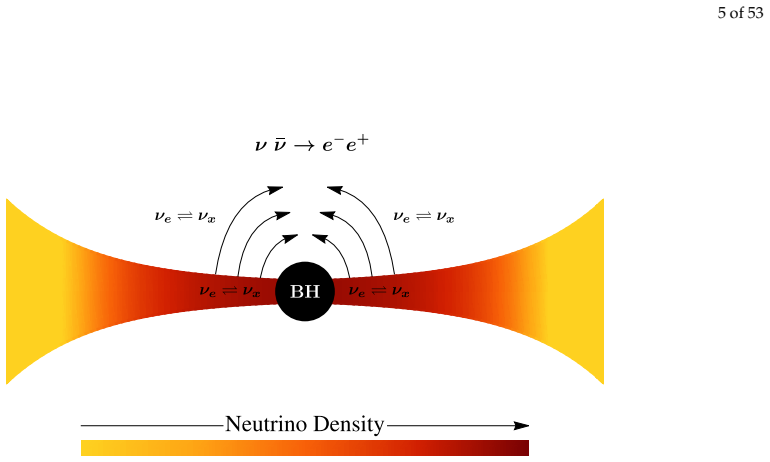
The paper's central claim is that in the inner region (inside the ignition radius) of a neutrino-dominated accretion disk around a Kerr black hole, the neutrino self-interaction potential obeys $\langle\omega\rangle \ll \mu \ll \lambda$, with electron-neutrino and antineutrino densities very similar, so the flavor pendulum is unstable in the inverted mass hierarchy and undergoes bipolar oscillations with periods of about $10^{-9}$ to $10^{-5}$ s. Because neighboring disk regions rapidly share neutrinos, the multi-angle term breaks isotropy and induces kinematic decoherence within a few oscillation cycles, driving the average electron-neutrino survival probability to $1/2$ throughout the disk. The authors incorporate this equipartition into a stationary thin-disk model and find that the disk becomes insensitive to electron-neutrino opacity, that total neutrino luminosity and annihilation luminosity change, and that the $\nu+\bar{\nu}\to e^-+e^+$ energy deposition rate is reduced by factors of 3.03, 4.73, and 3.66 for accretion rates of 1, 0.1, and 0.01 $M_\odot$ s$^{-1}$ respectively. In the normal mass hierarchy the oscillations remain small and no significant flavor change occurs.
Load-bearing premise
The load-bearing premise is that the multi-angle kinematic decoherence seen in supernova neutrino gases also drives the neutrino gas inside a thin accretion disk with a radial gradient and net flux to full flavor equipartition on timescales shorter than neutrino escape; the paper reasons this by analogy and does not simulate disk-specific multi-angle neutrino transport.
Editorial extensions
If this is right
- Neutrino-cooled disks in binary-driven hypernovae emit nearly equal numbers of electron and non-electron (anti)neutrinos, not the pure $\nu_e/\bar{\nu}_e$ spectrum usually assumed.
- The $e^+e^-$ pair plasma generated by neutrino-antineutrino annihilation above the disk—the seed of the GRB fireball—has its available power reduced by factors of 3.0, 4.7, and 3.7 at accretion rates of 1, 0.1, and 0.01 $M_\odot$ s$^{-1}$.
- Flavor equipartition makes the disk's neutrino cooling insensitive to electron-neutrino opacity, enhancing the neutrino cooling flux by factors of 1.9 to 2.5 and raising density while lowering temperature and electron fraction inside the ignition radius.
- In the normal mass hierarchy no significant flavor conversion occurs in these disks, so previous no-oscillation estimates would stand in that case.
- Neutrino luminosity and annihilation luminosity fits in the neutrino-dominated accretion flow literature, computed without oscillations, need to be re-derived.
Reading between the lines
- A dedicated multi-angle neutrino transport simulation in a Kerr disk geometry could directly test whether kinematic decoherence actually reaches equipartition before the neutrinos escape; the paper uses supernova-derived decoherence results rather than disk-specific simulations.
- If equipartition is confirmed, neutrino-driven r-process nucleosynthesis in disk winds would also shift, because the $\nu_e$ and $\bar{\nu}_e$ spectra that set the electron fraction are modified.
- The same mechanism plausibly applies to neutron star merger accretion disks and tori, where neutrino densities and anisotropies are comparable, so the reduction factor may extend beyond binary-driven hypernovae.
- The reduced annihilation power could appear observationally as a lower required accretion rate or efficiency to power a given GRB luminosity, offering a cross-check with observed jet luminosity distributions.
Editorial analysis
A structured set of objections, weighed in public.
Referee Report
Summary. The paper constructs a steady-state, general-relativistic alpha-disk model of a neutrino-dominated accretion disk around a Kerr black hole, including nuclear statistical equilibrium, a wide set of neutrino emission processes, and two-flavor neutrino oscillations driven by vacuum, matter, and neutrino self-interaction potentials. The authors solve the local oscillation equations at representative radii and then, invoking kinematic decoherence borrowed from supernova neutrino studies, impose flavor equipartition among electron and non-electron neutrinos. On this basis they recompute the disk structure and find that the neutrino-antineutrino annihilation energy deposition rate near the black hole is reduced by factors of about 3 to 5 compared with previous estimates that ignored oscillations inside the disk. The central claim is that neutrino self-interactions drive the disk to flavor equipartition, with consequences for the GRB central engine in the binary-driven hypernova scenario.
Significance. If the central claim were established, the result would be important for models of GRB central engines, neutrino-cooled accretion disks, and the energetics of e+e- pair production above hyperaccreting black holes. The paper contains a substantial amount of careful work: the derivation of the disk equations from the Kerr metric with explicit vertical averaging, the inclusion of a broad set of neutrino emissivities and opacities, the reduction of the oscillation equations to a soluble pendulum form, and detailed disk profiles. It also offers a useful comparison with prior neutrino-cooled disk models and is transparent about many of its limitations. The quantitative headline result, however, is not derived from the oscillation equations solved in the paper; it rests on an imported equipartition assumption that the disk-specific calculation does not establish. This makes the paper more a first-step exploratory study than a definitive calculation, a characterization the authors themselves adopt in the final section.
major comments (3)
- [Sec. 5, Table 3 and Fig. 6] The central quantitative claim, the factor of 3-5 reduction in the neutrino-antineutrino annihilation luminosity, is not obtained from the oscillation equations solved in the paper. The local calculation at r = 10 rs for Mdot = 0.1 Msun/s yields a time-averaged survival probability <P> = 0.92 (Fig. 6), i.e., only about 8% flavor conversion for the inverted hierarchy and essentially none for the normal hierarchy. The jump to <P> = 0.5 is imposed via the kinematic-decoherence argument imported from supernova references [35,36], not derived from a disk-specific transport calculation. Since the abstract and Sec. 6 present the reduction factors as results of the model, the paper should either provide a disk-specific multi-angle transport treatment, or explicitly recast flavor equipartition as an external assumption and label the Table 3 values as conditional estimates under that hypothesis.
- [Sec. 3.1, Eqs. (40)-(55), and Sec. 5 after Fig. 7] The multi-angle term v_q·v_p in Eq. (40) is essential for kinematic decoherence, but it is dropped when the neutrino gas is assumed isotropic, and the pendulum equations (Eq. 55) are derived under that isotropic approximation. The transition from the isotropic, locally independent-region model to an anisotropic multi-angle regime is argued only qualitatively, citing supernova results [33,35,36]. Given the disk's radial gradients, continuous emission and absorption, and large optical depths (Fig. 4 shows tau_nu_e up to ~10^3), it is not demonstrated that kinematic decoherence dominates on the relevant timescales and drives the volume-averaged survival probability to 0.5 before neutrinos escape. A quantitative estimate of the multi-angle term for the disk geometry, or a dedicated simulation, is needed to support the equipartition premise.
- [Sec. 5, text near Eq. (73) and Fig. 6] The statement that bipolar oscillations imply 'total flavor conversion' is inconsistent with the computed time average <P> = 0.92 at r = 10 rs for the inverted hierarchy (Fig. 6). The text distinguishes instantaneous conversion from time-averaged behavior only after presenting the result; this distinction should be made clear at the outset, because the averaged survival probability is the quantity that enters the re-integrated disk models and hence Table 3. As written, the phrasing overstates the local conversion efficiency and obscures the gap between the local calculation and the assumed equipartition.
minor comments (5)
- [Abstract] The abstract contains a LaTeX markup artifact: '\textcolor{red}{behaviour}' should be rendered as plain text.
- [Sec. 2.2] In the first paragraph there is a duplicated phrase: 'can be can be pigeonholed' should read 'can be pigeonholed'.
- [Fig. 6 caption] The caption reads 'Survival provability'; this should be 'Survival probability'.
- [Sec. 5, Eq. (77)] The relation for Feq_nu / F_nu is presented without derivation; a brief explanation of how it follows from the flux-weighted averages in Eq. (32) would improve readability.
- [Sec. 5, Eq. (75)] The expression 'trs << Max(tau_nu) rs approx 10^-2 s' is dimensionally unclear; the intended ordering of the oscillation, crossing, and accretion timescales would be clearer with explicit time variables.
Circularity Check
The headline factor 3-5 reduction in ννbar annihilation luminosity is imposed as <P>=0.5 flavor equipartition, not derived from the disk oscillation equations; the paper's own local calculation at r=10rs gives only <P>=0.92.
-
self definitional
[Sec. 5, equipartition paragraph following Fig. 7; Table 3]
"Within the disk dynamic, this is equivalent to imposing the condition⟨Pνe→νe⟩ =⟨P¯νe→ ¯νe⟩ = 0.5."
The central quantitative claim, the factor ~3-5 reduction of the neutrino-antineutrino annihilation luminosity (Sec. 5, Table 3), is computed from disk models in which the survival probability is set to 0.5 by hand: Table 3's 'with oscillations (flavour equipartition)' columns are not outputs of the oscillation equations (49)-(55). The paper's own local example at r=10rs for Mdot=0.1 Msun/s returns a time-averaged survival probability of 0.92 (Fig. 6 and Sec. 5 text), i.e. ~8% conversion, and the upgrade to 0.5 is imported from supernova neutrino-gas results [35,36] without a disk-specific multi-angle transport test. Sec. 6 concedes that 'time-dependent, multi-dimensional, neutrino-transport simulations' are required.
full rationale
The paper contains a substantial independent component: it constructs a full relativistic α-disk model, computes disk structure, optical depths, and oscillation potentials, and solves a single-region two-flavour pendulum problem, obtaining <P>=0.92 at one representative radius. Those parts are self-contained and not circular. However, the scientific headline—flavor equipartition inside the disk and the factor 3-5 decrease in Lννbar—rests entirely on replacing the local result with the imposed condition <P>=0.5. The text itself says this 'is equivalent to imposing' the condition, and Table 3 is labelled 'With oscillations (flavour equipartition)', so the luminosity reduction is built in by construction. The bridge from the solved local dynamics to global equipartition is supplied by Refs. [35,36] (supernova neutrino gases) without a disk-specific multi-angle transport calculation; the paper's own limitation note confirms that such simulations are still needed. This is partial circularity: the oscillation microphysics is independent, but the headline prediction reduces to an assumption. Normal self-citation to the authors' earlier [71] also appears in the abstract, but it is not load-bearing for the central result. Score 6.
Assumptions & free parameters
free parameters (4)
- Effective temperature polynomial coefficients a, b, c =
a = 0.0024, b = -0.085, c = 0.97
- Capture function fit coefficient =
0.3348
- Disk model parameters M, alpha, a =
M = 3 M_sun, alpha = 0.01, a = 0.95
- Flavor equipartition survival probability =
0.5
assumptions (6)
- domain assumption The disk is thin and in a steady state, with Shakura-Sunyaev alpha viscosity and vanishing bulk viscosity.
- domain assumption At each disk radius the neutrino gas can be treated as locally isotropic and homogeneous, with constant matter and self-interaction potentials.
- domain assumption A two-flavor approximation with a single mixing angle, theta_13, captures the relevant oscillation physics.
- ad hoc to paper Kinematic decoherence in supernova neutrino gases transfers to accretion disk geometry and drives full flavor equipartition.
- domain assumption The neutrino population starts purely electron flavor, with P = Pbar = (0,0,1).
- standard math The disk energy and lepton number budget follow the standard NDAF equations with NSE composition and the neutrino emissivities listed in Appendix D.
Cite this review
Pith. "Pith review of Neutrino oscillations in a neutrino-dominated accretion disk around a Kerr BH." pith.science (2026). https://pith.science/paper/MRFQS73N
@misc{pith2026190901841,
  author       = {Pith},
  title        = {Pith review of: Neutrino oscillations in a neutrino-dominated accretion disk around a Kerr BH},
  year         = {2026},
  howpublished = {\url{https://pith.science/paper/MRFQS73N}},
  note         = {Machine review of arXiv:1909.01841}
}
abstract
In the binary-driven hypernova model of long gamma-ray bursts, a carbon-oxygen star explodes as a supernova in presence of a neutron star binary companion in close orbit. Hypercritical (i.e. highly super-Eddington) accretion of the ejecta matter onto the neutron star sets in, making it reach the critical mass with consequent formation of a Kerr black hole. We have recently shown that, during the accretion process onto the neutron star, fast neutrino flavour oscillations occur. Numerical simulations of the above system show that a part of the ejecta keeps bound to the newborn Kerr black hole, leading to a new process of hypercritical accretion. We here address, also for this phase of the binary-driven hypernova, the occurrence of neutrino flavour oscillations given the extreme conditions of high density (up to $10^{12}$ g cm$^{-3}$) and temperatures (up to tens of MeV) inside this disk. We estimate the \textcolor{red}{behaviour} of the electronic and non-electronic neutrino content within the two-flavour formalism ($\nu_{e}\nu_{x}$) under the action of neutrino collective effects by neutrino self-interactions. We find that in the case of inverted mass hierarchy, neutrino oscillations inside the disk have frequencies between $\sim (10^{5}$-$10^{9})$ s$^{-1}$, leading the disk to achieve flavour equipartition. This implies that the energy deposition rate by neutrino annihilation ($\nu + \bar{\nu} \to e^{-} + e^{+}$) in the vicinity of the Kerr black hole, is smaller than previous estimates in the literature not accounting by flavour oscillations inside the disk. The exact value of the reduction factor depends on the $\nu_{e}$ and $\nu_{x}$ optical depths but it can be as high as $\sim 5$. The results of this work are a first step toward the analysis of neutrino oscillations in a novel astrophysical context and, as such, deserve further attention.
Figures


Figures from the paper (6 more)


Reference graph
Works this paper leans on
-
[1]
Status of neutrino oscillations 2018: 3σ hint for normal mass ordering and improved CP sensitivity
de Salas, P .F.; Forero, D.V .; Ternes, C.A.; Tortola, M.; Valle, J.W.F. Status of neutrino oscillations 2018: 3σ hint for normal mass ordering and improved CP sensitivity. Phys. Lett. 2018, B782, 633–640, [arXiv:hep-ph/1708.01186]. doi:10.1016/j.physletb.2018.06.019
arXiv 2018
-
[2]
Neutrino Oscillations in Matter
Wolfenstein, L. Neutrino Oscillations in Matter. Phys. Rev. 1978, D17, 2369–2374. [,294(1977)], doi:10.1103/PhysRevD.17.2369
-
[3]
Resonant amplification ofν oscillations in matter and solar-neutrino spectroscopy
Mikheyev, S.P .; Smirnov, A.Y. Resonant amplification ofν oscillations in matter and solar-neutrino spectroscopy. Il Nuovo Cimento C 1986, 9, 17–26. doi:10.1007/BF02508049
-
[4]
Neutrino oscillations in the early universe
Barbieri, R.; Dolgov, A. Neutrino oscillations in the early universe. Nuclear Physics B 1991, 349, 743 – 753. doi:https://doi.org/10.1016/0550-3213(91)90396-F
-
[5]
Refraction and Oscillations of Neutrinos in the Early Universe
Enqvist, K.; Kainulainen, K.; Maalampi, J. Refraction and Oscillations of Neutrinos in the Early Universe. Nucl. Phys. 1991, B349, 754–790. doi:10.1016/0550-3213(91)90397-G
-
[6]
Neutrino Oscillations and the Leptonic Charge of the Universe
Savage, M.J.; Malaney, R.A.; Fuller, G.M. Neutrino Oscillations and the Leptonic Charge of the Universe. Astrophys. J. 1991, 368, 1–11. doi:10.1086/169665
-
[7]
Neutrino oscillations in the early universe with an inverted neutrino mass hierarchy
Kostelecky, V .A.; Samuel, S. Neutrino oscillations in the early universe with an inverted neutrino mass hierarchy. Phys. Lett. 1993, B318, 127–133. doi:10.1016/0370-2693(93)91795-O. 45 of 53
-
[8]
Nonlinear neutrino oscillations in the expanding universe
Kostelecky, V .A.; Samuel, S. Nonlinear neutrino oscillations in the expanding universe. Phys. Rev. 1994, D49, 1740–1757. doi:10.1103/PhysRevD.49.1740
Show all 188 references
-
[9]
Neutrino oscillations in the early universe
Kostelecký, V .; Pantaleone, J.; Samuel, S. Neutrino oscillations in the early universe. Physics Letters B 1993, 315, 46 – 50. doi:https://doi.org/10.1016/0370-2693(93)90156-C
1993 doi
-
[10]
Oscillating doublet neutrinos in the early universe
McKellar, B.H.J.; Thomson, M.J. Oscillating doublet neutrinos in the early universe. Phys. Rev. 1994, D49, 2710–2728. doi:10.1103/PhysRevD.49.2710
1994 doi
-
[11]
High-energy neutrino conversion and the lepton asymmetry in the universe
Lunardini, C.; Smirnov, A.Y. High-energy neutrino conversion and the lepton asymmetry in the universe. Phys. Rev. D 2001, 64, 073006, [arXiv:hep-ph/hep-ph/0012056]. doi:10.1103/PhysRevD.64.073006
2001 arXiv
-
[12]
Cosmological bounds on neutrino degeneracy improved by flavor oscillations
Dolgov, A.D.; Hansen, S.H.; Pastor, S.; Petcov, S.T.; Raffelt, G.G.; Semikoz, D.V . Cosmological bounds on neutrino degeneracy improved by flavor oscillations. Nuclear Physics B 2002, 632, 363–382, [arXiv:hep-ph/hep-ph/0201287]. doi:10.1016/S0550-3213(02)00274-2
2002 arXiv
-
[13]
Analytical treatment of neutrino asymmetry equilibration from flavor oscillations in the early universe
Wong, Y.Y. Analytical treatment of neutrino asymmetry equilibration from flavor oscillations in the early universe. Phys. Rev. D 2002, 66, 025015, [arXiv:hep-ph/hep-ph/0203180]. doi:10.1103/PhysRevD.66.025015
2002 arXiv
-
[14]
Stringent constraints on cosmological neutrino-antineutrino asymmetries from synchronized flavor transformation
Abazajian, K.N.; Beacom, J.F.; Bell, N.F. Stringent constraints on cosmological neutrino-antineutrino asymmetries from synchronized flavor transformation. Phys. Rev. D 2002, 66, 013008, [arXiv:astro-ph/astro-ph/0203442]. doi:10.1103/PhysRevD.66.013008
2002 arXiv
-
[15]
Neutrino oscillations and the early universe
Kirilova, D.P . Neutrino oscillations and the early universe. Central European Journal of Physics 2004, 2, 467–491, [arXiv:astro-ph/astro-ph/0312569]. doi:10.2478/BF02476426
2004 arXiv
-
[16]
Solar Neutrinos Before and After KamLAND
Bahcall, J.N.; Concepcion Gonzalez-Garcia, M.; na-Garay, C.P . Solar Neutrinos Before and After KamLAND. Journal of High Energy Physics 2003, 2003, 009, [arXiv:hep-ph/hep-ph/0212147]. doi:10.1088/1126-6708/2003/02/009
2003 arXiv
-
[17]
Global Analysis of Solar Neutrino and KamLAND Data
Balantekin, A.B.; Yuksel, H. Global Analysis of Solar Neutrino and KamLAND Data. arXiv e-prints 2003, pp. hep–ph/0301072, [arXiv:hep-ph/hep-ph/0301072]
2003
-
[18]
Neutrino Oscillations: A Global Analysis
Fogli, G.L.; Lisi, E.; Marrone, A.; Montanino, D.; Palazzo, A.; Rotunno, A.M. Neutrino Oscillations: A Global Analysis. arXiv e-prints 2003, pp. hep–ph/0310012, [arXiv:hep-ph/hep-ph/0310012]
2003
-
[19]
Solar neutrinos: the SNO salt phase results and physics of conversion
de Holanda, P .C.; Smirnov, A.Y. Solar neutrinos: the SNO salt phase results and physics of conversion. Astroparticle Physics 2004, 21, 287–301, [arXiv:hep-ph/hep-ph/0309299]. doi:10.1016/j.astropartphys.2004.01.007
2004 arXiv
-
[20]
Status of neutrino masses and mixing
Giunti, C. Status of neutrino masses and mixing. European Physical Journal C 2004, 33, 852–856, [arXiv:hep-ph/hep-ph/0309024]. doi:10.1140/epjcd/s2003-03-917-2
2004 arXiv
-
[21]
Status of three-neutrino oscillations after the SNO-salt data
Maltoni, M.; Schwetz, T.; Tórtola, M.A.; Valle, J.W. Status of three-neutrino oscillations after the SNO-salt data. Phys. Rev. D 2003, 68, 113010, [arXiv:hep-ph/hep-ph/0309130]. doi:10.1103/PhysRevD.68.113010
2003 arXiv
-
[22]
Supernova neutrino oscillations: What do we understand? Journal of Physics Conference Series, 2010, Vol
Dighe, A. Supernova neutrino oscillations: What do we understand? Journal of Physics Conference Series, 2010, Vol. 203, Journal of Physics Conference Series , p. 012015, [arXiv:hep-ph/0912.4167]. doi:10.1088/1742-6596/203/1/012015
2010 arXiv
-
[23]
Solar Neutrinos: Status and Prospects
Haxton, W.C.; Hamish Robertson, R.G.; Serenelli, A.M. Solar Neutrinos: Status and Prospects. ARA&A 2013, 51, 21–61, [arXiv:astro-ph.SR/1208.5723]. doi:10.1146/annurev-astro-081811-125539
2013 arXiv
-
[24]
Solar neutrino physics on the beginning of 2017
Vissani, F. Solar neutrino physics on the beginning of 2017. Nuclear Physics and Atomic Energy 2017, 18, 5–12, [arXiv:nucl-th/1706.05435]. doi:10.15407/jnpae2017.01.005
2017 arXiv
-
[25]
Neutrino Dispersion at Finite Temperature and Density.Nucl
Notzold, D.; Raffelt, G. Neutrino Dispersion at Finite Temperature and Density.Nucl. Phys. 1988, B307, 924–936. doi:10.1016/0550-3213(88)90113-7
1988 doi
-
[26]
Neutrino oscillations at high densities
Pantaleone, J. Neutrino oscillations at high densities. Physics Letters B 1992, 287, 128–132. doi:10.1016/0370-2693(92)91887-F
1992 doi
-
[27]
Neutrino-neutrino scattering and matter enhanced neutrino flavor transformation in Supernovae
Qian, Y.Z.; Fuller, G.M. Neutrino-neutrino scattering and matter enhanced neutrino flavor transformation in Supernovae. Phys. Rev. 1995, D51, 1479–1494, [arXiv:astro-ph/astro-ph/9406073]. doi:10.1103/PhysRevD.51.1479
1995 arXiv
-
[28]
Flavor oscillations in the supernova hot bubble region: Nonlinear effects of neutrino background
Pastor, S.; Raffelt, G. Flavor oscillations in the supernova hot bubble region: Nonlinear effects of neutrino background. Phys. Rev. Lett. 2002, 89, 191101, [arXiv:astro-ph/astro-ph/0207281]. doi:10.1103/PhysRevLett.89.191101. 46 of 53
2002 arXiv
-
[30]
Speed-up of neutrino transformations in a supernova environment
Sawyer, R.F. Speed-up of neutrino transformations in a supernova environment. Physical Review D 2005, 72, 045003, [arXiv:astro-ph/hep-ph/0503013]. doi:10.1103/PhysRevD.72.045003
2005 arXiv
-
[31]
Simultaneous flavor transformation of neutrinos and antineutrinos with dominant potentials from neutrino-neutrino forward scattering
Fuller, G.M.; Qian, Y.Z. Simultaneous flavor transformation of neutrinos and antineutrinos with dominant potentials from neutrino-neutrino forward scattering. Phys. Rev. 2006, D73, 023004, [arXiv:astro-ph/astro-ph/0505240]. doi:10.1103/PhysRevD.73.023004
2006 arXiv
-
[32]
Coherent Development of Neutrino Flavor in the Supernova Environment
Duan, H.; Fuller, G.M.; Carlson, J.; Qian, Y.Z. Coherent Development of Neutrino Flavor in the Supernova Environment. Physical Review Letters 2006, 97, 241101, [arXiv:astro-ph/astro-ph/0608050]. doi:10.1103/PhysRevLett.97.241101
2006 arXiv
-
[33]
Collective neutrino flavor transitions in supernovae and the role of trajectory averaging
Fogli, G.L.; Lisi, E.; Marrone, A.; Mirizzi, A. Collective neutrino flavor transitions in supernovae and the role of trajectory averaging. JCAP 2007, 0712, 010, [arXiv:hep-ph/0707.1998]. doi:10.1088/1475-7516/2007/12/010
2007 arXiv
-
[34]
A Simple Picture for Neutrino Flavor Transformation in Supernovae
Duan, H.; Fuller, G.M.; Qian, Y.Z. A Simple Picture for Neutrino Flavor Transformation in Supernovae. Phys. Rev. 2007, D76, 085013, [arXiv:astro-ph/0706.4293]. doi:10.1103/PhysRevD.76.085013
2007 arXiv
-
[35]
Self-induced decoherence in dense neutrino gases
Raffelt, G.G.; Sigl, G. Self-induced decoherence in dense neutrino gases. Phys. Rev. 2007, D75, 083002, [arXiv:hep-ph/hep-ph/0701182]. doi:10.1103/PhysRevD.75.083002
2007 arXiv
-
[36]
Decoherence in supernova neutrino transformations suppressed by deleptonization
Esteban-Pretel, A.; Pastor, S.; Tomas, R.; Raffelt, G.G.; Sigl, G. Decoherence in supernova neutrino transformations suppressed by deleptonization. Phys. Rev. 2007, D76, 125018, [arXiv:astro-ph/0706.2498]. doi:10.1103/PhysRevD.76.125018
2007 arXiv
-
[37]
Mu-tau neutrino refraction and collective three-flavor transformations in supernovae
Esteban-Pretel, A.; Pastor, S.; Tomas, R.; Raffelt, G.G.; Sigl, G. Mu-tau neutrino refraction and collective three-flavor transformations in supernovae. Phys. Rev. 2008, D77, 065024, [arXiv:astro-ph/0712.1137]. doi:10.1103/PhysRevD.77.065024
2008 arXiv
-
[38]
Effect of Collective Flavor Oscillations on the Diffuse Supernova Neutrino Background
Chakraborty, S.; Choubey, S.; Dasgupta, B.; Kar, K. Effect of Collective Flavor Oscillations on the Diffuse Supernova Neutrino Background. JCAP 2008, 0809, 013, [arXiv:hep-ph/0805.3131]. doi:10.1088/1475-7516/2008/09/013
2008 arXiv
-
[39]
Flavor Evolution of the Neutronization Neutrino Burst from an O-Ne-Mg Core-Collapse Supernova
Duan, H.; Fuller, G.M.; Carlson, J.; Qian, Y.Z. Flavor Evolution of the Neutronization Neutrino Burst from an O-Ne-Mg Core-Collapse Supernova. Phys. Rev. Lett. 2008, 100, 021101, [arXiv:astro-ph/0710.1271]. doi:10.1103/PhysRevLett.100.021101
2008 arXiv
-
[40]
Simulating nonlinear neutrino flavor evolution
Duan, H.; Fuller, G.M.; Carlson, J. Simulating nonlinear neutrino flavor evolution. Comput. Sci. Dis. 2008, 1, 015007, [arXiv:astro-ph/0803.3650]. doi:10.1088/1749-4699/1/1/015007
2008 arXiv
-
[41]
Identifying neutrino mass hierarchy at extremely small theta(13) through Earth matter effects in a supernova signal
Dasgupta, B.; Dighe, A.; Mirizzi, A. Identifying neutrino mass hierarchy at extremely small theta(13) through Earth matter effects in a supernova signal. Phys. Rev. Lett. 2008, 101, 171801, [arXiv:hep-ph/0802.1481]. doi:10.1103/PhysRevLett.101.171801
2008 arXiv
-
[42]
Collective three-flavor oscillations of supernova neutrinos
Dasgupta, B.; Dighe, A. Collective three-flavor oscillations of supernova neutrinos. Phys. Rev. 2008, D77, 113002, [arXiv:hep-ph/0712.3798]. doi:10.1103/PhysRevD.77.113002
2008 arXiv
-
[43]
The multi-angle instability in dense neutrino systems
Sawyer, R.F. The multi-angle instability in dense neutrino systems. Phys. Rev. 2009, D79, 105003, [arXiv:astro-ph/0803.4319]. doi:10.1103/PhysRevD.79.105003
2009 arXiv
-
[44]
Collective Neutrino Oscillations
Duan, H.; Fuller, G.M.; Qian, Y.Z. Collective Neutrino Oscillations. Ann. Rev. Nucl. Part. Sci. 2010, 60, 569–594, [arXiv:hep-ph/1001.2799]. doi:10.1146/annurev.nucl.012809.104524
2010 arXiv
-
[45]
Resonances Driven by a Neutrino Gyroscope and Collective Neutrino Oscillations in Supernovae
Wu, M.R.; Qian, Y.Z. Resonances Driven by a Neutrino Gyroscope and Collective Neutrino Oscillations in Supernovae. Phys. Rev. 2011, D84, 045009, [arXiv:astro-ph.SR/1105.2068]. doi:10.1103/PhysRevD.84.045009
2011 arXiv
-
[46]
Neutrino oscillations: brief history and present status
Bilenky, S.M. Neutrino oscillations: brief history and present status. ArXiv e-prints 2014, [arXiv:hep-ph/1408.2864]
2014 arXiv
-
[47]
The Physics Of Supernova Neutrino Oscillations
Kneller, J.P . The Physics Of Supernova Neutrino Oscillations. Proceedings, 12th Conference on the Intersections of Particle and Nuclear Physics (CIPANP 2015): Vail, Colorado, USA, May 19-24, 2015, 2015, [arXiv:hep-ph/1507.01434]
2015 arXiv
-
[48]
Theoretical developments in supernova neutrino physics: mass corrections and pairing correlators
Volpe, C. Theoretical developments in supernova neutrino physics: mass corrections and pairing correlators. Journal of Physics Conference Series, 2016, Vol. 718, Journal of Physics Conference Series , p. 062068, [arXiv:astro-ph.HE/1601.05018]. doi:10.1088/1742-6596/718/6/06206...
2016 arXiv
-
[49]
Supernova neutrinos: production, oscillations and detection
Mirizzi, A.; Tamborra, I.; Janka, H.T.; Saviano, N.; Scholberg, K.; Bollig, R.; Hüdepohl, L.; Chakraborty, S. Supernova neutrinos: production, oscillations and detection. Nuovo Cimento Rivista Serie 2016, 39, 1–112, [arXiv:astro-ph.HE/1508.00785]. doi:10.1393/ncr/i2016-10120-8
2016 arXiv
-
[50]
What can be learned from a future supernova neutrino detection? Journal of Physics G Nuclear Physics 2018, 45, 043002, [arXiv:astro-ph.HE/1709.01515]
Horiuchi, S.; Kneller, J.P . What can be learned from a future supernova neutrino detection? Journal of Physics G Nuclear Physics 2018, 45, 043002, [arXiv:astro-ph.HE/1709.01515]. doi:10.1088/1361-6471/aaa90a
2018 arXiv
-
[51]
Collective neutrino oscillations and detectabilities in failed supernovae
Zaizen, M.; Yoshida, T.; Sumiyoshi, K.; Umeda, H. Collective neutrino oscillations and detectabilities in failed supernovae. Phys. Rev. D 2018, 98, 103020, [arXiv:astro-ph.HE/1811.03320]. doi:10.1103/PhysRevD.98.103020
2018 arXiv
-
[52]
The Physics of Gamma-Ray Bursts; Cambridge University Press, 2018
Zhang, B. The Physics of Gamma-Ray Bursts; Cambridge University Press, 2018. doi:10.1017/9781139226530
2018 doi
-
[53]
Black Hole Physics and Astrophysics: The GRB-Supernova Connection and URCA-1 - URCA-2
Ruffini, R.; Bernardini, M.G.; Bianco, C.L.; Vitagliano, L.; Xue, S.S.; Chardonnet, P .; Fraschetti, F.; Gurzadyan, V . Black Hole Physics and Astrophysics: The GRB-Supernova Connection and URCA-1 - URCA-2. The Tenth Marcel Grossmann Meeting. Proceedings of the MG10 Meeting hel...
2003 arXiv
-
[54]
On Gamma-Ray Bursts
Ruffini, R.; Bernardini, M.G.; Bianco, C.L.; Caito, L.; Chardonnet, P .; Cherubini, C.; Dainotti, M.G.; Fraschetti, F.; Geralico, A.; Guida, R.; Patricelli, B.; Rotondo, M.; Rueda Hernandez, J.A.; Vereshchagin, G.; Xue, S.S. On Gamma-Ray Bursts. The Eleventh Marcel Grossmann Me...
2008 arXiv
-
[55]
GRB 090618: a candidate for a neutron star gravitational collapse onto a black hole induced by a type Ib/c supernova
Izzo, L.; Rueda, J.A.; Ruffini, R. GRB 090618: a candidate for a neutron star gravitational collapse onto a black hole induced by a type Ib/c supernova. A&A 2012, 548, L5, [arXiv:astro-ph.HE/1206.2887]. doi:10.1051/0004-6361/201219813
2012 arXiv
-
[56]
On the Induced Gravitational Collapse of a Neutron Star to a Black Hole by a Type Ib/c Supernova
Rueda, J.A.; Ruffini, R. On the Induced Gravitational Collapse of a Neutron Star to a Black Hole by a Type Ib/c Supernova. ApJl 2012, 758, L7, [arXiv:astro-ph.HE/1206.1684]. doi:10.1088/2041-8205/758/1/L7
2012 arXiv
-
[57]
Hypercritical Accretion, Induced Gravitational Collapse, and Binary-Driven Hypernovae
Fryer, C.L.; Rueda, J.A.; Ruffini, R. Hypercritical Accretion, Induced Gravitational Collapse, and Binary-Driven Hypernovae. Astrophys. J. 2014, 793, L36, [arXiv:astro-ph.HE/1409.1473]. doi:10.1088/2041-8205/793/2/L36
2014 arXiv
-
[58]
GRB 130427A and SN 2013cq: A Multi-wavelength Analysis of An Induced Gravitational Collapse Event
Ruffini, R.; Wang, Y.; Enderli, M.; Muccino, M.; Kovacevic, M.; Bianco, C.L.; Penacchioni, A.V .; Pisani, G.B.; Rueda, J.A. GRB 130427A and SN 2013cq: A Multi-wavelength Analysis of An Induced Gravitational Collapse Event. ApJ 2015, 798, 10, [arXiv:astro-ph.HE/1405.5723]. doi:1...
2015 arXiv
-
[59]
Neutron-Star-Black-Hole Binaries Produced by Binary-Driven Hypernovae
Fryer, C.L.; Oliveira, F.G.; Rueda, J.A.; Ruffini, R. Neutron-Star-Black-Hole Binaries Produced by Binary-Driven Hypernovae. Physical Review Letters 2015, 115, 231102, [arXiv:astro-ph.HE/1505.02809]. doi:10.1103/PhysRevLett.115.231102
2015 arXiv
-
[60]
Two Predictions of Supernova: GRB 130427A/SN 2013cq and GRB 180728A/SN 2018fip
Wang, Y.; Rueda, J.A.; Ruffini, R.; Becerra, L.; Bianco, C.; Becerra, L.; Li, L.; Karlica, M. Two Predictions of Supernova: GRB 130427A/SN 2013cq and GRB 180728A/SN 2018fip. ApJ 2019, 874, 39, [arXiv:astro-ph.HE/1811.05433]. doi:10.3847/1538-4357/ab04f8
2019 arXiv
-
[61]
Magnetic Fields and Afterglows of BdHNe: Inferences from GRB 130427A, GRB 160509A, GRB 160625B, GRB 180728A, and GRB 190114C
Rueda, J.A.; Ruffini, R.; Karlica, M.; Moradi, R.; Wang, Y. Magnetic Fields and Afterglows of BdHNe: Inferences from GRB 130427A, GRB 160509A, GRB 160625B, GRB 180728A, and GRB 190114C. ApJ 2020, 893, 148, [arXiv:astro-ph.HE/1905.11339]. doi:10.3847/1538-4357/ab80b9
2020 arXiv
-
[62]
Induced Gravitational Collapse, Binary-Driven Hypernovae, Long Gramma-ray Bursts and Their Connection with Short Gamma-ray Bursts
Rueda, J.A.; Ruffini, R.; Wang, Y. Induced Gravitational Collapse, Binary-Driven Hypernovae, Long Gramma-ray Bursts and Their Connection with Short Gamma-ray Bursts. Universe 2019, 5, 110, [arXiv:astro-ph.HE/1905.06050]. doi:10.3390/universe5050110
2019 arXiv
-
[63]
On the Induced Gravitational Collapse Scenario of Gamma-ray Bursts Associated with Supernovae
Becerra, L.; Bianco, C.L.; Fryer, C.L.; Rueda, J.A.; Ruffini, R. On the Induced Gravitational Collapse Scenario of Gamma-ray Bursts Associated with Supernovae. ApJ 2016, 833, 107, [arXiv:astro-ph.HE/1606.02523]. doi:10.3847/1538-4357/833/1/107
2016 arXiv
-
[64]
The elementary spike produced by a pure e +e− pair-electromagnetic pulse from a Black Hole: The PEM Pulse
Bianco, C.L.; Ruffini, R.; Xue, S.S. The elementary spike produced by a pure e +e− pair-electromagnetic pulse from a Black Hole: The PEM Pulse. A&A 2001, 368, 377–390, [astro-ph/0102060]. doi:10.1051/0004-6361:20000556. 48 of 53
2001 arXiv
-
[65]
On the GeV Emission of the Type I BdHN GRB 130427A
Ruffini, R.; Moradi, R.; Rueda, J.A.; Becerra, L.; Bianco, C.L.; Cherubini, C.; Filippi, S.; Chen, Y.C.; Karlica, M.; Sahakyan, N.; Wang, Y.; Xue, S.S. On the GeV Emission of the Type I BdHN GRB 130427A. ApJ 2019, 886, 82. doi:10.3847/1538-4357/ab4ce6
2019 doi
-
[66]
On the Role of a Cavity in the Hypernova Ejecta of GRB 190114C
Ruffini, R.; Melon Fuksman, J.D.; Vereshchagin, G.V . On the Role of a Cavity in the Hypernova Ejecta of GRB 190114C. ApJ 2019, 883, 191. doi:10.3847/1538-4357/ab3c51
2019 doi
-
[67]
Early X-Ray Flares in GRBs
Ruffini, R.; Wang, Y.; Aimuratov, Y.; Barres de Almeida, U.; Becerra, L.; Bianco, C.L.; Chen, Y.C.; Karlica, M.; Kovacevic, M.; Li, L.; Melon Fuksman, J.D.; Moradi, R.; Muccino, M.; Penacchioni, A.V .; Pisani, G.B.; Primorac, D.; Rueda, J.A.; Shakeri, S.; Vereshchagin, G.V .; X...
2018 arXiv
-
[68]
A GRB Afterglow Model Consistent with Hypernova Observations
Ruffini, R.; Karlica, M.; Sahakyan, N.; Rueda, J.A.; Wang, Y.; Mathews, G.J.; Bianco, C.L.; Muccino, M. A GRB Afterglow Model Consistent with Hypernova Observations. ApJ 2018, 869, 101, [arXiv:astro-ph.HE/1712.05000]. doi:10.3847/1538-4357/aaeac8
2018 arXiv
-
[69]
Angular Momentum Role in the Hypercritical Accretion of Binary-driven Hypernovae
Becerra, L.; Cipolletta, F.; Fryer, C.L.; Rueda, J.A.; Ruffini, R. Angular Momentum Role in the Hypercritical Accretion of Binary-driven Hypernovae. ApJ 2015, 812, 100, [arXiv:astro-ph.HE/1505.07580]. doi:10.1088/0004-637X/812/2/100
2015 arXiv
-
[70]
SPH Simulations of the Induced Gravitational Collapse Scenario of Long Gamma-Ray Bursts Associated with Supernovae
Becerra, L.; Ellinger, C.L.; Fryer, C.L.; Rueda, J.A.; Ruffini, R. SPH Simulations of the Induced Gravitational Collapse Scenario of Long Gamma-Ray Bursts Associated with Supernovae. ApJ 2019, 871, 14, [arXiv:astro-ph.HE/1803.04356]. doi:10.3847/1538-4357/aaf6b3
2019 arXiv
-
[71]
Neutrino Oscillations within the Induced Gravitational Collapse Paradigm of Long Gamma-Ray Bursts
Becerra, L.; Guzzo, M.M.; Rossi-Torres, F.; Rueda, J.A.; Ruffini, R.; Uribe, J.D. Neutrino Oscillations within the Induced Gravitational Collapse Paradigm of Long Gamma-Ray Bursts. ApJ 2018, 852, 120, [arXiv:astro-ph.HE/1712.07210]. doi:10.3847/1538-4357/aaa296
2018 arXiv
-
[72]
Are gamma-ray bursts optically thick? ApJl 1986, 308, L47–L50
Goodman, J. Are gamma-ray bursts optically thick? ApJl 1986, 308, L47–L50. doi:10.1086/184741
1986 doi
-
[73]
Gamma-ray bursters at cosmological distances
Paczynski, B. Gamma-ray bursters at cosmological distances. ApJl 1986, 308, L43–L46. doi:10.1086/184740
1986 doi
-
[74]
Nucleosynthesis, neutrino bursts and gamma-rays from coalescing neutron stars
Eichler, D.; Livio, M.; Piran, T.; Schramm, D.N. Nucleosynthesis, neutrino bursts and gamma-rays from coalescing neutron stars. Nature 1989, 340, 126–128. doi:10.1038/340126a0
1989 doi
-
[75]
Neutron star and black hole binaries in the Galaxy
Narayan, R.; Piran, T.; Shemi, A. Neutron star and black hole binaries in the Galaxy. ApJl 1991, 379, L17–L20. doi:10.1086/186143
1991 doi
-
[76]
A powerful local shear instability in weakly magnetized disks
Balbus, S.A.; Hawley, J.F. A powerful local shear instability in weakly magnetized disks. I - Linear analysis. II - Nonlinear evolution. ApJ 1991, 376, 214–233. doi:10.1086/170270
1991 doi
-
[77]
A Powerful Local Shear Instability in Weakly Magnetized Disks
Hawley, J.F.; Balbus, S.A. A Powerful Local Shear Instability in Weakly Magnetized Disks. II. Nonlinear Evolution. ApJ 1991, 376, 223. doi:10.1086/170271
1991 doi
-
[78]
Instability, turbulence, and enhanced transport in accretion disks
Balbus, S.A.; Hawley, J.F. Instability, turbulence, and enhanced transport in accretion disks. Reviews of Modern Physics 1998, 70, 1–53. doi:10.1103/RevModPhys.70.1
1998 doi
-
[79]
Enhanced Angular Momentum Transport in Accretion Disks
Balbus, S.A. Enhanced Angular Momentum Transport in Accretion Disks. ARA&A 2003, 41, 555–597, [astro-ph/0306208]. doi:10.1146/annurev.astro.41.081401.155207
2003 arXiv
-
[80]
Black holes in binary systems
Shakura, N.I.; Sunyaev, R.A. Black holes in binary systems. Observational appearance. A&A 1973, 24, 337–355
1973
-
[81]
Accretion disc viscosity: how big is alpha? MNRAS 2007, 376, 1740–1746, [astro-ph/0701803]
King, A.R.; Pringle, J.E.; Livio, M. Accretion disc viscosity: how big is alpha? MNRAS 2007, 376, 1740–1746, [astro-ph/0701803]. doi:10.1111/j.1365-2966.2007.11556.x
2007 arXiv
-
[82]
The fundamental difference between shear alpha viscosity and turbulent magnetorotational stresses
Pessah, M.E.; Chan, C.K.; Psaltis, D. The fundamental difference between shear alpha viscosity and turbulent magnetorotational stresses. MNRAS 2008, 383, 683–690, [astro-ph/0612404]. doi:10.1111/j.1365-2966.2007.12574.x
2008 arXiv
-
[83]
Accretion disc theory since Shakura and Sunyaev
King, A. Accretion disc theory since Shakura and Sunyaev. Memorie della Societa Astronomica Italiana 2012, 83, 466, [arXiv:astro-ph.HE/1201.2060]
2012 arXiv
-
[84]
The viscosity parameterα and the properties of accretion disc outbursts in close binaries
Kotko, I.; Lasota, J.P . The viscosity parameterα and the properties of accretion disc outbursts in close binaries. A&A 2012, 545, A115, [arXiv:astro-ph.SR/1209.0017]. doi:10.1051/0004-6361/201219618
2012 arXiv
-
[85]
Accretion discs in astrophysics
Pringle, J.E. Accretion discs in astrophysics. ARA&A 1981, 19, 137–162. doi:10.1146/annurev.aa.19.090181.001033
1981
-
[86]
Active galactic nuclei : from the central black hole to the galactic environment; Princeton University Press, 1999
Krolik, J.H. Active galactic nuclei : from the central black hole to the galactic environment; Princeton University Press, 1999. 49 of 53
1999
-
[87]
Theory of Black Hole Accretion Discs; Cambridge University Press, 1999; p
Abramowicz, M.A.; Björnsson, G.; Pringle, J.E. Theory of Black Hole Accretion Discs; Cambridge University Press, 1999; p. 309
1999
-
[88]
Advection-dominated Accretion Flow around a Kerr Black Hole
Manmoto, T. Advection-dominated Accretion Flow around a Kerr Black Hole. ApJ 2000, 534, 734–746. doi:10.1086/308768
2000 doi
-
[89]
Accretion Power in Astrophysics: Third Edition; Cambridge University Press, 2002; p
Frank, J.; King, A.; Raine, D.J. Accretion Power in Astrophysics: Third Edition; Cambridge University Press, 2002; p. 398
2002
-
[90]
Course 3: Physics Fundamentals of Luminous Accretion Disks around Black Holes
Blaes, O.M. Course 3: Physics Fundamentals of Luminous Accretion Disks around Black Holes. Accretion Discs, Jets and High Energy Phenomena in Astrophysics; Beskin, V .; Henri, G.; Menard, F.; et al.., Eds., 2004, pp. 137–185, [astro-ph/0211368]
2004 arXiv
-
[91]
Advection-dominated accretion and the black hole event horizon
Narayan, R.; McClintock, J.E. Advection-dominated accretion and the black hole event horizon. New Astronomy Reviews 2008, 51, 733 – 751. Jean-Pierre Lasota, X-ray Binaries, Accretion Disks and Compact Stars, doi:https://doi.org/10.1016/j.newar.2008.03.002
2008 doi
-
[92]
Black-Hole Accretion Disks — Towards a New Paradigm — ; Kyoto University Press, 2008
Kato, S.; Fukue, J.; Mineshige, S. Black-Hole Accretion Disks — Towards a New Paradigm — ; Kyoto University Press, 2008
2008
-
[93]
The Polish doughnuts revisited
Qian, L.; Abramowicz, M.A.; Fragile, P .C.; Horák, J.; Machida, M.; Straub, O. The Polish doughnuts revisited. I. The angular momentum distribution and equipressure surfaces. A&A 2009, 498, 471–477, [0812.2467]. doi:10.1051/0004-6361/200811518
2009 arXiv
-
[94]
Review: Accretion Disk Theory
Montesinos, M. Review: Accretion Disk Theory. ArXiv e-prints 2012, [arXiv:astro-ph.HE/1203.6851]
2012 arXiv
-
[95]
Foundations of Black Hole Accretion Disk Theory
Abramowicz, M.A.; Fragile, P .C. Foundations of Black Hole Accretion Disk Theory. Living Reviews in Relativity 2013, 16, 1, [arXiv:astro-ph.HE/1104.5499]. doi:10.12942/lrr-2013-1
2013 arXiv
-
[96]
Hot Accretion Flows Around Black Holes
Yuan, F.; Narayan, R. Hot Accretion Flows Around Black Holes. ARA&A 2014, 52, 529–588, [arXiv:astro-ph.HE/1401.0586]. doi:10.1146/annurev-astro-082812-141003
2014 arXiv
-
[97]
General Overview of Black Hole Accretion Theory
Blaes, O. General Overview of Black Hole Accretion Theory. Space Sci. Rev. 2014, 183, 21–41, [arXiv:astro-ph.HE/1304.4879]. doi:10.1007/s11214-013-9985-6
2014 arXiv
-
[98]
Black Hole Accretion Discs
Lasota, J.P . Black Hole Accretion Discs. Astrophysics of Black Holes: From Fundamental Aspects to Latest Developments; Bambi, C., Ed., 2016, Vol. 440, Astrophysics and Space Science Library , p. 1, [arXiv:astro-ph.HE/1505.02172]. doi:10.1007/978-3-662-52859-4_1
2016 arXiv
-
[99]
Neutrino-dominated accretion flows as the central engine of gamma-ray bursts
Liu, T.; Gu, W.M.; Zhang, B. Neutrino-dominated accretion flows as the central engine of gamma-ray bursts. New Astronomy Reviews 2017, 79, 1 – 25. doi:https://doi.org/10.1016/j.newar.2017.07.001
2017 doi
-
[100]
Hyperaccreting Black Holes and Gamma-Ray Bursts
Popham, R.; Woosley, S.E.; Fryer, C. Hyperaccreting Black Holes and Gamma-Ray Bursts. ApJ 1999, 518, 356–374, [astro-ph/9807028]. doi:10.1086/307259
1999 arXiv
-
[101]
Accretion Models of Gamma-Ray Bursts
Narayan, R.; Piran, T.; Kumar, P . Accretion Models of Gamma-Ray Bursts. ApJ 2001, 557, 949–957, [astro-ph/0103360]. doi:10.1086/322267
2001 arXiv
-
[102]
Can Neutrino-cooled Accretion Disks Be an Origin of Gamma-Ray Bursts? ApJ 2002, 577, 311–321, [astro-ph/0203177]
Kohri, K.; Mineshige, S. Can Neutrino-cooled Accretion Disks Be an Origin of Gamma-Ray Bursts? ApJ 2002, 577, 311–321, [astro-ph/0203177]. doi:10.1086/342166
2002 arXiv
-
[103]
Neutrino Trapping and Accretion Models for Gamma-Ray Bursts
Di Matteo, T.; Perna, R.; Narayan, R. Neutrino Trapping and Accretion Models for Gamma-Ray Bursts. ApJ 2002, 579, 706–715, [astro-ph/0207319]. doi:10.1086/342832
2002 arXiv
-
[104]
Neutrino-dominated Accretion and Supernovae
Kohri, K.; Narayan, R.; Piran, T. Neutrino-dominated Accretion and Supernovae. ApJ 2005, 629, 341–361, [astro-ph/0502470]. doi:10.1086/431354
2005 arXiv
-
[105]
Dynamical Evolution of Neutrino-cooled Accretion Disks: Detailed Microphysics, Lepton-driven Convection, and Global Energetics
Lee, W.H.; Ramirez-Ruiz, E.; Page, D. Dynamical Evolution of Neutrino-cooled Accretion Disks: Detailed Microphysics, Lepton-driven Convection, and Global Energetics. ApJ 2005, 632, 421–437, [astro-ph/0506121]. doi:10.1086/432373
2005 arXiv
-
[106]
Neutrino-dominated Accretion Models for Gamma-Ray Bursts: Effects of General Relativity and Neutrino Opacity
Gu, W.M.; Liu, T.; Lu, J.F. Neutrino-dominated Accretion Models for Gamma-Ray Bursts: Effects of General Relativity and Neutrino Opacity. ApJl 2006, 643, L87–L90, [astro-ph/0604370]. doi:10.1086/505140
2006 arXiv
-
[107]
Neutrino-cooled Accretion Disks around Spinning Black Holes
Chen, W.X.; Beloborodov, A.M. Neutrino-cooled Accretion Disks around Spinning Black Holes. ApJ 2007, 657, 383–399, [astro-ph/0607145]. doi:10.1086/508923
2007 arXiv
-
[108]
Neutrino-cooled Accretion Disk and Its Stability
Kawanaka, N.; Mineshige, S. Neutrino-cooled Accretion Disk and Its Stability. ApJ 2007, 662, 1156–1166, [astro-ph/0702630]. doi:10.1086/517985. 50 of 53
2007 arXiv
-
[109]
The role of black hole spin and magnetic field threading the unstable neutrino disk in gamma ray bursts
Janiuk, A.; Yuan, Y.F. The role of black hole spin and magnetic field threading the unstable neutrino disk in gamma ray bursts. A&A 2010, 509, A55, [arXiv:astro-ph.HE/0911.0395]. doi:10.1051/0004-6361/200912725
2010 arXiv
-
[110]
Jet Luminosity from Neutrino-dominated Accretion Flows in Gamma-Ray Bursts
Kawanaka, N.; Piran, T.; Krolik, J.H. Jet Luminosity from Neutrino-dominated Accretion Flows in Gamma-Ray Bursts. ApJ 2013, 766, 31, [arXiv:astro-ph.HE/1211.5110]. doi:10.1088/0004-637X/766/1/31
2013 arXiv
-
[111]
Global neutrino heating in hyperaccretion flows
Luo, S.; Yuan, F. Global neutrino heating in hyperaccretion flows. MNRAS 2013, 431, 2362–2370, [arXiv:astro-ph.HE/1301.1102]. doi:10.1093/mnras/stt337
2013 arXiv
-
[112]
Relativistic Global Solutions of Neutrino-dominated Accretion Flows
Xue, L.; Liu, T.; Gu, W.M.; Lu, J.F. Relativistic Global Solutions of Neutrino-dominated Accretion Flows. ApJs 2013, 207, 23, [arXiv:astro-ph.HE/1306.0655]. doi:10.1088/0067-0049/207/2/23
2013 arXiv
-
[113]
Neutrino oscillations above black hole accretion disks: Disks with electron-flavor emission
Malkus, A.; Kneller, J.P .; McLaughlin, G.C.; Surman, R. Neutrino oscillations above black hole accretion disks: Disks with electron-flavor emission. Phys. Rev. D 2012, 86, 085015, [arXiv:hep-ph/1207.6648]. doi:10.1103/PhysRevD.86.085015
2012 arXiv
-
[114]
Neutrino flavor evolution in binary neutron star merger remnants
Frensel, M.; Wu, M.R.; Volpe, C.; Perego, A. Neutrino flavor evolution in binary neutron star merger remnants. Phys. Rev. D 2017, 95, 023011, [arXiv:astro-ph.HE/1607.05938]. doi:10.1103/PhysRevD.95.023011
2017 arXiv
-
[115]
Neutrino flavor evolution in neutron star mergers.Phys
Tian, J.Y.; Patwardhan, A.V .; Fuller, G.M. Neutrino flavor evolution in neutron star mergers.Phys. Rev. D 2017, 96, 043001, [arXiv:astro-ph.HE/1703.03039]. doi:10.1103/PhysRevD.96.043001
2017 arXiv
-
[116]
Fast neutrino conversions: Ubiquitous in compact binary merger remnants
Wu, M.R.; Tamborra, I. Fast neutrino conversions: Ubiquitous in compact binary merger remnants. Phys. Rev. D 2017, 95, 103007. doi:10.1103/PhysRevD.95.103007
2017 doi
-
[117]
Multi-Dimensional Solution of Fast Neutrino Conversions in Binary Neutron Star Merger Remnants
Padilla-Gay, I.; Shalgar, S.; Tamborra, I. Multi-Dimensional Solution of Fast Neutrino Conversions in Binary Neutron Star Merger Remnants. arXiv e-prints 2020, p. arXiv:2009.01843, [arXiv:astro-ph.HE/2009.01843]
2020 arXiv
-
[118]
ACCRETION AND OUTFLOW FROM A MAGNETIZED, NEUTRINO COOLED TORUS AROUND THE GAMMA-RAY BURST CENTRAL ENGINE
Janiuk, A.; Mioduszewski, P .; Moscibrodzka, M. ACCRETION AND OUTFLOW FROM A MAGNETIZED, NEUTRINO COOLED TORUS AROUND THE GAMMA-RAY BURST CENTRAL ENGINE. The Astrophysical Journal 2013, 776, 105. doi:10.1088/0004-637x/776/2/105
2013 doi
-
[119]
Microphysics in the Gamma-Ray Burst Central Engine
Janiuk, A. Microphysics in the Gamma-Ray Burst Central Engine. ApJ 2017, 837, 39, [arXiv:astro-ph.HE/1609.09361]. doi:10.3847/1538-4357/aa5f16
2017 arXiv
-
[120]
Numerical Simulations of Black Hole Accretion Flows
Janiuk, A.; Sapountzis, K.; Mortier, J.; Janiuk, I. Numerical Simulations of Black Hole Accretion Flows. Supercomputing Frontiers and Innovations 2018, 5
2018
-
[121]
The r-process Nucleosynthesis in the Outflows from Short GRB Accretion Disks
Janiuk, A. The r-process Nucleosynthesis in the Outflows from Short GRB Accretion Disks. ApJ 2019, 882, 163, [arXiv:astro-ph.HE/1907.00809]. doi:10.3847/1538-4357/ab3349
2019 arXiv
-
[122]
A Variational Principle for Rotating Stars in General Relativity
Bardeen, J.M. A Variational Principle for Rotating Stars in General Relativity. ApJ 1970, 162, 71. doi:10.1086/150635
1970 doi
-
[123]
Rotating Black Holes: Locally Nonrotating Frames, Energy Extraction, and Scalar Synchrotron Radiation
Bardeen, J.M.; Press, W.H.; Teukolsky, S.A. Rotating Black Holes: Locally Nonrotating Frames, Energy Extraction, and Scalar Synchrotron Radiation. ApJ 1972, 178, 347–370. doi:10.1086/151796
1972 doi
-
[124]
Advection-dominated Accretion Flows in the Kerr Metric
Gammie, C.F.; Popham, R. Advection-dominated Accretion Flows in the Kerr Metric. I. Basic Equations. ApJ 1998, 498, 313–326, [astro-ph/9705117]. doi:10.1086/305521
1998 arXiv
-
[125]
Kerr Metric Black Holes
Bardeen, J.M. Kerr Metric Black Holes. Nature 1970, 226, 64–65. doi:10.1038/226064a0
1970 doi
-
[126]
Disk-Accretion onto a Black Hole
Thorne, K.S. Disk-Accretion onto a Black Hole. II. Evolution of the Hole. ApJ 1974, 191, 507–520. doi:10.1086/152991
1974 doi
-
[127]
Astrophysics of black holes
Novikov, I.D.; Thorne, K.S. Astrophysics of black holes. Black Holes (Les Astres Occlus); Dewitt, C.; Dewitt, B.S., Eds., 1973, pp. 343–450
1973
-
[128]
Disk-Accretion onto a Black Hole
Page, D.N.; Thorne, K.S. Disk-Accretion onto a Black Hole. Time-Averaged Structure of Accretion Disk. ApJ 1974, 191, 499–506. doi:10.1086/152990
1974 doi
-
[129]
Fluid mechanics; Oxford: Pergamon Press, 1959, 1959
Landau, L.D.; Lifshitz, E.M. Fluid mechanics; Oxford: Pergamon Press, 1959, 1959
1959
-
[130]
Advection-Dominated Accretion Flows Around Kerr Black Holes
Abramowicz, M.A.; Chen, X.M.; Granath, M.; Lasota, J.P . Advection-Dominated Accretion Flows Around Kerr Black Holes. The Astrophysical Journal 1996, 471, 762–773. doi:10.1086/178004
1996 doi
-
[131]
Accretion Disks around Kerr Black Holes: Vertical Equilibrium Revisited
Abramowicz, M.A.; Lanza, A.; Percival, M.J. Accretion Disks around Kerr Black Holes: Vertical Equilibrium Revisited. The Astrophysical Journal 1997, 479, 179–183. doi:10.1086/303869
1997 doi
-
[132]
Gravitation; Princeton University Press, 1973
Misner, C.W.; Thorne, K.S.; Wheeler, J.A. Gravitation; Princeton University Press, 1973
1973
-
[133]
Foundations of radiation hydrodynamics; Oxford University Press, 1984
Mihalas, D.; Mihalas, B.W. Foundations of radiation hydrodynamics; Oxford University Press, 1984. 51 of 53
1984
-
[134]
The equilibrium distribution of nuclides in matter at high temperatures
Clifford, F.E.; Tayler, R.J. The equilibrium distribution of nuclides in matter at high temperatures. MmRAS 1965, 69, 21
1965
-
[135]
Capturing the Fire: Flame Energetics and Neutronization for Type Ia Supernova Simulations
Calder, A.C.; Townsley, D.M.; Seitenzahl, I.R.; Peng, F.; Messer, O.E.B.; Vladimirova, N.; Brown, E.F.; Truran, J.W.; Lamb, D.Q. Capturing the Fire: Flame Energetics and Neutronization for Type Ia Supernova Simulations. ApJ 2007, 656, 313–332, [astro-ph/0611009]. doi:10.1086/510709
2007 arXiv
-
[136]
Modification of the nuclear landscape in the inverse problem framework using the generalized Bethe-Weizsäcker mass formula
Mavrodiev, S.C.; Deliyergiyev, M.A. Modification of the nuclear landscape in the inverse problem framework using the generalized Bethe-Weizsäcker mass formula. International Journal of Modern Physics E 2018, 27, 1850015–708. doi:10.1142/S0218301318500155
2018 doi
-
[137]
Astrophysical Reaction Rates From Statistical Model Calculations
Rauscher, T.; Thielemann, F.K. Astrophysical Reaction Rates From Statistical Model Calculations. Atomic Data and Nuclear Data Tables 2000, 75, 1–351, [astro-ph/0004059]. http://nucastro.org/tables.html#partf, doi:10.1006/adnd.2000.0834
-
[138]
Nuclear Partition Functions at Temperatures Exceeding 10 10 K
Rauscher, T. Nuclear Partition Functions at Temperatures Exceeding 10 10 K. ApJs 2003, 147, 403–408, [astro-ph/0304047]. http://nucastro.org/tables.html#partf, doi:10.1086/375733
2003 arXiv
-
[139]
Introduction to physical gas dynamics; Krieger Pub Co (June 1, 1975), 1965
Vincenti, W.G.; Kruger, C.H. Introduction to physical gas dynamics; Krieger Pub Co (June 1, 1975), 1965
1975
-
[140]
A note on Stokes’ hypothesis
Buresti, G. A note on Stokes’ hypothesis. Acta Mechanica 2015, 226, 3555–3559. doi:10.1007/s00707-015-1380-9
2015 doi
-
[141]
Review of Particle Physics
Particle Data Group. Review of Particle Physics. Phys. Rev. D 2018, 98, 030001. doi:10.1103/PhysRevD.98.030001
2018 doi
-
[142]
Neutrinos in the Early Universe
Dolgov, A.D. Neutrinos in the Early Universe. Sov. J. Nucl. Phys. 1981, 33, 700–706. [Yad. Fiz.33,1309(1981)]
1981
-
[143]
General kinetic description of relativistic mixed neutrinos
Sigl, G.; Raffelt, G. General kinetic description of relativistic mixed neutrinos. Nucl. Phys. 1993, B406, 423–451. doi:10.1016/0550-3213(93)90175-O
1993 doi
-
[144]
Self-induced conversion in dense neutrino gases: Pendulum in flavour space
Hannestad, S.; Raffelt, G.G.; Sigl, G.; Wong, Y.Y.Y. Self-induced conversion in dense neutrino gases: Pendulum in flavour space. Phys. Rev. 2006, D74, 105010, [arXiv:astro-ph/astro-ph/0608695]. [Erratum: Phys. Rev.D76,029901(2007)], doi:10.1103/PhysRevD.74.105010, 10.1103/PhysR...
2007 arXiv
-
[145]
Liouville equations for neutrino distribution matrices
Cardall, C.Y. Liouville equations for neutrino distribution matrices. Phys. Rev. 2008, D78, 085017, [arXiv:astro-ph/0712.1188]. doi:10.1103/PhysRevD.78.085017
2008 arXiv
-
[146]
Generalized Boltzmann formalism for oscillating neutrinos.Phys
Strack, P .; Burrows, A. Generalized Boltzmann formalism for oscillating neutrinos.Phys. Rev. 2005, D71, 093004, [arXiv:hep-ph/hep-ph/0504035]. doi:10.1103/PhysRevD.71.093004
2005 arXiv
-
[147]
Collective neutrino oscillations in non-spherical geometry
Dasgupta, B.; Dighe, A.; Mirizzi, A.; Raffelt, G.G. Collective neutrino oscillations in non-spherical geometry. Phys. Rev. 2008, D78, 033014, [arXiv:hep-ph/0805.3300]. doi:10.1103/PhysRevD.78.033014
2008 arXiv
-
[148]
Collective neutrino flavor transformation in supernovae
Duan, H.; Fuller, G.M.; Qian, Y.Z. Collective neutrino flavor transformation in supernovae. Phys. Rev. D 2006, 74, 123004, [arXiv:astro-ph/astro-ph/0511275]. doi:10.1103/PhysRevD.74.123004
2006 arXiv
-
[149]
Relativity, Thermodynamics, and Cosmology; Clarendon Press, 1934
Tolman, R.C. Relativity, Thermodynamics, and Cosmology; Clarendon Press, 1934
1934
-
[150]
On the statistical derivation of the laws of chemical equilibrium
Klein, O. On the statistical derivation of the laws of chemical equilibrium. Il Nuovo Cimento (1943-1954) 1949, 6, 171–180. doi:10.1007/BF02780980
1943 doi
-
[151]
On the Thermodynamical Equilibrium of Fluids in Gravitational Fields
Klein, O. On the Thermodynamical Equilibrium of Fluids in Gravitational Fields. Rev. Mod. Phys. 1949, 21, 531–533. doi:10.1103/RevModPhys.21.531
1949 doi
-
[152]
A model of selfgravitating accretion disk
Paczynski, B. A model of selfgravitating accretion disk. Acta Astron. 1978, 28, 91–109
1978
-
[153]
Stars as laboratories for fundamental physics; University of Chicago Press, 1996
Raffelt, G.G. Stars as laboratories for fundamental physics; University of Chicago Press, 1996
1996
-
[154]
Turing’s paradox
Harris, R.A.; Stodolsky, L. Two state systems in media and “Turing’s paradox”. Physics Letters B 1982, 116, 464–468. doi:10.1016/0370-2693(82)90169-1
1982 doi
-
[155]
Treatment of neutrino oscillations in a thermal environment
Stodolsky, L. Treatment of neutrino oscillations in a thermal environment. Phys. Rev. D 1987, 36, 2273–2277. doi:10.1103/PhysRevD.36.2273
1987 doi
-
[156]
Implications of detailed neutrino transport for the heating by neutrino-antineutrino annihilation in supernova explosions
Janka, H.T. Implications of detailed neutrino transport for the heating by neutrino-antineutrino annihilation in supernova explosions. A&A 1991, 244, 378–382
1991
-
[157]
Coalescing neutron stars - a step towards physical models
Ruffert, M.; Janka, H.T.; Takahashi, K.; Schaefer, G. Coalescing neutron stars - a step towards physical models. II. Neutrino emission, neutron tori, and gamma-ray bursts. A&A 1997, 319, 122–153, [astro-ph/9606181]
1997 arXiv
-
[158]
High-resolution calculations of merging neutron stars - III
Rosswog, S.; Ramirez-Ruiz, E.; Davies, M.B. High-resolution calculations of merging neutron stars - III. Gamma-ray bursts. MNRAS 2003, 345, 1077–1090, [astro-ph/0306418]. doi:10.1046/j.1365-2966.2003.07032.x. 52 of 53
2003 arXiv
-
[159]
A possible origin of the rapid variability of gamma-ray bursts due to convective energy transfer in hyperaccretion discs
Kawanaka, N.; Kohri, K. A possible origin of the rapid variability of gamma-ray bursts due to convective energy transfer in hyperaccretion discs. MNRAS 2012, 419, 713–717, [arXiv:astro-ph.HE/1103.4713]. doi:10.1111/j.1365-2966.2011.19733.x
2012 arXiv
-
[160]
The dyadosphere of black holes and gamma-ray bursts
Preparata, G.; Ruffini, R.; Xue, S.S. The dyadosphere of black holes and gamma-ray bursts. A&A 1998, 338, L87–L90, [astro-ph/9810182]
1998 arXiv
-
[161]
On evolution of the pair-electromagnetic pulse of a charged black hole
Ruffini, R.; Salmonson, J.D.; Wilson, J.R.; Xue, S.S. On evolution of the pair-electromagnetic pulse of a charged black hole. A&As 1999, 138, 511–512, [astro-ph/9905021]. doi:10.1051/aas:1999330
1999 arXiv
-
[162]
On the pair-electromagnetic pulse from an electromagnetic black hole surrounded by a baryonic remnant
Ruffini, R.; Salmonson, J.D.; Wilson, J.R.; Xue, S.S. On the pair-electromagnetic pulse from an electromagnetic black hole surrounded by a baryonic remnant. A&A 2000, 359, 855–864, [astro-ph/0004257]
2000 arXiv
-
[163]
The appearance of cosmic fireballs
Shemi, A.; Piran, T. The appearance of cosmic fireballs. ApJl 1990, 365, L55–L58. doi:10.1086/185887
1990 doi
-
[164]
Hydrodynamics of Relativistic Fireballs
Piran, T.; Shemi, A.; Narayan, R. Hydrodynamics of Relativistic Fireballs. MNRAS 1993, 263, 861, [astro-ph/9301004]. doi:10.1093/mnras/263.4.861
1993 arXiv
-
[165]
Gasdynamics of relativistically expanding gamma-ray burst sources - Kinematics, energetics, magnetic fields, and efficiency
Meszaros, P .; Laguna, P .; Rees, M.J. Gasdynamics of relativistically expanding gamma-ray burst sources - Kinematics, energetics, magnetic fields, and efficiency. ApJ 1993, 415, 181–190, [astro-ph/9301007]. doi:10.1086/173154
1993 arXiv
-
[166]
Gamma-ray bursts and the fireball model
Piran, T. Gamma-ray bursts and the fireball model. Phys. Rep. 1999, 314, 575–667, [arXiv:astro-ph/9810256]. doi:10.1016/S0370-1573(98)00127-6
1999 arXiv
-
[167]
The physics of gamma-ray bursts
Piran, T. The physics of gamma-ray bursts. Reviews of Modern Physics 2004, 76, 1143–1210, [astro-ph/0405503]. doi:10.1103/RevModPhys.76.1143
2004 arXiv
-
[168]
Theories of Gamma-Ray Bursts
Mészáros, P . Theories of Gamma-Ray Bursts. ARA&A 2002, 40, 137, [arXiv:astro-ph/0111170]. doi:10.1146/annurev.astro.40.060401.093821
2002 arXiv
-
[169]
Gamma-ray bursts
Mészáros, P . Gamma-ray bursts. Reports on Progress in Physics 2006, 69, 2259–2321, [astro-ph/0605208]. doi:10.1088/0034-4885/69/8/R01
2006 arXiv
-
[170]
Short-Duration Gamma-Ray Bursts
Berger, E. Short-Duration Gamma-Ray Bursts. ARA&A 2014, 52, 43–105, [arXiv:astro-ph.HE/1311.2603]. doi:10.1146/annurev-astro-081913-035926
2014 arXiv
-
[171]
The physics of gamma-ray bursts and relativistic jets
Kumar, P .; Zhang, B. The physics of gamma-ray bursts and relativistic jets. Phys. Rep. 2015, 561, 1–109, [arXiv:astro-ph.HE/1410.0679]. doi:10.1016/j.physrep.2014.09.008
2015 arXiv
-
[172]
Detectable MeV neutrinos from black hole neutrino-dominated accretion flows
Liu, T.; Zhang, B.; Li, Y.; Ma, R.Y.; Xue, L. Detectable MeV neutrinos from black hole neutrino-dominated accretion flows. Phys. Rev. D 2016, 93, 123004, [arXiv:astro-ph.HE/1512.07203]. doi:10.1103/PhysRevD.93.123004
2016 arXiv
-
[173]
General Relativistic Augmentation of Neutrino Pair Annihilation Energy Deposition near Neutron Stars
Salmonson, J.D.; Wilson, J.R. General Relativistic Augmentation of Neutrino Pair Annihilation Energy Deposition near Neutron Stars. ApJ 1999, 517, 859–865, [arXiv:astro-ph/astro-ph/9908017]. doi:10.1086/307232
1999 arXiv
-
[174]
Neutrino pair annihilation near accreting, stellar-mass black holes
Birkl, R.; Aloy, M.A.; Janka, H.T.; Müller, E. Neutrino pair annihilation near accreting, stellar-mass black holes. A&A 2007, 463, 51–67, [arXiv:astro-ph/astro-ph/0608543]. doi:10.1051/0004-6361:20066293
2007 arXiv
-
[175]
Neutrino Spectra from Accretion Disks: Neutrino General Relativistic Effects and the Consequences for Nucleosynthesis
Caballero, O.L.; McLaughlin, G.C.; Surman, R. Neutrino Spectra from Accretion Disks: Neutrino General Relativistic Effects and the Consequences for Nucleosynthesis. ApJ 2012, 745, 170, [arXiv:astro-ph.HE/1105.6371]. doi:10.1088/0004-637X/745/2/170
2012 arXiv
-
[176]
On the Classification of GRBs and Their Occurrence Rates
Ruffini, R.; Rueda, J.A.; Muccino, M.; Aimuratov, Y.; Becerra, L.M.; Bianco, C.L.; Kovacevic, M.; Moradi, R.; Oliveira, F.G.; Pisani, G.B.; Wang, Y. On the Classification of GRBs and Their Occurrence Rates. ApJ 2016, 832, 136, [arXiv:astro-ph.HE/1602.02732]. doi:10.3847/0004-637...
2016 arXiv
-
[177]
Shear Tensor and Dynamics of Relativistic Accretion Disks around Rotating Black Holes
Moghaddas, M.; Ghanbari, J.; Ghodsi, A. Shear Tensor and Dynamics of Relativistic Accretion Disks around Rotating Black Holes. Publications of the Astronomical Society of Japan 2012, 64. doi:10.1093/pasj/64.6.137
2012 doi
-
[178]
Calculation of the relativistic bulk tensor and shear tensor of relativistic accretion flows in the Kerr metric
Moeen, M. Calculation of the relativistic bulk tensor and shear tensor of relativistic accretion flows in the Kerr metric. Iranian Journal of Astronomy and Astrophysics 2017, 4, 205–221, [http://ijaa.du.ac.ir/article_122_c850f8252ffbb5a2c5bbc939a691b85f.pdf]. doi:10.22128/ijaa.2017.122
2017 doi
-
[179]
Relativistic astrophysics
Zeldovich, Y.B.; Novikov, I.D. Relativistic astrophysics. Vol.1: Stars and relativity; University of Chicago Press, 1971
1971
-
[180]
Equation of state of fully ionized electron-ion plasmas
Potekhin, A.Y.; Chabrier, G. Equation of state of fully ionized electron-ion plasmas. II. Extension to relativistic densities and to the solid phase. Phys. Rev. E 2000, 62, 8554–8563. doi:10.1103/PhysRevE.62.8554. 53 of 53
-
[181]
Stellar energy-loss rates in a convergent theory of weak and electromagnetic interactions
Dicus, D.A. Stellar energy-loss rates in a convergent theory of weak and electromagnetic interactions. Phys. Rev. 1972, D6, 941–949. doi:10.1103/PhysRevD.6.941
1972 doi
-
[182]
Neutrino Opacities at High Temperatures and Densities
Tubbs, D.L.; Schramm, D.N. Neutrino Opacities at High Temperatures and Densities. ApJ 1975, 201, 467–488. doi:10.1086/153909
1975 doi
-
[183]
Stellar core collapse - Numerical model and infall epoch
Bruenn, S.W. Stellar core collapse - Numerical model and infall epoch. ApJs 1985, 58, 771–841. doi:10.1086/191056
1985 doi
-
[184]
Coalescing neutron stars - a step towards physical models
Ruffert, M.; Janka, H.T.; Schaefer, G. Coalescing neutron stars - a step towards physical models. I. Hydrodynamic evolution and gravitational-wave emission. A&A 1996, 311, 532–566, [astro-ph/9509006]
1996 arXiv
-
[185]
Neutrino emission from neutron stars.Phys
Yakovlev, D.G.; Kaminker, A.D.; Gnedin, O.Y.; Haensel, P . Neutrino emission from neutron stars.Phys. Rep. 2001, 354, 1–155, [astro-ph/0012122]. doi:10.1016/S0370-1573(00)00131-9
2001 arXiv
-
[186]
Neutrino-Matter Interaction Rates in Supernovae
Burrows, A.; Thompson, T.A. Neutrino-Matter Interaction Rates in Supernovae. Astrophysics and Space Science Library; Fryer, C.L., Ed., 2004, Vol. 302, pp. 133–174. doi:10.1007/978-0-306-48599-2_5
2004 doi
-
[187]
Neutrino opacities in nuclear matter
Burrows, A.; Reddy, S.; Thompson, T.A. Neutrino opacities in nuclear matter. Nuclear Physics A 2006, 777, 356 –
2006
-
[188]
A Simple and Accurate Method for the Calculation of Generalized Fermi Functions
Aparicio, J.M. A Simple and Accurate Method for the Calculation of Generalized Fermi Functions. ApJs 1998, 117, 627–632. doi:10.1086/313121
1998 doi
-
[394]
Special Issue on Nuclear Astrophysics, doi:https://doi.org/10.1016/j.nuclphysa.2004.06.012
2004 doi
Reviewed August 14, 2026 · model on record in the stance chip above.
Discussion (0). Continue with ORCID to comment.