A Superalgebra Within: representations of lightest standard model particles form a mathbb{Z}₂⁵-graded algebra
Pith reviewed 2026-05-22 15:51 UTC · model grok-4.3
The pith
Standard Model particle representations without the top quark form a superalgebra isomorphic to the 16 by 16 complex hermitian matrix algebra.
A machine-rendered reading of the paper's core claim, the machinery that carries it, and where it could break.
Core claim
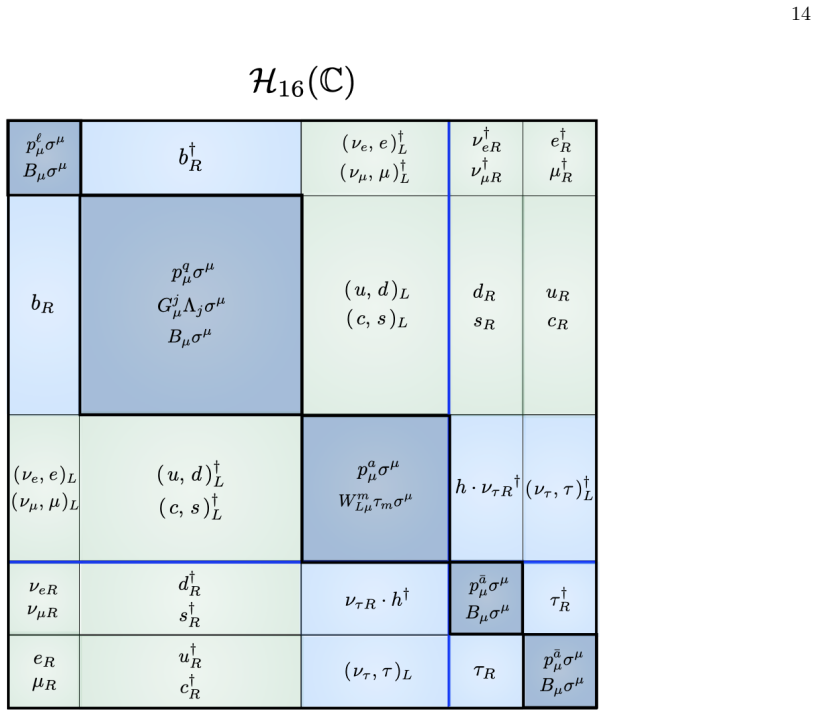
A set of particle representations mirroring the internal behaviour of the Standard Model's gauge bosons, and three generations of fermions, are each included in this algebra, with exception only to those irreps involving the top quark. This superalgebra is isomorphic to the Euclidean Jordan algebra of 16×16 hermitian matrices, H_16(C), and is generated by division algebras. The division algebraic substructure enables a natural factorization between internal and spacetime symmetries. It also allows for the definition of a Z_2^5 grading on the algebra. Those internal symmetries respecting this substructure are found to be su(3)_C ⊕ su(2)_L ⊕ u(1)_Y, in addition to four iterations of u(1). For
What carries the argument
The Euclidean Jordan algebra of 16 by 16 hermitian matrices over the complex numbers, generated by division algebras and carrying a Z_2^5 grading that selects the observed symmetries.
If this is right
- Internal symmetries respecting the grading are exactly su(3)_C ⊕ su(2)_L ⊕ u(1)_Y plus four additional u(1) factors.
- Spatial symmetries appear as multiple independent copies of so(3).
- The division algebra generators allow a clean separation of internal symmetries from spacetime ones.
- The non-relativistic Jordan algebraic character supplies a possible bridge to quantum computing models.
Where Pith is reading between the lines
- The algebraic closure might allow derivation of charge assignments directly from matrix multiplication rules rather than external postulates.
- Omitting top-quark representations could indicate that the third generation requires a separate extension or modified grading in a fuller version.
- Matrix elements in this algebra might be interpretable as states in a quantum information system, offering a computational view of particle interactions.
Load-bearing premise
The specific selection of representations for gauge bosons and fermions from the first two generations and the bottom quark forms the complete and natural set that closes under the superalgebra product.
What would settle it
A direct multiplication check within the selected representations that produces a result outside the set or requires top-quark irreps would show the algebra does not close as claimed.
Figures

read the original abstract
It is demonstrated how a set of particle representations, familiar from the Standard Model, collectively form a superalgebra. Those representations mirroring the internal behaviour of the Standard Model's gauge bosons, and three generations of fermions, are each included in this algebra, with exception only to those irreps involving the top quark. This superalgebra is isomorphic to the Euclidean Jordan algebra of $16\times 16$ hermitian matrices, $H_{16}(\mathbb{C}),$ and is generated by division algebras. The division algebraic substructure enables a natural factorization between internal and spacetime symmetries. It also allows for the definition of a $\mathbb{Z}_2^5$ grading on the algebra. Those internal symmetries respecting this substructure are found to be $\mathfrak{su}(3)_C \oplus \mathfrak{su}(2)_L \oplus \mathfrak{u}(1)_Y,$ in addition to four iterations of $\mathfrak{u}(1)$. For spatial symmetries, one finds multiple copies of $\mathfrak{so}(3)$. Given its Jordan algebraic foundation, and its apparent non-relativistic character, the model may supply a bridge between particle physics and quantum computing. We close by describing current research directions. This includes (1) detailing how this construction fits into the larger picture of Bott Periodic Particle Physics, first introduced in [1], [2], [3], and (2) detailing how the origin of this Peirce decomposition may be grounded in the unsung algebra $\mathbb{R} \oplus \mathbb{C} \oplus \mathbb{H} \oplus \mathbb{O}$.
Editorial analysis
A structured set of objections, weighed in public.
Referee Report
Summary. The manuscript presents a construction in which representations of the Standard Model's gauge bosons and fermions from the first two generations plus the bottom quark (excluding top quark irreps) form a superalgebra. This algebra is claimed to be isomorphic to the Euclidean Jordan algebra of 16x16 Hermitian matrices over the complex numbers, H_16(C), and is generated by the division algebras R ⊕ C ⊕ H ⊕ O. A Z_2^5 grading is defined on this algebra, from which the internal symmetries su(3)_C ⊕ su(2)_L ⊕ u(1)_Y and additional u(1) factors are derived, along with multiple so(3) for spatial symmetries. The work is framed within Bott Periodic Particle Physics and suggests applications to quantum computing.
Significance. If the explicit details of the algebra multiplication and the justification for the representation selection are provided, this could represent a significant advance in understanding the algebraic origins of the Standard Model using division algebras and Jordan structures. The natural factorization of internal and spacetime symmetries, the Z_2^5 grading, and the potential non-relativistic interpretation are promising features that could bridge particle physics with quantum information science. The parameter-free nature of the derivation from division algebras, if verified, would be a notable strength.
major comments (3)
- [Abstract and main construction] Abstract and main construction: The assertion that the selected set of representations closes under the superalgebra product to form an algebra isomorphic to H_16(C) lacks an explicit multiplication table or basis choice. Without this verification, it is difficult to confirm that the product of any two elements remains within the set excluding top-quark irreps, which is central to the isomorphism claim.
- [Selection of representations] Selection of representations: The exclusion of all irreps involving the top quark is stated without a derivation from the division-algebra generators. It is not shown that including the top quark would violate the Z_2^5 grading or the closure, making the selection appear tailored to fit the observed SM symmetries rather than emerging necessarily from the axioms.
- [Derivation of gauge symmetries] Derivation of gauge symmetries: The recovery of su(3)_C ⊕ su(2)_L ⊕ u(1)_Y from the internal symmetries respecting the division-algebra substructure is described, but the manuscript does not detail how the Z_2^5 grading is explicitly assigned to the particle representations or how the subalgebra is identified independently.
minor comments (2)
- [Abstract] The phrase 'three generations of fermions' is used but then qualified by excluding top quark; a more precise statement of which specific representations are included would improve clarity.
- [Conclusion] The discussion of current research directions, including the fit to Bott Periodic Particle Physics, would benefit from a brief summary of the key results from references [1], [2], [3] to make the connection self-contained.
Simulated Author's Rebuttal
We thank the referee for their thorough review and valuable comments, which help clarify the presentation of our construction. We address each major comment below and indicate revisions where they strengthen the manuscript without altering its core claims.
read point-by-point responses
-
Referee: The assertion that the selected set of representations closes under the superalgebra product to form an algebra isomorphic to H_16(C) lacks an explicit multiplication table or basis choice. Without this verification, it is difficult to confirm that the product of any two elements remains within the set excluding top-quark irreps, which is central to the isomorphism claim.
Authors: The isomorphism follows from identifying the chosen representations with the standard matrix units in H_16(C) via the action of the division-algebra generators R ⊕ C ⊕ H ⊕ O; the product is the Jordan product on Hermitian matrices, which by construction maps the selected 16-dimensional space to itself. We agree that an explicit basis and sample products would make the closure immediate to verify. In the revision we will add a dedicated subsection containing the basis labeling and a multiplication table for representative pairs. revision: yes
-
Referee: The exclusion of all irreps involving the top quark is stated without a derivation from the division-algebra generators. It is not shown that including the top quark would violate the Z_2^5 grading or the closure, making the selection appear tailored to fit the observed SM symmetries rather than emerging necessarily from the axioms.
Authors: The 16-dimensional space is fixed by the dimension of the Jordan algebra generated by the four division algebras; the top-quark representations lie outside this space and cannot be included without enlarging the algebra or breaking the Z_2^5 grading induced by the independent sign flips in each division-algebra factor. We will insert a short derivation showing that any attempt to adjoin a top-quark irrep forces either a higher-dimensional Jordan algebra or a loss of the grading, thereby demonstrating that the exclusion follows from algebraic closure rather than phenomenological fitting. revision: partial
-
Referee: The recovery of su(3)_C ⊕ su(2)_L ⊕ u(1)_Y from the internal symmetries respecting the division-algebra substructure is described, but the manuscript does not detail how the Z_2^5 grading is explicitly assigned to the particle representations or how the subalgebra is identified independently.
Authors: The five Z_2 generators are the independent sign changes associated with the real, complex, quaternionic and octonionic units; each particle representation receives a 5-tuple of eigenvalues under these generators, which defines its grade. The internal symmetry algebra is recovered as the graded derivations that commute with the division-algebra action. We will add an explicit table assigning the Z_2^5 grades to every included representation together with the step-by-step extraction of the su(3)_C ⊕ su(2)_L ⊕ u(1)_Y subalgebra from the graded derivation algebra. revision: yes
Circularity Check
Closure under the superalgebra product depends on an ad-hoc exclusion of top-quark irreps whose necessity is not derived from the division-algebra generators.
specific steps
-
fitted input called prediction
[Abstract]
"It is demonstrated how a set of particle representations, familiar from the Standard Model, collectively form a superalgebra. Those representations mirroring the internal behaviour of the Standard Model's gauge bosons, and three generations of fermions, are each included in this algebra, with exception only to those irreps involving the top quark. This superalgebra is isomorphic to the Euclidean Jordan algebra of 16×16 hermitian matrices, H_16(C), and is generated by division algebras."
The input set is assembled by taking known SM representations and manually excluding top-quark components so that the collection closes under the superalgebra product and yields exactly su(3)_C ⊕ su(2)_L ⊕ u(1)_Y plus extra u(1) factors. The subsequent claim that the algebra is generated by division algebras and that the symmetries follow from the Z_2^5 grading therefore reduces to a property of the pre-selected input rather than an output forced by the division-algebra axioms alone.
full rationale
The paper selects a specific subset of Standard Model representations (gauge bosons plus fermions from the first two generations and bottom quark, omitting all top-quark irreps) and asserts that this set forms a closed Z_2^5-graded superalgebra isomorphic to H_16(C) generated by division algebras. The internal symmetries su(3)_C ⊕ su(2)_L ⊕ u(1)_Y are then extracted from this pre-chosen set. No explicit multiplication table or derivation from the division-algebra generators (R ⊕ C ⊕ H ⊕ O) is shown to force the top-quark exclusion; the selection is justified only by the fact that the chosen elements close and reproduce the observed symmetries. This makes the central result a fitted construction rather than an independent prediction.
Axiom & Free-Parameter Ledger
axioms (2)
- domain assumption The chosen irreps for gauge bosons and fermions (excluding top-quark irreps) close under the superalgebra multiplication.
- domain assumption Division algebras generate the algebra and induce the Z_2^5 grading that separates internal and spacetime symmetries.
Lean theorems connected to this paper
-
IndisputableMonolith/Foundation/AlexanderDuality.leanalexander_duality_circle_linking echoes?
echoesECHOES: this paper passage has the same mathematical shape or conceptual pattern as the Recognition theorem, but is not a direct formal dependency.
This superalgebra is isomorphic to the Euclidean Jordan algebra of 16×16 hermitian matrices, H_16(C), and is generated by division algebras... Those internal symmetries respecting this substructure are found to be su(3)_C ⊕ su(2)_L ⊕ u(1)_Y
-
IndisputableMonolith/Cost/FunctionalEquation.leanwashburn_uniqueness_aczel unclear?
unclearRelation between the paper passage and the cited Recognition theorem.
H_16(C) ... Cl(8) ... 256R-dimensional ... Z_2^5 grading
What do these tags mean?
- matches
- The paper's claim is directly supported by a theorem in the formal canon.
- supports
- The theorem supports part of the paper's argument, but the paper may add assumptions or extra steps.
- extends
- The paper goes beyond the formal theorem; the theorem is a base layer rather than the whole result.
- uses
- The paper appears to rely on the theorem as machinery.
- contradicts
- The paper's claim conflicts with a theorem or certificate in the canon.
- unclear
- Pith found a possible connection, but the passage is too broad, indirect, or ambiguous to say the theorem truly supports the claim.
Forward citations
Cited by 2 Pith papers
-
Fermion mass ratios from the exceptional Jordan algebra
The complexified exceptional Jordan algebra yields fermion mass ratios via a diagonal-action theorem on Sym^3(3) representations after triality breaking, with a universal eigenvalue spectrum fixed by the Jordan cubic.
-
Spacetime Grand Unified Theory
Derives Standard Model from Dirac Lagrangian in 8D spacetime via Clifford algebra embedding, with SM gauge group as redundancy, four families, Spin(8) triality for strong force, and generalized Koide mass hierarchy.
Reference graph
Works this paper leans on
-
[1]
We find two full generations of fermions within the outer off-diagonals blocks
A Jordan algebraic mosaic In summary, withinH 16(C) we find irreducible repre- sentations corresponding to a (cursory) momentum-space covariant derivative, including gluons and electroweak bosons on the diagonal. We find two full generations of fermions within the outer off-diagonals blocks. Fi- nally, within the inner-off-diagonal blocks, we find the fer...
-
[2]
At first glance, we findso(3),notso(3,1). It is perhaps a feature of this model that spatial sym- metries enter the picture via equation (45) in exact anal- ogy to internal symmetries. With this said, this does not mean thatso(3,1) is excluded from the model. Lorentzian symmetry ap- pears naturally, given that the proper orthochronous group, SO +(3,1), co...
-
[3]
The model exhibits a non-trivial relationship be- tween generations (mass) and spin. As can be confirmed in Section VIII, this model repre- sents an excitation from one generation to another anal- ogously to how it represents an excitation from one spin state to another. With this said, these two properties are related to one another non-trivially. That i...
-
[4]
Generations: Three Prints, in Colour
Furey, C., “Generations: three prints, in colour,” JHEP, 10, 046 (2014) arXiv:1405.4601 [hep-th]
work page internal anchor Pith review Pith/arXiv arXiv 2014
-
[6]
Bott Periodic Particle Physics,
Furey, N., “Bott Periodic Particle Physics,” OSMU: Octonions, Standard Model, and Unification, Oxford Archive Trust for Research, Pune University (2023) https://youtu.be/0nr50YvWtGU
work page 2023
-
[7]
The quest to discover supersym- metry at the ATLAS experiment,
ATLAS Collaboration, “The quest to discover supersym- metry at the ATLAS experiment,” arXiv:2403.02455
-
[8]
Flavor at ssc energies: A new mechanism for dynamically generated fermion masses,
Kaplan, D., “Flavor at ssc energies: A new mechanism for dynamically generated fermion masses,” Nuc.Phys.B, vol 365, Issue 2, (1991)
work page 1991
-
[9]
Top Quark Compositeness: Feasibility and Implications
Pomarol, A., Serra, J., “Top Quark Compositeness: Fea- sibility and Implications,” Phys.Rev.D78:074026 (2008) arXiv:0806.3247 [hep-ph]
work page internal anchor Pith review Pith/arXiv arXiv 2008
-
[10]
Top-quark par- tial compositeness beyond the effective field theory paradigm,
Buarque Franzosi, D., Tonero, A., “Top-quark par- tial compositeness beyond the effective field theory paradigm,” J. High Energ. Phys. 2020, 40 (2020)
work page 2020
-
[11]
Introduction to exceptional Lie groups and algebras,
Ramond, P., “Introduction to exceptional Lie groups and algebras,” Caltech internal report, 1977
work page 1977
-
[12]
SO(8) Colour as possible origin of generations
Silagadze, Z.G., “SO(8) Colour as possible ori- gin of generations,” Phys.Atom.Nucl.58:1430-1434,1995; Yad.Fiz.58N8:1513-1517,1995 arXiv:hep-ph/9411381
work page internal anchor Pith review Pith/arXiv arXiv 1995
-
[13]
The three families fromSU(4) A ×SU(3) C × SU(2) L ×U(1) X SM-like chiral models,
Kong, O., “The three families fromSU(4) A ×SU(3) C × SU(2) L ×U(1) X SM-like chiral models,” Phys.Rev. D, 55, 383-396 (1997)
work page 1997
-
[14]
Number of fermion generations derived from anomaly cancellation,
Dobrescu, B.A., Poppitz, E., “Number of fermion generations derived from anomaly cancellation,” Phys.Rev.Lett., 87, 031801 (2001)
work page 2001
-
[15]
Division algebras: Family replication,
Dixon, G., “Division algebras: Family replication,” JMP 45, 3878 (2004); doi: 10.1063/1.1786682
-
[16]
Mon- odromies, fluxes, and compact three-generation F-theory GUTS,
Marsano, J., Saulina, N., Sch¨ afer-Nameki, S., “Mon- odromies, fluxes, and compact three-generation F-theory GUTS,” JHEP, 08, 046 (2009)
work page 2009
-
[17]
Octonions, E6, and Particle Physics,
Manogue, C.A., Dray, T., “Octonions, E6, and Particle Physics,” J.Phys.Conf.Ser., 254, 012005 (2010)
work page 2010
-
[18]
Non- anomalous discrete R-symmetry decrees three genera- tions,
Evans, J.L., Ibe, M., Kehayias, J., Yanagida, T.T., “Non- anomalous discrete R-symmetry decrees three genera- tions,” Phys.Rev.Lett., 109, 181801 (2012)
work page 2012
-
[19]
Anthropic Argument for Three Generations
Gould, A., “Anthropic argument for three generations,” arXiv:1011.2761 [hep-ph]
work page internal anchor Pith review Pith/arXiv arXiv
-
[20]
Spacetime as a topological insu- lator: mechanism for the origin of fermion generations,
Kaplan, D.B., Sun, S., “Spacetime as a topological insu- lator: mechanism for the origin of fermion generations,” Phys.Rev.Lett., 108, 181807 (2012)
work page 2012
-
[21]
Three-Family Particle Physics Models from Global F-theory Compactifications
Cvetiˇ c, M., Klevers, D., Mayorga Pe˜ na, D.K., Oehlmann, P.K., Reuter, J., “Three-family particle physics models from global F-theory compactifications,”JHEP, 08, 087 (2015) arXiv:1503.02068 [hep-th]
work page internal anchor Pith review Pith/arXiv arXiv 2015
-
[22]
Standard model fermions andN= 8 supergravity,
Meissner, K.A., Nicolai, H., “Standard model fermions andN= 8 supergravity,” Phys. Rev. D, 91, 065029 (2015)
work page 2015
-
[23]
Standard model physics from an algebra?
Furey, C., “Standard model physics from an alge- bra?” PhD thesis, University of Waterloo, (2015). www.repository.cam.ac.uk/handle/1810/254719 arXiv:1611.09182 [hep-th]
work page internal anchor Pith review Pith/arXiv arXiv 2015
-
[24]
Ibe, M., Kusenko, A., Yanagida, T.T., “Why three gen- erations?” Phys.Lett.B., 758, (2016)
work page 2016
-
[25]
Exceptional quantum geometry and particle physics,
Dubois-Violette, M., “Exceptional quantum geometry and particle physics,” Nuc.Phys.B, 912, (2016)
work page 2016
-
[26]
Todorov, I., Dubois-Violette, M., “Deducing the sym- metry of the Standard Model from the automorphism and structure groups of the exceptional Jordan algebra,” Int.J.Mod.Phys. A33 (2018) no.20, 1850118 18
work page 2018
-
[27]
Three generations, two unbroken gauge symmetries, and one eight-dimensional algebra,
Furey, C., “Three generations, two unbroken gauge symmetries, and one eight-dimensional algebra,” Phys.Lett.B, 785 (2018), pp. 84-89 arXiv:1910.08395
-
[28]
Three fermion generations with two unbroken gauge symmetries from the complex sedenions,
Gillard, A., Gresnigt, N., “Three fermion generations with two unbroken gauge symmetries from the complex sedenions,” Eur. Phys. J. C (2019) 79: 446
work page 2019
-
[29]
RCHO-valued gravity as a grand unified field theory,
C. Castro Perelman, “RCHO-valued gravity as a grand unified field theory,” Adv.Appl.Clifford Algebras 29 (2019) no.1, 22
work page 2019
-
[30]
Braids, 3-manifolds, elemen- tary particles: Number theory and symmetry in particle physics,
T. Asselmeyer-Maluga, “Braids, 3-manifolds, elemen- tary particles: Number theory and symmetry in particle physics,” Symmetry 11 (10), 1298 (2019)
work page 2019
-
[31]
B. Gording, A. Schmidt-May, “The unified Stan- dard Model,” Clifford Algebras 30, 55 (2020), arXiv:1909.05641
-
[32]
Beyond the stan- dard model with six-dimensional spacetime,
Chester, D., Rios, M., Marrani, A., “Beyond the stan- dard model with six-dimensional spacetime,” (2020) arXiv:2002.02391
-
[33]
The Standard Model, The Exceptional Jordan Al gebra, and Triality,
Boyle, L., “The Standard Model, The Exceptional Jor- dan Algebra, and Triality,” arXiv:2006.16265
-
[34]
Subgroups of Clifford algebras,
Wilson, R.A., “Subgroups of Clifford algebras,” Adv. App. Clifford Algebras 31 (2021), 59, arXiv:2011.05171
-
[35]
Towards a full set of division algebraic representations for the Stan- dard Model,
Furey, C., Romano, B., “Towards a full set of division algebraic representations for the Stan- dard Model,” 16th Marcel Grossmann Meet- ing on the 5th of July 2021, minute 1:21 of www.youtube.com/watch?v=9Dr3M9Kb2jo& list=PLr5RLbSWSonsaOnZukBDs0qsNIWM8A vRF&index=65&t=4849s
work page 2021
-
[36]
Jackson, D., “Oand the Standard Model,” Octonions and Standard Model workshop, Perimeter Institute (2021) https://pirsa.org/21050004
-
[37]
Castro Perelman., C., “On Jordan-Clifford algebras, three fermion generations with Higgs fields and a SU(3)×SU(2) L ×SU(2) R ×U(1) model,” Adv. Applied Clifford Algebras, 31:53, (2021)
work page 2021
-
[38]
Singh, T., Vaibhav, V., “Left-Right symmetric fermions and sterile neutrinos from complex split biquaternions and bioctonions, ” arXiv:2108.01858 [hep-ph]
-
[39]
Octions: An E8 description of the Standard Model,
Manogue, C.A., Dray, T., Wilson, R.A., “Octions: An E8 description of the Standard Model,” J. Math. Phys. 63, 081703 (2022) arXiv:2204.05310 [hep-ph]
-
[41]
Division algebraic sym- metry breaking,
Furey, N., Hughes, M.J., “Division algebraic sym- metry breaking,” Phys. Lett. B, 831 (2022). Sem- inar recording available https://pirsa.org/21030013 arXiv:2210.10126
-
[42]
The Standard Model’s Particle Content as a Jordan Algebraic Mosaic,
Furey, N., Romano, B., “The Standard Model’s Particle Content as a Jordan Algebraic Mosaic,” recorded talk, American Mathematical Society Meeting, April 6, 2022
work page 2022
-
[43]
Standard model irreps as an extension of 4-momentum: our first attempt,
Furey, N., Romano, B., “Standard model irreps as an extension of 4-momentum: our first attempt,” Dublin Institute for Advanced Study, seminar, 24 May, 2022, https://www.youtube.com/watch?v=jHHjJTztzkc
work page 2022
-
[44]
Dixon-Rosenfeld Lines and the Standard Model,
Chester, D., Marrani, A., Corradetti, D., Aschheim, R., Irwin, K., “Dixon-Rosenfeld Lines and the Standard Model,” (2023) arXiv:2303.11334 [hep-th]
-
[45]
Borˇ stnik, N.S.M., “How Clifford algebra helps under- stand second quantized quarks and leptons and corre- sponding vector and scalar boson fields, opening a new step beyond the standard model,” arXiv:2306.17167
-
[46]
Causal Fermion Sys- tems and Octonions,
Finster, F., Gresnigt, N., Isidro, J.M., Marciano A., Paganini, C., Singh, T.P., “Causal Fermion Sys- tems and Octonions,” Fortschr. Phys. 2024, 2400055 arXiv:2403.00360 [math-ph]
-
[47]
Three Generations and a Trio of Trialities,
Furey, N., Hughes, M., “Three Generations and a Trio of Trialities,” Phys.Lett.B, 865 (2025) arXiv:2409.17948
-
[48]
G¨ unaydin, M., “Massless Conformal Fields in Ten Di- mensions, Minimal Unitary Representation of E7(-25) and Exceptional Supergravity,” arXiv:2411.04049
-
[49]
Unconventional SUSY and Conventional Physics: A Pedagogical Review,
Alvarez, P.D., Delage, L., Valenzuela, M., Zanelli, J., “Unconventional SUSY and Conventional Physics: A Pedagogical Review, ” Symmetry 2021, 13(4), 628 arXiv:2104.05133 [hep-th]
-
[50]
Chiral gauge theory and gravity from unconventional supersymmetry,
Alvarez, P.D., Valenzuela, M., Zanelli, J., “Chiral gauge theory and gravity from unconventional supersymmetry,” 10.1007/JHEP07(2020)205 arXiv:2005.04178 [hep-th]
-
[51]
Division Algebras; Spinors; Idempotents; The Algebraic Structure of Reality
Dixon, G., “Division Algebras; Spinors; Idem- potents; The Algebraic Structure of Reality”, arXiv:1012.1304v1
work page internal anchor Pith review Pith/arXiv arXiv
-
[52]
Towards autotopies of normed compo- sition algebras in algebraic Quantum Field Theory,
K¨ oplinger, J., “Towards autotopies of normed compo- sition algebras in algebraic Quantum Field Theory,” DOI:10.13140/RG.2.2.19003.39209
-
[53]
Balbino, M., de Freitas, I.P., Rana, R.G., Toppan, F., “InequivalentZ n 2 -graded brackets, n-bit parastatistics and statistical transmutations of supersymmetric quan- tum mechanics,” Nucl. Phys. B 1009 (2024) 116729, arXiv:2309.00965
-
[54]
Z 3 2-grading of the Lie algebraG 2 and related color algebras,
Stoilova, N.I., Van der Jeugt, J., “Z 3 2-grading of the Lie algebraG 2 and related color algebras,” arXiv:2505.04378
-
[55]
Z2 ×Z 2-graded mechanics: the classical theory,
Aizawa, N., Kuznetsova, Z., Toppan, F., “Z2 ×Z 2-graded mechanics: the classical theory,” Eur. Phys. J. C 80, 668 (2020)
work page 2020
-
[56]
New Variables for Classical and Quantum Gravity,
Ashtekar, A., “New Variables for Classical and Quantum Gravity,” Phys.Rev.Lett., 57, 2244
-
[57]
Quark structure and the oc- tonions,
G¨ unaydin, M., G¨ ursey, F., “Quark structure and the oc- tonions,” J. Math. Phys., 14, No. 11 (1973)
work page 1973
-
[58]
Clifford algebras and spinors,
Lounesto, P., “Clifford algebras and spinors,” Cambridge University Press, 2001
work page 2001
-
[59]
Barrett, J.W., “Commuting Clifford actions,” arXiv:2405.08716
-
[60]
The Algebra of Grand Unified Theories
Baez, J., Huerta, J., “The Algebra of Grand Uni- fied Theories,” Bull.Am.Math.Soc.47:483-552 (2010) arXiv:0904.1556 [hep-th]
work page internal anchor Pith review Pith/arXiv arXiv 2010
-
[61]
An Algebraic Roadmap of Particle Theories, Part I: General Construction,
Furey, N., “An Algebraic Roadmap of Particle Theories, Part I: General Construction,” arXiv:2312.12377
-
[62]
An Algebraic Roadmap of Particle Theories, Part II: Theoretical Checkpoints,
Furey, N., “An Algebraic Roadmap of Particle Theories, Part II: Theoretical Checkpoints,” arXiv:2312.12799
-
[63]
Burgess, C., Moore, G., “The Standard Model, a primer”, Cambridge University Press (2011)
work page 2011
-
[64]
An electroweak theory of leptons in six dimensions,
Betancourt, C., “An electroweak theory of leptons in six dimensions,” Nuc.Phys.B, (2025)
work page 2025
-
[65]
TASI 2011 lectures notes: two- component fermion notation and supersymmetry,
Martin, S. P., “TASI 2011 lectures notes: two- component fermion notation and supersymmetry,” arXiv:1205.4076
-
[66]
Geometry from quantum particles
Kribs, D., Markopoulou, F., “Geometry from quantum particles,” (2005) arXiv:gr-qc/0510052, doi:10.48550/arXiv.gr-qc/0510052
work page internal anchor Pith review Pith/arXiv arXiv doi:10.48550/arxiv.gr-qc/0510052 2005
-
[67]
Gauge Theory on Fiber Bundle of Hyper- complex Algebras,
Hun Jang, “Gauge Theory on Fiber Bundle of Hyper- complex Algebras,” Nucl. Phys. B 993 (2023) 116281 arXiv:2303.08159 [hep-th]
-
[68]
Reality as a Vector in Hilbert Space,
Carroll, S., “Reality as a Vector in Hilbert Space,” Quan- tum Mechanics and Fundamentality: Naturalizing Quan- tum Theory Between Scientific Realism and Ontologi- 19 cal Indeterminacy; Valia Allori (ed.), (2021), Algebra, Particles, and Quantum Theory seminar series (2022) https://youtu.be/oW2ywdRRq M
work page 2021
-
[69]
Quasi-topological quantum er- ror correction codes,
Carteret, H., “Quasi-topological quantum er- ror correction codes,” PIRSA video archive https://pirsa.org/17050099 (2017)
-
[70]
Holographic Foliations: Self-Similar Quasicrystals from Hyperbolic Honeycombs,
Boyle, L., Kulp, J., “Holographic Foliations: Self-Similar Quasicrystals from Hyperbolic Honeycombs,” Phys. Rev. D 111, 046001 (2025), arXiv:2408.15316 [hep-th]
-
[71]
The Penrose Tiling is a Quantum Error-Correcting Code,
Li, Z., Boyle, L., “The Penrose Tiling is a Quantum Error-Correcting Code,” arXiv:2311.13040 [quant-ph]
-
[72]
The universe as quantum computer
Lloyd, S., “The universe as a quantum computer,” Chap- ter for A Computable Universe: Understanding and ex- ploring Nature as computation, H. Zenil ed., World Sci- entific, Singapore (2012) arXiv:1312.4455
work page internal anchor Pith review Pith/arXiv arXiv 2012
-
[73]
The structure of reversible computation determines the self-duality of quantum the- ory,
M¨ uller, M.P., Ududec, C., “The structure of reversible computation determines the self-duality of quantum the- ory,” Phys.Rev.Lett., 108, 130401 (2012)
work page 2012
-
[74]
Quantum Symmetries and Compatible Hamiltonians,
Moore, G., “Quantum Symmetries and Compatible Hamiltonians,” Lecture Notes (2013)
work page 2013
-
[75]
Baez, J., “The Tenfold Way,” Algebra, Parti- cles, and Quantum Theory seminar series, (2023) https://youtu.be/CgaMMjC3rnM
work page 2023
discussion (0)
Sign in with ORCID, Apple, or X to comment. Anyone can read and Pith papers without signing in.