REVIEW 4 major objections 5 minor 58 references
Operator-based machine learning framework for generalizable prediction of unsteady treatment dynamics in stormwater infrastructure
T0 review · 4 major / 5 minor · reviewed 2026-08-06 · deepseek-v4-flash
Pith's one-line read A neural network trained on 640 CFD runs predicts stormwater separator dynamics with R2 above 0.8 in most held-out cases.
desk verdict Solid operator-learning surrogate for 3D stormwater dynamics, with honest failure analysis; the main caveat is that 'generalizable' means interpolation within a single-peak synthetic event family, not real multi-peak storms. read the letter →
The pith
A machine-rendered reading of the paper's core claim, the machinery that carries it, and where it could break.
The reading
What carries the argument
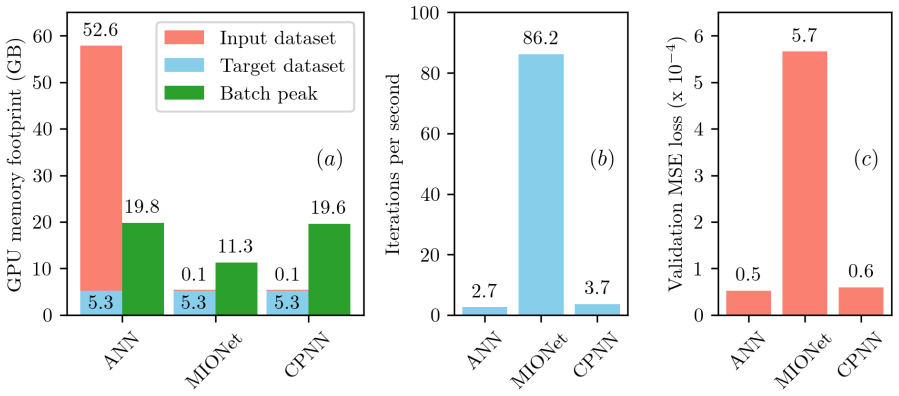
The load-bearing object is the composite operator-based neural network (CPNN), a MIONet-style encoder merged with a fully connected decoder. Four independent inputs — loading parameters $p$, particle terminal velocity $w_s$, time stamps, and spatial coordinates — are each processed by their own branch or trunk network and combined by element-wise Hadamard products, then decoded by a fully connected network to produce the solution. This factorization removes redundant data (about a 1000-fold input-size reduction versus a standard ANN in the paper's example) and lets the network generalize across loading scenarios it has not seen. A second machinery element is automatic differentiation of the trained network to compute quantities such as $\partial c/\partial \theta$, turning the surrogate into a spatial sensitivity model.
What would settle it
Run the trained CPNN on CFD simulations of multi-peak or prolonged storm hydrographs generated outside the single-peak parameter ranges used in training, and compare predicted outlet PM concentrations against the CFD results; if $R^2$ drops below 0.8 on a large share of such cases, the event-parameterization premise, not the neural architecture, is the failing link.
Extended reading notes
Core claim
The central claim is that unsteady stormwater treatment dynamics can be learned as an operator mapping rather than simulated case by case. With the hydrograph represented by a five-parameter modified gamma function and the pollutograph by a two-parameter exponential decay, the CPNN learns the operator that returns 3D velocity magnitude and PM concentration fields for any event in the parameter range. On 64 unseen CFD test cases the model keeps $R^2$ above 0.8 for velocity magnitude in 95.2% of cases and above 0.8 for concentration in 72.6% of cases, with a further 22.6% between 0.4 and 0.8. The paper also demonstrates a physics-free sensitivity analysis: differentiating the network output with respect to loading parameters reproduces expected first-flush behavior, such as flow scaling accelerating particle penetration and hydrograph shape parameters delaying it.
Load-bearing premise
Storm events are assumed to be well represented by single-peaked analytic curves — a modified gamma hydrograph and an exponential-decay pollutograph — and the paper itself states these forms struggle to represent multi-peak or prolonged events, so the model's generalizability claim is confined to that event family.
Editorial extensions
If this is right
- If CPNN generalizes as claimed, each new storm event costs a neural forward pass instead of a CFD run, enabling rapid evaluation of decades of rainfall records on a GPU.
- The network output at the system outlet can be integrated to build event-scale suspended-sediment discharge graphs, allowing continuous, long-term performance metrics for treatment devices.
- Because the same architecture handles different particle classes and loading parameters, retraining on new geometries and boundary conditions could extend the framework to retention basins, conveyance channels, and reactors.
- Automatic differentiation provides spatial maps of pollutant-transport sensitivity to loading parameters, which could support design choices and climate-scenario planning.
- The event-wise decomposition of continuous records can be parallelized and vectorized, making seasonal or multi-year simulation practical where CFD would be prohibitive.
Reading between the lines
- The reported accuracy holds only within the fitted single-peak event family; true multi-peak or prolonged events would require a hybrid parameterization that the paper sketches but does not implement, so the long-term workflow claim is conditional on that extension.
- Low-flow cases are systematically underweighted by the mean-squared-error loss, so a reweighted or log-scale training objective is a natural next step to recover the roughly 5% of failing concentration cases.
- The framework inherits the CFD model's one-way coupling assumption that particles do not affect the flow; applying it to very high sediment loads would require checking that assumption separately.
- The same operator-learning formulation could be transferred to other unsteady environmental systems where CFD is too costly for long horizons, such as detention ponds, treatment wetlands, or combined sewer storage.
Editorial analysis
A structured set of objections, weighed in public.
Referee Report
Summary. The paper develops a composite operator-based neural network (CPNN) that combines a MIONet encoder with a fully connected decoder to map storm-event loading parameters (five scalars), particle class, time stamps, and 3D coordinates to velocity magnitude and particulate-matter concentration in a hydrodynamic separator. Training data come from 640 URANS CFD simulations whose inlet hydrographs and pollutographs are parameterized by a modified gamma function and an exponential decay function and sampled by Latin hypercube sampling. On held-out cases, the model reports R2>0.8 in 95.2% of hydraulic predictions and 72.6% of PM concentration predictions, with the main failure mode at extreme low-flow/low-concentration cases. The paper also uses automatic differentiation to produce sensitivity maps of PM concentration to loading parameters and outlines a long-term, event-based performance-evaluation workflow.
Significance. If the reported performance holds beyond this study, CPNN is a practically useful surrogate for unsteady 3D CFD in stormwater treatment, with a large memory reduction relative to standard ANN inputs and improved expressivity over MIONet. The paper deserves credit for the 640-case CFD database, the held-out per-case evaluation, and its unusually candid discussion of low-flow failures and of the physically incorrect sensitivity gradients for kd. However, because no code or data are shipped and the CFD setup is only partially specified, the numerical claims cannot currently be independently verified.
major comments (4)
- [§4.2, Fig. 9, Eqs. (1)-(2)] The central generalizability claim is bounded by the event parameterization. All 640 CFD cases are generated by LHS over the modified-gamma/exponential family in Table 1, so the held-out split measures interpolation within that analytic family, not performance on multi-peak or prolonged real events. Section 4.2 concedes that these functions "struggle to represent multi-peak or prolonged events," and the paper does not quantify how often the 40 field events used to set Table 1 are multi-peak or prolonged, nor does it report per-event fit quality for Figs. S1-S4. Because the long-term workflow in Fig. 9 feeds parameterized events into the CPNN, an unknown parameterization failure rate is a direct input error to that workflow. Please quantify this limitation, or temper the generalizability and long-term claims.
- [§3.4, Fig. 8c] The sensitivity analysis, one of the three stated objectives, is not reliable for the decay coefficient kd. The paper acknowledges that for the second and third particle classes the model "incorrectly predicts that an increase in kd affects the velocity of PM" and yields a positive derivative at the first-flush leading edge. These gradients are not validated against CFD finite differences or an analytical baseline. The authors should either correct this with targeted training or reweighting, validate the gradients quantitatively, or explicitly remove the kd sensitivity claim from the abstract and conclusions.
- [§3.3 and Conclusion] The reported range "R2 for PM concentration in test cases ranges from 0.953 to 0.997" is inconsistent with the case-based R2 distribution in Fig. 7b, where 72.6% of cases have R2>0.8, 22.6% have 0.4<R2<0.8, and 4.8% have R2<0.4. The Fig. 5 range appears to be an aggregate over datasets, not a per-test-case range. Please correct the conclusion so that aggregate and per-case metrics are not conflated.
- [§2.1] The surrogate accuracy is measured against CFD, but the CFD setup is only partially specified: no turbulence closure, mesh resolution, boundary conditions, numerical schemes, or convergence criteria are given, and no code or data repository is provided. This prevents independent reproduction of the 640-case database and the headline R2 values. At minimum, provide a data/code availability statement and the complete CFD configuration in the supplemental material.
minor comments (5)
- [§2.2, after Eq. (5)] The sentence "This production merges the outputs..." should read "This product merges the outputs...".
- [§2.1 and §2.3] The text first says 8,000 spatial samples are generated by LHS for each case, then later calls them a subset of CFD meshing nodes; please clarify whether these are random sample points independent of the mesh or selected mesh nodes.
- [Conclusion bullet 2] The bullet compares MIONet and CPNN using MSE* values of 5.7e-4 and 6e-5, but Fig. 3c reports standardized MSE; please align the notation so that MSE and MSE* are used consistently.
- [§3.3, Figs. 6-7] The log-normal fits to the per-case MSE* distributions are presented without goodness-of-fit measures or confidence intervals; a direct histogram with the fitted curve overlaid would be sufficient and easier to assess.
- [Abstract and §1] The abstract motivates the work by contrasting with CSTR models, but the paper provides no quantitative comparison with CSTR predictions; a brief benchmark or a clearer statement that CSTR comparison is outside the scope would improve the framing.
Circularity Check
No circularity: CPNN is a supervised surrogate whose R2 claims are measured on a held-out CFD split; the acknowledged event-parameterization limitation is not a circular step.
full rationale
The paper's central object is a supervised operator surrogate: CPNN maps a 5-parameter event representation (lambda, k, theta, C0, kd), PM class, time, and spatial coordinates to CFD-computed velocity and concentration fields. The claimed predictive performance is evaluated on 64 held-out CFD cases (10% of 640) generated by LHS over the same parameter ranges used for training. This is interpolation within the training distribution rather than extrapolation, but it is a standard and statistically meaningful evaluation of the learned map; the test outputs are not used to fit the model. Nothing in the derivation defines the target output in terms of the prediction, and no per-case output is fitted and then relabeled as a prediction. The gamma/exponential parameterization is an input representation choice adopted to reduce the parameter space, not a consequence of the CPNN output. The long-term workflow in Section 4.2 contains an explicit limitation: "While the modified gamma and exponential-decay functions capture isolated hydrographs and pollutographs well, they struggle to represent multi-peak or prolonged events." This bounds the generalizability claim but is an acknowledged modeling limitation, not a circular step. Prior self-citations (CFD solver benchmarking in Li and Sansalone 2020a,b/2021a; the CPNN building on Li and Shatarah 2024) are either backed by laboratory experiments or describe architecture choices; they do not carry the burden of the R2 claims, which are computed against the independent test split. Therefore, no specific circular step can be exhibited from the paper's equations or citations.
Assumptions & free parameters
free parameters (1)
- Optimized hyperparameters =
Nb_L=226, Nb_t=227, Nb_s=195, Ne_l=2, Nf_l=6, Nh=92, lr=0.002, gamma=0.984
assumptions (5)
- domain assumption URANS CFD simulations are a faithful ground truth for the physical HS system.
- domain assumption Modified gamma and exponential functions with Table 1 parameter ranges represent real storm loadings.
- domain assumption One-way coupling between PM and flow is valid.
- domain assumption 8,000 LHS spatial samples per case sufficiently represent the 3D field.
- domain assumption Held-out LHS cases from the same parameter ranges test generalizability.
Cite this review
Pith. "Pith review of Operator-based machine learning framework for generalizable prediction of unsteady treatment dynamics in stormwater infrastructure." pith.science (2026). https://pith.science/paper/MX5HUKWH
@misc{pith2026250704682,
  author       = {Pith},
  title        = {Pith review of: Operator-based machine learning framework for generalizable prediction of unsteady treatment dynamics in stormwater infrastructure},
  year         = {2026},
  howpublished = {\url{https://pith.science/paper/MX5HUKWH}},
  note         = {Machine review of arXiv:2507.04682}
}
read the original abstract
Stormwater infrastructures are decentralized urban water-management systems that face highly unsteady hydraulic and pollutant loadings from episodic rainfall-runoff events. Accurately evaluating their in-situ treatment performance is essential for cost-effective design and planning. Traditional lumped dynamic models (e.g., continuously stirred tank reactor, CSTR) are computationally efficient but oversimplify transport and reaction processes, limiting predictive accuracy and insight. Computational fluid dynamics (CFD) resolves detailed turbulent transport and pollutant fate physics but incurs prohibitive computational cost for unsteady and long-term simulations. To address these limitations, this study develops a composite operator-based neural network (CPNN) framework that leverages state-of-the-art operator learning to predict the spatial and temporal dynamics of hydraulics and particulate matter (PM) in stormwater treatment. The framework is demonstrated on a hydrodynamic separator (HS), a common urban treatment device. Results indicate that the CPNN achieves R2 > 0.8 for hydraulic predictions in 95.2% of test cases; for PM concentration predictions, R2 > 0.8 in 72.6% of cases and 0.4 < R2 < 0.8 in 22.6%. The analysis identifies challenges in capturing dynamics under extreme low-flow conditions, owing to their lower contribution to the training loss. Exploiting the automatic-differentiation capability of the CPNN, sensitivity analyses quantify the influence of storm event loading on PM transport. Finally, the potential of the CPNN framework for continuous, long-term evaluation of stormwater infrastructure performance is discussed, marking a step toward robust, climate-aware planning and implementation.
Figures


Figures from the paper (6 more)


Reference graph
Works this paper leans on
-
[1]
author Akiba, T. , author Sano, S. , author Yanase, T. , author Ohta, T. , author Koyama, M. , year 2019 . title Optuna: A Next-generation Hyperparameter Optimization Framework . journal Proceedings of the ACM SIGKDD International Conference on Knowledge Discovery and Data Mining , pages 2623--2631 :10.1145/3292500.3330701
arXiv 2019
-
[2]
author Cai, S. , author Wang, Z. , author Lu, L. , author Zaki, T.A. , author Karniadakis, G.E. , year 2021 . title DeepM&Mnet: Inferring the electroconvection multiphysics fields based on operator approximation by neural networks . journal Journal of Computational Physics volume 436 , pages 110296 . :10.1016/j.jcp.2021.110296, arXiv:2009.12935 http://arx...
arXiv 2021
-
[3]
author Cataño-Lopera, Y.A. , author Spelman, D. , author Yee, T. , author Pathapati, S. , author Beck, K.J. , author Lee, J. , author Knatz, C. , author Wang, R.Q. , author Zhang, J. , author Camacho-Rincon, R. , author Kamojjala, S. , year 2023 . title Best practices for computational fluid dynamic applications in water infrastructure . journal Journal o...
-
[4]
author Chen, T. , author Chen, H. , year 1995 . title Universal Approximation to Nonlinear Operators by Neural Networks with Arbitrary Activation Functions and Its Application to Dynamical Systems . journal IEEE Transactions on Neural Networks volume 6 , pages 911--917 . :10.1109/72.392253
-
[5]
author Cho, H.C. , author Sansalone, J.J. , year 2013 . title Instantaneous Stepwise-Steady CFD Model of BMP Response to Unsteady PM Loadings . journal Journal of Environmental Engineering volume 139 , pages 1350--1360 . :10.1061/(asce)ee.1943-7870.0000749
-
[6]
author Dickenson, J.A. , author Sansalone, J.J. , year 2009 . title Discrete phase model representation of Particulate Matter (PM) for simulating PM separation by hydrodynamic unit operations . journal Environmental Science and Technology volume 43 , pages 8220--8226 . :10.1021/es901527r
-
[7]
author Dickenson, J.A. , author Sansalone, J.J. , year 2012 . title Distribution and disinfection of bacterial loadings associated with particulate matter fractions transported in urban wet weather flows . journal Water Research volume 46 , pages 6704--6714 . :10.1016/j.watres.2011.12.039
-
[8]
title Clean oceans and the blue economy – overview 2024
author European Investment Bank , year 2024 . title Clean oceans and the blue economy – overview 2024 . https://data.europa.eu/doi/10.2867/921418
Show all 58 references
-
[9]
, author Sansalone, J
author Garofalo, G. , author Sansalone, J. , year 2018 . title Urban Drainage Clarifier Load-Response as a Function of Flow, Unsteadiness, and Baffling . journal Journal of Environmental Engineering volume 144 , pages 1--9 . :10.1061/(asce)ee.1943-7870.0001283
2018
-
[11]
, author Sansalone, J.J
author Garofalo, G. , author Sansalone, J.J. , year 2011 . title Transient elution of particulate matter from hydrodynamic unit operations as a function of computational parameters and runoff hydrograph unsteadiness . journal Chemical Engineering Journal volume 175 , pages 150...
2011 doi
-
[12]
, author Kapelan, Z
author Garz \' o n, A. , author Kapelan, Z. , author Langeveld, J. , author Taormina, R. , year 2022 . title Machine Learning-Based Surrogate Modeling for Urban Water Networks: Review and Future Research Directions . journal Water Resources Research volume 58 . :10.1029/2021WR031808
2022 doi
-
[13]
, year 2010
author Howard, A.K. , year 2010 . title Use of standard sumps for suspended sediment removal from stormwater . Ph.D. thesis. University of Minnesota. http://hdl.handle.net/11299/93160
2010
-
[14]
, author Ma, C
author Huang, R. , author Ma, C. , author Ma, J. , author Huangfu, X. , author He, Q. , year 2021 . title Machine learning in natural and engineered water systems . journal Water Research volume 205 , pages 117666 . :10.1016/J.WATRES.2021.117666
2021
-
[15]
, author Cannon, L
author Huber, W.C. , author Cannon, L. , author Stouder, M. , year 2006 . title BMP modeling concepts and simulation . type Technical Report . United States Environmental Protection Agency. https://www.epa.gov/sites/production/files/2015-10/documents/bmp_tools_complex.pdf
2006
-
[16]
, author Meng, S
author Jin, P. , author Meng, S. , author Lu, L. , year 2022 . title MIONet: Learning Multiple-Input Operators via Tensor Product . journal SIAM Journal on Scientific Computing volume 44 , pages A3490--A3514 . :10.1137/22M1477751, arXiv:2202.06137 http://arxiv.org/abs/2202.06137
2022 arXiv
-
[17]
, author Gholami, A
author Krishnapriyan, A.S. , author Gholami, A. , author Zhe, S. , author Kirby, R.M. , author Mahoney, M.W. , year 2021 . title Characterizing possible failure modes in physics-informed neural networks . journal Advances in Neural Information Processing Systems volume 32 , pa...
2021 arXiv
-
[18]
, author Bang, K.W
author Lee, J.H. , author Bang, K.W. , year 2000 . title Characterization of urban stormwater runoff . journal Water Research volume 34 , pages 1773--1780 . :10.1016/S0043-1354(99)00325-5
2000 doi
-
[19]
, author Vanrolleghem, P.A
author Li, F. , author Vanrolleghem, P.A. , year 2022 . title An influent generator for WRRF design and operation based on a recurrent neural network with multi-objective optimization using a genetic algorithm . journal Water Science and Technology :10.2166/WST.2022.048
2022 doi
-
[20]
, year 2024
author Li, H. , year 2024 . title Time-resolving piv measurements and modal analysis of turbulent flow in a bench-scale hydrodynamic separator . journal arXiv
2024
-
[21]
, author Balachandar, S
author Li, H. , author Balachandar, S. , author Sansalone, J. , year 2021 a. title Discordance of Tracer Transport and Particulate Matter Fate in a Baffled Clarification System . journal Journal of Fluids Engineering, Transactions of the ASME volume 143 . :10.1115/1.4049690
2021 doi
-
[23]
, author Sansalone, J
author Li, H. , author Sansalone, J. , year 2020 b. title CFD Model of PM Sedimentation and Resuspension in Urban Water Clarification . journal Journal of Environmental Engineering volume 146 . :10.1061/(asce)ee.1943-7870.0001649
2020
-
[26]
, author Sansalone, J
author Li, H. , author Sansalone, J. , year 2022 a. title A CFD-ML augmented alternative to residence time for clarification basin scaling and design . journal Water Research volume 209 , pages 117965 . :10.1016/j.watres.2021.117965
2022
-
[27]
, author Sansalone, J
author Li, H. , author Sansalone, J. , year 2022 b. title Implementing machine learning to optimize the cost-benefit of urban water clarifier geometrics . journal Water Research volume 220 . :10.1016/j.watres.2022.118685
2022
-
[28]
, author Sansalone, J
author Li, H. , author Sansalone, J. , year 2022 c. title Interrogating common clarification models for unit operation systems with dynamic similitude . journal Water Research volume 215 . :10.1016/j.watres.2022.118265
2022
-
[29]
, author Shatarah, M
author Li, H. , author Shatarah, M. , year 2024 . title Operator learning for urban water clarification hydrodynamics and particulate matter transport with physics-informed neural networks . journal Water Research volume 251 , pages 121123 . :10.1016/j.watres.2024.121123
2024
-
[30]
, author Spelman, D
author Li, H. , author Spelman, D. , author Sansalone, J. , year 2021 b. title Baffled clarification basin hydrodynamics and elution in a continuous time domain . journal Journal of Hydrology volume 595 , pages 125958 . :10.1016/j.jhydrol.2021.125958
2021
-
[31]
, author Spelman, D
author Li, H. , author Spelman, D. , author Sansalone, J. , year 2023 a. title Coupling Computational Fluid Dynamics and Artificial Intelligence for Sustainable Urban Water Management and Treatment . journal Environmental Sciences Proceedings , pages 87 :10.3390/environsciproc...
2023 doi
-
[32]
, author Spelman, D
author Li, H. , author Spelman, D. , author Sansalone, J. , year 2023 b. title Extensibility of a Machine Learning Model for Stormwater Basin Design and Retrofit Optimization Through a User-Friendly Web Application . journal Transportation Research Record volume 2677 , pages 6...
2023 doi
-
[33]
, author Kovachki, N
author Li, Z. , author Kovachki, N. , author Azizzadenesheli, K. , author Liu, B. , author Bhattacharya, K. , author Stuart, A. , author Anandkumar, A. , year 2020 . title Fourier Neural Operator for Parametric Partial Differential Equations . journal arXiv
2020
-
[34]
, author Zheng, H
author Li, Z. , author Zheng, H. , author Kovachki, N. , author Jin, D. , author Chen, H. , author Liu, B. , author Azizzadenesheli, K. , author Anandkumar, A. , year 2024 . title Physics-Informed Neural Operator for Learning Partial Differential Equations . journal ACM / IMS ...
2024 arXiv
-
[35]
, author Sansalone, J
author Liu, H. , author Sansalone, J. , year 2019 . title CFD and physical models of PM separation for urban drainage hydrodynamic unit operations . journal Water Research volume 154 , pages 258--266 . :10.1016/j.watres.2019.01.057
2019 doi
-
[36]
, author Garc \' i a, M.H
author Liu, X. , author Garc \' i a, M.H. , year 2011 . title Computational Fluid Dynamics Modeling for the Design of Large Primary Settling Tanks . journal Journal of Hydraulic Engineering volume 137 , pages 343--355 . :10.1061/(asce)hy.1943-7900.0000313
2011
-
[37]
, author Zhang, J
author Liu, X. , author Zhang, J. , author Nielsen, K.D. , author Cata \ n o-Lopera, Y.A. , year 2020 . title Challenges and Opportunities of Computational Fluid Dynamics in Water, Wastewater, and Stormwater Treatment . journal Journal of Environmental Engineering volume 146 ,...
2020
-
[38]
, author Qin, R
author Lowe, M. , author Qin, R. , author Mao, X. , year 2022 . title A Review on Machine Learning, Artificial Intelligence, and Smart Technology in Water Treatment and Monitoring . journal Water (Switzerland) volume 14 , pages 1384 . :10.3390/w14091384
2022 doi
-
[39]
, author Jin, P
author Lu, L. , author Jin, P. , author Pang, G. , author Zhang, Z. , author Karniadakis, G.E. , year 2021 . title Learning nonlinear operators via DeepONet based on the universal approximation theorem of operators . journal Nature Machine Intelligence volume 3 , pages 218--22...
2021 arXiv
-
[40]
, author Lu, L
author Mao, Z. , author Lu, L. , author Marxen, O. , author Zaki, T.A. , author Karniadakis, G.E. , year 2021 . title DeepM&Mnet for hypersonics: Predicting the coupled flow and finite-rate chemistry behind a normal shock using neural-network approximation of operators . journ...
2021
-
[41]
, author Luschi, C
author Masters, D. , author Luschi, C. , year 2018 . title Revisiting Small Batch Training for Deep Neural Networks . journal arXiv
2018
-
[42]
, author Lee, D.H
author Mendoza, J.A. , author Lee, D.H. , author Lee, S.I. , author Kang, J.H. , year 2016 . title Structural improvements on hydrodynamic separators: A computational fluid dynamics approach . journal Water Science and Technology volume 74 , pages 2898--2908 . :10.2166/wst.2016.462
2016 doi
-
[43]
, author Lewis, M.J
author Mullapudi, A. , author Lewis, M.J. , author Gruden, C.L. , author Kerkez, B. , year 2020 . title Deep reinforcement learning for the real time control of stormwater systems . journal Advances in Water Resources volume 140 . :10.1016/j.advwatres.2020.103600
2020
-
[44]
, author Cherukumilli, K
author Okaikue-Woodi, F.E.K. , author Cherukumilli, K. , author Ray, J.R. , year 2020 . title A critical review of contaminant removal by conventional and emerging media for urban stormwater treatment in the United States . journal Water Research volume 187 . :10.1016/j.watres...
2020
-
[45]
, author Sansalone, J.J
author Pathapati, S.S. , author Sansalone, J.J. , year 2011 . title Can a stepwise steady flow computational fluid dynamics model reproduce unsteady particulate matter separation for common unit operations? journal Environmental Science and Technology volume 45 , pages 5605--5...
2011 doi
-
[46]
, year 2012
author Prechelt, L. , year 2012 . title Early stopping - But when? journal Lecture Notes in Computer Science (including subseries Lecture Notes in Artificial Intelligence and Lecture Notes in Bioinformatics) volume 7700 LECTU , pages 53--67 . 10.1007/978-3-642-35289-8 \_ 5/COVER
2012 doi
-
[47]
, author Richards, P.A
author Reynolds, T.D. , author Richards, P.A. , year 1996 . title Unit operations and processes in environmental engineering . publisher PWS Publishing Company , address Boston, MA
1996
-
[48]
, author Hird, J.P
author Sansalone, J.J. , author Hird, J.P. , author Cartledge, F.K. , author Tittlebaum, M.E. , year 2005 . title Event‐Based Stormwater Quality and Quantity Loadings from Elevated Urban Infrastructure Affected by Transportation . journal Water Environment Research volume 77 ,...
2005
-
[49]
, author Pathapati, S.S
author Sansalone, J.J. , author Pathapati, S.S. , year 2009 . title Particle dynamics in a hydrodynamic separator subject to transient rainfall-runoff . journal Water Resources Research volume 45 . :10.1029/2008WR007661
2009 doi
-
[50]
, author Sansalone, J.J
author Spelman, D. , author Sansalone, J.J. , year 2017 . title Methods to model particulate matter clarification of unit operations subject to unsteady loadings . journal Water Research volume 115 , pages 347--359 . :10.1016/j.watres.2017.02.053
2017 doi
-
[52]
, author Sansalone, J.J
author Spelman, D. , author Sansalone, J.J. , year 2018 b. title Is the treatment response of manufactured BMPs to urban drainage PM loads portable? journal Journal of Environmental Engineering volume 144 , pages 04018013 . :10.1061/(asce)ee.1943-7870.0001326
2018
-
[53]
, author Scanlon, B.R
author Sun, A.Y. , author Scanlon, B.R. , year 2019 . title How can Big Data and machine learning benefit environment and water management: A survey of methods, applications, and future directions . journal Environmental Research Letters volume 14 . :10.1088/1748-9326/ab1b7d
2019 doi
-
[54]
, author Srinivasan, P.P
author Tancik, M. , author Srinivasan, P.P. , author Mildenhall, B. , author Fridovich-Keil, S. , author Raghavan, N. , author Singhal, U. , author Ramamoorthi, R. , author Barron, J.T. , author Ng, R. , year 2020 . title Fourier Features Let Networks Learn High Frequency Func...
-
[55]
title Stormwater Inlet Controls; Fact Sheet
author United States Environmental Protection Agency , year 2021 . title Stormwater Inlet Controls; Fact Sheet . howpublished https://www.epa.gov/system/files/documents/2021-11/bmp-stormwater-inlet-bmps.pdf . note National Menu of Best Management Practices for Stormwater-Post-...
2021
-
[56]
title Water Infrastructure Investments
author United States Environmental Protection Agency , year 2023 . title Water Infrastructure Investments . https://www.epa.gov/infrastructure/water-infrastructure-investments
2023
-
[57]
, author Shazeer, N
author Vaswani, A. , author Shazeer, N. , author Parmar, N. , author Uszkoreit, J. , author Jones, L. , author Gomez, A.N. , author Kaiser, . , author Polosukhin, I. , year 2017 . title Attention is all you need . journal Advances in Neural Information Processing Systems volum...
2017 arXiv
-
[58]
, author Wang, H
author Wang, S. , author Wang, H. , author Perdikaris, P. , year 2021 . title Learning the solution operator of parametric partial differential equations with physics-informed DeepONets . journal Science Advances volume 7 , pages 1--9 . :10.1126/sciadv.abi8605, arXiv:2103.1097...
2021 arXiv
-
[59]
, author Mohseni, O
author Wilson, M.A. , author Mohseni, O. , author Gulliver, J.S. , author Hozalski, R.M. , author Stefan, H.G. , year 2009 . title Assessment of Hydrodynamic Separators for Storm-Water Treatment . journal Journal of Hydraulic Engineering volume 135 , pages 383--392 . :10.1061/...
2009
-
[60]
, author Zhang, J
author Yee, T. , author Zhang, J. , author Gruss, A.B. , year 2023 . title Evaluation of mixing capability improvement of a circular water storage tank by nozzle system retrofit using computational fluid dynamics . journal Urban Water Journal volume 20 , pages 158--170 . :10.1...
2023
-
[61]
, author Sansalone, J
author Ying, G. , author Sansalone, J. , author Pathapati, S. , author Garofalo, G. , author Maglionico, M. , author Bolognesi, A. , author Artina, A. , year 2012 . title Stormwater treatment: Examples of computational fluid dynamics modeling . journal Frontiers of Environment...
2012 doi
-
[62]
, author Tylor, N
author Zhang, J. , author Tylor, N. , author Zhao, W. , author Rui, R. , author He, C. , year 2025 . title Enhancing Coagulation Prediction in Water Treatment Using a Similarity Score–Based Piecewise Machine Learning Model . journal Journal of Environmental Engineering volume ...
2025 doi
-
[63]
write newline
" write newline "" before.all 'output.state := FUNCTION n.dashify 't := "" t empty not t #1 #1 substring "-" = t #1 #2 substring "--" = not "--" * t #2 global.max substring 't := t #1 #1 substring "-" = "-" * t #2 global.max substring 't := while if t #1 #1 substring * t #2 gl...
Reviewed August 6, 2026 · model on record in the stance chip above.
Discussion (0). Sign in to comment.