Frequency Phase Transfer for Future Millimetre Arrays with Arbitrary Frequency Ratios
Pith reviewed 2026-06-26 02:55 UTC · model grok-4.3
The pith
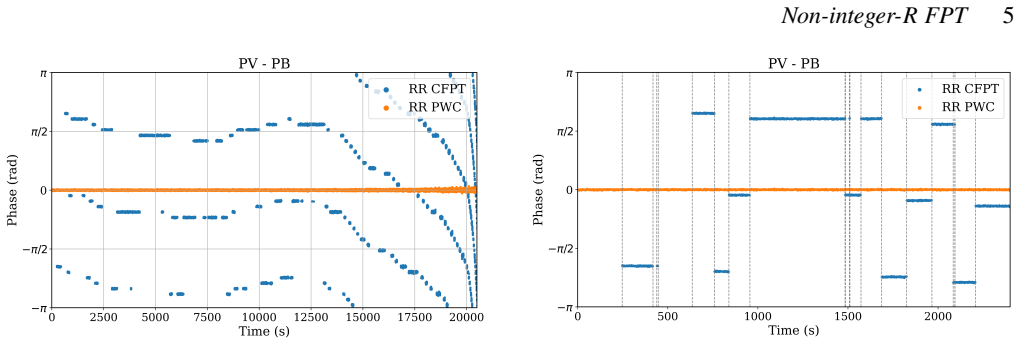
A phase-wrap counting algorithm enables frequency phase transfer at any frequency ratio by removing jump discontinuities in residual phases.
A machine-rendered reading of the paper's core claim, the machinery that carries it, and where it could break.
Core claim
The phase-wrap counting algorithm counts the integer number of phase wraps that occur when scaling a lower-frequency phase solution to a target frequency, then subtracts those wraps to produce a continuous residual phase. When applied to dual-band Event Horizon Telescope simulations, this approach calibrates the 230-GHz band using simultaneous 86-GHz observations and yields measurably higher coherence and recovered peak flux than conventional self-calibration.
What carries the argument
Phase-wrap counting (PWC), an algorithm that tracks and removes integer phase wraps during frequency scaling to produce continuous transferred phases for arbitrary frequency ratios.
If this is right
- Future Event Horizon Telescope arrays can use 86-GHz solutions to calibrate the 230-GHz band without requiring integer frequency ratios.
- The same algorithm extends to additional bands such as 345 GHz once they are added to the array.
- Imaging dynamic range at millimetre wavelengths improves because residual atmospheric phase errors are reduced below the level set by conventional methods.
- The software implementation (HITOPS) provides a practical route to test the method on existing multi-band receiver data.
Where Pith is reading between the lines
- If the method generalises beyond the simulated conditions, it could reduce the integration time needed to reach a given signal-to-noise ratio at the highest frequencies.
- Arrays without shared optical paths might still benefit if they can observe the same calibrator simultaneously at two frequencies.
Load-bearing premise
Tropospheric phase delays are identical at all frequencies so that a solution derived at one frequency can be scaled directly to another without extra frequency-dependent corrections.
What would settle it
An actual dual-band observation in which applying the scaled 86-GHz phases to the 230-GHz data produces no improvement in image coherence or peak flux relative to conventional calibration, or leaves visible residual phase jumps.
Figures


read the original abstract
Non-dispersive tropospheric turbulence-induced phase delays enforce significant, often dominant, limitations to the imaging fidelity and dynamic range in (sub-)millimetre astronomy. Frequency Phase Transfer (FPT), which removes such delays from high-frequency data using simultaneous lower-frequency observations, has become increasingly viable with the advent of shared-optical-path multi-band receivers and is a key motivator of the Event Horizon Telescope Collaboration's ambitions to add 86-GHz and 345-GHz bands alongside its existing 230-GHz band. However, existing FPT algorithms break down for non-integer frequency ratios, leaving jump discontinuities in the residual phases. We introduce a new FPT algorithm, phase-wrap counting (PWC), which works for any frequency ratio and clarifies the nature and source of the jump discontinuities left by previous FPT approaches. Using the newly developed High-frequency Inter-band Transfer of Phase Solutions (HITOPS) software package, we apply PWC to a simulated dual-band observation with the Event Horizon Telescope and demonstrate its effectiveness under realistic atmospheric conditions and thermal noise levels. The method successfully calibrates the 230-GHz phases using the 86-GHz phase solutions, outperforming the conventional phase calibration approach in both coherence and peak flux recovery. This result indicates that PWC has the potential to enable the calibration of the 230-GHz band using the 86-GHz band in future EHT operations.
Editorial analysis
A structured set of objections, weighed in public.
Referee Report
Summary. The manuscript introduces the phase-wrap counting (PWC) algorithm for frequency phase transfer (FPT) applicable to arbitrary frequency ratios, resolving jump discontinuities present in prior methods. Implemented in the HITOPS software package, PWC is applied to a simulated dual-band EHT observation at 86 and 230 GHz under modeled tropospheric turbulence and thermal noise; the results show successful calibration of 230-GHz phases from 86-GHz solutions with improved coherence and peak flux recovery relative to conventional phase calibration.
Significance. If the reported gains hold beyond the specific simulation, the work would enable more effective use of lower-frequency data for high-frequency phase calibration in future millimetre arrays, directly supporting EHT multi-band ambitions. Strengths include the provision of the HITOPS package and the use of realistic atmospheric and noise models in the simulation.
major comments (2)
- [Simulation results section] Simulation results section: the performance metrics (coherence and peak flux) are obtained from a simulation that embeds exact non-dispersive frequency-ratio scaling by construction. This setup cannot expose whether phase-wrap counting remains stable in the presence of small baseline-dependent residuals, instrumental drifts, or minor dispersive components that would violate the scaling assumption and potentially eliminate the reported improvements.
- [Abstract and conclusion] Abstract and conclusion: the claim that PWC 'has the potential to enable the calibration of the 230-GHz band using the 86-GHz band in future EHT operations' extrapolates from a single simulated dataset; the manuscript should include at least a brief sensitivity analysis or discussion of how wrap-count errors would propagate under modest violations of the non-dispersive assumption.
minor comments (2)
- [Figures] Figure captions: ensure explicit labeling of frequency bands and simulation parameters (e.g., turbulence strength, integration time) for all panels to improve clarity.
- [Algorithm description] Notation: the definition of the frequency ratio and the wrap-counting threshold should be stated once with consistent symbols across the algorithm description and the HITOPS implementation section.
Simulated Author's Rebuttal
We thank the referee for their constructive feedback and positive recommendation for minor revision. We address each major comment below.
read point-by-point responses
-
Referee: [Simulation results section] Simulation results section: the performance metrics (coherence and peak flux) are obtained from a simulation that embeds exact non-dispersive frequency-ratio scaling by construction. This setup cannot expose whether phase-wrap counting remains stable in the presence of small baseline-dependent residuals, instrumental drifts, or minor dispersive components that would violate the scaling assumption and potentially eliminate the reported improvements.
Authors: The simulation is constructed under the non-dispersive assumption because that is the physical basis for FPT; any deviation would invalidate the transfer principle itself. Our results demonstrate that PWC correctly handles the phase wraps under this assumption with realistic noise and turbulence. We will add a clarifying sentence in the simulation section to explicitly state this assumption and note that testing robustness to small dispersive effects is beyond the current scope but could be addressed in future work. revision: partial
-
Referee: [Abstract and conclusion] Abstract and conclusion: the claim that PWC 'has the potential to enable the calibration of the 230-GHz band using the 86-GHz band in future EHT operations' extrapolates from a single simulated dataset; the manuscript should include at least a brief sensitivity analysis or discussion of how wrap-count errors would propagate under modest violations of the non-dispersive assumption.
Authors: We will revise the abstract and conclusion to include a brief discussion on the sensitivity to violations of the non-dispersive assumption, explaining analytically how small errors in the frequency ratio would affect wrap counting. This addresses the extrapolation concern without requiring additional simulations. revision: yes
Circularity Check
No significant circularity; algorithm and validation are independent.
full rationale
The paper introduces a new phase-wrap counting (PWC) algorithm derived to resolve jump discontinuities for non-integer frequency ratios in frequency phase transfer, then evaluates it on separate simulated dual-band EHT data generated under the stated non-dispersive tropospheric model. No load-bearing step reduces by construction to a fitted parameter, self-citation, or renamed input; the simulation serves as an external testbed rather than embedding the result tautologically. The central performance claim (improved coherence and flux recovery versus conventional calibration) rests on explicit comparison metrics from the simulation, not on definitional equivalence. This is the common case of an honest, self-contained algorithmic contribution.
Axiom & Free-Parameter Ledger
axioms (1)
- domain assumption Tropospheric turbulence-induced phase delays are non-dispersive
Reference graph
Works this paper leans on
-
[1]
Blecher, T., Deane, R., Bernardi, G., & Smirnov, O.,
Studying black holes on horizon scales with vlbi ground arrays,arXiv preprint arXiv:1909.01411. Blecher, T., Deane, R., Bernardi, G., & Smirnov, O.,
arXiv 1909
-
[2]
Carter,M.,Lazareff,B.,Maier,D.,Chenu,J.-Y.,Fontana,A.-L.,Bortolotti,Y., Boucher,C.,Navarrini,A.,Blanchet,S.,Greve,A.,etal.,2012
meqsilhouette: a mm-vlbi observation and signal corruption simulator,Monthly Notices of the Royal Astronomical Society,464, 143–151. Carter,M.,Lazareff,B.,Maier,D.,Chenu,J.-Y.,Fontana,A.-L.,Bortolotti,Y., Boucher,C.,Navarrini,A.,Blanchet,S.,Greve,A.,etal.,2012. Theemir multi-bandmm-wavereceiverfortheiram30-mtelescope,Astronomy& Astrophysics,538, A89. Chen...
2012
-
[3]
source/frequencyphasereferenced
Vlba scientific memorandum n. 31: Astro- metriccalibrationofmm-vlbiusing"source/frequencyphasereferenced" observations,arXiv preprint arXiv:0910.1159. Dodson, R., Rioja, M. J., Jung, T.-H., Sohn, B.-W., Byun, D.-Y., Cho, S.-H., Lee, S.-S., Kim, J., Kim, K.-T., Oh, C.-S., Han, S.-T., Je, D.-H., Chung, M.-H., Wi, S.-O., Kang, J., Lee, J.-W., Chung, H., Kim,...
-
[4]
High-precision astrometric millimeter very long baseline interferometry using a new methodformulti-frequencycalibration,TheAstrophysicalJournal,834,
Dodson,R.,Rioja,M.J.,Molina,S.N.,&Gómez,J.L.,2017. High-precision astrometric millimeter very long baseline interferometry using a new methodformulti-frequencycalibration,TheAstrophysicalJournal,834,
2017
-
[5]
RASTI000, 1–10 (2026) Non-integer-𝑅FPT9 Doeleman,S.S.,Barrett,J.,Blackburn,L.,Bouman,K.L.,Broderick,A.E., Chaves,R.,Fish,V.L.,Fitzpatrick,G.,Freeman,M.,Fuentes,A.,Gómez, J.L.,Haworth,K.,Houston,J.,Issaoun,S.,Johnson,M.D.,Kettenis,M., Loinard, L., Nagar, N., Narayanan, G., Oppenheimer, A., Palumbo, D. C. M., Patel, N., Pesce, D. W., Raymond, A. W., Roelofs...
2026
-
[6]
rep., U.S
Mid-range science objectives for the event horizon telescope, Tech. rep., U.S. Department of Energy Office of Scientific and Technical Information. Frans,L.,Backes,M.,Falcke,H.,&Venturi,T.,2025. Acomparativeanalysis of gnss-inferred precipitable water vapour at the potential sites for the africa millimetre telescope,Monthly Notices of the Royal Astronomic...
2025
-
[7]
Han, S.-T., Lee, J.-W., Kang, J., Oh, C.-S., Byun, D.-Y., Je, D.-H., Chung, M.-H., Wi, S.-O., Song, M., Kang, Y.-W., Lee, S.-S., Kim, S.-Y., Sasao, T.,Goldsmith,P.F.,&Wylde,R.,2013
Millimeter-wave Receiver Optics for Korean VLBI Network,InternationalJournalofInfraredandMillimeterWaves,29(1), 69–78. Han, S.-T., Lee, J.-W., Kang, J., Oh, C.-S., Byun, D.-Y., Je, D.-H., Chung, M.-H., Wi, S.-O., Song, M., Kang, Y.-W., Lee, S.-S., Kim, S.-Y., Sasao, T.,Goldsmith,P.F.,&Wylde,R.,2013. KoreanVLBINetworkReceiver OpticsforSimultaneousMultifreq...
2013
-
[8]
11, Page 3,11,
Applications of the source- frequency phase-referencing technique for ngeht observations,Galaxies 2023, Vol. 11, Page 3,11,
2023
-
[9]
13092, pp
Johnson,M.D.,Akiyama,K.,Baturin,R.,Bilyeu,B.,Blackburn,L.,Boroson, D., Cárdenas-Avendaño, A., Chael, A., Chan, C.-k., Chang, D., et al., 2024.Theblackholeexplorer:Motivationandvision,inSpaceTelescopes and Instrumentation 2024: Optical, Infrared, and Millimeter Wave, vol. 13092, pp. 821–872, SPIE. Kemball,A.J.&Wieringa,M.H.,2000. MeasurementSetdefinitionve...
2024
-
[10]
Ultracompact jets in active galactic nuclei,Astronomy and Astrophysics, v. 330, p. 79-89 (1998),330, 79–89. McMullin, J. P., Waters, B., Schiebel, D., Young, W., & Golap, K.,
1998
-
[11]
Offringa,A.R.,McKinley,B.,Hurley-Walker,N.,Briggs,F.H.,Wayth,R.B., Kaplan, D
Meqsilhouette v2:spectrallyresolvedpolarimetricsyntheticdatagenerationfortheevent horizon telescope,Monthly Notices of the Royal Astronomical Society, 512, 490–504. Offringa,A.R.,McKinley,B.,Hurley-Walker,N.,Briggs,F.H.,Wayth,R.B., Kaplan, D. L., Bell, M. E., Feng, L., Neben, A. R., Hughes, J. D., Rhee, J., Murphy, T., Bhat, N. D. R., Bernardi, G., Bowman...
2014
-
[12]
RASTI000, 1–10 (2026) 10S. S. Simelane et al. Rioja, M. J., Dodson, R., Porcas, R. W., Suda, H., & Colomer, F.,
2026
-
[13]
Measurementofcore-shiftswithastrometricmulti-frequencycalibration, arXiv preprint astro-ph/0505475. Rioja, M. J., Dodson, R., Jung, T., Sohn, B. W., Byun, D. Y., Agudo, I., Cho, S. H., Lee, S. S., Kim, J., Kim, K. T., Oh, C. S., Han, S. T., Je, D. H., Chung, M. H., Wi, S. O., Kang, J., Lee, J. W., Chung, H., Kim, H. R., Kim, H. G., Lee, C. H., Roh, D. G.,...
-
[14]
Dask:Parallelcomputationwithblockedalgorithms and task scheduling., inSciPy, pp
Rocklin,M.etal.,2015. Dask:Parallelcomputationwithblockedalgorithms and task scheduling., inSciPy, pp. 126–132. Rosenkranz, P.,
2015
-
[15]
Shin, N., 2024.Studying blazars using mm VLBI data and development of wide IF 230 GHz SIS mixer, Ph.D
Shape of the 5 mm oxygen band in the atmosphere, IEEE Transactions on Antennas and Propagation,23(4), 498–506. Shin, N., 2024.Studying blazars using mm VLBI data and development of wide IF 230 GHz SIS mixer, Ph.D. thesis, Seoul National University. Simelane, S., Deane, R., Kemball, A., Botha, R., Julie, R., Molamu, K., Tiplady, A., & Witt, A. D.,
2024
-
[16]
the stimela2 frame- work: Scalable and repeatable workflows, from local to cloud compute, Astronomy and Computing,52, 100959
Africanus iv. the stimela2 frame- work: Scalable and repeatable workflows, from local to cloud compute, Astronomy and Computing,52, 100959. Thompson, A. R., Moran, J. M., & Swenson, G. W., 2017.Interferometry and synthesis in radio astronomy, Springer Nature. van Bemmel, I. M., Kettenis, M., Small, D., Janssen, M., Moellenbrock, G. A., Petry, D., Goddi, C...
2017
-
[17]
This paper has been typeset from a TEX/LATEX file prepared by the author
Shared-optical-path vlbi frequency phase transfer from 86to 258ghz onan 8600km baseline- demonstratedwith theapex and iram 30m telescopes,Astronomy & Astrophysics,701, A132. This paper has been typeset from a TEX/LATEX file prepared by the author. RASTI000, 1–10 (2026)
2026
discussion (0)
Sign in with ORCID, Apple, or X to comment. Anyone can read and Pith papers without signing in.