Cosmography of the Sloan Basin of Attraction and Neighborhood
Pith reviewed 2026-06-28 05:20 UTC · model grok-4.3
The pith
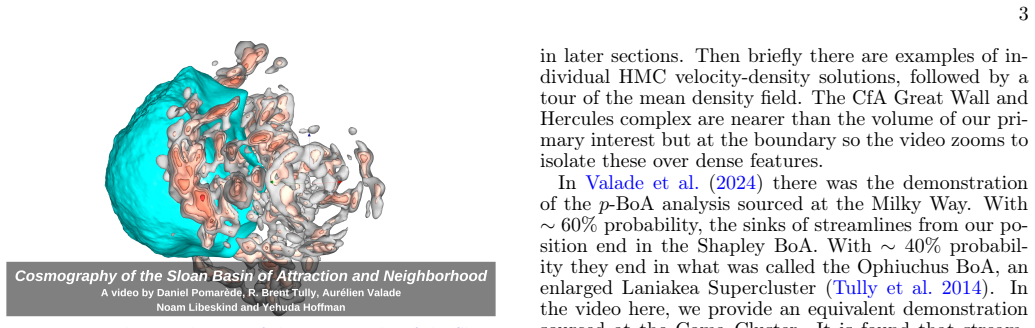
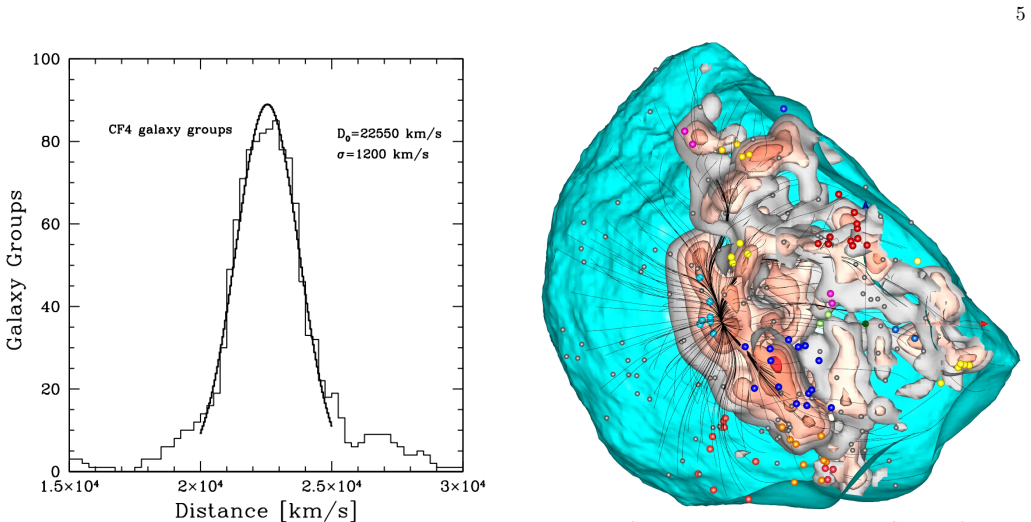
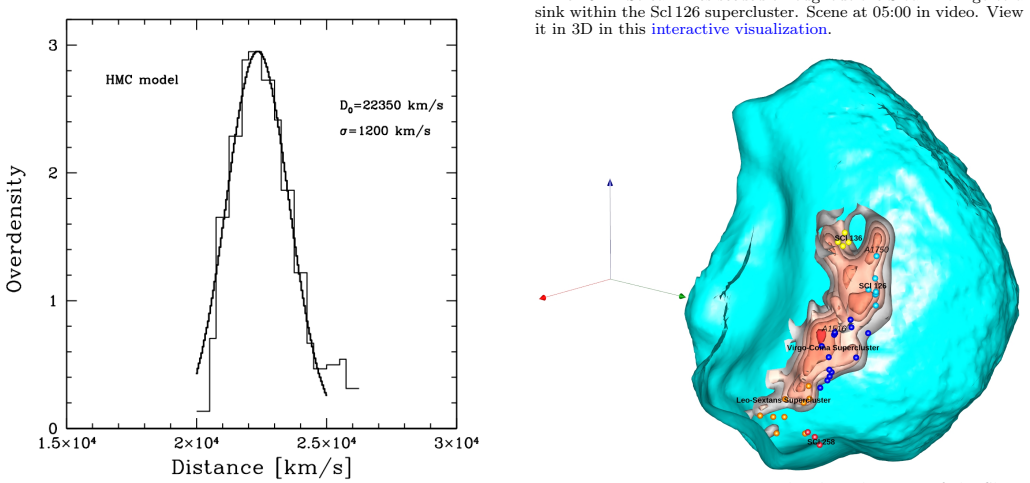
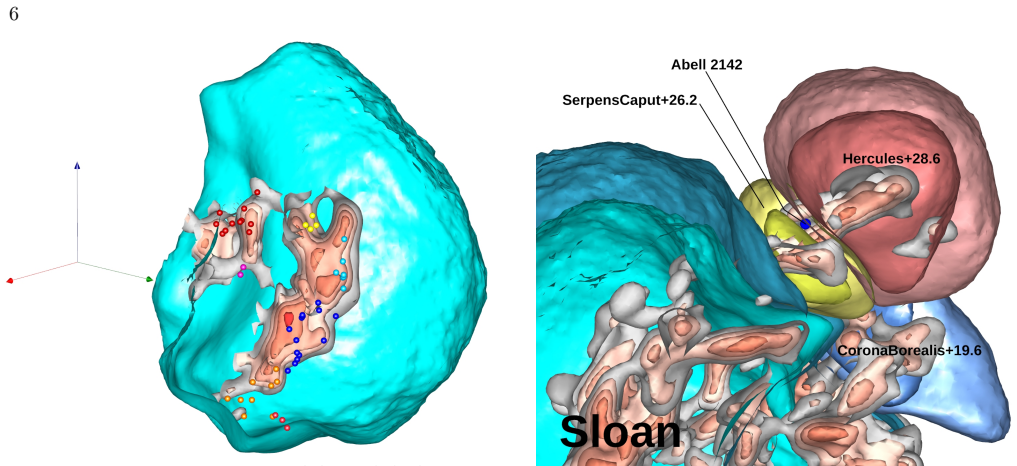
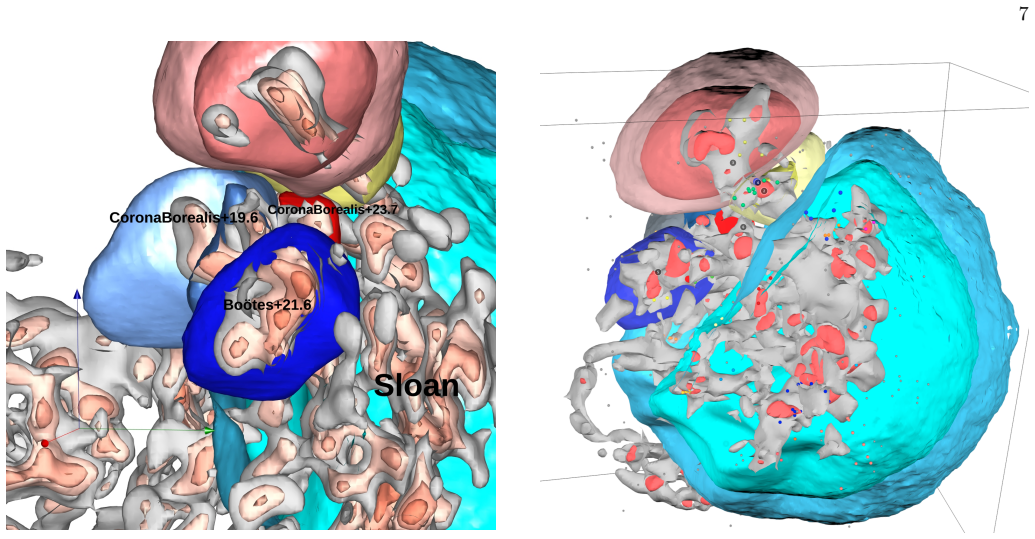
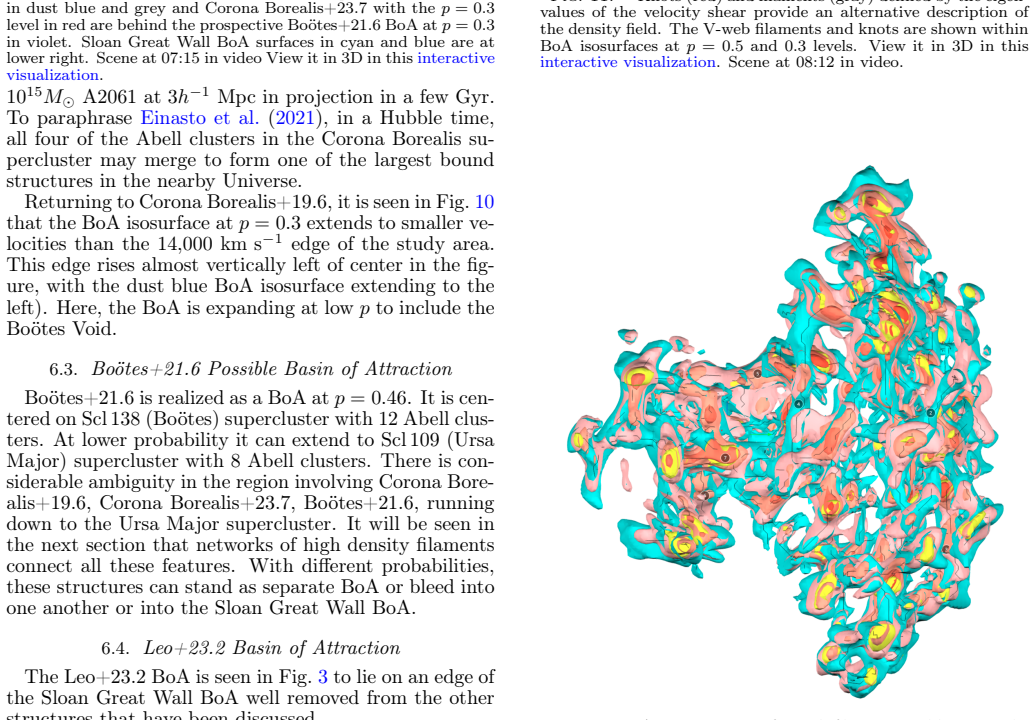
Reconstructed velocity streamlines show the Sloan basin of attraction as the largest in the local region with diameter ~0.13c.
A machine-rendered reading of the paper's core claim, the machinery that carries it, and where it could break.
Core claim
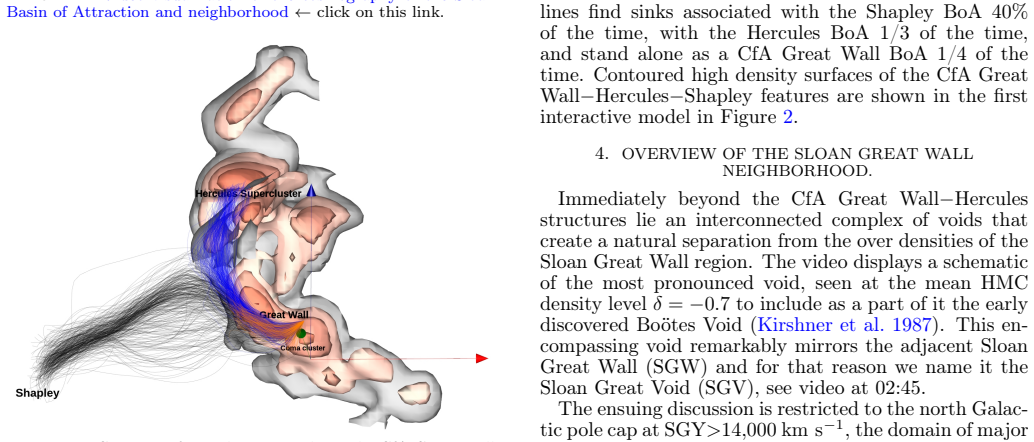
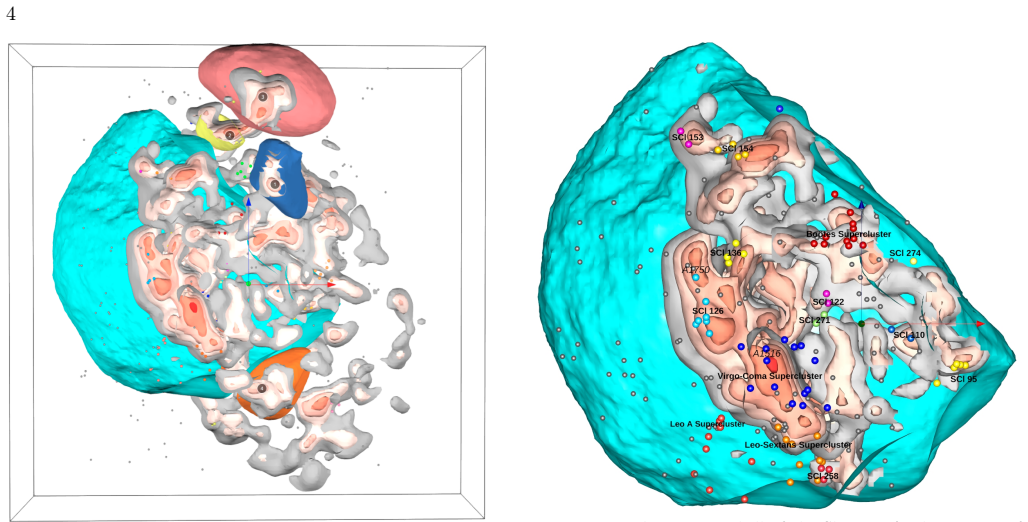
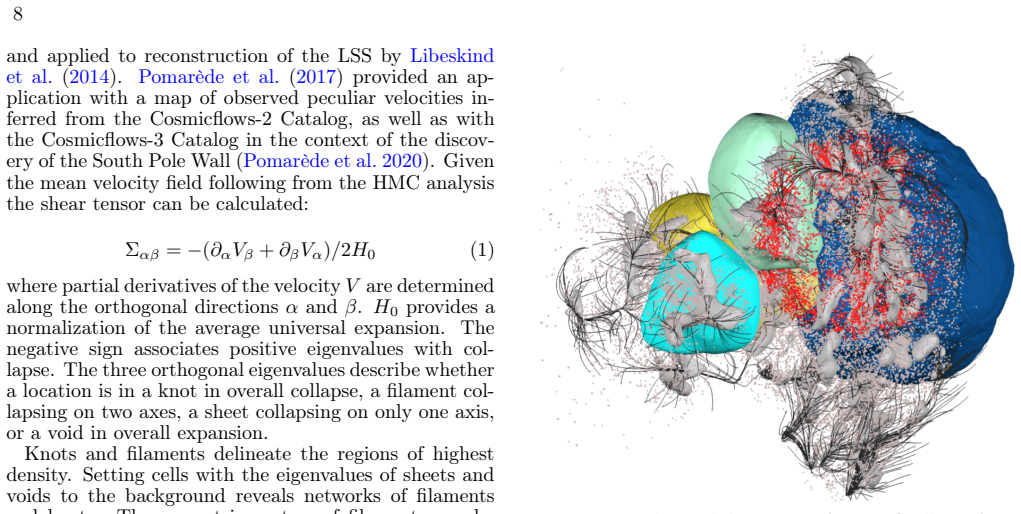
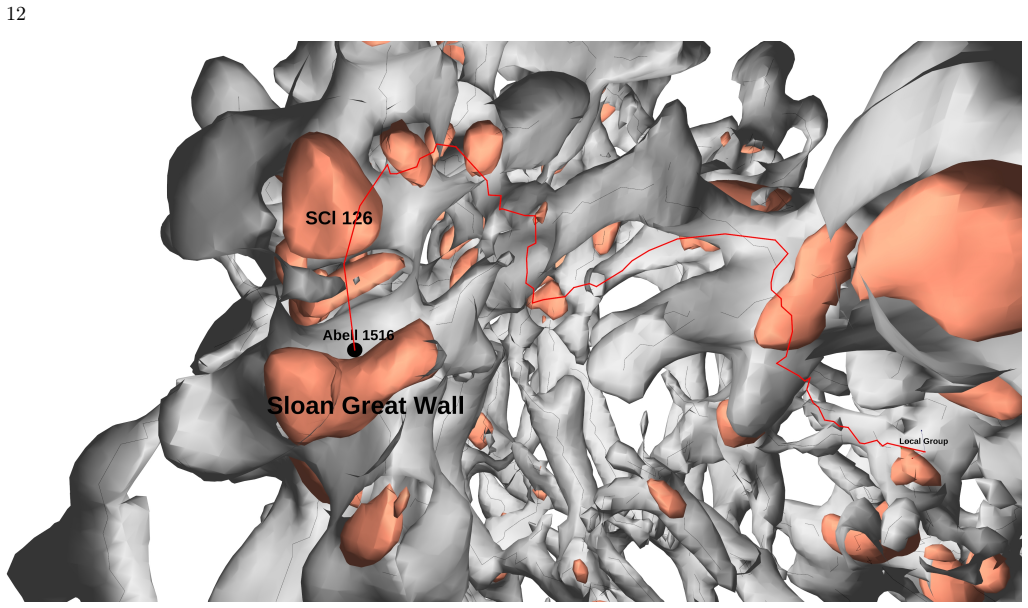
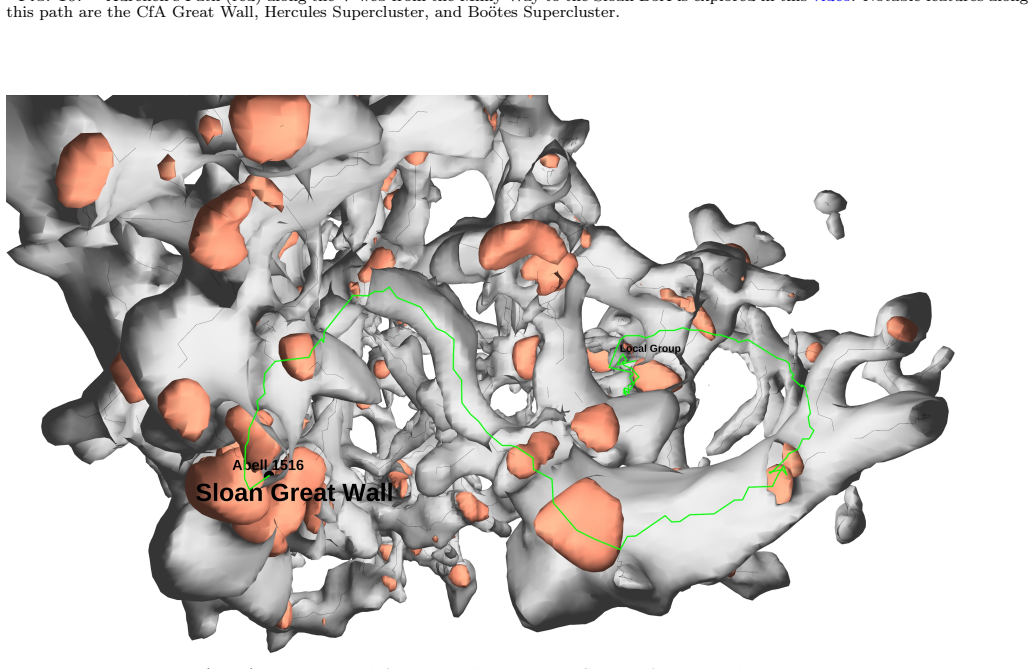
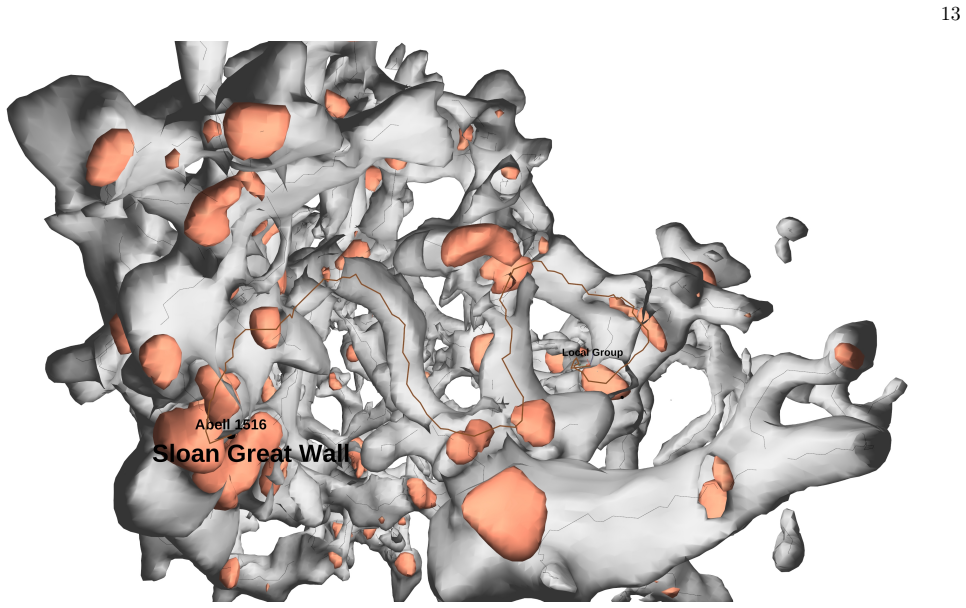
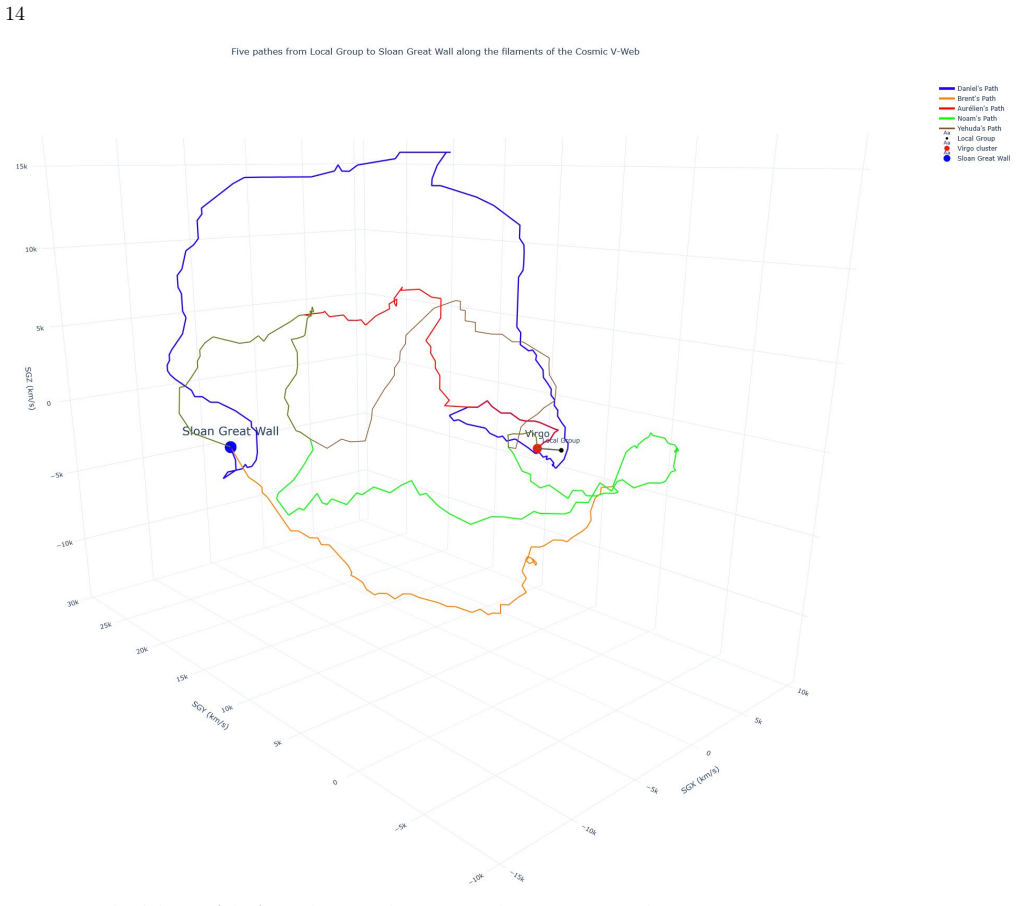
Hamiltonian Monte Carlo forward reconstruction in a LambdaCDM framework, constrained by Cosmicflows-4, produces probabilistic density and velocity fields. Streamlines of the velocity field converge to sinks corresponding to gravitational potential minima. The Sloan basin of attraction is the largest, with a diameter of ~0.13c, and can be traced by converging streamlines on the Sloan Great Wall, the density field, and the V-web filaments from velocity shear.
What carries the argument
Basin of attraction as the volume of all velocity streamlines ending at the same gravitational potential minimum sink.
If this is right
- The Sloan Great Wall serves as the primary gravitational attractor for flows in this volume.
- The basin appears consistently across velocity streamlines, density reconstruction, and shear-defined filaments.
- Probabilities and uncertainties can be assigned to the basin identification due to data limitations and model randomness.
- The Ho`oleilana baryon acoustic oscillation feature has a relationship to this basin that merits further exploration.
Where Pith is reading between the lines
- Similar reconstructions in other regions could map the full hierarchy of basins across the observable universe.
- Discrepancies between this reconstruction and N-body simulations might highlight missing physics in the model.
- The method provides a way to visualize and quantify the influence of known structures like the Sloan Great Wall on cosmic expansion.
Load-bearing premise
The LambdaCDM forward reconstruction from the Cosmicflows-4 data accurately locates the true gravitational potential minima and associated basins without major biases from incomplete data or model assumptions.
What would settle it
A more complete survey of galaxy distances and velocities in the region showing that streamlines do not predominantly converge on the Sloan Great Wall or that the potential minimum is elsewhere.
Figures


read the original abstract
The Sloan Great Wall is a dominant structure that is relatively nearby. As well as evident in redshift survey maps, its presence is manifested in distortions to cosmic expansion. Here, Hamiltonian Monte Carlo forward reconstruction in a {\Lambda}CDM framework gives probabilistic density and velocity fields constrained by the Cosmicflows-4 compendium of galaxy distances and radial velocities. Streamlines of the reconstructed velocity field started from arbitrary points in space can be followed to sinks, i.e. the minima of the gravitational potential, due to the distribution of mass. A basin of attraction encompasses the volume of all streamlines ending at the same sink. The solution can be assigned probabilities, with uncertainties associated with the imperfect data and the random nature of the {\Lambda}CDM model. The Sloan basin of attraction is by far the largest basin in the study region, extending across a diameter of ~0.13c. It can be described by velocity streamlines that converge on the Sloan Great Wall, by the reconstructed density field, and by the network of filaments of the V-web, formulated by shear in the velocity field. The discussion of these elements is augmented by a video and interactive models. It is of interest to see the relationship of the Ho`oleilana baryon acoustic oscillation feature with the Sloan basin of attraction.
Editorial analysis
A structured set of objections, weighed in public.
Referee Report
Summary. The manuscript applies Hamiltonian Monte Carlo forward reconstruction in a ΛCDM framework, constrained by the Cosmicflows-4 compendium, to generate probabilistic density and velocity fields. Basins of attraction are identified by tracing velocity streamlines to gravitational potential minima (sinks). The central result is that the Sloan basin of attraction is the largest in the study region, with a diameter of ~0.13c, and is characterized by converging streamlines to the Sloan Great Wall, the reconstructed density field, and the V-web filaments defined via velocity shear. The work also relates this structure to the Ho'oleilana baryon acoustic oscillation feature and supplies visualizations.
Significance. If the reconstruction reliably locates potential minima without dominant biases, the work supplies a probabilistic cosmographic map of local gravitational flows and the cosmic web on scales up to ~0.13c. The use of multiple independent descriptors (streamlines, density, V-web) and the provision of probabilistic uncertainties constitute methodological strengths. The visualizations and interactive models aid interpretability.
major comments (2)
- [Methods / Reconstruction] The central claim that the Sloan basin is accurately recovered and is by far the largest rests on the assumption that the HMC reconstruction from Cosmicflows-4 recovers true potential minima without dominant systematic biases from incompleteness or model assumptions. No quantitative validation, convergence tests, error budgets, or comparisons to independent data or simulations are reported to support this assumption.
- [Results / Basin Identification] The basin definition is obtained directly from the reconstructed velocity field via streamline tracing to sinks. Without reported tests for sensitivity to the probabilistic sampling or data gaps, it is unclear whether the reported diameter of ~0.13c and dominance over other basins could be affected by reconstruction artifacts.
minor comments (2)
- [Abstract] The abstract states that 'the solution can be assigned probabilities' but does not indicate how these probabilities are propagated into the basin boundaries or the quoted diameter.
- [Discussion] The relationship between the Sloan basin and the Ho'oleilana feature is mentioned but lacks quantitative measures (e.g., overlap statistics or distance between features).
Simulated Author's Rebuttal
We thank the referee for their thorough review and valuable comments. We respond point-by-point to the major comments below.
read point-by-point responses
-
Referee: [Methods / Reconstruction] The central claim that the Sloan basin is accurately recovered and is by far the largest rests on the assumption that the HMC reconstruction from Cosmicflows-4 recovers true potential minima without dominant systematic biases from incompleteness or model assumptions. No quantitative validation, convergence tests, error budgets, or comparisons to independent data or simulations are reported to support this assumption.
Authors: The HMC forward reconstruction builds on the same methodology validated in our prior Cosmicflows papers, where convergence, bias tests against mocks, and comparisons to independent datasets were presented. The current work is an application paper focused on cosmography rather than method development; the posterior sampling itself supplies the error budget, and internal consistency is checked via agreement among streamlines, density field, and V-web. We agree that explicit cross-references to those validations plus a short robustness subsection would strengthen the manuscript and will add them. revision: yes
-
Referee: [Results / Basin Identification] The basin definition is obtained directly from the reconstructed velocity field via streamline tracing to sinks. Without reported tests for sensitivity to the probabilistic sampling or data gaps, it is unclear whether the reported diameter of ~0.13c and dominance over other basins could be affected by reconstruction artifacts.
Authors: We will add a brief analysis showing that the Sloan basin remains the dominant structure (both in extent and in streamline convergence) when the same tracing is repeated on individual posterior samples and on reconstructions with masked data gaps. This directly tests sensitivity to sampling and incompleteness while remaining within the existing posterior ensemble. revision: yes
Circularity Check
No significant circularity
full rationale
The paper performs a standard cosmographic analysis by applying Hamiltonian Monte Carlo forward reconstruction in a ΛCDM model constrained by the Cosmicflows-4 dataset to recover probabilistic density and velocity fields. Basins of attraction are then identified as the volumes of streamlines converging to the same gravitational potential minimum (sink). This identification follows directly from the reconstructed fields using established streamline and V-web methods without any definitional reduction, fitted parameter renamed as prediction, or load-bearing self-citation chain. The central claim (Sloan basin as largest) is an empirical mapping result within the survey volume and does not loop back to the input data or model assumptions by construction. The derivation is self-contained against external benchmarks.
Axiom & Free-Parameter Ledger
axioms (1)
- domain assumption The ΛCDM model accurately describes the relationship between the density field and the peculiar velocity field on the scales probed by Cosmicflows-4.
Reference graph
Works this paper leans on
-
[1]
Abell, G. O. 1958, ApJS, 3, 211, doi:10.1086/190036
-
[2]
doi:10.1086/191333 , keywords =
Abell, G. O., Corwin, Harold G., J., & Olowin, R. P. 1989, ApJS, 70, 1, doi:10.1086/191333
-
[3]
Bag, S., Liivamägi, L. J., & Einasto, M. 2023, MNRAS, 521, 4712, doi:10.1093/mnras/stad811
-
[4]
Bond, J. R., Kofman, L., & Pogosyan, D. 1996, Nature, 380, 603, doi:10.1038/380603a0
work page internal anchor Pith review doi:10.1038/380603a0 1996
-
[5]
2021, A&A, 649, A37, doi:10.1051/0004-6361/202040083
Botteon, A., Giacintucci, S., Gastaldello, F., et al. 2021, A&A, 649, A37, doi:10.1051/0004-6361/202040083
-
[6]
The Astrophysical Journal , volume =
Davis, M., Efstathiou, G., Frenk, C. S., & White, S. D. M. 1985, ApJ, 292, 371, doi:10.1086/163168 de Lapparent, V., Geller, M. J., & Huchra, J. P. 1986, ApJ, 302, L1, doi:10.1086/184625 de Vaucouleurs, G. 1958, Nature, 182, 1478, doi:10.1038/1821478a0 Di Valentino, E., & Brout, D. 2024, The Hubble Constant Tension, doi:10.1007/978-981-99-0177-7
-
[7]
Dressler, A., Faber, S. M., Burstein, D., et al. 1987, ApJ, 313, L37, doi:10.1086/184827
-
[8]
Dupuy, A., & Courtois, H. M. 2023, A&A, 678, A176, doi:10.1051/0004-6361/202346802 10
-
[9]
Dupuy, A., Courtois, H. M., Libeskind, N. I., & Guinet, D. 2020, MNRAS, 493, 3513, doi:10.1093/mnras/staa536
-
[10]
2024, Dark Matter and Cosmic Web Story, doi:10.1142/13812
Einasto, J. 2024, Dark Matter and Cosmic Web Story, doi:10.1142/13812
-
[11]
2003a, A&A, 405, 425, doi:10.1051/0004-6361:20030419
Einasto, J., Hütsi, G., Einasto, M., et al. 2003a, A&A, 405, 425, doi:10.1051/0004-6361:20030419
-
[12]
Einasto, M., Einasto, J., Tago, E., Dalton, G. B., & Andernach, H. 1994, MNRAS, 269, 301, doi:10.1093/mnras/269.2.301
-
[13]
2001, AJ, 122, 2222, doi:10.1086/323707
Einasto, M., Einasto, J., Tago, E., Müller, V., & Andernach, H. 2001, AJ, 122, 2222, doi:10.1086/323707
-
[14]
2024, A&A, 681, A91, doi:10.1051/0004-6361/202347504
Einasto, M., Einasto, J., Tenjes, P., et al. 2024, A&A, 681, A91, doi:10.1051/0004-6361/202347504
-
[15]
2003b, A&A, 405, 821, doi:10.1051/0004-6361:20030632
Einasto, M., Jaaniste, J., Einasto, J., et al. 2003b, A&A, 405, 821, doi:10.1051/0004-6361:20030632
-
[16]
Einasto, M., Saar, E., Martínez, V. J., et al. 2008, ApJ, 685, 83, doi:10.1086/590374
-
[17]
2010, A&A, 522, A92, doi:10.1051/0004-6361/201015165
Einasto, M., Tago, E., Saar, E., et al. 2010, A&A, 522, A92, doi:10.1051/0004-6361/201015165
-
[18]
Einasto, M., Liivamägi, L. J., Tempel, E., et al. 2011, ApJ, 736, 51, doi:10.1088/0004-637X/736/1/51
-
[19]
2015, A&A, 580, A69, doi:10.1051/0004-6361/201526399
Einasto, M., Gramann, M., Saar, E., et al. 2015, A&A, 580, A69, doi:10.1051/0004-6361/201526399
-
[20]
2016, A&A, 595, A70, doi:10.1051/0004-6361/201628567
Einasto, M., Lietzen, H., Gramann, M., et al. 2016, A&A, 595, A70, doi:10.1051/0004-6361/201628567
-
[21]
2018, A&A, 620, A149, doi:10.1051/0004-6361/201833711
Einasto, M., Gramann, M., Park, C., et al. 2018, A&A, 620, A149, doi:10.1051/0004-6361/201833711
-
[22]
2020, A&A, 641, A172, doi:10.1051/0004-6361/202037982
Einasto, M., Deshev, B., Tenjes, P., et al. 2020, A&A, 641, A172, doi:10.1051/0004-6361/202037982
-
[23]
2021, A&A, 649, A51, doi:10.1051/0004-6361/202040200
Einasto, M., Kipper, R., Tenjes, P., et al. 2021, A&A, 649, A51, doi:10.1051/0004-6361/202040200
-
[24]
Giovanelli, R., & Haynes, M. P. 1985, AJ, 90, 2445, doi:10.1086/113949
-
[25]
Richard, I., Jurić, M., Schlegel, D., et al
Gott, J. Richard, I., Jurić, M., Schlegel, D., et al. 2005, ApJ, 624, 463, doi:10.1086/428890
-
[26]
Gregory, S. A., & Thompson, L. A. 1978, ApJ, 222, 784, doi:10.1086/156198
-
[27]
and Mellema, Garrelt and Mao, Yi and Iliev, Ilian T
Hoffman, Y., Metuki, O., Yepes, G., et al. 2012, MNRAS, 425, 2049, doi:10.1111/j.1365-2966.2012.21553.x
-
[28]
Hoffman, Y., Valade, A., Libeskind, N. I., et al. 2024, MNRAS, 527, 3788, doi:10.1093/mnras/stad3433
-
[29]
Hollinger, A. M., & Hudson, M. J. 2024, MNRAS, 531, 788, doi:10.1093/mnras/stae1042
-
[30]
Howlett, C., Said, K., Lucey, J. R., et al. 2022, MNRAS, 515, 953, doi:10.1093/mnras/stac1681 Jõeveer, M., Einasto, J., & Tago, E. 1978, MNRAS, 185, 357, doi:10.1093/mnras/185.2.357
-
[31]
Jones, D. H., Read, M. A., Saunders, W., et al. 2009, MNRAS, 399, 683, doi:10.1111/j.1365-2966.2009.15338.x
-
[32]
Shectman, S. A. 1987, ApJ, 314, 493, doi:10.1086/165080 Kovács, O. E., Zhu, Z., Werner, N., Simionescu, A., & Bogdán, Á. 2023, A&A, 678, A91, doi:10.1051/0004-6361/202347201
-
[33]
I., Hoffman, Y., & Gottlöber, S
Libeskind, N. I., Hoffman, Y., & Gottlöber, S. 2014, MNRAS, 441, 1974, doi:10.1093/mnras/stu629
-
[34]
Libeskind, N. I., Hoffman, Y., Tully, R. B., et al. 2015, MNRAS, 452, 1052, doi:10.1093/mnras/stv1302
-
[35]
I., van de Weygaert, R., Cautun, M., et al
Libeskind, N. I., van de Weygaert, R., Cautun, M., et al. 2018, MNRAS, 473, 1195, doi:10.1093/mnras/stx1976 Liivamägi, L. J., Tempel, E., & Saar, E. 2012, A&A, 539, A80, doi:10.1051/0004-6361/201016288
-
[36]
Robust Morphological Measures for Large-Scale Structure in the Universe
Mecke, K. R., Buchert, T., & Wagner, H. 1994, A&A, 288, 697, doi:10.48550/arXiv.astro-ph/9312028
work page internal anchor Pith review Pith/arXiv arXiv doi:10.48550/arxiv.astro-ph/9312028 1994
-
[37]
Pearson, D. W., Batiste, M., & Batuski, D. J. 2014, MNRAS, 441, 1601, doi:10.1093/mnras/stu693
-
[38]
Peebles, P. J. E. 2020, Cosmology’s Century: An Inside History of our Modern Understanding of the Universe, doi:10.1515/9780691201665
-
[39]
Pfeifer, S., Libeskind, N. I., Hoffman, Y., et al. 2022, MNRAS, 514, 470, doi:10.1093/mnras/stac1382
-
[40]
Simulating Galaxy Formation with the IllustrisTNG Model
Pillepich, A., Springel, V., Nelson, D., et al. 2018, MNRAS, 473, 4077, doi:10.1093/mnras/stx2656 Pomarède, D., Hoffman, Y., Courtois, H. M., & Tully, R. B. 2017, ApJ, 845, 55, doi:10.3847/1538-4357/aa7f78 Pomarède, D., Tully, R. B., Graziani, R., et al. 2020, ApJ, 897, 133, doi:10.3847/1538-4357/ab9952
work page internal anchor Pith review doi:10.1093/mnras/stx2656 2018
-
[41]
Postman, M., Geller, M. J., & Huchra, J. P. 1988, AJ, 95, 267, doi:10.1086/114635
-
[42]
1989, Nature, 342, 251, doi:10.1038/342251a0
Raychaudhury, S. 1989, Nature, 342, 251, doi:10.1038/342251a0
-
[43]
Sahni, V., Sathyaprakash, B. S., & Shandarin, S. F. 1998, ApJ, 495, L5, doi:10.1086/311214
-
[44]
2023, MNRAS, 519, 3227, doi:10.1093/mnras/stac3722
Sarkar, P., Pandey, B., & Sarkar, S. 2023, MNRAS, 519, 3227, doi:10.1093/mnras/stac3722
-
[45]
1989, Nature, 338, 562, doi:10.1038/338562a0
Scaramella, R., Baiesi-Pillastrini, G., Chincarini, G., Vettolani, G., & Zamorani, G. 1989, Nature, 338, 562, doi:10.1038/338562a0
-
[46]
2023, MNRAS, 526, 4978, doi:10.1093/mnras/stad2419
Schaye, J., Kugel, R., Schaller, M., et al. 2023, MNRAS, 526, 4978, doi:10.1093/mnras/stad2419
-
[47]
1937, Harvard College Observatory Circular, 423, 1
Shapley, H. 1937, Harvard College Observatory Circular, 423, 1
1937
-
[48]
Small, T. A., Ma, C.-P., Sargent, W. L. W., & Hamilton, D. 1998, ApJ, 492, 45, doi:10.1086/305037
-
[49]
2026, The Open Journal of Astrophysics, 9, 57824, doi:10.33232/001c.157824
Stiskalek, R., Desmond, H., McAlpine, S., et al. 2026, The Open Journal of Astrophysics, 9, 57824, doi:10.33232/001c.157824
-
[50]
Thompson, L. A. 1979, ApJ, 234, 793, doi:10.1086/157558
-
[51]
Tempel, E., Stoica, R. S., Martínez, V. J., et al. 2014, MNRAS, 438, 3465, doi:10.1093/mnras/stt2454
-
[52]
Tully, R. B. 1982, ApJ, 257, 389, doi:10.1086/159999
-
[53]
B., Courtois, H., Hoffman, Y., & Pomarède, D
Tully, R. B., Courtois, H., Hoffman, Y., & Pomarède, D. 2014, Nature, 513, 71, doi:10.1038/nature13674
-
[54]
B., Howlett, C., & Pomarède, D
Tully, R. B., Howlett, C., & Pomarède, D. 2023a, ApJ, 954, 169, doi:10.3847/1538-4357/aceaf3
-
[55]
Tully, R. B., Kourkchi, E., Courtois, H. M., et al. 2023b, ApJ, 944, 94, doi:10.3847/1538-4357/ac94d8
-
[56]
Valade, A., Hoffman, Y., Libeskind, N. I., & Graziani, R. 2022, MNRAS, 513, 5148, doi:10.1093/mnras/stac1244
-
[57]
Valade, A., Libeskind, N. I., Hoffman, Y., & Pfeifer, S. 2023, MNRAS, 519, 2981, doi:10.1093/mnras/stac3673
-
[58]
Valade, A., Libeskind, N. I., Pomarède, D., et al. 2024, Nature Astronomy, doi:10.1038/s41550-024-02370-0
-
[59]
Vogeley, M. S., Hoyle, F., Rojas, R. R., & Goldberg, D. M. 2004, in IAU Colloq. 195: Outskirts of Galaxy Clusters: Intense Life in the Suburbs, ed. A. Diaferio, 5–11, doi:10.1017/S1743921304000043
-
[60]
Zwicky, F., Herzog, E., Wild, P., Karpowicz, M., & Kowal, C. T. 1961, Catalogue of galaxies and of clusters of galaxies, Vol. I
1961
-
[61]
Catalogue of Galaxies and of Clusters of Galaxies
Zwicky, F., & Kowal, C. T. 1968, “Catalogue of Galaxies and of Clusters of Galaxies”, Volume VI APPENDIX The web of filaments is confusing even in the relatively small fraction of the Universe that is being explored in this study. A taste of the complexity is provided by the five videos included in this appendix. Each one follows the filament network from...
1968
discussion (0)
Sign in with ORCID, Apple, or X to comment. Anyone can read and Pith papers without signing in.