Generalising gravitationally induced decoherence beyond linear environmental interactions in a microscopic quantum mechanical toy model
Pith reviewed 2026-06-29 20:24 UTC · model grok-4.3
The pith
Gravitationally induced decoherence is generalized to sinus-like couplings using Weyl elements of environmental position operators.
A machine-rendered reading of the paper's core claim, the machinery that carries it, and where it could break.
Core claim
Using a Taylor expansion in the Weyl parameter, the first-order term reproduces the decoherence model of Xu, Blencowe (2022) and Domi et al. (2024); the renormalised master equation is solved for the generalised interaction based on sinus-like Weyl coupling.
What carries the argument
The sinus-like coupling formulated in terms of Weyl elements of the environment's position operators, which generates non-linear interactions and reduces to linear coupling in the small Weyl parameter limit.
If this is right
- The first-order term in the Weyl parameter expansion reproduces the previous linear decoherence models.
- The two complementary methods for calculating correlation functions yield identical results and one is generalisable to polymer quantisation.
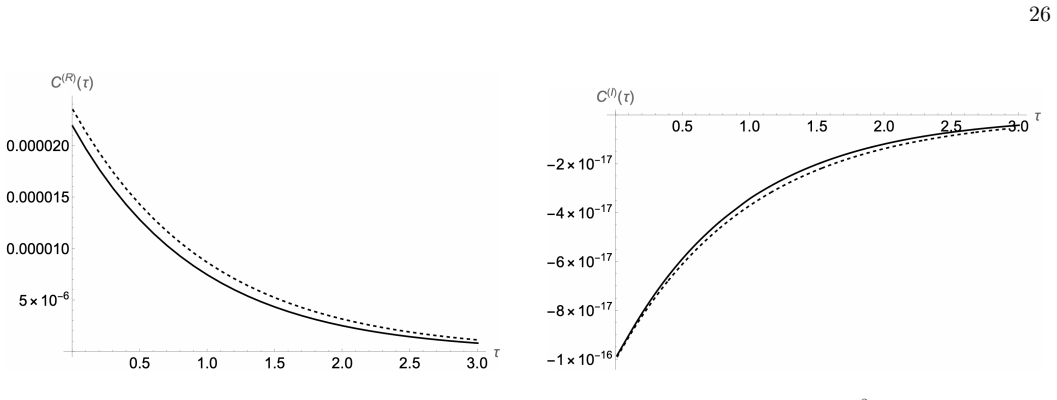
- The environmental correlation functions decay rapidly, supporting the Markov approximation in the master equation derivation.
- The spectral density is generalised for the exponential coupling structure.
- The solution to the renormalised master equation is derived for the generalised interaction.
Where Pith is reading between the lines
- This approach opens the door to incorporating polymer quantum mechanics effects into gravitational decoherence calculations.
- If the sinus-like coupling captures real non-linear gravitational interactions, it could lead to observable differences in decoherence rates at higher orders.
- Extensions to other non-linear couplings via truncations of the exponential Weyl elements might be explored in future toy models.
Load-bearing premise
The sinus-like coupling can be quantised using the Schrödinger representation and the Markov approximation holds due to rapid decay of the numerical correlation functions.
What would settle it
A calculation or measurement showing that the correlation functions do not decay rapidly enough to justify the Markov approximation, or that the higher-order terms in the Weyl expansion produce decoherence rates inconsistent with the renormalised master equation solution.
Figures

read the original abstract
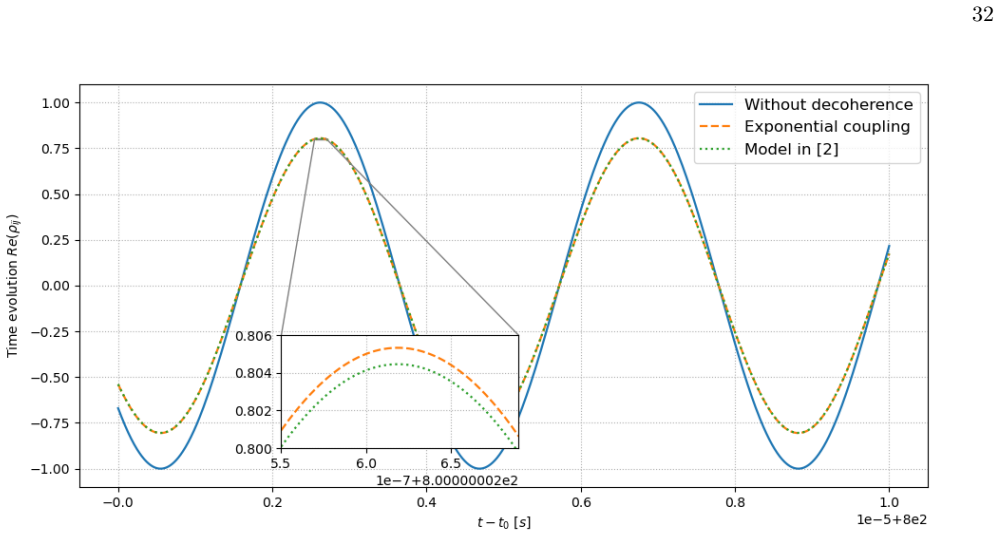
We generalise the quantum mechanical toy model for gravitationally induced decoherence presented in Xu, Blencowe (2022) and Domi et al. (2024). In contrast to earlier formulations, in which the Hamiltonian of the system of interest is linearly coupled to the position operators of the oscillators in the environment, we consider an interaction formulated in terms of Weyl elements of the environment's position operators. This extension is motivated by polymer quantum mechanics, in which Weyl elements are fundamental operators, as well as by the possibility of generating non-linear interactions through suitable truncations of the exponential Weyl elements. Here we focus on a sinus-like coupling that is still quantised using the Schr\"odinger representation and, in the limit of a small Weyl parameter, reproduces the conventional linear interaction. To derive the corresponding master equation, we developed two complementary methods for the analytical calculation of the environmental correlation functions. The first utilises Wick's theorem for thermal expectation values in conjunction with annihilation and creation operators, while the second is based on the short-time Fourier transform and completely avoids the use of annihilation and creation operators, making it more readily transferable and generalisable to a polymer quantisation. Both approaches yield identical results. We further generalise the spectral density required for the exponential coupling structure. A numerical analysis shows that the environmental correlation functions decay rapidly with time, which supports the validity of the Markov approximation. Using a Taylor expansion in the Weyl parameter, we show that the first-order term reproduces the decoherence model of Xu, Blencowe (2022) and Domi et al. (2024). Finally, we derive the solution to the renormalised master equation.
Editorial analysis
A structured set of objections, weighed in public.
Referee Report
Summary. The paper generalizes a microscopic toy model of gravitationally induced decoherence by replacing linear system-environment coupling with an interaction based on Weyl elements of the environmental position operators. It focuses on a sinus-like coupling (quantized in the Schrödinger representation) that reduces to the linear case for small Weyl parameter. Two independent analytic methods for the environmental correlation functions are derived and shown to agree; the spectral density is generalized accordingly. Numerical evaluation demonstrates rapid decay of the correlations, which is used to justify the Markov approximation. A Taylor expansion in the Weyl parameter recovers the master equation of Xu, Blencowe (2022) and Domi et al. (2024) at first order, and the renormalised master equation for the generalized interaction is solved.
Significance. If the Markov approximation remains valid, the work supplies a controlled microscopic extension of gravitational decoherence models into the non-linear regime, with direct relevance to polymer quantization and to future experimental tests that could distinguish linear from non-linear gravitational effects. Credit is due for the explicit agreement between the two correlation-function derivations (Wick theorem versus short-time Fourier transform) and for the parameter-free recovery of the prior linear result via Taylor expansion rather than by assumption.
major comments (1)
- [Numerical analysis of environmental correlation functions] Numerical analysis section: the validity of the Born-Markov master equation for the generalized (sinus-like) interaction rests on the numerical observation that correlation functions decay rapidly. No analytic bound on the decay rate, no scaling with the Weyl parameter λ, and no explicit comparison to the system’s intrinsic timescales are supplied. If the decay slows for λ away from the linear limit, the time-local master equation and its renormalised solution cease to apply in the regime the paper presents as the central generalization.
Simulated Author's Rebuttal
We thank the referee for the positive evaluation of the manuscript and for the constructive comment on the justification of the Markov approximation. We address the major comment below and agree that the manuscript will benefit from additional analysis in this area.
read point-by-point responses
-
Referee: Numerical analysis section: the validity of the Born-Markov master equation for the generalized (sinus-like) interaction rests on the numerical observation that correlation functions decay rapidly. No analytic bound on the decay rate, no scaling with the Weyl parameter λ, and no explicit comparison to the system’s intrinsic timescales are supplied. If the decay slows for λ away from the linear limit, the time-local master equation and its renormalised solution cease to apply in the regime the paper presents as the central generalization.
Authors: We agree that the current justification rests primarily on numerical observation and that an explicit scaling analysis with λ together with a comparison to system timescales would strengthen the claim. The correlation functions are available in closed analytic form from both derivation methods, which in principle permits extraction of the decay envelope. In the revised manuscript we will add a dedicated paragraph (or short subsection) that (i) extracts the leading large-t decay from the analytic expressions, (ii) shows its dependence on λ for the range of interest, and (iii) compares the resulting environmental correlation time to the system’s natural frequency and to the gravitational decoherence timescale. We will also state the parameter domain in which the Markov approximation is thereby justified. A fully rigorous analytic bound valid for arbitrary λ is not presently available and would require further technical work beyond the scope of the present toy model; we will therefore qualify the regime of validity accordingly. revision: yes
Circularity Check
Minor self-citation to prior linear model; central generalization from new Hamiltonian is independent
full rationale
The paper derives the master equation for the new sinus-like Weyl coupling from the interaction Hamiltonian using two analytical methods for correlation functions (Wick's theorem and short-time Fourier transform). The first-order Taylor expansion in the Weyl parameter is shown explicitly to recover the Xu/Blencowe/Domi linear model as a consistency check rather than an input assumption. The Markov approximation is justified by a separate numerical observation of rapid correlation decay, not by fitting or definitional reduction. Self-citations to the 2022/2024 works serve only to identify the model being generalized and are not load-bearing for the new derivation or its solution. No parameters are fitted to force the target result, and the derivation chain does not reduce to its inputs by construction.
Axiom & Free-Parameter Ledger
free parameters (1)
- Weyl parameter
axioms (2)
- standard math Wick's theorem applies to thermal expectation values of the environmental oscillators
- domain assumption Markov approximation is justified by rapid decay of environmental correlations
Reference graph
Works this paper leans on
-
[1]
11 144 πΩ3 +πβ 2ℏ2Ω + Ω3 24π3
is an exponential function of the sum of the position operators. Further, here we consider the sum of the difference of Weyl elements of the individual oscillators, whereas in [33] a sum of two exponentials is considered. As we realise similar to the case of a linear coupling, the square of the characteristic length of the individual oscillatorsl 2 j ente...
-
[2]
Using the small- argument behaviour of the Bessel functions Jn(v(ω))∼ O µ2n 0 , I n(r(ω))∼ O µ2n 0 ,(3.76) 28 we see that higher Fourier modes are rapidly suppressed for smallµ 0. In this sense, the present method is consistent with the perturbative expansion used above: truncating the Bessel series at low order reproduces the leading small-µ 0 behaviour,...
-
[3]
Bridging high and low energies in search of quantum gravity (BridgeQG)
to the case of couplings in the form of Weyl elements. Similar to [2], the introduced generalised counter-term causes it to exactly cancel out the Lamb shift term. In a companion paper [35], we apply the microscopic model presented in this work to neutrino oscillations. This means that we choose a 3-flavour neutrino as the system of interest, which determ...
- [4]
- [5]
-
[6]
A. Bassi, A. Großardt, and H. Ulbricht, Gravitational Decoherence, Class. Quant. Grav.34, 193002 (2017), arXiv:1706.05677 [quant-ph]
work page internal anchor Pith review Pith/arXiv arXiv 2017
-
[7]
C. Anastopoulos and B.-L. Hu, Gravitational decoherence: A thematic overview, AVS Quantum Sci.4, 015602 (2022), arXiv:2111.02462 [gr-qc]
-
[8]
Breuer and F
H.-P. Breuer and F. Petruccione,The Theory of Open Quantum Systems(Oxford University Press, 2007)
2007
-
[9]
H.-P. Breuer and F. Petruccione, Concepts and methods in the theory of open quantum systems (2003), arXiv:quant- ph/0302047
-
[10]
Rivas and S
t. Rivas and S. F. Huelga,Open Quantum Systems, SpringerBriefs in Physics (Springer, 2012)
2012
-
[11]
Lindblad, On the Generators of Quantum Dynamical Semigroups, Commun
G. Lindblad, On the Generators of Quantum Dynamical Semigroups, Commun. Math. Phys.48, 119 (1976)
1976
-
[12]
M. P. Blencowe, Effective Field Theory Approach to Gravitationally Induced Decoherence, Phys. Rev. Lett.111, 021302 (2013), arXiv:1211.4751 [quant-ph]
work page internal anchor Pith review Pith/arXiv arXiv 2013
-
[13]
A Master Equation for Gravitational Decoherence: Probing the Textures of Spacetime
C. Anastopoulos and B. L. Hu, A Master Equation for Gravitational Decoherence: Probing the Textures of Spacetime, Class. Quant. Grav.30, 165007 (2013), arXiv:1305.5231 [gr-qc]
work page internal anchor Pith review Pith/arXiv arXiv 2013
-
[14]
Quantum gravitational decoherence of light and matter
T. Oniga and C. H. T. Wang, Quantum gravitational decoherence of light and matter, Phys. Rev. D93, 044027 (2016), arXiv:1511.06678 [quant-ph]
work page internal anchor Pith review Pith/arXiv arXiv 2016
-
[15]
M. Lagouvardos and C. Anastopoulos, Gravitational decoherence of photons, Class. Quant. Grav.38, 115012 (2021), arXiv:2011.08270 [gr-qc]
- [16]
- [17]
- [18]
- [19]
-
[20]
A. Calatayud-Cadenillas, A. P´ erez-G, and A. M. Gago, Distinguishing Beyond-Standard Model Effects in Neutrino Oscillation (2024), arXiv:2408.04234 [hep-ph]
-
[21]
J. Aguilaret al.(ESSnuSB), Decoherence in neutrino oscillation at the ESSnuSB experiment, JHEP08, 063, arXiv:2404.17559 [hep-ex]
-
[22]
M. M. Guzzo, P. C. de Holanda, and R. L. N. Oliveira, Quantum dissipation in a neutrino system propagating in vacuum and in matter, Nucl. Phys. B908, 408 (2016), arXiv:1408.0823 [hep-ph]
work page internal anchor Pith review Pith/arXiv arXiv 2016
-
[23]
Decoherence in neutrino propagation through matter, and bounds from IceCube/DeepCore
P. Coloma, J. Lopez-Pavon, I. Martinez-Soler, and H. Nunokawa, Decoherence in Neutrino Propagation Through Matter, and Bounds from IceCube/DeepCore, Eur. Phys. J. C78, 614 (2018), arXiv:1803.04438 [hep-ph]
work page internal anchor Pith review Pith/arXiv arXiv 2018
-
[24]
V. De Romeri, C. Giunti, T. Stuttard, and C. A. Ternes, Neutrino oscillation bounds on quantum decoherence, JHEP 09, 097, arXiv:2306.14699 [hep-ph]
-
[25]
Lessing (KM3NeT), Search for Quantum Decoherence in Neutrino Oscillations with KM3NeT ORCA6, PoS ICRC2023, 1025 (2023)
N. Lessing (KM3NeT), Search for Quantum Decoherence in Neutrino Oscillations with KM3NeT ORCA6, PoS ICRC2023, 1025 (2023)
2023
-
[26]
S. Aielloet al.(KM3NeT), Search for quantum decoherence in neutrino oscillations with six detection units of KM3NeT/ORCA (2024), arXiv:2410.01388 [hep-ex]
-
[27]
Arg¨ uelleset al.(IceCube), Search for quantum gravity using astrophysical neutrino flavour with IceCube, PoS ICRC2023, 1225 (2023)
C. Arg¨ uelleset al.(IceCube), Search for quantum gravity using astrophysical neutrino flavour with IceCube, PoS ICRC2023, 1225 (2023)
2023
-
[28]
J. A. B. Coelho and W. A. Mann, Decoherence, matter effect, and neutrino hierarchy signature in long baseline experiments, Phys. Rev. D96, 093009 (2017), arXiv:1708.05495 [hep-ph]
work page internal anchor Pith review Pith/arXiv arXiv 2017
-
[29]
K. Giesel and M. Kobler, An open scattering model in polymerized quantum mechanics, Mathematics10, 4248 (2022), arXiv:2207.08749 [gr-qc]. 42
-
[30]
Surface state decoherence in loop quantum gravity, a first toy model
A. Feller and E. R. Livine, Surface state decoherence in loop quantum gravity, a first toy model, Class. Quant. Grav. 34, 045004 (2017), arXiv:1607.00182 [gr-qc]
work page internal anchor Pith review Pith/arXiv arXiv 2017
-
[31]
Quantum gravity, shadow states, and quantum mechanics
A. Ashtekar, S. Fairhurst, and J. L. Willis, Quantum gravity, shadow states, and quantum mechanics, Class. Quant. Grav.20, 1031 (2003), arXiv:gr-qc/0207106
work page internal anchor Pith review Pith/arXiv arXiv 2003
-
[32]
Polymer Quantum Mechanics and its Continuum Limit
A. Corichi, T. Vukasinac, and J. A. Zapata, Polymer Quantum Mechanics and its Continuum Limit, Phys. Rev. D 76, 044016 (2007), arXiv:0704.0007 [gr-qc]
work page internal anchor Pith review Pith/arXiv arXiv 2007
-
[33]
J. F. Barbero G., J. Prieto, and E. J. S. Villase˜ nor, Band structure in the polymer quantization of the harmonic oscillator, Class. Quant. Grav.30, 165011 (2013), arXiv:1305.5406 [gr-qc]
work page internal anchor Pith review Pith/arXiv arXiv 2013
-
[34]
Zheng and N.-H
D.-C. Zheng and N.-H. Tong, Dynamical correlation functions of the quadratic coupling spin-boson model, Chinese Physics B26, 060502 (2017)
2017
-
[35]
Zheng, L
D.-C. Zheng, L. Wan, and N.-H. Tong, Impurity-induced environmental quantum phase transitions in the quadratic- coupling spin-boson model, Phys. Rev. B98, 115131 (2018)
2018
- [36]
-
[37]
M. J. Fahn, R. Ferreo, K. Giesel, and R. Kemper, Gravitationally induced decoherence in a microscopic toy model in polymer quantum mechanics, to appear soon (2026)
2026
-
[38]
M. J. Fahn, R. Ferreo, K. Giesel, and R. Kemper, Generalising gravitationally induced decoherence beyond linear environmental interactions in a microscopic quantum mechanical toy model for neutrino oscillations, to appear soon (2026)
2026
-
[39]
Breuer, F
H.-P. Breuer, F. Petruccione,et al.,The theory of open quantum systems(Oxford University Press on Demand, 2002)
2002
-
[40]
Nakajima, On Quantum Theory of Transport Phenomena: Steady Diffusion, Prog
S. Nakajima, On Quantum Theory of Transport Phenomena: Steady Diffusion, Prog. Theor. Phys.20, 948 (1958)
1958
-
[41]
Zwanzig, Ensemble Method in the Theory of Irreversibility, J
R. Zwanzig, Ensemble Method in the Theory of Irreversibility, J. Chem. Phys.33, 1338 (1960)
1960
- [42]
-
[43]
Sch¨ onhammer, Quantum and thermal fluctuations in the harmonic chain and experimental implications, American Journal of Physics82, 887–895 (2014)
K. Sch¨ onhammer, Quantum and thermal fluctuations in the harmonic chain and experimental implications, American Journal of Physics82, 887–895 (2014)
2014
-
[44]
Cohen,Time-frequency analysis: theory and applications(Prentice-Hall, Inc., USA, 1995)
L. Cohen,Time-frequency analysis: theory and applications(Prentice-Hall, Inc., USA, 1995)
1995
-
[45]
Gr¨ ochenig, Foundations of time-frequency analysis, inApplied and Numerical Harmonic Analysis(2000)
K. Gr¨ ochenig, Foundations of time-frequency analysis, inApplied and Numerical Harmonic Analysis(2000)
2000
-
[46]
Gabor, Theory of communication, J
D. Gabor, Theory of communication, J. Inst. Electr. Engineering , 429 (1946)
1946
-
[47]
Daubechies, The Wavelet transform, time frequency localization and signal analysis, IEEE Trans
I. Daubechies, The Wavelet transform, time frequency localization and signal analysis, IEEE Trans. Info. Theor.36, 961 (1990)
1990
-
[48]
Alpay, A
D. Alpay, A. De Martino, K. Diki, and D. C. Struppa, Short-time fourier transform and superoscillations, Applied and Computational Harmonic Analysis73, 101689 (2024)
2024
-
[49]
A. J. E. M. Janssen, Gabor representation of generalized functions, J. Math. Anal. Appl.83, 377 (1981)
1981
-
[50]
Itˆ o, Complex multiple wiener integral, inJapanese journal of mathematics: transactions and abstracts, Vol
K. Itˆ o, Complex multiple wiener integral, inJapanese journal of mathematics: transactions and abstracts, Vol. 22 (The Mathematical Society of Japan, 1952) pp. 63–86
1952
-
[51]
G´ orska, A
K. G´ orska, A. Horzela, and F. H. Szafraniec, Holomorphic hermite polynomials in two variables, Journal of Mathe- matical Analysis and Applications470, 750 (2019)
2019
-
[52]
Olver, D
F. Olver, D. Lozier, R. Boisvert, and C. Clark, The nist handbook of mathematical functions (2010)
2010
-
[53]
Weiss,Quantum Dissipative Systems(World Scientific, 2021)
U. Weiss,Quantum Dissipative Systems(World Scientific, 2021)
2021
-
[54]
E. W. Kolb and M. S. Turner,The Early Universe, Vol. 69 (Taylor and Francis, 2019)
2019
-
[55]
Squeezed Thermal Vacuum and the Maximum Scale for Inflation
M. Gasperini, M. Giovannini, and G. Veneziano, Squeezed thermal vacuum and the maximum scale for inflation, Phys. Rev. D48, R439 (1993), arXiv:gr-qc/9306015
work page internal anchor Pith review Pith/arXiv arXiv 1993
-
[56]
Giovannini, Primordial backgrounds of relic gravitons, Prog
M. Giovannini, Primordial backgrounds of relic gravitons, Prog. Part. Nucl. Phys.112, 103774 (2020), arXiv:1912.07065 [astro-ph.CO]
-
[57]
Blanes, F
S. Blanes, F. Casas, J. A. Oteo, and J. Ros, The Magnus expansion and some of its applications, Phys. Rept.470, 151 (2009)
2009
discussion (0)
Sign in with ORCID, Apple, or X to comment. Anyone can read and Pith papers without signing in.