Non-Relativistic Spin-Orbit Interaction in Triplet Superconductors: Edelstein Effect and Spin Pumping by Electric Fields
Pith reviewed 2026-05-19 19:50 UTC · model grok-4.3
pith:NAMSIDXE Add to your LaTeX paper
What is a Pith Number?\usepackage{pith}
\pithnumber{NAMSIDXE}
Prints a linked pith:NAMSIDXE badge after your title and writes the identifier into PDF metadata. Compiles on arXiv with no extra files. Learn more
The pith
Triplet pairing creates a momentum-dependent spin texture that lets electric fields generate spin polarization in p-wave superconductors even without relativistic spin-orbit coupling.
A machine-rendered reading of the paper's core claim, the machinery that carries it, and where it could break.
Core claim
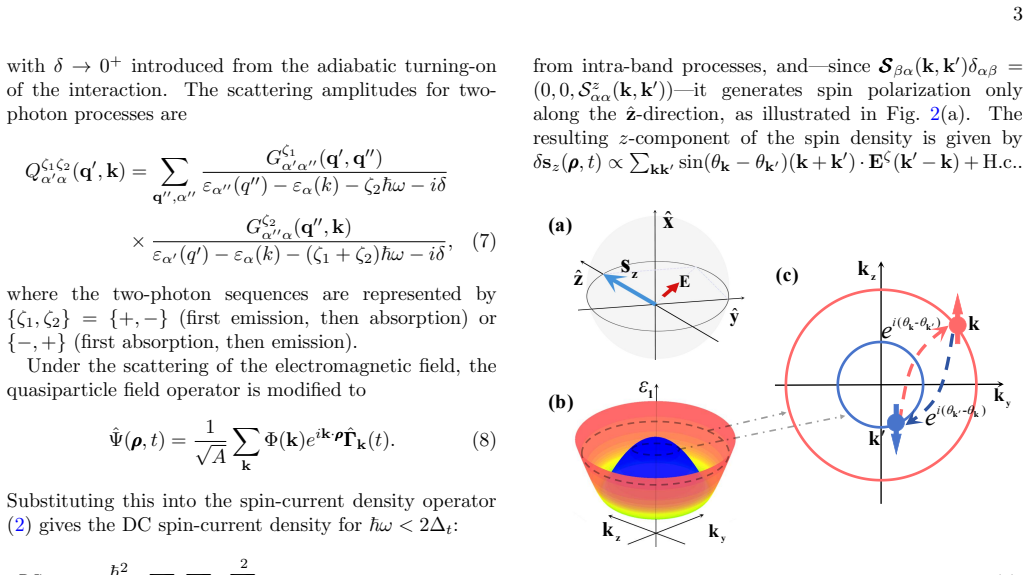
The triplet order parameter induces a wave-vector-dependent spin texture of Bogoliubov quasiparticles, thereby entangling their orbital and spin motions. Even in the absence of relativistic spin-orbit coupling, this intertwining of spin and orbital motion allows an electric field to generate spin polarization in a p-wave superconductor -- that is, an Edelstein effect. Building on this mechanism, we propose an efficient scheme for the nonlinear generation of a DC spin current via electric near fields, driven by AC spin polarization and electron velocity.
What carries the argument
The wave-vector-dependent spin texture of Bogoliubov quasiparticles induced by the triplet order parameter; it entangles orbital and spin motions to produce an electric-field-driven Edelstein effect.
If this is right
- An electric field generates spin polarization in a p-wave superconductor without relativistic spin-orbit coupling.
- AC electric near fields produce a nonlinear DC spin current through the combination of induced spin polarization and electron velocity.
- The same non-relativistic mechanism offers a general route to generate and manipulate spin currents in unconventional superconductors.
Where Pith is reading between the lines
- The effect could appear in candidate p-wave materials once electric fields are applied and spin accumulation is measured.
- The mechanism may link to spin splitting observed in altermagnets, suggesting shared non-relativistic routes to spin control across different ordered states.
- Device designs that rely on electric near fields for spin pumping could be explored in triplet superconducting heterostructures.
Load-bearing premise
The model assumes triplet pairing symmetry alone generates the described wave-vector-dependent spin texture and resulting Edelstein effect when relativistic spin-orbit coupling is omitted from the Hamiltonian.
What would settle it
A microscopic calculation or transport measurement that finds zero electric-field-induced spin polarization in a p-wave superconductor when all relativistic spin-orbit terms are explicitly removed would falsify the claim.
Figures


read the original abstract
Non-relativistic momentum-dependent spin splitting, as observed in collinear altermagnets and non-collinear $p$-wave magnets, provides exciting avenues for controlling spin dynamics. Here, we reveal a distinct form of non-relativistic ``spin-orbit coupling" in triplet superconductors by demonstrating that the triplet order parameter induces a wave-vector-dependent spin texture of Bogoliubov quasiparticles, thereby entangling their orbital and spin motions. Even in the absence of relativistic spin-orbit coupling, this intertwining of spin and orbital motion allows an electric field to generate spin polarization in a $p$-wave superconductor -- that is, an Edelstein effect. Building on this mechanism, we propose an efficient scheme for the nonlinear generation of a DC spin current via electric near fields, driven by AC spin polarization and electron velocity. This general principle offers a powerful route for generating and manipulating spin currents in unconventional superconductors.
Editorial analysis
A structured set of objections, weighed in public.
Referee Report
Summary. The manuscript claims that triplet superconductors exhibit a non-relativistic form of spin-orbit interaction arising solely from the triplet order parameter. Specifically, the d(k)·σ pairing term in the Bogoliubov-de Gennes Hamiltonian induces a wave-vector-dependent spin texture on the quasiparticles, entangling orbital and spin degrees of freedom even when all relativistic spin-orbit coupling terms are omitted from the Hamiltonian. This texture is asserted to enable an Edelstein effect, in which an applied electric field generates net spin polarization in a p-wave superconductor. The authors further propose a nonlinear scheme for generating a DC spin current via electric near-fields driven by AC spin polarization and electron velocity.
Significance. If the central claim is verified by explicit response-function calculations, the result would identify a previously overlooked non-relativistic mechanism for electric-field control of spin in unconventional superconductors. This could open routes to spin-current generation and manipulation that do not rely on heavy-element relativistic SOC, with potential relevance for superconducting spintronics and hybrid devices. The work builds on standard BdG modeling and offers falsifiable predictions for spin polarization in p-wave systems.
major comments (2)
- [Derivation of the Edelstein effect (likely §3 or §4)] The central claim that the triplet order parameter alone produces a nonzero Edelstein response rests on the assumption that the quasiparticle spin texture <σ> ∝ d(k)/E(k) survives in the linear-response spin density without cancellation. Particle-hole symmetry in the gapped BdG spectrum can enforce cancellations in the spin current or polarization response that are absent in the normal-state Rashba case. The manuscript must therefore provide an explicit calculation of the Edelstein conductivity (or equivalent response function) in the absence of relativistic SOC terms; this calculation is load-bearing for the claim that the effect is induced by the pairing term.
- [Nonlinear spin-current generation section] The proposed nonlinear DC spin-current generation scheme via AC spin polarization and electron velocity similarly requires a concrete expression for the second-order response. It is unclear whether the particle-hole symmetry that may suppress the linear Edelstein effect also constrains the nonlinear term; an explicit diagrammatic or Kubo-formula evaluation is needed to confirm the proposed mechanism.
minor comments (2)
- [Introduction or Model section] Notation for the Bogoliubov-de Gennes Hamiltonian should be stated explicitly at the outset (e.g., the precise form of the τ matrices and the definition of the gap function d(k)) to avoid ambiguity when relativistic SOC is later omitted.
- [Figures] Figure captions and axis labels for any plots of spin texture or Edelstein response should include the explicit parameter values (e.g., gap magnitude, chemical potential) used in the calculation.
Simulated Author's Rebuttal
We thank the referee for the constructive and detailed report. The comments correctly identify that explicit response-function calculations are needed to fully substantiate the central claims. We have revised the manuscript to include these calculations and address the particle-hole symmetry considerations. Point-by-point responses follow.
read point-by-point responses
-
Referee: [Derivation of the Edelstein effect (likely §3 or §4)] The central claim that the triplet order parameter alone produces a nonzero Edelstein response rests on the assumption that the quasiparticle spin texture <σ> ∝ d(k)/E(k) survives in the linear-response spin density without cancellation. Particle-hole symmetry in the gapped BdG spectrum can enforce cancellations in the spin current or polarization response that are absent in the normal-state Rashba case. The manuscript must therefore provide an explicit calculation of the Edelstein conductivity (or equivalent response function) in the absence of relativistic SOC terms; this calculation is load-bearing for the claim that the effect is induced by the pairing term.
Authors: We agree that an explicit linear-response calculation is required. In the revised manuscript we have added a full Kubo-formula evaluation of the Edelstein conductivity for the BdG Hamiltonian containing only the triplet d(k)·σ term (no relativistic SOC). The resulting spin polarization is finite and proportional to the applied electric field; the momentum-dependent quasiparticle spin texture <σ(k)> = d(k)/E(k) produces a net contribution because the spin operator connects states whose particle-hole character yields an unbalanced matrix element. We explicitly discuss why particle-hole symmetry does not cancel the response in this geometry, in contrast to certain spin-current operators. The new subsection contains the analytic expression, numerical plots for a model p-wave gap, and a comparison with the normal-state Rashba case. revision: yes
-
Referee: [Nonlinear spin-current generation section] The proposed nonlinear DC spin-current generation scheme via AC spin polarization and electron velocity similarly requires a concrete expression for the second-order response. It is unclear whether the particle-hole symmetry that may suppress the linear Edelstein effect also constrains the nonlinear term; an explicit diagrammatic or Kubo-formula evaluation is needed to confirm the proposed mechanism.
Authors: We have now included an explicit second-order Kubo-formula derivation for the nonlinear spin-current response. The calculation shows that the DC component generated by the product of AC spin polarization and electron velocity remains finite; the relevant diagrams involve two electric-field vertices and one spin-current vertex, and particle-hole symmetry does not enforce cancellation because the nonlinear combination of velocity and spin operators breaks the symmetry that would suppress the linear term. The revised section presents the analytic expression, the relevant Feynman diagrams, and estimates of the generated spin current for realistic parameters. revision: yes
Circularity Check
No significant circularity; derivation rests on standard BdG modeling of triplet pairing without reducing to self-inputs.
full rationale
The paper's central claim—that the triplet order parameter d(k)·σ alone induces a k-dependent spin texture on Bogoliubov quasiparticles, enabling an Edelstein response to electric fields even when all relativistic SOC terms are omitted from the Hamiltonian—is presented as a direct consequence of the standard BdG structure H = ξ(k)τ_z + d(k)·σ τ_x. The abstract and modeling description treat the texture <σ> ∝ d(k)/E(k) as following from the eigenvectors of this Hamiltonian, with the subsequent linear-response calculation to E (or vector potential) asserted to yield net spin polarization. No load-bearing step reduces by construction to a fitted parameter, self-citation chain, or ansatz smuggled from prior work by the same authors; the derivation chain remains self-contained against external benchmarks of BdG theory and does not rename known results or import uniqueness theorems. The reader's assessment of score 2.0 aligns with this, as the abstract shows no indication of circular reasoning.
Axiom & Free-Parameter Ledger
axioms (1)
- domain assumption Bogoliubov quasiparticles in triplet superconductors acquire a wave-vector-dependent spin texture determined by the pairing symmetry.
Lean theorems connected to this paper
-
IndisputableMonolith/Foundation/AlexanderDuality.leanalexander_duality_circle_linking unclear?
unclearRelation between the paper passage and the cited Recognition theorem.
the triplet order parameter induces a wave-vector-dependent spin texture of Bogoliubov quasiparticles... Even in the absence of relativistic spin-orbit coupling
-
IndisputableMonolith/Cost/FunctionalEquation.leanwashburn_uniqueness_aczel unclear?
unclearRelation between the paper passage and the cited Recognition theorem.
H0(ρ) = ... Δt e^{iθk} ... spin density operator ŝ ... continuity equation
What do these tags mean?
- matches
- The paper's claim is directly supported by a theorem in the formal canon.
- supports
- The theorem supports part of the paper's argument, but the paper may add assumptions or extra steps.
- extends
- The paper goes beyond the formal theorem; the theorem is a base layer rather than the whole result.
- uses
- The paper appears to rely on the theorem as machinery.
- contradicts
- The paper's claim conflicts with a theorem or certificate in the canon.
- unclear
- Pith found a possible connection, but the passage is too broad, indirect, or ambiguous to say the theorem truly supports the claim.
Reference graph
Works this paper leans on
-
[1]
M. Z. Hasan and C. L. Kane, Colloquium: Topological insulators, Rev. Mod. Phys. 82, 3045 (2010)
work page 2010
-
[2]
X. L. Qi and S. C. Zhang, Topological insulators and superconductors, Rev. Mod. Phys. 83, 1057 (2011)
work page 2011
-
[3]
C. X. Liu, S. C. Zhang, and X. L. Qi, The quantum anomalous Hall effect: Theory and experiment, Annu. Rev. Condens. Matter Phys. 7, 301 (2016)
work page 2016
-
[4]
Y. F. Ren, Z. H. Qiao, and Q. Niu, Topological phases in two-dimensional materials: a review, Rep. Progr. Phys. 79, 066501 (2016)
work page 2016
-
[5]
X. G. Wen, Colloquium: Zoo of quantum-topological phases of matter, Rev. Mod. Phys. 89, 041004 (2017)
work page 2017
-
[6]
I. A. Dzyaloshinsky, A thermodynamic theory of weak ferromagnetism of antiferromagnetics, J. Phys. Chem. Solids 4, 241 (1958)
work page 1958
-
[7]
Moriya, New mechanism of anisotropic superexchange interaction, Phys
T. Moriya, New mechanism of anisotropic superexchange interaction, Phys. Rev. Lett. 4, 228 (1960)
work page 1960
-
[8]
F. Hellman, A. Hoffmann, Y. Tserkovnyak, G. S. D. Beach, E. E. Fullerton, C. Leighton, A. H. MacDonald, D. C. Ralph, D. A. Arena, H. A. D¨ urr, P. Fischer, J. Grollier, J. P. Heremans, T. Jungwirth, A. V. Kimel, B. Koopmans, I. N. Krivorotov, S. J. May, A. K. Petford- Long, J. M. Rondinelli, N. Samarth, I. K. Schuller, A. N. Slavin, M. D. Stiles, O. Tcher...
work page 2017
-
[9]
M. Kuepferling, A. Casiraghi, G. Soares, G. Durin, F. G. Sanchez, L. Chen, C. H. Back, C. H. Marrows, S. Tacchi, and G. Carlotti, Measuring interfacial Dzyaloshinskii- Moriya interaction in ultrathin magnetic films, Rev. Mod. Phys. 95, 015003 (2023)
work page 2023
-
[10]
S. D. Bader and S. S. P. Parkin, Spintronics, Annu. Rev. Condens. Matter Phys. 1, 71 (2010)
work page 2010
-
[12]
A. Manchon, J. ˇZelezn´ y, I. M. Miron, T. Jungwirth, J. Sinova, A. Thiaville, K. Garello, and P. Gambardella, Current-induced spin-orbit torques in ferromagnetic and antiferromagnetic systems, Rev. Mod. Phys. 91, 035004 (2019)
work page 2019
-
[13]
S. R. Elliott and M. Franz, Colloquium: Majorana fermions in nuclear, particle, and solid-state physics, Rev. Mod. Phys. 87, 137 (2015)
work page 2015
-
[14]
L. ˇSmejkal, R. Gonz´ alez-Hern´ andez, T. Jungwirth, and J. Sinova, Crystal time-reversal symmetry breaking and spontaneous Hall effect in collinear antiferromagnets, Sci. Adv. 6, eaaz8809 (2020)
work page 2020
-
[15]
L. ˇSmejkal, J. Sinova, and T. Jungwirth, Beyond conven- tional ferromagnetism and antiferromagnetism: A phase with nonrelativistic spin and crystal rotation symmetry, Phys. Rev. X 12, 031042 (2022)
work page 2022
-
[16]
L. ˇSmejkal, J. Sinova, and T. Jungwirth, Emerging re- search landscape of altermagnetism, Phys. Rev. X 12, 040501 (2022)
work page 2022
-
[17]
L. Bai, W. Feng, S. Liu, L. ˇSmejkal, Y. Mokrousov, and Y. Yao, Altermagnetism: Exploring new frontiers in mag- netism and spintronics, Adv. Funct. Mater. 34, 2409327 (2024)
work page 2024
-
[18]
O. Fedchenko, J. Min´ ar, A. Akashdeep, S. W. D’Souza, D. Vasilyev, O. Tkach, L. Odenbreit, Q. Nguyen, D. Kut- nyakhov, N. Wind, L. Wenthaus, M. Scholz, K. Ross- nagel, M. Hoesch, M. Aeschlimann, B. Stadtm¨ uller, M. Kl¨ aui, G. Sch¨ onhense, T. Jungwirth, A. B. Hellenes, G. Jakob, L. ˇSmejkal, J. Sinova, and H. J. Elmers, Obser- vation of time-reversal s...
work page 2024
-
[19]
C. Song, H. Bai, Z. Zou, L. Han, H. Reichlova, J. H. Dil, J. Liu, X. Chen, and F. Pan, Altermagnets as a new class of functional materials, Nat. Rev. Mater. 10, 473 (2025)
work page 2025
-
[20]
J. Krempask´ y, L.ˇSmejkal, S. W. D’Souza, M. Hajlaoui, G. Springholz, K. Uhl´ ıˇ rov´ a, F. Alarab, P. C. Constanti- nou, V. Strocov, D. Usanov, W. R. Pudelko, R. Gonz´ alez- Hern´ andez, A. B. Hellenes, Z. Jansa, H. Reichlov´ a, Z. ˇSob´ aˇ n, R. D. Betancourt, P. Wadley, J. Sinova, D. Krieg- ner, J. Min´ ar, J. H. Dil, and T. Jungwirth, Altermagnetic 6...
work page 2024
-
[21]
T. Jungwirth, J. Sinova, R. M. Fernandes, Q. H. Liu, H. Watanabe, S. Murakami, S. Nakatsuji, and L. ˇSmejkal, Symmetry, microscopy and spectroscopy signatures of al- termagnetism, Nature. 649, 837 (2026)
work page 2026
- [22]
-
[23]
A. B. Hellenes, T. Jungwirth, J. Sinova, and L. ˇSmejkal, Unconventional p-wave magnets, arXiv:2309.01607
- [24]
-
[25]
Rashba, Properties of semiconductors with an ex- tremum loop
E. Rashba, Properties of semiconductors with an ex- tremum loop. I. Cyclotron and combinational Resonance in a magnetic field perpendicular to the plane of the loop, Sov. Phys.-Solid State, 2, 1109 (1960)
work page 1960
-
[26]
Dresselhaus, Spin-Orbit Coupling Effects in Zinc Blende Structures, Phys
G. Dresselhaus, Spin-Orbit Coupling Effects in Zinc Blende Structures, Phys. Rev. 100, 580 (1955)
work page 1955
-
[27]
M. Amundsen, J. Linder, J. W. A. Robinson, I. ˇZuti´ c, and N. Banerjee, Colloquium: Spin-orbit effects in su- perconducting hybrid structures, Rev. Mod. Phys. 96, 021003, (2024)
work page 2024
- [28]
-
[29]
P. Sukhachov, H. G. Giil, B. Brekke, and J. Linder, Co- existence of p-wave magnetism and superconductivity, Phys. Rev. B 111, L220403 (2025)
work page 2025
-
[30]
Zeng, Tunneling spin Hall effect induced by uncon- ventional p-wave magnetism, Phys
W. Zeng, Tunneling spin Hall effect induced by uncon- ventional p-wave magnetism, Phys. Rev. B 112, 144516 (2025)
work page 2025
-
[31]
Y. Yu, M. B. Lyngby, T. Shishidou, M. Roig, A. Kreisel, M. Weinert, B. M. Andersen, and D. F. Agterberg, Odd-Parity Magnetism Driven by Antiferromagnetic Ex- change, Phys. Rev. Lett. 135, 046701 (2025)
work page 2025
-
[32]
A. Chakraborty, A. B. Hellenes, R. Jaeschke-Ubiergo, T. Jungwirth, L. ˇSmejkal, and J. Sinova, Highly efficient non-relativistic Edelstein effect in p-wave magnets, Nat. Commu. 16, 7270 (2025)
work page 2025
-
[33]
M. L. Hu, O. Janson, C. Felser, P. McClarty, J. van den Brink, and M. G. Vergniory, Spin Hall and Edelstein ef- fects in chiral non-collinear altermagnets, Nat. Commun. 16, 8529 (2025)
work page 2025
-
[34]
T. Kokkeler, I. Tokatly, and F. S. Bergeret, Quantum transport theory for unconventional magnets; interplay of altermagnetism and p-wave magnetism with supercon- ductivity, SciPost Phys. 18, 178 (2025)
work page 2025
- [35]
-
[36]
H. Tou, Y. Kitaoka, K. Ishida, K. Asayama, N. Kimura, Y. Onuki, and E. Yamamoto, Nonunitary Spin-Triplet Superconductivity in UPt3: Evidence from 195Pt Knight Shift Study, Phys. Rev. Lett. 80, 3129 (1998)
work page 1998
-
[37]
J. D. Strand, D. J. Bahr, D. J. Van Harlingen, J. P. Davis, W. J. Gannon, and W. P. Halperin, The Transi- tion Between Real and Complex Superconducting Order Parameter Phases in UPt 3, Science 328, 1368 (2010)
work page 2010
-
[38]
J. K. Bao, J. Y. Liu, C. W. Ma, Z. H. Meng, Z. T. Tang, Y. L. Sun, H. F. Zhai, H. Jiang, H. Bai, C. M. Feng, Z. A. Xu, and G. H. Cao, Superconductivity in Quasi-One- Dimensional K 2Cr3As3 with Significant Electron Corre- lations, Phys. Rev. X 5, 011013 (2015)
work page 2015
-
[39]
H. K. Zuo, J. K. Bao, Y. Liu, J. H. Wang, Z. Jin, Z. C. Xia, L. Li, Z. Xu, J. Kang, Z. W. Zhu, and G. H. Cao, Temperature and angular dependence of the upper criti- cal field in K 2Cr3As3, Phys. Rev. B 95, 014502 (2017)
work page 2017
-
[40]
J. Yang, J. Luo, C. Yi, Y. Shi, Y. Zhou, and G. Q. Zheng, Spin-triplet superconductivity in K 2Cr3As3, Sci. Adv. 7, eabl4432 (2021)
work page 2021
-
[41]
K. M. Taddei, B. H. Lei, M. A. Susner, H. F. Zhai, T. J. Bullard, L. D. Sanjeewa, Q. Zheng, A. S. Sefat, S. X. Chi, C. D. Cruz, D. J. Singh, and B. Lv, Gapless spin excitations in the superconducting state of a quasi-one- dimensional spin-triplet superconductor, Phys. Rev. B. 107, L180504 (2023)
work page 2023
-
[42]
T. Metz, S. Bae, S. Ran, I. L. Liu, Y. S. Eo, W. T. Fuhrman, D. F. Agterberg, S. M. Anlage, N. P. Butch, and J. Paglione, Point-node gap structure of the spin- triplet superconductor UTe 2, Phys. Rev. B 100, 220504 (2017)
work page 2017
-
[43]
S. Ran, C. Eckberg, Q.-P. Ding, Y. Furukawa, T. Metz, S. R. Saha, I.-L. Liu, M. Zic, H. Kim, J. Paglione, and N. P. Butch, Nearly ferromagnetic spin-triplet supercon- ductivity, Science 365, 684 (2019)
work page 2019
-
[44]
D. Aoki, A. Nakamura, F. Honda, D. X. Li, Y. Homma, and Y. Shimizu, Unconventional Superconductivity in Heavy Fermion UTe 2, J. Phys. Soc. Jpn. 88, 043702 (2019)
work page 2019
-
[45]
M. Kriener, K. Segawa, Y. Ando, and G. Q. Zheng, Spin- rotation symmetry breaking in the superconducting state of CuxBi2Se3, Nat. Phys. 12, 852 (2016)
work page 2016
-
[46]
M. Yokoyama, H. Nishigaki, S. Ogawa, S. Nita, H. Sh- iokawa, K. Matano, and G. Q. Zheng, Manipulating the nematic director by magnetic fields in the spin-triplet superconducting state of Cu xBi2Se3, Phys. Rev. B 107, L100505 (2023)
work page 2023
-
[47]
Z. Chen, Y. Liu, H. Zhang, Z. Liu, H. Tian, Y. Sun, M. Zhang, Y. Zhou, J. Sun, and Y. Xie, Electric field control of superconductivity at the LaAlO3/KTaO3(111) interface, Science 372, 721 (2021)
work page 2021
-
[48]
C. Liu, X. Yan, D. Jin, Y. Ma, H. W. Hsiao, Y. Lin, T. M. Bretz-Sullivan, X. Zhou, J. Pearson, B. Fisher, J. S. Jiang, W. Han, J. M. Zuo, J. Wen, D. D. Fong, J. Sun, H. Zhou, and A. Bhattacharya, Two-dimensional superconductivity and anisotropic transport at KTaO 3 (111) interfaces, Science 371, 716 (2021)
work page 2021
-
[49]
W. L. Qiao, S. Yuan, L. L. Guo, H. R. Fan, W. Y. Xing, R. R. Cai, X. C. Xie, X. Lin, and W. Han, Large Perpendicular Critical Field of Superconductiv- ity at EuO/KTaO 3 (111) Interface, Adv. Funct. Mater. e26199 (2025)
work page 2025
-
[50]
B. L. Wang, L. H. Guo, G. P. Ying, W. B. Duan, J. Li, and C. G. Zeng, Contact-induced Andreev bound states in normal-metal/superconductor planar junctions, Nat. Sci. Rev. 12, nwaf105 (2025)
work page 2025
-
[51]
A. G. Aronov and Y. B. Lyanda-Geller, Nuclear electric resonance and orientation of carrier spins by an electric field, JETP Lett. 50, 431 (1989)
work page 1989
-
[52]
V. M. Edelstein, Spin Polarization of conduction elec- trons induced by electric current in two-dimensional asymmetric electron systems, Solid State Commun. 73, 233 (1990). 7
work page 1990
-
[53]
Johansson, Theory of spin and orbital Edelstein ef- fects, J
A. Johansson, Theory of spin and orbital Edelstein ef- fects, J. Phys.: Condens. Matter 36, 423002 (2024)
work page 2024
-
[54]
Edelstein, Magnetoelectric Effect in Polar Super- conductors, Phys
V.M. Edelstein, Magnetoelectric Effect in Polar Super- conductors, Phys. Rev. Lett. 75, 2004 (1995)
work page 2004
-
[55]
Edelstein, Magnetoelectric effect in dirty supercon- ductors with broken mirror symmetry, Phys
V.M. Edelstein, Magnetoelectric effect in dirty supercon- ductors with broken mirror symmetry, Phys. Rev. B 72, 172501 (2005)
work page 2005
-
[56]
I.V. Bobkova, A.M. Bobkov, A.A. Zyuzin, amd M. Ali- doust, Magnetoelectrics in disordered topological insula- tor Josephson junctions, Phys. Rev. B 94, 134506 (2016)
work page 2016
-
[57]
G. Tkachov, Magnetoelectric Andreev Effect due to Proximity-Induced Nonunitary Triplet Superconductiv- ity in Helical Metals, Phys. Rev. Lett. 118, 016802 (2017)
work page 2017
-
[58]
S. V. Mironov, A. S. Mel´ nikov, I. D. Tokman, V. Vadi- mov, B. Lounis, and A. I. Buzdin, Inverse Faraday Effect for Superconducting Condensates, Phys. Rev. Lett. 126, 137002 (2021)
work page 2021
-
[59]
V. D. Plastovets, I. D. Tokman, B. Lounis, A. S. Mel’nikov, and A. I. Buzdin, All-optical generation of Abrikosov vortices by the inverse Faraday effect, Phys. Rev. B 106, 174504 (2022)
work page 2022
-
[60]
S. V. Mironov, A. I. Buzdin, O. B. Zuev, M. V. Ko- valenko, A. S. Mel’nikov, Photogalvanic and photon drag phenomena in superconductors and hybrid superconduct- ing systems, Mesosci. Nanotechnol. 1, 02004 (2025)
work page 2025
-
[61]
M. Dzero and V. Kozii, Light-induced magnetization in d-wave superconductors, arXiv:2603.18134
-
[62]
Y. Tserkovnyak, A. Brataas, G. E. W. Bauer, and B. I. Halperin, Nonlocal magnetization dynamics in ferromag- netic heterostructures, Rev. Mod. Phys. 77, 1375 (2005)
work page 2005
-
[65]
Y. Au, E. Ahmad, O. Dmytriiev, M. Dvornik, T. Davi- son, and V.V. Kruglyak, Resonant microwave-to-spin- wave transducer, Appl. Phys. Lett. 100, 182404 (2012)
work page 2012
-
[66]
C. Y. Cai, Z. Zhang, J. Zou, G. E. W. Bauer, and T. Yu, Spin-orbit-locked coupling of localized microwaves to magnons, Phys. Rev. Applied 22, 034042 (2024)
work page 2024
- [67]
- [68]
-
[69]
E. Betzig and R. J. Chichester, Single Molecules Ob- served by Near-Field Scanning Optical Microscopy, Sci- ence 262, 1422 (1993)
work page 1993
-
[73]
See Supplementary Material [...] for the eigenstates of the BdG Hamiltonian (1) and for discussing the contribution of the electric and magnetic fields to the DC spin-current and spin-torque densities
-
[74]
E. Betzig and R. J. Chichester, Single molecules observed by near-field scanning optical microscopy, Science 262, 1422 (1993)
work page 1993
-
[75]
L. Wang and X. G. Xu, Scattering-type scanning near- field optical microscopy with reconstruction of vertical interaction, Nat. Commun. 6, 8973 (2015)
work page 2015
-
[76]
H. Wang, L. Wang, D. S. Jakob, and X. G. Xu, Tomo- graphic and multimodal scattering-type scanning near- field optical microscopy with peak force tapping mode, Nat. Commun. 9, 2005 (2018)
work page 2005
-
[77]
Vincent, Scanning near-field infrared microscopy, Nat
T. Vincent, Scanning near-field infrared microscopy, Nat. Rev. Phys. 3, 537 (2021)
work page 2021
- [78]
-
[79]
K. Uchida, H. Hirori, T. Aoki, C. Wolpert, T. Tamaya, K. Tanaka, T. Mochizuki, C. Kim, M. Yoshita, H. Akiyama, L. N. Pfeiffer, and K. W. West, Time-resolved observa- tion of coherent excitonic nonlinear response with a table- top narrowband THz pulse wave, Appl. Phys. Lett. 107, 221106 (2015)
work page 2015
-
[80]
W. X. Feng, Y. G. Yao, W. G. Zhu, J. J. Zhou, W. Yao, and D. Xiao, Intrinsic spin Hall effect in monolayers of group-VI dichalcogenides: A first-principles study, Phys. Rev. B 86, 165108 (2012)
work page 2012
- [81]
-
[82]
J. Q. Zhou, S. Pon´ ce, and J. C. Charlier, High- throughput calculations of spin Hall conductivity in non- magnetic 2D materials, npj 2D Mater. Appl.9, 39 (2025)
work page 2025
discussion (0)
Sign in with ORCID, Apple, or X to comment. Anyone can read and Pith papers without signing in.