REVIEW 3 major objections 5 minor 25 references
Listen to Your Map: An Online Representation for Spatial Sonification
T0 review · 3 major / 5 minor · reviewed 2026-08-11 · deepseek-v4-flash
Pith's one-line read The paper claims that a sensor-centric 360-degree circular or cylindrical raster, built online from VDB-Gaussian Process distance fields, gives a compact, accurate, and complete scene representation for binaural sonification, beating raw…
desk verdict Solid geometric representation with externally validated accuracy, but the sonification claim outruns the evidence—needs a perceptual check or softer wording. read the letter →
The pith
A machine-rendered reading of the paper's core claim, the machinery that carries it, and where it could break.
The reading
What carries the argument
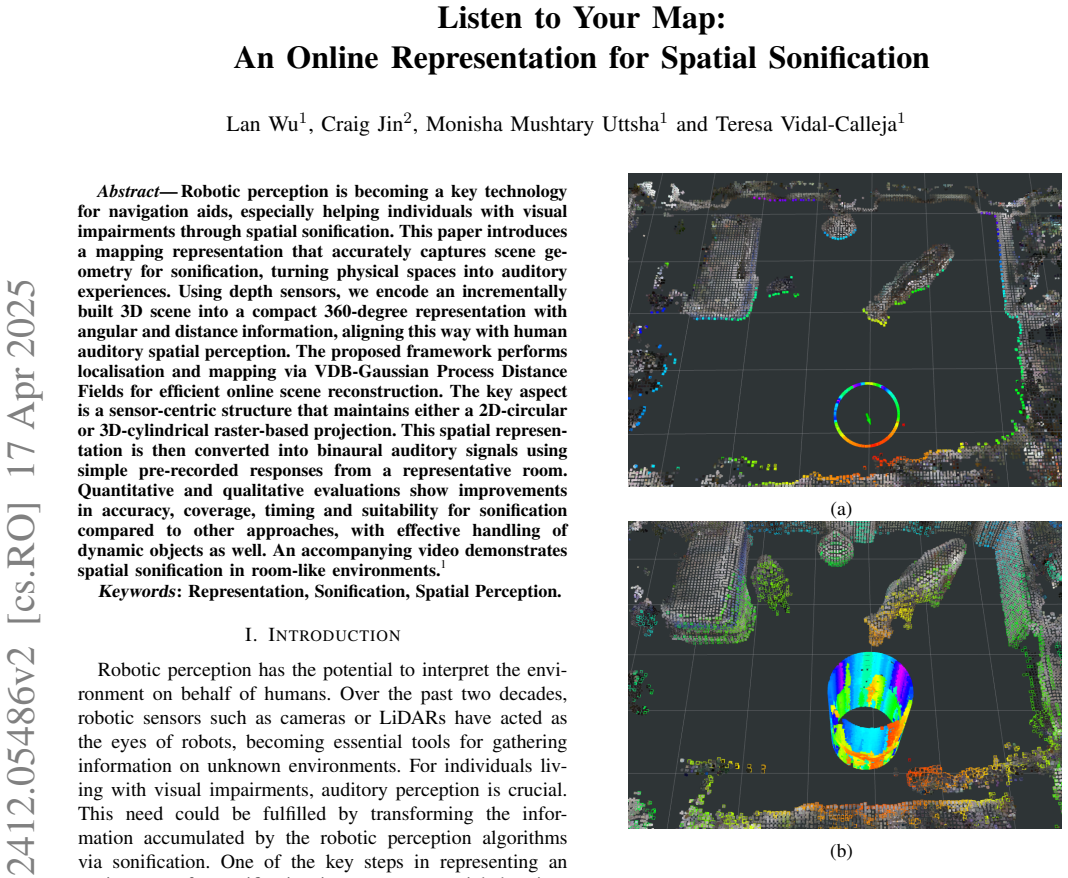
The load-bearing mechanism is the combination of a VDB-Gaussian Process Distance Field (VDB-GPDF) with a sensor-centric rasterization step. VDB-GPDF is a sparse, fast-access volumetric distance field fused incrementally from depth measurements; the rasterization step reduces that 3D field to a 2D circle or 3D cylinder of radial distances by keeping the closest surface point in each angular (and elevation) bin. This reduction to one distance per bearing gives a compact, ordered signal that can be mapped directly to spatial audio cues.
What would settle it
A headphone listening test in a room different from the recording laboratory, with blindfolded participants asked to point toward or estimate the distance of sonified obstacles; if localization or distance judgments are at chance with the fixed BRIR set and scaling, the suitability-for-sonification claim fails even though the geometric maps may remain accurate.
Extended reading notes
Core claim
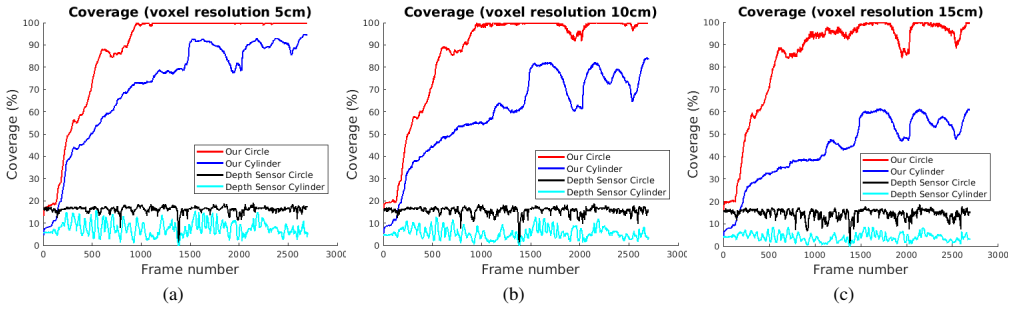
The central claim is that the right abstraction for spatial sonification is a compact, incrementally maintained, sensor-centric projection of scene geometry. The paper defines a 2D circular grid and a 3D cylindrical grid, each storing the closest visible surface distance along rays ordered by azimuth (and elevation for the cylinder). These grids are updated online from the global VDB-GPDF distance field, so the representation accumulates evidence across frames instead of relying on single-frame depth. Against ground truth, the reported RMSE is lower than raw depth projections and coverage is substantially higher: at 5 cm voxel resolution the circle reaches 100% coverage and the cylinder over 90%, whereas depth-only representations stay below roughly 20% and 10%. The paper further argues the representation is inherently more sonification-friendly than a Euclidean distance field, because each obstacle's bearing follows the sensor's angular scan order, enabling sequential 'tapping cane' audio cues rather than gradient vectors whose directions slip around. The sonification stage maps each 10-degree sector's closest distance to a tap sound filtered by a pre-recorded binaural room impulse response, with pitch shifts for near and far ranges.
Load-bearing premise
The perceptual claim rests on the assumption that one fixed set of pre-recorded room impulse responses, a constant distance scaling, and fixed pitch thresholds will make distances and directions sound intuitive in any environment; the paper does not test this with human listeners.
Editorial extensions
If this is right
- The representation supports real-time use: circle and cylinder construction stay fast enough for online mapping at voxel resolutions from 5 to 15 cm on a standard laptop CPU.
- Coverage grows with exploration: because measurements are fused in the distance field, the 360-degree map becomes increasingly complete even though the camera observes only a slice at a time.
- The per-angle ordering maps directly to a scanning 'tapping cane' audio metaphor, with each angular sector contributing a tap sound at the correct azimuth.
- Dynamic objects are accommodated: the circle updates when objects enter or leave the scene, since free-space carving continues to update the distance field.
- The same rasterized circle or cylinder could serve as a compact geometric front end for other downstream audio or navigation tasks.
Reading between the lines
- A perceptual user study is the natural next step; absent such a study, the paper establishes geometric suitability but not whether listeners can reliably localize or estimate distances.
- The cylindrical representation is described but not sonified in the evaluation, so extending the auditory mapping to elevation would need its own perceptual validation.
- The fixed BRIR set and constant scaling could likely be replaced by room-adaptive binaural synthesis or learned distance-to-audio mappings, which would test and probably improve generalization.
- Because the raster compresses a scene to nearest-surface distance per angle, it may also be useful as a compact input for obstacle avoidance, exploration, or scene understanding beyond sonification.
Signed reviews
Editorial analysis
A structured set of objections, weighed in public.
Referee Report
Summary. The paper proposes a sensor-centric 360-degree representation for spatial sonification: a 2D circular raster and a 3D cylindrical raster are built incrementally from VDB-GPDF distance fields and then rendered to binaural audio using prerecorded BRIRs. The authors evaluate the geometric representation against the Cow and Lady dataset with Vicon ground truth, compare accuracy and coverage with raw depth projections, demonstrate dynamic-object handling, and compare qualitatively with Euclidean distance fields. The abstract and conclusion claim that this representation is suitable for sonification.
Significance. If the geometric and coverage results hold, the sensor-centric raster representation is a useful compact format for robotic mapping and a plausible front-end for sonification. The evaluation uses external ground truth with clear RMSE and coverage metrics, and the dynamic-object demonstration shows online update behavior. However, the sonification-suitability claim is not supported by any perceptual measurement: the paper establishes that the representation is accurate and complete, not that it conveys spatial information to listeners. The significance as a sonification paper is therefore limited unless the perceptual claim is either validated or explicitly weakened.
major comments (3)
- [Section IV.C and Section V.F] The abstract's claim of 'suitability for sonification compared to other approaches' is not supported by the evidence. Section IV.C fixes the BRIR set (recorded in one representative laboratory), a constant scaling into the 0.4-4 m BRIR range with clamping beyond 4 m, 10-degree sectorization with closest-range selection, and pitch-shift thresholds (1.5 m/2.5 m, +/-4 semitones) without any user study or perceptual metric. Section V.F only provides a video demonstration, and the conclusion lists user studies as future work for the 3D representation. This is a load-bearing gap: either add a perceptual study (for example, azimuth and distance localization tasks) or revise the claim to state that the representation is a geometric candidate intended for sonification.
- [Section V.E] The comparison to Euclidean distance fields in Fig. 8 is qualitative: the 'gradients slip around' argument is based on visual inspection of arrows, and no metric or listening test shows that the resulting bearing sequence is more useful for sonification. Because this is the only direct evidence for superiority over EDF, the 'suitability compared to other approaches' claim is overstated. A quantitative measure, such as the continuity or monotonicity of bearing angle as a function of azimuth, or a user study with listeners, would be needed.
- [Section V.B] The RMSE comparison against raw depth is confounded by coverage: depth-based circles and cylinders are computed only within the camera's current field of view, while the proposed representation is evaluated over the full 360-degree structure, as the authors acknowledge in Section V.B. The occasional lower RMSE of the depth baseline is explained as a consequence of the smaller evaluation set, but the same logic undermines the conclusion that the proposed representation is more accurate. Please report a matched-coverage comparison, such as RMSE restricted to angular sectors observed by the depth camera, or per-sector RMSE.
minor comments (5)
- [Figure 3 and Figure 4] The caption of Fig. 3 reads 'The efficiency performance of our proposed representation', but the surrounding text in Section IV.C describes the BRIR recording setup with a loudspeaker row; Fig. 4 has the same efficiency caption. The BRIR geometry figure appears to be missing or mislabeled.
- [Section V.D] The text says 'From Fig. 9a to Fig. 9d' when referring to the dynamic-object sequence, but the sequence appears in Fig. 7; please correct the cross-reference.
- [Section V.A] The timing evaluation reports absolute computation times for the proposed framework but does not compare against any baseline, so the abstract's 'improvements in timing' is not directly supported by the presented figure.
- [Section V.B] Please rewrite 'the depth sensor its only calculated in the field of view' and check the grammar of the surrounding sentence; the current phrasing obscures the coverage-mismatch explanation.
- [Section IV.A and IV.B] The choice of the 0.1-2 m elevation range for the cylinder and the height criteria for non-ground points are stated without justification; a sentence connecting these choices to human body geometry and navigation needs would help.
Circularity Check
No significant circularity: the central geometric representation is validated against external ground truth, while the sonification suitability claim is a demonstration with acknowledged missing perceptual validation.
full rationale
The paper's core accuracy evaluation (Sec. V.B) is anchored to external ground truth (Cow and Lady GT point cloud), so the claimed RMSE improvements over raw depth are not circular. The mapping backbone is the authors' own VDB-GPDF [1], but its output is independently tested here rather than assumed; this is a minor self-citation, not a load-bearing circular step. The coverage metric (Sec. V.C) uses the 'fully reconstructed mesh' as benchmark, which is also the mesh from which the circular/cylindrical representations are rasterized (Sec. IV.B), so the absolute 100%/90% coverage figures are partly self-referential; however, the raw-depth vs. accumulated-map comparison still demonstrates the intended integration benefit. The sonification suitability claim (Sec. IV.C, V.E) relies on hand-tuned BRIRs, scaling, and pitch shifts, and the paper explicitly defers user studies to future work; this is missing perceptual validation, not circularity. Overall no derivation step reduces to its own inputs by construction.
Assumptions & free parameters
free parameters (4)
- Distance scaling constant for BRIR range =
not specified
- Pitch shift thresholds and semitone shift =
1.5 m / 2.5 m thresholds, +/- 4 semitones
- Angular sector resolution =
10 degrees
- Cylinder elevation range =
0.1 to 2 meters
assumptions (6)
- domain assumption VDB-GPDF provides an accurate and online distance field and surface reconstruction from depth data.
- domain assumption Modified VINS-RGBD yields 'precise camera poses' for mapping.
- ad hoc to paper BRIRs recorded in a representative laboratory generalize to other rooms and listeners.
- domain assumption The closest surface point along each azimuth or elevation preserves the navigationally relevant geometry.
- domain assumption Ground and non-ground segmentation can be performed reliably from the map.
- domain assumption Auditory perception prioritizes bearing and coarse distance over full 3D geometry.
Cite this review
Pith. "Pith review of Listen to Your Map: An Online Representation for Spatial Sonification." pith.science (2026). https://pith.science/paper/NB5BTEJG
@misc{pith2026241205486,
  author       = {Pith},
  title        = {Pith review of: Listen to Your Map: An Online Representation for Spatial Sonification},
  year         = {2026},
  howpublished = {\url{https://pith.science/paper/NB5BTEJG}},
  note         = {Machine review of arXiv:2412.05486}
}
read the original abstract
Robotic perception is becoming a key technology for navigation aids, especially helping individuals with visual impairments through spatial sonification. This paper introduces a mapping representation that accurately captures scene geometry for sonification, turning physical spaces into auditory experiences. Using depth sensors, we encode an incrementally built 3D scene into a compact 360-degree representation with angular and distance information, aligning this way with human auditory spatial perception. The proposed framework performs localisation and mapping via VDB-Gaussian Process Distance Fields for efficient online scene reconstruction. The key aspect is a sensor-centric structure that maintains either a 2D-circular or 3D-cylindrical raster-based projection. This spatial representation is then converted into binaural auditory signals using simple pre-recorded responses from a representative room. Quantitative and qualitative evaluations show improvements in accuracy, coverage, timing and suitability for sonification compared to other approaches, with effective handling of dynamic objects as well. An accompanying video demonstrates spatial sonification in room-like environments. https://tinyurl.com/ListenToYourMap
Figures


Figures from the paper (5 more)



Reference graph
Works this paper leans on
-
[1]
Vdb-gpdf: Online gaussian process distance field with vdb structure,
L. Wu, C. L. Gentil, and T. Vidal-Calleja, “Vdb-gpdf: Online gaussian process distance field with vdb structure,” arXiv preprint arXiv:2407.09649, 2024
arXiv 2024
-
[2]
Vdb: High-resolution sparse volumes with dynamic topology,
K. Museth, “Vdb: High-resolution sparse volumes with dynamic topology,” ACM transactions on graphics (TOG) , vol. 32, no. 3, pp. 1–22, 2013
work page 2013
-
[3]
Openvdb: an open-source data structure and toolkit for high-resolution volumes,
K. Museth, J. Lait, J. Johanson, J. Budsberg, R. Henderson, M. Alden, P. Cucka, D. Hill, and A. Pearce, “Openvdb: an open-source data structure and toolkit for high-resolution volumes,” in Acm siggraph 2013 courses, 2013, pp. 1–1
work page 2013
-
[4]
Rgbd-inertial trajectory estima- tion and mapping for ground robots,
Z. Shan, R. Li, and S. Schwertfeger, “Rgbd-inertial trajectory estima- tion and mapping for ground robots,” Sensors, vol. 19, no. 10, p. 2251, 2019
2019
-
[5]
Visual experiences in the blind induced by an auditory sensory substitution device,
J. Ward and P. Meijer, “Visual experiences in the blind induced by an auditory sensory substitution device,” Consciousness and cognition , vol. 19, no. 1, pp. 492–500, 2010
work page 2010
-
[6]
K. Yang, K. Wang, S. Lin, J. Bai, L. M. Bergasa, and R. Arroyo, “Long-range traversability awareness and low-lying obstacle negotia- tion with realsense for the visually impaired,” in Proceedings of the 1st International Conference on Information Science and Systems , 2018, pp. 137–141
work page 2018
-
[7]
Z. Li, F. Song, B. C. Clark, D. R. Grooms, and C. Liu, “A wearable device for indoor imminent danger detection and avoidance with region-based ground segmentation,” IEEE Access, vol. 8, pp. 184 808– 184 821, 2020
work page 2020
-
[8]
L. Comm `ere and J. Rouat, “Sonified distance in sensory substitution does not always improve localization: Comparison with a 2-d and 3- d handheld device,” IEEE Transactions on Human-Machine Systems , vol. 53, no. 1, pp. 154–163, 2022
work page 2022
Show all 25 references
-
[9]
Supporting blind navigation using depth sensing and sonification,
M. Brock and P. O. Kristensson, “Supporting blind navigation using depth sensing and sonification,” in Proceedings of the 2013 ACM con- ference on Pervasive and ubiquitous computing adjunct publication , 2013, pp. 255–258
2013
-
[10]
Navigating from a depth image converted into sound,
C. Stoll, R. Palluel-Germain, V . Fristot, D. Pellerin, D. Alleysson, and C. Graff, “Navigating from a depth image converted into sound,” Applied bionics and biomechanics , vol. 2015, no. 1, p. 543492, 2015
2015
-
[11]
See-2-sound: Zero-shot spatial environment-to-spatial sound,
R. Dagli, S. Prakash, R. Wu, and H. Khosravani, “See-2-sound: Zero-shot spatial environment-to-spatial sound,” arXiv preprint arXiv:2406.06612, 2024
2024 arXiv
-
[12]
Sonifyar: Context- aware sound generation in augmented reality,
X. Su, J. E. Froehlich, E. Koh, and C. Xiao, “Sonifyar: Context- aware sound generation in augmented reality,” arXiv preprint arXiv:2405.07089, 2024
2024 arXiv
-
[13]
Exploring sonification mapping strategies for spatial auditory guidance in immersive virtual environ- ments,
Z. Gao, H. Wang, G. Feng, and H. Lv, “Exploring sonification mapping strategies for spatial auditory guidance in immersive virtual environ- ments,” ACM Transactions on Applied Perceptions (TAP) , vol. 19, no. 3, pp. 1–21, 2022
2022
-
[14]
Echosee: An assistive mobile ap- plication for real-time 3d environment reconstruction and sonification supporting enhanced navigation for people with vision impairments,
B. S. Schwartz, S. King, and T. Bell, “Echosee: An assistive mobile ap- plication for real-time 3d environment reconstruction and sonification supporting enhanced navigation for people with vision impairments,” Bioengineering, vol. 11, no. 8, p. 831, 2024
2024
-
[15]
Disability and rehabilitation: Assistive technology,
K. Peetoom, M. Lexis, M. Joore, C. Dirksen, and L. Witte, “Disability and rehabilitation: Assistive technology,” Adv. Intell. Syst. Comput , vol. 10, pp. 271–294, 2015
2015
-
[16]
A multi-sensor fusion system for improving indoor mobility of the visually impaired,
Y . Zhao, R. Huang, and B. Hu, “A multi-sensor fusion system for improving indoor mobility of the visually impaired,” in 2019 Chinese Automation Congress (CAC). IEEE, 2019, pp. 2950–2955
2019
-
[17]
Yolov3: An incremental improvement,
J. Redmon, “Yolov3: An incremental improvement,” arXiv preprint arXiv:1804.02767, 2018
2018 arXiv
-
[18]
Octomap: an efficient probabilistic 3d mapping framework based on octrees,
A. Hornung, K. M. Wurm, M. Bennewitz, C. Stachniss, and W. Bur- gard, “Octomap: an efficient probabilistic 3d mapping framework based on octrees,” Autonomous Robots, pp. 189–206, 2013
2013
-
[19]
Faithful euclidean distance field from log-gaussian process implicit surfaces,
L. Wu, K. M. B. Lee, L. Liu, and T. Vidal-Calleja, “Faithful euclidean distance field from log-gaussian process implicit surfaces,” IEEE Robotics and Automation Letters , vol. 6, no. 2, pp. 2461–2468, 2021
2021
-
[20]
Log- GPIS-MOP: A Unified Representation for Mapping, Odometry, and Planning,
L. Wu, K. M. B. Lee, C. Le Gentil, and T. Vidal-Calleja, “Log- GPIS-MOP: A Unified Representation for Mapping, Odometry, and Planning,” IEEE Transactions on Robotics , pp. 1–17, 2023
2023
-
[21]
Accurate gaussian-process-based distance fields with applications to echolocation and mapping,
C. Le Gentil, O.-L. Ouabi, L. Wu, C. Pradalier, and T. Vidal-Calleja, “Accurate gaussian-process-based distance fields with applications to echolocation and mapping,” IEEE Robotics and Automation Letters , 2023
2023
-
[22]
Marching cubes: A high resolution 3d surface construction algorithm,
W. E. Lorensen and H. E. Cline, “Marching cubes: A high resolution 3d surface construction algorithm,” in Proceedings of the 14th Annual Conference on Computer Graphics and Interactive Techniques , ser. SIGGRAPH ’87. Association for Computing Machinery, 1987
1987
-
[23]
Aes69-2022: Aes standard for file ex- change - spatial acoustic data file format,
AES Standards Committee, “Aes69-2022: Aes standard for file ex- change - spatial acoustic data file format,” 2022
2022
-
[24]
Auditory distance perception in humans: a review of cues, development, neuronal bases, and effects of sensory loss,
A. J. Kolarik, B. C. J. Moore, P. Zahorik, S. Cirstea, and S. Pard- han, “Auditory distance perception in humans: a review of cues, development, neuronal bases, and effects of sensory loss,” Attention, Perception, & Psychophysics, vol. 78, no. 2, pp. 373–395, Feb. 2016
2016
-
[25]
V oxblox: Incremental 3d euclidean signed distance fields for on-board mav planning,
H. Oleynikova, Z. Taylor, M. Fehr, R. Siegwart, and J. Nieto, “V oxblox: Incremental 3d euclidean signed distance fields for on-board mav planning,” in 2017 IEEE/RSJ IROS , 2017, pp. 1366–1373
2017
Reviewed August 11, 2026 · model on record in the stance chip above.
Discussion (0). Continue with ORCID to comment.