REVIEW 2 major objections 6 minor 116 references
Scattered near-infrared light maps water ice across prestellar cores, and the densest cores show a central absorption drop that simple scattering models cannot explain.
Reviewed by Pith at T0; open to challenge. T0 means a machine referee read the full paper against a public rubric. the ladder, T0–T4 →
T0 review · grok-4.5
2026-07-31 05:29 UTC pith:NDM74JZG
load-bearing objection First real coreshine ice maps from SPHEREx; the maps and method hold up, but the claim that simple RT excludes a scattering origin for the central dip is not yet numerically secure. the 2 major comments →
Using Scattered Near-Infrared Light to Map Water Ice in Prestellar Cores with SPHEREx
The pith
A machine-rendered reading of the paper's core claim, the machinery that carries it, and where it could break.
Core claim
Coreshine-derived SPHEREx spectra yield the first uniform, spatially resolved maps of 3 µm H2O ice absorption in four nearby prestellar cores. Two cores show the expected centre-peaked ice absorption; the two densest show a surprising central drop. Models of scattered light in a Bonnor-Ebert sphere demonstrate that such spectra robustly trace spatially varying ice density and composition, but standard geometric, grain-growth, and ice-composition variants cannot produce the reduced central absorption, implying an unexplained effect in the densest regions.
What carries the argument
Coreshine ice-depth maps: pixel-by-pixel continuum-subtracted optical depth of the 3 µm H2O band measured against diffuse scattered Galactic light inside the core, interpreted with single-scattering analytics and 3D Monte Carlo radiative transfer of a Bonnor-Ebert sphere.
Load-bearing premise
That a simple spherical density profile with constant or simply thresholded ice fraction, ordinary grain sizes, and a basic radiation field is a fair null model—so failure to match the central ice dip means real physics or chemistry rather than missing complexity in dust or light.
What would settle it
Deep multi-band ice maps or background-star sightlines through the true centres of the densest cores that either confirm lower central water-ice column than at intermediate radii, or erase the dip once full multi-scattering and anisotropic illumination are included.
If this is right
- Ice absorption can be mapped at roughly thousand-AU resolution across the large share of cores that show coreshine, without needing background stars.
- When dust or gas tracers fix the density structure, coreshine ice depth can constrain ice mass fraction and column.
- The unexplained central dip marks densest, evolved prestellar regions as places where ice may not scale linearly with gas.
- The same scattered-light method can be extended with SPHEREx to other ice bands and much larger core samples.
Where Pith is reading between the lines
- A confirmed central water-ice deficit would tighten links between dense-core freeze-out, oxygen budget, and the inventory of solids that later feed planet-forming disks.
- A statistical sample of coreshine cores sorted by central density and evolutionary stage could separate local chemistry from illumination geometry as the driver of the dip.
- Joint coreshine ice maps with gas-phase water and CO freeze-out tracers would test whether oxygen is reallocated among ices rather than simply depleted.
Editorial analysis
A structured set of objections, weighed in public.
Referee Report
Summary. The authors present the first spatially resolved maps of the 3 µm H2O ice absorption feature measured against coreshine (Galactic radiation scattered by micron-sized grains in dense cores), using SPHEREx spectrophotometry of four nearby prestellar cores (L1544, CrA 151, L260, L1512). The two lower-density cores show ice absorption peaking toward the center, as expected, while the two densest cores show a central drop in tau_ice. The observational pipeline is carefully validated: continuum-fit variants and S/N cuts change tau_ice by ≲10%, foreground subtraction cannot reverse the central-dip trend except at unphysical foreground levels (App. B), and SPHEREx tau_ice for L1544 background stars agrees with Goto et al. (2021) within ~10% (App. A). To interpret the maps, the authors build a single-scattering analytical model and RADMC-3D Monte Carlo models of a Bonnor-Ebert-like sphere; the models reproduce the continuum central dip but not the central tau_ice drop, and variants testing ISRF geometry, grain growth to 100 µm, ice-formation thresholds, and CO–H2O mixing also fail. Only an ad hoc central ice-saturation model reproduces the dip. The authors conclude that an unexplained physical or chemical effect operates in the densest regions, and advertise coreshine spectroscopy as a new probe of ice density and composition.
Significance. If it holds, this is a genuinely useful methodological advance: spatially continuous ice-abundance maps for any coreshine-bright core, rather than maps limited to the sparse set of background-star sightlines — enabling statistically large samples with an all-sky survey. The pipeline is reproducible (public SPHEREx/WISE/Herschel data, public RADMC-3D and OpTool codes), carries an external ~10% cross-calibration against IRTF background-star measurements (App. A), and is tested against foreground and continuum-fitting systematics. The reported central ice-absorption drop in the two densest cores, if confirmed as non-scattering in origin, would be a new and interesting constraint on ice chemistry at n_H2 ~ 10^6-10^7 cm^-3. The proof-of-concept value of the technique stands independently of how the interpretive question resolves.
major comments (2)
- [§3.3, App. C (Eq. C1)] §3.3 vs §3.1/App. C: the high-density null tests appear to under-resolve the region that dominates the physics. The BE profile uses r0 = 0.002 pc inside a 0.2 pc truncation radius, so a uniform 40^3 Cartesian grid spanning the cloud gives ~0.01 pc cells — 5x r0 — and an even-numbered grid need not place a cell at the center. App. C itself states that 'the opacity is dominated by the central flat region' (tau ~ kappa rho0 r0) and that the single-scattering assumption fails at n_H2 = 10^7 cm^-3 (tau ~ 10), so the analytical model cannot validate the Monte Carlo result precisely where the claimed discrepancy lives. The statement that the 40^3 grid was 'found sufficient' is asserted without a convergence test. Since the abstract's claim that 'none of these [models] can explain the reduced central absorption' rests entirely on these high-density RADMC-3D runs, a convergence demonstration is n
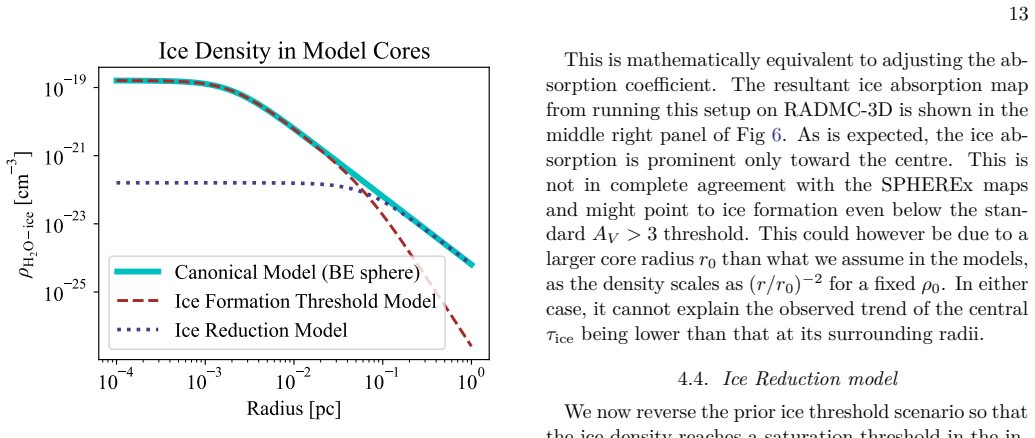
- [Abstract; §5, item 3] Conclusion 3 and the abstract state the null result more strongly than the explored parameter space supports, given the magnitude of the mismatch. In the high-density fiducial model the central tau_ice reaches ~1.5 (Fig. 4, top right), while the observed central values are ~0.6-0.8 with a ring peaking near ~1 (Fig. 2) — a factor ~2 offset, well above the 10-15% measurement errors. The §4 variants test only coarse departures (a sharp 5-to-100 um a_max jump, a single 30 deg cap ISRF orientation, one threshold density). The body text is appropriately hedged ('Other physical explanations... cannot be ruled out', §4.4.1), but the abstract and Conclusions should be brought in line — e.g., 'within the model family tested' — or the variant suite should be broadened (continuous rgrowth, swept ISRF directions combined with the Major-Comment-1 convergence test). As written, a reader could take the
minor comments (6)
- [§2.2] §2.2: the 7.2-arcsec grid spacing is justified against the 6.2-arcsec native pixel, but adjacent grid points are not independent given the SPHEREx PSF (~2 pixels); please state the effective spatial resolution of the tau_ice maps and confirm the central dip spans more than one independent beam.
- [§3.3] §3.3: please justify the 10^6 photons per wavelength and the 200 MJy/sr flux floor. Photon noise and the floor could both affect the derived central tau_ice in the faint central depression; a brief noise estimate for the simulated images would help.
- [Fig. 3, Fig. 5] Fig. 3 legends: the density labels (e.g., '0 = 0.1x10^6') do not state whether the quantity is n_H2 or rho0, nor units; the axis label 'ice' should be tau_ice. Same notation issue in Fig. 5.
- [Table 1] Table 1's 'Central Density' column contains 'Low'/'High' rather than densities; either give approximate central densities (with the references already cited in §2.1) or rename the column.
- [§2.3, Fig. 2] Fig. 2 radial profiles: describe the annulus binning and how the +/-1 sigma band is constructed (the text mentions only adding 10% to the upper error for the bandpass correction).
- [Various] Typos/style: 'gasesous' (§4.4.1), 'upto' (§4.2), 'focussing' (§2.1), 'roughly corresponding' (§2.2); 'megajansky per steradian' in §3.3 without distance scaling makes the absolute flux comparison to data unclear.
Circularity Check
No circularity: ice maps are measured independently from SPHEREx photometry; models are null tests that fail to force the central dip.
full rationale
The paper’s load-bearing observational product is τ_ice computed pixel-by-pixel from SPHEREx coreshine spectra via continuum fitting and −ln(F/F_cont) (Eq. 1, §2.2); that quantity is not defined in terms of the Bonnor–Ebert or RADMC-3D models. The models (§3–4) are used as interpretive null tests: they adopt standard domain choices (BE profile, MRN-like grains, η_ice, isotropic/cap ISRF) and are shown to reproduce continuum central dips and monotonic ice profiles, but not the observed central τ_ice drop in the densest cores. Failure of the null models is not a fitted-input-called-prediction, nor is any uniqueness theorem or self-citation chain used to forbid alternatives. Literature central densities are used only to label cores high vs low density, which does not make the measured maps or the model–data mismatch circular. Cross-checks (background-star comparison in App. A, foreground subtraction in App. B, continuum-fit variants) are external consistency tests, not self-referential closures. Score 0 is therefore appropriate.
Axiom & Free-Parameter Ledger
free parameters (7)
- fiducial ice mass fraction η_ice =
0.4 (fiducial)
- central flat-density radius r0 =
0.002 pc
- core truncation radius R =
0.2 pc
- maximum grain size a_max (and rgrowth) =
5 µm fiducial; 100 µm in core for growth tests
- ice-threshold density ρt (via n_H2 = 10^4 cm^{-3}) =
n_H2 ≈ 10^4 cm^{-3}
- continuum-fit wavelength windows and spike cut =
1.5× median spike cut; stated windows
- ISRF geometry (full sphere vs 30° cap) =
isotropic ~500-star Fibonacci sphere; 30° cap test
axioms (7)
- domain assumption Prestellar cores can be approximated as Bonnor-Ebert spheres: constant density for r < r0, ρ ∝ r^{-2} outside.
- domain assumption Gas-to-dust mass ratio ≈ 100 and DHS porous grains with MRN size distribution generate NIR opacities via OpTool.
- domain assumption Single-scattering, forward-dominated transport is adequate for the analytical model at moderate τ (mean free path argument in App. C).
- domain assumption Quadratic continuum interpolation outside 2.9–3.1 µm yields an unbiased estimate of the H2O ice optical depth at SPHEREx resolution (correction factor ≈1–1.1).
- domain assumption Thermal NIR emission and Galactic foreground are subdominant to coreshine for these <150 pc cores after off-core checks.
- standard math Ice absorption opacity scales with ice mass on grains; continuum scattering opacity is set by dust size distribution.
- ad hoc to paper Failure of the tested model suite to produce a central τ_ice dip implies an unexplained physical or chemical effect in the densest regions.
invented entities (1)
-
Ice-reduction / saturation model (ice density plateaus above n_H2 ~ 10^4 cm^{-3})
no independent evidence
read the original abstract
We present the first coreshine-derived, spatially-resolved maps of the 3 $\mu$m H$_2$O ice absorption feature in four prestellar cores, using SPHEREx spectra. Ices are a key component of dense cores in molecular clouds, playing a central role in the chemistry of planet formation around young stars. However, spatially resolved abundance studies remain limited, typically relying on unevenly distributed background star sightlines. Here, we take advantage of the all-sky spectrophotometric capabilities of SPHEREx to construct ice absorption maps with uniform spatial resolution using the illumination of dense cores by scattered Galactic radiation, or coreshine. To demonstrate proof of concept, we analyse the spatially varying H$_2$O ice absorption in four nearby (~140 pc) prestellar cores - L1544, CrA 151, L260 and L1512. Two cores follow the expected spatial trend of ice absorption peaking at the centre, but the two densest cores show a surprising drop in observed ice absorption in the innermost regions. To interpret the absorption maps, we construct analytical and simulated models of a Bonnor-Ebert sphere illuminated by scattering. We study the effects of different geometric configurations, ice mass fractions, and spatial differences in ice composition. None of these can explain the reduced central absorption, pointing to an unexplained physical or chemical effect operating in the densest prestellar regions. Our simulations further show that spectra derived from coreshine provide a robust tracer of spatially varying ice density and composition, establishing SPHEREx scattered-light spectroscopy as a powerful new probe of ice in dense cores.
Figures




Reference graph
Works this paper leans on
-
[1]
The SPHEREx Satellite Mission. arXiv e-prints , keywords =. doi:10.48550/arXiv.2511.02985 , archivePrefix =. 2511.02985 , primaryClass =
-
[2]
Infrared Emission from Interstellar Dust. II. The Diffuse Interstellar Medium. , keywords =. doi:10.1086/323147 , archivePrefix =. astro-ph/0011319 , primaryClass =
-
[3]
Is the dust-to-gas ratio constant in molecular clouds?. , keywords =. doi:10.1093/mnrasl/slx096 , archivePrefix =. 1706.05107 , primaryClass =
-
[4]
The infrared band strengths of H\_2\_O, CO and CO\_2\_ in laboratory simulations of astrophysical ice mixtures. , keywords =. doi:10.48550/arXiv.astro-ph/9409076 , archivePrefix =. astro-ph/9409076 , primaryClass =
-
[5]
Mit 5 Textabbildungen
\"U ber die Verdichtung von H I-Gebieten. Mit 5 Textabbildungen. , year = 1955, month = jan, volume =
1955
-
[6]
, year = 1956, month = jan, volume =
Boyle's Law and gravitational instability. , year = 1956, month = jan, volume =. doi:10.1093/mnras/116.3.351 , adsurl =
-
[7]
RADMC-3D: A multi-purpose radiative transfer tool
-
[8]
OpTool: Command-line driven tool for creating complex dust opacities
-
[9]
Modeling optical properties of cosmic dust grains using a distribution of hollow spheres. , keywords =. doi:10.1051/0004-6361:20041920 , archivePrefix =. astro-ph/0503068 , primaryClass =
-
[10]
Scattering from dust in molecular clouds: Constraining the dust grain size distribution through near-infrared cloudshine and infrared coreshine. , keywords =. doi:10.1051/0004-6361/201322102 , archivePrefix =. 1310.7105 , primaryClass =
-
[11]
, keywords =
Interstellar radiation field and dust temperatures in the diffuse interstellar medium and in giant molecular clouds. , keywords =
-
[12]
Properties of starless and prestellar cores in Taurus revealed by Herschel: SPIRE/PACS imaging. , keywords =. doi:10.1093/mnras/stu219 , archivePrefix =. 1401.7871 , primaryClass =
-
[13]
On the internal structure of starless cores. I. Physical conditions and the distribution of CO, CS, N _ 2 H ^ + , and NH _ 3 in L1498 and L1517B. , keywords =. doi:10.1051/0004-6361:20031704 , adsurl =
-
[14]
An analytical model for the evolution of starless cores - I. The constant-mass case. , keywords =. doi:10.1093/mnras/stw729 , archivePrefix =. 1603.09591 , primaryClass =
-
[15]
, keywords =
Dust opacities for protostellar cores. , keywords =
-
[16]
, year = 1941, month = jan, volume =
Diffuse radiation in the Galaxy. , year = 1941, month = jan, volume =. doi:10.1086/144246 , adsurl =
doi:10.1086/144246 1941
-
[17]
, year = 1965, month = nov, volume =
Multiple Scattering by Large Particles. , year = 1965, month = nov, volume =. doi:10.1086/148436 , adsurl =
-
[18]
Multiple Scattering by Large Particles. II. Optically Thick Layers. , year = 1968, month = jun, volume =. doi:10.1086/149598 , adsurl =
-
[19]
A note on double Henyey-Greenstein phase function. , keywords =. doi:10.1016/j.jqsrt.2016.06.016 , adsurl =
-
[20]
Multiple scattering in reflection nebulae. I. A Monte Carlo approach. , keywords =. doi:10.1086/190463 , adsurl =
-
[21]
Dust particle size, shape and optical depth during the 2018/MY34 Martian global dust storm retrieved by MSL Curiosity rover Navigation Cameras. , keywords =. doi:10.1016/j.icarus.2020.114021 , archivePrefix =. 2008.01968 , primaryClass =
arXiv 2018
-
[22]
A three-parameter analytic phase function for multiple scattering calculations. , keywords =. doi:10.1016/0022-4073(75)90095-3 , adsurl =
-
[23]
SPHEREx Wide-Field Infrared Spectral Mapping of Interstellar Ices and Polycyclic Aromatic Hydrocarbons. arXiv e-prints , keywords =. doi:10.48550/arXiv.2603.12390 , archivePrefix =. 2603.12390 , primaryClass =
-
[24]
The Central 1000 au of a Pre-stellar Core Revealed with ALMA. I. 1.3 mm Continuum Observations. , keywords =. doi:10.3847/1538-4357/ab0700 , archivePrefix =. 1902.05299 , primaryClass =
Pith/arXiv arXiv 1902
-
[25]
The Spitzer Ice Legacy: Ice Evolution from Cores to Protostars. , keywords =. doi:10.1088/0004-637X/740/2/109 , archivePrefix =. 1107.5825 , primaryClass =
-
[26]
Observations of the icy universe. , keywords =. doi:10.1146/annurev-astro-082214-122348 , archivePrefix =. 1501.05317 , primaryClass =
-
[27]
Water in star-forming regions: physics and chemistry from clouds to disks as probed by Herschel spectroscopy. , keywords =. doi:10.1051/0004-6361/202039084 , archivePrefix =. 2102.02225 , primaryClass =
-
[28]
Laboratory and Computational Studies of Interstellar Ices. , keywords =. doi:10.1146/annurev-astro-071221-052732 , archivePrefix =. 2407.06657 , primaryClass =
-
[29]
An Embedded Disk (eDisk) in the IceAge: Investigating the Jet and Outflow from Ced 110 IRS4. , keywords =. doi:10.3847/1538-3881/adb1ba , archivePrefix =. 2502.00394 , primaryClass =
-
[30]
Methanol-rich ice in the envelope of Serpens SMM 4
Mapping ices in protostellar environments on 1000 AU scales. Methanol-rich ice in the envelope of Serpens SMM 4. , keywords =. doi:10.1051/0004-6361:20041276 , archivePrefix =. astro-ph/0407316 , primaryClass =
-
[31]
Tracing the chemical environment and thermal history of ices in protostellar envelopes
JWST observations of ^ 13 CO _ 2 ice. Tracing the chemical environment and thermal history of ices in protostellar envelopes. , keywords =. doi:10.1051/0004-6361/202348718 , archivePrefix =. 2402.04314 , primaryClass =
-
[32]
The c2d Spitzer Spectroscopic Survey of Ices around Low-Mass Young Stellar Objects. I. H _ 2 O and the 5-8 m Bands. , keywords =. doi:10.1086/533425 , archivePrefix =. 0801.1167 , primaryClass =
-
[33]
The c2d Spitzer Spectroscopic Survey of Ices around Low-Mass Young Stellar Objects. II. CO _ 2. , keywords =. doi:10.1086/533431 , archivePrefix =. 0711.4616 , primaryClass =
-
[34]
The c2d Spitzer Spectroscopic Survey of Ices around Low-Mass Young Stellar Objects. III. CH _ 4. , keywords =. doi:10.1086/533432 , archivePrefix =. 0801.1223 , primaryClass =
-
[35]
The c2d Spitzer Spectroscopic Survey of Ices Around Low-mass Young Stellar Objects. IV. NH _ 3 and CH _ 3 OH. , keywords =. doi:10.1088/0004-637X/718/2/1100 , archivePrefix =. 1005.2225 , primaryClass =
-
[36]
JWST Observations of Young protoStars (JOYS): Overview of program and early results. , keywords =. doi:10.1051/0004-6361/202554444 , archivePrefix =. 2505.08002 , primaryClass =
-
[37]
Journal of Korean Astronomical Society , keywords =
Near- to Mid-Infrared Spectroscopic Study of Ice Analysis Using the AKARI/IRC and Spitzer/IRS Spectra. Journal of Korean Astronomical Society , keywords =. doi:10.5303/JKAS.2025.58.1.111 , archivePrefix =. 2505.05390 , primaryClass =
Pith/arXiv arXiv 2025
-
[38]
Enhanced formation of interstellar complex organic molecules on carbon monoxide ice. , keywords =. doi:10.1051/0004-6361/202449604 , archivePrefix =. 2405.20707 , primaryClass =
-
[39]
Molecules with ALMA at Planet-forming Scales (MAPS). I. Program Overview and Highlights. , keywords =. doi:10.3847/1538-4365/ac1432 , archivePrefix =. 2109.06268 , primaryClass =
-
[40]
Protostars and Planets VI , year = 2014, editor =
Water: From Clouds to Planets. Protostars and Planets VI , year = 2014, editor =. doi:10.2458/azu_uapress_9780816531240-ch036 , archivePrefix =. 1401.8103 , primaryClass =
Pith/arXiv arXiv 2014
-
[41]
Encyclopedia of Astrophysics, Volume 1 , year = 2026, volume =
Protoplanetary disk chemistry and structure. Encyclopedia of Astrophysics, Volume 1 , year = 2026, volume =. doi:10.1016/B978-0-443-21439-4.00044-4 , archivePrefix =. 2410.23235 , primaryClass =
Pith/arXiv arXiv 2026
-
[42]
, keywords =
The 3.1 m absorption in molecular clouds is probably due to amorphous H _ 2 O ice. , keywords =
-
[43]
The Wide-field Infrared Survey Explorer (WISE): Mission Description and Initial On-orbit Performance. , keywords =. doi:10.1088/0004-6256/140/6/1868 , archivePrefix =. 1008.0031 , primaryClass =
-
[44]
The Ubiquity of Micrometer-Sized Dust Grains in the Dense Interstellar Medium. Science , keywords =. doi:10.1126/science.1193211 , archivePrefix =. 1110.4180 , primaryClass =
-
[45]
Grain size limits derived from 3.6 m and 4.5 m coreshine. , keywords =. doi:10.1051/0004-6361/201425434 , archivePrefix =. 1508.04691 , primaryClass =
-
[46]
Hunting pre-stellar cores with APEX: Corona Australis 151, the densest pre-stellar core or the youngest protostar?. , keywords =. doi:10.1051/0004-6361/202452579 , archivePrefix =. 2502.13745 , primaryClass =
-
[47]
Monthly Notices of the Royal Astronomical Society , volume =
Keto, Eric and Rawlings, Jonathan and Caselli, Paola , title =. Monthly Notices of the Royal Astronomical Society , volume =. 2014 , month =. doi:10.1093/mnras/stu426 , url =
-
[48]
Physical and chemical modeling of the starless core L 1512. , keywords =. doi:10.1051/0004-6361/201936877 , archivePrefix =. 2002.01346 , primaryClass =
Pith/arXiv arXiv 2002
-
[49]
Noble, J. A. and Fraser, H. J. and Pontoppidan, K. M. and Craigon, A. M. , title =. Monthly Notices of the Royal Astronomical Society , volume =. 2017 , month =. doi:10.1093/mnras/stx329 , url =
-
[50]
The Astrophysical Journal Supplement Series , year =
Murakawa, Koji and Tamura, Motohide and Nagata, Tetsuya , title =. The Astrophysical Journal Supplement Series , year =
-
[51]
A direct measurement of CO depletion and the formation of CO\_2
Spatial mapping of ices in the Ophiuchus-F core. A direct measurement of CO depletion and the formation of CO\_2. , keywords =. doi:10.1051/0004-6361:20065569 , archivePrefix =. astro-ph/0605576 , primaryClass =
-
[52]
Sonnentrucker, P. and Neufeld, D. A. and Gerakines, P. A. and Bergin, E. A. and Melnick, G. J. and Forrest, W. J. and Pipher, J. L. and Whittet, D. C. B. , year=. Fully Sampled Maps of Ices and Silicates in Front of Cepheus A East with theSpitzer Space Telescope , volume=. The Astrophysical Journal , publisher=. doi:10.1086/523790 , number=
-
[53]
A Survey of H _ 2 O, CO _ 2 , and CO Ice Features toward Background Stars and low-mass Young Stellar Objects Using AKARI. , keywords =. doi:10.1088/0004-637X/775/2/85 , archivePrefix =. 1307.1527 , primaryClass =
-
[54]
Nature Astronomy , year = 2025, month = jun, volume =
Cospatial ice mapping of H _ 2 O with CO _ 2 and CO across a molecular cloud with JWST/NIRCam. Nature Astronomy , year = 2025, month = jun, volume =. doi:10.1038/s41550-025-02511-z , adsurl =
-
[55]
Infrared spectroscopy of dust in the Taurus dark clouds : ice and silicates. , keywords =. doi:10.1093/mnras/233.2.321 , adsurl =
-
[56]
Spitzer Mid-Infrared Spectroscopy of Ices toward Extincted Background Stars. , keywords =. doi:10.1086/499584 , archivePrefix =. astro-ph/0511467 , primaryClass =
-
[57]
Spitzer Observations of CO _ 2 Ice toward Field Stars in the Taurus Molecular Cloud. , keywords =. doi:10.1086/431932 , archivePrefix =. astro-ph/0505345 , primaryClass =
-
[58]
The SPHEREx Target List of Ice Sources (SPLICES). , keywords =. doi:10.3847/1538-4357/acc86b , archivePrefix =. 2501.17797 , primaryClass =
-
[59]
Multi-wavelength observations and modelling of a quiescent cloud LDN1512. , keywords =. doi:10.1051/0004-6361/202038401 , archivePrefix =. 2101.12032 , primaryClass =
-
[60]
A survey of magnetic field properties in Bok Globules. , keywords =. doi:10.1093/mnras/staf529 , archivePrefix =. 2412.00201 , primaryClass =
-
[61]
The link between water gas and ice in protostellar envelopes
Water in low-mass star-forming regions with Herschel. The link between water gas and ice in protostellar envelopes. , keywords =. doi:10.1051/0004-6361/201424236 , archivePrefix =. 1409.6473 , primaryClass =
-
[62]
, year = 2009, month = sep, volume =
Complex Organic Interstellar Molecules. , year = 2009, month = sep, volume =. doi:10.1146/annurev-astro-082708-101654 , adsurl =
-
[63]
Awad, Zainab and Viti, Serena and Collings, Mark P. and Williams, David A. , title =. Monthly Notices of the Royal Astronomical Society , volume =. 2010 , month =. doi:10.1111/j.1365-2966.2010.17077.x , url =
arXiv 2010
-
[64]
JWST Observations of Young protoStars (JOYS): Overview of gaseous molecular emission and absorption in low-mass protostars. , keywords =. doi:10.1051/0004-6361/202451967 , archivePrefix =. 2410.01636 , primaryClass =
-
[65]
An ALMA Survey of H _ 2 CO in Protoplanetary Disks. , keywords =. doi:10.3847/1538-4357/ab64d9 , archivePrefix =. 2002.12525 , primaryClass =
Pith/arXiv arXiv 2002
-
[66]
Survey description and a first look at G9.62+0.19
ATOMS: ALMA Three-millimeter Observations of Massive Star-forming regions - I. Survey description and a first look at G9.62+0.19. , keywords =. doi:10.1093/mnras/staa1577 , archivePrefix =. 2006.01549 , primaryClass =
arXiv 2006
-
[67]
The ALMA-QUARKS Survey. I. Survey Description and Data Reduction. Research in Astronomy and Astrophysics , keywords =. doi:10.1088/1674-4527/ad0d5c , archivePrefix =. 2311.08651 , primaryClass =
-
[68]
ALMA Observations of Massive Clouds in the Central Molecular Zone: Ubiquitous Protostellar Outflows. , keywords =. doi:10.3847/1538-4357/abde3c , archivePrefix =. 2101.07925 , primaryClass =
-
[69]
The Disk Substructures at High Angular Resolution Project (DSHARP). I. Motivation, Sample, Calibration, and Overview. , keywords =. doi:10.3847/2041-8213/aaf741 , archivePrefix =. 1812.04040 , primaryClass =
Pith/arXiv arXiv 2041
-
[70]
JWST Edge-on Disk Ice (JEDIce): Program overview and ice survey results. arXiv e-prints , keywords =. doi:10.48550/arXiv.2603.18163 , archivePrefix =. 2603.18163 , primaryClass =
-
[71]
JOYS: MIRI/MRS spectroscopy of gas-phase molecules from the high-mass star-forming region IRAS 23385+6053. , keywords =. doi:10.1051/0004-6361/202348105 , archivePrefix =. 2401.06880 , primaryClass =
-
[72]
An Ice Age JWST inventory of dense molecular cloud ices. Nature Astronomy , keywords =. doi:10.1038/s41550-022-01875-w , archivePrefix =. 2301.09140 , primaryClass =
-
[73]
arXiv e-prints , keywords =
The SPHEREx Ices Investigation: An Overview. arXiv e-prints , keywords =
-
[74]
Parallaxes and proper motions of interstellar masers toward the Cygnus X star-forming complex. I. Membership of the Cygnus X region. , keywords =. doi:10.1051/0004-6361/201118211 , archivePrefix =. 1111.7023 , primaryClass =
-
[75]
The Colors of Ices: Measuring ice column density through photometry. arXiv e-prints , keywords =. doi:10.48550/arXiv.2510.00292 , archivePrefix =. 2510.00292 , primaryClass =
-
[76]
JWST Reveals Widespread CO Ice and Gas Absorption in the Galactic Center Cloud G0.253+0.016. , keywords =. doi:10.3847/1538-4357/acfc34 , archivePrefix =. 2308.16050 , primaryClass =
-
[77]
Mapping CO Ice in a Star-Forming Filament in the 3 kpc Arm with JWST. arXiv e-prints , keywords =. doi:10.48550/arXiv.2509.21763 , archivePrefix =. 2509.21763 , primaryClass =
-
[78]
Photometric Mapping of Carbonaceous/Siliceous Dust and Water Ice in the ISM with JWST: Applications to the Dense Sightlines. , keywords =. doi:10.3847/1538-3881/adf103 , archivePrefix =. 2507.17550 , primaryClass =
-
[79]
Bolometric Temperatures of Young Stellar Objects. , keywords =. doi:10.1086/186956 , adsurl =
-
[80]
Fractionation in young cores: Direct determinations of nitrogen and carbon fractionation in HCN. , keywords =. doi:10.1051/0004-6361/202449344 , archivePrefix =. 2403.04408 , primaryClass =
discussion (0)
Sign in with ORCID, Apple, or X to comment. Anyone can read and Pith papers without signing in.