Loss of the Scaling Attractor in Self-Gravitating Domain Wall Networks
Pith reviewed 2026-06-27 21:18 UTC · model grok-4.3
The pith
Gravitational backreaction turns the domain wall scaling solution into a saddle with no stable fixed points in the physical phase space.
A machine-rendered reading of the paper's core claim, the machinery that carries it, and where it could break.
Core claim
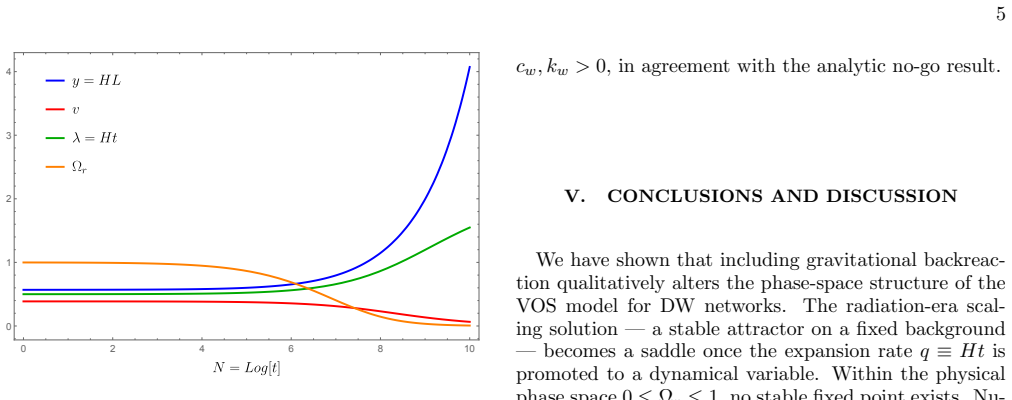
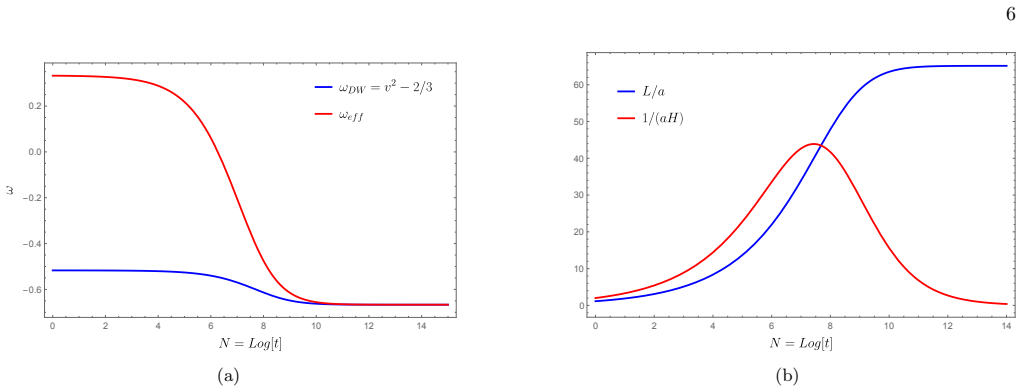
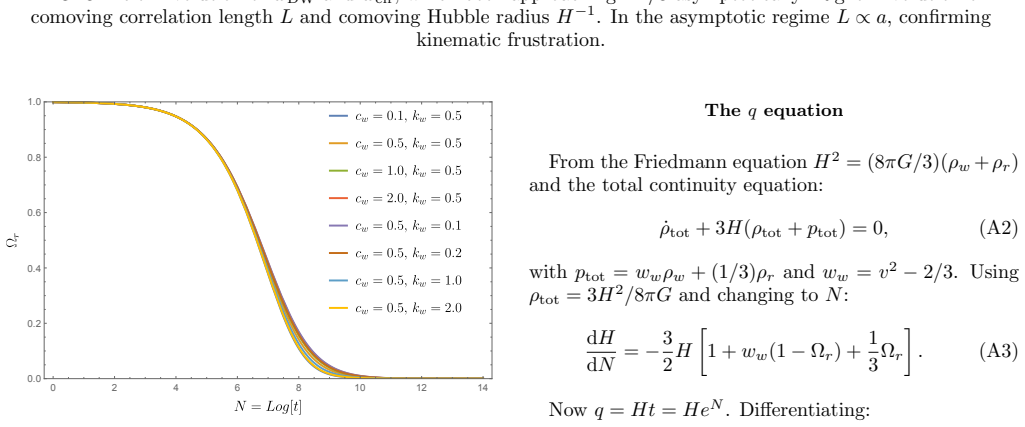
Coupling the velocity-dependent one-scale equations to the Friedmann equation and radiation transfer produces an autonomous dynamical system in which the radiation-era scaling solution is a saddle rather than an attractor. No stable fixed points exist within the physical phase space, so the network evolves generically toward wall domination and kinematic frustration where the walls freeze in comoving coordinates.
What carries the argument
The autonomous dynamical system obtained by coupling the velocity-dependent one-scale model equations to the Friedmann equation with radiation energy transfer.
If this is right
- The scaling regime survives only as a transient stage before wall domination begins.
- Every trajectory in the physical phase space reaches a wall-dominated state.
- The walls become kinematically frustrated and freeze in comoving coordinates at late times.
- The assumption that scaling persists indefinitely does not hold once gravitational backreaction is included.
Where Pith is reading between the lines
- Predictions for gravitational waves or other late-time signatures from domain walls may change if the frustration dynamics replace scaling.
- The same loss of stable attractors could appear in other cosmic defect networks once their gravitational influence on the expansion is treated dynamically.
- Full numerical simulations that include metric perturbations would provide an independent check on whether the analytic phase-space structure survives.
Load-bearing premise
The velocity-dependent one-scale model remains an accurate description of the network even when the walls become gravitationally dominant.
What would settle it
Numerical integration of the coupled equations that converges to a stable scaling fixed point instead of wall domination, or observational evidence that domain wall networks maintain relativistic scaling at late cosmic times.
Figures

read the original abstract
Domain-wall(DW) networks are known to approach a relativistic scaling regime on fixed radiation- and matter-dominated backgrounds, forming the basis of the no-frustration conjecture. However, this picture assumes that the defect network remains gravitationally subdominant. We investigate the self-consistent evolution of DWs by coupling the velocity-dependent one-scale model to the Friedmann equation and radiation energy transfer. The resulting autonomous system allows the cosmic expansion history to evolve dynamically rather than being imposed externally. We demonstrate analytically that gravitational backreaction qualitatively changes the phase-space structure: the radiation-era scaling solution, which is a stable attractor on a fixed background, becomes a saddle once the expansion rate is promoted to a dynamical degree of freedom. Furthermore, we establish that no stable fixed point exists within the physical phase space. Consequently, the scaling regime survives only as a transient stage, and all trajectories are driven toward a wall dominated and kinematically frustrated state in which the walls freeze in comoving coordinates. Our results demonstrate that the scaling attractor is not preserved in self-gravitating DW networks and reveal the generic late-time frustration dynamics of wall domination.
Editorial analysis
A structured set of objections, weighed in public.
Referee Report
Summary. The paper couples the velocity-dependent one-scale (VOS) model for domain-wall networks to the Friedmann equation (with radiation energy transfer) to obtain an autonomous dynamical system in which the expansion rate evolves self-consistently. It claims to demonstrate analytically that the radiation-era scaling solution, a stable attractor on a fixed background, becomes a saddle once gravitational backreaction is included, that no stable fixed point exists in the physical phase space, and that all trajectories are driven to a wall-dominated, kinematically frustrated state.
Significance. If the central derivation holds, the result would show that the scaling attractor of the no-frustration conjecture is lost once domain walls are allowed to source the metric, implying that scaling survives only as a transient and that late-time frustration is generic. This would constitute a qualitative change in the expected cosmological evolution of self-gravitating wall networks.
major comments (1)
- [Abstract] Abstract (and the autonomous system obtained by coupling VOS to the Friedmann equation): the central claim that the scaling solution becomes a saddle and that no stable fixed point exists rests on the assumption that the VOS equations (including their averaged energy-loss and curvature terms) remain valid when the walls become gravitationally dominant and source significant metric perturbations. The manuscript does not provide a derivation or justification for retaining the VOS form in this regime, which was originally obtained under the assumption of a fixed background and subdominant defects; if this assumption fails, the phase-space analysis does not apply to the actual field theory.
Simulated Author's Rebuttal
We thank the referee for the careful and insightful review. We address the major comment below.
read point-by-point responses
-
Referee: [Abstract] Abstract (and the autonomous system obtained by coupling VOS to the Friedmann equation): the central claim that the scaling solution becomes a saddle and that no stable fixed point exists rests on the assumption that the VOS equations (including their averaged energy-loss and curvature terms) remain valid when the walls become gravitationally dominant and source significant metric perturbations. The manuscript does not provide a derivation or justification for retaining the VOS form in this regime, which was originally obtained under the assumption of a fixed background and subdominant defects; if this assumption fails, the phase-space analysis does not apply to the actual field theory.
Authors: We agree that the VOS equations were originally derived under the assumption of a fixed background with subdominant defects. Our analysis couples these averaged equations to the Friedmann equation to include gravitational backreaction self-consistently, which is a standard effective-model approach used in prior literature on defect networks (including cosmic strings). The manuscript does not contain a first-principles re-derivation of the VOS terms from the field theory in the wall-dominated regime. We will revise the manuscript to add an explicit discussion of this modeling assumption, its limitations, and references to related applications of VOS beyond the subdominant regime. This will clarify the scope of the phase-space results without changing the analytic findings within the extended model. revision: partial
Circularity Check
No significant circularity; derivation is standard coupling and fixed-point analysis
full rationale
The paper takes the established VOS equations from prior literature, couples them to the Friedmann equation to obtain an autonomous dynamical system, and performs an analytic fixed-point analysis showing the radiation-era scaling solution becomes a saddle with no stable physical fixed points. This is a direct mathematical consequence of the coupled ODEs and does not reduce any claimed prediction to a fitted parameter or self-citation by construction. The VOS model is invoked as an external input whose validity in the new regime is an assumption, not a definitional step inside the derivation. No self-citation is load-bearing for the phase-space result, and the analysis is self-contained against external benchmarks.
Axiom & Free-Parameter Ledger
axioms (2)
- domain assumption The velocity-dependent one-scale (VOS) model equations hold for self-gravitating networks
- standard math The system can be reduced to an autonomous dynamical system with radiation energy transfer
Reference graph
Works this paper leans on
-
[1]
AddingH 1 >0 constrainsk w from below via a cubic Root object
-
[2]
The necessary condition for stability is therefore kw < v2cw 1−v 2 .(C4) Combining with the fixed-point relation Ω r = cwv2/[kw(1−v 2)] yields Ω r >1
AddingH 2 >0 preserves the same structure. The necessary condition for stability is therefore kw < v2cw 1−v 2 .(C4) Combining with the fixed-point relation Ω r = cwv2/[kw(1−v 2)] yields Ω r >1. Thus any mathemat- ically stable interior fixed point lies strictly outside the physical phase space
-
[3]
T. W. B. Kibble, J. Phys. A9, 1387 (1976)
1976
-
[4]
Vilenkin, Phys
A. Vilenkin, Phys. Rept.121, 263 (1985)
1985
-
[5]
Sikivie, Phys
P. Sikivie, Phys. Rev. Lett.48, 1156 (1982)
1982
-
[6]
A. D. Linde and D. H. Lyth, Phys. Lett. B246, 353 (1990)
1990
-
[7]
Vilenkin and E
A. Vilenkin and E. P. S. Shellard,Cosmic Strings and Other Topological Defects(Cambridge University Press, 2000)
2000
-
[8]
Hiramatsu, M
T. Hiramatsu, M. Kawasaki, and K. Saikawa, Jour- nal of Cosmology and Astroparticle Physics2011(08), 030–030
-
[9]
M. Kawasaki, K. Saikawa, and T. Sekiguchi, Phys. Rev. D91, 065014 (2015), arXiv:1412.0789 [hep-ph]
Pith/arXiv arXiv 2015
-
[10]
T. Hiramatsu, M. Kawasaki, K. Saikawa, and T. Sekiguchi, Phys. Rev. D85, 105020 (2012), [Erra- tum: Phys.Rev.D 86, 089902 (2012)], arXiv:1202.5851 [hep-ph]
Pith/arXiv arXiv 2012
-
[11]
Hiramatsu, M
T. Hiramatsu, M. Kawasaki, K. Saikawa, and T. Sekiguchi, Journal of Cosmology and Astroparticle Physics2013(01), 001–001
-
[12]
Bhattacharjee, C
P. Bhattacharjee, C. T. Hill, and D. N. Schramm, Phys. Rev. Lett.69, 567 (1992). 9
1992
-
[13]
B. Bajc, A. Riotto, and G. Senjanovic, Phys. Rev. Lett. 81, 1355 (1998), arXiv:hep-ph/9710415
Pith/arXiv arXiv 1998
-
[14]
J. Chakrabortty, R. Maji, and S. F. King, Phys. Rev. D 99, 095008 (2019), arXiv:1901.05867 [hep-ph]
Pith/arXiv arXiv 2019
-
[15]
S. F. King, S. Pascoli, J. Turner, and Y.-L. Zhou, Physi- cal Review Letters126, 10.1103/physrevlett.126.021802 (2021)
-
[16]
S. A. Abel, S. Sarkar, and P. L. White, Nucl. Phys. B 454, 663 (1995), arXiv:hep-ph/9506359
Pith/arXiv arXiv 1995
-
[17]
Preskill, S
J. Preskill, S. P. Trivedi, F. Wilczek, and M. B. Wise, Nucl. Phys. B363, 207 (1991)
1991
-
[18]
R. A. Battye, G. D. Brawn, and A. Pilaftsis, JHEP08, 020, arXiv:1106.3482 [hep-ph]
-
[19]
Y. B. Zeldovich, I. Y. Kobzarev, and L. B. Okun, Zh. Eksp. Teor. Fiz.67, 3 (1974)
1974
-
[20]
R. Z. Ferreira, S. Gasparotto, T. Hiramatsu, I. Obata, and O. Pujolas, Axionic defects in the cmb: birefringence and gravitational waves (2025), arXiv:2312.14104 [hep- ph]
arXiv 2025
-
[21]
G. B. Gelmini, M. Gleiser, and E. W. Kolb, Phys. Rev. D39, 1558 (1989)
1989
-
[22]
Coulson, Z
D. Coulson, Z. Lalak, and B. Ovrut, Phys. Rev. D53, 4237 (1996)
1996
-
[23]
Holdom, Phys
B. Holdom, Phys. Rev. D28, 1419 (1983)
1983
-
[24]
E. Babichev, I. Dankovsky, D. Gorbunov, S. Ramazanov, and A. Vikman, JCAP10, 103, arXiv:2504.07902 [hep- ph]
- [25]
-
[26]
Z. Lalak and S. Thomas, Phys. Lett. B306, 10 (1993), arXiv:hep-ph/9303250
Pith/arXiv arXiv 1993
-
[27]
D. Gonzalez, N. Kitajima, F. Takahashi, and W. Yin, Phys. Lett. B843, 137990 (2023), arXiv:2211.06849 [hep- ph]
arXiv 2023
-
[28]
E. Babichev, D. Gorbunov, S. Ramazanov, and A. Vikman, JCAP04(04), 028, arXiv:2112.12608 [hep- ph]
- [29]
-
[30]
S. Blasi and A. Mariotti, Physical Review Letters129, 10.1103/physrevlett.129.261303 (2022)
-
[31]
Vilenkin, Phys
A. Vilenkin, Phys. Rev. D23, 852 (1981)
1981
-
[32]
S. Chang, C. Hagmann, and P. Sikivie, Physical Review D59, 10.1103/physrevd.59.023505 (1998)
-
[33]
Gleiser and R
M. Gleiser and R. Roberts, Physical Review Letters81, 5497–5500 (1998)
1998
-
[34]
Hiramatsu, M
T. Hiramatsu, M. Kawasaki, and K. Saikawa, Jour- nal of Cosmology and Astroparticle Physics2010(05), 032–032
-
[35]
Kuroyanagi, T
S. Kuroyanagi, T. Chiba, and T. Takahashi, Journal of Cosmology and Astroparticle Physics2018(11), 038–038
-
[36]
I. Dankovsky, S. Ramazanov, E. Babichev, D. Gorbunov, and A. Vikman, JCAP02, 064, arXiv:2410.21971 [hep- ph]
-
[37]
I. Dankovsky, E. Babichev, D. Gorbunov, S. Ramazanov, and A. Vikman, JCAP09, 047, arXiv:2406.17053 [astro- ph.CO]
-
[38]
Saikawa, Universe3, 40 (2017)
K. Saikawa, Universe3, 40 (2017)
2017
-
[39]
R. Roshan, Imprint of domain wall annihilation on in- duced gravitational waves (2026), arXiv:2604.25726 [hep- ph]
Pith/arXiv arXiv 2026
- [40]
- [41]
-
[42]
B. Cyr, S. Cotterill, and R. Battye, Near-peak spec- trum of gravitational waves from collapsing domain walls (2025), arXiv:2504.02076 [astro-ph.CO]
arXiv 2025
-
[43]
W. H. Press, B. S. Ryden, and D. N. Spergel, Astrophys. J.347, 590 (1989)
1989
-
[44]
P. P. Avelino, C. J. A. P. Martins, J. Menezes, R. Menezes, and J. C. R. E. Oliveira, Physical Review D73, 10.1103/physrevd.73.123520 (2006)
-
[45]
A. M. M. Leite and C. J. A. P. Martins, Phys. Rev. D 84, 103523 (2011)
2011
-
[46]
T. Garagounis and M. Hindmarsh, Physical Review D 68, 10.1103/physrevd.68.103506 (2003)
-
[48]
Leite, C
A. Leite, C. Martins, and E. Shellard, Physics Letters B 718, 740–744 (2013)
2013
-
[49]
P. P. Avelino, D. Gr¨ uber, and L. Sousa, Analytical scal- ing solutions for the evolution of cosmic domain walls in a parameter-free velocity-dependent one-scale model (2022), arXiv:2203.16173 [astro-ph.CO]
arXiv 2022
-
[50]
P. P. Avelino, C. J. A. P. Martins, and J. C. R. E. Oliveira, Physical Review D72, 10.1103/phys- revd.72.083506 (2005)
-
[51]
C. Martins, I. Rybak, A. Avgoustidis, and E. Shel- lard, Physical Review D93, 10.1103/physrevd.93.043534 (2016)
-
[52]
Y. Gouttenoire, S. F. King, R. Roshan, X. Wang, G. White, and M. Yamazaki, Phys. Rev. D112, 075007 (2025), arXiv:2501.16414 [hep-ph]
arXiv 2025
- [53]
-
[54]
Kaloper, Electromagnetic couplings of dark domain walls (2026), arXiv:2602.03933 [hep-th]
N. Kaloper, Electromagnetic couplings of dark domain walls (2026), arXiv:2602.03933 [hep-th]
Pith/arXiv arXiv 2026
-
[55]
L. M. Widrow, Phys. Rev. D40, 1002 (1989)
1989
-
[56]
Kawasaki and K
M. Kawasaki and K. Saikawa, Journal of Cosmology and Astroparticle Physics2011(09), 008–008
-
[57]
Bucher and D
M. Bucher and D. Spergel, Phys. Rev. D60, 043505 (1999)
1999
-
[58]
C. Faroughy, Cosmological perturbations in a universe with a domain wall era (2018), arXiv:1812.02344 [hep- ph]
Pith/arXiv arXiv 2018
discussion (0)
Sign in with ORCID, Apple, or X to comment. Anyone can read and Pith papers without signing in.