REVIEW 3 major objections 6 minor 72 references
High-order fully discrete multi-entropy-stable and bound-preserving schemes for relativistic Euler equations
T0 review · 3 major / 6 minor · reviewed 2026-08-11 · deepseek-v4-flash
Pith's one-line read One cellwise projection per step makes high-order relativistic Euler schemes fully discrete entropy stable for a whole family of entropy pairs and keeps every quadrature state admissible.
desk verdict Strong construction, first fully discrete multi-entropy-stable bound-preserving schemes for relativistic Euler, but the headline guarantee is conditional on an unproved Riemann-solution hypothesis. read the letter →
The pith
A machine-rendered reading of the paper's core claim, the machinery that carries it, and where it could break.
The reading
What carries the argument
The load-bearing object is the two-point local Lax-Friedrichs average with unit viscosity, $H_n(U_L,U_R) = (U_L+U_R)/2 - (F_n(U_R)-F_n(U_L))/2$, combined with the light-cone factorization showing that every directional characteristic speed of the relativistic Euler system lies in $[-1,1]$ for any causal equation of state. Because $H_n$ is the average of the self-similar Riemann solution over the light cone, it is admissible and satisfies the two-point entropy inequality (7) for every prescribed entropy pair, with only the canonical thermodynamic pair needing an entropy admissibility assumption. The Gauss-Lobatto endpoint decomposition (10) then expresses a forward Euler cell average as a convex combination of admissible states and two such averages, giving one weak budget per pair; the radial multi-entropy projection with radius $\theta^{\mathrm{EPO}}_j = \min\{\theta^P_j \theta^{ME}_j, \theta^O_j\}$ converts those weak budgets into strong nodal inequalities, with the convex nondecreasing feasibility profile $\Phi_j(\vartheta)$ ensuring that the intersection of per-pair feasible intervals is itself a single interval.
What would settle it
Run the proposed P2 DG scheme with a non-ideal causal EOS on a one-dimensional Riemann problem whose pressure ratio spans twelve orders of magnitude, and at every time step check at every Gauss-Lobatto node that $D>0$ and $E - \sqrt{D^2 + |m|^2} > 0$ and that each prescribed entropy budget $B_j^{(\ell)}$ is satisfied; a single violation would refute the universal claim, as would a direct computation of $H_n(U_L,U_R)$ for two admissible states whose exact Riemann solution leaves the admissible set.
Extended reading notes
Core claim
The central discovery is that relativistic causality turns a potential obstacle into the engine of the method: every directional characteristic speed of the system lies in $[-1,1]$ for any causal equation of state, so the Lax-Friedrichs viscosity can be set to $\alpha = 1$ uniformly, with no wave-speed estimate and no dependence on the state or equation of state. The resulting two-point average $H_n(U_L,U_R)$ is the average of the self-similar Riemann solution over the light cone; assuming that solution stays admissible and satisfies the canonical entropy inequality, $H_n$ is itself admissible and inherits a two-point entropy inequality for every member of any finite family of convex entropy pairs. A Gauss-Lobatto decomposition writes one forward Euler step of the high-order scheme as a convex combination of nodal states and two such averages, producing one weak entropy budget per pair for the updated cell average. The high-order candidate is then contracted along a single ray anchored at that average: a positivity radius is computed first, then the common feasible interval of all entropy budgets is intersected on the shortened admissible ray, together with an optional oscillation-suppressing interval. Because SSP multistep methods are convex combinations of forward Euler steps, the fully discrete update satisfies local and global discrete entropy inequalities for the entire family while preserving the cell average and the design order.
Load-bearing premise
The whole construction rests on the standard assumption that the directional Riemann problem has a self-similar solution staying inside the physically admissible set and obeying the canonical entropy inequality, together with a radial-projection geometry taken from a companion preprint rather than proved here.
Editorial extensions
If this is right
- The same conservative update and one projection enforce local and global discrete entropy inequalities for every member of a user-chosen finite entropy family, not just one pair.
- The schemes keep the design order (verified for P2 DG at third order) even when smooth solutions approach vacuum within $10^{-5}$, and conservation is exact because the projection anchors at the cell average.
- Because the viscosity coefficient $\alpha=1$ is independent of state and equation of state, the entropy mechanism needs no wave-speed estimate and no EOS-specific tuning beyond primitive recovery.
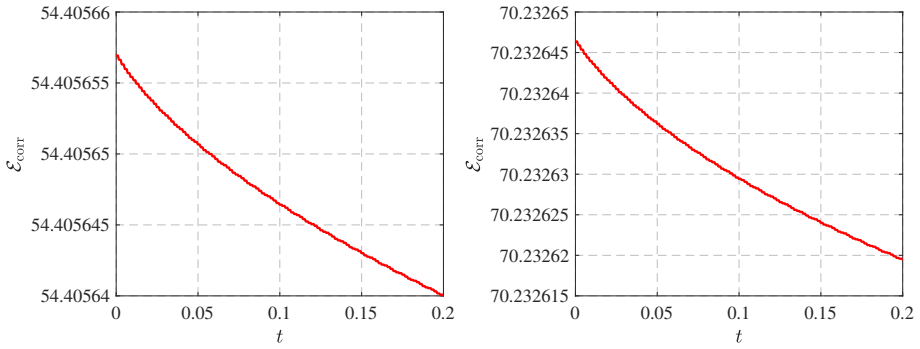
- SSP multistep time integration makes the entropy bound fully discrete, so the boundary-corrected discrete total entropy decreases at every step for each enforced pair.
- The authors argue the same construction transfers to any related system with a convex admissible set and a uniform speed bound, such as relativistic magnetohydrodynamics and general relativistic hydrodynamics.
Reading between the lines
- One extension the paper leaves implicit is that the enforced entropy histories could serve as a runtime health check in production codes: because a rise would signal a violated assumption or an implementation error, not merely discretization error.
- The authors show that three entropy pairs remove a post-contact overshoot that one pair leaves; a natural next step is to make the number or weighting of entropy pairs adaptive, using the gap between feasible radii as an error indicator.
- The uniform alpha=1 flux is more dissipative than a local Rusanov speed in smooth regions, and the paper notes the restrictive CFL condition from the Gauss-Lobatto endpoint weight; sharper compatible fluxes or optimal cell-average decompositions could reduce cost without touching the entropy guarantee.
Editorial analysis
A structured set of objections, weighed in public.
Referee Report
Summary. This paper constructs fully discrete, bound-preserving, multi-entropy-stable discontinuous Galerkin and finite volume schemes for the special relativistic Euler equations with a general causal equation of state. The central claims are: for any prescribed finite family of convex entropy pairs, the scheme satisfies local and global discrete entropy inequalities for every member of the family; every quadrature state that enters an entropy evaluation or a primitive recovery is provably admissible; and conservation and high-order accuracy are retained with a single cellwise radial projection per time step. The construction combines a light-cone speed bound that fixes the Lax-Friedrichs viscosity at alpha = 1 (Section 3.1), a two-point average that under a Riemann-solution hypothesis inherits one entropy inequality per pair (Section 3.2), Gauss-Lobatto decompositions that convert two-point inequalities into weak cell-average budgets (Section 4), a radial projection that enforces positivity before entropy (Section 5), and SSP multistep integration (Section 6). Numerical experiments with four equations of state, including near-vacuum flows and jets with Lorentz factor above 70, report third-order convergence, absence of inadmissible states, and monotone decay of every enforced discrete total entropy.
Significance. If the advertised properties hold as stated, this is a substantial advance: the existing entropy-stable relativistic hydrodynamics literature is semi-discrete, single-entropy, and positivity is imposed by a separate limiter, whereas this paper couples admissibility and entropy control in one conservative projection for an arbitrary finite entropy family, in a fully discrete setting. The structural argument is attractive, since only convexity of the admissible set and the universal speed bound are used, which suggests transferability to RMHD and GRHD. The paper also contains genuinely parameter-free elements (alpha = 1 from causality), a clear weak-budget mechanism, and extensive, demanding numerical tests with four equations of state; the reported monotone entropy histories and absence of inadmissible states are crisp falsifiable diagnostics. The main theorems, however, are conditional on an unverified Riemann-solution hypothesis, the global decay claim for the multistep realization is stronger than the estimates prove, and a load-bearing part of the projection machinery is imported from an unpublished preprint by the same author.
major comments (3)
- [Section 3.2, Eqs. (7), (10), (13), (17), (27)] The assumption that the directional Riemann problem has a self-similar solution that remains in G and satisfies the canonical entropy inequality is load-bearing: it is the only argument given for the admissibility of the two-point average H_n and for the per-pair inequality (7), which in turn produce the weak budgets (13), the projection input (17), and the strong nodal inequalities (27) advertised in the abstract. For the TM, RC, and IP equations of state used in the experiments, existence of such a solution for arbitrary admissible data is not established in the paper, and the light-cone bound of Section 3.1 controls only wave speeds. Since the abstract states "provably admissible wherever an entropy is evaluated" unconditionally, the authors should either state the main theorems as conditional on this hypothesis or replace the assumption by a direct proof: the admissibility of the LF average may be provable by the kind of algebraic invariant-domain lemma used in the positivity-preserving literature on relativistic hydrodynamics, and (7) by the standard entropy-stability theory for LF-type fluxes; neither route is currently taken, and both would make the advertised guarantees unconditional.
- [Section 6 and Section 5.5] The global monotone decay statement is proven in Section 5.5 only at the forward-Euler level, where summing (13) gives E^{n+1}_{corr} <= E^n_{corr}. For the third-order SSP multistep scheme of Example 6.1, summing the local strong inequalities (27) with the multistep budget of Section 6 yields at best a convex-combination bound of the form S_{n+1} <= (16/27) S_n + (11/27) S_{n-3} in the periodic case, possibly with weighted boundary terms; this does not imply stepwise monotone decay. The abstract and the Conclusions ("Every reported entropy history decreases monotonically, in agreement with the theoretical estimates") therefore overstate what the estimates prove for the fully discrete multistep scheme. The authors should either prove a stronger estimate for the multistep realization or state the exact convex-combination inequality as the theoretical claim and present the monotone histories as numerical observations.
- [Sections 1.2, 5, 6; reference [68]] A load-bearing part of the construction is imported from the unpublished preprint [68] by the same author: the radial projection geometry, the SSP convex-combination argument for the limiting step, and the Cartesian-mesh extension are stated to be taken from [68], and Section 6 explicitly refers to [68, Section 7] for the SSP limiting argument. While Section 5 does prove the relativistic-specific radii (positivity radius via concavity of q, entropy radius via monotonicity of the profile), the general machinery that guarantees mean preservation, nodal admissibility, and budget inheritance under the SSP limiting is not restated here. For a paper claiming a first construction of fully discrete multi-entropy-stable schemes, the main theorems should be self-contained modulo clearly identified statements; I recommend restating the needed results of [68] as numbered assumptions or lemmas, with at least proof sketches.
minor comments (6)
- [Section 3.2] The symbol H denotes both the entropy-generating function H(S) in (3) and the two-point average H_n(U_L,U_R) introduced in Section 3.2; this clash is confusing and should be resolved, for example by renaming the two-point average.
- [Section 5.4.2] There is a typo: "Define the prodile" should read "Define the profile".
- [Sections 2.4 and 5.3] The same symbol E^{(ℓ)}_j is used for the entropy function evaluated at a single state, such as E^{(ℓ)}(\bar U^⋆_j), and for the quadrature entropy of a nodal array, such as E^{(ℓ)}_j(U^{n-r}_j); this makes the budgets (13) and (27) harder to parse, and a separate notation for the discrete quadrature operator would improve readability.
- [Section 7] The title and Section 1.3 claim high-order DG and finite volume schemes, but Section 7 presents only P2 DG computations; either add a finite volume test or state explicitly that the FV variant is constructed but not separately benchmarked.
- [Section 6] The entropy inequalities (27) are enforced only for time steps after the SSP-RK startup, since the startup steps apply only the bound-preserving module; the paper should state explicitly that the fully discrete entropy guarantee holds for n >= 3, because the conclusions' monotone-histories phrasing covers t = 0 onward.
- [Section 3.1] The displayed factorizations that establish the light-cone bound are unnumbered; numbering them, or at least the final bound, would help readers verify the key estimate that motivates alpha = 1.
Circularity Check
No significant circularity: the multi-entropy stability and admissibility results are enforced by an explicit projection from stated convexity and Riemann-solution hypotheses; self-citations are supportive, not load-bearing.
full rationale
The derivation chain is essentially self-contained. The central two-point entropy inequality (7) follows from the explicitly stated Riemann-solution hypothesis in Section 3.2 together with Jensen's inequality and the H'(S)>0 transfer argument; this is a stated assumption, not a conclusion smuggled back into the inputs. The uniform light-cone bound in Section 3.1 is proved directly by factorization of the acoustic speed formulas, and the weak budgets (13) and (16) are algebraic consequences of the Gauss-Lobatto decomposition and (7). The multi-entropy projection in Section 5 converts these weak budgets into the strong nodal inequalities (27) using only convexity of the admissible set and of each entropy, with admissibility enforced before any entropy evaluation; this is an enforcement construction rather than a circular reduction. Fully discrete extension uses the standard convex-combination property of SSP multistep methods, cited to both [69] and [68]. The paper does import the EPO radial geometry from the same-author preprint [68] without reproving it, and the entropy-pair family from [66], but these are general convex-geometry and entropy-construction results whose stated assumptions do not include the present target theorem; the relativistic content of this paper is derived here from those assumptions. Numerical tests are external benchmarks against exact or reference solutions and are not used to fit parameters. The main caveat is genuinely conditional, not circular: the advertised 'provably admissible wherever an entropy is evaluated' claim rests on the unproved Section 3.2 hypothesis that the directional Riemann problem has a self-similar solution remaining in G and satisfying the canonical entropy inequality. That is an external gap, not a self-referential derivation.
Assumptions & free parameters
free parameters (4)
- positivity thresholds epsilon_D, epsilon_q =
1e-13 (used in all tests)
- COS damping constant C_k =
0.15 (1D), 0.1 (2D)
- Shock indicator threshold delta =
0.05
- Local speed bound beta_j for COS =
1 (set in all runs)
assumptions (4)
- domain assumption For every direction n and all admissible UL, UR, the Riemann problem has a self-similar solution in the admissible set satisfying the canonical entropy inequality.
- domain assumption Convex entropy pairs are of the form E(U)=-D H(S(U)), Q_i(U)=-D v_i H(S(U)) for H satisfying H'(S)>0 and H'(S)-(1+e'(theta)) H''(S)>0.
- domain assumption The EPO radial projection geometry, SSP convex-combination argument, and Cartesian mesh extension of [68] are correct.
- domain assumption Primitive recovery from conservative to primitive variables is well-posed on the admissible set G.
Cite this review
Pith. "Pith review of High-order fully discrete multi-entropy-stable and bound-preserving schemes for relativistic Euler equations." pith.science (2026). https://pith.science/paper/NI2RLS63
@misc{pith2026260809327,
  author       = {Pith},
  title        = {Pith review of: High-order fully discrete multi-entropy-stable and bound-preserving schemes for relativistic Euler equations},
  year         = {2026},
  howpublished = {\url{https://pith.science/paper/NI2RLS63}},
  note         = {Machine review of arXiv:2608.09327}
}
abstract
A discrete entropy inequality is the principal nonlinear stability estimate available for systems of conservation laws, and evaluating it presupposes a physically admissible state. So far, however, the two have been secured separately. Entropy-stable schemes are almost always semi-discrete, are built around one selected entropy pair, and take for granted the positivity of density and pressure that makes the entropy well defined in the first place, whereas bound-preserving limiters keep the solution admissible but deliver no entropy estimate. For the special relativistic Euler equations, the two cannot be separated at all, since the conservative-to-primitive map is implicit, and an inadmissible state therefore has no entropy to correct. Here we construct high-order discontinuous Galerkin and finite volume schemes that, to our knowledge, for the first time, are entropy stable in the fully discrete sense for an arbitrary prescribed finite family of convex entropy pairs, a property we call multi-entropy stability, and are provably admissible wherever an entropy is evaluated. All of this is achieved by a single cellwise projection, and neither conservation nor the design order is lost. The construction rests on relativistic causality, which bounds every characteristic speed by the speed of light. Consequently, the numerical viscosity can be fixed once for all states and all equations of state, and one two-point building block then serves the whole entropy family. Since only the convexity of the admissible set and this speed bound are used, the same route remains open for related systems. Finally, in computations with four equations of state, the schemes retain high-order accuracy close to vacuum, produce no inadmissible state in strong shocks, near-vacuum shock--vortex interaction or jets with Lorentz factor above $70$, and confirm the monotone decay of every enforced discrete entropy.
Figures


Figures from the paper (13 more)




Reference graph
Works this paper leans on
-
[68]
K. Wu, EPO: A unified framework for entropy stability, positivity, and oscillation sup- pression, arXiv preprint arXiv:2604.00301v1 (2026). doi:10.48550/arXiv.2604.00301
-
[1]
M. H. van Putten, Knots in simulations of magnetized relativistic jets, Astrophys. J. Lett. 467 (2) (1996) L57
work page 1996
-
[2]
P. A. Hughes, M. A. Miller, G. C. Duncan, Three-dimensional hydrodynamic simulations of relativistic extragalactic jets, Astrophys. J. 572 (2) (2002) 713
work page 2002
-
[3]
M. M. May, R. H. White, Hydrodynamic calculations of general-relativistic collapse, Phys. Rev. 141 (4) (1966) 1232
work page 1966
-
[4]
J. R. Wilson, Numerical study of fluid flow in a Kerr space, Astrophys. J. 173 (1972) 431
work page 1972
-
[5]
J. M. Martí, E. Müller, Numerical hydrodynamics in special relativity, Living Rev. Rel- ativ. 6 (1) (2003) 7
work page 2003
-
[6]
J. A. Font, Numerical hydrodynamics and magnetohydrodynamics in general relativity, Living Reviews in Relativity 11 (1) (2008) 7
work page 2008
-
[7]
L. Rezzolla, O. Zanotti, Relativistic Hydrodynamics, Oxford University Press, 2013
work page 2013
Show all 72 references
-
[8]
J. M. Martí, E. Müller, Grid-based methods in relativistic hydrodynamics and magne- tohydrodynamics, Living Reviews in Computational Astrophysics 1 (1) (2015) 3. 36
2015
-
[9]
K. Wu, H. Tang, Physical-constraint-preserving central discontinuous Galerkin methods for special relativistic hydrodynamics with a general equation of state, Astrophys. J. Suppl. Ser. 228 (1) (2017)
2017
-
[10]
D. Ryu, I. Chattopadhyay, E. Choi, Equation of state in numerical relativistic hydrody- namics, Astrophys. J. Suppl. Ser. 166 (1) (2006) 410
2006
-
[11]
C. Cai, J. Qiu, K. Wu, Provably convergent Newton–Raphson methods for recovering primitive variables with applications to physical-constraint-preserving Hermite WENO schemes for relativistic hydrodynamics, J. Comput. Phys. 498 (2024) 112669
2024
-
[12]
C. M. Dafermos, Hyperbolic Conservation Laws in Continuum Physics, 4th Edition, Vol. 325, Springer, 2016
2016
-
[13]
Tadmor, Entropy stability theory for difference approximations of nonlinear conser- vation laws and related time-dependent problems, Acta Numer
E. Tadmor, Entropy stability theory for difference approximations of nonlinear conser- vation laws and related time-dependent problems, Acta Numer. 12 (2003) 451–512
2003
-
[14]
Zhang, C.-W
X. Zhang, C.-W. Shu, On maximum-principle-satisfying high order schemes for scalar conservation laws, J. Comput. Phys. 229 (9) (2010) 3091–3120
2010
-
[15]
Zhang, C.-W
X. Zhang, C.-W. Shu, On positivity-preserving high order discontinuous Galerkin schemes for compressible Euler equations on rectangular meshes, J. Comput. Phys. 229 (23) (2010) 8918–8934
2010
-
[16]
Qin, C.-W
T. Qin, C.-W. Shu, Y. Yang, Bound-preserving discontinuous Galerkin methods for relativistic hydrodynamics, J. Comput. Phys. 315 (2016) 323–347
2016
-
[17]
K. Wu, H. Tang, Admissible states and physical-constraints-preserving schemes for rel- ativistic magnetohydrodynamic equations, Math. Models Methods Appl. Sci. 27 (10) (2017) 1871–1928
2017
-
[18]
Wu, C.-W
K. Wu, C.-W. Shu, A provably positive discontinuous Galerkin method for multidimen- sional ideal magnetohydrodynamics, SIAM J. Sci. Comput. 40 (5) (2018) B1302–B1329
2018
-
[19]
Wu, C.-W
K. Wu, C.-W. Shu, Provably positive high-order schemes for ideal magnetohydrodynam- ics: analysis on general meshes, Numer. Math. 142 (4) (2019) 995–1047
2019
-
[20]
Wu, Design of provably physical-constraint-preserving methods for general relativistic hydrodynamics, Phys
K. Wu, Design of provably physical-constraint-preserving methods for general relativistic hydrodynamics, Phys. Rev. D 95 (10) (2017) 103001
2017
-
[21]
Zhang, C.-W
X. Zhang, C.-W. Shu, Maximum-principle-satisfying and positivity-preserving high- order schemes for conservation laws: survey and new developments, Proc. R. Soc. A 467 (2011) 2752–2776
2011
-
[22]
J. P. Boris, D. L. Book, Flux-corrected transport. I. SHASTA, a fluid transport algorithm that works, J. Comput. Phys. 11 (1) (1973) 38–69
1973
-
[23]
D. L. Book, J. P. Boris, K. Hain, Flux-corrected transport II: Generalizations of the method, J. Comput. Phys. 18 (3) (1975) 248–283. 37
1975
-
[24]
J. P. Boris, D. L. Book, Flux-corrected transport. III. Minimal-error FCT algorithms, J. Comput. Phys. 20 (4) (1976) 397–431
1976
-
[25]
S. T. Zalesak, Fully multidimensional flux-corrected transport algorithms for fluids, J. Comput. Phys. 31 (3) (1979) 335–362
1979
-
[26]
S. T. Zalesak, The design of Flux-Corrected Transport (FCT) algorithms for structured grids, Springer, 2012
2012
-
[27]
X. Y. Hu, N. A. Adams, C.-W. Shu, Positivity-preserving method for high-order con- servative schemes solving compressible Euler equations, J. Comput. Phys. 242 (2013) 169–180
2013
-
[28]
K. Wu, H. Tang, High-order accurate physical-constraints-preserving finite difference WENO schemes for special relativistic hydrodynamics, J. Comput. Phys. 298 (2015) 539–564
2015
-
[29]
Guermond, B
J.-L. Guermond, B. Popov, Invariant domains and second-order continuous finite element approximation for scalar conservation equations, SIAM J. Numer. Anal. 55 (6) (2017) 3120–3146
2017
-
[30]
Guermond, M
J.-L. Guermond, M. Nazarov, B. Popov, I. Tomas, Second-order invariant domain pre- serving approximation of the Euler equations using convex limiting, SIAM J. Sci. Com- put. 40 (5) (2018) A3211–A3239
2018
-
[31]
Guermond, B
J.-L. Guermond, B. Popov, I. Tomas, Invariant domain preserving discretization- independent schemes and convex limiting for hyperbolic systems, Comput. Methods Appl. Mech. Eng. 347 (2019) 143–175
2019
-
[32]
Abgrall, M
R. Abgrall, M. Jiao, Y. Liu, K. Wu, Bound preserving Point-A verage-Moment PolynomiAl-interpreted (PAMPA) scheme: one-dimensional case, Commun. Comput. Phys. 39 (5) (2026) 29–58
2026
-
[33]
Abgrall, Y
R. Abgrall, Y. Liu, W. Boscheri, Bound preserving Point-A verage-Moment PolynomiAl- interpreted (PAMPA) on polygonal meshes https://arxiv.org/abs/2502.10069 (2025)
2025 arXiv
-
[34]
Abgrall, M
R. Abgrall, M. Jiao, Y. Liu, K. Wu, A novel and simple invariant-domain-preserving framework for PAMPA scheme: 1D case, SIAM J. Sci. Comput. 47 (6) (2025) A3536– A3565
2025
-
[35]
L. Xu, S. Ding, K. Wu, GQL-based physical-constraint-preserving high-order finite differ- ence schemes for special relativistic hydrodynamics in arbitrary dimensions, J. Comput. Phys. 565 (2026) 115184
2026
-
[36]
Wu, C.-W
K. Wu, C.-W. Shu, Geometric quasilinearization framework for analysis and design of bound-preserving schemes, SIAM Rev. 65 (4) (2023) 1031–1073
2023
-
[37]
Kuzmin, H
D. Kuzmin, H. Hajduk, Property-preserving numerical schemes for conservation laws, World Scientific, 2024. 38
2024
-
[38]
K. Wu, X. Zhang, C.-W. Shu, High order numerical methods preserving invariant domain for hyperbolic and related systems, SIAM Rev. in press, https://doi.org/10.48550/arXiv.2512.09116 (2025)
2025 doi
-
[39]
Harten, J
A. Harten, J. M. Hyman, P. D. Lax, B. Keyfitz, On finite-difference approximations and entropy conditions for shocks, Commun. Pure Appl. Math. 29 (3) (1976) 297–322
1976
-
[40]
M. G. Crandall, A. Majda, Monotone difference approximations for scalar conservation laws, Math. Comp. 34 (149) (1980) 1–21
1980
-
[41]
Osher, Riemann solvers, the entropy condition, and difference, SIAM J
S. Osher, Riemann solvers, the entropy condition, and difference, SIAM J. Numer. Anal. 21 (2) (1984) 217–235
1984
-
[42]
Osher, E
S. Osher, E. Tadmor, On the convergence of difference approximations to scalar conser- vation laws, Math. Comp. 50 (181) (1988) 19–51
1988
-
[43]
Tadmor, The numerical viscosity of entropy stable schemes for systems of conservation laws
E. Tadmor, The numerical viscosity of entropy stable schemes for systems of conservation laws. I, Math. Comp. 49 (179) (1987) 91–103
1987
-
[44]
G. S. Jiang, C.-W. Shu, On a cell entropy inequality for discontinuous Galerkin methods, Math. Comp. 62 (206) (1994) 531–538
1994
-
[45]
P. G. Lefloch, J.-M. Mercier, C. Rohde, Fully discrete, entropy conservative schemes of arbitrary order, SIAM J. Numer. Anal. 40 (5) (2002) 1968–1992
2002
-
[46]
U. S. Fjordholm, S. Mishra, E. Tadmor, Arbitrarily high-order accurate entropy stable essentially nonoscillatory schemes for systems of conservation laws, SIAM J. Numer. Anal. 50 (2) (2012) 544–573
2012
-
[47]
U. S. Fjordholm, S. Mishra, E. Tadmor, ENO reconstruction and ENO interpolation are stable, Found. Comput. Math. 13 (2) (2013) 139–159
2013
-
[48]
Hiltebrand, S
A. Hiltebrand, S. Mishra, Entropy stable shock capturing space–time discontinuous Galerkin schemes for systems of conservation laws, Numer. Math. 126 (1) (2014) 103– 151
2014
-
[49]
Chen, C.-W
T. Chen, C.-W. Shu, Entropy stable high order discontinuous Galerkin methods with suitable quadrature rules for hyperbolic conservation laws, J. Comput. Phys. 345 (2017) 427–461
2017
-
[50]
Ismail, P
F. Ismail, P. L. Roe, Affordable, entropy-consistent Euler flux functions II: Entropy production at shocks, J. Comput. Phys. 228 (15) (2009) 5410–5436
2009
-
[51]
Chandrashekar, Kinetic energy preserving and entropy stable finite volume schemes for compressible Euler and Navier-Stokes equations, Commun
P. Chandrashekar, Kinetic energy preserving and entropy stable finite volume schemes for compressible Euler and Navier-Stokes equations, Commun. Comput. Phys. 14 (5) (2013) 1252–1286
2013
-
[52]
Liu, C.-W
Y. Liu, C.-W. Shu, M. Zhang, Entropy stable high order discontinuous Galerkin methods for ideal compressible MHD on structured meshes, J. Comput. Phys. 354 (2018) 163–178. 39
2018
-
[53]
J. Duan, H. Tang, High-order accurate entropy stable finite difference schemes for one- and two-dimensional special relativistic hydrodynamics, Adv. Appl. Math. Mech. 12 (1) (2020) 1–29
2020
-
[54]
Bhoriya, H
D. Bhoriya, H. Kumar, Entropy-stable schemes for relativistic hydrodynamics equations, Z. Angew. Math. Phys. 71 (1) (2020) 1–29
2020
-
[55]
J. Duan, H. Tang, Entropy stable adaptive moving mesh schemes for 2D and 3D special relativistic hydrodynamics, J. Comput. Phys. 426 (2021) 109949
2021
-
[56]
Wu, C.-W
K. Wu, C.-W. Shu, Entropy symmetrization and high-order accurate entropy stable numerical schemes for relativistic MHD equations, SIAM J. Sci. Comput. 42 (4) (2020) A2230–A2261
2020
-
[57]
J. Duan, H. Tang, High-order accurate entropy stable nodal discontinuous Galerkin schemes for the ideal special relativistic magnetohydrodynamics, J. Comput. Phys. 421 (2020) 109731
2020
-
[58]
L. Xu, S. Ding, K. Wu, High-order accurate entropy stable schemes for relativistic hydrodynamics with general synge-type equation of state, J. Sci. Comput. 98 (2) (2024) 43
2024
-
[59]
Abgrall, P
R. Abgrall, P. Öffner, H. Ranocha, Reinterpretation and extension of entropy correc- tion terms for residual distribution and discontinuous Galerkin schemes: Application to structure preserving discretization, J. Comput. Phys. 453 (2022) 110955
2022
-
[60]
Ranocha, M
H. Ranocha, M. Sayyari, L. Dalcin, M. Parsani, D. I. Ketcheson, Relaxation Runge– Kutta methods: Fully discrete explicit entropy-stable schemes for the compressible Euler and Navier–Stokes equations, SIAM J. Sci. Comput. 42 (2) (2020) A612–A638
2020
-
[61]
Kuzmin, H
D. Kuzmin, H. Hajduk, A. Rupp, Limiter-based entropy stabilization of semi-discrete and fully discrete schemes for nonlinear hyperbolic problems, Comput. Methods Appl. Mech. Engrg. 389 (2022) 114428
2022
-
[62]
Y. Liu, W. Guo, Y. Jiang, Z. Sun, A limiter-based approach to construct high- order fully-discrete entropy stable explicit DG schemes for hyperbolic conservation lawshttps://arxiv.org/abs/2603.27478 (2026)
2026
-
[63]
E. J. Ching, R. F. Johnson, A. D. Kercher, Positivity-preserving and entropy-bounded discontinuous Galerkin method for the chemically reacting, compressible Euler equations. part I: The one-dimensional case, J. Comput. Phys. (2024) 112881
2024
-
[64]
E. J. Ching, R. F. Johnson, A. D. Kercher, Positivity-preserving and entropy-bounded discontinuous Galerkin method for the chemically reacting, compressible Euler equations. part II: The multidimensional case, J. Comput. Phys. 505 (2024) 112878
2024
-
[65]
Wu, Minimum principle on specific entropy and high-order accurate invariant region preserving numerical methods for relativistic hydrodynamics, SIAM J
K. Wu, Minimum principle on specific entropy and high-order accurate invariant region preserving numerical methods for relativistic hydrodynamics, SIAM J. Sci. Comput. 43 (6) (2021) B1164–B1197. 40
2021
-
[66]
S. Cui, K. Wu, L. Xu, On local minimum entropy principle of high-order schemes for relativistic Euler equations, Math. Comp. in press, https://doi.org/10.1090/mcom/4139 (2025)
2025 doi
-
[67]
Guercilena, D
F. Guercilena, D. Radice, L. Rezzolla, Entropy-limited hydrodynamics: a novel approach to relativistic hydrodynamics, Comput. Astrophys. Cosmol. 4 (1) (2017) 3
2017
-
[69]
Gottlieb, D
S. Gottlieb, D. I. Ketcheson, C.-W. Shu, High order strong stability preserving time discretizations, J. Sci. Comput. 38 (3) (2009) 251–289
2009
-
[70]
H. Cao, Y. Huang, Z. Li, K. Wu, COS (DG): A convex oscillation-suppressing framework for high-order discontinuous Galerkin methods, J. Comput. Phys. 554 (2026) 114755
2026
-
[71]
S. Cui, S. Ding, K. Wu, On optimal cell average decomposition for high-order bound- preserving schemes of hyperbolic conservation laws, SIAM J. Numer. Anal. 62 (2) (2024) 775–810
2024
-
[72]
J. Yue, F. Du, K. Wu, Robust and provably convergent primitive variable recovery for relativistic hydrodynamics with Synge-type equations of state, J. Comput. Phys. 564 (2026) 115155. 41
2026
Reviewed August 11, 2026 · model on record in the stance chip above.
Discussion (0). Continue with ORCID to comment.