Higher-Order-Phonon Scattering Governs Targeted Control of Heat Conduction in Bulk Boron Arsenide
Pith reviewed 2026-05-18 09:16 UTC · model grok-4.3
The pith
Four-phonon scattering turns targeted phonon excitation into predominantly suppressive control of thermal conductivity in bulk boron arsenide.
A machine-rendered reading of the paper's core claim, the machinery that carries it, and where it could break.
Core claim
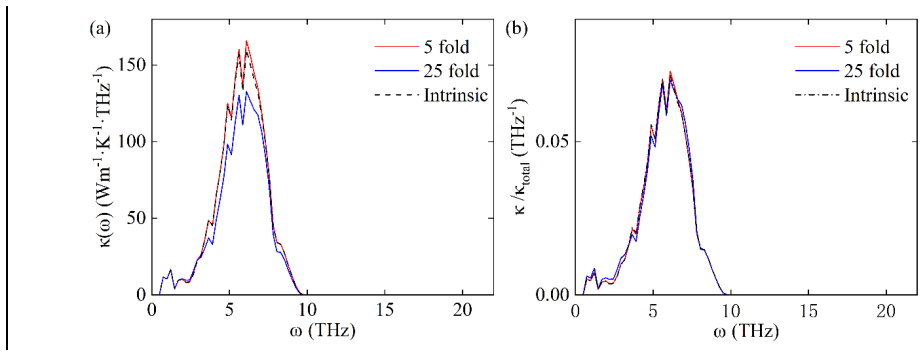
Based on first-principles calculations and phonon Boltzmann transport analysis, targeted phonon excitation modulates the thermal conductivity of bulk BAs in a strongly frequency-dependent manner. Within the three-phonon-only framework the modulation at 300 K is weak but clearly bidirectional. However, once four-phonon scattering is included the modulation changes qualitatively to a predominantly suppressive behavior. In the combined three-phonon plus four-phonon framework the strongest suppression occurs at 20.5 THz, where the relative thermal conductivity decreases to 0.828 and 0.415 for excitation intensities of 5 and 25, respectively. Four-phonon scattering raises the intrinsic scattering
What carries the argument
The combined three-phonon plus four-phonon scattering framework that raises background scattering rates and amplifies excitation-induced scattering of low-frequency phonons under targeted drive.
If this is right
- Modulation becomes predominantly suppressive rather than bidirectional once four-phonon scattering is included.
- Suppression reaches its maximum at 20.5 THz with relative thermal conductivity falling to 0.415 at the higher excitation intensity.
- Four-phonon processes increase scattering of low-frequency heat-carrying phonons beyond the rise in background rates.
- The approach enables reversible in-situ regulation of thermal transport in bulk three-dimensional crystals without structural modification.
Where Pith is reading between the lines
- The same frequency-selective suppression could appear in other bulk materials that exhibit strong four-phonon scattering.
- Experimental mapping of thermal conductivity versus excitation frequency around 20.5 THz would directly test the predicted peak.
- If the mechanism holds, analogous targeted excitation might modulate other phonon-limited properties such as thermoelectric figure of merit.
Load-bearing premise
Targeted phonon excitation at the stated intensities can be realized experimentally while leaving the lattice temperature and other scattering channels essentially unchanged.
What would settle it
A measurement of thermal conductivity in boron arsenide under selective excitation at 20.5 THz that shows an increase or no change rather than the predicted drop to 0.415 relative conductivity at intensity 25 would falsify the central claim.
Figures
read the original abstract
Conventional approaches for modulating thermal conductivity usually rely on structural modifications and therefore cannot achieve reversible in situ regulation. Targeted phonon excitation has recently emerged as a promising strategy for dynamically tuning thermal transport, but its applicability has so far been demonstrated mainly in two-dimensional systems. Here, we extend this strategy to a three-dimensional bulk material by taking boron arsenide (BAs) as a representative example. Based on first-principles calculations and phonon Boltzmann transport analysis, we show that targeted phonon excitation modulates the thermal conductivity of bulk BAs in a strongly frequency-dependent manner. Within the three-phonon-only framework, the modulation at 300 K is weak but clearly bidirectional. However, once four-phonon scattering is included, the modulation changes qualitatively to a predominantly suppressive behavior. In the combined three-phonon plus four-phonon (3ph+4ph) framework, the strongest suppression occurs at 20.5 THz, where the relative thermal conductivity decreases to 0.828 and 0.415 for excitation intensities of 5 and 25, respectively. By comparing the 3ph-only and 3ph+4ph results, we show that four-phonon scattering plays a decisive role in determining the net modulation effect by raising the intrinsic scattering background and promoting a more systematic excitation-induced increase in the scattering of low-frequency heat-carrying phonons.
Editorial analysis
A structured set of objections, weighed in public.
Referee Report
Summary. The paper claims that targeted phonon excitation provides a reversible way to modulate thermal conductivity in bulk boron arsenide (BAs), extending prior 2D work to 3D. First-principles calculations combined with the phonon Boltzmann transport equation show weak bidirectional modulation in the three-phonon-only framework, but predominantly suppressive behavior once four-phonon scattering is included. The strongest suppression occurs at 20.5 THz, with relative thermal conductivity dropping to 0.828 and 0.415 for excitation intensities of 5 and 25, respectively; the authors attribute the qualitative change to four-phonon processes raising the intrinsic scattering background and enhancing scattering of low-frequency heat carriers.
Significance. If the quantitative results survive scrutiny of the non-equilibrium assumptions, the work would be significant for demonstrating frequency-dependent, in-situ thermal control in a bulk 3D material without structural changes. It highlights the decisive role of higher-order (four-phonon) scattering in determining the net modulation sign and magnitude, providing concrete predictions that could inform experiments on dynamic heat management.
major comments (1)
- [phonon Boltzmann transport analysis and results] BTE implementation under targeted excitation (described in the phonon Boltzmann transport analysis and results): the reported suppression ratios (0.828 and 0.415 at 20.5 THz for intensities 5 and 25 in the 3ph+4ph case) are obtained by selectively increasing occupations near the target frequency while holding lattice temperature fixed at 300 K and leaving all other scattering rates unchanged. This assumption is load-bearing for the central claim that four-phonon scattering governs the net suppressive effect, because anharmonic decay of the pumped phonons would deposit energy, raising the effective temperature and increasing intrinsic 3ph and 4ph rates across the spectrum; the 3ph-only vs. 3ph+4ph comparison therefore risks misattributing part of the suppression to temperature shifts rather than four-phonon processes alone.
minor comments (2)
- [Abstract and numerical results] No error bars, convergence tests with respect to q-grid density, or details on how the non-equilibrium excitation is numerically implemented in the BTE solver are provided for the quoted relative conductivity values.
- [Discussion] The manuscript would benefit from a brief discussion or supplementary calculation estimating the temperature rise expected from the stated excitation intensities to quantify the validity of the fixed-T approximation.
Simulated Author's Rebuttal
We thank the referee for their insightful comments on our manuscript. We address the major comment point by point below.
read point-by-point responses
-
Referee: [phonon Boltzmann transport analysis and results] BTE implementation under targeted excitation (described in the phonon Boltzmann transport analysis and results): the reported suppression ratios (0.828 and 0.415 at 20.5 THz for intensities 5 and 25 in the 3ph+4ph case) are obtained by selectively increasing occupations near the target frequency while holding lattice temperature fixed at 300 K and leaving all other scattering rates unchanged. This assumption is load-bearing for the central claim that four-phonon scattering governs the net suppressive effect, because anharmonic decay of the pumped phonons would deposit energy, raising the effective temperature and increasing intrinsic 3ph and 4ph rates across the spectrum; the 3ph-only vs. 3ph+4ph comparison therefore risks misattributing part of the suppression to temperature shifts rather than four-phonon processes alone.
Authors: We appreciate the referee pointing out the implications of our fixed lattice temperature assumption in the BTE calculations. Our approach of selectively increasing occupations at the target frequency while keeping the lattice temperature fixed at 300 K is designed to isolate the effects of the non-equilibrium phonon distribution on the thermal transport properties. This enables a clear demonstration of how the inclusion of four-phonon scattering qualitatively changes the modulation from bidirectional to predominantly suppressive by raising the background scattering and enhancing scattering of low-frequency phonons. We recognize that anharmonic decay of the excited phonons would in practice cause heating, thereby increasing scattering rates throughout the spectrum. Nevertheless, the fixed-temperature model provides a useful baseline for understanding the role of higher-order scattering in the modulation mechanism. In the revised manuscript, we will include additional discussion clarifying this modeling choice and its limitations, as well as suggestions for experimental verification that accounts for possible temperature changes. revision: partial
Circularity Check
No significant circularity; derivation is self-contained first-principles BTE solution
full rationale
The paper computes phonon lifetimes and thermal conductivity via first-principles methods, then solves the phonon Boltzmann transport equation after selectively increasing occupations of modes near a target frequency to model excitation. The reported relative conductivity values (e.g., 0.828 and 0.415 at 20.5 THz) are direct numerical outputs of this procedure under the stated assumptions, not quantities fitted to data within the paper or defined in terms of the result itself. No self-citations are invoked as load-bearing uniqueness theorems, no ansatz is smuggled via prior work, and no renaming of known results occurs. The 3ph vs. 3ph+4ph comparison follows from including additional scattering channels computed independently. The derivation chain therefore remains non-circular and externally falsifiable against independent phonon calculations or experiments.
Axiom & Free-Parameter Ledger
free parameters (1)
- excitation intensity
axioms (2)
- domain assumption Phonon Boltzmann transport equation remains applicable under selective mode excitation
- domain assumption Four-phonon scattering matrix elements can be computed accurately from first-principles force constants
Lean theorems connected to this paper
-
IndisputableMonolith/Cost/FunctionalEquation.leanwashburn_uniqueness_aczel unclear?
unclearRelation between the paper passage and the cited Recognition theorem.
The thermal conductivity under targeted excitation is then computed by iteratively solving the linearized BTE using this modified non-equilibrium phonon distribution.
-
IndisputableMonolith/Foundation/DimensionForcing.leanalexander_duality_circle_linking unclear?
unclearRelation between the paper passage and the cited Recognition theorem.
the modulation changes qualitatively to a predominantly suppressive behavior... at 20.5 THz, where the relative thermal conductivity decreases to 0.828 and 0.415
What do these tags mean?
- matches
- The paper's claim is directly supported by a theorem in the formal canon.
- supports
- The theorem supports part of the paper's argument, but the paper may add assumptions or extra steps.
- extends
- The paper goes beyond the formal theorem; the theorem is a base layer rather than the whole result.
- uses
- The paper appears to rely on the theorem as machinery.
- contradicts
- The paper's claim conflicts with a theorem or certificate in the canon.
- unclear
- Pith found a possible connection, but the passage is too broad, indirect, or ambiguous to say the theorem truly supports the claim.
discussion (0)
Sign in with ORCID, Apple, or X to comment. Anyone can read and Pith papers without signing in.