Unsupervised Causal Abstractions Discovery
Pith reviewed 2026-06-26 20:43 UTC · model grok-4.3
The pith
Observations generated by a low-rank graph induce latents that form a causal abstraction.
A machine-rendered reading of the paper's core claim, the machinery that carries it, and where it could break.
Core claim
The paper claims that observations generated by a low-rank graph induce latents that form a causal abstraction, provides identifiability results about these latents, and proposes a practical objective to learn the high-level SCM from low-level measurements.
What carries the argument
The low-rank graph structure, which generates observations whose induced latents form a causal abstraction of the low-level system.
If this is right
- High-level structural causal models can be learned directly from low-level data without expert-proposed candidates.
- The induced latents are identifiable under the low-rank graph assumption.
- A practical objective exists for recovering the high-level model in an unsupervised manner.
Where Pith is reading between the lines
- This approach might enable automated abstraction discovery in domains such as biology or social sciences where manual hypothesis generation is expensive.
- Integration with neural representation learning could extend the method to high-dimensional data while preserving causal semantics.
- Relaxing the low-rank condition to other structured graph families could broaden applicability if similar induction properties hold.
Load-bearing premise
The low-level system must be generated according to a low-rank graph structure.
What would settle it
Generating observations from a causal graph that lacks low-rank structure and checking whether the induced latents still form a valid causal abstraction would test the claim; failure to form an abstraction would support the necessity of the low-rank condition.
Figures

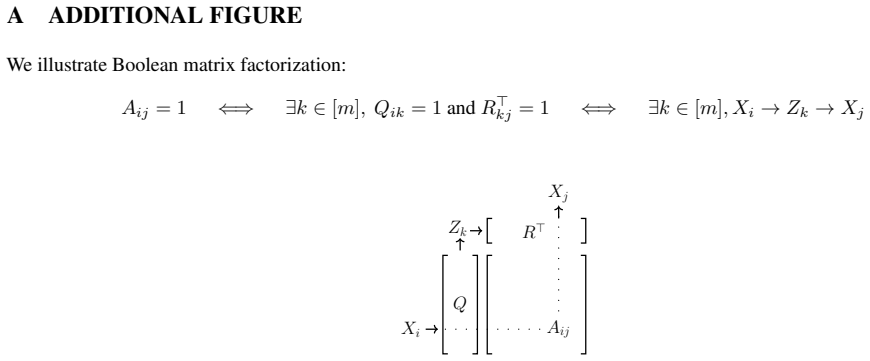
read the original abstract
Causal abstractions formalize when a high-level structural causal model (SCM) captures the interventional behavior of a lower-level SCM. Existing applications of this notion largely follow a hypothesis-testing paradigm: an expert proposes a candidate high-level model and then evaluates if the low-level system implements it. We study the complementary problem of learning a high-level model directly from low-level measurements. Our contributions leverage hypotheses from low-rank causal discovery, and can be summarized as follows: (1) we show that observations generated by a low-rank graph induce latents that form a causal abstraction, (2) we provide identifiability results about these latents, and (3) we propose a practical objective to learn this high-level SCM.
Editorial analysis
A structured set of objections, weighed in public.
Referee Report
Summary. The manuscript addresses unsupervised discovery of causal abstractions. It claims that observations generated by a low-rank graph induce latents forming a causal abstraction of the low-level system, establishes identifiability results for these latents, and proposes a practical objective for learning the corresponding high-level SCM, all by leveraging hypotheses from low-rank causal discovery.
Significance. If the identifiability results hold under the stated low-rank assumption, the work would provide a data-driven route to high-level causal models without expert-proposed candidates, extending causal discovery into the abstraction setting. The explicit leverage of low-rank graph structure as a hypothesis (rather than a derived claim) is a clear strength.
minor comments (1)
- [Abstract] Abstract: the three listed contributions are stated at a high level; the main text should include an early, self-contained statement of the precise conditions under which the induced latents are identifiable (e.g., rank assumptions, observational vs. interventional data).
Simulated Author's Rebuttal
We thank the referee for their positive assessment of our work on unsupervised causal abstractions discovery and for recommending minor revision. We appreciate the recognition that our identifiability results, if they hold under the low-rank assumption, offer a data-driven approach to high-level causal models.
Circularity Check
No significant circularity
full rationale
The paper's main claims rest on external hypotheses from low-rank causal discovery literature rather than any self-referential definition, fitted parameter renamed as prediction, or load-bearing self-citation chain. The abstract explicitly positions the low-rank graph structure as a leveraged assumption, not something derived or fitted within the paper. No equations or steps in the provided text reduce the claimed induction of causal abstractions or identifiability results to the inputs by construction. This is the normal case of a self-contained derivation against external benchmarks.
Axiom & Free-Parameter Ledger
axioms (1)
- domain assumption Low-level observations are generated by a low-rank graph structure
Reference graph
Works this paper leans on
-
[1]
Algebraic Priors for Approximately Equivariant Networks
Parameter-Free Approximate Equivariance for Tasks with Finite Group Symmetry , author =. 2025 , month = jun, number =. doi:10.48550/arXiv.2506.08244 , urldate =. arXiv , keywords =:2506.08244 , primaryclass =
work page internal anchor Pith review Pith/arXiv arXiv doi:10.48550/arxiv.2506.08244 2025
-
[2]
Arjovsky, Martin and Bottou, L. Invariant. 2020 , month = mar, number =. doi:10.48550/arXiv.1907.02893 , urldate =. arXiv , keywords =:1907.02893 , primaryclass =
work page internal anchor Pith review Pith/arXiv arXiv doi:10.48550/arxiv.1907.02893 2020
-
[3]
Battiloro, Claudio and Karaismailo. E(n). 2025 , month = feb, number =. doi:10.48550/arXiv.2405.15429 , urldate =. arXiv , keywords =:2405.15429 , primaryclass =
-
[4]
Proceedings of the aaai conference on artificial intelligence , volume=
Abstracting causal models , author=. Proceedings of the aaai conference on artificial intelligence , volume=
-
[5]
Bengio, Yoshua and Deleu, Tristan and Rahaman, Nasim and Ke, Rosemary and Lachapelle, S. A. 2019 , month = feb, number =. doi:10.48550/arXiv.1901.10912 , urldate =. arXiv , keywords =:1901.10912 , primaryclass =
work page internal anchor Pith review Pith/arXiv arXiv doi:10.48550/arxiv.1901.10912 2019
-
[6]
Brown, Noam and Lerer, Adam and Gross, Sam and Sandholm, Tuomas , year =. Deep. doi:10.48550/arXiv.1811.00164 , urldate =. arXiv , keywords =:1811.00164 , primaryclass =
work page internal anchor Pith review Pith/arXiv arXiv doi:10.48550/arxiv.1811.00164
-
[7]
Learning
Buchholz, Simon and Rajendran, Goutham and Rosenfeld, Elan and Aragam, Bryon and Sch. Learning
-
[8]
Cadei, Riccardo and Demirel, Ilker and Bartolomeis, Piersilvio De and Lindorfer, Lukas and Cremer, Sylvia and Schmid, Cordelia and Locatello, Francesco , year =. Causal. doi:10.48550/arXiv.2502.06343 , urldate =. arXiv , langid =:2502.06343 , primaryclass =
-
[9]
Causal Feature Learning: An Overview , shorttitle =
Chalupka, Krzysztof and Eberhardt, Frederick and Perona, Pietro , year =. Causal Feature Learning: An Overview , shorttitle =. Behaviormetrika , volume =. doi:10.1007/s41237-016-0008-2 , urldate =
-
[10]
Artificial intelligence and statistics , pages=
Multi-level cause-effect systems , author=. Artificial intelligence and statistics , pages=. 2016 , organization=
2016
-
[11]
Chen, Siyi and Zhang, Huijie and Guo, Minzhe and Lu, Yifu and Wang, Peng and Qu, Qing , year =. Exploring. doi:10.48550/arXiv.2409.02374 , urldate =. arXiv , keywords =:2409.02374 , primaryclass =
-
[12]
Chen, Haolin and Feng, Yihao and Liu, Zuxin and Yao, Weiran and Prabhakar, Akshara and Heinecke, Shelby and Ho, Ricky and Mui, Phil and Savarese, Silvio and Xiong, Caiming and Wang, Huan , year =. Language. doi:10.48550/arXiv.2411.04282 , urldate =. arXiv , keywords =:2411.04282 , primaryclass =
-
[13]
Conreux, Louis and Soulaire, Tom , abstract =. The
-
[14]
Cui, Jingyi and Wen, Hongwei and Wang, Yisen , year =. An. doi:10.48550/arXiv.2505.22196 , urldate =. arXiv , keywords =:2505.22196 , primaryclass =
-
[15]
Cunningham, Hoagy and Ewart, Aidan and Riggs, Logan and Huben, Robert and Sharkey, Lee , year =. Sparse. doi:10.48550/arXiv.2309.08600 , urldate =. arXiv , keywords =:2309.08600 , primaryclass =
work page internal anchor Pith review Pith/arXiv arXiv doi:10.48550/arxiv.2309.08600
-
[16]
Daunhawer, Imant and Bizeul, Alice and Palumbo, Emanuele and Marx, Alexander and Vogt, Julia E. , year =. Identifiability. doi:10.48550/arXiv.2303.09166 , urldate =. arXiv , langid =:2303.09166 , primaryclass =
-
[17]
ACM Transactions on Knowledge Discovery from Data (TKDD) , volume=
Factorization of binary matrices: Rank relations, uniqueness and model selection of boolean decomposition , author=. ACM Transactions on Knowledge Discovery from Data (TKDD) , volume=. 2022 , publisher=
2022
-
[18]
Eastwood, Cian and Robey, Alexander and Singh, Shashank and von K. Probable. 2023 , month = aug, number =. doi:10.48550/arXiv.2207.09944 , urldate =. arXiv , keywords =:2207.09944 , primaryclass =
-
[19]
Learning to Estimate Sample-Specific Transcriptional Networks for 7,000 Tumors , author =. 2025 , month = may, journal =. doi:10.1073/pnas.2411930122 , urldate =
-
[20]
Friedman, Dan and Dieng, Adji Bousso , abstract =. The
-
[21]
Learning Disentangled Representations via Product Manifold Projection , author =. 2021 , month = oct, number =. doi:10.48550/arXiv.2103.01638 , urldate =. arXiv , keywords =:2103.01638 , primaryclass =
-
[22]
G. On. 2022 , month = sep, urldate =
2022
-
[23]
Gat, Itai and Remez, Tal and Shaul, Neta and Kreuk, Felix and Chen, Ricky T. Q. and Synnaeve, Gabriel and Adi, Yossi and Lipman, Yaron , year =. Discrete. doi:10.48550/arXiv.2407.15595 , urldate =. arXiv , keywords =:2407.15595 , primaryclass =
-
[24]
Advances in neural information processing systems , volume=
Causal abstractions of neural networks , author=. Advances in neural information processing systems , volume=
-
[25]
Journal of Machine Learning Research , volume=
Causal abstraction: A theoretical foundation for mechanistic interpretability , author=. Journal of Machine Learning Research , volume=
-
[26]
Causal Learning and Reasoning , pages=
Finding alignments between interpretable causal variables and distributed neural representations , author=. Causal Learning and Reasoning , pages=. 2024 , organization=
2024
-
[27]
Ghosh, Shubhangi and Gresele, Luigi and von K. Independent. 2023 , month = dec, number =. doi:10.48550/arXiv.2312.13438 , urldate =. arXiv , langid =:2312.13438 , primaryclass =
-
[28]
Independent Mechanism Analysis, a New Concept? , author =. 2022 , month = feb, number =. doi:10.48550/arXiv.2106.05200 , urldate =. arXiv , langid =:2106.05200 , primaryclass =
-
[29]
Guo, Zihao and Willis, Richard and Shi, Shuqing and Tomilin, Tristan and Leibo, Joel Z. and Du, Yali , year =. doi:10.48550/arXiv.2503.14576 , urldate =. arXiv , keywords =:2503.14576 , primaryclass =
-
[30]
Towards a Definition of Disentangled Representations
Higgins, Irina and Amos, David and Pfau, David and Racaniere, Sebastien and Matthey, Loic and Rezende, Danilo and Lerchner, Alexander , year =. Towards a. doi:10.48550/arXiv.1812.02230 , urldate =. arXiv , keywords =:1812.02230 , primaryclass =
work page internal anchor Pith review Pith/arXiv arXiv doi:10.48550/arxiv.1812.02230
-
[31]
Amortizing intractable inference in large language models.arXiv preprint arXiv:2310.04363, 2023
Amortizing Intractable Inference in Large Language Models , author =. 2024 , month = mar, number =. doi:10.48550/arXiv.2310.04363 , urldate =. arXiv , keywords =:2310.04363 , primaryclass =
-
[32]
Huang, Wei and Han, Andi and Chen, Yongqiang and Cao, Yuan and Xu, Zhiqiang and Suzuki, Taiji , abstract =. On the
-
[33]
doi:10.48550/arXiv.2401.06781 , urldate =
Huang, Chenghao and Cao, Yanbo and Wen, Yinlong and Zhou, Tao and Zhang, Yanru , year =. doi:10.48550/arXiv.2401.06781 , urldate =. arXiv , langid =:2401.06781 , primaryclass =
-
[34]
Normality and Actual Causal Strength , author =. 2017 , month = apr, journal =. doi:10.1016/j.cognition.2017.01.010 , urldate =
-
[35]
What Is Causal about Causal Models and Representations? , author =. 2025 , month = feb, number =. doi:10.48550/arXiv.2501.19335 , urldate =. arXiv , langid =:2501.19335 , primaryclass =
-
[36]
An Analytic Theory of Creativity in Convolutional Diffusion Models , author =. 2025 , month = jun, number =. doi:10.48550/arXiv.2412.20292 , urldate =. arXiv , langid =:2412.20292 , primaryclass =
-
[37]
Learning to induce causal structure.arXiv preprint arXiv:2204.04875, 2022
Ke, Nan Rosemary and Chiappa, Silvia and Wang, Jane and Goyal, Anirudh and Bornschein, Jorg and Rey, Melanie and Weber, Theophane and Botvinic, Matthew and Mozer, Michael and Rezende, Danilo Jimenez , year =. Learning to. doi:10.48550/arXiv.2204.04875 , urldate =. arXiv , keywords =:2204.04875 , primaryclass =
-
[38]
Kempf, Elias and Schrodi, Simon and Argus, Max and Brox, Thomas , year =. When and. doi:10.48550/arXiv.2502.09507 , urldate =. arXiv , keywords =:2502.09507 , primaryclass =
-
[39]
Kim, Hyunsu and Lee, Hyungi and Yang, Hongseok and Lee, Juho , year =. Regularizing. doi:10.48550/arXiv.2306.00356 , urldate =. arXiv , keywords =:2306.00356 , primaryclass =
-
[40]
Krueger, David and Caballero, Ethan and Jacobsen, Joern-Henrik and Zhang, Amy and Binas, Jonathan and Zhang, Dinghuai and Priol, Remi Le and Courville, Aaron , year =. Out-of-. doi:10.48550/arXiv.2003.00688 , urldate =. arXiv , keywords =:2003.00688 , primaryclass =
-
[41]
Lachapelle, S. Synergies between. 2023 , month = jun, number =. doi:10.48550/arXiv.2211.14666 , urldate =. arXiv , keywords =:2211.14666 , primaryclass =
-
[42]
Langlais, Pierre-Carl and Chizhov, Pavel and Nee, Mattia and Hinostroza, Carlos Rosas and Girard, Ir. Even
-
[43]
Learning to Estimate Sample-Specific Transcriptional Networks for 7,000 Tumors , doi =
-
[44]
Multi-agent Reinforcement Learning in Sequential Social Dilemmas
Leibo, Joel Z. and Zambaldi, Vinicius and Lanctot, Marc and Marecki, Janusz and Graepel, Thore , year =. Multi-Agent. doi:10.48550/arXiv.1702.03037 , urldate =. arXiv , keywords =:1702.03037 , primaryclass =
work page internal anchor Pith review Pith/arXiv arXiv doi:10.48550/arxiv.1702.03037
-
[45]
Lei, Anson and Sch. 2024 , month = nov, number =. doi:10.48550/arXiv.2411.06890 , urldate =. arXiv , keywords =:2411.06890 , primaryclass =
-
[46]
Lin, Yuchao and Helwig, Jacob and Gui, Shurui and Ji, Shuiwang , year =. Equivariance via. doi:10.48550/arXiv.2406.07598 , urldate =. arXiv , keywords =:2406.07598 , primaryclass =
-
[47]
Lipman, Yaron and Havasi, Marton and Holderrieth, Peter and Shaul, Neta and Le, Matt and Karrer, Brian and Chen, Ricky T. Q. and. Flow. 2024 , month = dec, number =. doi:10.48550/arXiv.2412.06264 , urldate =. arXiv , keywords =:2412.06264 , primaryclass =
work page internal anchor Pith review Pith/arXiv arXiv doi:10.48550/arxiv.2412.06264 2024
-
[48]
Challenging Common Assumptions in the Unsupervised Learning of Disentangled Representations
Locatello, Francesco and Bauer, Stefan and Lucic, Mario and R. Challenging. 2019 , month = jun, number =. doi:10.48550/arXiv.1811.12359 , urldate =. arXiv , langid =:1811.12359 , primaryclass =
work page internal anchor Pith review Pith/arXiv arXiv doi:10.48550/arxiv.1811.12359 2019
-
[49]
Advances in Neural Information Processing Systems , volume=
Large-scale differentiable causal discovery of factor graphs , author=. Advances in Neural Information Processing Systems , volume=
-
[50]
Lorch, Lars and Sussex, Scott and Rothfuss, Jonas and Krause, Andreas and Sch. Amortized. 2022 , month = dec, number =. doi:10.48550/arXiv.2205.12934 , urldate =. arXiv , keywords =:2205.12934 , primaryclass =
-
[51]
Mahajan, Divyat and Pezeshki, Mohammad and Arnal, Charles and Mitliagkas, Ioannis and Ahuja, Kartik and Vincent, Pascal , year =. Compositional. doi:10.48550/arXiv.2410.06303 , urldate =. arXiv , langid =:2410.06303 , primaryclass =
-
[52]
Maurer, Andreas and Pontil, Massimiliano and. The. 2016 , month = mar, number =. doi:10.48550/arXiv.1505.06279 , urldate =. arXiv , keywords =:1505.06279 , primaryclass =
work page internal anchor Pith review Pith/arXiv arXiv doi:10.48550/arxiv.1505.06279 2016
-
[53]
Signal Processing , volume=
Boolean decomposition of binary matrices using a post-nonlinear mixture approach , author=. Signal Processing , volume=. 2021 , publisher=
2021
-
[54]
Neller, Todd W and Lanctot, Marc , langid =. An
-
[55]
Learning Explanations That Are Hard to Vary , author =. 2020 , month = oct, number =. doi:10.48550/arXiv.2009.00329 , urldate =. arXiv , langid =:2009.00329 , primaryclass =
-
[56]
Park, Core Francisco and Okawa, Maya and Lee, Andrew and Tanaka, Hidenori and Lubana, Ekdeep Singh , year =. Emergence of. doi:10.48550/arXiv.2406.19370 , urldate =. arXiv , keywords =:2406.19370 , primaryclass =
-
[57]
Pouget, Ang. Suitability. 2025 , month = may, number =. doi:10.48550/arXiv.2505.22356 , urldate =. arXiv , keywords =:2505.22356 , primaryclass =
-
[58]
Priol, R. An. 2021 , month = feb, number =. doi:10.48550/arXiv.2005.09136 , urldate =. arXiv , langid =:2005.09136 , primaryclass =
-
[59]
and Balestriero, Randall and Brendel, Wieland and Klindt, David , year =
Reizinger, Patrik and Bizeul, Alice and Juhos, Attila and Vogt, Julia E. and Balestriero, Randall and Brendel, Wieland and Klindt, David , year =. Cross-. doi:10.48550/arXiv.2410.21869 , urldate =. arXiv , keywords =:2410.21869 , primaryclass =
-
[60]
Decision-
Reyes, Emilio , abstract =. Decision-
-
[61]
Roeder, Geoffrey and Metz, Luke and Kingma, Diederik P. , year =. On. doi:10.48550/arXiv.2007.00810 , urldate =. arXiv , keywords =:2007.00810 , primaryclass =
-
[62]
Scherrer, Nino and Goyal, Anirudh and Bauer, Stefan and Bengio, Yoshua and Ke, Nan Rosemary , year =. On the. doi:10.48550/arXiv.2206.04620 , urldate =. arXiv , keywords =:2206.04620 , primaryclass =
-
[63]
Senellart, Agathe and Allassonni. Bridging the Inference Gap in. 2025 , month = feb, number =. doi:10.48550/arXiv.2502.03952 , urldate =. arXiv , keywords =:2502.03952 , primaryclass =
-
[64]
Shafer, Glenn and Kogan, Alex and Spirtes, Peter , langid =. A
-
[65]
Sim, Aaron and Wiatrak, Maciej and Brayne, Angus and Creed, P. Directed. 2021 , month = jun, number =. doi:10.48550/arXiv.2106.08678 , urldate =. arXiv , langid =:2106.08678 , primaryclass =
-
[66]
and Knutins, Maksis and Ziyin, Liu and Geisz, Daniel and Fetterman, Abraham J
Simon, James B. and Knutins, Maksis and Ziyin, Liu and Geisz, Daniel and Fetterman, Abraham J. and Albrecht, Joshua , year =. On the. doi:10.48550/arXiv.2303.15438 , urldate =. arXiv , langid =:2303.15438 , primaryclass =
-
[67]
Anderson and Sebe, Nicu and Welling, Max , year =
Song, Yue and Keller, T. Anderson and Sebe, Nicu and Welling, Max , year =. Flow. doi:10.48550/arXiv.2309.13167 , urldate =. arXiv , keywords =:2309.13167 , primaryclass =
-
[68]
Soudry, Daniel and Hoffer, Elad and Nacson, Mor Shpigel and Gunasekar, Suriya and Srebro, Nathan , year =. The. doi:10.48550/arXiv.1710.10345 , urldate =. arXiv , keywords =:1710.10345 , primaryclass =
-
[69]
Squires, Chandler and Yun, Annie and Nichani, Eshaan and Agrawal, Raj and Uhler, Caroline , year =. Causal. doi:10.48550/arXiv.2207.01237 , urldate =. arXiv , keywords =:2207.01237 , primaryclass =
-
[70]
Syrota, Stas and Zainchkovskyy, Yevgen and Xi, Johnny and. Identifying. 2025 , month = may, number =. doi:10.48550/arXiv.2502.13757 , urldate =. arXiv , keywords =:2502.13757 , primaryclass =
-
[71]
Vafidis, Pantelis and Bhargava, Aman and Rangel, Antonio , year =. Disentangling. doi:10.48550/arXiv.2407.11249 , urldate =. arXiv , langid =:2407.11249 , primaryclass =
-
[72]
Wang, Qizhou and Lin, Yong and Chen, Yongqiang and Schmidt, Ludwig and Han, Bo and Zhang, Tong , year =. A. doi:10.48550/arXiv.2403.11497 , urldate =. arXiv , langid =:2403.11497 , primaryclass =
-
[73]
Wildberger, Jonas and Guo, Siyuan and Bhattacharyya, Arnab and Sch. On the. 2023 , month = feb, journal =
2023
-
[74]
Xi, Johnny and Osea, Jana and Xu, Zuheng and Hartford, Jason , year =. Propensity. doi:10.48550/arXiv.2404.01595 , urldate =. arXiv , keywords =:2404.01595 , primaryclass =
-
[75]
Xu, Hengyuan and Xiang, Liyao and Ye, Hangyu and Yao, Dixi and Chu, Pengzhi and Li, Baochun , year =. Permutation. doi:10.48550/arXiv.2304.07735 , urldate =. arXiv , keywords =:2304.07735 , primaryclass =
-
[77]
Yao, Dingling and Muller, Caroline and Locatello, Francesco , year =. Marrying. doi:10.48550/arXiv.2405.13888 , urldate =. arXiv , langid =:2405.13888 , primaryclass =
-
[78]
Yao, Dingling and Xu, Danru and Lachapelle, S. Multi-. 2024 , month = mar, number =. doi:10.48550/arXiv.2311.04056 , urldate =. arXiv , langid =:2311.04056 , primaryclass =
-
[79]
Yao, Dingling and Huang, Shimeng and Cadei, Riccardo and Zhang, Kun and Locatello, Francesco , year =. The. doi:10.48550/arXiv.2505.17708 , urldate =. arXiv , langid =:2505.17708 , primaryclass =
-
[80]
Yao, Dingling and Rancati, Dario and Cadei, Riccardo and Fumero, Marco and Locatello, Francesco , year =. Unifying. doi:10.48550/arXiv.2409.02772 , urldate =. arXiv , keywords =:2409.02772 , primaryclass =
-
[81]
Yu, Haizi and Mineyev, Igor , abstract =. A
discussion (0)
Sign in with ORCID, Apple, or X to comment. Anyone can read and Pith papers without signing in.