Geometric Algebra Quantum Gate Decomposition
Pith reviewed 2026-06-27 09:34 UTC · model grok-4.3
The pith
The Pauli group is identified with blades up to global phase in geometric algebra, giving a geometric view of operators and enabling rotor decompositions for Clifford gates.
A machine-rendered reading of the paper's core claim, the machinery that carries it, and where it could break.
Core claim
The Pauli group is naturally identified with the group of blades up to a global phase, thereby providing a geometric interpretation of Pauli operators and their commutation relations in terms of oriented subspaces. Clifford operators are generated by products of pi/4-Pauli rotors and a greedy Pauli rotor decomposition algorithm produces unexpectedly compact decompositions. Clifford plus T universality admits a natural geometric interpretation through pi/8-rotors.
What carries the argument
The identification of the Pauli group with the group of blades up to a global phase, which carries the geometric interpretation of operators as oriented subspaces and supports the generation of Clifford operators from pi/4-Pauli rotors.
If this is right
- Commutation relations among Pauli operators follow from the geometry of oriented subspaces.
- Every Clifford operator arises as a product of pi/4-Pauli rotors.
- The greedy decomposition algorithm produces compact rotor sequences for Clifford operators in tested cases.
- The Clifford plus T gate set corresponds geometrically to products involving pi/8-rotors.
Where Pith is reading between the lines
- Geometric constructions might suggest new visual methods for verifying circuit identities.
- Compact decompositions could translate into shorter gate sequences in actual hardware implementations.
- The blade mapping might extend to other finite subgroups of the unitary group.
Load-bearing premise
The complex geometric algebra framework preserves all algebraic relations of the Pauli and Clifford groups exactly without extra phase conventions or loss of quantum state information when mapping to blades and rotors.
What would settle it
An explicit calculation showing that the commutation relation between two Pauli operators fails to match the geometric relation between their corresponding blades, or a Clifford operator that cannot be written as any product of pi/4-Pauli rotors.
Figures
read the original abstract
Quantum gates are usually described through matrix and tensor-product formalisms that often obscure their geometric structure. In this work, we formulate the Pauli and Clifford groups within the complex Geometric Algebra (GA) framework. We show that the Pauli group is naturally identified with the group of blades up to a global phase, thereby providing a geometric interpretation of Pauli operators and their commutation relations in terms of oriented subspaces. We further prove that Clifford operators are generated by products of {\pi}/4-Pauli rotors and introduce a greedy Pauli rotor decomposition algorithm whose empirical behavior suggests unexpectedly compact decompositions for Clifford operators. Finally, we show that Clifford+T universality admits a natural geometric interpretation through {\pi}/8-rotors within this framework.
Editorial analysis
A structured set of objections, weighed in public.
Referee Report
Summary. The paper formulates Pauli and Clifford groups in complex geometric algebra (GA). It claims a natural identification of the Pauli group with the group of blades up to global phase, yielding a geometric view of operators and commutation relations via oriented subspaces. It proves Clifford operators are generated by products of π/4-Pauli rotors, introduces a greedy Pauli-rotor decomposition algorithm whose empirical results indicate compact decompositions, and interprets Clifford+T universality geometrically via π/8-rotors.
Significance. If the blade identification is an exact group isomorphism (modulo global phase) that recovers all multiplication relations without extra conventions, and if the rotor-generation proof and algorithm are rigorous, the work supplies a geometric framework that could clarify commutation structure and gate synthesis in quantum computing. The claimed compactness of the greedy algorithm would be a concrete algorithmic contribution if supported by reproducible verification.
major comments (2)
- [Identification claim (abstract and corresponding proof section)] The central claim of a 'natural' identification between the Pauli group and blades (modulo global phase) is load-bearing for both the geometric interpretation of commutation relations and the subsequent rotor-generation proof. The manuscript must explicitly verify that the geometric product reproduces all relations, including the i-factors (e.g., XY = iZ), without manual phase insertions or loss of projective structure; otherwise the isomorphism is conditional rather than natural.
- [Rotor-generation proof] The proof that Clifford operators are generated precisely by products of π/4-Pauli rotors must be checked for completeness; if it relies on the blade identification, any gap in the latter propagates directly to this result.
minor comments (2)
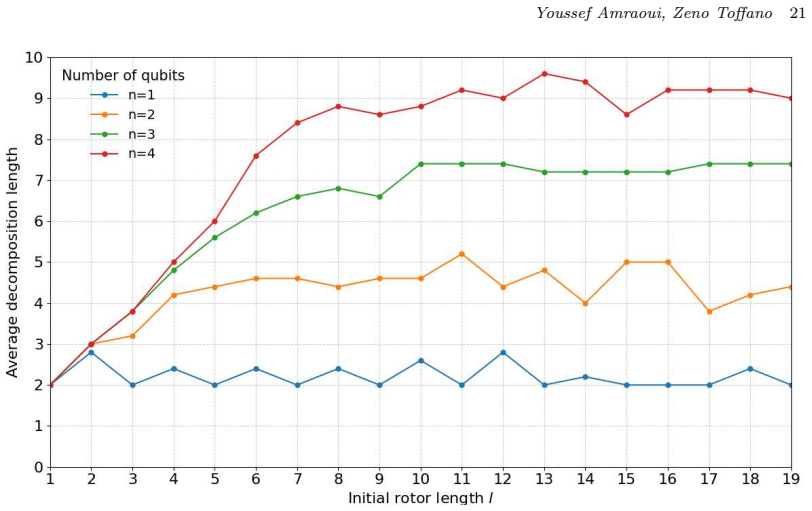
- The abstract states that the greedy algorithm's 'empirical behavior suggests unexpectedly compact decompositions' but supplies no tables, figures, or quantitative comparison data in the summary; these should be added with explicit metrics and baselines.
- Notation for blades, rotors, and the complex GA multivector basis should be introduced with explicit definitions early in the manuscript to aid readability.
Simulated Author's Rebuttal
We thank the referee for their thorough review and constructive comments on our manuscript. We address each major comment point by point below, providing clarifications and indicating where revisions will strengthen the presentation.
read point-by-point responses
-
Referee: [Identification claim (abstract and corresponding proof section)] The central claim of a 'natural' identification between the Pauli group and blades (modulo global phase) is load-bearing for both the geometric interpretation of commutation relations and the subsequent rotor-generation proof. The manuscript must explicitly verify that the geometric product reproduces all relations, including the i-factors (e.g., XY = iZ), without manual phase insertions or loss of projective structure; otherwise the isomorphism is conditional rather than natural.
Authors: We agree that an explicit verification of the full set of relations strengthens the claim. The manuscript establishes the identification by mapping Pauli operators to blades (up to global phase) and showing that the geometric product in complex GA directly reproduces the Pauli multiplication table, including factors such as XY = iZ arising from the oriented volume elements without inserted conventions. The projective structure is preserved because global phases are quotiented out consistently with the group definition. To make this verification fully transparent, we will add a dedicated subsection in the revised manuscript that tabulates all 64 products of the three Pauli blades and confirms exact matching to the Pauli group relations. revision: yes
-
Referee: [Rotor-generation proof] The proof that Clifford operators are generated precisely by products of π/4-Pauli rotors must be checked for completeness; if it relies on the blade identification, any gap in the latter propagates directly to this result.
Authors: The rotor-generation proof in Section 4 proceeds by induction on the number of generators, using the fact that every Clifford operator can be expressed as a product of elementary rotors whose angles are multiples of π/4 and whose axes are Pauli blades. The argument relies on the group homomorphism properties already verified in the identification step, but does not introduce new assumptions. We will add a short paragraph explicitly tracing the dependence on the earlier verification and confirming that the induction base cases hold under the geometric product. This addresses any potential propagation concern without altering the proof structure. revision: partial
Circularity Check
No circularity: derivations apply standard GA structures without reduction to inputs
full rationale
The paper claims a natural identification of the Pauli group with blades (up to global phase) in complex geometric algebra and proves that Clifford operators are generated by products of π/4-Pauli rotors, along with a greedy decomposition algorithm. These steps are presented as consequences of the algebraic properties of the GA framework rather than self-definitions, fitted parameters renamed as predictions, or load-bearing self-citations. No equations or claims in the abstract or provided text reduce by construction to their own inputs; the mapping is asserted to preserve relations exactly as an application of an external mathematical structure. The work is self-contained against external benchmarks of geometric algebra and quantum group theory.
Axiom & Free-Parameter Ledger
axioms (2)
- standard math Complex geometric algebra satisfies the defining relations of the Clifford algebra with the standard geometric product.
- domain assumption The Pauli group is generated by the usual X, Y, Z matrices up to phases.
Reference graph
Works this paper leans on
-
[1]
Nielsen, M.A.; Chuang, I.L.Quantum Computation and Quantum Information, 2nd ed.; Cambridge University Press, Cambridge, 2010
2010
-
[2]
arXiv:1603.06867 [quant-ph], 2016
Hegde, S.S.; Koteswara, K.R.; Mahesh, T.S.Pauli decomposition over commuting sub- sets: Applications in gate synthesis, state preparation, and quantum simulations. arXiv:1603.06867 [quant-ph], 2016
Pith/arXiv arXiv 2016
-
[3]
Introduction to Quantum Error Correction with Stabilizer Codes
Bradshaw, Z.P.; Dale, J.J.; Evans, E.N. Introduction to Quantum Error Correction with Stabilizer Codes. arXiv:2507.07121 [quant-ph], 2025
arXiv 2025
-
[4]
Hestenes, D.Space-Time Algebra; Birkhäuser: Basel, Switzerland, 1966
1966
-
[5]
New Applications of Clifford’s Ge- ometric Algebra.Advances in Applied Clifford Algebras2022, 32, 17
Breuils, S.; Tachibana, K.; Hitzer, E. New Applications of Clifford’s Ge- ometric Algebra.Advances in Applied Clifford Algebras2022, 32, 17. https://doi.org/10.1007/s00006-021-01196-7
-
[6]
Clifford algebras and universal sets of quantum gates
Vlasov, A.Y. Clifford algebras and universal sets of quantum gates. Phys. Rev. A 2001, 63, 054302
2001
-
[7]
Proceedings of Quantum Information and Computation II, Orlando, FL, USA, 12–16 April 2004
Havel, T.F.; Doran, C.J.L.A Bloch-Sphere-Type Model for Two Qubits in the Geo- metric Algebra of a 6-D Euclidean Vector Space. Proceedings of Quantum Information and Computation II, Orlando, FL, USA, 12–16 April 2004
2004
-
[8]
Cafaro, C.; Mancini, S.A Geometric Algebra Perspective On Quantum Computational Gates And Universality In Quantum Computing. Adv. Appl. Clifford Algebr. 2010, 21, 493–519
2010
-
[9]
Geometric Algebra Jordan–Wigner Transformation for Quan- tum Simulation.Entropy2024, 26(5), 410
Veyrac, G.; Toffano, Z. Geometric Algebra Jordan–Wigner Transformation for Quan- tum Simulation.Entropy2024, 26(5), 410
-
[10]
Quantum Computing Based on Complex Clifford Algebras
Hrdina, J.; Návrat, A.; Vašík, P. Quantum Computing Based on Complex Clifford Algebras. arXiv:2201.02246 [quant-ph], 2022
arXiv 2022
-
[11]
Preliminary sketch of bi-quaternions.Proc
Clifford, W.K. Preliminary sketch of bi-quaternions.Proc. London Math. Soc. 4, 1873
-
[12]
Applications of Grassmann’s Extensive Algebra.The Johns Hopkins University Press, vol
Clifford, W.K. Applications of Grassmann’s Extensive Algebra.The Johns Hopkins University Press, vol. 1, no 4, 1878, pp. 350-358
-
[13]
The Heisenberg Representation of Quantum Computers
Gottesman, D. The Heisenberg Representation of Quantum Computers. arXiv:quant- ph/9807006 [quant-ph], 1998
arXiv 1998
-
[14]
Improved Simulation of Stabilizer Circuits
Aaronson, S.; Gottesman, D. Improved Simulation of Stabilizer Circuits. arXiv:quant- ph/0406196 [quant-ph], 2004
arXiv 2004
-
[15]
Fast and Efficient Exact Synthesis of Single Qubit Unitaries Generated by Clifford and T Gates
Kliuchnikov, V.; Maslov, D.; Mosca, M. Fast and Efficient Exact Synthesis of Single Qubit Unitaries Generated by Clifford and T Gates. arXiv:1206.5236 [quant-ph], 2013
Pith/arXiv arXiv 2013
-
[16]
Ross, N. J.; Selinger, P. Optimal Ancilla-Free Clifford+T Approximation of z- Rotations. arXiv:1403.2975 [quant-ph], 2016
Pith/arXiv arXiv 2016
-
[17]
Amy, M.; Glaudell, A. N.; Ross, N. J. Number-Theoretic Characterizations of Some Restricted Clifford+T Circuits. Quantum 4, 318 (2020). arXiv:1908.06076
arXiv 2020
-
[18]
Dawson, C. M.; Nielsen, M. A. The Solovay-Kitaev Algorithm.Quantum Information and Computation2005. arXiv:quant-ph/0505030
-
[19]
Patel, K. N.; Markov, I. L.; Hayes, J. P. Efficient Synthesis of Linear Reversible Circuits. arXiv:quant-ph/0302002 [quant-ph], 2003
Pith/arXiv arXiv 2003
-
[20]
Shorter Stabilizer Circuits via Bruhat Decomposition and Quantum Circuit Transformations
Maslov, D.; Roetteler, M. Shorter Stabilizer Circuits via Bruhat Decomposition and Quantum Circuit Transformations. arXiv:1705.09176 [quant-ph], 2018
Pith/arXiv arXiv 2018
-
[21]
Babbush, R.; King, R.; Boixo, S.; Huggins, W.; Khattar, T.; Low, G. H.; Mc- Clean, J. R.; O’Brien, T.; Rubin, N. The Grand Challenge of Quantum Applications. arXiv:2511.09124 [quant-ph], 2025. Youssef Amraoui, Zeno Toffano25
arXiv 2025
-
[22]
Hardness of Decoding Quantum Stabilizer Codes
Iyer, P.; Poulin, D. Hardness of Decoding Quantum Stabilizer Codes. arXiv:1310.3235 [quant-ph], 2013
Pith/arXiv arXiv 2013
-
[23]
Deep Neural Network Probabilistic Decoder for Stabilizer Codes
Krastanov, S.; Jiang, L. Deep Neural Network Probabilistic Decoder for Stabilizer Codes. arXiv:1705.09334 [quant-ph], 2017
Pith/arXiv arXiv 2017
discussion (0)
Sign in with ORCID, Apple, or X to comment. Anyone can read and Pith papers without signing in.