REVIEW 2 major objections 4 minor 51 references
Existing ATLAS top-plus-b-jet measurements already limit light charged Higgs bosons decaying through an off-shell top to a few-percent product of branching ratios.
Reviewed by Pith at T0; open to challenge. T0 means a machine referee read the full paper against a public rubric. the ladder, T0–T4 →
T0 review · grok-4.5
2026-07-11 06:47 UTC pith:NU6IYKFW
load-bearing objection Clean first limits on the off-shell H± o t*b mode from public ATLAS ttbb data; useful complementary probe, not a field-changer. the 2 major comments →
Searching for charged Higgs bosons in top decays via the t^*b channel
The pith
A machine-rendered reading of the paper's core claim, the machinery that carries it, and where it could break.
Core claim
Reinterpretation of ATLAS dileptonic ttbb fiducial measurements yields observed 95 % CL upper limits of 1.9 %–2.9 % on Br(t → H±b) imes Br(H± → t*b) for charged-Higgs masses from 110 to 165 GeV, strongest in the inclusive ≥3b region; the same limits exclude previously open parameter space in top-philic and top-specific two-Higgs-doublet models.
What carries the argument
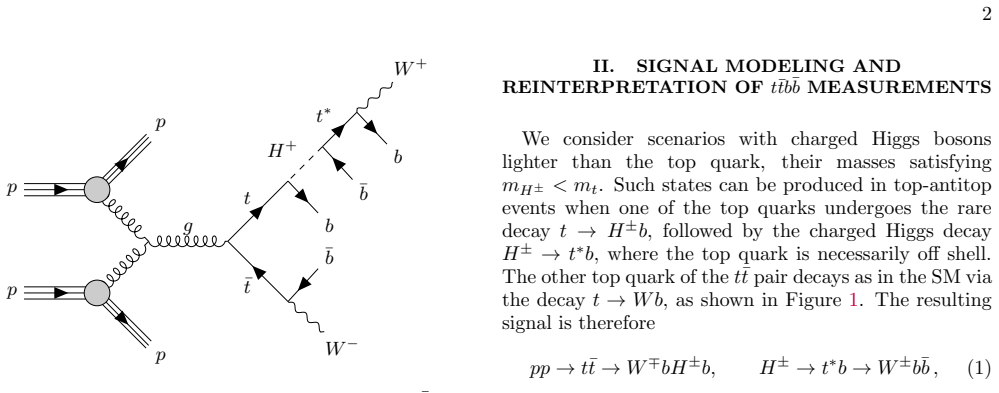
The signal topology t t-bar → (W b)(H± b) with H± → t*b → W b b-bar, whose rate is controlled by the product of branching ratios and whose acceptance is measured inside the same four ATLAS fiducial regions used for Standard-Model ttbb studies.
Load-bearing premise
The analysis assumes that interference between the Standard-Model ttbb amplitude and the resonant charged-Higgs cascade can be neglected after integration over the fiducial phase space.
What would settle it
A dedicated ATLAS or CMS search that reconstructs the same dileptonic multi-b final state with optimized multivariate discriminants and reports a significantly weaker (or stronger) limit on the same branching-ratio product for m_H± ≈ 140 GeV.
Editorial analysis
A structured set of objections, weighed in public.
Referee Report
Summary. The paper reinterprets ATLAS fiducial cross-section measurements of dileptonic ttbar production with additional b-jets (140 fb^{-1}, 13 TeV) to constrain light charged Higgs bosons (m_{H^\pm} < m_t) produced via the rare decay t \to H^\pm b followed by the off-shell mode H^\pm \to t^* b \to W b b-bar. This yields a ttbb-like final state. Model-independent 95% CL upper limits of 1.9%–2.9% are obtained on the product Br(t \to H^\pm b) \times Br(H^\pm \to t^* b) for masses 110–165 GeV (strongest in the inclusive \ge3b region). These are interpreted in top-philic, up-type aligned, top-specific, and canonical Z_2-symmetric 2HDM scenarios, demonstrating complementarity to existing cs, cb, and \tau\nu searches, particularly near threshold or when conventional modes are suppressed.
Significance. The work fills a genuine gap: the off-shell H^\pm \to t^* b channel, which can dominate below the tb threshold due to the large top Yukawa, has not been targeted by dedicated LHC searches. The model-independent limits are cleanly extracted from public data via a validated simulation chain (SM ttbb reproduces ATLAS Powheg+Pythia8 and data in Fig. 2) and a conservative R-fit treatment of the ~30% theory uncertainty. The subsequent 2HDM interpretations are standard and highlight concrete complementarity (e.g., low-tan\beta exclusion in the top-specific model, direct constraint in the top-philic case). The paper therefore supplies a useful, immediately usable probe of nonstandard top decays and motivates dedicated experimental analyses with Run 3/HL-LHC statistics and improved SM predictions.
major comments (2)
- [Sec. III.1] Sec. III.1 (paragraph beginning “In doing so, we neglect the interference…”): the neglect of SM–BSM interference after fiducial integration is justified only qualitatively by resonant and kinematic mismatch. Because the extracted limits rest on adding a pure signal contribution to the SM prediction, a quantitative estimate (e.g., via MadGraph interference terms or a simple virtuality-window check) is needed to confirm that residual interference remains negligible compared with the 30% theory uncertainty; otherwise the model-independent bounds carry an unquantified systematic.
- [Sec. II] Sec. II and Eq. (2): the charged-Higgs signal is generated at LO while the SM ttbb sample is NLO. Acceptance differences or K-factors for the signal topology are not discussed. Given that the limits are driven by the absolute fiducial rate, a brief assessment of the LO-to-NLO correction (or a statement that it is absorbed into the conservative theory uncertainty) would strengthen the robustness claim.
minor comments (4)
- [Fig. 3] Fig. 3 caption and surrounding text: the mass dependence of the acceptance is explained clearly, but a short sentence quantifying the acceptance variation (or a supplementary plot of A(m_{H^\pm})) would help readers assess the kinematic competition between the two decay stages.
- [Appendix A] Appendix A, Eqs. (A5)–(A7): the three-body matrix element is given in full; a brief numerical cross-check against an independent tool (e.g., MadWidth) for a benchmark mass would increase confidence in the Br(H^\pm \to t^* b) evaluation used throughout Sec. III.2.
- [Table I] Table I and Fig. 2: the four overlapping fiducial regions are treated independently (justified by theory uncertainty). A parenthetical remark on the expected size of correlations, even if not used, would complete the statistical discussion.
- [Introduction] References [25–32]: the local excesses near 152 GeV are cited as motivation. A single clarifying sentence that the present limits do not claim to exclude or confirm those excesses would avoid any ambiguity of interpretation.
Circularity Check
No significant circularity: model-independent limits are a standard recast of public ATLAS fiducial cross sections; model interpretations use textbook 2HDM widths.
full rationale
The central numerical claim (95% CL limits of 1.9–2.9% on Br(t→H±b)×Br(H±→t*b) in the inclusive ≥3b region) is obtained by generating a LO signal sample, applying the published ATLAS object and fiducial selections of Ref. [24], and comparing the resulting additional contribution against the measured fiducial cross sections after an R-fit treatment of the ~30% SM ttbb theory uncertainty. No parameter is fitted to the same data and then re-used as a prediction; the four overlapping regions are treated separately rather than combined; and interference is explicitly neglected with a kinematic argument that is independent of the extracted numbers. Subsequent translations into top-philic, up-type-aligned, top-specific and Z2-symmetric 2HDMs employ the standard partial-width formulae collected in Appendix A and the conventional Yukawa patterns of Eqs. (8)–(10) and Table II; these are not derived from the present limits. Self-citations to the authors’ earlier excess papers appear only as motivation and do not enter the limit-setting procedure. The derivation chain is therefore self-contained against external public data and standard model-building inputs.
Axiom & Free-Parameter Ledger
axioms (4)
- ad hoc to paper Interference between SM ttbb and the resonant H± cascade can be neglected after fiducial integration because of mismatched resonant structure and kinematics.
- domain assumption SM ttbb theory uncertainty is ~30% and is treated by the R-fit prescription (SM prediction free to float inside the band).
- domain assumption Additional neutral scalars are heavy enough that they do not open extra charged-Higgs decay modes.
- domain assumption Standard Model top-pair production cross section is 832±49 pb at 13 TeV for mt=172.5 GeV (NNLO).
read the original abstract
Rare top-quark decays offer a sensitive probe of charged Higgs bosons with masses below the top mass, owing to the large $t\bar t$ production rate at the LHC and the distinctive final states involving leptons and $b$-jets. While existing searches target the $H^\pm\to \tau\nu$, $cs$, and $cb$ modes, the decay $H^\pm\to tb$ has been studied only for heavier charged Higgs bosons with an on-shell top quark in the final state. The low-mass off-shell channel $H^\pm\to t^*b$ therefore remains essentially unconstrained, even though it can become the dominant decay mode below the top-quark threshold owing to the large top Yukawa coupling. We study charged-Higgs production from the rare top decay $t\to H^\pm b$, followed by the decay $H^\pm\to t^*b$. Top-antitop production and decay hence give rise to a $t\bar t b\bar b$-like final state, which we constrain by reinterpreting recent ATLAS fiducial measurements in dileptonic events. We obtain model-independent limits of 1.9%-2.9% on the product of branching ratios ${\rm Br}(t\to H^\pm b)\times{\rm Br}(H^\pm\to t^*b)$ for charged-Higgs masses between 110 and 165 GeV, and interpret these bounds in several two-Higgs-doublet scenarios. While dedicated searches for conventional charged-Higgs decays dominate for canonical $Z_2$-symmetric models, the $t^*b$ reinterpretation becomes competitive near the top-quark threshold in the up-type aligned limit and provides relevant direct constraint in a top-philic scenario. In the top-specific Two-Higgs-Doublet Model, it additionally excludes a low-$\tan\beta$ region not covered by conventional searches. These results thus establish $t\bar t$ production with additional $b$-jets as a complementary probe of light charged Higgs bosons and nonstandard top-quark decays, and motivate dedicated analyses by the LHC collaborations.
Figures


Reference graph
Works this paper leans on
-
[1]
T. G. Rizzo,Top Quark Decay in Models with Higgs Triplets,Phys. Rev. D41(1990) 1504
1990
-
[2]
J. A. Coarasa Perez, J. Guasch, J. Sola, and W. Hollik, Top quark decay into charged Higgs boson in a general two Higgs doublet model: Implications for the Tevatron data,Phys. Lett. B442(1998) 326–334, [hep-ph/9808278]
Pith/arXiv arXiv 1998
-
[3]
S. Bejar, J. Guasch, and J. Sola,Loop induced flavor changing neutral decays of the top quark in a general two Higgs doublet model,Nucl. Phys. B600(2001) 21–38, [hep-ph/0011091]. [6]ALEPH, DELPHI, L3, OPAL, LEPCollaboration, G. Abbiendi et al.,Search for Charged Higgs bosons: Combined Results Using LEP Data,Eur. Phys. J. C73 (2013) 2463, [arXiv:1301.6065]...
Pith/arXiv arXiv 2001
-
[4]
S. Ashanujjaman, A. Crivellin, S. P. Maharathy, and B. Mellado,Searching for a charged Higgs boson in top-quark decays via theW Zmode,Phys. Rev. D113 (2026), no. 11 115048, [arXiv:2509.07094]. [15]ATLASCollaboration, G. Aad et al.,Search for charged Higgs bosons decaying into a top quark and a bottom quark at √s= 13 TeV with the ATLAS detector, JHEP06(202...
Pith/arXiv arXiv 2026
-
[5]
J. F. Gunion, H. E. Haber, G. L. Kane, and S. Dawson, The Higgs Hunter’s Guide, vol. 80. 2000
2000
-
[6]
G. C. Branco, P. M. Ferreira, L. Lavoura, M. N. Rebelo, M. Sher, and J. P. Silva,Theory and phenomenology of two-Higgs-doublet models,Phys. Rept.516(2012) 1–102, [arXiv:1106.0034]. [19]LHC Higgs Cross Section Working Group Collaboration, J. R. Andersen et al.,Handbook of LHC Higgs Cross Sections: 3. Higgs Properties, arXiv:1307.1347
Pith/arXiv arXiv 2012
-
[7]
A. G. Akeroyd et al.,Prospects for charged Higgs searches at the LHC,Eur. Phys. J. C77(2017), no. 5 276, [arXiv:1607.01320]
Pith/arXiv arXiv 2017
-
[8]
A. Arbey, F. Mahmoudi, O. Stal, and T. Stefaniak, Status of the Charged Higgs Boson in Two Higgs Doublet Models,Eur. Phys. J. C78(2018), no. 3 182, [arXiv:1706.07414]
Pith/arXiv arXiv 2018
-
[9]
K. Cheung, A. Jueid, J. Kim, S. Lee, C.-T. Lu, and J. Song,Comprehensive study of the light charged Higgs boson in the type-I two-Higgs-doublet model,Phys. Rev. D105(2022), no. 9 095044, [arXiv:2201.06890]
Pith/arXiv arXiv 2022
-
[10]
S. Ashanujjaman, S. Banik, G. Coloretti, A. Crivellin, S. P. Maharathy, and B. Mellado,Anatomy of the real Higgs triplet model,JHEP04(2025) 003, [arXiv:2411.18618]. [24]ATLASCollaboration, G. Aad et al.,Measurement of ttproduction in association with additional b-jets in the eµfinal state in proton–proton collisions at √s= 13 TeV with the ATLAS detector,J...
arXiv 2025
-
[11]
A. Crivellin, Y. Fang, O. Fischer, S. Bhattacharya, M. Kumar, E. Malwa, B. Mellado, N. Rapheeha, X. Ruan, and Q. Sha,Accumulating evidence for the associated production of a new Higgs boson at the LHC, Phys. Rev. D108(2023), no. 11 115031, [arXiv:2109.02650]
Pith/arXiv arXiv 2023
-
[12]
S. Bhattacharya, G. Coloretti, A. Crivellin, S.-E. Dahbi, Y. Fang, M. Kumar, and B. Mellado,Growing Excesses of New Scalars at the Electroweak Scale, arXiv:2306.17209
-
[13]
S. Ashanujjaman, S. Banik, G. Coloretti, A. Crivellin, S. P. Maharathy, and B. Mellado,Explaining theγγ+X excesses at≈151.5 GeV via the Drell-Yan production of a Higgs triplet,Phys. Lett. B862(2025) 139298, [arXiv:2402.00101]. 10
Pith/arXiv arXiv 2025
-
[14]
S. Bhattacharya, B. Lieberman, M. Kumar, A. Crivellin, Y. Fang, R. Mazini, and B. Mellado, Emerging Excess Consistent with a Narrow Resonance at 152 GeV in High-Energy Proton-Proton Collisions, arXiv:2503.16245
-
[15]
S. Banik, G. Coloretti, A. Crivellin, and B. Mellado, Uncovering new Higgses in the LHC analyses of differentialt tcross sections,JHEP01(2025) 155, [arXiv:2308.07953]
Pith/arXiv arXiv 2025
-
[16]
G. Coloretti, A. Crivellin, and B. Mellado,Combined explanation of LHC multilepton, diphoton, and top-quark excesses,Phys. Rev. D110(2024), no. 7 073001, [arXiv:2312.17314]
Pith/arXiv arXiv 2024
-
[17]
A. Crivellin, S. Ashanujjaman, S. Banik, G. Coloretti, S. P. Maharathy, and B. Mellado,Growing evidence for a Higgs triplet,Chin. Phys. C49(2025), no. 5 053107, [arXiv:2404.14492]
Pith/arXiv arXiv 2025
-
[18]
B. Fuks, M. D. Goodsell, and T. Murphy,Monojets from compressed weak frustrated dark matter,Phys. Rev. D111(2025), no. 5 055010, [arXiv:2409.03014]
Pith/arXiv arXiv 2025
-
[19]
M. Czakon and A. Mitov,Top++: A Program for the Calculation of the Top-Pair Cross-Section at Hadron Colliders,Comput. Phys. Commun.185(2014) 2930, [arXiv:1112.5675]
Pith/arXiv arXiv 2014
-
[20]
J. Alwall, R. Frederix, S. Frixione, V. Hirschi, F. Maltoni, O. Mattelaer, H. S. Shao, T. Stelzer, P. Torrielli, and M. Zaro,The automated computation of tree-level and next-to-leading order differential cross sections, and their matching to parton shower simulations,JHEP07(2014) 079, [arXiv:1405.0301]
Pith/arXiv arXiv 2014
-
[21]
R. Frederix, S. Frixione, V. Hirschi, D. Pagani, H. S. Shao, and M. Zaro,The automation of next-to-leading order electroweak calculations,JHEP07(2018) 185, [arXiv:1804.10017]. [Erratum: JHEP 11, 085 (2021)]. [36]NNPDFCollaboration, R. D. Ball et al.,Parton distributions from high-precision collider data,Eur. Phys. J. C77(2017), no. 10 663, [arXiv:1706.00428]
Pith/arXiv arXiv 2018
-
[22]
A. Buckley, J. Ferrando, S. Lloyd, K. Nordstr¨ om, B. Page, M. R¨ ufenacht, M. Sch¨ onherr, and G. Watt, LHAPDF6: parton density access in the LHC precision era,Eur. Phys. J. C75(2015) 132, [arXiv:1412.7420]
Pith/arXiv arXiv 2015
-
[23]
P. Artoisenet, R. Frederix, O. Mattelaer, and R. Rietkerk,Automatic spin-entangled decays of heavy resonances in Monte Carlo simulations,JHEP03 (2013) 015, [arXiv:1212.3460]
Pith/arXiv arXiv 2013
-
[24]
J. Alwall, C. Duhr, B. Fuks, O. Mattelaer, D. G. ¨Ozt¨ urk, and C.-H. Shen,Computing decay rates for new physics theories with FeynRules and MadGraph 5 aMC@NLO,Comput. Phys. Commun.197(2015) 312–323, [arXiv:1402.1178]
Pith/arXiv arXiv 2015
-
[25]
Bierlich et al.,A comprehensive guide to the physics and usage of PYTHIA 8.3,SciPost Phys
C. Bierlich et al.,A comprehensive guide to the physics and usage of PYTHIA 8.3,SciPost Phys. Codeb.2022 (2022) 8, [arXiv:2203.11601]. [41]ATLAS Pythia 8 tunes to 7 TeV data,
Pith/arXiv arXiv 2022
-
[26]
N. D. Christensen et al.,A Comprehensive approach to new physics simulations,Eur. Phys. J.C71(2011) 1541, [arXiv:0906.2474]
Pith/arXiv arXiv 2011
-
[27]
A. Alloul, N. D. Christensen, C. Degrande, C. Duhr, and B. Fuks,FeynRules 2.0 - A complete toolbox for tree-level phenomenology,Comput. Phys. Commun.185 (2014) 2250–2300, [arXiv:1310.1921]
Pith/arXiv arXiv 2014
-
[28]
C. Degrande, C. Duhr, B. Fuks, D. Grellscheid, O. Mattelaer, and T. Reiter,UFO - The Universal FeynRules Output,Comput. Phys. Commun.183 (2012) 1201–1214, [arXiv:1108.2040]
Pith/arXiv arXiv 2012
-
[29]
Darm´ e et al.,UFO 2.0: the ‘Universal Feynman Output’ format,Eur
L. Darm´ e et al.,UFO 2.0: the ‘Universal Feynman Output’ format,Eur. Phys. J. C83(2023), no. 7 631, [arXiv:2304.09883]
Pith/arXiv arXiv 2023
-
[30]
M. Cacciari, G. P. Salam, and G. Soyez,The anti-k t jet clustering algorithm,JHEP04(2008) 063, [arXiv:0802.1189]
Pith/arXiv arXiv 2008
-
[31]
M. Cacciari, G. P. Salam, and G. Soyez,FastJet User Manual,Eur. Phys. J. C72(2012) 1896, [arXiv:1111.6097]
Pith/arXiv arXiv 2012
-
[32]
T. Jeˇ zo, J. M. Lindert, N. Moretti, and S. Pozzorini, New NLOPS predictions fort ¯t+b-jet production at the LHC,Eur. Phys. J. C78(2018), no. 6 502, [arXiv:1802.00426]
Pith/arXiv arXiv 2018
-
[33]
K. J. F. Gaemers and F. Hoogeveen,Higgs Production and Decay Into Heavy Flavors With the Gluon Fusion Mechanism,Phys. Lett. B146(1984) 347–349
1984
-
[34]
D. A. Dicus and S. S. D. Willenbrock,Photon Pair Production and the Intermediate Mass Higgs Boson, Phys. Rev. D37(1988) 1801
1988
-
[35]
D. Dicus, A. Stange, and S. Willenbrock,Higgs decay to top quarks at hadron colliders,Phys. Lett. B333(1994) 126–131, [hep-ph/9404359]
Pith/arXiv arXiv 1994
-
[36]
W. Bernreuther, M. Flesch, and P. Haberl,Signatures of Higgs bosons in the top quark decay channel at hadron colliders,Phys. Rev. D58(1998) 114031, [hep-ph/9709284]
Pith/arXiv arXiv 1998
-
[37]
H. Bahl, R. Kumar, and G. Weiglein,Impact of interference effects on Higgs-boson searches in the di-top final state at the LHC,JHEP05(2025) 098, [arXiv:2503.02705]
Pith/arXiv arXiv 2025
-
[38]
T. Flacke, B. Fuks, D. Kim, J. Kim, S. J. Lee, and L. Munoz-Aillaud,New physics in toponium’s shadow?, Phys. Lett. B879(2026) 140613, [arXiv:2512.03220]
Pith/arXiv arXiv 2026
-
[39]
G. Bevilacqua, H.-Y. Bi, H. B. Hartanto, M. Kraus, M. Lupattelli, and M. Worek,t tbbat the LHC: on the size of corrections and b-jet definitions,JHEP08 (2021) 008, [arXiv:2105.08404]
Pith/arXiv arXiv 2021
-
[40]
G. Bevilacqua, H.-Y. Bi, H. B. Hartanto, M. Kraus, M. Lupattelli, and M. Worek,tt¯bb¯at the LHC: On the size of off-shell effects and prompt b-jet identification,Phys. Rev. D107(2023), no. 1 014028, [arXiv:2202.11186]
Pith/arXiv arXiv 2023
-
[41]
A. Hocker, H. Lacker, S. Laplace, and F. Le Diberder, A New approach to a global fit of the CKM matrix,Eur. Phys. J. C21(2001) 225–259, [hep-ph/0104062]. [58]Particle Data GroupCollaboration, S. Navas et al., Review of particle physics,Phys. Rev. D110(2024), no. 3 030001
Pith/arXiv arXiv 2001
-
[42]
X.-D. Huang, X.-G. Wu, J. Zeng, Q. Yu, X.-C. Zheng, and S. Xu,Determination of the top-quark M Srunning mass via its perturbative relation to the on-shell mass with the help of the principle of maximum conformality, Phys. Rev. D101(2020), no. 11 114024, [arXiv:2005.04996]
Pith/arXiv arXiv 2020
-
[43]
Aparisi et al.,m b atm H: The Running Bottom Quark Mass and the Higgs Boson,Phys
J. Aparisi et al.,m b atm H: The Running Bottom Quark Mass and the Higgs Boson,Phys. Rev. Lett.128 (2022), no. 12 122001, [arXiv:2110.10202]
Pith/arXiv arXiv 2022
-
[44]
S.-Y. Ma, X.-D. Huang, X.-C. Zheng, and X.-G. Wu, Precise Determination of the Bottom-Quark On-Shell Mass Using Its Four-Loop Relation to the MS¯-Scheme Running Mass,Chin. Phys. Lett.41(2024), no. 10 101201, [arXiv:2406.18025]. 11
Pith/arXiv arXiv 2024
-
[45]
X.-M. Shen, Y. Hu, C. Sun, and J. Gao,Decay of the charged Higgs boson and the top quark in two-Higgs-doublet model at NNLO in QCD,JHEP05 (2022) 157, [arXiv:2201.08139]
Pith/arXiv arXiv 2022
-
[46]
L.-B. Chen, H. T. Li, J. Wang, and Y. Wang,Analytic result for the top-quark width at next-to-next-to-leading order in QCD,Phys. Rev. D108(2023), no. 5 054003, [arXiv:2212.06341]
Pith/arXiv arXiv 2023
-
[47]
M. Misiak and M. Steinhauser,Weak radiative decays of theBmeson and bounds onM H± in the Two-Higgs-Doublet Model,Eur. Phys. J. C77(2017), no. 3 201, [arXiv:1702.04571]
Pith/arXiv arXiv 2017
-
[48]
M. Jung, A. Pich, and P. Tuzon,Charged-Higgs phenomenology in the Aligned two-Higgs-doublet model, JHEP11(2010) 003, [arXiv:1006.0470]
Pith/arXiv arXiv 2010
-
[49]
T. Enomoto and R. Watanabe,Flavor constraints on the Two Higgs Doublet Models of Z 2 symmetric and aligned types,JHEP05(2016) 002, [arXiv:1511.05066]
Pith/arXiv arXiv 2016
-
[50]
A. M. Coutinho, A. Karan, V. Miralles, and A. Pich, Light scalars within theCP-conserving Aligned-two-Higgs-doublet model,JHEP02(2025) 057, [arXiv:2412.14906]
Pith/arXiv arXiv 2025
-
[51]
A. Crivellin, A. Kokulu, and C. Greub, Flavor-phenomenology of two-Higgs-doublet models with generic Yukawa structure,Phys. Rev. D87(2013), no. 9 094031, [arXiv:1303.5877]. [69]CMSCollaboration, V. Khachatryan et al., Measurement of the RatioB(t→W b)/B(t→W q)in pp Collisions at √s= 8 TeV,Phys. Lett. B736(2014) 33–57, [arXiv:1404.2292]
Pith/arXiv arXiv 2013
discussion (0)
Sign in with ORCID, Apple, or X to comment. Anyone can read and Pith papers without signing in.